

Modern Artificial Intelligence Model Development for Undergraduate Student Performance Prediction: An Investigation on Engineering Mathematics Courses
Open accessThe DOI matches its Crossref record; 66 of the 67 references it cites were found in a registry or an index.
Abstract
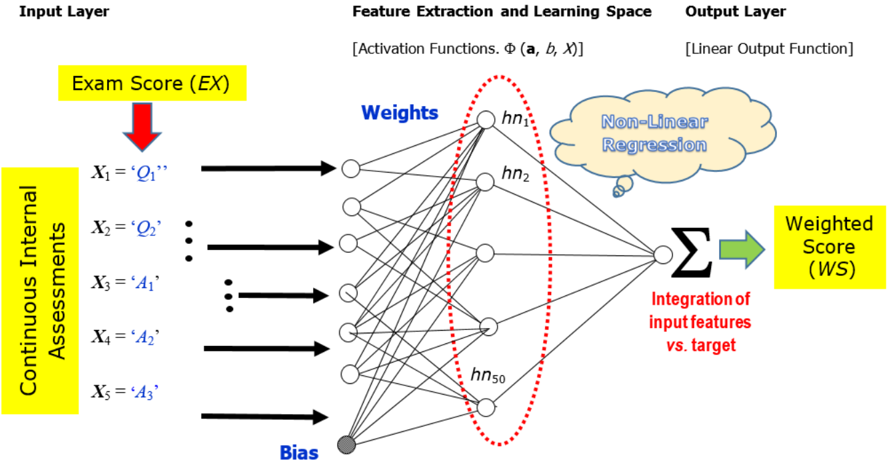
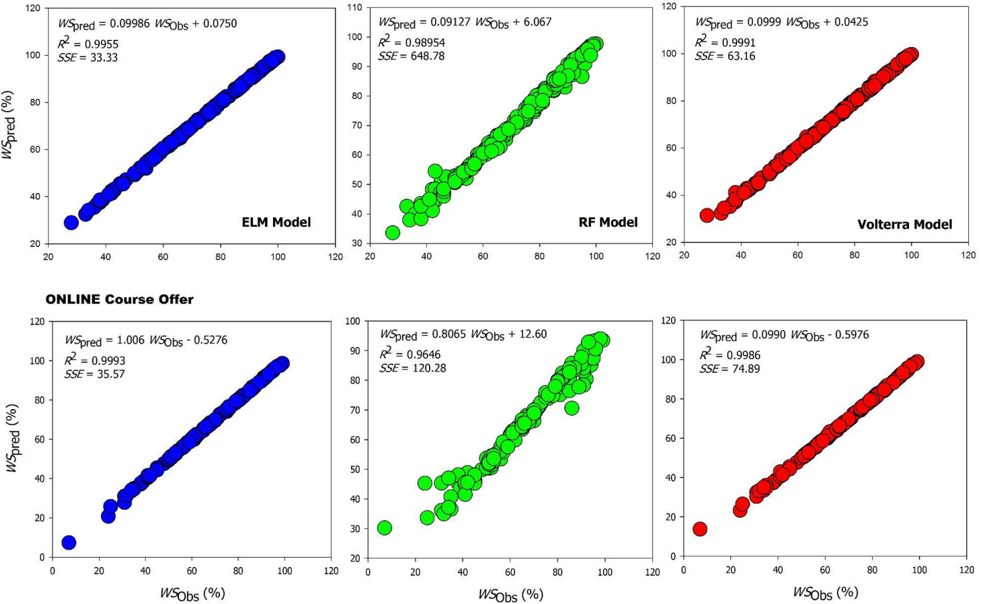
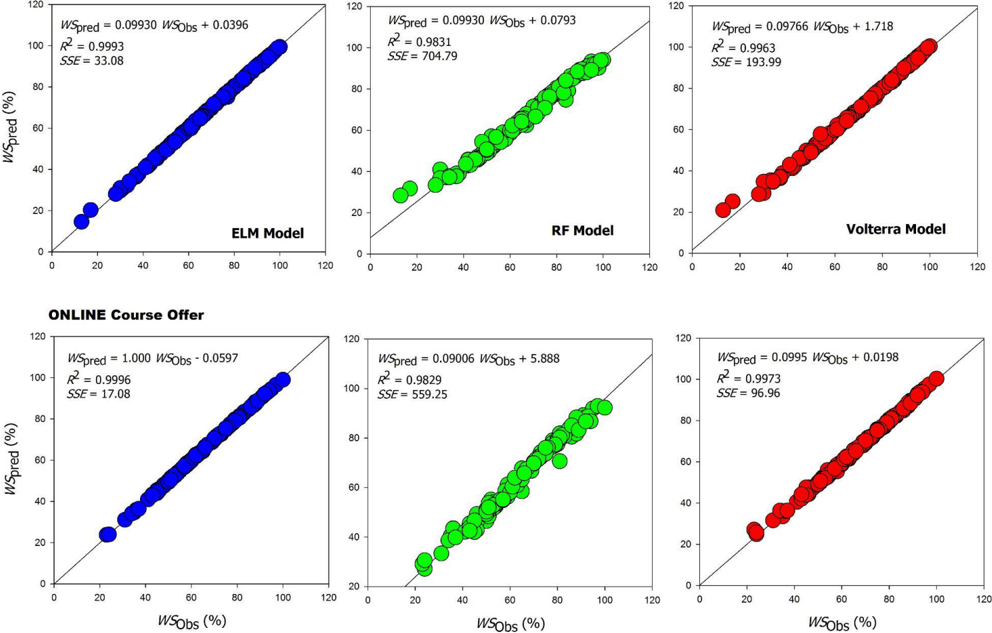
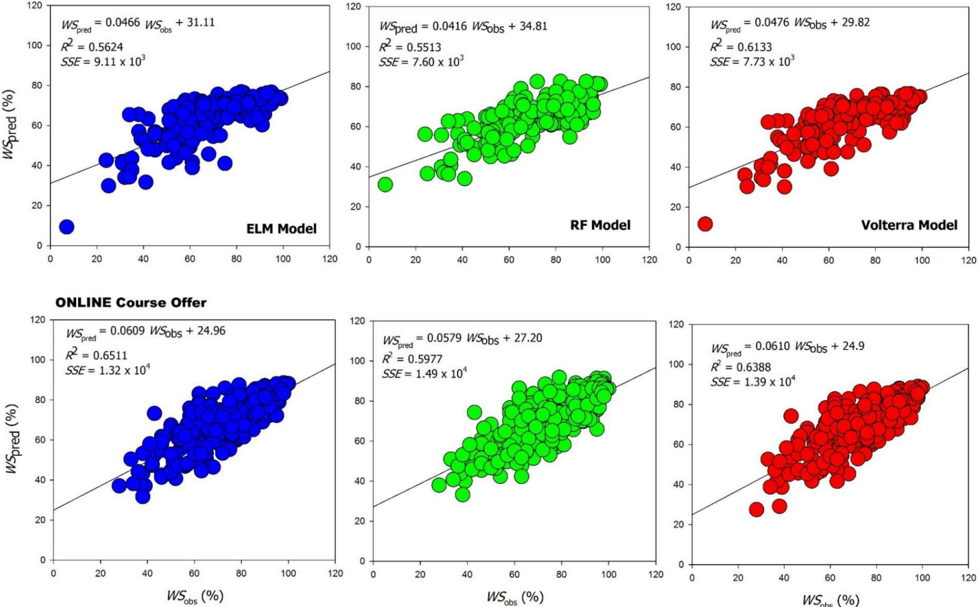
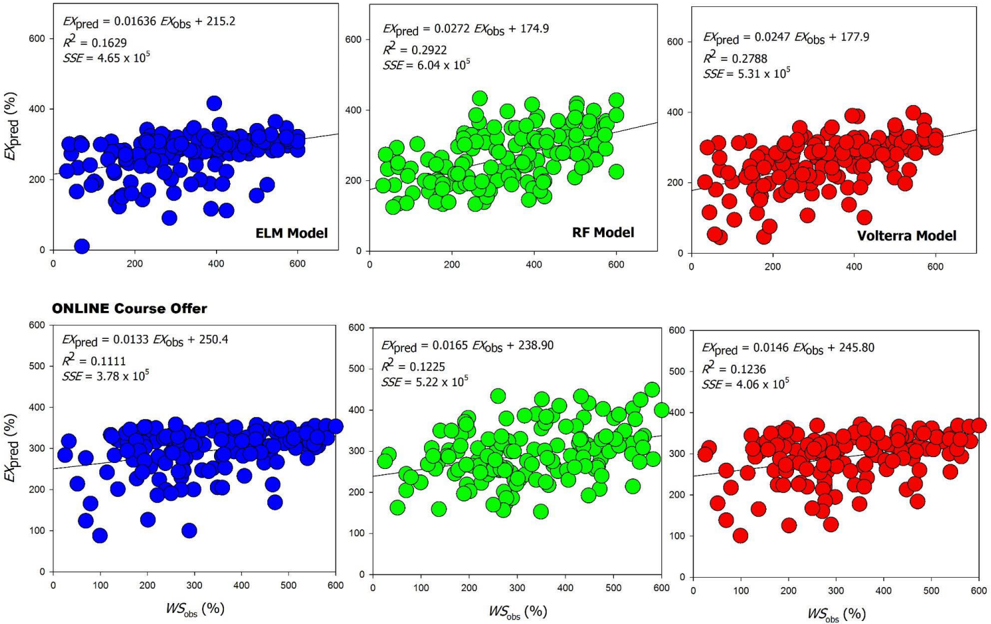
A computationally efficient artificial intelligence (AI) model called Extreme Learning Machines (ELM) is adopted to analyze patterns embedded in continuous assessment to model the weighted score (WS) and the examination (EX) score in engineering mathematics courses at an Australian regional university. The student performance data taken over a six-year period in multiple courses ranging from the mid- to the advanced level and a diverse course offering mode (i.e., on-campus, ONC, and online, ONL) are modelled by ELM and further benchmarked against competing models: random forest (RF) and Volterra. With the assessments and examination marks as key predictors of WS (leading to a grade in the mid-level course), ELM (with respect to RF and Volterra) outperformed its counterpart models both for the ONC and the ONL offer. This generated relative prediction error in the testing phase, of only 0.74%, compared to about 3.12% and 1.06%, respectively, while for the ONL offer, the prediction errors were only 0.51% compared to about 3.05% and 0.70%. In modelling the student performance in advanced engineering mathematics course, ELM registered slightly larger errors: 0.77% (vs. 22.23% and 1.87%) for ONC and 0.54% (vs. 4.08% and 1.31%) for the ONL offer. This study advocates a pioneer implementation of a robust AI methodology to uncover relationships among student learning variables, developing teaching and learning intervention and course health checks to address issues related to graduate outcomes, and student learning attributes in the higher education sector.
Overview
The claims and statistics of this paper haven’t been checked yet.
Free: it reads the open-access text and checks the first 5 claims that cite a source we can check. Create a free account to check every claim.
Integrity signals
Registry
Cites
Statistics
Figures









Verification
Claims the paper makes
The claims and statistics of this paper haven’t been checked yet.
Free: it reads the open-access text and checks the first 5 claims that cite a source we can check. Create a free account to check every claim.
Self-check
Percentages, sums and reported differences re-computed from the paper’s own numbers.
The self-check needs the paper’s full text.
Citations
Cites
Breiman, L. (2001) · Machine Learning · doi:10.1023/a:1010933404324 · Cited by 133,538
Extreme learning machine: Theory and applications
Huang, G.-B., Zhu, Q.-Y., & Siew, C.-K. (2006) · Neurocomputing · doi:10.1016/j.neucom.2005.12.126 · Cited by 13,285
Chai, T., & Draxler, R. R. (2014) · Geoscientific Model Development · doi:10.5194/gmd-7-1247-2014 · Cited by 8,761 · cited 1×
“the relative prediction error (%), given mathematically as follows [54], [55], (15)–(22), as shown at the bottom of the page, whereWSObs andWSPred were the observed and the predicted ith value of WS; WSObs and WSPred were the observed and forecasted mean WS in testing phase; and N was the number of datum points in the…”
BackgroundThe role of artificial intelligence in achieving the Sustainable Development Goals
Vinuesa, R., Azizpour, H., Leite, I., Balaam, M., Dignum, V., Domisch, S., Felländer, A., Langhans, S. D., Tegmark, M., & Fuso Nerini, F. (2020) · Nature Communications · doi:10.1038/s41467-019-14108-y · Cited by 3,294
Universal Approximation using Incremental Constructive Feedforward Networks with Random Hidden Nodes
Huang, G.-B., Chen, L., & Siew, C.-K. (2006) · IEEE Transactions on Neural Networks · doi:10.1109/tnn.2006.875977 · Cited by 2,614
A Fast and Accurate Online Sequential Learning Algorithm for Feedforward Networks
Liang, N.-Y., Huang, G.-B., Saratchandran, P., & Sundararajan, N. (2006) · IEEE Transactions on Neural Networks · doi:10.1109/tnn.2006.880583 · Cited by 1,965
Penetrating the Fog: Analytics in Learning and Education.
Siemens, G., & Long, P. (2011) · Adelaide Research & Scholarship (AR&S) (University of Adelaide) · Cited by 1,752
Trends in extreme learning machines: A review
Huang, G., Huang, G.-B., Song, S., & You, K. (2015) · Neural Networks · doi:10.1016/j.neunet.2014.10.001 · Cited by 1,732
Machine Learning Benchmarks and Random Forest Regression
Segal, M. R. (2004) · eScholarship (California Digital Library) · Cited by 1,250
On big data, artificial intelligence and smart cities
Allam, Z., & Dhunny, Z. A. (2019) · Cities · doi:10.1016/j.cities.2019.01.032 · Cited by 1,178
An Insight into Extreme Learning Machines: Random Neurons, Random Features and Kernels
Huang, G.-B. (2014) · Cognitive Computation · doi:10.1007/s12559-014-9255-2 · Cited by 957
A Review on Predicting Student's Performance Using Data Mining Techniques
Shahiri, A. M., Husain, W., & Rashid, N. A. (2015) · Procedia Computer Science · doi:10.1016/j.procs.2015.12.157 · Cited by 840
Random forests: from early developments to recent advancements
Fawagreh, K., Gaber, M. M., & Elyan, E. (2014) · Systems Science & Control Engineering · doi:10.1080/21642583.2014.956265 · Cited by 776
Academic Analytics: A New Tool for a New Era.
Campbell, J. P., DeBlois, P. B., & Oblinger, D. G. (2007) · Educational Review · Cited by 539
Criteria for Evaluation of Watershed Models
ASCE Task Committee on Definition of Criteria for Evaluation of Watershed Models of the Watershed Management Committee, I. A. D. D. (1993) · Journal of Irrigation and Drainage Engineering · doi:10.1061/(asce)0733-9437(1993)119:3(429 · Cited by 528
Huang, G.-B. (2015) · Cognitive Computation · doi:10.1007/s12559-015-9333-0 · Cited by 471
Huang, S., & Fang, N. (2013) · Computers & Education · doi:10.1016/j.compedu.2012.08.015 · Cited by 373
Genuer, R., Poggi, J.-M., Tuleau-Malot, C., & Villa-Vialaneix, N. (2017) · Big Data Research · doi:10.1016/j.bdr.2017.07.003 · Cited by 367
Factors that Influence Participation In Online Learning
Vonderwell, S., & Zachariah, S. (2005) · Journal of Research on Technology in Education · doi:10.1080/15391523.2005.10782457 · Cited by 331
Data Division for Developing Neural Networks Applied to Geotechnical Engineering
Shahin, M. A., Maier, H. R., & Jaksa, M. B. (2004) · Journal of Computing in Civil Engineering · doi:10.1061/(asce)0887-3801(2004)18:2(105 · Cited by 331
EXPLORING COLLABORATIVE ONLINE LEARNING
Curtis, D. D., & Lawson, M. J. (2019) · Online Learning · doi:10.24059/olj.v5i1.1885 · Cited by 316
Xing, W., Guo, R., Petakovic, E., & Goggins, S. (2015) · Computers in Human Behavior · doi:10.1016/j.chb.2014.09.034 · Cited by 295
Smart Education with artificial intelligence based determination of learning styles
Bajaj, R., & Sharma, V. (2018) · Procedia Computer Science · doi:10.1016/j.procs.2018.05.095 · Cited by 269
Examining student satisfaction with wholly online learning
Palmer, S. R., & Holt, D. M. (2009) · Journal of Computer Assisted Learning · doi:10.1111/j.1365-2729.2008.00294.x · Cited by 225
Identification of non-linear output-affine systems using an orthogonal least-squares algorithm
BILLINGS, S. A., KORENBERG, M. J., & CHEN, S. (1988) · International Journal of Systems Science · doi:10.1080/00207728808964057 · Cited by 209
Online sequential extreme learning machine with kernels for nonstationary time series prediction
Wang, X., & Han, M. (2014) · Neurocomputing · doi:10.1016/j.neucom.2014.05.068 · Cited by 196
Gorr, W. L., Nagin, D. S., & Szczypula, J. (1994) · International Journal of Forecasting · doi:10.1016/0169-2070(94)90046-9 · Cited by 183
Advanced Applications of Neural Networks and Artificial Intelligence: A Review
Kumar, K., & Thakur, G. S. M. (2012) · International Journal of Information Technology and Computer Science · doi:10.5815/ijitcs.2012.06.08 · Cited by 176
Bonneville-Roussy, A., Evans, P., Verner-Filion, J., Vallerand, R. J., & Bouffard, T. (2017) · Contemporary Educational Psychology · doi:10.1016/j.cedpsych.2016.08.003 · Cited by 162
Online Sequential Extreme Learning Machine With Kernels
Scardapane, S., Comminiello, D., Scarpiniti, M., & Uncini, A. (2014) · IEEE Transactions on Neural Networks and Learning Systems · doi:10.1109/tnnls.2014.2382094 · Cited by 160
Naser, S. A., Zaqout, I., Ghosh, M. A., Atallah, R., & Alajrami, E. (2015) · International Journal of Hybrid Information Technology · doi:10.14257/ijhit.2015.8.2.20 · Cited by 159
Extreme learning machines: new trends and applications
Deng, C., Huang, G.-B., Xu, J. W., & Tang, J. (2015) · Science China Information Sciences · doi:10.1007/s11432-014-5269-3 · Cited by 151
The Gender Gap in Mathematics Achievement: Evidence from Italian Data
Tommaso, M. D. D., Mendolia, S., & Contini, D. (2016) · Social Science Research Network · doi:10.1016/j.econedurev.2017.03.001 · Cited by 150
Hourigan, M., & O’Donoghue, J. (2007) · International Journal of Mathematical Education in Science and Technology · doi:10.1080/00207390601129279 · Cited by 139
Becerra‐Fernandez, I. (2000) · Knowledge-Based Systems · doi:10.1016/s0950-7051(00)00091-5 · Cited by 96
Evaluation of student performance in laboratory applications using fuzzy logic
Gokmen, G., Akinci, T. Ç., Tektaş, M., Onat, N., Kocyigit, G., & Tektaş, N. (2010) · Procedia - Social and Behavioral Sciences · doi:10.1016/j.sbspro.2010.03.124 · Cited by 93
Prasad, R., Deo, R. C., Li, Y., & Maraseni, T. (2018) · Soil and Tillage Research · doi:10.1016/j.still.2018.03.021 · Cited by 81
Self-citationBig Data Analytics in Higher Education: A Review
Murumba, J., & Micheni, E. M. (2017) · The International Journal of Engineering and Science · doi:10.9790/1813-0606021421 · Cited by 69
Improving the expressiveness of black-box models for predicting student performance
Arnedo, C.-J. V., Gallego-Durán, F. J., Largo, F. L., Compañ, P., Cuerda, R. S., & Molina-Carmona, R. (2016) · Computers in Human Behavior · doi:10.1016/j.chb.2016.09.001 · Cited by 67
Modeling Academic Performance Evaluation Using Soft Computing Techniques: A Fuzzy Logic Approach
Yadav, R. S., & Singh, V. P. (2011) · Cited by 67
Nuutila, K., Tuominen, H., Tapola, A., Vainikainen, M.-P., & Niemivirta, M. (2018) · Learning and Instruction · doi:10.1016/j.learninstruc.2018.04.003 · Cited by 66
A Review on Predictive Modeling Technique for Student Academic Performance Monitoring
Asiah, M., Khidzir, N. Z., Deris, S., Hafzan, M. Y. N. N., Saberi, M. M., & Syuhaida, S. S. (2019) · MATEC Web of Conferences · doi:10.1051/matecconf/201925503004 · Cited by 57
Adoption of Artificial Intelligence in Agriculture
Popa, C. (2011) · Bulletin of University of Agricultural Sciences and Veterinary Medicine Cluj-Napoca Agriculture · doi:10.15835/buasvmcn-agr:6454 · Cited by 56
The Use of Advanced Technologies in Special Education
Yin, R. K., & Moore, G. B. (1987) · Journal of Learning Disabilities · doi:10.1177/002221948702000111 · Cited by 55
Artificial neural network-based performance assessments
Stevens, R., Ikeda, J., Casillas, A., Palacio-Cayetano, J., & Clyman, S. G. (1999) · Computers in Human Behavior · doi:10.1016/s0747-5632(99)00025-4 · Cited by 55
Using Neural Networks to Predict MBA Student Success.
Naik, B., & Ragothaman, S. C. (2004) · College student journal · Cited by 54
Gabriele, A. J., Joram, E., & Park, K. H. (2016) · Learning and Instruction · doi:10.1016/j.learninstruc.2016.06.008 · Cited by 47
Criteria for Evaluation of Watershed Models
Yen, B. C. (1995) · Journal of Irrigation and Drainage · Cited by 42
Wei, H., & Billings, S. A. (2004) · International Journal of Control · doi:10.1080/0020717042000197622 · Cited by 35
Propose of fuzzy logic-based students' learning assessment
Sripan, R., & Suksawat, B. (2010) · ICCAS 2010 · doi:10.1109/iccas.2010.5669786 · Cited by 32
The Effect of Time Online on Grades in Online Sociology Courses
Ryabov, I. (2012) · Cited by 29
A supervised learning framework for learning management systems
Olivé, D. M., Huynh, D. Q., Reynolds, M. A., Dougiamas, M., & Wiese, D. (2018) · International Conference on Data Science, E-Learning and Information Systems (DATA) · doi:10.1145/3279996.3280014 · Cited by 29
Devlin, M., & McKay, J. (2014) · University of Adelaide Press eBooks · doi:10.20851/universities-transition-04 · Cited by 28
A good practice guide : Safeguarding student learning engagement
Nelson, K. J., & Creagh, T. (2013) · University of Southern Queensland ePrints (University of Southern Queensland) · Cited by 26
Neural Volterra filter for chaotic time series prediction
Heng-Chao, L., Zhang, J., & Xian-Ci, X. (2005) · Chinese Physics · doi:10.1088/1009-1963/14/11/007 · Cited by 25
Of Students Academic Performance Rates Using Artificial Neural Networks (ANNs)
Asogwa, O. C., & V.Oladugba, A. (2015) · American Journal of Applied Mathematics and Statistics · doi:10.12691/ajams-3-4-3 · Cited by 24
Prediction of Online Students Performance by Means of Genetic Programming
Cazarez, R. L. U., López‐Martín, C., Abran, A., & Yáñez-Márquéz, C. (2018) · Applied Artificial Intelligence · doi:10.1080/08839514.2018.1508839 · Cited by 23
Facilitating Success for Students from Low Socioeconomic Status Backgrounds at Regional Universities
Devlin, M., & McKay, J. (2018) · Victoria University Research Repository (Victoria University) · doi:10.6084/m9.figshare.6984014 · Cited by 23
Can online student performance be forecasted by learning analytics?
Strang, K. D. (2016) · International Journal of Technology Enhanced Learning · doi:10.1504/ijtel.2016.075950 · Cited by 18
Attentiveness assessment in learning based on fuzzy logic analysis
Hwang, K., & Yang, C. (2008) · Expert Systems with Applications · doi:10.1016/j.eswa.2008.07.025 · Cited by 16
Xing, W., & Goggins, S. (2015) · International Conference on Learning Analytics and Knowledge (LAK) · doi:10.1145/2723576.2723602 · Cited by 15
Widening Participation in Australia
McKay, J., & Devlin, M. (2015) · Elsevier eBooks · doi:10.1016/b978-0-08-100213-1.00010-x · Cited by 12
Applications of Utility Theory in Artificial Intelligence Research
Farquhar, P. H. (1987) · Lecture notes in economics and mathematical systems · doi:10.1007/978-3-642-46609-0_17 · Cited by 12
Samigulina, G. A., & Shayakhmetova, A. (2015) · Smart innovation, systems and technologies · doi:10.1007/978-3-319-19875-0_23 · Cited by 12
Cook, C. E., Wright, M. C., & O’Neal, C. (2007) · To improve the academy · doi:10.1002/j.2334-4822.2007.tb00478.x · Cited by 10
Explaining university course grade gaps
Mongeon, K., Ulrick, S. W., & Giannetto, M. P. (2016) · Empirical Economics · doi:10.1007/s00181-016-1078-4 · Cited by 3
Research works printed but not linked: 5
- calvo-flores, 2006, Predicting students’ marks from Moodle logs using neural network models, Current Develop Technol Edu, 1, 586
- bhatt, 2011, Fuzzy logic based student performance evaluation model for practical components of engineering institutions subjects, International Journal of Technology and Engineering Education, 8, 1
- 2019, Study Book (ENM2600 Engineering Mathematics
- 2019, Study Book (ENM1600 Engineering Mathematics)
- 2017, The Higher Education Reform Package
Cited by
Artificial Intelligence for Student Assessment: A Systematic Review
González-Calatayud, V., Prendes-Espinosa, P., & Roig-Vila, R. (2021) · Applied Sciences · doi:10.3390/app11125467 · Cited by 503
“[48] determine that AI could be incorporated as a subcategory of intelligent algorithms implemented in stand-alone models, or within a hybrid integrated computer systems model.”
BackgroundThe application of AI technologies in STEM education: a systematic review from 2011 to 2021
Xu, W., & Ouyang, F. (2022) · International Journal of STEM Education · doi:10.1186/s40594-022-00377-5 · Cited by 495
“First, in the sub-category of learning performance prediction, AI algorithms and modeling techniques were employed in STEM education to help instructors adjust the instructional processes by predicting students’ learning performance (Deo et al., 2020; Hellings & Haelermans, 2020).”
BackgroundMethodArtificial intelligence in educational leadership: a comprehensive taxonomy and future directions
Sposato, M. (2025) · International Journal of Educational Technology in Higher Education · doi:10.1186/s41239-025-00517-1 · Cited by 260
Owoc, M. L., Sawicka, A., & Weichbroth, P. (2021) · IFIP Advances in Information and Communication Technology · doi:10.1007/978-3-030-85001-2_4 · Cited by 222
Artificial Intelligence and Machine Learning Approaches in Digital Education: A Systematic Revision
Munir, H., Vogel, B., & Jacobsson, A. (2022) · Information · doi:10.3390/info13040203 · Cited by 165
Metadata
- Authors
- Deo, R. C., Yaseen, Z. M., Al-Ansari, N., Nguyen-Huy, T., Langlands, T. A. M., & Galligan, L.
- Affiliations
- University of Southern Queensland (AU)
- Luleå University of Technology (SE)
- ORCID
- Venue
- IEEE Access
- Published
- 2020
- Volume
- 8
- Pages
- 136697-136724
- ISSN
- 2169-3536 (ISSN-L)
- OpenAlex
- W3044093562
- Cited by
- 89
- References
- 67
- Citations by year
- 2026: 8 · 2025: 27 · 2024: 16 · 2023: 12 · 2022: 16 · 2021: 8 · 2020: 1
- FWCI
- 8.45
- Type
- journal article
- Language
- en
- Open access
- gold
- doi.org
- Locations
- IEEE Access (publishedVersion, cc-by)
- Epubl LTU (submittedVersion, other-oa)
- DOAJ (DOAJ: Directory of Open Access Journals) (submittedVersion, cc-by-sa)
- Funders
- University of Southern Queensland, through the School of Sciences Quartile 1 Challenge Internal Grant, for this research study under Grant 2018
- Office for the Advancement of Learning and Teaching: Technology Demonstrator Project (H18REA236)
- Topics
- Physical Sciences › Computer Science › Computer Science Applications › Online Learning and Analytics
- Physical Sciences › Computer Science › Artificial Intelligence › Machine Learning and ELM
- Social Sciences › Education › Educational Technology and Pedagogy
- Keywords
- student performance prediction, extreme learning machine, continuous assessment, test scores, online learning, on-campus learning, random forest, Volterra model, higher education
About these checks
Registry, retraction, Cites and statistics results are computed, not judged, with one exception: a printed reference that no index lists is read once by a model before it counts as a citation error. Claims are extracted by a model and kept only when their quote appears verbatim in the text; each cited source is then checked, with a model’s help, for whether it says what the claim relies on. Those verdicts can be wrong — read the claim’s quote and the cited source before relying on one.
Statistics and arithmetic are recomputed, not judged.
Confidence bands are shown only for fields calibrated on our annotated test set. None is calibrated yet, so no band is shown.
What counts as a claim ›How we measure confidence ›How we check this ›
Are you an author, or do you see a problem with this page? Request a review
Data sources
Bibliographic data: Semantic Scholar, OpenAlex, Crossref.
Contains information from the Semantic Scholar Academic Graph Datasets, made available under the ODC Attribution License (ODC-BY 1.0).
Semantic Scholar’s data is described in: Kinney, R., et al. (2023). The Semantic Scholar Open Data Platform. arXiv:2301.10140.
