

The DOI matches its Crossref record; 154 of the 172 references it cites were found in a registry or an index; 28 of the 100 sources its claims cite were checked for support.
Hands-Free Accessible Digital Musical Instruments: Conceptual Framework, Challenges, and Perspectives
Open accessAbstract
Exponential increases of available computational resources, miniaturization, and sensors, are enabling the development of digital musical instruments that use non-conventional interaction paradigms and interfaces. This scenario opens up new opportunities and challenges in the creation of accessible instruments to include persons with disabilities into music practice. This work focuses in particular on instruments dedicated to people who can not use limbs, for whom the only means for musical expression are the voice and a small number of traditional instruments. First, a modular and adaptable conceptual framework is discussed for the design of accessible digital musical instruments targeted at performers with motor impairments. Physical interaction channels available from the neck upwards (head, mouth, eyes, brain) are analyzed in terms of potential and limitations for musical interaction. Second, a systematic survey of previously developed instruments is presented: each is analyzed in terms of design choices, physical interaction channels and related sensors, mapping strategies, performer interface and feedback. As a result of this survey, several open research directions are discussed, including the use of unconventional interaction channels, musical control mappings, multisensory feedback, design, evaluation, and adaptation.
Overview
CoChat Summary
TL;DR
This paper proposes a modular conceptual framework for hands-free accessible digital musical instruments (HeaDMIs) that use only physical channels from the neck upward—head, mouth, eyes, and brain—and surveys existing instruments against it. It finds the field underexplored, with limited channel use, mostly note- or process-level control, one-to-one mappings, and little structured evaluation or extrinsic feedback.
Key findings
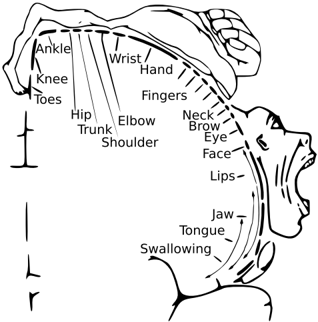
- The framework identifies physical channels available from the neck upward: Eyes (gaze pointing, eye movements, blinking, eyebrow movements), Mouth (voice, whistling, breath, mouth/lip movements, tongue, teeth), Head (head movements, neck tension), and Brain (mental states, attention, imagery), characterized by properties such as resolution, fatigue, involuntary movement, stability, persistence, rest, smoothness, accuracy, and velocity.
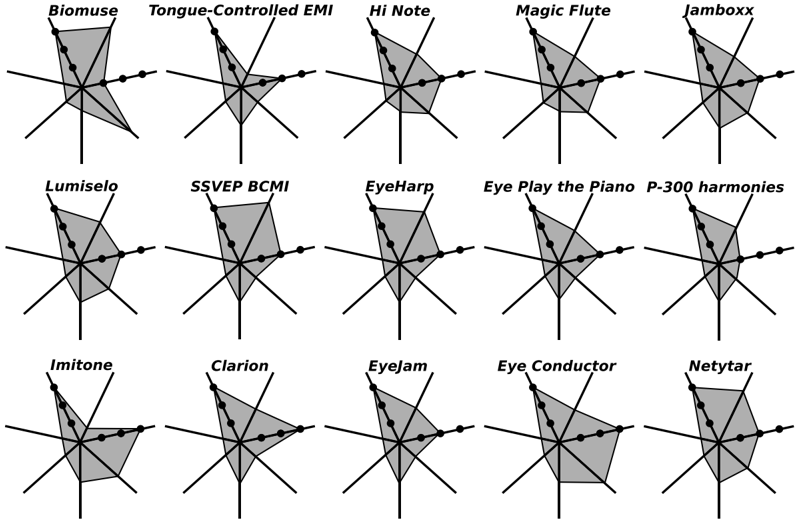
- The survey’s Table 4 lists 15 HeaDMIs from 1990 to 2018. The most explored channels were Gaze pointing (7 instruments), Breath (5), Head movements (4), Mental states (2), Attention (2), and Voice, Tongue, Eye movements, Mouth and lip movements, EyeBrows, and Whistling (1 each); Blinking, Teeth, Neck Tension, and Imagery were ignored or rarely considered.
- Design trends: most instruments have few degrees of freedom; musical control is generally confined to the note or process level; mappings are mostly one-to-one, with EyeHarp and Clarion providing one-to-many examples; gaze pointing and head movements are typically mapped to pitch via Discrete range, breath pressure to intensity via Continuous range, and brain channels mostly to process-level parameters except SSVEP BCMI.
- Extrinsic feedback is absent or very limited in most instruments; Lumiselo and Eye Play the Piano provide 3D visual feedback, while Jamboxx and Tongue-Controlled EMI include tactile or proprioceptive feedback.
Methods
- Design: a conceptual framework for HeaDMIs, including a structural diagram and definitions adapted from Malloch et al. and Rasmussen; physical channels are characterized qualitatively with binary high-low/yes-no values, using able-bodied persons as a best-case reference.
- Survey: literature search on Google Scholar and Google for commercial products, using free-text terms related to DMIs (“digital musical instrument”, “musical (or music) interface”) combined with terms for the physical channels, plus references from previous ADMI reviews. Inclusion criteria required a skill-based DMI, use of one or more of the paper’s physical channels with no additional ones, a concrete working implementation, and explicit reference to users with motor impairment.
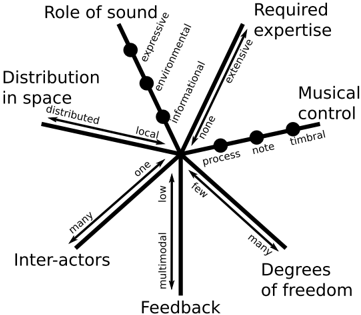
- Analysis: instruments were presented chronologically and compared using Birnbaum et al.’s 7-axis dimension space, covering design choices, physical channels and sensors, mapping strategies, performer interface, and feedback.
Limitations
- The paper states that channel properties are only qualitatively characterized with binary values and reference to able-bodied persons, not motor-impaired users; detailed characterization would require large amounts of physiological data, and user models calibrated on able-bodied subjects are not applicable to persons with various motor impairments.
- The paper states that most surveyed instruments lack structured evaluation, that required expertise in the dimension-space analysis was estimated qualitatively based on subjective judgement, and that no formal evaluation studies were retrieved for many instruments.
- Evident from the text: the survey relies on Google Scholar/Google searches and prior reviews, with inclusion criteria excluding augmented instruments or DMIs requiring upper/lower limbs; many surveyed items are commercial or non-academic projects analyzed from web and audio-video materials, and the retrieved number of HeaDMIs is described as relatively small.
Model-written summary. Check it against the paper before relying on it.
Integrity signals
Registry
Cites
Statistics
Figures



Verification
Claims the paper makes
18 Valid · 31 Not valid · 56 Not checked · 92 Own results and interpretations
Every source the paper cites for this claim was checked and supports it.
In the paper
“A large percentage of the ADMIs reviewed by Frid [8] focuses on user groups with physical impairments (39 : 8%).”
What the sources say
- Supportedcites [8] [8] E. Frid, ''Accessible digital musical Instruments A review of musical interfaces in inclusive music practice,'' Multimodal Technol. Interact. , vol. 3, no. 3, p. 57, Jul. 2019. - source
Section 4.5, “Target User Group,” states that 39.8% of the ADMIs reviewed were explicitly said to focus on user groups with physical impairments. This directly supports the cited percentage and population. (LLM, conf=0.95)
plain- Asserted: passes — The authors put it forward as true.
- Checkable: passes — It can be checked against evidence.
- Load-bearing: passes — The paper’s conclusions depend on it.
- Based: passes — The paper gives a reason why it holds.
- Supported
Every source the paper cites for this claim was checked and supports it.
In the paper
“On the other hand, only 4 : 8%of the reviewed ADMIs are devoted to persons with quadriplegia.”
What the sources say
- Supportedcites [8] [8] E. Frid, ''Accessible digital musical Instruments A review of musical interfaces in inclusive music practice,'' Multimodal Technol. Interact. , vol. 3, no. 3, p. 57, Jul. 2019. - source
Section 4.5 (Target User Group) states that 4.8% of the reviewed ADMIs were developed for persons with quadriplegia. This supports the citing sentence’s percentage and user-group claim. (LLM, conf=0.94)
plain- Asserted: passes — The authors put it forward as true.
- Checkable: passes — It can be checked against evidence.
- Load-bearing: passes — The paper’s conclusions depend on it.
- Based: passes — The paper gives a reason why it holds.
- Supported
The cited sources support only part of this claim — read each source’s verdict below.
In the paper
“This provides support to the idea of using these channels (plus the brain cortex itself) as musical controllers [14].”
What the sources say
- Partly supportedcites [14] [14] M. J. Lyons, M. Haehnel, and N. Tetsutani, ''Designing, playing, and performing with a vision-based mouth interface,'' in Proc. Int. Conf. New Interfaces Musical Expression (NIME) , Montreal, QC, Canada, 2003, pp. 116 121. - sourceExperimental — accuracy not yet measured
The Introduction (p. 1) uses the motor-cortex representation of the face and mouth to motivate a musical controller operated by facial actions. The Conclusion (p. 5) reports that mouth movements were suitable for expressive musical control. The paper does not propose using the brain cortex itself as a musical controller. (LLM, conf=0.85)
hedgedstates an association- Asserted: passes — The authors put it forward as true.
- Checkable: passes — It can be checked against evidence.
- Load-bearing: passes — The paper’s conclusions depend on it.
- Based: passes — The paper gives a reason why it holds.
- Partly supported
The cited sources that could be checked couldn’t confirm or dispute this claim.
In the paper
“However, many of these are aimed at musicians with partially able limbs [11].”
What the sources say
- Could not verifycites [11] [11] J. Harrison and A. McPherson, ''An adapted bass guitar for one-handed playing,'' in Proc. Int. Conf. New Interfaces Musical Expression (NIME) , Copenhagen, Denmark, May 2017. - sourceExperimental — accuracy not yet measured
Section 2.1 discusses accessible digital musical instruments for people with varied physical abilities, including musicians with quadriplegia, but does not say that many are aimed at musicians with partially able limbs. A further search for that phrase and for instruments requiring some use of an arm or hand found no such characterization in our copy. (LLM, conf=0.72)
plain- Asserted: passes — The authors put it forward as true.
- Checkable: passes — It can be checked against evidence.
- Load-bearing: passes — The paper’s conclusions depend on it.
- Based: passes — The paper gives a reason why it holds.
- Could not verify
Every source the paper cites for this claim was checked and supports it.
In the paper
“Moreover, it is known that user models calibrated exclusively on able-bodied subjects are not applicable to persons with various motor impairments [35].”
What the sources say
- Supportedcites [35] [35] S. Keates, J. Clarkson, and P. Robinson, ''Investigating the applicability of user models for motion-impaired users,'' in Proc. 4th Int. ACM Conf. Assistive Technol. (Assets) , 2000, pp. 129 136. - source
The Conclusions advise designers not to rely on accepted able-bodied models for motion-impaired users, but to measure differences in interaction styles across capabilities. The Abstract also reports significant differences between motion-impaired users’ behaviour and accepted modelling theory. (LLM, conf=0.91)
boosted- Asserted: passes — The authors put it forward as true.
- Checkable: passes — It can be checked against evidence.
- Load-bearing: passes — The paper’s conclusions depend on it.
- Based: passes — The paper gives a reason why it holds.
- Supported
51 more claims · 5 with their cited sources checked
Create a free account to see all 197 claims and to verify the 1 reference still open.
- It may state two separate claims as one. 55
- Probably not a substantial claim. 123
- The quote only partly states this claim. 1
Self-check
Percentages, sums and reported differences re-computed from the paper’s own numbers.
Each contradiction between two passages listed here was confirmed by an independent check.
Rated minor: it would not touch a result — a value no result rests on, a p-value that stays on the same side of the significance level, or a conflict that is clerical, resolved elsewhere in the paper, or outside its own findings.
In the paper
§ A. CHANNELS, MAPPINGS, FEEDBACK
“some are completely ignored (Blinking, Teeth, Neck Tension, Imagery).”
§ 9) EYE PLAY THE PIANO [136]
“Gaze pointing and Blinking (Eyes) are employed as physical channels, by means of an eye tracker integrated into a HMD.”
Citations
Cites
Russell, J. A. (1980) · Journal of Personality and Social Psychology · doi:10.1037/h0077714 · Cited by 16,334 · cited 1×
“‘‘Affective BCIs’’ [97], [98] are often based on the so-called ‘‘valence-arousal’’ 2D space [99] to define emotional classes of interest.”
Brain–computer interfaces for communication and control
Wolpaw, J. R., Birbaumer, N., McFarland, D. J., Pfurtscheller, G., & Vaughan, T. M. (2002) · Clinical Neurophysiology · doi:10.1016/s1388-2457(02)00057-3 · Cited by 7,927 · cited 3×
“It has been shown that a subject can learn to actively control SCPs by means of various mental tasks, and thus to use them for control [40].”
BackgroundRasmussen, J. (1983) · IEEE Transactions on Systems, Man, and Cybernetics · doi:10.1109/tsmc.1983.6313160 · Cited by 3,434 · cited 2×
“’s conceptual framework [23], which is in turn inspired by Rasmussen’s model of human information processing [24].”
BackgroundReach and grasp by people with tetraplegia using a neurally controlled robotic arm
Hochberg, L. R., Bacher, D., Jarosiewicz, B., Masse, N. Y., Simeral, J. D., Vogel, J., Haddadin, S., Liu, J., Cash, S. S., van der Smagt, P., et al. (2012) · Nature · doi:10.1038/nature11076 · Cited by 2,719
Principles of Voice Production
Titze, I. R., & Martin, D. W. (1998) · The Journal of the Acoustical Society of America · doi:10.1121/1.424266 · Cited by 1,643 · cited 2×
“The tongue is capable of very rapid and precise movements [51].”
BackgroundEEG analysis based on time domain properties
Hjorth, B. (1970) · Electroencephalography and Clinical Neurophysiology · doi:10.1016/0013-4694(70)90143-4 · Cited by 1,504 · cited 1×
“Temporal features are also used, such as Hjorth parameters (activity, mobility, and complexity) [96], which are estimated on successive windows (epochs) from the time-domain signal and its derivatives.”
MethodParticipatory Design: Principles and Practices
(2017) · CRC Press eBooks · doi:10.1201/9780203744338 · Cited by 1,500 · cited 1×
“since the early stages, using a cyclical, participatory design approach [148] in which mock-ups and early prototypes are evaluated and redesigned based on stakeholders’ feedback.”
MethodMotor Learning and Control : Concepts and Applications
Magill, R. A. (2020) · Civil War Book Review · Cited by 1,306
The organization of human postural movements: A formal basis and experimental synthesis
Nashner, L. M., & McCollum, G. (1985) · Behavioral and Brain Sciences · doi:10.1017/s0140525x00020008 · Cited by 1,265
The mental prosthesis: assessing the speed of a P300-based brain-computer interface
Donchin, E., Spencer, K. M., & Wijesinghe, R. (2000) · IEEE Transactions on Rehabilitation Engineering · doi:10.1109/86.847808 · Cited by 1,222 · cited 1×
“The ‘‘P300 speller’’ is perhaps the best known embodiment of this paradigm, and allows to select letters from a matrix [107].”
Background
Research works printed but not linked: 10
- jensenius, 2017, A NIME Reader Fifteen Years of New Interfaces for Musical Expression
- 2019, Instruments
- niikawa, 2004, Tongue-controlled electro-musical instrument, Proc 18th Int Congr Acoust (ICA), 1905
- 2019, Jamboxx
- 2019, Magic Flute
- 2019, Eye Play the Piano
- 2019, Imitone Mind to Melody
- 2019, CLARION
- refsgaard, 2019, Eye Conductor
- singh, 2013, Emotion recognition using electroencephalography (EEG): A review, Int J Inf Technol Knowl Manage, 7, 1
Cited by
The development of a Modular Accessible Musical Instrument Technology Toolkit using action research
Ward, A. (2023) · Frontiers in Computer Science · doi:10.3389/fcomp.2023.1113078 · Cited by 15
Ivanyi, B. A., Tjemsland, T. B., Tsalidis, C., Tóth, L., Dyrholm, M. A., Naylor, S. J., Paradiso, A., Lamb, D., Chudge, J., Adjorlu, A., et al. (2023) · CHI Conference on Human Factors in Computing Systems · doi:10.1145/3544548.3581285 · Cited by 11
“As Davanzo and Avanzini [15] have pointed out, the importance of conducting end-user studies with individuals with motor impairments cannot be understated.”
BackgroundAccessible Music for Everyone: Discovering Resources
Moreno, D., & Maia, A. (2021) · Smart innovation, systems and technologies · doi:10.1007/978-981-16-5063-5_73 · Cited by 10
Davanzo, N., Avanzini, F., Ludovico, L. A., Moreno, D., Moreira, A. A. D. F. G., Tymoshchuk, O., Azevedo, J., & Marques, C. P. (2023) · Communications in computer and information science · doi:10.1007/978-3-031-49425-3_22 · Cited by 8
Self-citationKiroll: A Gaze-Based Instrument for Quadriplegic Musicians Based on the Context-Switching Paradigm
Davanzo, N., Valente, L., Ludovico, L. A., & Avanzini, F. (2023) · Audio Mostly Conference (AM) · doi:10.1145/3616195.3616225 · Cited by 4
“Davanzo and Avanzini [7] provide an overview, as well as several techniques and cues to address them.”
BackgroundInfluentialSelf-citation
Metadata
- Authors
- Davanzo, N., & Avanzini, F.
- Affiliations
- University of Milan (IT)
- Venue
- IEEE Access
- Published
- 2020
- Volume
- 8
- Pages
- 163975-163995
- ISSN
- 2169-3536 (ISSN-L)
- OpenAlex
- W3082288852
- Cited by
- 16
- References
- 172
- Citations by year
- 2026: 5 · 2025: 2 · 2024: 2 · 2023: 4 · 2022: 1 · 2021: 2
- FWCI
- 0.68
- Type
- journal article
- Language
- en
- Open access
- gold
- doi.org
- Licence
- Locations
- IEEE Access (publishedVersion, cc-by-sa)
- Archivio Istituzionale della Ricerca (Universita Degli Studi Di Milano) (submittedVersion, cc-by)
- DOAJ (DOAJ: Directory of Open Access Journals) (submittedVersion, cc-by-sa)
- Topics
- Social Sciences › Arts and Humanities › Music › Music Technology and Sound Studies
- Health Sciences › Health Professions › Occupational Therapy › Assistive Technology in Communication and Mobility
- Social Sciences › Human Factors and Ergonomics › Digital Accessibility for Disabilities
- Keywords
- motor impairment, brain-computer interface, multisensory feedback
About these checks
Registry, retraction, Cites and statistics results are computed, not judged, with one exception: a printed reference that no index lists is read once by a model before it counts as a citation error. Claims are extracted by a model and kept only when their quote appears verbatim in the text; each cited source is then checked, with a model’s help, for whether it says what the claim relies on. Those verdicts can be wrong — read the claim’s quote and the cited source before relying on one.
The claim verdicts this report counts are experimental: their accuracy is not yet measured.
A language model drew the claims from the paper on 2026-09-29, under version 3 of the claim definition (model deepseek-v4.1-flash, prompt extract-v3).
A second model labelled each claim on 2026-09-29 (model jev-1.13-20260917, definition revision gold-guideline-v0.2).
Cited sources are checked with a language model’s help (gpt-6-sol).
Statistics and arithmetic are recomputed, not judged.
Confidence bands are shown only for fields calibrated on our annotated test set. None is calibrated yet, so no band is shown.
What counts as a claim ›How we measure confidence ›How we check this ›
Are you an author, or do you see a problem with this page? Request a review
How to cite
Cite CoChat for the checks on this page, and the paper for its own findings.
- This page
- CoChat. (2026). Citation check: Hands-Free Accessible Digital Musical Instruments: Conceptual Framework, Challenges, and Perspectives. https://app.cochat.ai/papers/10.1109/access.2020.3019978
- The paper
- Davanzo, N., & Avanzini, F. (2020). Hands-Free Accessible Digital Musical Instruments: Conceptual Framework, Challenges, and Perspectives. IEEE Access. https://doi.org/10.1109/access.2020.3019978
Data sources
Bibliographic data: Semantic Scholar, OpenAlex, Crossref.
Contains information from the Semantic Scholar Academic Graph Datasets, made available under the ODC Attribution License (ODC-BY 1.0).
Semantic Scholar’s data is described in: Kinney, R., et al. (2023). The Semantic Scholar Open Data Platform. arXiv:2301.10140.
