

The DOI matches its Crossref record; 154 of the 172 references it cites were found in a registry or an index; 28 of the 100 sources its claims cite were checked for support.
Hands-Free Accessible Digital Musical Instruments: Conceptual Framework, Challenges, and Perspectives
Open accessAbstract
Exponential increases of available computational resources, miniaturization, and sensors, are enabling the development of digital musical instruments that use non-conventional interaction paradigms and interfaces. This scenario opens up new opportunities and challenges in the creation of accessible instruments to include persons with disabilities into music practice. This work focuses in particular on instruments dedicated to people who can not use limbs, for whom the only means for musical expression are the voice and a small number of traditional instruments. First, a modular and adaptable conceptual framework is discussed for the design of accessible digital musical instruments targeted at performers with motor impairments. Physical interaction channels available from the neck upwards (head, mouth, eyes, brain) are analyzed in terms of potential and limitations for musical interaction. Second, a systematic survey of previously developed instruments is presented: each is analyzed in terms of design choices, physical interaction channels and related sensors, mapping strategies, performer interface and feedback. As a result of this survey, several open research directions are discussed, including the use of unconventional interaction channels, musical control mappings, multisensory feedback, design, evaluation, and adaptation.
Overview
CoChat Summary
TL;DR
This paper proposes a modular conceptual framework for hands-free accessible digital musical instruments (HeaDMIs) that use only physical channels from the neck upward—head, mouth, eyes, and brain—and surveys existing instruments against it. It finds the field underexplored, with limited channel use, mostly note- or process-level control, one-to-one mappings, and little structured evaluation or extrinsic feedback.
Key findings
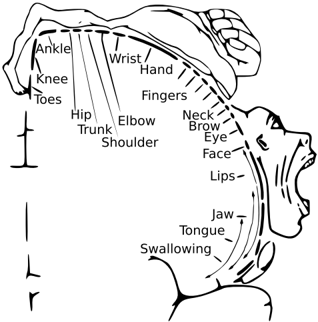
- The framework identifies physical channels available from the neck upward: Eyes (gaze pointing, eye movements, blinking, eyebrow movements), Mouth (voice, whistling, breath, mouth/lip movements, tongue, teeth), Head (head movements, neck tension), and Brain (mental states, attention, imagery), characterized by properties such as resolution, fatigue, involuntary movement, stability, persistence, rest, smoothness, accuracy, and velocity.
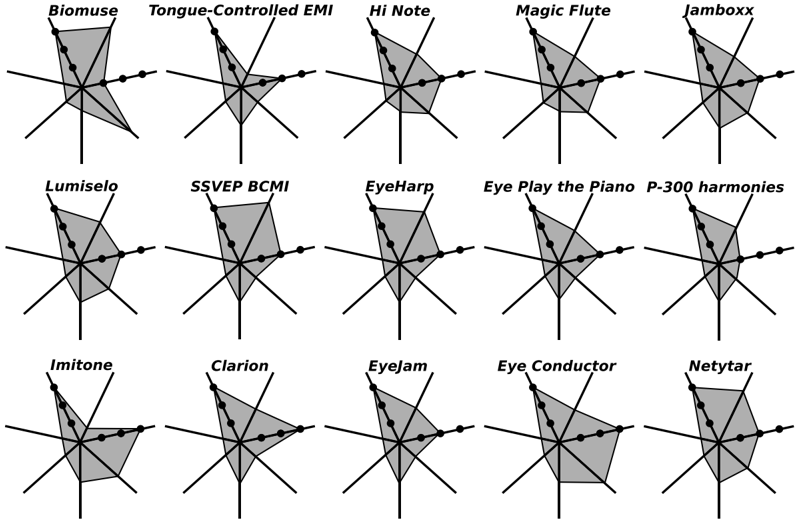
- The survey’s Table 4 lists 15 HeaDMIs from 1990 to 2018. The most explored channels were Gaze pointing (7 instruments), Breath (5), Head movements (4), Mental states (2), Attention (2), and Voice, Tongue, Eye movements, Mouth and lip movements, EyeBrows, and Whistling (1 each); Blinking, Teeth, Neck Tension, and Imagery were ignored or rarely considered.
- Design trends: most instruments have few degrees of freedom; musical control is generally confined to the note or process level; mappings are mostly one-to-one, with EyeHarp and Clarion providing one-to-many examples; gaze pointing and head movements are typically mapped to pitch via Discrete range, breath pressure to intensity via Continuous range, and brain channels mostly to process-level parameters except SSVEP BCMI.
- Extrinsic feedback is absent or very limited in most instruments; Lumiselo and Eye Play the Piano provide 3D visual feedback, while Jamboxx and Tongue-Controlled EMI include tactile or proprioceptive feedback.
Methods
- Design: a conceptual framework for HeaDMIs, including a structural diagram and definitions adapted from Malloch et al. and Rasmussen; physical channels are characterized qualitatively with binary high-low/yes-no values, using able-bodied persons as a best-case reference.
- Survey: literature search on Google Scholar and Google for commercial products, using free-text terms related to DMIs (“digital musical instrument”, “musical (or music) interface”) combined with terms for the physical channels, plus references from previous ADMI reviews. Inclusion criteria required a skill-based DMI, use of one or more of the paper’s physical channels with no additional ones, a concrete working implementation, and explicit reference to users with motor impairment.
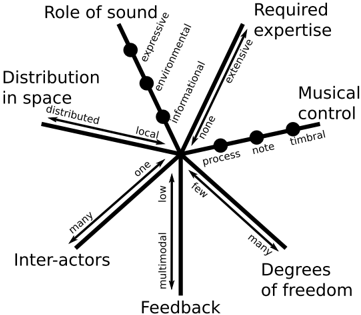
- Analysis: instruments were presented chronologically and compared using Birnbaum et al.’s 7-axis dimension space, covering design choices, physical channels and sensors, mapping strategies, performer interface, and feedback.
Limitations
- The paper states that channel properties are only qualitatively characterized with binary values and reference to able-bodied persons, not motor-impaired users; detailed characterization would require large amounts of physiological data, and user models calibrated on able-bodied subjects are not applicable to persons with various motor impairments.
- The paper states that most surveyed instruments lack structured evaluation, that required expertise in the dimension-space analysis was estimated qualitatively based on subjective judgement, and that no formal evaluation studies were retrieved for many instruments.
- Evident from the text: the survey relies on Google Scholar/Google searches and prior reviews, with inclusion criteria excluding augmented instruments or DMIs requiring upper/lower limbs; many surveyed items are commercial or non-academic projects analyzed from web and audio-video materials, and the retrieved number of HeaDMIs is described as relatively small.
Model-written summary. Check it against the paper before relying on it.
Integrity signals
Registry
Cites
Statistics
Figures



Verification
Claims the paper makes
18 Valid · 31 Not valid · 56 Not checked · 92 Own results and interpretations
Every source the paper cites for this claim was checked and supports it.
In the paper
“A large percentage of the ADMIs reviewed by Frid [8] focuses on user groups with physical impairments (39 : 8%).”
What the sources say
- Supportedcites [8] [8] E. Frid, ''Accessible digital musical Instruments A review of musical interfaces in inclusive music practice,'' Multimodal Technol. Interact. , vol. 3, no. 3, p. 57, Jul. 2019. - source
Section 4.5, “Target User Group,” states that 39.8% of the ADMIs reviewed were explicitly said to focus on user groups with physical impairments. This directly supports the cited percentage and population. (LLM, conf=0.95)
plain- Asserted: passes — The authors put it forward as true.
- Checkable: passes — It can be checked against evidence.
- Load-bearing: passes — The paper’s conclusions depend on it.
- Based: passes — The paper gives a reason why it holds.
- Supported
Every source the paper cites for this claim was checked and supports it.
In the paper
“On the other hand, only 4 : 8%of the reviewed ADMIs are devoted to persons with quadriplegia.”
What the sources say
- Supportedcites [8] [8] E. Frid, ''Accessible digital musical Instruments A review of musical interfaces in inclusive music practice,'' Multimodal Technol. Interact. , vol. 3, no. 3, p. 57, Jul. 2019. - source
Section 4.5 (Target User Group) states that 4.8% of the reviewed ADMIs were developed for persons with quadriplegia. This supports the citing sentence’s percentage and user-group claim. (LLM, conf=0.94)
plain- Asserted: passes — The authors put it forward as true.
- Checkable: passes — It can be checked against evidence.
- Load-bearing: passes — The paper’s conclusions depend on it.
- Based: passes — The paper gives a reason why it holds.
- Supported
The cited sources support only part of this claim — read each source’s verdict below.
In the paper
“This provides support to the idea of using these channels (plus the brain cortex itself) as musical controllers [14].”
What the sources say
- Partly supportedcites [14] [14] M. J. Lyons, M. Haehnel, and N. Tetsutani, ''Designing, playing, and performing with a vision-based mouth interface,'' in Proc. Int. Conf. New Interfaces Musical Expression (NIME) , Montreal, QC, Canada, 2003, pp. 116 121. - sourceExperimental — accuracy not yet measured
The Introduction (p. 1) uses the motor-cortex representation of the face and mouth to motivate a musical controller operated by facial actions. The Conclusion (p. 5) reports that mouth movements were suitable for expressive musical control. The paper does not propose using the brain cortex itself as a musical controller. (LLM, conf=0.85)
hedgedstates an association- Asserted: passes — The authors put it forward as true.
- Checkable: passes — It can be checked against evidence.
- Load-bearing: passes — The paper’s conclusions depend on it.
- Based: passes — The paper gives a reason why it holds.
- Partly supported
The cited sources that could be checked couldn’t confirm or dispute this claim.
In the paper
“However, many of these are aimed at musicians with partially able limbs [11].”
What the sources say
- Could not verifycites [11] [11] J. Harrison and A. McPherson, ''An adapted bass guitar for one-handed playing,'' in Proc. Int. Conf. New Interfaces Musical Expression (NIME) , Copenhagen, Denmark, May 2017. - sourceExperimental — accuracy not yet measured
Section 2.1 discusses accessible digital musical instruments for people with varied physical abilities, including musicians with quadriplegia, but does not say that many are aimed at musicians with partially able limbs. A further search for that phrase and for instruments requiring some use of an arm or hand found no such characterization in our copy. (LLM, conf=0.72)
plain- Asserted: passes — The authors put it forward as true.
- Checkable: passes — It can be checked against evidence.
- Load-bearing: passes — The paper’s conclusions depend on it.
- Based: passes — The paper gives a reason why it holds.
- Could not verify
Every source the paper cites for this claim was checked and supports it.
In the paper
“Moreover, it is known that user models calibrated exclusively on able-bodied subjects are not applicable to persons with various motor impairments [35].”
What the sources say
- Supportedcites [35] [35] S. Keates, J. Clarkson, and P. Robinson, ''Investigating the applicability of user models for motion-impaired users,'' in Proc. 4th Int. ACM Conf. Assistive Technol. (Assets) , 2000, pp. 129 136. - source
The Conclusions advise designers not to rely on accepted able-bodied models for motion-impaired users, but to measure differences in interaction styles across capabilities. The Abstract also reports significant differences between motion-impaired users’ behaviour and accepted modelling theory. (LLM, conf=0.91)
boosted- Asserted: passes — The authors put it forward as true.
- Checkable: passes — It can be checked against evidence.
- Load-bearing: passes — The paper’s conclusions depend on it.
- Based: passes — The paper gives a reason why it holds.
- Supported
51 more claims · 5 with their cited sources checked
Create a free account to see all 197 claims and to verify the 1 reference still open.
- It may state two separate claims as one. 55
- Probably not a substantial claim. 123
- The quote only partly states this claim. 1
Self-check
Percentages, sums and reported differences re-computed from the paper’s own numbers.
Each contradiction between two passages listed here was confirmed by an independent check.
Rated minor: it would not touch a result — a value no result rests on, a p-value that stays on the same side of the significance level, or a conflict that is clerical, resolved elsewhere in the paper, or outside its own findings.
In the paper
§ A. CHANNELS, MAPPINGS, FEEDBACK
“some are completely ignored (Blinking, Teeth, Neck Tension, Imagery).”
§ 9) EYE PLAY THE PIANO [136]
“Gaze pointing and Blinking (Eyes) are employed as physical channels, by means of an eye tracker integrated into a HMD.”
Citations
Cites
Russell, J. A. (1980) · Journal of Personality and Social Psychology · doi:10.1037/h0077714 · Cited by 16,334 · cited 1×
“‘‘Affective BCIs’’ [97], [98] are often based on the so-called ‘‘valence-arousal’’ 2D space [99] to define emotional classes of interest.”
Brain–computer interfaces for communication and control
Wolpaw, J. R., Birbaumer, N., McFarland, D. J., Pfurtscheller, G., & Vaughan, T. M. (2002) · Clinical Neurophysiology · doi:10.1016/s1388-2457(02)00057-3 · Cited by 7,927 · cited 3×
“It has been shown that a subject can learn to actively control SCPs by means of various mental tasks, and thus to use them for control [40].”
BackgroundRasmussen, J. (1983) · IEEE Transactions on Systems, Man, and Cybernetics · doi:10.1109/tsmc.1983.6313160 · Cited by 3,434 · cited 2×
“’s conceptual framework [23], which is in turn inspired by Rasmussen’s model of human information processing [24].”
BackgroundReach and grasp by people with tetraplegia using a neurally controlled robotic arm
Hochberg, L. R., Bacher, D., Jarosiewicz, B., Masse, N. Y., Simeral, J. D., Vogel, J., Haddadin, S., Liu, J., Cash, S. S., van der Smagt, P., et al. (2012) · Nature · doi:10.1038/nature11076 · Cited by 2,719
Principles of Voice Production
Titze, I. R., & Martin, D. W. (1998) · The Journal of the Acoustical Society of America · doi:10.1121/1.424266 · Cited by 1,643 · cited 2×
“The tongue is capable of very rapid and precise movements [51].”
BackgroundEEG analysis based on time domain properties
Hjorth, B. (1970) · Electroencephalography and Clinical Neurophysiology · doi:10.1016/0013-4694(70)90143-4 · Cited by 1,504 · cited 1×
“Temporal features are also used, such as Hjorth parameters (activity, mobility, and complexity) [96], which are estimated on successive windows (epochs) from the time-domain signal and its derivatives.”
MethodParticipatory Design: Principles and Practices
(2017) · CRC Press eBooks · doi:10.1201/9780203744338 · Cited by 1,500 · cited 1×
“since the early stages, using a cyclical, participatory design approach [148] in which mock-ups and early prototypes are evaluated and redesigned based on stakeholders’ feedback.”
MethodMotor Learning and Control : Concepts and Applications
Magill, R. A. (2020) · Civil War Book Review · Cited by 1,306
The organization of human postural movements: A formal basis and experimental synthesis
Nashner, L. M., & McCollum, G. (1985) · Behavioral and Brain Sciences · doi:10.1017/s0140525x00020008 · Cited by 1,265
The mental prosthesis: assessing the speed of a P300-based brain-computer interface
Donchin, E., Spencer, K. M., & Wijesinghe, R. (2000) · IEEE Transactions on Rehabilitation Engineering · doi:10.1109/86.847808 · Cited by 1,222 · cited 1×
“The ‘‘P300 speller’’ is perhaps the best known embodiment of this paradigm, and allows to select letters from a matrix [107].”
BackgroundThe Cerebral Cortex of Man: A Clinical Study of Localization of Function
(1968) · JAMA: The Journal of the American Medical Association · doi:10.1001/jama.1968.03150020096041 · Cited by 1,214 · cited 2×
“The motor homunculus, a topographic representation of body areas on the motor cortex [12].”
BackgroundGlobal prevalence and incidence of traumatic spinal cord injury
Fehlings, M., Singh, A., Tetreault, L., Kalsi-Ryan, S., & Nouri, A. (2014) · Clinical Epidemiology · doi:10.2147/clep.s68889 · Cited by 945 · cited 1×
“Rates of prevalence (persons affected at a given time) range from 906 per million in the US (highest recorded) to 250 per million in France (lowest recorded) [18].”
BackgroundBrain–computer interfaces for communication and rehabilitation
Chaudhary, U., Birbaumer, N., & Ramos-Murguialday, A. (2016) · Nature Reviews Neurology · doi:10.1038/nrneurol.2016.113 · Cited by 928 · cited 2×
“This brings about the more general topic of Brain-Computer Interfaces (BCIs), which are well discussed in several surveys [39]–[41].”
BackgroundChiò, A., Logroscino, G., Traynor, B. J., Collins, J., Simeone, J. C., Goldstein, L. A., & White, L. A. (2013) · Neuroepidemiology · doi:10.1159/000351153 · Cited by 862 · cited 1×
“6 cases per 100,000 people every year [19], and is particularly high in Europe, with 15,000 new cases per year [20], [21].”
BackgroundA Survey of Stimulation Methods Used in SSVEP-Based BCIs
Zhu, D., Bieger, J., Garcia Molina, G., & Aarts, R. M. (2010) · Computational Intelligence and Neuroscience · doi:10.1155/2010/702357 · Cited by 654 · cited 1×
“widely used, and can be measured from the EEG at the occipital cortex during periodic presentation of visual stimuli [108], with a latency of ∼100 ms.”
BackgroundLaFleur, K., Cassady, K., Doud, A., Shades, K., Rogin, E., & He, B. (2013) · Journal of Neural Engineering · doi:10.1088/1741-2560/10/4/046003 · Cited by 583 · cited 1×
“Applications range from prosthetic limbs [116] to the control of quadricopter drones [117].”
BackgroundEye Tracking and Eye-Based Human–Computer Interaction
Majaranta, P., & Bulling, A. (2014) · Human–Computer Interaction Series · doi:10.1007/978-1-4471-6392-3_3 · Cited by 530 · cited 5×
“problem [36]: fixations on an interface element may lead to its activation even when the user has no such intention.”
BackgroundInfluentialThe thought translation device (TTD) for completely paralyzed patients
Birbaumer, N., Kubler, A., Ghanayim, N., Hinterberger, T., Perelmouter, J., Kaiser, J., Iversen, I., Kotchoubey, B., Neumann, N., & Flor, H. (2000) · IEEE Transactions on Rehabilitation Engineering · doi:10.1109/86.847812 · Cited by 493 · cited 1×
“The most famous interface based on SCPs is probably the ‘‘Thought Translation Device’’ [118], which allows 1D displacement of a cursor.”
BackgroundDenby, B., Schultz, T., Honda, K., Hueber, T., Gilbert, J. M., & Brumberg, J. S. (2010) · Speech Communication · doi:10.1016/j.specom.2009.08.002 · Cited by 487 · cited 1×
“This is demonstrated by EMG-based ‘‘silent speech’’ interfaces for speech disabled people [66].”
BackgroundThe coordination of eye, head, and arm movements during reaching at a single visual target
Biguer, B., Jeannerod, M., & Prablanc, C. (1982) · Experimental Brain Research · doi:10.1007/bf00237188 · Cited by 483 · cited 1×
“Active head movements, especially along the three rotational degrees of freedom (yaw, pitch, roll), are actively used in several everyday interactions: in conjunction with the vestibular and visual systems for postural balance [84], as a support to vision and audition in localization and target reaching tasks [85], [8…”
BackgroundThe Importance of Parameter Mapping in Electronic Instrument Design
Hunt, A., Wanderley, M., & Paradis, M. (2002) · New Interfaces for Musical Expression · doi:10.5281/zenodo.1176424 · Cited by 469
(2014) · Dove Medical Press (Taylor and Francis Group) · Cited by 468
(2006) · Cited by 361
The epidemiology of amyotrophic lateral sclerosis
(2016) · Handbook of Clinical Neurology · doi:10.1016/b978-0-12-802973-2.00013-6 · Cited by 353 · cited 2×
“6 cases per 100,000 people every year [19], and is particularly high in Europe, with 15,000 new cases per year [20], [21].”
BackgroundA morphological analysis of the design space of input devices
Card, S. K., Mackinlay, J. D., & Robertson, G. G. (1991) · ACM Transactions on Information Systems · doi:10.1145/123078.128726 · Cited by 337 · cited 1×
“The fact that some groups of muscles can be controlled more finely than others has well-known implications for the design of human-computer interfaces [13].”
BackgroundEpidemiology of worldwide spinal cord injury: a literature review
Kang, Y., Ding, H., Zhou, H., Wei, Z., Liu, L., Pan, D., & Feng, S. (2017) · Journal of Neurorestoratology · doi:10.2147/jn.s143236 · Cited by 315
A survey of affective brain computer interfaces: principles, state-of-the-art, and challenges
Mühl, C., Allison, B., Nijholt, A., & Chanel, G. (2014) · Brain-Computer Interfaces · doi:10.1080/2326263x.2014.912881 · Cited by 282 · cited 1×
“‘‘Affective BCIs’’ [97], [98] are often based on the so-called ‘‘valence-arousal’’ 2D space [99] to define emotional classes of interest.”
Learning From EEG Error-Related Potentials in Noninvasive Brain-Computer Interfaces
Chavarriaga, R., & Millan, J. D. R. (2010) · IEEE Transactions on Neural Systems and Rehabilitation Engineering · doi:10.1109/tnsre.2010.2053387 · Cited by 277 · cited 1×
“cursor movements outside a defined visual field or to detect an error in a sequence of target stimuli [109].”
BackgroundDemonstrating the feasibility of using forearm electromyography for muscle-computer interfaces
Saponas, T. S., Tan, D. S., Morris, D., & Balakrishnan, R. (2008) · Proceedings of the SIGCHI Conference on Human Factors in Computing Systems · doi:10.1145/1357054.1357138 · Cited by 275
The Importance of Parameter Mapping in Electronic Instrument Design
Hunt, A., Wanderley, M. M., & Paradis, M. (2003) · Journal of New Music Research · doi:10.1076/jnmr.32.4.429.18853 · Cited by 274
A Systematic Review of Mapping Strategies for the Sonification of Physical Quantities
Dubus, G., & Bresin, R. (2013) · PLoS ONE · doi:10.1371/journal.pone.0082491 · Cited by 272 · cited 1×
“To this end, each reviewed instrument is analyzed along a set of technology-, design-, and music-related dimensions (this approach is partly inspired by a previous systematic survey on sonification strategies [22]).”
BackgroundA Comprehensive Review of Smart Wheelchairs: Past, Present, and Future
Leaman, J., & La, H. M. (2017) · IEEE Transactions on Human-Machine Systems · doi:10.1109/thms.2017.2706727 · Cited by 253 · cited 1×
“Head tracking is used ubiquitously in HCI applications, including assistive technologies (as an example, powered wheelchairs operated by head gestures are common [89]).”
BackgroundCosta-Giomi, E. (2004) · Psychology of Music · doi:10.1177/0305735604041491 · Cited by 238 · cited 1×
“Its engaging power applies to all ages [2], and is known to provide benefits also in terms of non-musical skills [3], [4].”
BackgroundEnhancing Human-Computer Interaction with Input from Active and Passive Brain-Computer Interfaces
Zander, T. O., Kothe, C., Jatzev, S., & Gaertner, M. (2010) · Human-Computer Interaction Series · doi:10.1007/978-1-84996-272-8_11 · Cited by 222
The Cerebral Cortex of Man: Clinical Study of Localization of Function
&NA; (1950) · Academic Medicine · doi:10.1097/00001888-195009000-00037 · Cited by 214
Effect of Induced Head Movements on Localization of Direction of Sounds
Thurlow, W. R., & Runge, P. S. (1967) · The Journal of the Acoustical Society of America · doi:10.1121/1.1910604 · Cited by 205 · cited 1×
“Active head movements, especially along the three rotational degrees of freedom (yaw, pitch, roll), are actively used in several everyday interactions: in conjunction with the vestibular and visual systems for postural balance [84], as a support to vision and audition in localization and target reaching tasks [85], [8…”
BackgroundEyelid Movements: Behavioral Studies of Blinking in Humans Under Different Stimulus Conditions
VanderWerf, F., Brassinga, P., Reits, D., Aramideh, M., & Ongerboer de Visser, B. (2003) · Journal of Neurophysiology · doi:10.1152/jn.00557.2002 · Cited by 197 · cited 2×
“Blink duration has been used as a salient feature, where the duration of a spontaneous blink is about 300 − 350 ms [43].”
BackgroundMethodGestural Control of Sound Synthesis
Wanderley, M. M., & Depalle, P. (2004) · Proceedings of the IEEE · doi:10.1109/jproc.2004.825882 · Cited by 196 · cited 2×
“III: whereas the importance of characterizing sensors for musical applications is well recognized [30], the same cannot be said for intrinsic characteristics of”
BackgroundCommunication via eye blinks and eyebrow raises: video-based human-computer interfaces
Grauman, K., Betke, M., Lombardi, J., Gips, J., & Bradski, G. R. (2003) · Universal Access in the Information Society · doi:10.1007/s10209-003-0062-x · Cited by 185
A Magneto-Inductive Sensor Based Wireless Tongue-Computer Interface
Huo, X., Wang, J., & Ghovanloo, M. (2008) · IEEE Transactions on Neural Systems and Rehabilitation Engineering · doi:10.1109/tnsre.2008.2003375 · Cited by 182 · cited 1×
“In the field of assistive technologies, several works have used tongue tip movements for the control of powered wheelchairs [69]–[71].”
BackgroundAn Inductive Tongue Computer Interface for Control of Computers and Assistive Devices
Struijk, L. N. S. A. (2006) · IEEE Transactions on Biomedical Engineering · doi:10.1109/tbme.2006.880871 · Cited by 180 · cited 1×
“In the field of assistive technologies, several works have used tongue tip movements for the control of powered wheelchairs [69]–[71].”
BackgroundAccessible Digital Musical Instruments—A Review of Musical Interfaces in Inclusive Music Practice
Frid, E. (2019) · Multimodal Technologies and Interaction · doi:10.3390/mti3030057 · Cited by 177 · cited 13×
“This latter remark may be extended to the fields of ADMIs and HeaDMIs, and may explain why the issue of adaptation is largely disregarded in almost all of the instruments reviewed in this work.”
BackgroundMethodInfluentialVoice as sound: using non-verbal voice input for interactive control
Igarashi, T., & Hughes, J. F. (2001) · Proceedings of the 14th annual ACM symposium on User interface software and technology · doi:10.1145/502348.502372 · Cited by 154 · cited 1×
“The use of non-verbal voice input for interactive control has been widely explored [52], [53].”
BackgroundEvidence for exercise therapy in mechanical neck disorders
Sarig-Bahat, H. (2003) · Manual Therapy · doi:10.1054/math.2002.0480 · Cited by 151 · cited 1×
“The related kinematics have been extensively studied [88].”
BackgroundThe effect of distinct mental strategies on classification performance for brain–computer interfaces
Friedrich, E. V. C., Scherer, R., & Neuper, C. (2012) · International Journal of Psychophysiology · doi:10.1016/j.ijpsycho.2012.01.014 · Cited by 147 · cited 1×
“This channel relates to the active performance of cognitive tasks associated to various types of mental imagery, including geometric shapes, familiar faces, tunes, word associations, calculations, and motor imagery [115].”
BackgroundVirtual Reality Musical Instruments: State of the Art, Design Principles, and Future Directions
Serafin, S., Erkut, C., Kojs, J., Nilsson, N. C., & Nordahl, R. (2016) · Computer Music Journal · doi:10.1162/comj_a_00372 · Cited by 139 · cited 1×
“used to refer to DMIs that include a simulated visual component delivered via a head-mounted display or other forms of immersive visualization [90].”
MethodYuksel, B. F., Oleson, K. B., Harrison, L., Peck, E. M., Afergan, D., Chang, R., & Jacob, R. J. (2016) · Proceedings of the 2016 CHI Conference on Human Factors in Computing Systems · doi:10.1145/2858036.2858388 · Cited by 137 · cited 1×
“for intelligent music tutoring systems [100] and automatic accompaniment [101].”
BackgroundInteracting with computers by voice: automatic speech recognition and synthesis
O'Shaughnessy, D. (2003) · Proceedings of the IEEE · doi:10.1109/jproc.2003.817117 · Cited by 132 · cited 1×
“On a different level, speech input is a well established interaction modality [57].”
BackgroundA Framework for the Evaluation of Digital Musical Instruments
O'Modhrain, S. (2011) · Computer Music Journal · doi:10.1162/comj_a_00038 · Cited by 130
Virtual human representation and communication in VLNet
Capin, T. K., Noser, H., Thalmann, D., Sunday Pandzic, I., & Thalmann, N. M. (1997) · IEEE Computer Graphics and Applications · doi:10.1109/38.574680 · Cited by 129 · cited 1×
“stretch/squeeze are typically estimated through vision-based approaches [65].”
BackgroundThe changing picture of amyotrophic lateral sclerosis: lessons from European registers
Hardiman, O., Al-Chalabi, A., Brayne, C., Beghi, E., van den Berg, L. H., Chio, A., Martin, S., Logroscino, G., & Rooney, J. (2017) · Journal of Neurology, Neurosurgery & Psychiatry · doi:10.1136/jnnp-2016-314495 · Cited by 126 · cited 2×
“6 cases per 100,000 people every year [19], and is particularly high in Europe, with 15,000 new cases per year [20], [21].”
BackgroundMapping transparency through metaphor: towards more expressive musical instruments
Fels, S., Gadd, A., & Mulder, A. (2002) · Organised Sound · doi:10.1017/s1355771802002042 · Cited by 124 · cited 1×
“This quality refers to the ‘‘psychophysiological distance’’ [28] between physical and musical parameters of the mapping, from both the performer and the audience perspective.”
BackgroundComparison of Deliberate and Spontaneous Facial Movement in Smiles and Eyebrow Raises
Schmidt, K. L., Bhattacharya, S., & Denlinger, R. (2009) · Journal of Nonverbal Behavior · doi:10.1007/s10919-008-0058-6 · Cited by 117
Experiments on the Fluid Mechanics of Whistling
Wilson, T. A., Beavers, G. S., DeCoster, M. A., Holger, D. K., & Regenfuss, M. D. (1971) · The Journal of the Acoustical Society of America · doi:10.1121/1.1912641 · Cited by 110 · cited 1×
“Acoustically, a whistle is produced by the action of a Helmholtz resonator consisting of the oral cavity bounded by two orifices [58].”
BackgroundThe Nature of Music and Its Evolution
(2015) · doi:10.1093/oxfordhb/9780198722946.013.5 · Cited by 109
Turchet, L., West, T., & Wanderley, M. M. (2021) · Personal and Ubiquitous Computing · doi:10.1007/s00779-020-01395-2 · Cited by 104 · cited 1×
“, visuals [33] or haptics [34]) can help reestablish such a link by increasing the transparency of the interaction.”
BackgroundA Bioelectric Controller for Computer Music Applications
Knapp, R. B., & Lusted, H. S. (1990) · Computer Music Journal · doi:10.2307/3680115 · Cited by 100 · cited 3×
“[124] E. Lyon, R. B. Knapp, and G. Ouzounian, ‘‘Compositional and performance mapping in computer chamber music: A case study,’’ Comput.”
MethodInfluentialGuide to Brain-Computer Music Interfacing
(2014) · doi:10.1007/978-1-4471-6584-2 · Cited by 100
Physical disabilities and computing technologies: An analysis of impairments
(2009) · Human-Computer Interaction · doi:10.1201/9781420088885-11 · Cited by 97
The vocal joystick: evaluation of voice-based cursor control techniques
Harada, S., Landay, J. A., Malkin, J., Li, X., & Bilmes, J. A. (2006) · Proceedings of the 8th international ACM SIGACCESS conference on Computers and accessibility · doi:10.1145/1168987.1169021 · Cited by 95 · cited 1×
“The use of non-verbal voice input for interactive control has been widely explored [52], [53].”
BackgroundSmart Musical Instruments: Vision, Design Principles, and Future Directions
Turchet, L. (2019) · IEEE Access · doi:10.1109/access.2018.2876891 · Cited by 94 · cited 4×
“[146] L. Turchet, ‘‘Smart musical instruments: Vision, design principles, and future directions,’’ IEEE Access, vol. 7, pp. 8944–8963, 2019.”
BackgroundInfluentialAn isometric tongue pointing device
Salem, C., & Zhai, S. (1997) · Proceedings of the ACM SIGCHI Conference on Human factors in computing systems · doi:10.1145/258549.259021 · Cited by 88 · cited 1×
“Tongue pointing devices have been proposed [68].”
A meta-instrument for interactive, on-the-fly machine learning
Fiebrink, R., Trueman, D., & Cook, P. R. (2009) · Zenodo · doi:10.5281/zenodo.1177512 · Cited by 86
An Auditory Brain-Computer Interface Based on the Self-Regulation of Slow Cortical Potentials
Pham, M., Hinterberger, T., Neumann, N., Kübler, A., Hofmayer, N., Grether, A., Wilhelm, B., Vatine, J., & Birbaumer, N. (2005) · Neurorehabilitation and neural repair · doi:10.1177/1545968305277628 · Cited by 85 · cited 1×
“[119] used SCPs to control pre-set pitch”
Brain-Computer Music Interfacing (BCMI): From Basic Research to the Real World of Special Needs
Miranda, E. R., Magee, W. L., Wilson, J. J., Eaton, J., & Palaniappan, R. (2011) · Music and Medicine · doi:10.1177/1943862111399290 · Cited by 83
A Wireless Magnetoresistive Sensing System for an Intraoral Tongue-Computer Interface
Park, H., Kiani, M., Lee, H.-M., Kim, J., Block, J., Gosselin, B., & Ghovanloo, M. (2012) · IEEE Transactions on Biomedical Circuits and Systems · doi:10.1109/tbcas.2012.2227962 · Cited by 79
Eye-controlled human/computer interface using the line-of-sight and the intentional blink
Park, K. S., & Lee, K. T. (1996) · Computers & Industrial Engineering · doi:10.1016/0360-8352(96)00018-6 · Cited by 70 · cited 2×
“Numerous blink detection algorithms based on image analysis have been developed [44], [45].”
BackgroundMethodBrain-computer music interface for composition and performance
Miranda, E. R. (2006) · International Journal on Disability and Human Development · doi:10.1515/ijdhd.2006.5.2.119 · Cited by 68
Investigating the applicability of user models for motion-impaired users
Keates, S., Clarkson, J., & Robinson, P. (2000) · Proceedings of the fourth international ACM conference on Assistive technologies · doi:10.1145/354324.354354 · Cited by 67 · cited 1×
“models calibrated exclusively on able-bodied subjects are not applicable to persons with various motor impairments [35].”
MethodGuaïtella, I., Santi, S., Lagrue, B., & Cavé, C. (2009) · Language and Speech · doi:10.1177/0023830909103167 · Cited by 62 · cited 1×
“Spontaneous movements are present, and are known to be strongly correlated with emotional states, as well as vocal activity (particularly with prosody) [47].”
BackgroundTooth-Click Control of a Hands-Free Computer Interface
Simpson, T. W., Broughton, C., Gauthier, M. J. A., & Procházka, A. (2008) · IEEE Transactions on Biomedical Engineering · doi:10.1109/tbme.2008.921161 · Cited by 60 · cited 1×
“Employed sensors include EMG sensing on the temporal muscles [77], [78], sensing of vibrations in the jawbone and skull through an accelerometer (typically positioned around the external ear) [79], [80], as well as acoustic detection of tooth clicks using contact microphones on the throat or ear [81], [82].”
Affective brain–computer music interfacing
Daly, I., Williams, D., Kirke, A., Weaver, J., Malik, A., Hwang, F., Miranda, E., & Nasuto, S. J. (2016) · Journal of Neural Engineering · doi:10.1088/1741-2560/13/4/046022 · Cited by 59
Tongue-Movement Communication and Control Concept for Hands-Free Human–Machine Interfaces
Vaidyanathan, R., Chung, B., Gupta, L., Kook, H., Kota, S., & West, J. D. (2007) · IEEE Transactions on Systems, Man, and Cybernetics - Part A: Systems and Humans · doi:10.1109/tsmca.2007.897919 · Cited by 59 · cited 1×
“[72] used a microphone in the ear canal to detect pressure variations due to tongue movements and found that at least 4 tongue gestures could be accurately recognized; Cheng et al.”
MethodFood simulator: a haptic interface for biting
(2004) · doi:10.1109/vr.2004.40 · Cited by 58 · cited 1×
“is provided by ‘‘food simulators’’ [83], which use pressure sensors in between the dental arches.”
Background2005: Towards a Dimension Space for Musical Devices
Birnbaum, D., Fiebrink, R. A., Malloch, J. W., & Wanderley, M. M. (2017) · Current research in systematic musicology · doi:10.1007/978-3-319-47214-0_14 · Cited by 58
Honing, H., Ladinig, O., Háden, G. P., & Winkler, I. (2009) · Annals of the New York Academy of Sciences · doi:10.1111/j.1749-6632.2009.04761.x · Cited by 54
Vision-based eye blink monitoring system for human-computer interfacing
Królak, A., & Strumiłło, P. (2008) · Conference on Human System Interactions · doi:10.1109/hsi.2008.4581580 · Cited by 54 · cited 1×
“In addition eye blinks can be detected through electrooculography, as well as EEG headsets, with extensive uses for assistive technologies [45], [46].”
BackgroundAnalysis of relationship between head motion events and speech in dialogue conversations
Ishi, C. T., Ishiguro, H., & Hagita, N. (2013) · Speech Communication · doi:10.1016/j.specom.2013.06.008 · Cited by 54 · cited 1×
“information in synchrony with speech utterances [87].”
Food simulator: a haptic interface for biting
(2004) · doi:10.1109/vr.2004.1310055 · Cited by 52
(2006) · Cited by 51
Toward Direct Brain-Computer Musical Interfaces
Miranda, E. R., & Brouse, A. (2005) · Zenodo (CERN European Organization for Nuclear Research) · doi:10.5281/zenodo.1176791 · Cited by 51
Girouard, A., Solovey, E., & Jacob, R. J. K. (2012) · International Journal of Autonomous and Adaptive Communications Systems · doi:10.1504/ijaacs.2013.050689 · Cited by 50 · cited 1×
“Estimated affective states have been used for automatic generation of music, for composition [102], in computer games [103], or for modulating the affective”
MethodKatan, S., Grierson, M., & Fiebrink, R. (2015) · Proceedings of the 33rd Annual ACM Conference on Human Factors in Computing Systems · doi:10.1145/2702123.2702474 · Cited by 50 · cited 1×
“musical rehabilitation devices for children with severe motor impairments [145].”
BackgroundBitey: an exploration of tooth click gestures for hands-free user interface control
Ashbrook, D., Tejada, C., Mehta, D., Jiminez, A., Muralitharam, G., Gajendra, S., & Tallents, R. (2016) · Proceedings of the 18th International Conference on Human-Computer Interaction with Mobile Devices and Services · doi:10.1145/2935334.2935389 · Cited by 49 · cited 1×
“Employed sensors include EMG sensing on the temporal muscles [77], [78], sensing of vibrations in the jawbone and skull through an accelerometer (typically positioned around the external ear) [79], [80], as well as acoustic detection of tooth clicks using contact microphones on the throat or ear [81], [82].”
2003: Designing, Playing, and Performing with a Vision-Based Mouth Interface
Lyons, M. J., Hähnel, M., & Tetsutani, N. (2017) · Current research in systematic musicology · doi:10.1007/978-3-319-47214-0_8 · Cited by 43
Musical Instruments for Novices: Comparing NIME, HCI and Crowdfunding Approaches
McPherson, A., Morreale, F., & Harrison, J. (2019) · Springer series on cultural computing · doi:10.1007/978-3-319-92069-6_12 · Cited by 41 · cited 1×
“peutic’’ instruments [7], where the former include ADMIs designed to enable masterful performances bymusicians with disabilities, while the latter include instruments designed to elicit therapeutic or wellbeing aspects of music making, even for non-musicians.”
BackgroundThe design space of input devices
Card, S. K., Mackinlay, J. D., & Robertson, G. G. (1992) · ACM eBooks · doi:10.1145/146022.146058 · Cited by 41
A review of real-time EEG sonification research
Väljamäe, A., Steffert, T., Holland, S., Marimon, X., Benítez, R., Cincuegrani, S. M., Oliveira, A., & Jordà, S. (2013) · Open Research Online (The Open University) · Cited by 40
Deuel, T. A., Pampin, J., Sundstrom, J., & Darvas, F. (2017) · Frontiers in Human Neuroscience · doi:10.3389/fnhum.2017.00213 · Cited by 40 · cited 1×
“is followed by the ‘‘encephalophone’’ [121], where users can generate different notes of a C major musical scale.”
Background2004: The Electronic Sitar Controller
Kapur, A., Lazier, A. J., Davidson, P., Wilson, R. S., & Cook, P. R. (2017) · Current research in systematic musicology · doi:10.1007/978-3-319-47214-0_10 · Cited by 40
A Sip-and-Puff wireless remote control for the apple iPod
Jones, M., Grogg, K., Anschutz, J., & Fierman, R. (2008) · Assistive Technology · doi:10.1080/10400435.2008.10131937 · Cited by 38
Rantanen, V., Niemenlehto, P.-H., Verho, J., & Lekkala, J. (2010) · Medical & Biological Engineering & Computing · doi:10.1007/s11517-009-0565-6 · Cited by 37 · cited 1×
“Movements can be sensed through cameras, but also electromyography [50], and even inertial sensors such as accelerometers attached to the skin.”
BackgroundMaking music through real-time voice timbre analysis: machine learning and timbral control
Stowell, D. (2010) · OpenGrey (Institut de l'Information Scientifique et Technique) · Cited by 36
Composing only by thought: Novel application of the P300 brain-computer interface
Pinegger, A., Hiebel, H., Wriessnegger, S. C., & Müller-Putz, G. (2017) · PLoS ONE · doi:10.1371/journal.pone.0181584 · Cited by 36
The Problem of DMI Adoption and Longevity: Envisioning a NIME Performance Pedagogy
Marquez-Borbon, A., & Avila, J. P. M. (2018) · New Interfaces for Musical Expression · doi:10.5281/zenodo.1302541 · Cited by 36
Grierson, M. (2008) · University of Michigan Library Repository · Cited by 34
Stensæth, K. (2013) · International Journal of Qualitative Studies on Health and Well-being · doi:10.3402/qhw.v8i0.20704 · Cited by 33 · cited 1×
“Its engaging power applies to all ages [2], and is known to provide benefits also in terms of non-musical skills [3], [4].”
BackgroundQuery by humming with the VocalSearch system
(2006) · doi:10.1145/1145287.1145313 · Cited by 30 · cited 1×
“whistling as an input to query-by-humming music retrieval systems [61].”
BackgroundThe Problem of DMI Adoption and Longevity: Envisioning a NIME Performance Pedagogy
Marquez-Borbon, A., & Martinez-Avila, J. P. (2018) · Zenodo · doi:10.5281/zenodo.1302540 · Cited by 26
Instruments That Learn, Refined Controllers, and Source Model Loudspeakers
Wessel, D. (1991) · Computer Music Journal · doi:10.2307/3681079 · Cited by 26 · cited 1×
“This was proposed already in 1991 [74], however with limited success.”
BackgroundTongue 'n' Groove: An Ultrasound based Music Controller
Vogt, F., McCaig, G., Ali, M. A., & Fels, S. (2002) · New Interfaces for Musical Expression · doi:10.5281/zenodo.1176468 · Cited by 26
The Prospects Of Musical Instruments For People With Physical Disabilities
Larsen, J. V., Overholt, D., & Moeslund, T. B. (2016) · Zenodo · doi:10.5281/zenodo.1176055 · Cited by 25
On the tip of my tongue: a non-invasive pressure-based tongue interface
Cheng, J., Okoso, A., Kunze, K., Henze, N., Schmidt, A., Lukowicz, P., & Kise, K. (2014) · Proceedings of the 5th Augmented Human International Conference · doi:10.1145/2582051.2582063 · Cited by 24
Head-Tracking for Gestural and Continuous Control of Parameterized Audio Effects
Merrill, D. J. (2003) · New Interfaces for Musical Expression · doi:10.5281/zenodo.1176531 · Cited by 24
The physiology of oral whistling: a combined radiographic and MRI analysis
Azola, A., Palmer, J., Mulheren, R., Hofer, R., Fischmeister, F., & Fitch, W. T. (2018) · Journal of Applied Physiology · doi:10.1152/japplphysiol.00902.2016 · Cited by 23 · cited 1×
“cavity responsible for the modulation of the sound is mainly given by tongue movements, rather than by jaw posture, as well as by the presence of ‘‘lateral chambers’’ inside the mouth, during the emission of notes at high frequencies [59].”
BackgroundThe EyeHarp: A Gaze-Controlled Digital Musical Instrument
Vamvakousis, Z., & Ramirez, R. (2016) · Frontiers in Psychology · doi:10.3389/fpsyg.2016.00906 · Cited by 23
Tongue `N' Groove: An Ultrasound Based Music Controller
(2002) · doi:10.5281/zenodo.1176467 · Cited by 22
The Prospects For Eye-Controlled Musical Performance
Hornof, A. (2014) · New Interfaces for Musical Expression · doi:10.5281/zenodo.1178804 · Cited by 20
Playing music with the eyes through an isomorphic interface
Davanzo, N., Dondi, P., Mosconi, M., & Porta, M. (2018) · Proceedings of the Workshop on Communication by Gaze Interaction · doi:10.1145/3206343.3206350 · Cited by 19
Self-citationCollaborating with an Autonomous Agent to Generate Affective Music
Morreale, F., & Angeli, A. D. (2016) · Computers in entertainment · doi:10.1145/2967508 · Cited by 19 · cited 1×
“Estimated affective states have been used for automatic generation of music, for composition [102], in computer games [103], or for modulating the affective”
MethodArai, K., & Mardiyanto, R. (2011) · 2011 Eighth International Conference on Information Technology: New Generations · doi:10.1109/itng.2011.84 · Cited by 19
MusEEGk: a brain computer musical interface
Chew, Y. C., & Caspary, E. (2011) · CHI Conference Extended Abstracts on Human Factors in Computing Systems (CHI EA) · doi:10.1145/1979742.1979784 · Cited by 16 · cited 1×
“[112] used the P300 to select notes from a matrix.”
MethodByte.it: Discreet Teeth Gestures for Mobile Device Interaction
Vega Gálvez, T., Sapkota, S., Dancu, A., & Maes, P. (2019) · Extended Abstracts of the 2019 CHI Conference on Human Factors in Computing Systems · doi:10.1145/3290607.3312925 · Cited by 15 · cited 1×
“Employed sensors include EMG sensing on the temporal muscles [77], [78], sensing of vibrations in the jawbone and skull through an accelerometer (typically positioned around the external ear) [79], [80], as well as acoustic detection of tooth clicks using contact microphones on the throat or ear [81], [82].”
Generating an integrated musical expression with a brain-computer interface
(2013) · Institutional Repositories DataBase (IRDB) · doi:10.5072/zenodo.209165 · Cited by 14
Adaptive Music Technology: History and Future Perspectives
(2015) · Cited by 13
Braahms: A Novel Adaptive Musical Interface Based On Users' Cognitive State
Yuksel, B. F., Afergan, D., Peck, E., Griffin, G., Harrison, L., Chen, N., Chang, R., & Jacob, R. (2015) · Zenodo · doi:10.5281/zenodo.1181417 · Cited by 13
(2006) · doi:10.1007/11825890_10 · Cited by 12 · cited 1×
“‘‘Whistling user interfaces’’ have been proposed [60].”
(1990) · University of Michigan Library Repository · Cited by 12
SMS Application Using EMG Signal of Clenching Teeth for e-Health Communication
Lee, Y., & Lee, M. (2008) · Telemedicine and e-Health · doi:10.1089/tmj.2007.0098 · Cited by 12 · cited 1×
“Employed sensors include EMG sensing on the temporal muscles [77], [78], sensing of vibrations in the jawbone and skull through an accelerometer (typically positioned around the external ear) [79], [80], as well as acoustic detection of tooth clicks using contact microphones on the throat or ear [81], [82].”
Effect of Age on Human–Computer Interface Control Via Neck Electromyography
Hands, G. L., & Stepp, C. E. (2014) · Interacting with Computers · doi:10.1093/iwc/iwu030 · Cited by 11 · cited 2×
“One such example is provided in the work by Hands and Stepp [93], who experimented with the use of EMG sensors on the anterior neck and on the submental surface to control the vertical displacement of a pointer in a target reaching task.”
MethodEyejam: a gaze-controlled musical interface
Morimoto, C. H., Díaz-Tula, A., Leyva, J. A. T., & Elmadjian, C. (2015) · Brazilian Symposium on Human Factors in Computing Systems (IHC) · doi:10.1145/3148456.3148493 · Cited by 11
Brain-Computer Interface Research: A State-of-the-Art Summary 7
Guger, C., Allison, B. Z., & Mrachacz-Kersting, N. (2019) · SpringerBriefs in Electrical and Computer Engineering · doi:10.1007/978-3-030-05668-1_1 · Cited by 11 · cited 1×
“This brings about the more general topic of Brain-Computer Interfaces (BCIs), which are well discussed in several surveys [39]–[41].”
BackgroundTemporal Control In The Eyeharp Gaze-Controlled Musical Interface
Vamvakousis, Z., & Ramírez, R. (2012) · New Interfaces for Musical Expression · doi:10.5281/zenodo.1178442 · Cited by 11
An Adapted Bass Guitar For One-Handed Playing
Harrison, J., & McPherson, A. (2017) · Zenodo (CERN European Organization for Nuclear Research) · doi:10.5281/zenodo.1176345 · Cited by 10
Evaluation of tooth-touch sound and expiration based mouse device for disabled persons
Kuzume, K. (2012) · IEEE International Conference on Pervasive Computing and Communications Workshops (PerCom Workshops) · doi:10.1109/percomw.2012.6197515 · Cited by 10 · cited 1×
“Employed sensors include EMG sensing on the temporal muscles [77], [78], sensing of vibrations in the jawbone and skull through an accelerometer (typically positioned around the external ear) [79], [80], as well as acoustic detection of tooth clicks using contact microphones on the throat or ear [81], [82].”
Tongue music: the sound of a kiss
Nam, H. Y., & DiSalvo, C. (2010) · CHI '10 Extended Abstracts on Human Factors in Computing Systems · doi:10.1145/1753846.1754235 · Cited by 10 · cited 1×
“DiSalvo [76] described an experiment in sonification of tongue movements via a Hall Effect Sensor.”
MethodHuman instruments: Accessible musical instruments for people with varied physical ability
Vahakn, M., & Rolf, G. (2015) · Studies in Health Technology and Informatics · doi:10.3233/978-1-61499-595-1-202 · Cited by 10
A Study of an EMG-controlled HCI Method by Clenching Teeth
Jeong, H., Kim, J.-S., & Choi, J.-S. (2004) · Lecture Notes in Computer Science · doi:10.1007/978-3-540-27795-8_17 · Cited by 9 · cited 2×
“recognition of up to seven different clicks [77], which can be used to emulate a mouse.”
Background(2014) · doi:10.5072/zenodo.209427 · Cited by 9
P300 Harmonies: A Brain-Computer Musical Interface
Vamvakousis, Z., & Ramírez, R. (2014) · University of Michigan Library Repository · doi:10.5281/zenodo.850666 · Cited by 8
Fourteen years of nime: the value and meaning of 'community' in interactive music research
Marquez-Borbon, A., & Stapleton, P. (2015) · Zenodo · doi:10.5281/zenodo.1179128 · Cited by 8
Compositional and Performance Mapping in Computer Chamber Music: A Case Study
Lyon, E., Knapp, R. B., & Ouzounian, G. (2014) · Computer Music Journal · doi:10.1162/comj_a_00257 · Cited by 7
Towards a Low Cost Mu-Rhythm Based BCI
(2020) · doi:10.3217/978-3-85125-260-6-13 · Cited by 6
Head-Tracking Techniques for Virtual Acoustics Applications
(2012) · Cited by 6
(2010) · doi:10.1007/s11042-010-0510-6 · Cited by 4 · cited 1×
“Shen and Lee proposed a whistle-to-music composition system [62], but to our knowledge this channel has not been used in DMIs.”
BackgroundToward augmented familiarity of the audience with digital musical instruments
Capra, O., Berthaut, F., & Grisoni, L. (2018) · Lecture Notes in Computer Science · doi:10.1007/978-3-030-01692-0_37 · Cited by 4 · cited 1×
“, visuals [33] or haptics [34]) can help reestablish such a link by increasing the transparency of the interaction.”
BackgroundA Brain-Gaze Controlled Musical Interface
Vamvakousis, Z., & Ramírez, R. (2012) · Cited by 3
A Proposal for the Interactive Sonification of the Human Face
Bonafede, D., Ludovico, L. A., & Presti, G. (2018) · Proceedings of the 2nd International Conference on Computer-Human Interaction Research and Applications · doi:10.5220/0006957001630169 · Cited by 3 · cited 1×
“In the context of musical interactions, vision-based approaches have been used to estimate andmap this channel’s parameters into musical control [14], [67], mainly at the timbral level.”
MethodA NEW P300 NO EYE-GAZE BASED INTERFACE: GEOSPELL
Fabio Aloise, A., Aricò, P., Schettini, F., Riccio, A., Risetti, M., Salinari, S., Donatella Mattia, A., Babiloni, F., & Febo Cincotti, A. (2011) · International Conference on Bio-inspired Systems and Signal Processing · doi:10.5220/0003161202270232 · Cited by 3 · cited 1×
“Many BCIs based on P300 use a matrix-like visual interface, operated through an ‘‘oddball paradigm’’ [106], in which”
MethodBrain-computer music interfacing: Designing practical systems for creative applications
Eaton, J. (2016) · Plymouth University · doi:10.24382/4875 · Cited by 2
Singing-driven interfaces for sound synthesizers
(2008) · doi:10.5281/zenodo.3685558 · Cited by 2
Voice-Controlled Interface for Digital Musical Instruments
Fasciani, S. (2014) · doi:10.13140/rg.2.1.4896.7283 · Cited by 2
Interaction Design forDigital Musical Instruments
(2014) · Cited by 1
Designing, playing, and performing with a vision-based mouth interface
Lyons, M. J., Haehnel, M., & Tetsutani, N. (2003) · Zenodo · doi:10.5281/zenodo.1176529 · Cited by 1
Vogels, J. (2015) · McGill University · doi:10.82308/6701
Eeg Data For: "Composing Only By Thought: Novel Application Of The P300 Brain-Computer Interface"
Pinegger, A., Hiebel, H., Wriessnegger, S. C., et al. (2017) · Zenodo (CERN European Organization for Nuclear Research) · doi:10.5281/zenodo.838542
Igarashi, T., & Hughes, J. F. (2001) · Proceedings of the 14th annual ACM symposium on User interface software and technology - UIST '01 · doi:10.1145/502368.502372
Iwata, H., Yano, H., Uemura, T., et al. (2004) · IEEE Computer Graphics and Applications · doi:10.1109/mcg.2004.1273448
Turchet, L., & Barthet, M. (2020) · Foundations in Sound Design for Embedded Media · doi:10.5040/9781138093874.ch-011
Chew, Y. C. (., & Caspary, E. (2011) · Proceedings of the 8th ACM conference on Creativity and cognition · doi:10.1145/2069618.2069679
Research works printed but not linked: 10
- jensenius, 2017, A NIME Reader Fifteen Years of New Interfaces for Musical Expression
- 2019, Instruments
- niikawa, 2004, Tongue-controlled electro-musical instrument, Proc 18th Int Congr Acoust (ICA), 1905
- 2019, Jamboxx
- 2019, Magic Flute
- 2019, Eye Play the Piano
- 2019, Imitone Mind to Melody
- 2019, CLARION
- refsgaard, 2019, Eye Conductor
- singh, 2013, Emotion recognition using electroencephalography (EEG): A review, Int J Inf Technol Knowl Manage, 7, 1
Cited by
The development of a Modular Accessible Musical Instrument Technology Toolkit using action research
Ward, A. (2023) · Frontiers in Computer Science · doi:10.3389/fcomp.2023.1113078 · Cited by 15
Ivanyi, B. A., Tjemsland, T. B., Tsalidis, C., Tóth, L., Dyrholm, M. A., Naylor, S. J., Paradiso, A., Lamb, D., Chudge, J., Adjorlu, A., et al. (2023) · CHI Conference on Human Factors in Computing Systems · doi:10.1145/3544548.3581285 · Cited by 11
“As Davanzo and Avanzini [15] have pointed out, the importance of conducting end-user studies with individuals with motor impairments cannot be understated.”
BackgroundAccessible Music for Everyone: Discovering Resources
Moreno, D., & Maia, A. (2021) · Smart innovation, systems and technologies · doi:10.1007/978-981-16-5063-5_73 · Cited by 10
Davanzo, N., Avanzini, F., Ludovico, L. A., Moreno, D., Moreira, A. A. D. F. G., Tymoshchuk, O., Azevedo, J., & Marques, C. P. (2023) · Communications in computer and information science · doi:10.1007/978-3-031-49425-3_22 · Cited by 8
Self-citationKiroll: A Gaze-Based Instrument for Quadriplegic Musicians Based on the Context-Switching Paradigm
Davanzo, N., Valente, L., Ludovico, L. A., & Avanzini, F. (2023) · Audio Mostly Conference (AM) · doi:10.1145/3616195.3616225 · Cited by 4
“Davanzo and Avanzini [7] provide an overview, as well as several techniques and cues to address them.”
BackgroundInfluentialSelf-citation
Metadata
- Authors
- Davanzo, N., & Avanzini, F.
- Affiliations
- University of Milan (IT)
- Venue
- IEEE Access
- Published
- 2020
- Volume
- 8
- Pages
- 163975-163995
- ISSN
- 2169-3536 (ISSN-L)
- OpenAlex
- W3082288852
- Cited by
- 16
- References
- 172
- Citations by year
- 2026: 5 · 2025: 2 · 2024: 2 · 2023: 4 · 2022: 1 · 2021: 2
- FWCI
- 0.68
- Type
- journal article
- Language
- en
- Open access
- gold
- doi.org
- Licence
- Locations
- IEEE Access (publishedVersion, cc-by-sa)
- Archivio Istituzionale della Ricerca (Universita Degli Studi Di Milano) (submittedVersion, cc-by)
- DOAJ (DOAJ: Directory of Open Access Journals) (submittedVersion, cc-by-sa)
- Topics
- Social Sciences › Arts and Humanities › Music › Music Technology and Sound Studies
- Health Sciences › Health Professions › Occupational Therapy › Assistive Technology in Communication and Mobility
- Social Sciences › Human Factors and Ergonomics › Digital Accessibility for Disabilities
- Keywords
- motor impairment, brain-computer interface, multisensory feedback
About these checks
Registry, retraction, Cites and statistics results are computed, not judged, with one exception: a printed reference that no index lists is read once by a model before it counts as a citation error. Claims are extracted by a model and kept only when their quote appears verbatim in the text; each cited source is then checked, with a model’s help, for whether it says what the claim relies on. Those verdicts can be wrong — read the claim’s quote and the cited source before relying on one.
The claim verdicts this report counts are experimental: their accuracy is not yet measured.
A language model drew the claims from the paper on 2026-09-29, under version 3 of the claim definition (model deepseek-v4.1-flash, prompt extract-v3).
A second model labelled each claim on 2026-09-29 (model jev-1.13-20260917, definition revision gold-guideline-v0.2).
Cited sources are checked with a language model’s help (gpt-6-sol).
Statistics and arithmetic are recomputed, not judged.
Confidence bands are shown only for fields calibrated on our annotated test set. None is calibrated yet, so no band is shown.
What counts as a claim ›How we measure confidence ›How we check this ›
Are you an author, or do you see a problem with this page? Request a review
Data sources
Bibliographic data: Semantic Scholar, OpenAlex, Crossref.
Contains information from the Semantic Scholar Academic Graph Datasets, made available under the ODC Attribution License (ODC-BY 1.0).
Semantic Scholar’s data is described in: Kinney, R., et al. (2023). The Semantic Scholar Open Data Platform. arXiv:2301.10140.
