

Estimation of the SOC of Energy-Storage Lithium Batteries Based on the Voltage Increment
Open accessThe DOI matches its Crossref record; 15 of the 15 references it cites were found in a registry or an index.
Abstract
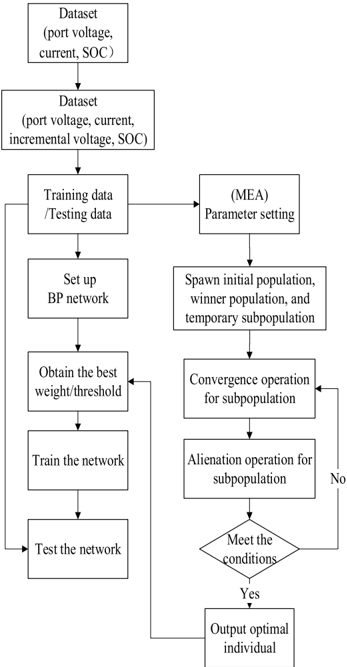
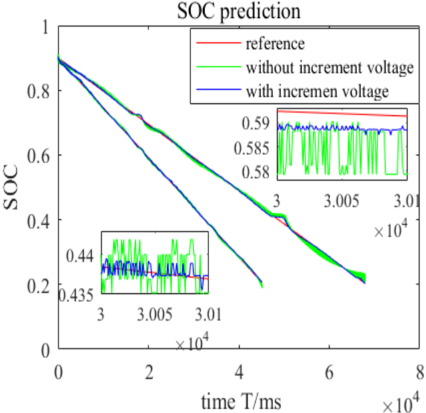
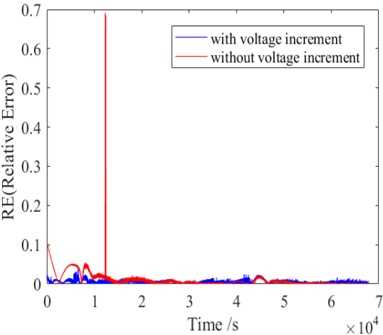
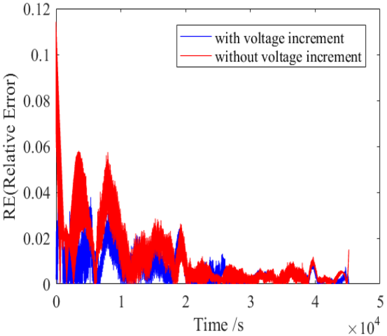
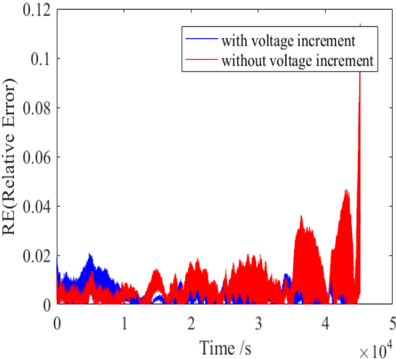
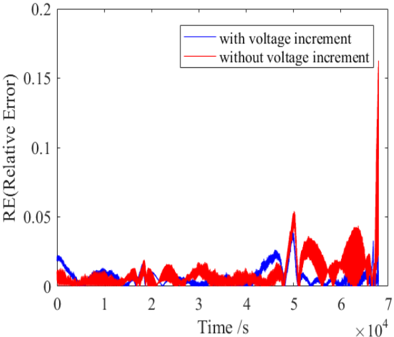
State of charge (SOC) estimations are an important part of lithium-ion battery management systems. Aiming at existing SOC estimation algorithms based on neural networks, the voltage increment is proposed in this paper as a new input feature for estimation of the SOC of lithium-ion batteries. In this method, the port voltage, current and voltage increment are taken as inputs and the current SOC is used as output to train a neural network. Different from the adaptive filtering algorithm, which requires complex equivalent circuit parameter identification, this algorithm uses the voltage increment instead of the open circuit voltage (OCV); hence, the complexity of the SOC estimation algorithm is reduced, and the problem of inaccurate estimation caused by neural network algorithms without considering the internal structure of the battery is avoided. The experimental results show that compared with the traditional neural network algorithm, the neural network SOC estimation algorithm based on the voltage increment could improve the accuracy of SOC estimation.
Overview
The claims and statistics of this paper haven’t been checked yet.
Free: it reads the open-access text and checks the first 5 claims that cite a source we can check. Create a free account to check every claim.
Integrity signals
Registry
Cites
Statistics
Figures
Verification
Claims the paper makes
The claims and statistics of this paper haven’t been checked yet.
Free: it reads the open-access text and checks the first 5 claims that cite a source we can check. Create a free account to check every claim.
Claims other papers make about this one
Each is checked against this paper’s own text: does it say what the citing paper says it does?
The source backs part of the claim, not all of it — or backs it for a different population, condition or comparison.
In the citing paper
“MAE ≤ 1 %”
From Recent developments and challenges in state-of-charge estimation techniques for electric vehicle batteries: A review (2024) · cites this paper as [95]
Experimental — accuracy not yet measured
Self-check
Percentages, sums and reported differences re-computed from the paper’s own numbers.
The self-check needs the paper’s full text.
Citations
Cites
Long Short-Term Memory Networks for Accurate State-of-Charge Estimation of Li-ion Batteries
Chemali, E., Kollmeyer, P. J., Preindl, M., Ahmed, R., & Emadi, A. (2018) · IEEE Transactions on Industrial Electronics · doi:10.1109/tie.2017.2787586 · Cited by 906
State of Charge and State of Health Estimation for Lithium Batteries Using Recurrent Neural Networks
Chaoui, H., & Ibe-Ekeocha, C. C. (2017) · IEEE Transactions on Vehicular Technology · doi:10.1109/tvt.2017.2715333 · Cited by 555 · cited 3×
“Therefore, a lot of related methods on soc estimation have been presented, such as dynamically driven recurrent networks (DDRNs) [13], the combination of long short-term memory networks and recurrent neural networks [14], the combination of convolutional neural networks and long short-term arithmetic memory networks […”
MethodCombined CNN-LSTM Network for State-of-Charge Estimation of Lithium-Ion Batteries
Song, X., Yang, F., Wang, D., & Tsui, K.-L. (2019) · IEEE Access · doi:10.1109/access.2019.2926517 · Cited by 373 · cited 1×
“[11] used a fast sparse bayesian algorithm for training and then combined this algorithm with an incremental learning method to establish an incremental learning correlation vector machine model, which improved SOC estimation.”
MethodHannan, M. A., Lipu, M. S. H., Hussain, A., Saad, M. H., & Ayob, A. (2018) · IEEE Access · doi:10.1109/access.2018.2797976 · Cited by 288 · cited 1×
“Therefore, a lot of related methods on soc estimation have been presented, such as dynamically driven recurrent networks (DDRNs) [13], the combination of long short-term memory networks and recurrent neural networks [14], the combination of convolutional neural networks and long short-term arithmetic memory networks […”
MethodBattery state of charge estimation using a load-classifying neural network
Tong, S., Lacap, J. H., & Park, J. W. (2016) · Journal of Energy Storage · doi:10.1016/j.est.2016.07.002 · Cited by 234 · cited 1×
“Compared with the adaptive filtering method, which is sensitive to the initial value, machine learning algorithms have wider applicability with a simpler model training procedure, broader choice of training data, and smaller computational cost [9].”
MethodHuang, Z., Yang, F., Xu, F., Song, X., & Tsui, K.-L. (2019) · IEEE Access · doi:10.1109/access.2019.2928037 · Cited by 188 · cited 1×
“Therefore, a lot of related methods on soc estimation have been presented, such as dynamically driven recurrent networks (DDRNs) [13], the combination of long short-term memory networks and recurrent neural networks [14], the combination of convolutional neural networks and long short-term arithmetic memory networks […”
MethodPeng, S., Chen, C., Shi, H., & Yao, Z. (2017) · IEEE Access · doi:10.1109/access.2017.2725301 · Cited by 180 · cited 1×
“These methods further include adaptive Kalman filtering [5], adaptive regression extended Kalman filtering [6], the data-driven extended Kalman filtering algorithm [7] and so on.”
MethodXiao, B., Liu, Y., & Xiao, B. (2019) · IEEE Access · doi:10.1109/access.2019.2913078 · Cited by 172 · cited 2×
“Hu and Wang [16] proposed a convolution recursive unit (CNN-GRU) network for the estimation of the state of charge of lithium-ion batteries.”
MethodLipu, M. S. H., Hannan, M. A., Hussain, A., Saad, M. H. M., Ayob, A., & Blaabjerg, F. (2018) · IEEE Access · doi:10.1109/access.2018.2837156 · Cited by 162 · cited 1×
“Therefore, a lot of related methods on soc estimation have been presented, such as dynamically driven recurrent networks (DDRNs) [13], the combination of long short-term memory networks and recurrent neural networks [14], the combination of convolutional neural networks and long short-term arithmetic memory networks […”
MethodHan, W., Zou, C., Zhou, C., & Zhang, L. (2019) · IEEE Transactions on Smart Grid · doi:10.1109/tsg.2018.2867017 · Cited by 126 · cited 1×
“[23] proposed a computationally efficient algorithm for estimating the battery cell state evolution throughout the charge equalization process.”
MethodSelf-citation
Research works printed but not linked: 8
- W. S. Wang, Q. F. Teng, and T. Liu, ''Neural network method for battery SOC estimation in electric vehicles,'' Comput. Appl. Chem., vol. 32, no. 6, pp. 744-748, 2015.
- Z. Cheng, X. M. Sun, and S. L. Cheng, ''A method for estimating the charged state and power of lithium-ion batteries,'' Chin. J. Electr. Technol., vol. 32, no. 15, pp. 180-189, 2017.
- Y. J. Chen, G. Yang, and H. P. Zu, ''Estimation method of open circuit voltage and internal resistance of lithium ion battery based on constant current experiment,'' J. Electr. Technol., vol. 33, no. 17, pp. 3976-3988, 2018.
- X. D. Liu, C. Z. Liu, and Z. J. Yang, ''State estimation of all vanadium flow battery based on unscented Kalman filter,'' Proc. CSEE, vol. 38, no. 6, pp. 1769-1777, 2018.
- X. M. Fan, C. Wang, and X. Zhang, ''Prediction method of lithium ion battery SOC based on incremental learning correlation vector machine,'' Chin. J. Electr. Eng., vol. 34, no. 13, pp. 2700-2708, 2019.
- Q. Wang, Y. K. Sun, and F. Y. Ni, ''A new method of battery state of charge prediction for hybrid electric vehicles,'' J. Electr. Eng., vol. 31, no. 9, pp. 189-196, 2016.
- D. Sun and X. Q. Chen, ''Estimation of the charged state of lithium batteries based on discrete sliding mode observer,'' Chin. J. Elect. Eng., vol. 35, no. 1, pp. 185-191, 2015.
- Y. Luo, B. W. Qi, and H. Huang, ''Research on estimation method of On- time integral SOC based on capacity correction,'' Automot. Eng., vol. 42, no. 5, pp. 681-687, 2020.
Cited by
Cui, Z., Wang, L., Li, Q., & Wang, K. (2022) · International Journal of Energy Research · doi:10.1002/er.7545 · Cited by 384
Ghaeminezhad, N., Ouyang, Q., Wei, J., Xue, Y., & Wang, Z. (2023) · Journal of Energy Storage · doi:10.1016/j.est.2023.108707 · Cited by 130
Yang, X. Q., Wang, S., Xu, W., Qiao, J., Yu, C., Takyi‐Aninakwa, P., & Jin, S. (2022) · Electrochimica Acta · doi:10.1016/j.electacta.2022.140241 · Cited by 88
Barik, S., & Saravanan, B. (2024) · Journal of Energy Storage · doi:10.1016/j.est.2024.113623 · Cited by 73
A Review for Green Energy Machine Learning and AI Services
Mehta, Y., Xu, R. P., Lim, B., Wu, J., & Gao, J. Z. (2023) · Energies · doi:10.3390/en16155718 · Cited by 54
Khalid, A., & Sarwat, A. I. (2021) · IEEE Access · doi:10.1109/access.2021.3061478 · Cited by 51
“[21] by using another statistical approach referred to as mind evolutionary algorithm in conjunction with it.”
MethodLi, J. H., Wang, S., Chen, L., Wang, Y., Zhou, H., & Guerrero, J. M. (2024) · Journal of Energy Storage · doi:10.1016/j.est.2024.110750 · Cited by 38
Chianese, G., Iannucci, L., Veneri, O., & Capasso, C. (2025) · Applied Energy · doi:10.1016/j.apenergy.2025.125783 · Cited by 33
Yu, Z., Liu, J., Lu, Y., Feng, C., Li, L., & Wu, Q. (2024) · Journal of Power Electronics · doi:10.1007/s43236-024-00801-9 · Cited by 24
“The open-circuit voltage method [3] and the ampere-hour integration method [4] have difficulty when applied separately to the estimation of battery SOC due to the influence of sensor measurement errors and the need for a sufficiently long soak time for the battery [5].”
Liu, Y., Wang, S., Xie, Y., Fernández, C., Qiu, J., & Zhang, Y. (2022) · International Journal of Circuit Theory and Applications · doi:10.1002/cta.3339 · Cited by 21
“From the discrete system Equation (2), the following equation can be derived.”
BackgroundVariational Autoencoder Based Anomaly Detection in Large-Scale Energy Storage Power Stations
Ji, T., Xu, P., Guo, D., Sun, L., Ma, K., Wang, Y., & Han, X. (2025) · Energies · doi:10.3390/en18112770 · Cited by 17
Chen, L., Wang, S., Chen, L., Gao, H., & Fernández, C. (2024) · Ionics · doi:10.1007/s11581-024-05610-5 · Cited by 19
“However, the data-driven SOC estimation method has high data quality requirements and computational costs and is not widely applicable to the BMS of electric vehicles [11].”
Ibrahim, A.-W., Al-Shamma’a, A. A., Farh, H. M. H., Shi, Z., Abu-Rub, H., Kotb, H., & Mekhilef, S. (2026) · Journal of Energy Storage · doi:10.1016/j.est.2026.120976 · Cited by 17
Robustness estimation for state-of-charge of a lithium-ion battery based on feature fusion
Xia, B., Ye, M., Wang, Q., Lian, G., Li, Y., Zhang, B., & Zhang, Y. (2024) · Energy Reports · doi:10.1016/j.egyr.2024.09.072 · Cited by 11
SOC Estimation for Lithium-Ion Batteries Based on the AEKF-SVM Algorithm
Lei Zhang1, Q. S. (2024) · Academic Journal of Computing & Information Science · doi:10.25236/ajcis.2024.070525 · Cited by 7
“As the state of charge (SOC) of a lithium-ion battery cannot be measured directly by instruments, it can only be estimated indirectly by measuring the voltage [7,8] , current [9] , and temperature of the battery.”
BackgroundBhat, A., Suryawanshi, A., Jadhav, O., & Jawale, S. A. (2025) · IEEE International Conference on Industrial Electronics: Developments & Applications (ICIDeA) · doi:10.1109/icidea64800.2025.10962934 · Cited by 4
“[5,6] However, efficiency balancing the energy distribution during both the braking and discharging processes remains a significant challenge.”
Memristive Equivalent Circuit Model for Battery
Mogadem, M. M., & Li, Y. (2021) · Sustainability · doi:10.3390/su132011204 · Cited by 4
“where Z is the monotonic function of the SOC and memristor relationship, the actual data obtained from the Center for Advanced Life Cycle Engineering (CALCE) [30], was based on incremental OCV because it is more recommended to describe and find the essential relationship between the OCV and SOC [47].”
MethodRobust Estimation of Lithium-Ion Battery State of Charge Based on Feature Preference
Wang, Y., & Jiale, Z. (2026) · Journal of The Electrochemical Society · doi:10.1149/1945-7111/ae55cf · Cited by 1
State-of-charge estimation method for large unmanned aerial vehicle
Wu, J., Cao, J., Guerrero, J. M., Wang, S., Shi, W., Yang, X. G., & Hao, X. (2023) · Elsevier eBooks · doi:10.1016/b978-0-443-16160-5.00015-9
Range Estimation of Electric Vehicle Using Matlab Simulink ModelPreprint
Barve, H., Argade, S. G., Chavan, S., Bharambe, S., Mulla, A. C., & Anantwar, H. (2024) · SSRN Electronic Journal · doi:10.2139/ssrn.4838318
Analysis of FOC & Trapezoidal Method of PMSM Motor for Variable Speed Application
Patil, H., Argade, S. G., Mulla, A. C., Bharambe, S., Barve, H., & Suryawanshi, R. (2025) · International Conference for Emerging Technology (INCET) · doi:10.1109/incet64471.2025.11140901
Wang, Z., Tang, H., Wang, Y., Dong, Z., & Wang, Z. (2026) · IEEE Internet of Things Journal · doi:10.1109/jiot.2026.3717938
“Although simple and responsive, its lack of feedback causes sensor errors to accumulate, leading to estimation drift [5].”
Metadata
- Authors
- Zhao, B., Hu, J., Xu, S., Wang, J., Zhu, Y., Zhang, L., & Gao, C.
- Affiliations
- China Electric Power Research Institute (CN)
- Hunan University (CN)
- Beijing Information Science & Technology University (CN)
- Venue
- IEEE Access
- Published
- 2020
- Volume
- 8
- Pages
- 198706-198713
- ISSN
- 2169-3536 (ISSN-L)
- OpenAlex
- W3097743225
- Semantic Scholar
- a1cef05f9cb5fd355c7fc8a1226aa67f06bffcbe
- Cited by
- 22
- References
- 15
- Citations by year
- 2026: 3 · 2025: 4 · 2024: 7 · 2023: 3 · 2022: 2 · 2021: 3
- FWCI
- 0.74
- Type
- journal article
- Language
- en
- Open access
- gold
- doi.org
- Locations
- IEEE Access (publishedVersion, cc-by)
- DOAJ (DOAJ: Directory of Open Access Journals) (submittedVersion, cc-by-sa)
- Funders
- Open Fund of the State Key Laboratory of Operation and Control of Renewable Energy & Storage Systems (DGB51201901183)
- Topics
- Physical Sciences › Engineering › Automotive Engineering › Battery Modeling and Management
- Physical Sciences › Engineering › Electrical and Electronic Engineering › Advancements in Battery Materials
- Physical Sciences › Engineering › Control and Systems Engineering › Control Systems and Identification
- Keywords
- state of charge estimation, lithium-ion batteries, artificial neural networks, battery management systems, open-circuit voltage, energy storage batteries
About these checks
Registry, retraction, Cites and statistics results are computed, not judged, with one exception: a printed reference that no index lists is read once by a model before it counts as a citation error. Claims are extracted by a model and kept only when their quote appears verbatim in the text; each cited source is then checked, with a model’s help, for whether it says what the claim relies on. Those verdicts can be wrong — read the claim’s quote and the cited source before relying on one.
Statistics and arithmetic are recomputed, not judged.
Confidence bands are shown only for fields calibrated on our annotated test set. None is calibrated yet, so no band is shown.
What counts as a claim ›How we measure confidence ›How we check this ›
Are you an author, or do you see a problem with this page? Request a review
Data sources
Bibliographic data: Semantic Scholar, OpenAlex, Crossref.
Contains information from the Semantic Scholar Academic Graph Datasets, made available under the ODC Attribution License (ODC-BY 1.0).
Semantic Scholar’s data is described in: Kinney, R., et al. (2023). The Semantic Scholar Open Data Platform. arXiv:2301.10140.
