

Decentralized and Self-Sovereign Identity: Systematic Mapping Study
Open accessThe DOI matches its Crossref record; 129 of the 129 references it cites were found in a registry or an index; 12 of the 54 sources its claims cite were checked for support.
Abstract
Self-Sovereign Identity is an emerging, user-centric, decentralized identity approach utilizing some form of decentralized technology. It provides a means for digital identification without reliance on any external authority, enabling entities to control their identity and data flow during digital interactions while enhancing security and privacy. With the rise of blockchain technology, Self-Sovereign Identity is gathering momentum in academia and industry while the number of research papers increases rapidly. Yet Self-Sovereign Identity is still in a young unstructured field in its early stages of research. Thus, a systematic mapping methodology was adopted to provide a coarse-grained overview of decentralized and Self-Sovereign Identity and structure the research area by identifying, analyzing, and classifying the research papers according to predefined parameters, precisely according to their contribution, application domain, IT field, research type, research method, and place of publication. Furthermore, the nature and scope of the research are determined, meanwhile existing research topics, gained insights into trends, demographics, challenges, gaps, and opportunities for future research are also presented.
Overview
CoChat Summary
TL;DR
This paper is a systematic mapping study of decentralized identity and Self-Sovereign Identity (SSI) research, classifying 120 included papers to map contributions, domains, IT fields, research types, methods, and publication venues. It finds rapid growth in the literature, with most work still concentrated on validation/solution proposals, systems/architectures, and general rather than domain-specific applications.
Key findings
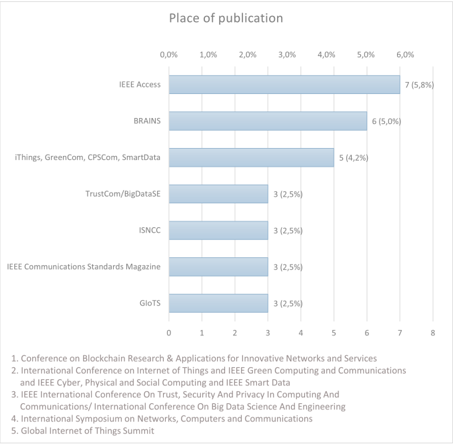
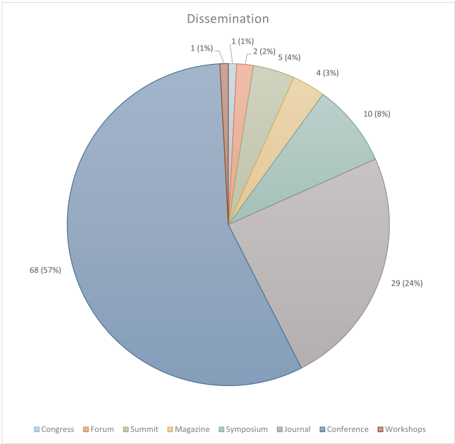
- The review included 120 papers: 108 (90%) from IEEE Xplore and 12 (10%) from ScienceDirect. The number of papers grew by 83.3% from 2017 to 2018, 58.6% from 2018 to 2019, 50.0% from 2019 to 2020, and 96.7% overall from 2017 to 2021.
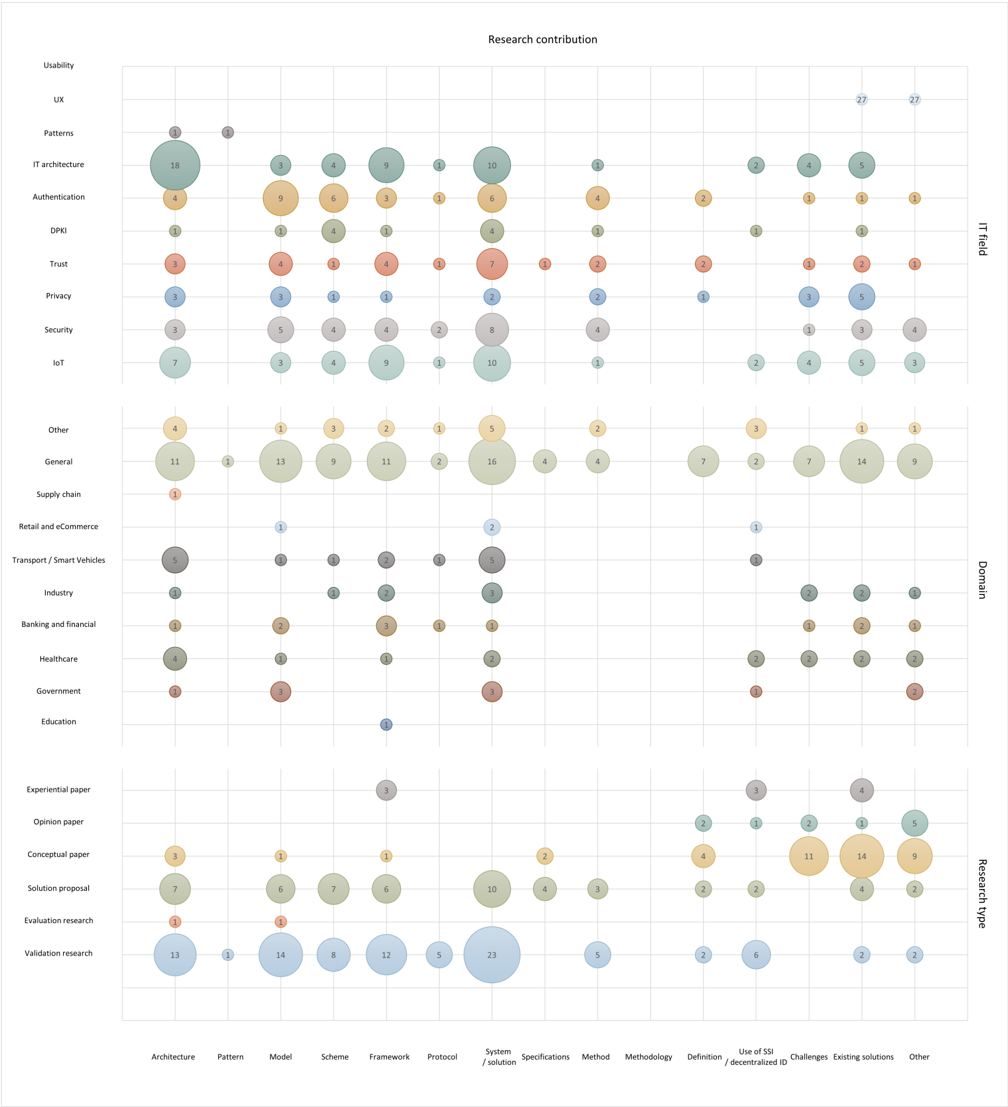
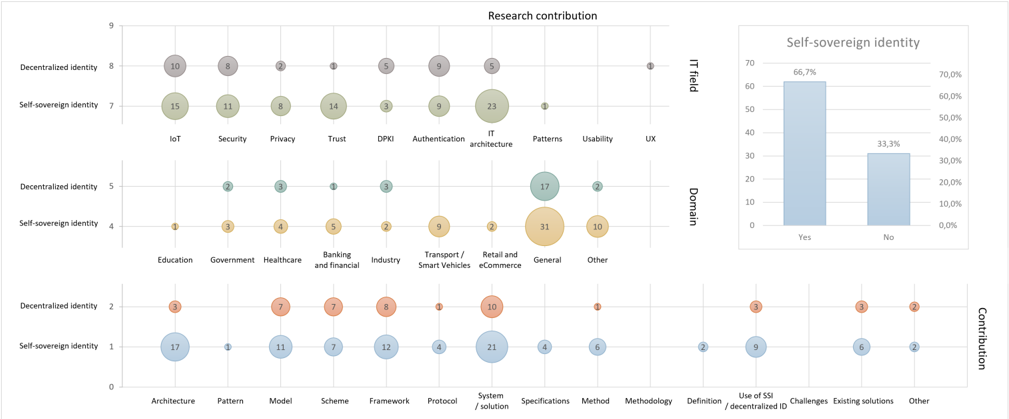
- The dominant contribution types were system/solution (32 studies, 26.7%), architecture (22, 18.3%), and framework (22, 18.3%); secondary papers most often compare/evaluate existing solutions (22, 18.3%).
- By research type, validation research (57 studies, 47.5%) and solution proposals (36, 30.0%) dominated; by method, prototyping was the most common, producing proofs of concept (40.0%).
- The field is still mostly general-purpose: 69 studies (57.5%) addressed decentralized identity in general, while specific domains included IoT (29 studies, 24.2%), transport/smart vehicles (10, 8.3%), healthcare (9, 7.5%), and banking/finance (8, 6.7%).
Methods
- The paper conducted a systematic mapping study (SMS) to provide a coarse-grained overview and classify studies by contribution, domain, IT field, research type, research method, and place of publication.
- Search covered IEEE Xplore and ScienceDirect, using keywords such as “self-sovereign identity,” “decentralized identity,” “blockchain identity,” and “decentralized identifier,” with publication years limited to January 2013 to January 2021 and English papers only.
- Screening proceeded through database search, year/publication-type filtering, title/abstract/keyword screening, and full-text screening; 120 studies were retained for classification and mapping.
Limitations
- The paper explicitly states its scope was limited to two databases, English-language papers, and papers published between January 2013 and January 2021.
- It also notes that the search was conducted in January 2021, so papers added later would not be included.
- Evident from the method: the review may miss relevant work outside IEEE Xplore and ScienceDirect, and the mapping is only as complete as the selected keywords and screening criteria.
Model-written summary. Check it against the paper before relying on it.
Integrity signals
Registry
Cites
Statistics
Figures






Verification
Claims the paper makes
10 Valid · 6 Not valid · 26 Not checked · 82 Own results and interpretations
The cited sources support only part of this claim — read each source’s verdict below.
In the paper
“And usually relies on some form of decentralized ledger technology (DLT), blockchain, distributed file system, or another decentralized system, such as Hashgraphes and Tangle [12].”
§ Decentralized and Self-Sovereign Identity: Systematic Mapping Study > II. DECENTRALIZED IDENTITY
What the sources say
- Partly supportedcites [12] 12. L. Stockburger, G. Kokosioulis, A. Mukkamala, R. R. Mukkamala, and M. Avital, "Blockchain- enabled decentralized identity management: The case of self-sovereign identity in public transportation," Blockchain: Research and Applications, p. 100 014, 2021, ISSN: 2096-7209. DOI: https : / / doi . org / 10 . 1016/j.bcra.2021.100014. [Online]. Available: https: / / www . sciencedirect . com / science / article / pii / S2096720921000099. sourceExperimental — accuracy not yet measured
Our copy supports the core of the attribution: Section 2.3 ('Blockchain technology in identity management') describes a 'DLT-based SSI system' in which 'a distributed system relies on a shared ledger, which is validated and stored by several network nodes', and states that identity management networks 'utilize blockchain technology to eliminate the need for any intermediary as an identity provider'; Section 3.2.6 adds the distributed-file-system element ('uPort utilizes IPFS (InterPlanetary File System, a distributed file system) for storage'). However, the claim's final alternative — 'another decentralized system, such as Hashgraphes and Tangle' — is not stated: Hashgraph is absent from our copy entirely, and Tangle/IOTA appears only as a DLT used in one healthcare data-sharing study (Zheng et al., Section 3.1), not as a substrate that decentralized identity usually relies on. So the enumerated non-DLT/non-blockchain examples are attributed to a source that does not make that point. (LLM, conf=0.72)
plainstates an association- Asserted: passes — The authors put it forward as true.
- Checkable: passes — It can be checked against evidence.
- Load-bearing: unclear — It is unclear whether the paper’s conclusions depend on it.
- Based: passes — The paper gives a reason why it holds.
- Partly supported
The cited sources support only part of this claim — read each source’s verdict below.
In the paper
“However, the central IdP is accompanied by decentralized storage, where validated attestations are stored on a distributed ledger for later validation, presenting main differentiation [10].”
§ Decentralized and Self-Sovereign Identity: Systematic Mapping Study > II. DECENTRALIZED IDENTITY
What the sources say
- Partly supportedcites [10] 10. M. Schanzenbach, G. Bramm, and J. Schütte, "Re- claimid: Secure, self-sovereign identities using name systems and attribute-based encryption," in 2018 17th IEEE International Conference On Trust, Security And Privacy In Computing And Communications/ 12th IEEE International Conference On Big Data Science And Engineering (TrustCom/BigDataSE), 2018, pp. 946-957. DOI: 10 . 1109 / TrustCom / BigDataSE.2018.00134. sourceExperimental — accuracy not yet measured
Section II (p. 2) describes NameID as combining a central IdP with decentralized storage, and Related Work (p. 11) says its attributes are stored on the Namecoin blockchain. But Related Work explicitly says those attributes are self-issued, with no third party certifying them; the paper therefore does not support describing them as validated attestations. The paper also distinguishes NameID from its own reclaimID system, which has no central IdP (Introduction, p. 2). (LLM, conf=0.87)
plainstates an association- Asserted: passes — The authors put it forward as true.
- Checkable: passes — It can be checked against evidence.
- Load-bearing: unclear — It is unclear whether the paper’s conclusions depend on it.
- Based: passes — The paper gives a reason why it holds.
- Partly supported
The cited sources support only part of this claim — read each source’s verdict below.
In the paper
“Meanwhile, Gans et al. [49] focus on SSI possibilities for undocumented individuals during the pandemic.”
§ Decentralized and Self-Sovereign Identity: Systematic Mapping Study > (RQ2.2).
What the sources say
- Partly supportedcites [49] 49. M. Shuaib, S. Alam, M. Shahnawaz Nasir, and M. Shabbir Alam, "Immunity credentials using self- sovereign identity for combating covid-19 pan- demic," Materials Today: Proceedings, 2021, ISSN: 2214-7853. DOI: https : / / doi . org / 10 . 1016 / j . matpr . 2021 . 03 . 096. [Online]. Available: https : / / www . sciencedirect . com / science / article / pii / S2214785321021155. sourceExperimental — accuracy not yet measured
The title in our copy identifies the paper as a study of self-sovereign identity for COVID-19 immunity credentials, supporting the general SSI-and-pandemic connection. It names Mohammed and colleagues, not Gans et al., and the available passages do not address undocumented individuals. (LLM, conf=0.86)
plain- Asserted: passes — The authors put it forward as true.
- Checkable: passes — It can be checked against evidence.
- Load-bearing: unclear — It is unclear whether the paper’s conclusions depend on it.
- Based: passes — The paper gives a reason why it holds.
- Partly supported
The cited sources that could be checked couldn’t confirm or dispute this claim.
In the paper
“With the COVID-19 outbreak, the potential and the need for decentralized and Self-Sovereign Identities was further recognized [48][49][50][51] [52].”
§ Decentralized and Self-Sovereign Identity: Systematic Mapping Study > (RQ2.2).
What the sources say
- Not checked — no full text of the sourcecites [48] 48. A. Abraham, K. Theuermann, and E. Kirchengast, "Qualified eid derivation into a distributed ledger based idm system," in 2018 17th IEEE Interna- tional Conference On Trust, Security And Privacy In Computing And Communications/ 12th IEEE Inter- national Conference On Big Data Science And En- gineering (TrustCom/BigDataSE), 2018, pp. 1406- 1412. DOI: 10 . 1109 / TrustCom / BigDataSE . 2018 . 00195. source
- Could not verifycites [49] 49. M. Shuaib, S. Alam, M. Shahnawaz Nasir, and M. Shabbir Alam, "Immunity credentials using self- sovereign identity for combating covid-19 pan- demic," Materials Today: Proceedings, 2021, ISSN: 2214-7853. DOI: https : / / doi . org / 10 . 1016 / j . matpr . 2021 . 03 . 096. [Online]. Available: https : / / www . sciencedirect . com / science / article / pii / S2214785321021155. sourceExperimental — accuracy not yet measured
The available copy contains the paper’s title and a withdrawal notice, but no substantive discussion of whether COVID-19 increased recognition of the potential or need for decentralized, self-sovereign identities. Searches for that claim and for decentralized identity credentials returned no further passages. (LLM, conf=0.75)
- Not checked — no full text of the sourcecites [50] 50. R. B. Gans, J. Ubacht, and M. Janssen, "Self- sovereign identities for fighting the impact of covid- 19 pandemic," Digital Government: Research and Practice, vol. 2, no. 2, pp. 1-4, 2021. DOI: https : / / doi.org/10.1145/3429629. [Online]. Available: https: //dl.acm.org/doi/abs/10.1145/3429629. source
plainstates a cause- Asserted: passes — The authors put it forward as true.
- Checkable: passes — It can be checked against evidence.
- Load-bearing: unclear — It is unclear whether the paper’s conclusions depend on it.
- Based: passes — The paper gives a reason why it holds.
A result the paper reports from its own data — it cites no other source for it, so there is none to check. The quote shows it is in the paper.
In the paper
“there are hardly any studies addressing usability (0 studies)”
§ Decentralized and Self-Sovereign Identity: Systematic Mapping Study > (RQ2.2).
plain- Asserted: passes — The authors put it forward as true.
- Checkable: passes — It can be checked against evidence.
- Load-bearing: passes — The paper’s conclusions depend on it.
- Based: passes — The paper gives a reason why it holds.
59 more claims
Create a free account to see all 124 claims and to verify the 3 references still open.
- Probably not a substantial claim. 42
- It may state two separate claims as one. 37
- The quote only partly states this claim. 1
Self-check
Percentages, sums and reported differences re-computed from the paper’s own numbers.
Self-check results appear here once an independent check has confirmed them.
Cited works that were retracted
Works this paper cites that were later retracted, from the retraction notices publishers deposit. Major when the notice came out before this paper was published.
A note, not an issue: for example, a cited work that was retracted only after this paper was published, which its authors could not have known.
In the paper
“[48] reviewed the aspects of SSI application.”
Cited work 10.1016/j.matpr.2021.03.096 · retracted 2021-03-22 · notice 10.1016/j.matpr.2021.03.096 · this paper published 2021
Citations
Cites
1 retracted
(2021) · doi:10.1016/j.matpr.2021.03.096 · Cited by 26 · cited 2×
“[48] reviewed the aspects of SSI application.”
BackgroundRetractedSystematic Mapping Studies in Software Engineering
Petersen, K., Feldt, R., Mujtaba, S., & Mattsson, M. (2008) · Electronic Workshops in Computing · doi:10.14236/ewic/ease2008.8 · Cited by 3,239
Guidelines for conducting systematic mapping studies in software engineering: An update
Petersen, K., Vakkalanka, S., & Kuzniarz, L. (2015) · Information and Software Technology · doi:10.1016/j.infsof.2015.03.007 · Cited by 2,669 · cited 2×
“[41], [42] and conducted an SMS process, performing the following steps:”
BackgroundMethodRequirements engineering paper classification and evaluation criteria: a proposal and a discussion
Wieringa, R., Maiden, N., Mead, N., & Rolland, C. (2006) · Requirements Engineering · doi:10.1007/s00766-005-0021-6 · Cited by 940 · cited 2×
“[43], which have proposed the classification of research papers with evaluation criteria extension.”
BackgroundA survey on essential components of a self-sovereign identity
Mühle, A., Grüner, A., Gayvoronskaya, T., & Meinel, C. (2018) · Computer Science Review · doi:10.1016/j.cosrev.2018.10.002 · Cited by 483
Privacy-Preserving Solutions for Blockchain: Review and Challenges
Bernal Bernabe, J., Canovas, J. L., Hernandez-Ramos, J. L., Torres Moreno, R., & Skarmeta, A. (2019) · IEEE Access · doi:10.1109/access.2019.2950872 · Cited by 459
A first look at identity management schemes on the blockchain
Dunphy, P., & Petitcolas, F. A. P. (2018) · IEEE Security & Privacy · doi:10.1109/msp.2018.3111247 · Cited by 416 · cited 4×
“After verifying, validated identity attestations are recorded on a distributed ledger for later verification by third parties [11], [18], [26].”
BackgroundMethodInfluentialBlockchain 3.0 applications survey
Di Francesco Maesa, D., & Mori, P. (2020) · Journal of Parallel and Distributed Computing · doi:10.1016/j.jpdc.2019.12.019 · Cited by 372 · cited 3×
“Maesa and Mori [2] have surveyed six applications of blockchain, specifically (i) electronic voting, (ii) healthcare records, (iii) identity management, (iv) access control, (v) decentralized notary, and (vi) supply chain.”
BackgroundBlockchain-based identity management systems: A review
Liu, Y., He, D., Obaidat, M. S., Kumar, N., Khan, M. K., & Raymond Choo, K.-K. (2020) · Journal of Network and Computer Applications · doi:10.1016/j.jnca.2020.102731 · Cited by 314
Security, Performance, and Applications of Smart Contracts: A Systematic Survey
Rouhani, S., & Deters, R. (2019) · IEEE Access · doi:10.1109/access.2019.2911031 · Cited by 309
Research works printed but not linked: 40
- 20. K. Wagner, B. Némethi, E. Renieris, P. Lang, E. Brunet, and E. Holst, "Self-sovereign identity: A position paper on blockchain enabled identity and the road ahead," 2018. [Online]. Available: https : / / jolocom . io / wp -content / uploads / 2018 / 10 / Self - sovereign -Identity -_ -Blockchain -Bundesverband - 2018.pdf.
- 23. C. Allen. (2016). "The path to self-sovereign identity," [Online]. Available: http : / / www . lifewithalacrity . com / 2016 / 04 / the -path -to -self - soverereign-identity.html. (accessed: 16.06.2021).
- 55. M. S. Ferdous, F. Chowdhury and M. O. Alassafi, "In Search of Self- Sovereign Identity Leveraging Blockchain Technology," IEEE Access, vol. 7, pp. 103059-103079, 2019.
- 56. R. Soltani, U. Trang Nguyen and A. An, "A New Approach to Client Onboarding Using Self-Sovereign Identity and Distributed Ledger," 2018 IEEE International Conference on Internet of Things (iThings) and IEEE Green Computing and Communications (GreenCom) and IEEE Cyber, Physical and Social Computing (CPSCom) and IEEE Smart Data (SmartData), 2018, pp. 1129-1136.
- 57. M. Takemiya and B. Vanieiev, "Sora Identity: Secure, Digital Identity on the Blockchain," 2018 IEEE 42nd Annual Computer Software and Applications Conference (COMPSAC), 2018, pp. 582-587.
- 58. A. Grüner, A. Mühle and C. Meinel, "An Integration Architecture to Enable Service Providers for Self-sovereign Identity," 2019 IEEE 18th International Symposium on Network Computing and Applications (NCA), 2019, pp. 1-5.
- 62. R. Soltani, U. T. Nguyen and A. An, "Practical Key Recovery Model for Self-Sovereign Identity Based Digital Wallets," 2019 IEEE Intl Conf on Dependable, Autonomic and Secure Computing, Intl Conf on Pervasive Intelligence and Computing, Intl Conf on Cloud and Big Data Computing, Intl Conf on Cyber Science and Technology Congress (DASC/PiCom/CBDCom/CyberSciTech), 2019, pp. 320-325.
- 69. P. C. Bartolomeu, E. Vieira, S. M. Hosseini and J. Ferreira, "Self- Sovereign Identity: Use-cases, Technologies, and Challenges for In- dustrial IoT," 2019 24th IEEE International Conference on Emerging Technologies and Factory Automation (ETFA), 2019, pp. 1173-1180.
- 71. P. Dunphy and F. A. P. Petitcolas, "A First Look at Identity Management Schemes on the Blockchain," IEEE Security & Privacy, vol. 16, no. 4, pp. 20-29, July/August 2018.
- 72. K. C. Toth and A. Anderson-Priddy, "Self-Sovereign Digital Identity: A Paradigm Shift for Identity," IEEE Security & Privacy, vol. 17, no. 3, pp. 17-27, May-June 2019.
- 75. A. Abraham, K. Theuermann and E. Kirchengast, "Qualified eID Deriva- tion Into a Distributed Ledger Based IdM System," 2018 17th IEEE International Conference On Trust, Security And Privacy In Computing And Communications/ 12th IEEE International Conference On Big Data Science And Engineering (TrustCom/BigDataSE), 2018, pp. 1406-1412.
- 76. B. Houtan, A. S. Hafid and D. Makrakis, "A Survey on Blockchain-Based Self-Sovereign Patient Identity in Healthcare," IEEE Access, vol. 8, pp. 90478-90494, 2020, doi: 10.1109/ACCESS.2020.2994090. · DOI · Paper page
- 77. J. Kaneriya and H. Patel, "A Comparative Survey on Blockchain Based Self Sovereign Identity System," 2020 3rd International Conference on Intelligent Sustainable Systems (ICISS), 2020, pp. 1150-1155.
- 80. S. E. Haddouti and M. D. Ech-Cherif El Kettani, "Analysis of Identity Management Systems Using Blockchain Technology," 2019 Interna- tional Conference on Advanced Communication Technologies and Net- working (CommNet), 2019, pp. 1-7.
- 87. K. Gilani, E. Bertin, J. Hatin and N. Crespi, "A Survey on Blockchain- based Identity Management and Decentralized Privacy for Personal Data," 2020 2nd Conference on Blockchain Research & Applications for Innovative Networks and Services (BRAINS), 2020, pp. 97-101.
- 89. X. Zhu and Y. Badr, "A Survey on Blockchain-Based Identity Man- agement Systems for the Internet of Things," 2018 IEEE International Conference on Internet of Things (iThings) and IEEE Green Computing and Communications (GreenCom) and IEEE Cyber, Physical and Social Computing (CPSCom) and IEEE Smart Data (SmartData), 2018, pp. 1568-1573.
- 91. M. Davie, D. Gisolfi, D. Hardman, J. Jordan, D. O'Donnell and D. Reed, "The Trust over IP Stack," in IEEE Communications Standards Magazine, vol. 3, no. 4, pp. 46-51, December 2019.
- 92. P. Dunphy, L. Garratt and F. Petitcolas, "Decentralizing Digital Identity: Open Challenges for Distributed Ledgers," 2018 IEEE European Sympo- sium on Security and Privacy Workshops (EuroS&PW), 2018, pp. 75-78.
- 94. M. Kuperberg, "Blockchain-Based Identity Management: A Survey From the Enterprise and Ecosystem Perspective," IEEE Transactions on Engineering Management, vol. 67, no. 4, pp. 1008-1027, Nov. 2020.
- 97. W. Xin, "Fighting COVID-19 and helping economy reopen by using blockchain technology," 2020 IEEE/CIC International Conference on Communications in China (ICCC Workshops), 2020, pp. 102-105.
- 11. R. Rana, R. N. Zaeem, and K. S. Barber, "An assessment of blockchain identity solutions: Mini- mizing risk and liability of authentication," in 2019 IEEE/WIC/ACM International Conference on Web Intelligence (WI), 2019, pp. 26-33.
- 124. W. L. Sim, H. N. Chua and M. Tahir, "Blockchain for Identity Man- agement: The Implications to Personal Data Protection," 2019 IEEE Conference on Application, Information and Network Security (AINS), 2019, pp. 30-35.
- 129. M. Schanzenbach, G. Bramm and J. Schütte, "reclaimID: Secure, Self- Sovereign Identities Using Name Systems and Attribute-Based Encryp- tion," 2018 17th IEEE International Conference On Trust, Security And Privacy In Computing And Communications/ 12th IEEE Inter- national Conference On Big Data Science And Engineering (Trust- Com/BigDataSE), 2018, pp. 946-957.
- 130. M. Alessi, A. Camillo, E. Giangreco, M. Matera, S. Pino and D. Storelli, "Make Users Own Their Data: A Decentralized Personal Data Store Pro- totype Based on Ethereum and IPFS," 2018 3rd International Conference on Smart and Sustainable Technologies (SpliTech), 2018, pp. 1-7. VOLUME 4, 2016
- 135. D. Li, W. Peng, W. Deng and F. Gai, "A Blockchain-Based Authen- tication and Security Mechanism for IoT," 2018 27th International Conference on Computer Communication and Networks (ICCCN), 2018, pp. 1-6.
- 150. C. Patsonakis, K. Samari, A. Kiayias and M. Roussopoulos, "Imple- menting a Smart Contract PKI," IEEE Transactions on Engineering Management, vol. 67, no. 4, pp. 1425-1443, Nov. 2020.
- 152. A. S. Omar and O. Basir, "Smart Phone Anti-counterfeiting Sys- tem Using a Decentralized Identity Management Framework," 2019 IEEE Canadian Conference of Electrical and Computer Engineering (CCECE), 2019, pp. 1-5.
- 155. J. Bernal Bernabe, J. L. Canovas, J. L. Hernandez-Ramos, R. Torres Moreno and A. Skarmeta, "Privacy-Preserving Solutions for Blockchain: Review and Challenges," IEEE Access, vol. 7, pp. 164908-164940, 2019.
- 157. S. Rouhani and R. Deters, "Security, Performance, and Applications of Smart Contracts: A Systematic Survey," IEEE Access, vol. 7, pp. 50759- 50779, 2019.
- 161. D. Li, W. Peng, W. Deng and F. Gai, "A Blockchain-Based Au- thentication and Security Mechanism for IoT," 2018 27th International Conference on Computer Communication and Networks (ICCCN), 2018, pp. 1-6.
- 162. E. Bandara, X. Liang, P. Foytik, S. Shetty, C. Hall, D. Bowden, N. Ranasinghe and K. De Zoysa, "A blockchain empowered and privacy preserving digital contact tracing platform," Information Processing & Management, vol. 58, no. 4, 2021.
- 164. T. Rathee, P. Singh, "A systematic literature mapping on secure identity management using blockchain technology," Journal of King Saud Uni- versity -Computer and Information Sciences, 2021.
- 165. A. Mühle, A. Grüner, T. Gayvoronskaya, C. Meinel, "A survey on essential components of a self-sovereign identity," Computer Science Review, vol. 30, 2018, p.. 80-86.
- 167. M. Shuaib, S. Alam, M. S. Alam, M. S. Nasir, "Self-sovereign identity for healthcare using blockchain", Materials Today: Proceedings, 2021.
- 170. D. F. Maesa, P. Mori, "Blockchain 3.0 applications survey", Journal of Parallel and Distributed Computing, vol. 138, 2020, pp. 99-114.
- 14. T. L. Foundation. (). "Hyperledger indy," [Online]. Available: https : / / www . hyperledger . org / use / hyperledger-indy. (accessed: 18.08.2021).
- 3. E. B. S. I. (EBSI). (). "Ebsi documentation," [Online]. Available: https : / / ec . europa . eu / cefdigital / wiki / display/CEFDIGITAL/ebsi. (accessed: 18.08.2021).
- 43. A. Preukschat and D. Reed, Self-Sovereign Identity: Decentralized digital identity and verifiable creden- tials. Manning, 2021, ISBN: 9781617296598.
- 8. E. Commission. (). "Commission proposes a trusted and secure digital identity for all europeans," [On- line]. Available: https : / / ec . europa . eu / commission / presscorner / detail / en / ip _ 21 _ 2663. (accessed: 08.07.2021).
- 7. DIF. (). "Dif -decentralized identity foundation," [Online]. Available: https : / / identity . foundation/. (accessed: 08.07.2021).
Cited by
The transparency challenge of blockchain in organizations
Sedlmeir, J., Lautenschlager, J., Fridgen, G., & Urbach, N. (2022) · Electronic Markets · doi:10.1007/s12525-022-00536-0 · Cited by 160
“This decentralized or self-sovereign identity (SSI) paradigm was largely motivated by the digital wallets that became popular through blockchains and is also often affiliated with blockchains (Čučko & Turkanovic, 2021; Soltani et al., 2021).”
BackgroundAhmed, M. R., Islam, A. K. M. M., Shatabda, S., & Islam, S. (2022) · IEEE Access · doi:10.1109/access.2022.3216643 · Cited by 202
“With DTI, a user is not associated with any IdP or central registry [65].”
BackgroundSelf-Sovereign Identity: A Systematic Review, Mapping and Taxonomy
Schardong, F., & Custódio, R. F. (2022) · Sensors · doi:10.3390/s22155641 · Cited by 198
“[10] presented a systematic map of decentralized identity.”
BackgroundMethodInfluentialGlöckler, J., Sedlmeir, J., Frank, M., & Fridgen, G. (2023) · Business & Information Systems Engineering · doi:10.1007/s12599-023-00830-x · Cited by 134
A Taxonomy of Challenges for Self-Sovereign Identity Systems
Satybaldy, A., Ferdous, M. S., & Nowostawski, M. (2024) · IEEE Access · doi:10.1109/access.2024.3357940 · Cited by 71
“Čučko et al. [4] presented a systematic map of decentralized and self-sovereign identity solutions, classifying research papers based on predefined parameters such as contribution, application domain, IT field, research type, research method, and place of publication.”
BackgroundSurvey on Digital Sovereignty and Identity: From Digitization to Digitalization
Tan, K.-L., Chi, C., & Lam, K. (2023) · ACM Computing Surveys · doi:10.1145/3616400 · Cited by 112
Jena, S. K., Barik, R. C., & Priyadarshini, R. (2024) · Internet of Things · doi:10.1016/j.iot.2024.101111 · Cited by 60
Blockchain-driven decentralized identity management: An interdisciplinary review and research agenda
Yan, Z., Zhao, X., Liu, Y., & Luo, X. R. (2024) · Information & Management · doi:10.1016/j.im.2024.104026 · Cited by 52
Self-sovereign identity and digital wallets
Babel, M., Willburger, L., Lautenschlager, J., Völter, F., Guggenberger, T. M., Körner, M.-F., Sedlmeir, J., Strüker, J., & Urbach, N. (2025) · Electronic Markets · doi:10.1007/s12525-025-00772-0 · Cited by 53
“Fundamentally, an SSI-based solution incorporates three key roles: issuers, holders, and verifiers (Davie et al., 2019; ˇCuˇcko & Turkanovi´c, 2021).”
Blockchain-Assisted Self-Sovereign Identities on Education: A Survey
Chan, W., Gai, K., Yu, J., & Zhu, L. (2025) · Blockchains · doi:10.3390/blockchains3010003 · Cited by 46
“A 2021 paper by ˇCuˇcko et al. emphasizes that decentralized and blockchain-based systems can reduce verification times from weeks to mere minutes, underscoring the inefficacy of conventional methods [99].”
Towards a Catalogue of Self-Sovereign Identity Design Patterns
Čučko, Š., Keršič, V., & Turkanović, M. (2023) · Applied Sciences · doi:10.3390/app13095395 · Cited by 22
Self-citationOrchestrating Digital Wallets for On- and Off-Chain Decentralized Identity Management
Keršič, V., Vidovič, U., Vrečko, A., Domajnko, M., & Turkanović, M. (2023) · IEEE Access · doi:10.1109/access.2023.3299047 · Cited by 30
“Those can be used for identification, authentication, and digital signing, as well as collecting and managing attestations in the form of VCs [29], [30], [31].”
BackgroundSelf-citationA Systematic Literature Mapping on Using Blockchain Technology in Identity Management
Ngo, T. T. T., Dang, T. A., Huynh, V. V., & Le, T. C. (2023) · IEEE Access · doi:10.1109/access.2023.3256519 · Cited by 32
“Although, in [16], the authors did not describe them in details so that readers cannot know how the identified papers were classified.”
BackgroundResultInfluentialSelf-Sovereign Identity for Organizations: Requirements for Enterprise Software
Bochnia, R., Richter, D., & Anke, J. (2024) · IEEE Access · doi:10.1109/access.2023.3349095 · Cited by 20
“Although the SSI domain is relatively new, it has gained increasing research popularity in recent years [3], [4].”
BackgroundDigital Sovereignty in the Era of Industry 5.0: Challenges and Opportunities
Misra, S., Barik, K., & Kvalvik, P. (2025) · Procedia Computer Science · doi:10.1016/j.procs.2025.02.069 · Cited by 35
Trust framework for self-sovereign identity in metaverse healthcare applications
Ling, A., & Butakov, S. (2024) · Data Science and Management · doi:10.1016/j.dsm.2024.04.003 · Cited by 17
An offline mobile access control system based on self-sovereign identity standards
Enge, A. H., Satybaldy, A., & Nowostawski, M. (2022) · Computer Networks · doi:10.1016/j.comnet.2022.109434 · Cited by 22
Nguyen, H.-N., Pham, H.-A., Tuong, N. H., & Nguyen, D.-H. (2024) · IEEE Access · doi:10.1109/access.2024.3405409 · Cited by 21
“…relying on SSI to manage the identities of entities (e.g., individuals, organizations, and applications), users who are subjects of identities [48], [49] have control and are assured of security and information privacy, as well as mitigating the risks of data leakage or identity theft [50].”
Başer, M. Y., Büyükbeşe, T., & Kizildag, M. (2023) · Asia Pacific Journal of Tourism Research · doi:10.1080/10941665.2023.2229922 · Cited by 15
Usability Evaluation of SSI Digital Wallets
Satybaldy, A. (2023) · IFIP advances in information and communication technology · doi:10.1007/978-3-031-31971-6_9 · Cited by 16
Akli, A., & Chougdali, K. (2025) · IEEE Access · doi:10.1109/access.2025.3567137 · Cited by 10
“This also allows sharing of data in a privacy-preserving manner [7].”
Braun, C. H.-J., Papanchev, V., & Käfer, T. (2023) · International World Wide Web Conference (WWW) · doi:10.1145/3543507.3583409 · Cited by 16
“SSI sees increasing attention [16] and adoption across the globe [8, 19, 33, 38] and across domains, e.”
BackgroundEnabling technologies for Web 3.0: A comprehensive survey
Hassan, M. A., Jamshidi, M. B., Manh, B. D., Chu, N. H., Nguyen, C.-H., Hieu, N. Q., Nguyen, C. T., Hoang, D. T., Nguyen, D. N., Huynh, N. V., et al. (2025) · Computer Networks · doi:10.1016/j.comnet.2025.111242 · Cited by 14
Teuschel, M., Pöhn, D., Grabatin, M., Dietz, F., Hommel, W., & Alt, F. (2023) · IEEE Access · doi:10.1109/access.2023.3334908 · Cited by 16
“Current SSI research is mostly theoretical, see [39], [40], [41], [42], [43], and [44].”
BackgroundAhmed, I., Toyoda, K., Nakano, T., Kasahara, S., Goyal, S. R., & Tran, T. H. (2025) · IEEE Internet of Things Journal · doi:10.1109/jiot.2025.3597356 · Cited by 19
“Cucko et al. [55] mapped research on decentralized identity and SSI, categorizing topics and trends.”
A Taxonomy of Decentralized Identifier Methods for Practitioners
Hoops, F., Mühle, A., Matthes, F., & Meinel, C. (2023) · 2023 IEEE International Conference on Decentralized Applications and Infrastructures (DAPPS) · doi:10.1109/dapps57946.2023.00017 · Cited by 8
“[3] created an overview of the current research area.”
BackgroundFathalla, E., Azab, M., Xin, C., & Wu, H. (2026) · ACM Computing Surveys · doi:10.1145/3785466 · Cited by 15
“A structured approach emphasizing phased migration can facilitate smoother transitions and minimize disruptions.”
Radha, S. K., Kuehlkamp, A., & Nabrzyski, J. (2025) · ACM Journal on Responsible Computing · doi:10.1145/3768151 · Cited by 16
“SSI ensures data privacy and security with the usage of verifiable credentials [29].”
LSAC:A Lightweight, Scalable, and Anonymous Cross-Domain Authentication Scheme in IoMT
Hak, L., Fugkeaw, S., & Satō, H. (2024) · doi:10.1109/mobilecloud62079.2024.00009 · Cited by 7
“To address these challenges, Self-Sovereign Identity (SSI) in schemes [1], [2], [3], [4], [5], has emerged as a promising solution that empowers users to manage and control their identities autonomously.”
BackgroundSecure Access Control Realization Based on Self-Sovereign Identity for Cloud CDM
Kang, Y., & Park, Y. B. (2022) · Applied Sciences · doi:10.3390/app12199833 · Cited by 8
Self-Sovereign Identity in University Context
Queiruga‐Dios, A., Pérez, J. J. B., & Encinas, L. H. (2022) · Conference of Open Innovations Association (FRUCT) · doi:10.23919/fruct54823.2022.9770913 · Cited by 13
“…1) To define the technological components and architecture of the ESSIF 2) To establish the ESSIF’s trust and governance frameworks 3) To integrate the EU regulations 4) To define the core services and minimal functionalities for a full capability 5) To design the different process’s paths Fig.”
BackgroundA Survey on Credential Revocation and DID Deactivation in Self-Sovereign Identity Systems
Lee, Y., Shin, H., & Choi, D. (2025) · IEEE Access · doi:10.1109/access.2025.3649792 · Cited by 13
“Blockchain-based approaches (e.g., Ethereum, Hyperledger Indy, Bitcoin) emphasize decentralization and tamper-resistance, which is valuable for establishing trust and immutability in identity systems [2], [3], [6].”
InfluentialFuture Digital Identity Management With Quantum Secure Blockchain
Bhoi, S. S., Saini, A., Diro, A. A., Kaisar, S., & Rao, A. (2025) · IEEE Communications Surveys & Tutorials · doi:10.1109/comst.2025.3608794 · Cited by 12
The Future of Digital Authentication: Blockchain-driven Decentralized Authentication in Web 3.0
Seo, J. (2024) · Journal of Web Engineering · doi:10.13052/jwe1540-9589.2351 · Cited by 8
“Furthermore, since these authorities oversee user authentication data, they are not immune to various forms of breaches, exposures, and misuse [25].”
BackgroundAASSI: A Self-Sovereign Identity Protocol With Anonymity and Accountability
Gao, L., Yu, J., Zhang, J., Tang, Y., & Wen, Q. (2024) · IEEE Access · doi:10.1109/access.2024.3391423 · Cited by 9
“Since Allen first proposed and defined the SSI [5], many works have been proposed on blockchain-based SSI [9], [10], [11].”
BackgroundBlockchain in Higher Education: A Secure Traceability Architecture for Degree Verification
Daniel Ioan, C. H. I. S., & Caramihai, M. D. (2023) · IntechOpen eBooks · doi:10.5772/intechopen.1001997 · Cited by 6
Sampath, S., Sanjay, M., Ahmed, N., Bhagavath, A., & Nanjesh, B. R. (2022) · IEEE International Conference on Recent Advances and Innovations in Engineering (ICRAIE) · doi:10.1109/icraie56454.2022.10054286 · Cited by 6
“From this paper, [22], we can see the extensive research done”
Imen, R., & Sliman, L. (2026) · Future Internet · doi:10.3390/fi18030126 · Cited by 11
A survey on decentralized identity management systems
Xian, J., You, L., Yi, Q., Wang, J., & Hu, G. (2025) · Computer Science Review · doi:10.1016/j.cosrev.2025.100811 · Cited by 11
da Costa, B. J. D., Ferro, M., Zarouk, M. Y., da Silva, A. P., Martins, M. A. F., & Paraguaçu, F. (2025) · Sustainability · doi:10.3390/su17167448 · Cited by 7
Decentralized Data Networks for Lifecycle Management in the Built Environment
Bucher, D. F., Hunhevicz, J., Byers, B. S., Honic, M., Wolf, C. D., & Hall, D. (2025) · Journal of Information Technology in Construction · doi:10.36680/j.itcon.2025.034 · Cited by 14
“First, decentralized data networks promise the same integration of data across different phases of the lifecycle and distributed origins as traditional systems (Cucko and Turkanovic, 2021).”
Self-sovereign identity in the public sector: Affordances, experimentation, and actualization
Feulner, S., Guggenberger, T. M., Lautenschlager, J., Urbach, N., & Völter, F. (2025) · Government Information Quarterly · doi:10.1016/j.giq.2025.102052 · Cited by 10
Hak, L., & Fugkeaw, S. (2025) · IEEE Open Journal of the Computer Society · doi:10.1109/ojcs.2025.3570087 · Cited by 4
SSI, from Specifications to Protocol? Formally Verify Security!
Braun, C. H.-J., Horne, R., Käfer, T., & Mauw, S. (2024) · International World Wide Web Conference (WWW) · doi:10.1145/3589334.3645426 · Cited by 4
“SSI systems are being considered internationally [8, 15, 17, 28, 34] and in various domains, e.g., finance [14], healthcare [26], and the public sector [21, 34].”
BackgroundA PROPOSAL OF DIGITAL IDENTITY MANAGEMENT USING BLOCKCHAIN
BRĂCĂCESCU, R. V., Mocanu, S. A., Ioniţă, A. D., & Bracacescu, C. (2024) · REVUE ROUMAINE DES SCIENCES TECHNIQUES — SÉRIE ÉLECTROTECHNIQUE ET ÉNERGÉTIQUE · doi:10.59277/rrst-ee.2024.1.15 · Cited by 4
Digital Management of Competencies in Web 3.0: The C-Box® Approach
Francia, A., Mariani, S., Adduce, G., Vecchiarelli, S., & Zambonelli, F. (2023) · Future Internet · doi:10.3390/fi15110350 · Cited by 5
“The Verifier user can now evaluate the hash of this JSON using SHA256 through the verification page or any online hash tool (11) .”
BackgroundMethodBlockchain Redaction in Self-Sovereign Identity
Bećirović, Š., Čučko, Š., Turkanović, M., Šupić, H., & Mrdović, S. (2022) · International Conference on Software, Telecommunications and Computer Networks (SoftCOM) · doi:10.23919/softcom55329.2022.9911445 · Cited by 4
“Self-Sovereign identity is considered to be in its infancy, and there are few standards and architectures that define it completely [5].”
BackgroundSelf-citationNFTs and Self-Sovereign Identity: Opportunities and ChallengesPreprint
Parry, G. M., & Ellul, J. (2024) · doi:10.36227/techrxiv.171328049.93969442/v1 · Cited by 6
A Comprehensive Approach to User Delegation and Anonymity within Decentralized Identifiers for IoT
Kim, T., Seo, D., Kim, S., & Lee, I.-Y. (2024) · Sensors · doi:10.3390/s24072215 · Cited by 5
Enhancing Security in User-Centered Authentication Using KERI
Boi, B., Santis, M. D., & Esposito, C. (2024) · Euromicro International Conference on Parallel, Distributed and Network-Based Processing (PDP) · doi:10.1109/pdp62718.2024.00030 · Cited by 5
“A trust triangle can be managed using a shared registry that contains information on public-facing claims or using cryptographic signatures applied on credentials that prove the identity [10].”
BackgroundCampbell, M. (2023) · Computer · doi:10.1109/mc.2023.3263020 · Cited by 3
An Investigation into How Smartphones Can Be Secured Against MiTM Attacks: Financial Sector
Steiner-Otoo, D., & Jahankhani, H. (2022) · Advanced sciences and technologies for security applications · doi:10.1007/978-3-030-98225-6_7 · Cited by 4
Selective Disclosure Approaches in Self-Sovereign Identity: An Experimental Comparison
Salve, A. D., Lisi, A., Cascino, M., Mori, P., & Ricci, L. (2025) · IEEE Access · doi:10.1109/access.2025.3649167 · Cited by 4
“The authors of [17] and [21] focused on the use of SSI in academic context by providing a systematic mapping study [17] and a bibliometric analysis [21] of the scientific production.”
An analytical approach to blockchain-driven identity management in sustainable forest supply chains
Damaševičius, R., & Maskeliūnas, R. (2025) · Supply Chain Analytics · doi:10.1016/j.sca.2025.100161 · Cited by 6
Abinaya, P., Jagatheesaperumal, S. K., Rahouti, M., Chehri, A., & Hafid, A. (2025) · IEEE Internet of Things Magazine · doi:10.1109/iotm.001.2400161 · Cited by 2
“In addressing the concerns related to ownership and reliability in the circulation Digital Heritage Assets (DHAs), the study outlined in reference [9] introduces an approach for open sharing of DHAs self-sovereign identity technology.”
Web 3.0 Protocol-as-Platform: Vision and Framework for Decentralized Agentic Super IntelligencePreprint
Xiong, Y., Jaiswal, A. K., Tang, T., Zuo, Q., Venables, O., & Lai, K. C. (2025) · SSRN Electronic Journal · doi:10.2139/ssrn.5162502 · Cited by 2
Čučko, Š., & Turkanović, M. (2025) · IEEE Access · doi:10.1109/access.2025.3582312 · Cited by 4
“Moreover, utilizing decentralized technologies and cryptographic mechanisms can increase security, privacy, trust, and transparency, and achieve data minimization [58].”
Self-citationBlockchain-Based Self-Sovereign Identities: Current Landscape and Research Opportunities
Costa, R. D. S., & da Cunha, P. R. (2024) · Proceedings of the International Conference on Information Systems Development · doi:10.62036/isd.2024.20 · Cited by 6
“In [16], the authors analyzed 120 papers published between January 2013 and January 2021, in IEEE Xplore and the Science Direct databases.”
A Review on Blockchain-based Digital Identity Management System
Fadul, O. E., Kumar, Y., Garg, A., et al. (2023) · doi:10.1109/icacctech61146.2023.00119 · Cited by 2
“[20]”
RiBAC: Strengthening Access Control Systems for Pandemic Risk Reduction while Preserving Privacy
Krenn, S., Orlicky, J., Slamanig, D., & Trpišovský, T. (2023) · International Conference on Availability, Reliability and Security (ARES) · doi:10.1145/3600160.3605039 · Cited by 4
“Finally, we want to mention that the deployment of DHCs has inspired the design of various distributed systems with a particular focus on self-sovereign identity (SSI) as well as distributed ledger technologies [9].”
BackgroundDecentralized Identity Management: Prerequisiteof Web3 Identity ModelPreprint
Bai, P., & Bisht, C. (2022) · doi:10.36227/techrxiv.20424633.v1 · Cited by 2
Self-sovereign identity: A conceptual framework and research agenda
Richter, D., & Anke, J. (2026) · Electronic Markets · doi:10.1007/s12525-025-00867-8 · Cited by 7
“In the early days of SSI development, blockchain and other distributed ledger technologies played a prominent role in establishing trust relationships in a decentralized way (Cucko & Turkanovic, 2021; Liu et al., 2020; Mühle et al., 2018).”
Evaluating self-sovereign identity solutions for agricultural supply chains: a systematic review
Alar, T. M., Bharathy, G. K., Batra, U., & Prasad, M. (2026) · Frontiers in Blockchain · doi:10.3389/fbloc.2025.1672752 · Cited by 2
“Thus, it allows individuals and organizations to control their identity at a global level without relying on national or other central authorities (Čučko and Turkanović, 2021; Bhat et al., 2022).”
Metaverse Hierarchical T/Key-Based Lightweight Authentication Protocol
Nakkar, M., Seifelnasr, M., AlTawy, R., & Youssef, A. (2025) · IEEE Transactions on Network Science and Engineering · doi:10.1109/tnse.2025.3628214 · Cited by 1
“Blockchain is the most popular decentralized technology that can facilitate the implementation of DID and SSI [43].”
Nweke, L. O. (2025) · IntechOpen eBooks · doi:10.5772/intechopen.1012880 · Cited by 4
Improving Personal Data Protection Interaction in Digital Identity Wallets: A User-Centric Analysis
de Chaves, S. A., & Benitti, F. B. V. (2025) · Lecture notes in computer science · doi:10.1007/978-3-032-04999-5_13 · Cited by 1
From Model to Mechanism: Enforcing Delegated Authority in SSI with Language-Based Security
Turkanović, M., Keršič, V., Horvat, A., Beron, D., & Čučko, Š. (2025) · Mathematics · doi:10.3390/math13182971 · Cited by 1
Self-citationinterID - An Ecosystem-Agnostic Verifier Application for Self-Sovereign Identity
Yildiz, H., & Küpper, A. (2025) · doi:10.1109/iisa66859.2025.11311231 · Cited by 1
“Although WACI is designed to be credential-agnostic, implementations typically remain bound to specific ecosystems that rely on peer-to-peer communications.”
Fathalla, E., & Azab, M. (2025) · Information · doi:10.3390/info16030159 · Cited by 1
Self-Sovereign Identities: Brief History and Survey of the Field
Costa, R. D. S., & da Cunha, P. R. (2025) · Lecture notes in information systems and organisation · doi:10.1007/978-3-031-87880-0_3 · Cited by 2
Kim, J., Lee, Y., & Choi, D. (2025) · IEEE Access · doi:10.1109/access.2025.3597593 · Cited by 3
“Similarly, Cucko and Turkanovic conducted a systematic review of various SSI frameworks, noting that most systems rely on single-VC-based verification and lack support for integrated multi-VC verification structures suitable for complex authentication scenarios [27].”
Poberezhnyk, V., & Nakonechnyi, T. (2025) · Cybersecurity Education Science Technique · doi:10.28925/2663-4023.2025.31.1033 · Cited by 1
Web3-Powered Service Provisioning in Cellular Networks using NFT and Self-Sovereign Identity
Aryal, N., Ghaffari, F., Bertin, E., & Crespi, N. (2024) · Conference on Blockchain Research & Applications for Innovative Networks and Services (BRAINS) · doi:10.1109/brains63024.2024.10732879 · Cited by 3
“Moreover, they can selectively disclose their personal information in various scenarios, such as interacting with businesses, using online services, etc. Note that, in the SSI model, the users can store their data locally, in an external database, or within the databases of claim issuers [6], [7].”
BackgroundMethodSelf-Sovereign Identity Management in Ship-Based 5G-Devices Use Case
Foytik, P. B., Bouk, S. H., Anderson, G. W., & Shetty, S. S. (2024) · IEEE Consumer Communications and Networking Conference · doi:10.1109/ccnc51664.2024.10454874 · Cited by 1
“A lot of work has been done to formalize and construct standardized SSI much of it described by [10], [13] and [9].”
BackgroundAnonymous Credentials and Self-Sovereign Identity - An Initial Assessment
Assaf, K. (2024) · Lecture notes on data engineering and communications technologies · doi:10.1007/978-3-031-57942-4_32 · Cited by 1
Toward Privacy-Sensitive Heterogeneous Hypercomputing
Dao, N., Na, W., Cho, S., & Dustdar, S. (2023) · IEEE Communications Magazine · doi:10.1109/mcom.001.2300145 · Cited by 1
Bachan, S., & Pawiński, M. (2023) · Journal of Developing Societies · doi:10.1177/0169796x231209099 · Cited by 1
Lindner, R., Schmudde, M., González, A. J., Loureiro-Acuña, J., & Blind, K. (2023) · Journal of ICT Standardization · doi:10.13052/jicts2245-800x.1145 · Cited by 2
“The main disadvantage of this approach is the lack of research [23].”
BackgroundDecentralized and Autonomous Key Management for Open Multi-agent Systems of Embedded Agents
Baudet, A., Aktouf, O.-E.-K., Mercier, A., & Elbaz–Vincent, P. (2023) · Lecture notes in computer science · doi:10.1007/978-3-031-46846-9_7 · Cited by 2
Orellana, I. P. C., Zúñiga, A. P. R., Eusebio, A., Avila, E., & Cárdenas-Delgado, P. (2023) · Proceedings of the International Conference on Information Systems Development · doi:10.62036/isd.2023.17 · Cited by 3
“However, only two results were found: an SSI systematic and mapping review [9] in 2021 and a DID and SSI mapping review [11] in 2020.”
InfluentialReimagining Education - The Role of E-Learning, Creativity, and Technology in the Post-Pandemic Era
Mistretta, S. (2023) · IntechOpen eBooks · doi:10.5772/intechopen.110350 · Cited by 17
Čučko, Š., Šumak, B., & Turkanović, M. (2023) · IEEE International Conference on Decentralized Applications and Infrastructures (DAPPS) · doi:10.1109/dapps57946.2023.00030 · Cited by 2
“Despite this, there are still many research opportunities and challenges [9], including the design and implementation of User Interfaces (UI) and User Experience”
BackgroundSelf-citationSecuring a National Driver and Vehicle Registration System with Blockchain
Florez, L., & Correal, D. (2023) · IEEE International Conference on Software Architecture Companion (ICSA-C) · doi:10.1109/icsa-c57050.2023.00058 · Cited by 1
Decentralized Identity Management: Prerequisiteof Web3 Identity ModelPreprint
Bai, P., & Bisht, C. (2022) · doi:10.36227/techrxiv.20424633 · Cited by 1
Evropske digitalne denarnice EUDIW in EBW: od regulative do prakse
(2026) · doi:10.18690/um.feri.7.2026.13
Self-citationA survey charting trust models and systems in self-sovereign identity
Turco, C., Salve, A. D., Maesa, D. D. F., Mori, P., & Ricci, L. (2026) · Computer Science Review · doi:10.1016/j.cosrev.2026.101048
SoK: Self-Sovereign Digital Identities [Systematization of Knowledge Paper]
Ambati, S., Adeel, K., Myers, J., & Ivanov, N. (2026) · ACM Symposium on Access Control Models and Technologies (SACMAT) · doi:10.1145/3750555.3811903 · Cited by 1
“%) propose systems built on a specific blockchain platform, with Ethereum, Hyper-ledger Indy, or Hyperledger Fabric being the most common [13, 30, 44, 94, 101, 102, 107, 110, 113, 114].”
Onchoka, K. N., Omariba, Z. B., & Kemei, P. K. (2026) · Trends in Computer Science and Information Technology · doi:10.17352/tcsit.000112
Blockchain-Based Mobile Digital Identification for Older Adults in Peru
Arana-Ramos, W., Pastrana-Leon, A. F., & Aleman, J. L. (2026) · Engineering Technology & Applied Science Research · doi:10.48084/etasr.17039
“The methodological approach adapted in this research combines agile development techniques and user-centered design frameworks, with a specific focus on digital inclusion and accessibility [8].”
InfluentialKanu, V. I., Isong, J. A., Ajakwe, S. O., & Kim, D. (2026) · IEEE International Conference on Blockchain and Cryptocurrency (ICBC) · doi:10.1109/icbc67748.2026.11575467
“VC frameworks improve issuer accountability but lack a shared state machine enforcing recency and transfer completeness [7], [8].”
Accessing Web3 Onboarding and Trust via Vipps
Kathayat, S. B., Svendsen, M., & Brataas, B. H. (2026) · doi:10.1145/3786157.3788565
“Future work could explore the integration of Self-Sovereign Identity (SSI) solutions [7], which have the potential to reduce reliance on centralized providers and support privacy-preserving identity verification without requiring third-party data storage.”
MDID: a multi-layer blockchain-based secure and scalable decentralized identity scheme for web 3.0
Yu, Q., Razali, A., Salleh, R., et al. (2026) · Journal of King Saud University - Computer and Information Sciences · doi:10.1007/s44443-025-00462-z
“Decentralized Identity (DID) (Cucko and Turkanovic 2021) has emerged as a fundamental solution to address identity management challenges in Web 3.0 (Peng et al. 2024).”
InfluentialXevgenis, M. G., Polychronaki, M., Kogias, D. G., et al. (2026) · Electronics · doi:10.3390/electronics15020266
Overview of Self-sovereign Identity for Multi-cloud Services Management and Privacy
Rebei, A., Guzmán, A. S. R., Fuente, P. B., & Valdeolmillos, D. (2026) · Lecture notes in networks and systems · doi:10.1007/978-3-032-05877-5_15
SSI-Trust: A Blockchain-Based Framework for Trusted Issuer Management in Self-Sovereign Identity
Rao, K. V., Murala, D. K., Dash, S. K., Panda, S. K., & Vikruthi, R. (2026) · Lecture notes in electrical engineering · doi:10.1007/978-3-032-20318-2_22
TLS-D: An Integrated Design of TLS Protocol with Decentralized Identification
Chen, X., Sun, L., & Gu, T. (2025) · IEEE International Conference on Computer and Communications (ICCC) · doi:10.1109/iccc68654.2025.11437625
MDID: A Multi-layer Blockchain-based Secure and Scalable Decentralized Identity Scheme for Web 3.0Preprint
Yu, Q., Razali, A., Salleh, R., et al. (2025) · Research Square · doi:10.21203/rs.3.rs-8096609/v1
Ye, Y. (2025) · doi:10.1109/ssitcon66133.2025.11341958
“To address this pain point, this paper introduces an authentication mechanism based on zero-knowledge proof (ZKP) to achieve trusted verification of access policies without exposing the attribute content [12].”
Metadata
- Authors
- Cucko, S., & Turkanovic, M.
- Affiliations
- Faculty of Electrical Engineering and Computer Science, University of Maribor, Maribor, Slovenia
- Venue
- IEEE Access
- Published
- 2021
- Volume
- 9
- Pages
- 139009-139027
- ISSN
- 2169-3536 (ISSN-L)
- OpenAlex
- W3202149324
- Cited by
- 117
- References
- 49
- Citations by year
- 2026: 20 · 2025: 35 · 2024: 21 · 2023: 26 · 2022: 15
- FWCI
- 14.01
- Type
- journal article
- Language
- en
- Open access
- gold
- doi.org
- Locations
- IEEE Access (publishedVersion, cc-by)
- Zenodo (CERN European Organization for Nuclear Research) (submittedVersion, cc-by)
- DOAJ (DOAJ: Directory of Open Access Journals) (submittedVersion, cc-by-sa)
- Funders
- Slovenian Research Agency (P2-00577)
- European Union’s Horizon 2020 Research and Innovation Program [Digital Europe for All (DE4A)] (870635)
- Topics
- Physical Sciences › Computer Science › Information Systems › Blockchain Technology Applications and Security
- Physical Sciences › Computer Science › Information Systems › Blockchain Technology in Education and Learning
- Social Sciences › Sociology and Political Science › Privacy, Security, and Data Protection
- Keywords
- self-sovereign identity, decentralized identity, blockchain, digital identity, user-centric identity management, privacy, research trends, research gaps
About these checks
Registry, retraction, Cites and statistics results are computed, not judged, with one exception: a printed reference that no index lists is read once by a model before it counts as a citation error. Claims are extracted by a model and kept only when their quote appears verbatim in the text; each cited source is then checked, with a model’s help, for whether it says what the claim relies on. Those verdicts can be wrong — read the claim’s quote and the cited source before relying on one.
The claim verdicts this report counts are experimental: their accuracy is not yet measured.
A language model drew the claims from the paper on 2026-10-10, under version 3 of the claim definition (model deepseek-v4.1-flash, prompt extract-v3).
A second model labelled each claim on 2026-10-10 (model jev-1.13-20260917, definition revision gold-guideline-v0.2).
Cited sources are checked with a language model’s help (qwen3.8-omni-flash and gpt-6-sol).
Statistics and arithmetic are recomputed, not judged.
Confidence bands are shown only for fields calibrated on our annotated test set. None is calibrated yet, so no band is shown.
What counts as a claim ›How we measure confidence ›How we check this ›
Are you an author, or do you see a problem with this page? Request a review
Data sources
Bibliographic data: Semantic Scholar, OpenAlex, Crossref.
Contains information from the Semantic Scholar Academic Graph Datasets, made available under the ODC Attribution License (ODC-BY 1.0).
Semantic Scholar’s data is described in: Kinney, R., et al. (2023). The Semantic Scholar Open Data Platform. arXiv:2301.10140.
