

Decentralized and Self-Sovereign Identity: Systematic Mapping Study
Open accessThe DOI matches its Crossref record; 129 of the 129 references it cites were found in a registry or an index; 12 of the 54 sources its claims cite were checked for support.
Abstract
Self-Sovereign Identity is an emerging, user-centric, decentralized identity approach utilizing some form of decentralized technology. It provides a means for digital identification without reliance on any external authority, enabling entities to control their identity and data flow during digital interactions while enhancing security and privacy. With the rise of blockchain technology, Self-Sovereign Identity is gathering momentum in academia and industry while the number of research papers increases rapidly. Yet Self-Sovereign Identity is still in a young unstructured field in its early stages of research. Thus, a systematic mapping methodology was adopted to provide a coarse-grained overview of decentralized and Self-Sovereign Identity and structure the research area by identifying, analyzing, and classifying the research papers according to predefined parameters, precisely according to their contribution, application domain, IT field, research type, research method, and place of publication. Furthermore, the nature and scope of the research are determined, meanwhile existing research topics, gained insights into trends, demographics, challenges, gaps, and opportunities for future research are also presented.
Overview
CoChat Summary
TL;DR
This paper is a systematic mapping study of decentralized identity and Self-Sovereign Identity (SSI) research, classifying 120 included papers to map contributions, domains, IT fields, research types, methods, and publication venues. It finds rapid growth in the literature, with most work still concentrated on validation/solution proposals, systems/architectures, and general rather than domain-specific applications.
Key findings
- The review included 120 papers: 108 (90%) from IEEE Xplore and 12 (10%) from ScienceDirect. The number of papers grew by 83.3% from 2017 to 2018, 58.6% from 2018 to 2019, 50.0% from 2019 to 2020, and 96.7% overall from 2017 to 2021.
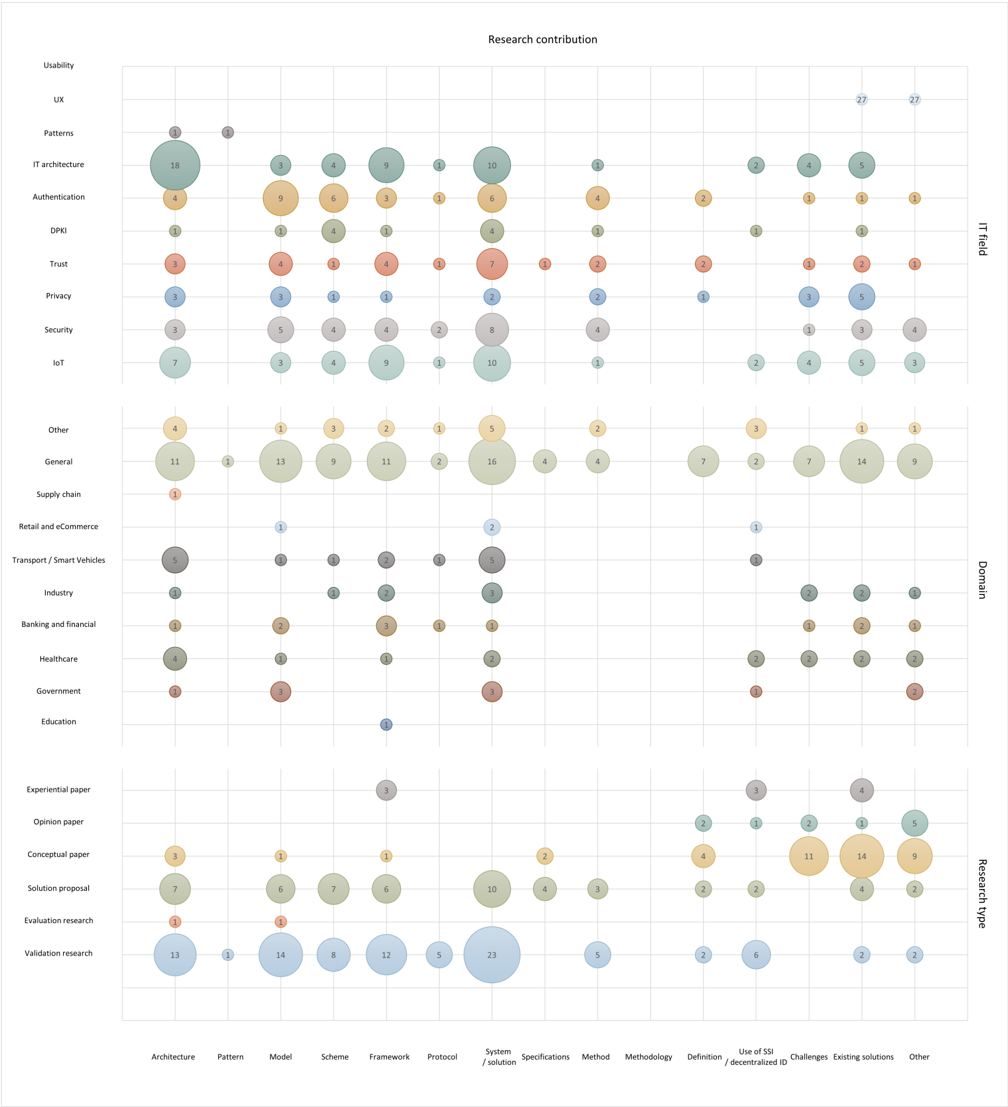
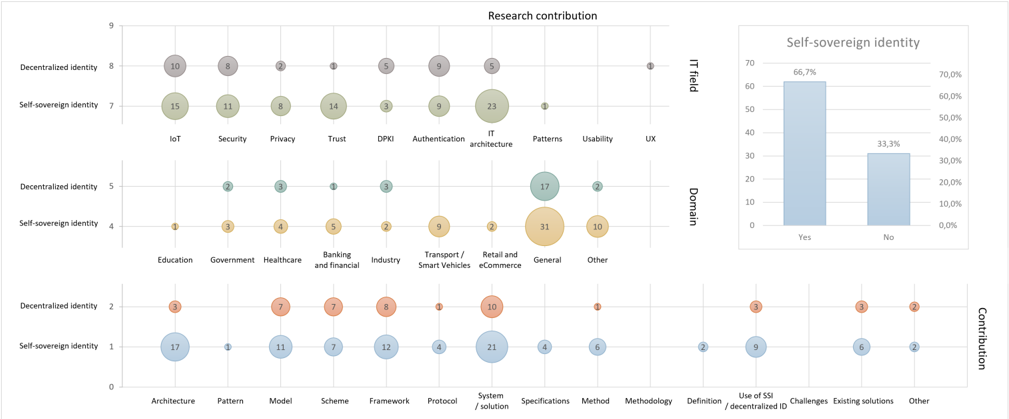
- The dominant contribution types were system/solution (32 studies, 26.7%), architecture (22, 18.3%), and framework (22, 18.3%); secondary papers most often compare/evaluate existing solutions (22, 18.3%).
- By research type, validation research (57 studies, 47.5%) and solution proposals (36, 30.0%) dominated; by method, prototyping was the most common, producing proofs of concept (40.0%).
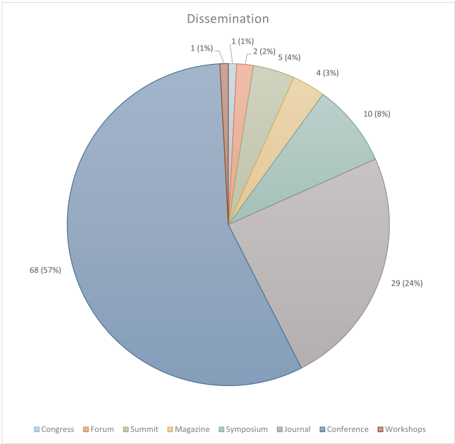
- The field is still mostly general-purpose: 69 studies (57.5%) addressed decentralized identity in general, while specific domains included IoT (29 studies, 24.2%), transport/smart vehicles (10, 8.3%), healthcare (9, 7.5%), and banking/finance (8, 6.7%).
Methods
- The paper conducted a systematic mapping study (SMS) to provide a coarse-grained overview and classify studies by contribution, domain, IT field, research type, research method, and place of publication.
- Search covered IEEE Xplore and ScienceDirect, using keywords such as “self-sovereign identity,” “decentralized identity,” “blockchain identity,” and “decentralized identifier,” with publication years limited to January 2013 to January 2021 and English papers only.
- Screening proceeded through database search, year/publication-type filtering, title/abstract/keyword screening, and full-text screening; 120 studies were retained for classification and mapping.
Limitations
- The paper explicitly states its scope was limited to two databases, English-language papers, and papers published between January 2013 and January 2021.
- It also notes that the search was conducted in January 2021, so papers added later would not be included.
- Evident from the method: the review may miss relevant work outside IEEE Xplore and ScienceDirect, and the mapping is only as complete as the selected keywords and screening criteria.
Model-written summary. Check it against the paper before relying on it.
Integrity signals
Registry
Cites
Statistics
Figures






Verification
Claims the paper makes
10 Valid · 6 Not valid · 26 Not checked · 82 Own results and interpretations
The cited sources support only part of this claim — read each source’s verdict below.
In the paper
“And usually relies on some form of decentralized ledger technology (DLT), blockchain, distributed file system, or another decentralized system, such as Hashgraphes and Tangle [12].”
§ Decentralized and Self-Sovereign Identity: Systematic Mapping Study > II. DECENTRALIZED IDENTITY
What the sources say
- Partly supportedcites [12] 12. L. Stockburger, G. Kokosioulis, A. Mukkamala, R. R. Mukkamala, and M. Avital, "Blockchain- enabled decentralized identity management: The case of self-sovereign identity in public transportation," Blockchain: Research and Applications, p. 100 014, 2021, ISSN: 2096-7209. DOI: https : / / doi . org / 10 . 1016/j.bcra.2021.100014. [Online]. Available: https: / / www . sciencedirect . com / science / article / pii / S2096720921000099. sourceExperimental — accuracy not yet measured
Our copy supports the core of the attribution: Section 2.3 ('Blockchain technology in identity management') describes a 'DLT-based SSI system' in which 'a distributed system relies on a shared ledger, which is validated and stored by several network nodes', and states that identity management networks 'utilize blockchain technology to eliminate the need for any intermediary as an identity provider'; Section 3.2.6 adds the distributed-file-system element ('uPort utilizes IPFS (InterPlanetary File System, a distributed file system) for storage'). However, the claim's final alternative — 'another decentralized system, such as Hashgraphes and Tangle' — is not stated: Hashgraph is absent from our copy entirely, and Tangle/IOTA appears only as a DLT used in one healthcare data-sharing study (Zheng et al., Section 3.1), not as a substrate that decentralized identity usually relies on. So the enumerated non-DLT/non-blockchain examples are attributed to a source that does not make that point. (LLM, conf=0.72)
plainstates an association- Asserted: passes — The authors put it forward as true.
- Checkable: passes — It can be checked against evidence.
- Load-bearing: unclear — It is unclear whether the paper’s conclusions depend on it.
- Based: passes — The paper gives a reason why it holds.
- Partly supported
The cited sources support only part of this claim — read each source’s verdict below.
In the paper
“However, the central IdP is accompanied by decentralized storage, where validated attestations are stored on a distributed ledger for later validation, presenting main differentiation [10].”
§ Decentralized and Self-Sovereign Identity: Systematic Mapping Study > II. DECENTRALIZED IDENTITY
What the sources say
- Partly supportedcites [10] 10. M. Schanzenbach, G. Bramm, and J. Schütte, "Re- claimid: Secure, self-sovereign identities using name systems and attribute-based encryption," in 2018 17th IEEE International Conference On Trust, Security And Privacy In Computing And Communications/ 12th IEEE International Conference On Big Data Science And Engineering (TrustCom/BigDataSE), 2018, pp. 946-957. DOI: 10 . 1109 / TrustCom / BigDataSE.2018.00134. sourceExperimental — accuracy not yet measured
Section II (p. 2) describes NameID as combining a central IdP with decentralized storage, and Related Work (p. 11) says its attributes are stored on the Namecoin blockchain. But Related Work explicitly says those attributes are self-issued, with no third party certifying them; the paper therefore does not support describing them as validated attestations. The paper also distinguishes NameID from its own reclaimID system, which has no central IdP (Introduction, p. 2). (LLM, conf=0.87)
plainstates an association- Asserted: passes — The authors put it forward as true.
- Checkable: passes — It can be checked against evidence.
- Load-bearing: unclear — It is unclear whether the paper’s conclusions depend on it.
- Based: passes — The paper gives a reason why it holds.
- Partly supported
The cited sources support only part of this claim — read each source’s verdict below.
In the paper
“Meanwhile, Gans et al. [49] focus on SSI possibilities for undocumented individuals during the pandemic.”
§ Decentralized and Self-Sovereign Identity: Systematic Mapping Study > (RQ2.2).
What the sources say
- Partly supportedcites [49] 49. M. Shuaib, S. Alam, M. Shahnawaz Nasir, and M. Shabbir Alam, "Immunity credentials using self- sovereign identity for combating covid-19 pan- demic," Materials Today: Proceedings, 2021, ISSN: 2214-7853. DOI: https : / / doi . org / 10 . 1016 / j . matpr . 2021 . 03 . 096. [Online]. Available: https : / / www . sciencedirect . com / science / article / pii / S2214785321021155. sourceExperimental — accuracy not yet measured
The title in our copy identifies the paper as a study of self-sovereign identity for COVID-19 immunity credentials, supporting the general SSI-and-pandemic connection. It names Mohammed and colleagues, not Gans et al., and the available passages do not address undocumented individuals. (LLM, conf=0.86)
plain- Asserted: passes — The authors put it forward as true.
- Checkable: passes — It can be checked against evidence.
- Load-bearing: unclear — It is unclear whether the paper’s conclusions depend on it.
- Based: passes — The paper gives a reason why it holds.
- Partly supported
The cited sources that could be checked couldn’t confirm or dispute this claim.
In the paper
“With the COVID-19 outbreak, the potential and the need for decentralized and Self-Sovereign Identities was further recognized [48][49][50][51] [52].”
§ Decentralized and Self-Sovereign Identity: Systematic Mapping Study > (RQ2.2).
What the sources say
- Not checked — no full text of the sourcecites [48] 48. A. Abraham, K. Theuermann, and E. Kirchengast, "Qualified eid derivation into a distributed ledger based idm system," in 2018 17th IEEE Interna- tional Conference On Trust, Security And Privacy In Computing And Communications/ 12th IEEE Inter- national Conference On Big Data Science And En- gineering (TrustCom/BigDataSE), 2018, pp. 1406- 1412. DOI: 10 . 1109 / TrustCom / BigDataSE . 2018 . 00195. source
- Could not verifycites [49] 49. M. Shuaib, S. Alam, M. Shahnawaz Nasir, and M. Shabbir Alam, "Immunity credentials using self- sovereign identity for combating covid-19 pan- demic," Materials Today: Proceedings, 2021, ISSN: 2214-7853. DOI: https : / / doi . org / 10 . 1016 / j . matpr . 2021 . 03 . 096. [Online]. Available: https : / / www . sciencedirect . com / science / article / pii / S2214785321021155. sourceExperimental — accuracy not yet measured
The available copy contains the paper’s title and a withdrawal notice, but no substantive discussion of whether COVID-19 increased recognition of the potential or need for decentralized, self-sovereign identities. Searches for that claim and for decentralized identity credentials returned no further passages. (LLM, conf=0.75)
- Not checked — no full text of the sourcecites [50] 50. R. B. Gans, J. Ubacht, and M. Janssen, "Self- sovereign identities for fighting the impact of covid- 19 pandemic," Digital Government: Research and Practice, vol. 2, no. 2, pp. 1-4, 2021. DOI: https : / / doi.org/10.1145/3429629. [Online]. Available: https: //dl.acm.org/doi/abs/10.1145/3429629. source
plainstates a cause- Asserted: passes — The authors put it forward as true.
- Checkable: passes — It can be checked against evidence.
- Load-bearing: unclear — It is unclear whether the paper’s conclusions depend on it.
- Based: passes — The paper gives a reason why it holds.
A result the paper reports from its own data — it cites no other source for it, so there is none to check. The quote shows it is in the paper.
In the paper
“there are hardly any studies addressing usability (0 studies)”
§ Decentralized and Self-Sovereign Identity: Systematic Mapping Study > (RQ2.2).
plain- Asserted: passes — The authors put it forward as true.
- Checkable: passes — It can be checked against evidence.
- Load-bearing: passes — The paper’s conclusions depend on it.
- Based: passes — The paper gives a reason why it holds.
59 more claims
Create a free account to see all 124 claims and to verify the 3 references still open.
- Probably not a substantial claim. 42
- It may state two separate claims as one. 37
- The quote only partly states this claim. 1
Self-check
Percentages, sums and reported differences re-computed from the paper’s own numbers.
Self-check results appear here once an independent check has confirmed them.
Cited works that were retracted
Works this paper cites that were later retracted, from the retraction notices publishers deposit. Major when the notice came out before this paper was published.
A note, not an issue: for example, a cited work that was retracted only after this paper was published, which its authors could not have known.
In the paper
“[48] reviewed the aspects of SSI application.”
Cited work 10.1016/j.matpr.2021.03.096 · retracted 2021-03-22 · notice 10.1016/j.matpr.2021.03.096 · this paper published 2021
Citations
Cites
1 retracted
(2021) · doi:10.1016/j.matpr.2021.03.096 · Cited by 26 · cited 2×
“[48] reviewed the aspects of SSI application.”
BackgroundRetractedSystematic Mapping Studies in Software Engineering
Petersen, K., Feldt, R., Mujtaba, S., & Mattsson, M. (2008) · Electronic Workshops in Computing · doi:10.14236/ewic/ease2008.8 · Cited by 3,239
Guidelines for conducting systematic mapping studies in software engineering: An update
Petersen, K., Vakkalanka, S., & Kuzniarz, L. (2015) · Information and Software Technology · doi:10.1016/j.infsof.2015.03.007 · Cited by 2,669 · cited 2×
“[41], [42] and conducted an SMS process, performing the following steps:”
BackgroundMethodRequirements engineering paper classification and evaluation criteria: a proposal and a discussion
Wieringa, R., Maiden, N., Mead, N., & Rolland, C. (2006) · Requirements Engineering · doi:10.1007/s00766-005-0021-6 · Cited by 940 · cited 2×
“[43], which have proposed the classification of research papers with evaluation criteria extension.”
BackgroundA survey on essential components of a self-sovereign identity
Mühle, A., Grüner, A., Gayvoronskaya, T., & Meinel, C. (2018) · Computer Science Review · doi:10.1016/j.cosrev.2018.10.002 · Cited by 483
Privacy-Preserving Solutions for Blockchain: Review and Challenges
Bernal Bernabe, J., Canovas, J. L., Hernandez-Ramos, J. L., Torres Moreno, R., & Skarmeta, A. (2019) · IEEE Access · doi:10.1109/access.2019.2950872 · Cited by 459
A first look at identity management schemes on the blockchain
Dunphy, P., & Petitcolas, F. A. P. (2018) · IEEE Security & Privacy · doi:10.1109/msp.2018.3111247 · Cited by 416 · cited 4×
“After verifying, validated identity attestations are recorded on a distributed ledger for later verification by third parties [11], [18], [26].”
BackgroundMethodInfluentialBlockchain 3.0 applications survey
Di Francesco Maesa, D., & Mori, P. (2020) · Journal of Parallel and Distributed Computing · doi:10.1016/j.jpdc.2019.12.019 · Cited by 372 · cited 3×
“Maesa and Mori [2] have surveyed six applications of blockchain, specifically (i) electronic voting, (ii) healthcare records, (iii) identity management, (iv) access control, (v) decentralized notary, and (vi) supply chain.”
BackgroundBlockchain-based identity management systems: A review
Liu, Y., He, D., Obaidat, M. S., Kumar, N., Khan, M. K., & Raymond Choo, K.-K. (2020) · Journal of Network and Computer Applications · doi:10.1016/j.jnca.2020.102731 · Cited by 314
Security, Performance, and Applications of Smart Contracts: A Systematic Survey
Rouhani, S., & Deters, R. (2019) · IEEE Access · doi:10.1109/access.2019.2911031 · Cited by 309
In Search of Self-Sovereign Identity Leveraging Blockchain Technology
Ferdous, M. S., Chowdhury, F., & Alassafi, M. O. (2019) · IEEE Access · doi:10.1109/access.2019.2931173 · Cited by 267
Sanka, A. I., Irfan, M., Huang, I., & Cheung, R. C. C. (2021) · Computer Communications · doi:10.1016/j.comcom.2020.12.028 · Cited by 265 · cited 1×
“INTRODUCTION There is a growing interest in decentralized technology, especially blockchain, and its application in different domains, including identity management [1], [2].”
BackgroundSullivan, C., & Burger, E. (2017) · Computer Law & Security Review · doi:10.1016/j.clsr.2017.03.016 · Cited by 264
Blockchain-Based Identity Management: A Survey From the Enterprise and Ecosystem Perspective
Kuperberg, M. (2020) · IEEE Transactions on Engineering Management · doi:10.1109/tem.2019.2926471 · Cited by 187 · cited 2×
“Unlike SLR, in order to get a coarse-grained overview and gain insights into the trends and demographics of existing studies on a broader research topic, a Systematic Mapping Study (SMS) can be performed [41], [42].”
MethodA Blockchain-Based Authentication and Security Mechanism for IoT
Li, D., Peng, W., Deng, W., & Gai, F. (2018) · 2018 27th International Conference on Computer Communication and Networks (ICCCN) · doi:10.1109/icccn.2018.8487449 · Cited by 179 · cited 1×
“2) In some decentralized proposals [27], [28], a single identity is allocated for every entity and stored in the blockchain for authentication purposes.”
BackgroundA Survey on Blockchain-Based Self-Sovereign Patient Identity in Healthcare
Houtan, B., Hafid, A. S., & Makrakis, D. (2020) · IEEE Access · doi:10.1109/access.2020.2994090 · Cited by 174
Stockburger, L., Kokosioulis, G., Mukkamala, A., Mukkamala, R. R., & Avital, M. (2021) · Blockchain: Research and Applications · doi:10.1016/j.bcra.2021.100014 · Cited by 172 · cited 1×
“It enhances decentralization, transparency, and user control [12] in transactions involving identity information.”
BackgroundAn Identity Management and Authentication Scheme Based on Redactable Blockchain for Mobile Networks
Xu, J., Xue, K., Tian, H., Hong, J., Wei, D. S. L., & Hong, P. (2020) · IEEE Transactions on Vehicular Technology · doi:10.1109/tvt.2020.2986041 · Cited by 150
Blockchain-Based Solution for COVID-19 Digital Medical Passports and Immunity Certificates
Hasan, H. R., Salah, K., Jayaraman, R., Arshad, J., Yaqoob, I., Omar, M., & Ellahham, S. H. (2020) · IEEE Access · doi:10.1109/access.2020.3043350 · Cited by 141
Naik, N., & Jenkins, P. (2020) · IEEE International Symposium on Systems Engineering · doi:10.1109/isse49799.2020.9272223 · Cited by 130
Deployment of a Blockchain-Based Self-Sovereign Identity
Stokkink, Q., & Pouwelse, J. (2018) · 2018 IEEE International Conference on Internet of Things (iThings) and IEEE Green Computing and Communications (GreenCom) and IEEE Cyber, Physical and Social Computing (CPSCom) and IEEE Smart Data (SmartData) · doi:10.1109/cybermatics_2018.2018.00230 · Cited by 120
Decentralized Identity: Where Did It Come From and Where Is It Going?
Avellaneda, O., Bachmann, A., Barbir, A., Brenan, J., Dingle, P., Duffy, K. H., Maler, E., Reed, D., & Sporny, M. (2019) · IEEE Communications Standards Magazine · doi:10.1109/mcomstd.2019.9031542 · Cited by 116
A comprehensive survey on authentication and privacy-preserving schemes in VANETs
Mundhe, P., Verma, S., & Venkatesan, S. (2021) · Computer Science Review · doi:10.1016/j.cosrev.2021.100411 · Cited by 108 · cited 1×
“[32] conducted a survey, studying various authentication and privacy-preserving techniques in VANETS, including decentralized blockchain-based schemes, and providing scheme classification, strengths, and weaknesses.”
BackgroundCecoin: A decentralized PKI mitigating MitM attacks
Qin, B., Huang, J., Wang, Q., Luo, X., Liang, B., & Shi, W. (2020) · Future Generation Computer Systems · doi:10.1016/j.future.2017.08.025 · Cited by 108
Analysis of identity management systems using blockchain technology
Haddouti, S. E., & Ech-Cherif El Kettani, M. D. (2019) · 2019 International Conference on Advanced Communication Technologies and Networking (CommNet) · doi:10.1109/commnet.2019.8742375 · Cited by 106 · cited 1×
“2) In some decentralized proposals [27], [28], a single identity is allocated for every entity and stored in the blockchain for authentication purposes.”
BackgroundNaik, N., & Jenkins, P. (2020) · IEEE International Conference on Mobile Cloud Computing, Services, and Engineering (MobileCloud) · doi:10.1109/mobilecloud48802.2020.00021 · Cited by 97
Distributed-Ledger-based Authentication with Decentralized Identifiers and Verifiable Credentials
Lux, Z. A., Thatmann, D., Zickau, S., & Beierle, F. (2020) · Conference on Blockchain Research & Applications for Innovative Networks and Services (BRAINS) · doi:10.1109/brains49436.2020.9223292 · Cited by 96
Self-Sovereign Digital Identity: A Paradigm Shift for Identity
Toth, K. C., & Anderson-Priddy, A. (2019) · IEEE Security & Privacy · doi:10.1109/msec.2018.2888782 · Cited by 91 · cited 2×
“The Sovrin Foundation grouped Allen’s principles into three categories security, controllability, and portability [19], while Toth and Anderson-Priddy [24] validated them and suggested five additional principles, namely usability, counterfeit prevention, identity verification, identity assurance, and secure transactions.”
MethodA Survey on Blockchain-based Identity Management and Decentralized Privacy for Personal Data
Gilani, K., Bertin, E., Hatin, J., & Crespi, N. (2020) · 2020 2nd Conference on Blockchain Research & Applications for Innovative Networks and Services (BRAINS) · doi:10.1109/brains49436.2020.9223312 · Cited by 89 · cited 1×
“[35] recognized a lack of evaluation criteria, e.”
BackgroundPatwary, A. A.-N., Fu, A., Battula, S. K., Naha, R. K., Garg, S., & Mahanti, A. (2020) · Computer Communications · doi:10.1016/j.comcom.2020.08.021 · Cited by 87
Sora Identity: Secure, Digital Identity on the Blockchain
Takemiya, M., & Vanieiev, B. (2018) · 2018 IEEE 42nd Annual Computer Software and Applications Conference (COMPSAC) · doi:10.1109/compsac.2018.10299 · Cited by 85 · cited 1×
“the solution proposed by [44] uses a central server for storing key-pairs, while [45] mentioning an approach to key backup and recovery using trusted third-party repositories.”
MethodSelf-sovereign identity for healthcare using blockchain
Shuaib, M., Alam, S., Shabbir Alam, M., & Shahnawaz Nasir, M. (2023) · Materials Today: Proceedings · doi:10.1016/j.matpr.2021.03.083 · Cited by 79 · cited 2×
“[30] have also stated several requirements for adopting SSI in healthcare and have presented some advantages and a use case involving different stakeholders.”
BackgroundSelf-Sovereign Identity: Use-cases, Technologies, and Challenges for Industrial IoT
Bartolomeu, P. C., Vieira, E., Hosseini, S. M., & Ferreira, J. (2019) · 2019 24th IEEE International Conference on Emerging Technologies and Factory Automation (ETFA) · doi:10.1109/etfa.2019.8869262 · Cited by 79 · cited 1×
“[34] also focused on the IoT and provided a review of use-cases, technology, and challenges of SSI, including a discussion regarding technical challenges, best practices, and standardization.”
BackgroundA systematic literature mapping on secure identity management using blockchain technology
Rathee, T., & Singh, P. (2022) · Journal of King Saud University - Computer and Information Sciences · doi:10.1016/j.jksuci.2021.03.005 · Cited by 78
A New Approach to Client Onboarding Using Self-Sovereign Identity and Distributed Ledger
Soltani, R., Trang Nguyen, U., & An, A. (2018) · 2018 IEEE International Conference on Internet of Things (iThings) and IEEE Green Computing and Communications (GreenCom) and IEEE Cyber, Physical and Social Computing (CPSCom) and IEEE Smart Data (SmartData) · doi:10.1109/cybermatics_2018.2018.00205 · Cited by 77 · cited 1×
“While many solutions have been compared and evaluated based on the law of identity [18], [25], [37] or SSI taxonomy [22], [38], they performed a technical evaluation, disclosing differences in design and implementation, such as a network or blockchain type and data storage, key management, selective disclosure, smart…”
MethodDecentralized Identity and Trust Management Framework for Internet of Things
Luecking, M., Fries, C., Lamberti, R., & Stork, W. (2020) · IEEE International Conference on Blockchain and Cryptocurrency (ICBC) · doi:10.1109/icbc48266.2020.9169411 · Cited by 72
A novel framework for policy based on-chain governance of blockchain networks
Dursun, T., & Üstündağ, B. B. (2021) · Information Processing & Management · doi:10.1016/j.ipm.2021.102556 · Cited by 71
Potential Identity Resolution Systems for the Industrial Internet of Things: A Survey
Ren, Y., Xie, R., Yu, F. R., Huang, T., & Liu, Y. (2020) · IEEE Communications Surveys & Tutorials · doi:10.1109/comst.2020.3045136 · Cited by 70
Design Patterns for Blockchain-based Self-Sovereign Identity
Liu, Y., Lu, Q., Paik, H.-Y., & Xu, X. (2020) · European Conference on Pattern Languages of Programs · doi:10.1145/3424771.3424802 · Cited by 69
The Horcrux Protocol: A Method for Decentralized Biometric-based Self-sovereign Identity
Othman, A., & Callahan, J. (2018) · 2018 International Joint Conference on Neural Networks (IJCNN) · doi:10.1109/ijcnn.2018.8489316 · Cited by 69
Self-Sovereign Identity for IoT environments: A Perspective
Fedrecheski, G., Rabaey, J. M., Costa, L. C. P., Calcina Ccori, P. C., Pereira, W. T., & Zuffo, M. K. (2020) · 2020 Global Internet of Things Summit (GIoTS) · doi:10.1109/giots49054.2020.9119664 · Cited by 69
Davie, M. C., Gisolfi, D., Hardman, D., et al. (2019) · IEEE Communications Standards Magazine · doi:10.1109/mcomstd.001.1900029 · Cited by 68 · cited 1×
“While many solutions have been compared and evaluated based on the law of identity [18], [25], [37] or SSI taxonomy [22], [38], they performed a technical evaluation, disclosing differences in design and implementation, such as a network or blockchain type and data storage, key management,…”
MethodA Survey on Blockchain-Based Identity Management Systems for the Internet of Things
Zhu, X., & Badr, Y. (2018) · 2018 IEEE International Conference on Internet of Things (iThings) and IEEE Green Computing and Communications (GreenCom) and IEEE Cyber, Physical and Social Computing (CPSCom) and IEEE Smart Data (SmartData) · doi:10.1109/cybermatics_2018.2018.00263 · Cited by 66 · cited 1×
“Zhu and Badr [33] conducted a survey on traditional and blockchain-based identity management systems focusing on IoT, identifying solutions and challenges including access control, privacy, trust, and performance.”
BackgroundBlockchain: the Emperors New PKI?
Orman, H. K. (2018) · IEEE Internet Computing · doi:10.1109/mic.2018.022021659 · Cited by 65
Design Pattern as a Service for Blockchain-Based Self-Sovereign Identity
Liu, Y., Lu, Q., Paik, H.-Y., Xu, X., Chen, S., & Zhu, L. (2020) · IEEE Software · doi:10.1109/ms.2020.2992783 · Cited by 64 · cited 5×
“While many solutions have been compared and evaluated based on the law of identity [18], [25], [37] or SSI taxonomy [22], [38], they performed a technical evaluation, disclosing differences in design and implementation, such as a network or blockchain type and data storage, key management, selective disclosure, smart…”
BackgroundMethodResultInfluentialAn Identity Management System Based on Blockchain
Liu, Y., Zhao, Z., Guo, G., Wang, X., Tan, Z., & Wang, S. (2017) · Conference on Privacy, Security and Trust · doi:10.1109/pst.2017.00016 · Cited by 62
Self-Sovereign Identity Solutions: The Necessity of Blockchain Technology
van Bokkem, D., Hageman, R., Koning, G., Nguyen, L., & Zarin, N. (2019) · arXiv · doi:10.48550/arxiv.1904.12816 · Cited by 58 · cited 1×
“Nevertheless, blockchain may facilitate the implementation of decentralized identity, and it coincides with some desirable properties of Self-Sovereign Identity [16].”
BackgroundAutonomic Identity Framework for the Internet of Things
Zhu, X., Badr, Y., Pacheco, J., & Hariri, S. (2017) · International Conference on Cloud and Autonomic Computing (ICCAC) · doi:10.1109/iccac.2017.14 · Cited by 57
Identity Management in IoT Networks Using Blockchain and Smart Contracts
Omar, A. S., & Basir, O. (2018) · IEEE International Conference on Internet of Things (iThings) and IEEE Green Computing and Communications (GreenCom) and IEEE Cyber, Physical and Social Computing (CPSCom) and IEEE Smart Data (SmartData) · doi:10.1109/cybermatics_2018.2018.00187 · Cited by 54
Securing Emission Data of Smart Vehicles with Blockchain and Self-Sovereign Identities
Terzi, S., Savvaidis, C., Votis, K., Tzovaras, D. K., & Stamelos, I. G. (2020) · IEEE International Conference on Blockchain (Blockchain) · doi:10.1109/blockchain50366.2020.00067 · Cited by 53
Naik, N., & Jenkins, P. (2020) · IEEE International Symposium on Systems Engineering · doi:10.1109/isse49799.2020.9272212 · Cited by 51
Alzahrani, B. A. (2020) · IEEE Access · doi:10.1109/access.2020.3011656 · Cited by 50
Enhancing the Security and Privacy of Self-Sovereign Identities on Hyperledger Indy Blockchain
Bhattacharya, M. P., Zavarsky, P., & Butakov, S. (2020) · International Symposium on Networks, Computers and Communications (ISNCC) · doi:10.1109/isncc49221.2020.9297357 · Cited by 46
A Quantifiable Trust Model for Blockchain-Based Identity Management
Grüner, A., Mühle, A., Gayvoronskaya, T., & Meinel, C. (2018) · IEEE International Conference on Internet of Things (iThings) and IEEE Green Computing and Communications (GreenCom) and IEEE Cyber, Physical and Social Computing (CPSCom) and IEEE Smart Data (SmartData) · doi:10.1109/cybermatics_2018.2018.00250 · Cited by 45
Improved Identity Management with Verifiable Credentials and FIDO
Chadwick, D. W., Laborde, R., Oglaza, A., Venant, R., Wazan, S., & Nijjar, M. (2019) · IEEE Communications Standards Magazine · doi:10.1109/mcomstd.001.1900020 · Cited by 42
A Blockchain Approach for Decentralized V2X (D-V2X)
Agudo, I., Montenegro-Gómez, M., & López, J. (2020) · IEEE Transactions on Vehicular Technology · doi:10.1109/tvt.2020.3046640 · Cited by 42
Blockchain-Based Identity Verification System
Jamal, A., Helmi, R. A. A., Syahirah, A. S. N., & Fatima, M.-A. (2019) · IEEE International Conference on System Engineering and Technology (ICSET) · doi:10.1109/icsengt.2019.8906403 · Cited by 41
MedRec: A Network for Personal Information Distribution
Nchinda, N., Cameron, A., Retzepi, K., & Lippman, A. (2019) · 2012 International Conference on Computing, Networking and Communications (ICNC) · doi:10.1109/iccnc.2019.8685631 · Cited by 41
Blockchain for Identity Management: The Implications to Personal Data Protection
Sim, W. L., Chua, H. N., & Tahir, M. (2019) · 2019 IEEE Conference on Application, Information and Network Security (AINS) · doi:10.1109/ains47559.2019.8968708 · Cited by 40 · cited 1×
“After verifying, validated identity attestations are recorded on a distributed ledger for later verification by third parties [11], [18], [26].”
MethodAn Integration Architecture to Enable Service Providers for Self-sovereign Identity
Gruner, A., Muhle, A., & Meinel, C. (2019) · 2019 IEEE 18th International Symposium on Network Computing and Applications (NCA) · doi:10.1109/nca.2019.8935015 · Cited by 39 · cited 1×
“Some solutions rely on gateways that can introduce centralization to a certain extent [46], [47] and some utilize centralized servers that are responsible for mediating between involved entities and serve as intermediaries for storing encrypted identity attributes [18].”
BackgroundA blockchain empowered and privacy preserving digital contact tracing platform
Bandara, E., Liang, X., Foytik, P., Shetty, S., Hall, C., Bowden, D., Ranasinghe, N., & De Zoysa, K. (2021) · Information Processing & Management · doi:10.1016/j.ipm.2021.102572 · Cited by 39 · cited 2×
“[52] developed Connect, an identity wallet”
BackgroundPractical Key Recovery Model for Self-Sovereign Identity Based Digital Wallets
Soltani, R., Nguyen, U. T., & An, A. (2019) · 2019 IEEE Intl Conf on Dependable, Autonomic and Secure Computing, Intl Conf on Pervasive Intelligence and Computing, Intl Conf on Cloud and Big Data Computing, Intl Conf on Cyber Science and Technology Congress (DASC/PiCom/CBDCom/CyberSciTech) · doi:10.1109/dasc/picom/cbdcom/cyberscitech.2019.00066 · Cited by 39 · cited 2×
“Hence, the ecosystem consists of various entities that enact roles formerly performed by a central authority [9].”
BackgroundEnabling Secure and Privacy Preserving Identity Management via Smart Contract
Liu, Y., Sun, G., & Schuckers, S. (2019) · IEEE Conference on Communications and Network Security · doi:10.1109/cns.2019.8802771 · Cited by 39
reclaimID: Secure, Self-Sovereign Identities Using Name Systems and Attribute-Based Encryption
Schanzenbach, M., Bramm, G., & Schutte, J. (2018) · 2018 17th IEEE International Conference On Trust, Security And Privacy In Computing And Communications/ 12th IEEE International Conference On Big Data Science And Engineering (TrustCom/BigDataSE) · doi:10.1109/trustcom/bigdatase.2018.00134 · Cited by 36 · cited 1×
“Alternatives to maintaining centralized storage are decentralized approaches [10].”
BackgroundLaborde, R., Oglaza, A., Wazan, A. S., Barrère, F., Benzekri, A., Chadwick, D. W., & Venant, R. (2020) · IEEE Consumer Communications and Networking Conference · doi:10.1109/ccnc46108.2020.9045440 · Cited by 33
DPKI: A Blockchain-Based Decentralized Public Key Infrastructure System
Papageorgiou, A., Mygiakis, A., Loupos, K., & Krousarlis, T. (2020) · Global Internet of Things Summit (GIoTS) · doi:10.1109/giots49054.2020.9119673 · Cited by 33
Distributed, Secure, Self-Sovereign Identity for IoT Devices
Gebresilassie, S. K., Rafferty, J., Morrow, P., Chen, L., Abu-Tair, M., & Cui, Z. (2020) · IEEE World Forum on Internet of Things (WF-IoT) · doi:10.1109/wf-iot48130.2020.9221144 · Cited by 32
A Comparative Survey on Blockchain Based Self Sovereign Identity System
Kaneriya, J., & Patel, H. (2020) · 2020 3rd International Conference on Intelligent Sustainable Systems (ICISS) · doi:10.1109/iciss49785.2020.9315899 · Cited by 31 · cited 1×
“[36] described and analyzed existing blockchain-based identity management solutions that claim to fulfil self-sovereignty.”
BackgroundA Blockchain-enabled Architecture for IoMT Device Authentication
Fotopoulos, F., Malamas, V., Dasaklis, T. K., Kotzanikolaou, P., & Douligeris, C. (2020) · IEEE Eurasia Conference on IOT, Communication and Engineering (ECICE) · doi:10.1109/ecice50847.2020.9301913 · Cited by 31
Decentralized Attestation of Conceptual Models Using the Ethereum Blockchain
Härer, F., & Fill, H.-G. (2019) · IEEE Conference on Business Informatics · doi:10.1109/cbi.2019.00019 · Cited by 28
DecentID: Decentralized and Privacy-Preserving Identity Storage System Using Smart Contracts
Friebe, S., Sobik, I., & Zitterbart, M. (2018) · IEEE International Conference on Trust, Security and Privacy in Computing and Communications (TrustCom) · doi:10.1109/trustcom/bigdatase.2018.00016 · Cited by 28
Nym Credentials: Privacy-Preserving Decentralized Identity with Blockchains
Halpin, H. (2020) · Crypto Valley Conference on Blockchain Technology (CVCBT) · doi:10.1109/cvcbt50464.2020.00010 · Cited by 27
KYoT: Self-sovereign IoT Identification with a Physically Unclonable Function
Niya, S. R., Jeffrey, B., & Stiller, B. (2020) · Conference on Local Computer Networks · doi:10.1109/lcn48667.2020.9314816 · Cited by 27
Decentralizing Digital Identity: Open Challenges for Distributed Ledgers
Dunphy, P., Garratt, L., & Petitcolas, F. (2018) · 2018 IEEE European Symposium on Security and Privacy Workshops (EuroS&PW) · doi:10.1109/eurospw.2018.00016 · Cited by 26 · cited 1×
“Kuperberg [39] has conducted a systematic survey of existing blockchain-based identity and access management solutions and provided an evaluation framework consisting of 75 criteria for the evaluation of decentralized and SSI management systems.”
MethodEthereum for Secure Authentication of IoT using Pre-Shared Keys (PSKs)
El-Hajj, M. I., Fadlallah, A., Chamoun, M., & Serhrouchni, A. (2019) · International Conference on Wireless Networks and Mobile Communications (WINCOM) · doi:10.1109/wincom47513.2019.8942487 · Cited by 26
An Assessment of Blockchain Identity Solutions: Minimizing Risk and Liability of Authentication
Rana, R., Zaeem, R. N., & Barber, K. S. (2019) · IEEE/WIC/ACM International Conference on Web Intelligence · doi:10.1145/3350546.3352497 · Cited by 25 · cited 2×
“After verifying, validated identity attestations are recorded on a distributed ledger for later verification by third parties [11], [18], [26].”
BackgroundMethodTowards a Blockchain-based Identity and Trust Management Framework for the IoV Ecosystem
Theodouli, A., Moschou, K., Votis, K., Tzovaras, D. K., Lauinger, J., & Steinhorst, S. (2020) · Global Internet of Things Summit (GIoTS) · doi:10.1109/giots49054.2020.9119623 · Cited by 25
Identity Verification and Management of Electronic Health Records with Blockchain Technology
Liang, Y. (2019) · IEEE International Conference on Healthcare Informatics (ICHI) · doi:10.1109/ichi.2019.8904712 · Cited by 25
A Blockchain based Identity Management System Considering Reputation
Zhao, Z., & Liu, Y. (2019) · IEEE International Conference on Information Systems and Computer Aided Education (ICISCAE) · doi:10.1109/iciscae48440.2019.221582 · Cited by 23
Full-text Search for Verifiable Credential Metadata on Distributed Ledgers
Lux, Z. A., Beierle, F., Zickau, S., & Göndör, S. (2019) · International Conference on Internet of Things: Systems, Management and Security (IOTSMS) · doi:10.1109/iotsms48152.2019.8939249 · Cited by 22
Countering Botnet of Things using Blockchain-Based Authenticity Framework
Cui, P., & Guin, U. (2019) · IEEE Computer Society Annual Symposium on VLSI · doi:10.1109/isvlsi.2019.00112 · Cited by 21
Omar, A. S., & Basir, O. (2020) · Canadian Journal of Electrical and Computer Engineering · doi:10.1109/cjece.2020.2970737 · Cited by 21
Self-Sovereign Dynamic Digital Identities based on Blockchain Technology
Gulati, H., & Huang, C. (2019) · IEEE SoutheastCon · doi:10.1109/southeastcon42311.2019.9020518 · Cited by 19
Pay as You Go: A Generic Crypto Tolling Architecture
Bartolomeu, P., Vieira, E. D. F., & Ferreira, J. (2020) · IEEE Access · doi:10.1109/access.2020.3034299 · Cited by 19
Qualified eID Derivation Into a Distributed Ledger Based IdM System
Abraham, A., Theuermann, K., & Kirchengast, E. (2018) · 2018 17th IEEE International Conference On Trust, Security And Privacy In Computing And Communications/ 12th IEEE International Conference On Big Data Science And Engineering (TrustCom/BigDataSE) · doi:10.1109/trustcom/bigdatase.2018.00195 · Cited by 18 · cited 1×
“Some solutions rely on gateways that can introduce centralization to a certain extent [46], [47] and some utilize centralized servers that are responsible for mediating between involved entities and serve as intermediaries for storing encrypted identity attributes [18].”
BackgroundSelfIs: Self-Sovereign Biometric IDs
Bathen, L. A. D., Flores, G., Madl, G., Jadav, D., Arvanitis, A., Santhanam, K., Zeng, C., & Gordon, A. (2019) · IEEE/CVF Conference on Computer Vision and Pattern Recognition Workshops (CVPRW) · doi:10.1109/cvprw.2019.00344 · Cited by 18
Sani, A. S., Yuan, D., Meng, K., & Dong, Z. Y. (2020) · IEEE Power Engineering Society General Meeting · doi:10.1109/pesgm41954.2020.9281929 · Cited by 16
A Blockchain-based Decentralized Data Sharing Infrastructure for Off-grid Networking
Niavis, H., Papadis, N., Reddy, V., Rao, H., & Tassiulas, L. (2020) · 2020 IEEE International Conference on Blockchain and Cryptocurrency (ICBC) · doi:10.1109/icbc48266.2020.9169441 · Cited by 16
Smart Phone Anti-counterfeiting System Using a Decentralized Identity Management Framework
Omar, A. S., & Basir, O. (2019) · 2019 IEEE Canadian Conference of Electrical and Computer Engineering (CCECE) · doi:10.1109/ccece.2019.8861955 · Cited by 15 · cited 1×
“2) In some decentralized proposals [27], [28], a single identity is allocated for every entity and stored in the blockchain for authentication purposes.”
BackgroundMaldonado-Ruiz, D., Torres, J., & Madhoun, N. E. (2020) · Conference on Blockchain Research & Applications for Innovative Networks and Services (BRAINS) · doi:10.1109/brains49436.2020.9223300 · Cited by 15
Digital identities – self-sovereignty and blockchain are the keys to success
Seifert, R. (2020) · Network Security · doi:10.1016/s1353-4858(20)30131-8 · Cited by 15
Blockchain based Digital Identity Management System: A Case Study of Myanmar
Htet, M., Yee, P. T., & Rajasekera, J. R. (2020) · International Conference on Advanced Information Technologies (ICAIT) · doi:10.1109/icait51105.2020.9261785 · Cited by 15
Edge Computing: Smart Identity Wallet Based Architecture and User Centric
Guerbouj, S. S. E., Gharsellaoui, H., & Bouamama, S. (2019) · Procedia Computer Science · doi:10.1016/j.procs.2019.09.294 · Cited by 15
Self-sovereign Identities for Fighting the Impact of COVID-19 Pandemic
Gans, R. B., Ubacht, J., & Janssen, M. (2021) · Digital Government: Research and Practice · doi:10.1145/3429629 · Cited by 14 · cited 1×
“[49] focused on SSI possibilities for undocumented individuals during the pandemic.”
BackgroundTawki: Towards Self-Sovereign Social Communication
Westerkamp, M., Göndör, S., & Küpper, A. (2019) · IEEE International Conference on Decentralized Applications and Infrastructures (DAPPS) · doi:10.1109/dappcon.2019.00014 · Cited by 13
Blockchain-Based Privacy Protection Unified Identity Authentication
Zheng, Y., Li, Y., Wang, Z., Deng, C., Luo, Y., Li, Y., & Ding, J. (2019) · International Conference on Cyber-Enabled Distributed Computing and Knowledge Discovery (CyberC) · doi:10.1109/cyberc.2019.00017 · Cited by 13
Chu, Y., Kim, J. M., Lee, Y., Shim, S., & Huh, J. (2020) · International Conference on Consumer Electronics · doi:10.1109/icce46568.2020.9043086 · Cited by 13
Risk Analysis Methodology to Blockchain-based Solutions
Ribeiro, S. L., & Barbosa, I. A. D. P. (2020) · Conference on Blockchain Research & Applications for Innovative Networks and Services (BRAINS) · doi:10.1109/brains49436.2020.9223309 · Cited by 13
Reducing Modern Slavery Using AI and Blockchain
Tambe, P., & Tambay, P. (2020) · IEEE/ITU International Conference on Artificial Intelligence for Good (AI4G) · doi:10.1109/ai4g50087.2020.9311031 · Cited by 12
WalliD: Secure your ID in an Ethereum Wallet
Tavares, M., Guerreiro, A., Coutinho, C., et al. (2018) · doi:10.1109/is.2018.8710547 · Cited by 11
An analysis of digital identity management systems - a two-mapping view
Liu, J., Hodges, A., Clay, L., & Monarch, J. (2020) · Conference on Blockchain Research & Applications for Innovative Networks and Services (BRAINS) · doi:10.1109/brains49436.2020.9223281 · Cited by 11
Smart-Contract Enabled Decentralized Identity Management Framework for Industry 4.0
Dixit, A., Asif, W., & Rajarajan, M. (2020) · Annual Conference of the IEEE Industrial Electronics Society (IECON) · doi:10.1109/iecon43393.2020.9254545 · Cited by 10
Block - NID: A Conceptual Secure Blockchain Based National Identity Management System Model
Tonu, M. A. R., Hridoy, S., Ali, M., et al. (2019) · IEEE Asia-Pacific Conference on Computer Science and Data Engineering (CSDE) · doi:10.1109/csde48274.2019.9162366 · Cited by 9
Binding of Endpoints to Identifiers by On-Chain Proofs
Pennino, D., Pizzonia, M., Vitaletti, A., & Zecchini, M. (2020) · IEEE Symposium on Computers and Communications (ISCC) · doi:10.1109/iscc50000.2020.9219594 · Cited by 9
A Fully Decentralized Infrastructure for Subscription-based IoT Data Trading
Lin, C.-H. V., Huang, C., Yuan, Y.-H., & Yuan, Z. (2020) · International Congress on Blockchain and Applications · doi:10.1109/blockchain50366.2020.00027 · Cited by 9
Decentralized and Privacy-Preserving Key Management Model
Soltani, R., Nguyen, U. T., & An, A. (2020) · 2020 International Symposium on Networks, Computers and Communications (ISNCC) · doi:10.1109/isncc49221.2020.9297294 · Cited by 8
Decentralized IoT Data Authorization with Pebble Tracker
Fan, X., Chai, Q., Li, Z., et al. (2020) · IEEE World Forum on Internet of Things (WF-IoT) · doi:10.1109/wf-iot48130.2020.9221130 · Cited by 8
Kim, E., Cho, Y.-S., Kim, B., Ji, W., Kim, S., Woo, S. S., & Kim, H. (2020) · IEEE Internet of Things Magazine · doi:10.1109/iotm.0001.2000050 · Cited by 7
Blockchain-enhanced Identities for Secure Interaction
Chakravarty, D., & Deshpande, T. (2018) · IEEE Conference on Technologies for Homeland Security (HST) · doi:10.1109/ths.2018.8574130 · Cited by 7
Wittek, K., Lazzati, L., Bothe, D., Sinnaeve, A.-J., & Pohlmann, N. (2020) · IEEE European Technology and Engineering Management Summit (E-TEMS) · doi:10.1109/e-tems46250.2020.9111805 · Cited by 6
Windley, P. J. (2019) · IEEE Internet Computing · doi:10.1109/mic.2019.2940222 · Cited by 6
Deployment and Decentralized Identity Management for VANETs
Patil, S. D., & Ragha, L. L. (2020) · International Conference on Emerging Technologies in Computer Engineering: Machine Learning and Internet of Things (ICETCE) · doi:10.1109/icetce48199.2020.9091766 · Cited by 5
Is the user identity perception influenced by the blockchain technology?
Drăgnoiu, A.-E. (2020) · IEEE International Conference on Intelligence and Security Informatics (ISI) · doi:10.1109/isi49825.2020.9280530 · Cited by 5
Fighting COVID-19 and helping economy reopen by using blockchain technology
Xin, W. (2020) · 2020 IEEE/CIC International Conference on Communications in China (ICCC Workshops) · doi:10.1109/icccworkshops49972.2020.9209939 · Cited by 4 · cited 1×
“For example, the solution proposed by [44] uses a central server for storing key-pairs, while [45] mentioning an approach to key backup and recovery using trusted third-party repositories.”
MethodUsing Biometrics to Fight Credential Fraud
Hardman, D., Harchandani, L., Othman, A., et al. (2019) · IEEE Communications Standards Magazine · doi:10.1109/mcomstd.001.1900033 · Cited by 4
Using Probabilistic Attribute Aggregation for Increasing Trust in Attribute Assurance
Grüner, A., Mühle, A., & Meinel, C. (2019) · IEEE Symposium Series on Computational Intelligence (SSCI) · doi:10.1109/ssci44817.2019.9003094 · Cited by 4
CVIN: Connected Vehicle Information Network
Prakash, N., Michelson, D. G., & Feng, C. (2020) · IEEE Vehicular Technology Conference · doi:10.1109/vtc2020-spring48590.2020.9128642 · Cited by 3
Unique Identity Management Scheme for Distributed NFV Market Place using Ethereum
Ganta, S., Rebekka, B., Gunavathi, N., & Malarkodi, B. (2019) · TEQIP III Sponsored International Conference on Microwave Integrated Circuits, Photonics and Wireless Networks (IMICPW) · doi:10.1109/imicpw.2019.8933182 · Cited by 2
Anonymous Authentication Scheme with Decentralized Multi-Authorities
Anada, H., & Arita, S. (2017) · IEEE International Conference on Smart Computing · doi:10.1109/smartcomp.2017.7946989 · Cited by 1
A propose for a federated ledger for regulated self-sovereignty
Coelho, P., Zúquete, A., & Gomes, H. (2018) · Iberian Conference on Information Systems and Technologies (CISTI) · doi:10.23919/cisti.2018.8399301 · Cited by 1
Novel NFV entities managing scheme for telecom providers using Proof of Concept Blockchain
Rathina, V. S., Rebekka, B., Gunavathi, N., et al. (2019) · TEQIP III Sponsored International Conference on Microwave Integrated Circuits, Photonics and Wireless Networks (IMICPW) · doi:10.1109/imicpw.2019.8933273 · Cited by 1
Process Scheduling of Personal Identity Verification on Decentralized Trust
Inoue, K., Suzuki, D., Kurita, T., & Imai, S. (2020) · Conference on Blockchain Research & Applications for Innovative Networks and Services (BRAINS) · doi:10.1109/brains49436.2020.9223301
Research on network security protection technology of energy industry based on blockchain
Yang, K., Liao, H.-M., Zhao, L.-H., et al. (2020) · 2020 IEEE/CIC International Conference on Communications in China (ICCC Workshops) · doi:10.1109/icccworkshops49972.2020.9209919
Blockchain-based Solution for COVID-19 Digital Medical Passports and Immunity Certificates
Hasan, H. R., Salah, K., Jayaraman, R., et al. (2020) · doi:10.36227/techrxiv.12800360.v1
Priya, N., Ponnavaikko, M., & Aantonny, R. (2020) · 2020 International Conference on Emerging Trends in Information Technology and Engineering (ic-ETITE) · doi:10.1109/ic-etite47903.2020.469
Design of Work Ticket System and Scheduling Algorithm based on Blockchain
Wang, H., Yao, Y., Hou, Q., et al. (2020) · 2020 IEEE Symposium Series on Computational Intelligence (SSCI) · doi:10.1109/ssci47803.2020.9308362
Gnomon: Decentralized Identifiers for Securing 5G Iot Device Registration and Software Update
Ansey, R., Kempf, J., Berzin, O., et al. (2019) · 2019 IEEE Globecom Workshops (GC Wkshps) · doi:10.1109/gcwkshps45667.2019.9024702
Improving WebRTC Security via Blockchain Based Smart Contracts
Yilmaz, B., Barak, E., & Ozdemir, S. (2020) · 2020 International Symposium on Networks, Computers and Communications (ISNCC) · doi:10.1109/isncc49221.2020.9297333
Know Your Customer: Opening a new bank account online using UAAF
Laborde, R., Oglaza, A., Wazan, S., Barrere, F., Benzekri, A., Chadwick, D. W., & Venant, R. (2020) · 2020 IEEE 17th Annual Consumer Communications & Networking Conference (CCNC) · doi:10.1109/ccnc46108.2020.9045148
Research works printed but not linked: 40
- 20. K. Wagner, B. Némethi, E. Renieris, P. Lang, E. Brunet, and E. Holst, "Self-sovereign identity: A position paper on blockchain enabled identity and the road ahead," 2018. [Online]. Available: https : / / jolocom . io / wp -content / uploads / 2018 / 10 / Self - sovereign -Identity -_ -Blockchain -Bundesverband - 2018.pdf.
- 23. C. Allen. (2016). "The path to self-sovereign identity," [Online]. Available: http : / / www . lifewithalacrity . com / 2016 / 04 / the -path -to -self - soverereign-identity.html. (accessed: 16.06.2021).
- 55. M. S. Ferdous, F. Chowdhury and M. O. Alassafi, "In Search of Self- Sovereign Identity Leveraging Blockchain Technology," IEEE Access, vol. 7, pp. 103059-103079, 2019.
- 56. R. Soltani, U. Trang Nguyen and A. An, "A New Approach to Client Onboarding Using Self-Sovereign Identity and Distributed Ledger," 2018 IEEE International Conference on Internet of Things (iThings) and IEEE Green Computing and Communications (GreenCom) and IEEE Cyber, Physical and Social Computing (CPSCom) and IEEE Smart Data (SmartData), 2018, pp. 1129-1136.
- 57. M. Takemiya and B. Vanieiev, "Sora Identity: Secure, Digital Identity on the Blockchain," 2018 IEEE 42nd Annual Computer Software and Applications Conference (COMPSAC), 2018, pp. 582-587.
- 58. A. Grüner, A. Mühle and C. Meinel, "An Integration Architecture to Enable Service Providers for Self-sovereign Identity," 2019 IEEE 18th International Symposium on Network Computing and Applications (NCA), 2019, pp. 1-5.
- 62. R. Soltani, U. T. Nguyen and A. An, "Practical Key Recovery Model for Self-Sovereign Identity Based Digital Wallets," 2019 IEEE Intl Conf on Dependable, Autonomic and Secure Computing, Intl Conf on Pervasive Intelligence and Computing, Intl Conf on Cloud and Big Data Computing, Intl Conf on Cyber Science and Technology Congress (DASC/PiCom/CBDCom/CyberSciTech), 2019, pp. 320-325.
- 69. P. C. Bartolomeu, E. Vieira, S. M. Hosseini and J. Ferreira, "Self- Sovereign Identity: Use-cases, Technologies, and Challenges for In- dustrial IoT," 2019 24th IEEE International Conference on Emerging Technologies and Factory Automation (ETFA), 2019, pp. 1173-1180.
- 71. P. Dunphy and F. A. P. Petitcolas, "A First Look at Identity Management Schemes on the Blockchain," IEEE Security & Privacy, vol. 16, no. 4, pp. 20-29, July/August 2018.
- 72. K. C. Toth and A. Anderson-Priddy, "Self-Sovereign Digital Identity: A Paradigm Shift for Identity," IEEE Security & Privacy, vol. 17, no. 3, pp. 17-27, May-June 2019.
- 75. A. Abraham, K. Theuermann and E. Kirchengast, "Qualified eID Deriva- tion Into a Distributed Ledger Based IdM System," 2018 17th IEEE International Conference On Trust, Security And Privacy In Computing And Communications/ 12th IEEE International Conference On Big Data Science And Engineering (TrustCom/BigDataSE), 2018, pp. 1406-1412.
- 76. B. Houtan, A. S. Hafid and D. Makrakis, "A Survey on Blockchain-Based Self-Sovereign Patient Identity in Healthcare," IEEE Access, vol. 8, pp. 90478-90494, 2020, doi: 10.1109/ACCESS.2020.2994090. · DOI · Paper page
- 77. J. Kaneriya and H. Patel, "A Comparative Survey on Blockchain Based Self Sovereign Identity System," 2020 3rd International Conference on Intelligent Sustainable Systems (ICISS), 2020, pp. 1150-1155.
- 80. S. E. Haddouti and M. D. Ech-Cherif El Kettani, "Analysis of Identity Management Systems Using Blockchain Technology," 2019 Interna- tional Conference on Advanced Communication Technologies and Net- working (CommNet), 2019, pp. 1-7.
- 87. K. Gilani, E. Bertin, J. Hatin and N. Crespi, "A Survey on Blockchain- based Identity Management and Decentralized Privacy for Personal Data," 2020 2nd Conference on Blockchain Research & Applications for Innovative Networks and Services (BRAINS), 2020, pp. 97-101.
- 89. X. Zhu and Y. Badr, "A Survey on Blockchain-Based Identity Man- agement Systems for the Internet of Things," 2018 IEEE International Conference on Internet of Things (iThings) and IEEE Green Computing and Communications (GreenCom) and IEEE Cyber, Physical and Social Computing (CPSCom) and IEEE Smart Data (SmartData), 2018, pp. 1568-1573.
- 91. M. Davie, D. Gisolfi, D. Hardman, J. Jordan, D. O'Donnell and D. Reed, "The Trust over IP Stack," in IEEE Communications Standards Magazine, vol. 3, no. 4, pp. 46-51, December 2019.
- 92. P. Dunphy, L. Garratt and F. Petitcolas, "Decentralizing Digital Identity: Open Challenges for Distributed Ledgers," 2018 IEEE European Sympo- sium on Security and Privacy Workshops (EuroS&PW), 2018, pp. 75-78.
- 94. M. Kuperberg, "Blockchain-Based Identity Management: A Survey From the Enterprise and Ecosystem Perspective," IEEE Transactions on Engineering Management, vol. 67, no. 4, pp. 1008-1027, Nov. 2020.
- 97. W. Xin, "Fighting COVID-19 and helping economy reopen by using blockchain technology," 2020 IEEE/CIC International Conference on Communications in China (ICCC Workshops), 2020, pp. 102-105.
- 11. R. Rana, R. N. Zaeem, and K. S. Barber, "An assessment of blockchain identity solutions: Mini- mizing risk and liability of authentication," in 2019 IEEE/WIC/ACM International Conference on Web Intelligence (WI), 2019, pp. 26-33.
- 124. W. L. Sim, H. N. Chua and M. Tahir, "Blockchain for Identity Man- agement: The Implications to Personal Data Protection," 2019 IEEE Conference on Application, Information and Network Security (AINS), 2019, pp. 30-35.
- 129. M. Schanzenbach, G. Bramm and J. Schütte, "reclaimID: Secure, Self- Sovereign Identities Using Name Systems and Attribute-Based Encryp- tion," 2018 17th IEEE International Conference On Trust, Security And Privacy In Computing And Communications/ 12th IEEE Inter- national Conference On Big Data Science And Engineering (Trust- Com/BigDataSE), 2018, pp. 946-957.
- 130. M. Alessi, A. Camillo, E. Giangreco, M. Matera, S. Pino and D. Storelli, "Make Users Own Their Data: A Decentralized Personal Data Store Pro- totype Based on Ethereum and IPFS," 2018 3rd International Conference on Smart and Sustainable Technologies (SpliTech), 2018, pp. 1-7. VOLUME 4, 2016
- 135. D. Li, W. Peng, W. Deng and F. Gai, "A Blockchain-Based Authen- tication and Security Mechanism for IoT," 2018 27th International Conference on Computer Communication and Networks (ICCCN), 2018, pp. 1-6.
- 150. C. Patsonakis, K. Samari, A. Kiayias and M. Roussopoulos, "Imple- menting a Smart Contract PKI," IEEE Transactions on Engineering Management, vol. 67, no. 4, pp. 1425-1443, Nov. 2020.
- 152. A. S. Omar and O. Basir, "Smart Phone Anti-counterfeiting Sys- tem Using a Decentralized Identity Management Framework," 2019 IEEE Canadian Conference of Electrical and Computer Engineering (CCECE), 2019, pp. 1-5.
- 155. J. Bernal Bernabe, J. L. Canovas, J. L. Hernandez-Ramos, R. Torres Moreno and A. Skarmeta, "Privacy-Preserving Solutions for Blockchain: Review and Challenges," IEEE Access, vol. 7, pp. 164908-164940, 2019.
- 157. S. Rouhani and R. Deters, "Security, Performance, and Applications of Smart Contracts: A Systematic Survey," IEEE Access, vol. 7, pp. 50759- 50779, 2019.
- 161. D. Li, W. Peng, W. Deng and F. Gai, "A Blockchain-Based Au- thentication and Security Mechanism for IoT," 2018 27th International Conference on Computer Communication and Networks (ICCCN), 2018, pp. 1-6.
- 162. E. Bandara, X. Liang, P. Foytik, S. Shetty, C. Hall, D. Bowden, N. Ranasinghe and K. De Zoysa, "A blockchain empowered and privacy preserving digital contact tracing platform," Information Processing & Management, vol. 58, no. 4, 2021.
- 164. T. Rathee, P. Singh, "A systematic literature mapping on secure identity management using blockchain technology," Journal of King Saud Uni- versity -Computer and Information Sciences, 2021.
- 165. A. Mühle, A. Grüner, T. Gayvoronskaya, C. Meinel, "A survey on essential components of a self-sovereign identity," Computer Science Review, vol. 30, 2018, p.. 80-86.
- 167. M. Shuaib, S. Alam, M. S. Alam, M. S. Nasir, "Self-sovereign identity for healthcare using blockchain", Materials Today: Proceedings, 2021.
- 170. D. F. Maesa, P. Mori, "Blockchain 3.0 applications survey", Journal of Parallel and Distributed Computing, vol. 138, 2020, pp. 99-114.
- 14. T. L. Foundation. (). "Hyperledger indy," [Online]. Available: https : / / www . hyperledger . org / use / hyperledger-indy. (accessed: 18.08.2021).
- 3. E. B. S. I. (EBSI). (). "Ebsi documentation," [Online]. Available: https : / / ec . europa . eu / cefdigital / wiki / display/CEFDIGITAL/ebsi. (accessed: 18.08.2021).
- 43. A. Preukschat and D. Reed, Self-Sovereign Identity: Decentralized digital identity and verifiable creden- tials. Manning, 2021, ISBN: 9781617296598.
- 8. E. Commission. (). "Commission proposes a trusted and secure digital identity for all europeans," [On- line]. Available: https : / / ec . europa . eu / commission / presscorner / detail / en / ip _ 21 _ 2663. (accessed: 08.07.2021).
- 7. DIF. (). "Dif -decentralized identity foundation," [Online]. Available: https : / / identity . foundation/. (accessed: 08.07.2021).
Cited by
The transparency challenge of blockchain in organizations
Sedlmeir, J., Lautenschlager, J., Fridgen, G., & Urbach, N. (2022) · Electronic Markets · doi:10.1007/s12525-022-00536-0 · Cited by 160
“This decentralized or self-sovereign identity (SSI) paradigm was largely motivated by the digital wallets that became popular through blockchains and is also often affiliated with blockchains (Čučko & Turkanovic, 2021; Soltani et al., 2021).”
BackgroundAhmed, M. R., Islam, A. K. M. M., Shatabda, S., & Islam, S. (2022) · IEEE Access · doi:10.1109/access.2022.3216643 · Cited by 194
“With DTI, a user is not associated with any IdP or central registry [65].”
BackgroundSelf-Sovereign Identity: A Systematic Review, Mapping and Taxonomy
Schardong, F., & Custódio, R. F. (2022) · Sensors · doi:10.3390/s22155641 · Cited by 191
“[10] presented a systematic map of decentralized identity.”
BackgroundMethodInfluentialGlöckler, J., Sedlmeir, J., Frank, M., & Fridgen, G. (2023) · Business & Information Systems Engineering · doi:10.1007/s12599-023-00830-x · Cited by 132
A Taxonomy of Challenges for Self-Sovereign Identity Systems
Satybaldy, A., Ferdous, M. S., & Nowostawski, M. (2024) · IEEE Access · doi:10.1109/access.2024.3357940 · Cited by 71
“Čučko et al. [4] presented a systematic map of decentralized and self-sovereign identity solutions, classifying research papers based on predefined parameters such as contribution, application domain, IT field, research type, research method, and place of publication.”
Background
Metadata
- Authors
- Cucko, S., & Turkanovic, M.
- Affiliations
- Faculty of Electrical Engineering and Computer Science, University of Maribor, Maribor, Slovenia
- Venue
- IEEE Access
- Published
- 2021
- Volume
- 9
- Pages
- 139009-139027
- ISSN
- 2169-3536 (ISSN-L)
- OpenAlex
- W3202149324
- Cited by
- 117
- References
- 49
- Citations by year
- 2026: 20 · 2025: 35 · 2024: 21 · 2023: 26 · 2022: 15
- FWCI
- 14.01
- Type
- journal article
- Language
- en
- Open access
- gold
- doi.org
- Locations
- IEEE Access (publishedVersion, cc-by)
- Zenodo (CERN European Organization for Nuclear Research) (submittedVersion, cc-by)
- DOAJ (DOAJ: Directory of Open Access Journals) (submittedVersion, cc-by-sa)
- Funders
- Slovenian Research Agency (P2-00577)
- European Union’s Horizon 2020 Research and Innovation Program [Digital Europe for All (DE4A)] (870635)
- Topics
- Physical Sciences › Computer Science › Information Systems › Blockchain Technology Applications and Security
- Physical Sciences › Computer Science › Information Systems › Blockchain Technology in Education and Learning
- Social Sciences › Sociology and Political Science › Privacy, Security, and Data Protection
- Keywords
- self-sovereign identity, decentralized identity, blockchain, digital identity, user-centric identity management, privacy, research trends, research gaps
About these checks
Registry, retraction, Cites and statistics results are computed, not judged, with one exception: a printed reference that no index lists is read once by a model before it counts as a citation error. Claims are extracted by a model and kept only when their quote appears verbatim in the text; each cited source is then checked, with a model’s help, for whether it says what the claim relies on. Those verdicts can be wrong — read the claim’s quote and the cited source before relying on one.
The claim verdicts this report counts are experimental: their accuracy is not yet measured.
A language model drew the claims from the paper on 2026-10-10, under version 3 of the claim definition (model deepseek-v4.1-flash, prompt extract-v3).
A second model labelled each claim on 2026-10-10 (model jev-1.13-20260917, definition revision gold-guideline-v0.2).
Cited sources are checked with a language model’s help (qwen3.8-omni-flash and gpt-6-sol).
Statistics and arithmetic are recomputed, not judged.
Confidence bands are shown only for fields calibrated on our annotated test set. None is calibrated yet, so no band is shown.
What counts as a claim ›How we measure confidence ›How we check this ›
Are you an author, or do you see a problem with this page? Request a review
Data sources
Bibliographic data: Semantic Scholar, OpenAlex, Crossref.
Contains information from the Semantic Scholar Academic Graph Datasets, made available under the ODC Attribution License (ODC-BY 1.0).
Semantic Scholar’s data is described in: Kinney, R., et al. (2023). The Semantic Scholar Open Data Platform. arXiv:2301.10140.
