

Insider Threat Detection Model Using Anomaly-Based Isolation Forest Algorithm
Open accessThe DOI matches its Crossref record; 47 of the 48 references it cites were found in a registry or an index.
Abstract
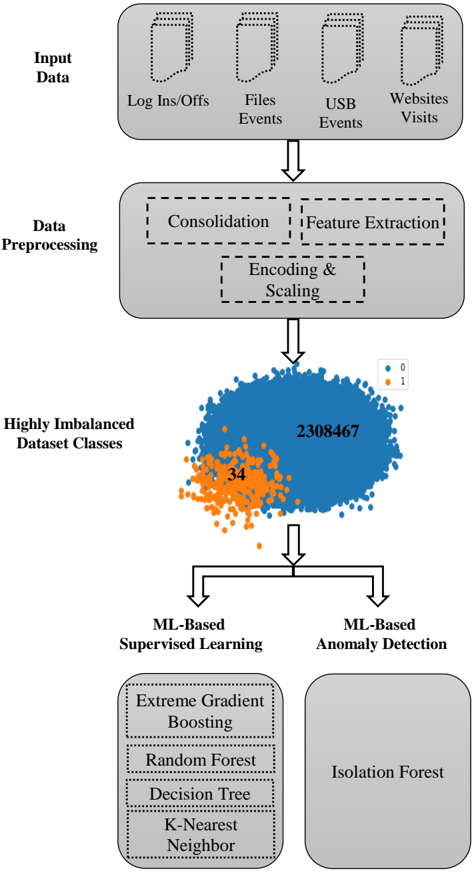
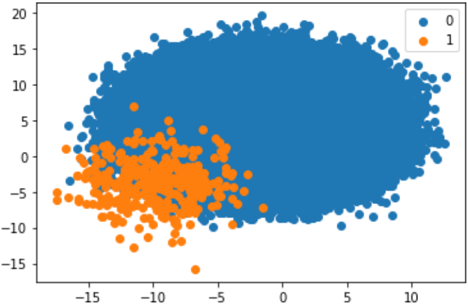
Insider attacks may inflict far greater damage to an organization than outsider threats since insiders are authorized users who are acquainted with the business’s system, making detection harder. Many techniques to detecting insider threats have been developed, but they are neither flexible nor resilient owing to different obstacles (e.g., lack of real-world dataset and highly skewed class distribution of the available dataset), making insider threat detection an understudied research field. Previous techniques attempted to solve the dataset’s imbalance issue by increasing or lowering the observations of the dataset’s classes, however this might lead to underfitting and overfitting problems. We present an insider threat detection model that addresses the class imbalance problem at the algorithm level using anomaly-based techniques, as an enhancement over previous approaches. To limit the effect of skewed class distribution on insider threat detection, the Isolation Forest (IF) technique is used. The model is verified using the benchmarked CERT’s insider threat dataset, which is significantly unbalanced, with a small number of malicious cases vs a large number of non-malicious instances. Several contamination ratios of IF’s parameters are used to verify the model’s performance throughout a range of anomaly scores. The experimental findings reveal that the suggested model handles the dataset class imbalance problem with an accuracy score of 98%. The findings are compared to the baseline technique to demonstrate how the proposed model enhances detection performance and addresses the problem of data imbalance. The findings indicate the usefulness of the suggested approach for identifying insider threats when compared to previous studies.
Overview
The claims and statistics of this paper haven’t been checked yet.
Free: it reads the open-access text and checks the first 5 claims that cite a source we can check. Create a free account to check every claim.
Integrity signals
Registry
Cites
Statistics
Figures
Verification
Claims the paper makes
The claims and statistics of this paper haven’t been checked yet.
Free: it reads the open-access text and checks the first 5 claims that cite a source we can check. Create a free account to check every claim.
Claims other papers make about this one
Each is checked against this paper’s own text: does it say what the citing paper says it does?
The source backs part of the claim, not all of it — or backs it for a different population, condition or comparison.
In the citing paper
“Their reliance on global thresholds and the absence of user-specific adaptation restricted practical precision in live SOC settings.”
From A SIEM-Integrated Cybersecurity Prototype for Insider Threat Anomaly Detection Using Enterprise Logs and Behavioural Biometrics (2025) · cites this paper as [6]
Experimental — accuracy not yet measured
Self-check
Percentages, sums and reported differences re-computed from the paper’s own numbers.
The self-check needs the paper’s full text.
Citations
Cites
XGBoost: A Scalable Tree Boosting System
Chen, T., & Guestrin, C. (2016) · Proceedings of the 22nd ACM SIGKDD International Conference on Knowledge Discovery and Data Mining · doi:10.1145/2939672.2939785 · Cited by 54,569
SMOTE synthetic minority over-sampling technique
Chawla, N. V., Bowyer, K. W., Hall, L. O., & Kegelmeyer, W. P. (2002) · Journal of Artificial Intelligence Research · doi:10.1613/jair.953 · Cited by 32,865 · cited 1×
“In order to address this problem, the Synthetic Minority Oversampling Technique (SMOTE) approach [7] generates synthetic samples based on samples from the minority class using a linear process.”
MethodLiu, F. T., Ting, K. M., & Zhou, Z.-H. (2008) · 2008 Eighth IEEE International Conference on Data Mining · doi:10.1109/icdm.2008.17 · Cited by 6,601
Learning from Imbalanced Data Sets
Fernández, A., García, S., Galar, M., Prati, R. C., Krawczyk, B., & Herrera, F. (2018) · doi:10.1007/978-3-319-98074-4 · Cited by 1,349 · cited 1×
“Extensive testing has shown this to be the case [22].”
BackgroundAn experimental comparison of performance measures for classification
Ferri, C., Hernández-Orallo, J., & Modroiu, R. (2009) · Pattern Recognition Letters · doi:10.1016/j.patrec.2008.08.010 · Cited by 889 · cited 1×
“The F-score is also adopted for its expressive power and it is a popular metric for imbalanced classification [47].”
BackgroundRandom forests: from early developments to recent advancements
Fawagreh, K., Gaber, M. M., & Elyan, E. (2014) · Systems Science & Control Engineering · doi:10.1080/21642583.2014.956265 · Cited by 776 · cited 1×
“However, the RF algorithm might suffer from a decrease in classification tasks’ accuracy because it creates a number of noisy trees [39].”
BackgroundRandom Forest Modeling for Network Intrusion Detection System
Farnaaz, N., & Jabbar, M. A. (2016) · Procedia Computer Science · doi:10.1016/j.procs.2016.06.047 · Cited by 684 · cited 1×
“Additionally, RF resolves the overfitting problem [36], and automatically generates the variable importance [37].”
BackgroundMachine learning–XGBoost analysis of language networks to classify patients with epilepsy
Torlay, L., Perrone-Bertolotti, M., Thomas, E., & Baciu, M. (2017) · Brain Informatics · doi:10.1007/s40708-017-0065-7 · Cited by 483
Efficient C4.5 [classification algorithm]
Ruggieri, S. (2002) · IEEE Transactions on Knowledge and Data Engineering · doi:10.1109/69.991727 · Cited by 389
Fernández, A., López, V., Galar, M., del Jesus, M. J., & Herrera, F. (2013) · Knowledge-Based Systems · doi:10.1016/j.knosys.2013.01.018 · Cited by 388 · cited 1×
“Researchers have proposed many ways, the most prominent and general of which is to rebalance the class distribution via data augmentation methodologies [6].”
Background
Research works printed but not linked: 2
- C. R. Partners, "2018 insider threat report." https://crowdresearchpartners.com/insider-threat-report/ (accessed Aug. 13, 2022).
- Meritalk, "The 2017 federal insider threat report." https://www.insight.com/en_US/content-and- resources/brands/symantec/2017-federal-insider-threat-report.html (accessed Dec. 21, 2022).
Cited by
Web Traffic Anomaly Detection Using Isolation Forest
Chua, W., Pajas, A. L. D., Castro, C. S., Panganiban, S. P., Pasuquin, A. J., Purganan, M. J., Malupeng, R., Pingad, D. J., Orolfo, J. P., Lua, H. H., et al. (2024) · Informatics · doi:10.3390/informatics11040083 · Cited by 71
Severity-Oriented Multiclass Drone Flight Logs Anomaly Detection
Silalahi, S., Ahmad, T., Studiawan, H., Anthi, E., & Williams, L. (2024) · IEEE Access · doi:10.1109/access.2024.3396926 · Cited by 13
“Ensemble models have been shown to perform better than a single classifier, exemplified by [38], who proposed an isolation forest (IF)-based method to perform anomaly detection with various contamination ratios.”
BackgroundKotb, H. M., Gaber, T., AlJanah, S., Zawbaa, H. M., & Alkhathami, M. (2025) · Scientific Reports · doi:10.1038/s41598-024-84673-w · Cited by 23
Harnessing Generative AI for Sustainable Supply Chains: Lean, Circular and Green Perspectives
Singh, A., Alghafes, R. A., Koltai, J. P., & Vishnoi, S. K. (2026) · Business Strategy and the Environment · doi:10.1002/bse.70515 · Cited by 14
Insider Threat Detection: A Review
Manoharan, P., Yin, J., Wang, H., Zhang, Y., & Ye, W. (2024) · International Conference on Networking and Network Applications (NaNA) · doi:10.1109/nana63151.2024.00031 · Cited by 8
“Al-Shehari et al. [41] introduced an unsupervised method for insider threat detection using the Isolation Forest algo-rithm to address imbalanced datasets.”
MethodPredictive modeling and anomaly detection in large-scale web portals through the CAWAL framework
Canay, Ö., & Kocabıçak, Ü. (2024) · Knowledge-Based Systems · doi:10.1016/j.knosys.2024.112710 · Cited by 14
Rough set-inspired isolation forest
Rachwał, A., Karczmarek, P., & Rachwał, A. (2025) · Information Sciences · doi:10.1016/j.ins.2025.122390 · Cited by 6
Classifying Insider Threat Scenarios Through Explainable Articial Intelligence
Grzeczkowicz, R., Neal, C., Baghalizadeh-Moghadam, N., Cuppens-Boulahia, N., & Cuppens, F. (2025) · Lecture notes in computer science · doi:10.1007/978-3-031-89350-6_10 · Cited by 7
Insider Threat Defense Strategies: Survey and Knowledge Integration
Song, C., Zhang, J., Ma, L., Hu, X., Zheng, J., & Yang, L. (2024) · Lecture notes in computer science · doi:10.1007/978-981-97-5489-2_10 · Cited by 5
Mohamed, M. S. M., & Arabo, A. (2025) · doi:10.20944/preprints202511.1003.v1 · Cited by 3
Machine Learning-Based Network Monitoring for Cybersecurity Threat Detection
Eshmawi, A. A., Al-Nowami, A., Mirza, M., Abu-Raya, N., Al-Thabit, R., Shiaeles, S. N., Choi, J., & Ashraf, I. (2025) · Journal of Network and Systems Management · doi:10.1007/s10922-025-10001-w · Cited by 5
“In contrast, [50 ] addresses data imbalance challenges at the algorithmic level using the Isolation Forest method, achieving 98% accuracy on the CERT dataset.”
Insider Threat Detection using Explainable Machine Learning Models in Corporate Networks
Bhatnagar, P., Mandru, S. K., Sharma, P., Singh, V., Singh, J. P., & Katheria, S. (2025) · International Conference on Electronics, Communication and Aerospace Technology (ICECA) · doi:10.1109/iceca66444.2025.11383006 · Cited by 3
Taleb, N. R. M., Zahary, A. T., Althor, H. L., Homid, H. S., Alammari, S. M., Al-Watary, M. A. K., Rafeeq, M. A., & Zubeiri, T. H. A. (2025) · International Conference on Emerging Smart Technologies and Applications (eSmarTA) · doi:10.1109/esmarta66764.2025.11132116 · Cited by 3
Enhancing malware detection and classification in network traffic using deep learning techniques
Tambewagh, P. A., & Ingle, D. R. (2025) · Journal of Forensic Sciences · doi:10.1111/1556-4029.70189 · Cited by 5
“Among these, malicious software (malware) designed to damage or exploit system vulnerabilities remains one of the most persistent and dangerous [1, 2].”
Achaal, B., Adda, M., Berger, M., & Awde, A. (2025) · Cyber Security and Applications · doi:10.1016/j.csa.2025.100115 · Cited by 3
Assessing Current Scenario of Insider Threat in the Perspective of Recent Pandemic
Sandra, G., Silas, S., & Rajsingh, E. B. (2024) · IEEE International Conference on Signal Processing, Informatics, Communication and Energy Systems (SPICES) · doi:10.1109/spices62143.2024.10779964 · Cited by 2
AI Based Methods for Insider Threats Detection for Cloud Risk Mitigation
Wairagade, A., Sonani, R., & Govindarajan, V. (2025) · International Conference on IT Innovation and Knowledge Discovery (ITIKD) · doi:10.1109/itikd63574.2025.11004994 · Cited by 3
“According to [28], Isolation forest (IF) based anomaly detection identify insider threats by treating them as outliers, overcoming the class imbalance at the algorithm level.”
Anciline Jenifer, J., & Piramu, P. S. K. (2025) · International Conference on Machine Learning and Autonomous Systems (ICMLAS) · doi:10.1109/icmlas64557.2025.10967684 · Cited by 1
“The model is validated against the benchmarked CERT insider threat dataset, which is considerably imbalanced, with just a few of malicious cases and a big number of non-malicious occurrences [14]..”
A Machine Learning Approach to Detecting Financial Anomalies in Large Global Companies
Ji, J. (2024) · International Conference on Big Data, Artificial Intelligence and Risk Management (ICBAR) · doi:10.1145/3718751.3718820 · Cited by 4
Faqihi, R., Nanda, P., Mohanty, M., Alqahtani, S., & Alrashed, B. (2025) · IEEE/ACS International Conference on Computer Systems and Applications (AICCSA) · doi:10.1109/aiccsa66935.2025.11315452 · Cited by 3
“Although machine learning (ML) offers a promising alternative, practical challenges such as extreme class imbalance, lack of temporal context, and high false positive rates persist [5]–[7].”
Atalay, M. F., Öztoprak, K., & Tuncel, Y. K. (2025) · IEEE International Conference on Big Data (BigData) · doi:10.1109/bigdata66926.2025.11400869 · Cited by 1
“[10]”
Hamza, Y. A., & Dabagh, N. B. A. (2026) · International Journal of Computers and Applications · doi:10.1080/1206212x.2026.2659275 · Cited by 1
“Generally, insider cyberthreat datasets can be characterized by severe label scarcity and temporal imbalance [12].”
Elsisi, M., Bergies, S., Yu, J. C., Su, C., & Lee, P. (2026) · IEEE Transactions on Transportation Electrification · doi:10.1109/tte.2026.3694727 · Cited by 1
“The anomaly score for an observation x is computed using the formula [25], [29] where s ( x ) represents the anomaly score for the observation x .”
A Pipeline-Based Approach for Enhancing Political Threat Detection Using Machine Learning
Sanaboina, C. S. (2025) · International Journal of Innovative Science and Research Technology · doi:10.38124/ijisrt/25jul232 · Cited by 1
Density-based isolation forest
Levêque, N., Frénod, E., Lacaille, J., Poterie, A., Septier, F., & Yahia-Bacha, M. (2025) · IEEE Statistical Signal Processing Workshop (SSP) · doi:10.1109/ssp64130.2025.11073205
“Outlier detection has been a major research topic for several decades across various fields, including industrial control [2], finance [3], and cybersecurity [4].”
A Survey on AI Algorithms and Techniques for Developing Intelligent and Sustainable Cities
RAJALAKSHMI, E., & Shobana, M. (2025) · doi:10.1002/9781394406357.ch5
Enhancing Network Security: Anomaly Detection Using Generalized Isolation Forest and Explainable AI
Alang, K. S., Khanna, A., & Nalluri, S. (2025) · Springer eBooks · doi:10.1007/978-3-032-02853-2_6
Enhancing Cyberattack Prevention Through Anomaly Detection Ensembles and Diverse Training Sets
Alraddadi, F. S. S., Lago-Fernández, L. F., & Rodrı́guez, F. B. (2025) · Computers · doi:10.3390/computers14110477
“The investigation [17] analyzes the effect of contaminations of IF on a highly unbalanced dataset (CERT r4.”
Qin, Y., & Ling, P. (2025) · IEEE International Conference on Sensors, Electronics and Computer Engineering (ICSECE) · doi:10.1109/icsece65727.2025.11257002
“…a credit model that incorporates multi-dimensional indicators including node activity and response time rate, and combining Isolation Forest [8] anomaly detection, K-Means clustering [9],and delay fluctuation detection, it achieves three-level classification of nodes and establishes a…”
Unsupervised Anomaly Detection in IoT Attacks Using Isolation Forest on the Kitsune Dataset
Ram, M. L., Gabi, C. A. G., Agullo, J. C., Clemente, R. D., Malangsa, R. D., & Lintao, D. S. (2026) · Lecture notes in networks and systems · doi:10.1007/978-3-032-10827-2_12
Yoo, H., Lee, C., & Jaekwang, K. I. M. (2025) · International Conference on Computational Intelligence and Intelligent Systems (CIIS) · doi:10.1145/3787256.3787266
“…iForest-SMOTE improve traditional oversampling methods like SMOTE by incorporating anomaly scores to reduce noise sensitivity, though standard Isolation Forest still faces limitations like axis-parallel splits and ghost clusters, which affect the reliability of anomaly score distributions[17-22].”
Hybrid Anomaly-Based Cloud Security with SDP and Machine Learning for Threat Detection
Gattupalli, K., Gollavilli, V. S. B. H., Alagarsundaram, P., Nagarajan, H., Sitaraman, S. R., & Balachander., J. (2025) · International Conference on Emerging Technologies in Computer Engineering: Machine Learning and Internet of Things (ICETCE) · doi:10.1109/icetce66848.2025.11389020
“The proposed method outperforms the baseline approaches through efficient handling of unbalanced data and improvement in insider threat detection performance [17].”
A Review of User Account Anomaly Detection and Insider Threat Detection Techniques
Childress, J., & Min, M. (2026) · IEEE International Conference on AI in Cybersecurity (ICAIC) · doi:10.1109/icaic67076.2026.11395680
“In [12], the purpose of the authors’ work was to evaluate the performance of a ML-based anomaly detection system in detecting insider threats across an organization’s computer network.”
Predictive Modeling of Insider Threats and Corporate Espionage Through Employee Activity Analysis
Srivarshini, R., Suthish., J., & Senthamilarasi, N. (2026) · International Conference on Mobile Computing and Sustainable Informatics (ICMCSI) · doi:10.1109/icmcsi67283.2026.11412695
“Traditional security mechanisms like firewalls, intrusion detection systems [2], and antivirus solutions designed to fight off external intruders cannot offer sufficient visibility into internal behavior patterns.”
User Account Compromise and Insider Threat Detection for Medical Image Information Systems
Childress, J., & Min, M. (2026) · 2012 International Conference on Computing, Networking and Communications (ICNC) · doi:10.1109/icnc68183.2026.11416951
LIME-Enhanced Insider Threat Detection for Distributed Security Systems
Faqihi, R., Nanda, P., Mohanty, M., Alqahtani, S., & Alrashed, B. (2026) · Lecture notes in computer science · doi:10.1007/978-981-95-8408-6_18 · Cited by 1
Eswari Petchiammal, G., Abishek Kashyap., S., Karthikeyan, P., Agash Balaji, B., & Harishankar, K. (2026) · International Conference on Expert Clouds and Applications (ICOECA) · doi:10.1109/icoeca68095.2026.11485181
“…adaptive access while improving detection accuracy by 8–15% using federated learning, behavioral LSTM, and Zero Trust with dynamic trust scoring [7] By using federated learning, behavioral LSTM with fuzzy risk scoring, and Zero Trust to allow secure multi-cloud collaboration and…”
Detecting Insider Threats Using Unsupervised Machine Learning
Darla, S., N, Y. N. M., Tarun, N., Gaonkar, V. V., & K, M. G. D. (2026) · Contemporary Computing Innovations Conference (CCIC) · doi:10.1109/ccic68129.2026.11486248
“For instance, Isolation Forest (IF) is a very strong unsupervised outlier detection algorithm which works by isolating outliers in the feature space [8], [9].”
InfluentialBehavioral Anomaly–Driven Risk Assessment for Access Control in Enterprise Systems
Pavan Karthick, T., Nair, A. A., & Gnanavel, S. (2026) · International Conference on Research Methodologies in Knowledge Management, Artificial Intelligence and Telecommunication Engineering (RMKMATE) · doi:10.1109/rmkmate69073.2026.11518951
“Al-Shehari et al [4], present an anomaly-based model for detecting insider threats that applies the Isolation Forest algorithm.”
Kuldeyev, N., Mamyrbayev, O., Аkhmediyarova, A., & Yerzhan, A. (2026) · Electronics · doi:10.3390/electronics15112400
Chirchi, V., Prakash, M., Duraimutharasan, N. K. B., Viswanathan, C., Senthilvel, P. G., Balasubramaniam, S., & Ayalew, F. (2026) · Journal of Cloud Computing Advances Systems and Applications · doi:10.1186/s13677-026-00943-0
“The Isolation Forest method utilizes an unsupervised approach to identify anomalies by repeatedly dividing the input data through hierarchical relationships of feature values [22].”
Jurišić, M., Tomičić, I., & Bernik, A. (2026) · Signals · doi:10.3390/signals7040059 · Cited by 2
Hariharan, P. K., Eswar, M. S., Jacob, P. P. P. D., Nirmala, A. V., & Thangakumar, J. (2026) · International Conference on Connected Intelligence for Industrial Applications (CI2A) · doi:10.1109/ci2a69097.2026.11576789
Sun, H., Li, N., Guo, M., Wei, J., & Yuan, T. (2026) · Journal of Marine Science and Engineering · doi:10.3390/jmse14131255
Thalupuru, V. S., Singaraju, S. P., & Gupta, V. (2026) · IEEE International Conference on Smart Computing Workshops and Other Affiliated Events (SMARTCOMP Companion) · doi:10.1109/smartcomp-companion70724.2026.00082
“UBA systems [1], [5] introduce peer-relative baselines but remain user-centric, assuming human behavioural rhythms (work hours, session patterns) that do not transfer to autonomous entities [2].”
Adaptive Behavioural Intelligent Insider Threat Detection: A Systematic ReviewPreprint
Galadima, I. B., Wahab, N. H. A., Osman, M. Z., & Danlamid, G. (2026) · SSRN Electronic Journal · doi:10.2139/ssrn.7302121
Hybrid Ensemble Learning Model with Explainable Anomaly Detection for Insider Threat Analysis
Oommen, L., Abhinav, P., V, Indu Shree, B., & Gadde, A. (2026) · International Conference on Power, Control and Computing Technologies (ICPC2T) · doi:10.1109/icpc2t68221.2026.11646349
Ikpe, I., Ekpah, D., & Egbe, T. I. (2026) · Springer eBooks · doi:10.1007/978-3-032-20513-1_17
Anomaly-Based Detection of Insider Threats Using Network Traffic Behaviour
Sumayah, K., Ullas, S., & Sreerag, G. (2026) · International Conference on Emerging Technologies in Computing and Communication (ETCC) · doi:10.1109/etcc69750.2026.11681991
“Al-Shehari et al [4] developed an insider threat detection model that works using an anomaly detection strategy, specifically employing an Isolation Forest algorithm.”
CausalXBoost: A Causal Explainable CatBoost Framework for Insider Threat Detection
Jayaraman, V., Harvin Krishnan, H., Vishaal, R. G. S., Aishwarya, B., Parthasarathy, S., & Kavitha, R. (2026) · International Conference Computational Vision and Bio Inspired Computing · doi:10.1109/iccvbic71195.2026.11689492
“Al-Shehari et al., developed anomaly-based isolation forest-based model which resulted with 98% of accuracy [23].”
PrivGuardAI for adaptive privacy preserving sensitive data protection in cloud environments
Racha, S. R., & Karri, G. R. (2026) · Discover Computing · doi:10.1007/s10791-026-10472-8
Patel, K. L., & Kumar, R. (2026) · International Engineering Data Analytics and Management Conference (EAMCON) · doi:10.68337/cpsm.v1.i2.2026-027
Metadata
- Authors
- Al-Shehari, T., Al-Razgan, M., Alfakih, T., Alsowail, R. A., & Pandiaraj, S.
- Affiliations
- Computer Skills, Department of Self-Development Skills, Common First Year Deanship, King Saud University, Riyadh, Saudi Arabia
- Department of Software Engineering, College of Computer and Information Sciences, King Saud University, Riyadh, Saudi Arabia
- King Saud University (SA)
- Venue
- IEEE Access
- Published
- 2023
- Volume
- 11
- Pages
- 118170-118185
- ISSN
- 2169-3536 (ISSN-L)
- OpenAlex
- W4387886031
- Cited by
- 52
- References
- 46
- Citations by year
- 2026: 25 · 2025: 20 · 2024: 7
- FWCI
- 5.78
- Type
- journal article
- Language
- en
- Open access
- gold
- doi.org
- Licence
- Locations
- IEEE Access (publishedVersion, cc-by-nc-nd)
- DOAJ (DOAJ: Directory of Open Access Journals) (submittedVersion, cc-by-sa)
- Funders
- King Saud University (RSP2023R206)
- Topics
- Physical Sciences › Computer Science › Computer Networks and Communications › Network Security and Intrusion Detection
- Physical Sciences › Computer Science › Information Systems › Information and Cyber Security
- Physical Sciences › Computer Science › Artificial Intelligence › Anomaly Detection Techniques and Applications
- Keywords
- insider threat detection, Isolation Forest, anomaly detection, class imbalance, CERT insider threat dataset, malicious user identification, anomaly score
About these checks
Registry, retraction, Cites and statistics results are computed, not judged, with one exception: a printed reference that no index lists is read once by a model before it counts as a citation error. Claims are extracted by a model and kept only when their quote appears verbatim in the text; each cited source is then checked, with a model’s help, for whether it says what the claim relies on. Those verdicts can be wrong — read the claim’s quote and the cited source before relying on one.
Statistics and arithmetic are recomputed, not judged.
Confidence bands are shown only for fields calibrated on our annotated test set. None is calibrated yet, so no band is shown.
What counts as a claim ›How we measure confidence ›How we check this ›
Are you an author, or do you see a problem with this page? Request a review
Data sources
Bibliographic data: Semantic Scholar, OpenAlex, Crossref.
Contains information from the Semantic Scholar Academic Graph Datasets, made available under the ODC Attribution License (ODC-BY 1.0).
Semantic Scholar’s data is described in: Kinney, R., et al. (2023). The Semantic Scholar Open Data Platform. arXiv:2301.10140.
