

Devising and Detecting Phishing Emails Using Large Language Models
Open accessThe DOI matches its Crossref record; 31 of the 31 references it cites were found in a registry or an index.
Abstract
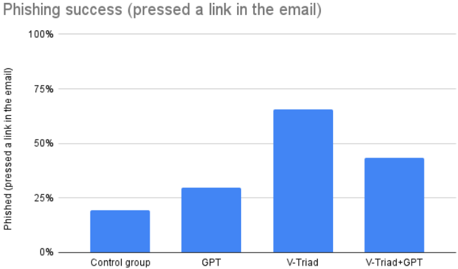
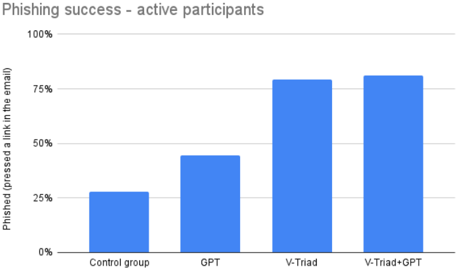
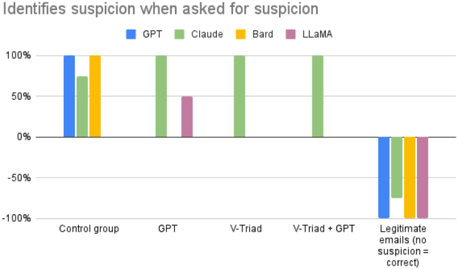
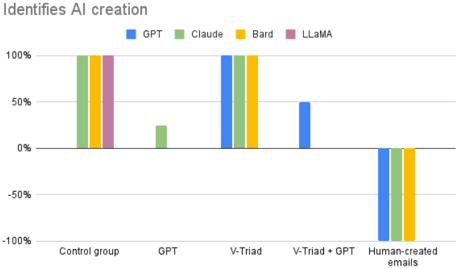
AI programs, built using large language models, make it possible to automatically create phishing emails based on a few data points about a user. The V-Triad is a set of rules for manually designing phishing emails to exploit our cognitive heuristics and biases. In this study, we compare the performance of phishing emails created automatically by GPT-4 and manually using the V-Triad. We also combine GPT-4 with the V-Triad to assess their combined potential. A fourth group, exposed to generic phishing emails, was our control group. We sent emails to 112 participants recruited for the study. The control group emails received a click-through rate between 19-28%, the GPT-generated emails 30-44%, emails generated by the V-Triad 69-79%, and emails generated by GPT and the V-Triad 43-81%. Each participant was asked to explain why they pressed or did not press a link in the email. These answers often contradict each other, highlighting the importance of personal differences. Next, we used four popular large language models (GPT, Claude, PaLM, and LLaMA) to detect the intention of phishing emails and compare the results to human detection. The language models demonstrated a strong ability to detect malicious intent, even in non-obvious phishing emails. They sometimes surpassed human detection, although often being slightly less accurate than humans. Finally, we make an analysis of the economic aspects of AI-enabled phishing attacks, showing how large language models increase the incentives of phishing and spear phishing by reducing their costs.
Overview
The claims and statistics of this paper haven’t been checked yet.
Free: it reads the open-access text and checks the first 5 claims that cite a source we can check. Create a free account to check every claim.
Integrity signals
Registry
Cites
Statistics
Figures






Verification
Claims the paper makes
The claims and statistics of this paper haven’t been checked yet.
Free: it reads the open-access text and checks the first 5 claims that cite a source we can check. Create a free account to check every claim.
Claims other papers make about this one
Each is checked against this paper’s own text: does it say what the citing paper says it does?
The check wasn’t confident either way, so it gives no verdict — never disputed.
In the citing paper
“Among its versions, CERT 4.2 was chosen for this work as it contains data from 1000 users over 501 days, including 70 malicious actors and over 32 million possible activities with 7327 malicious actions [7] .”
From User Behavior Analytics for Insider Threat using Transformer Based Approach (2026) · cites this paper as [7]
Experimental — accuracy not yet measuredThe check wasn’t confident either way, so it gives no verdict — never disputed.
In the citing paper
“The CERT Insider Threat Dataset, developed by the CERT Division at Carnegie Mellon University, is a widely used synthetic dataset for insider threat research, offering realistic, privacy free data for benchmarking and model development [6] .”
From User Behavior Analytics for Insider Threat using Transformer Based Approach (2026) · cites this paper as [6]
Experimental — accuracy not yet measured
Self-check
Percentages, sums and reported differences re-computed from the paper’s own numbers.
The self-check needs the paper’s full text.
Citations
Cites
LLaMA: Open and Efficient Foundation Language Models
Touvron, H., Lavril, T., Izacard, G., Martinet, X., Lachaux, M.-A., Lacroix, T., Rozière, B., Goyal, N., Hambro, E., Azhar, F., et al. (2023) · arXiv · doi:10.48550/arxiv.2302.13971 · Cited by 4,602 · cited 1×
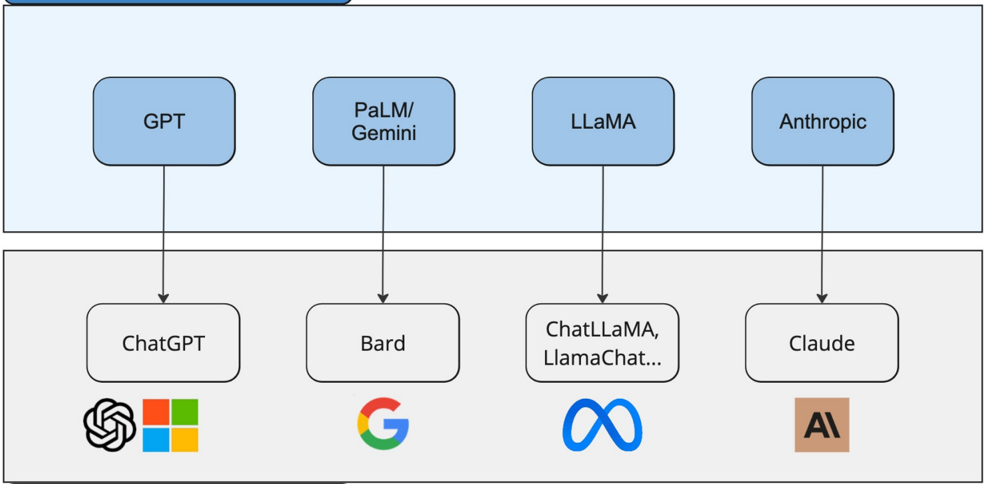
“LLMs come in different versions (such as GPT [29] created by OpenAI, Anthropic’s LLM 3 , PaLM [1] and Gemini [34] created by Google, and LLaMA [36] from Meta).”
Influence: The Psychology of Persuasion
Cialdini, R. B. (1993) · Cited by 2,563
Dhamija, R., Tygar, J. D., & Hearst, M. (2006) · Proceedings of the SIGCHI Conference on Human Factors in Computing Systems · doi:10.1145/1124772.1124861 · Cited by 1,376 · cited 2×
“We are also training an LLM to be specifically tuned for creating and detecting deceptive content by exposing it to the Cambridge Cybercrime Dataset 8 .”
Gemini: A Family of Highly Capable Multimodal Models
Gemini Team, Anil, R., Borgeaud, S., Alayrac, J.-B., Yu, J., Soricut, R., Schalkwyk, J., Dai, A. M., Hauth, A., Millican, K., et al. (2023) · arXiv · doi:10.48550/arxiv.2312.11805 · Cited by 990
Anil, R., Dai, A. M., Firat, O., Johnson, M., Lepikhin, D., Passos, A., Shakeri, S., Taropa, E., Bailey, P., Chen, Z., et al. (2023) · arXiv · doi:10.48550/arxiv.2305.10403 · Cited by 834 · cited 2×
“LLMs come in different versions (such as GPT [29] created by OpenAI, Anthropic’s LLM 3 , PaLM [1] and Gemini [34] created by Google, and LLaMA [36] from Meta).”
Puhakainen, P., & Siponen, M. (2010) · MIS Quarterly · doi:10.2307/25750704 · Cited by 638 · cited 1×
“Frequently mentioned problems include a lack of engagement, failure to personalize the content, irrelevant training material, and too infrequent training, [5], [3], [22, 5, 27, 30, 5, 27, 30, 5, 3].”
A comprehensive survey of AI-enabled phishing attacks detection techniques
Basit, A., Zafar, M., Liu, X., Javed, A. R., Jalil, Z., & Kifayat, K. (2021) · Telecommunication Systems · doi:10.1007/s11235-020-00733-2 · Cited by 429 · cited 1×
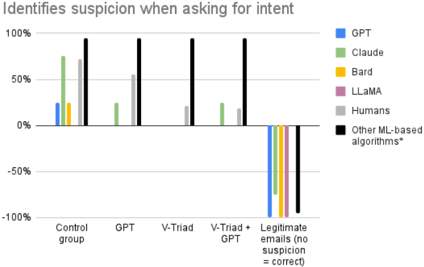
“For comparison, we also included a bar representing other ML-based phishing detection techniques that often reach an accuracy well above 95% [13, 2, 9].”
Social Engineering: The Science of Human Hacking
Hadnagy, C. (2018) · Wiley eBooks · doi:10.1002/9781119433729 · Cited by 331
Individual differences and Information Security Awareness
McCormac, A., Zwaans, T., Parsons, K., Calic, D., Butavicius, M., & Pattinson, M. (2017) · Computers in Human Behavior · doi:10.1016/j.chb.2016.11.065 · Cited by 300 · cited 1×
“Frequently mentioned problems include a lack of engagement, failure to personalize the content, irrelevant training material, and too infrequent training, [5], [3], [22, 5, 27, 30, 5, 27, 30, 5, 3].”
Deep Learning for Phishing Detection: Taxonomy, Current Challenges and Future Directions
Do, N. Q., Selamat, A., Krejcar, O., Herrera-Viedma, E., & Fujita, H. (2022) · IEEE Access · doi:10.1109/access.2022.3151903 · Cited by 221 · cited 1×
“For comparison, we also included a bar representing other ML-based phishing detection techniques that often reach an accuracy well above 95% [13, 2, 9].”
URLTran: Improving Phishing URL Detection Using Transformers
Maneriker, P., Stokes, J. W., Lazo, E. G., Carutasu, D., Tajaddodianfar, F., & Gururajan, A. (2021) · IEEE Military Communications Conference (MILCOM) · doi:10.1109/milcom52596.2021.9653028 · Cited by 191 · cited 2×
“However, the same models also show promising signs of being able to counter deception by improving phishing detection [23, 28, 38, 28, 26].”
Applicability of machine learning in spam and phishing email filtering: review and approaches
Gangavarapu, T., Jaidhar, C. D., & Chanduka, B. (2020) · Artificial Intelligence Review · doi:10.1007/s10462-020-09814-9 · Cited by 163 · cited 1×
“For comparison, we also included a bar representing other ML-based phishing detection techniques that often reach an accuracy well above 95% [13, 2, 9].”
Bauer, S., & Bernroider, E. W. N. (2017) · ACM SIGMIS Database the DATABASE for Advances in Information Systems · doi:10.1145/3130515.3130519 · Cited by 129 · cited 1×
“Frequently mentioned problems include a lack of engagement, failure to personalize the content, irrelevant training material, and too infrequent training, [5], [3], [22, 5, 27, 30, 5, 27, 30, 5, 3].”
Recommendations for information security awareness training for college students
Kim, E. B. (2014) · Information Management & Computer Security · doi:10.1108/imcs-01-2013-0005 · Cited by 127 · cited 1×
“Frequently mentioned problems include a lack of engagement, failure to personalize the content, irrelevant training material, and too infrequent training, [5], [3], [22, 5, 27, 30, 5, 27, 30, 5, 3].”
Cognitive Triaging of Phishing AttacksPreprint
van der Heijden, A., & Allodi, L. (2019) · arXiv (Cornell University) · doi:10.48550/arxiv.1905.02162 · Cited by 98 · cited 1×
“[18] presents a similar cognitive framework for creating phishing emails based on two cognitive characteristics that overlap with the V-Triad’s credibility metric: believability and persuasiveness.”
Generating Phishing Attacks using ChatGPTPreprint
Roy, S. S., Naragam, K. V., & Nilizadeh, S. (2023) · arXiv (Cornell University) · doi:10.48550/arxiv.2305.05133 · Cited by 78 · cited 2×
“Given their ability to produce increasingly human-like text, generative language models are often perceived to be well suited for persuasion and deception [17, 21, 24, 31, 14, 20].”
Fundamentals of Generative Large Language Models and Perspectives in Cyber-DefensePreprint
Kucharavy, A., Schillaci, Z. M., Maréchal, L., Würsch, M., Dolamic, L., Sabonnadiere, R., David, D. P., Mermoud, A., & Lenders, V. (2023) · arXiv (Cornell University) · doi:10.48550/arxiv.2303.12132 · Cited by 55 · cited 2×
“One study also analyzes OPT [21], and another study analyzes Bart’s capacity for creating phishing emails but maintains a theoretical perspective and does not create or send emails [24].”
Why is phishing still successful?
Bhardwaj, A., Sapra, V., Kumar, A., Kumar, N., & Arthi, S. (2020) · Computer Fraud & Security · doi:10.1016/s1361-3723(20)30098-1 · Cited by 48 · cited 1×
“Even though many organizations spend immense resources to train their employees, phishing is one of the most persistent cybersecurity threats to organizations, governments, and institutes around the world [37, 16, 4].”
Phishing Dark Waters: The Offensive and Defensive Sides of Malicious E‐mails
Hadnagy, C., & Fincher, M. (2015) · Wiley eBooks · doi:10.1002/9781119183624 · Cited by 42 · cited 1×
“Even though many organizations spend immense resources to train their employees, phishing is one of the most persistent cybersecurity threats to organizations, governments, and institutes around the world [37, 16, 4].”
Making security awareness training work
Caldwell, T. (2016) · Computer Fraud & Security · doi:10.1016/s1361-3723(15)30046-4 · Cited by 41
A Large-Scale Pretrained Deep Model for Phishing URL Detection
Wang, Y., Zhu, W., Xu, H., Qin, Z., Ren, K., & Ma, W. (2023) · ICASSP 2023 - 2023 IEEE International Conference on Acoustics, Speech and Signal Processing (ICASSP) · doi:10.1109/icassp49357.2023.10095719 · Cited by 33 · cited 2×
“However, the same models also show promising signs of being able to counter deception by improving phishing detection [23, 28, 38, 28, 26].”
Spear Phishing With Large Language Models
Hazell, J. (2023) · arXiv · doi:10.48550/arxiv.2305.06972 · Cited by 28 · cited 2×
“Given their ability to produce increasingly human-like text, generative language models are often perceived to be well suited for persuasion and deception [17, 21, 24, 31, 14, 20].”
Detecting Phishing Sites Using ChatGPT
Koide, T., Fukushi, N., Nakano, H., & Chiba, D. (2023) · arXiv (Cornell University) · doi:10.48550/arxiv.2306.05816 · Cited by 22 · cited 2×
“However, the same models also show promising signs of being able to counter deception by improving phishing detection [23, 28, 38, 28, 26].”
LMs go Phishing: Adapting Pre-trained Language Models to Detect Phishing Emails
Misra, K., & Rayz, J. T. (2022) · IEEE/WIC/ACM International Conference on Web Intelligence and Intelligent Agent Technology (WI-IAT) · doi:10.1109/wi-iat55865.2022.00028 · Cited by 21 · cited 2×
“However, the same models also show promising signs of being able to counter deception by improving phishing detection [23, 28, 38, 28, 26].”
Targeted Phishing Campaigns using Large Scale Language Models
Karanjai, R. (2022) · arXiv (Cornell University) · doi:10.48550/arxiv.2301.00665 · Cited by 18 · cited 3×
“One study also analyzes OPT [21], and another study analyzes Bart’s capacity for creating phishing emails but maintains a theoretical perspective and does not create or send emails [24].”
Vishwanath, A. (2022) · The MIT Press eBooks · doi:10.7551/mitpress/14653.001.0001 · Cited by 15
Self-citationCould What Happened to Sony Happen to Us?
Houser, W. (2015) · IT Professional · doi:10.1109/mitp.2015.21 · Cited by 10 · cited 1×
“Some studies claim that well above 70-80% of all cyberattacks use social engineering [15, 35].”
Guo, S.-W., Chen, T.-C., Wang, H.-J., Leu, F., & Fan, Y.-C. (2022) · Lecture notes in networks and systems · doi:10.1007/978-3-031-20029-8_26 · Cited by 5 · cited 2×
“Given their ability to produce increasingly human-like text, generative language models are often perceived to be well suited for persuasion and deception [17, 21, 24, 31, 14, 20].”
Phisherman: Phishing Link Scanner
Escoses, C. A. A., Magno, M. R. R., Balba, H. M. P., Enriquez, N. C., & Diloy, M. A. (2023) · Lecture notes in computer science · doi:10.1007/978-3-031-36183-8_11 · Cited by 2
Advances on Broad-Band Wireless Computing, Communication and Applications
Barolli, L. (2022) · Lecture notes in networks and systems · doi:10.1007/978-3-031-20029-8 · Cited by 1
OpenAI, Achiam, J., Adler, S., Agarwal, S., Ahmad, L., Akkaya, I., Aleman, F. L., Almeida, D., Altenschmidt, J., Altman, S., et al. (2023) · arXiv · doi:10.48550/arxiv.2303.08774 · cited 3×
“LLMs come in different versions (such as GPT [29] created by OpenAI, Anthropic’s LLM 3 , PaLM [1] and Gemini [34] created by Google, and LLaMA [36] from Meta).”
Research works printed but not linked: 5
- 6. Casino giant MGM expects $100 million hit from hack that led to data breach | Reuters. URL: https://www.re uters.com/business/mgm-expects-cybersecurity-issue -negatively-impact-third-quarter-earnings-2023-10-0 5/.
- 10. Email Marketing Benchmarks and Statistics for 2022 | Campaign Monitor. URL: https://www.campaignmonit or.com/resources/guides/email-marketing-benchmark s/.
- 11. Email Marketing Statistics & Benchmarks | Mailchimp. URL: https://mailchimp.com/resources/email-marketi ng-benchmarks/.
- 33. Security awareness training: Top challenges and what to do about them | Security Magazine. URL: https://ww w.securitymagazine.com/articles/96565-security-awa reness-training-top-challenges-and-what-to-do-about -them.
- 35. Positive Technologies. Cybersecurity threatscape: Q3 2022. 2022.
Cited by
A survey on large language model (LLM) security and privacy: The Good, The Bad, and The Ugly
Yao, Y., Duan, J., Xu, K., Cai, Y., Sun, Z., & Zhang, Y. (2024) · High-Confidence Computing · doi:10.1016/j.hcc.2024.100211 · Cited by 1,083
A survey on LLM-based multi-agent systems: Workflow, infrastructure, and challenges
Li, X., Wang, S., Zeng, S., Wu, Y., & Yang, Y. (2024) · Vicinagearth · doi:10.1007/s44336-024-00009-2 · Cited by 404
AI deception: A survey of examples, risks, and potential solutions
Park, P. S., Goldstein, S., O’Gara, A., Chen, M., & Hendrycks, D. (2024) · Patterns · doi:10.1016/j.patter.2024.100988 · Cited by 243
“44 These trends continue to increase the degree to which victims are vulnerable to scams, extortion, and other forms of fraud, and, in the words 27 illustratesthat,ineachgame played byanLLM-basedAIagent, thereisatext-based storythatisgeneratedadaptively as the agent observes the current text-based…”
Self-citationAI Deception: A Survey of Examples, Risks, and Potential Solutions
Park, P. S., Goldstein, S., O'Gara, A., Chen, M., & Hendrycks, D. (2023) · arXiv · doi:10.48550/arxiv.2308.14752 · Cited by 243
“44 These trends continue to increase the degree to which victims are vulnerable to scams, extortion, and other forms of fraud, and, in the words 27 illustratesthat,ineachgame played byanLLM-basedAIagent, thereisatext-based storythatisgeneratedadaptively as the agent observes the current text-based…”
Self-citationWhen LLMs meet cybersecurity: a systematic literature review
Zhang, J., Bu, H., Wen, H., Liu, Y., Fei, H., Xi, R., Li, L., Yang, Y., Zhu, H., & Meng, D. (2025) · Cybersecurity · doi:10.1186/s42400-025-00361-w · Cited by 383
Metadata
- Authors
- Heiding, F., Schneier, B., Vishwanath, A., Bernstein, J., & Park, P. S.
- Affiliations
- Harvard John A. Paulson School of Engineering And Applied Sciences, Harvard University, Cambridge, MA, USA
- Harvard University (US)
- Avant Research Group, Buffalo, NY, USA
- Massachusetts Institute of Technology (US)
- Venue
- IEEE Access
- Published
- 2024
- Volume
- 12
- Pages
- 42131-42146
- ISSN
- 2169-3536 (ISSN-L)
- OpenAlex
- W4392667162
- Cited by
- 123
- References
- 29
- Citations by year
- 2026: 61 · 2025: 46 · 2024: 16
- FWCI
- 46.25
- Type
- journal article
- Language
- en
- Open access
- gold
- doi.org
- Licence
- Locations
- IEEE Access (publishedVersion, cc-by-nc-nd)
- DOAJ (DOAJ: Directory of Open Access Journals) (submittedVersion, cc-by-sa)
- Topics
- Physical Sciences › Computer Science › Information Systems › Spam and Phishing Detection
- Social Sciences › Sociology and Political Science › Misinformation and Its Impacts
- Physical Sciences › Computer Science › Artificial Intelligence › Adversarial Robustness in Machine Learning
- Keywords
- phishing emails, large language models, GPT-4, phishing email detection, click-through rate, AI-generated phishing, spear phishing
About these checks
Registry, retraction, Cites and statistics results are computed, not judged, with one exception: a printed reference that no index lists is read once by a model before it counts as a citation error. Claims are extracted by a model and kept only when their quote appears verbatim in the text; each cited source is then checked, with a model’s help, for whether it says what the claim relies on. Those verdicts can be wrong — read the claim’s quote and the cited source before relying on one.
Statistics and arithmetic are recomputed, not judged.
Confidence bands are shown only for fields calibrated on our annotated test set. None is calibrated yet, so no band is shown.
What counts as a claim ›How we measure confidence ›How we check this ›
Are you an author, or do you see a problem with this page? Request a review
Data sources
Bibliographic data: Semantic Scholar, OpenAlex, Crossref.
Contains information from the Semantic Scholar Academic Graph Datasets, made available under the ODC Attribution License (ODC-BY 1.0).
Semantic Scholar’s data is described in: Kinney, R., et al. (2023). The Semantic Scholar Open Data Platform. arXiv:2301.10140.
