

Devising and Detecting Phishing Emails Using Large Language Models
Open accessThe DOI matches its Crossref record; 31 of the 31 references it cites were found in a registry or an index.
Abstract
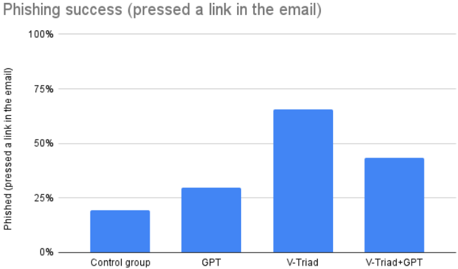
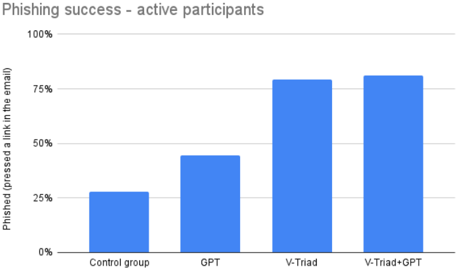
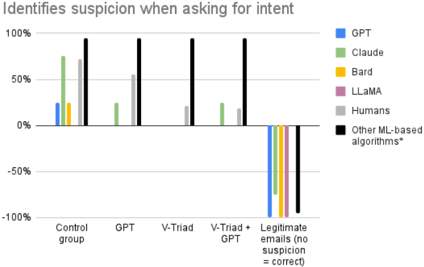
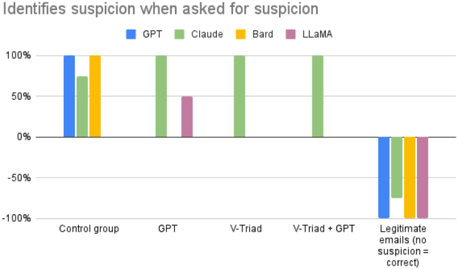
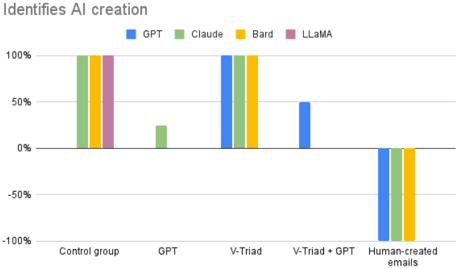
AI programs, built using large language models, make it possible to automatically create phishing emails based on a few data points about a user. The V-Triad is a set of rules for manually designing phishing emails to exploit our cognitive heuristics and biases. In this study, we compare the performance of phishing emails created automatically by GPT-4 and manually using the V-Triad. We also combine GPT-4 with the V-Triad to assess their combined potential. A fourth group, exposed to generic phishing emails, was our control group. We sent emails to 112 participants recruited for the study. The control group emails received a click-through rate between 19-28%, the GPT-generated emails 30-44%, emails generated by the V-Triad 69-79%, and emails generated by GPT and the V-Triad 43-81%. Each participant was asked to explain why they pressed or did not press a link in the email. These answers often contradict each other, highlighting the importance of personal differences. Next, we used four popular large language models (GPT, Claude, PaLM, and LLaMA) to detect the intention of phishing emails and compare the results to human detection. The language models demonstrated a strong ability to detect malicious intent, even in non-obvious phishing emails. They sometimes surpassed human detection, although often being slightly less accurate than humans. Finally, we make an analysis of the economic aspects of AI-enabled phishing attacks, showing how large language models increase the incentives of phishing and spear phishing by reducing their costs.
Overview
The claims and statistics of this paper haven’t been checked yet.
Free: it reads the open-access text and checks the first 5 claims that cite a source we can check. Create a free account to check every claim.
Integrity signals
Registry
Cites
Statistics
Figures






Verification
Claims the paper makes
The claims and statistics of this paper haven’t been checked yet.
Free: it reads the open-access text and checks the first 5 claims that cite a source we can check. Create a free account to check every claim.
Claims other papers make about this one
Each is checked against this paper’s own text: does it say what the citing paper says it does?
The check wasn’t confident either way, so it gives no verdict — never disputed.
In the citing paper
“Among its versions, CERT 4.2 was chosen for this work as it contains data from 1000 users over 501 days, including 70 malicious actors and over 32 million possible activities with 7327 malicious actions [7] .”
From User Behavior Analytics for Insider Threat using Transformer Based Approach (2026) · cites this paper as [7]
Experimental — accuracy not yet measuredThe check wasn’t confident either way, so it gives no verdict — never disputed.
In the citing paper
“The CERT Insider Threat Dataset, developed by the CERT Division at Carnegie Mellon University, is a widely used synthetic dataset for insider threat research, offering realistic, privacy free data for benchmarking and model development [6] .”
From User Behavior Analytics for Insider Threat using Transformer Based Approach (2026) · cites this paper as [6]
Experimental — accuracy not yet measured
Self-check
Percentages, sums and reported differences re-computed from the paper’s own numbers.
The self-check needs the paper’s full text.
Citations
Cites
LLaMA: Open and Efficient Foundation Language Models
Touvron, H., Lavril, T., Izacard, G., Martinet, X., Lachaux, M.-A., Lacroix, T., Rozière, B., Goyal, N., Hambro, E., Azhar, F., et al. (2023) · arXiv · doi:10.48550/arxiv.2302.13971 · Cited by 4,602 · cited 1×
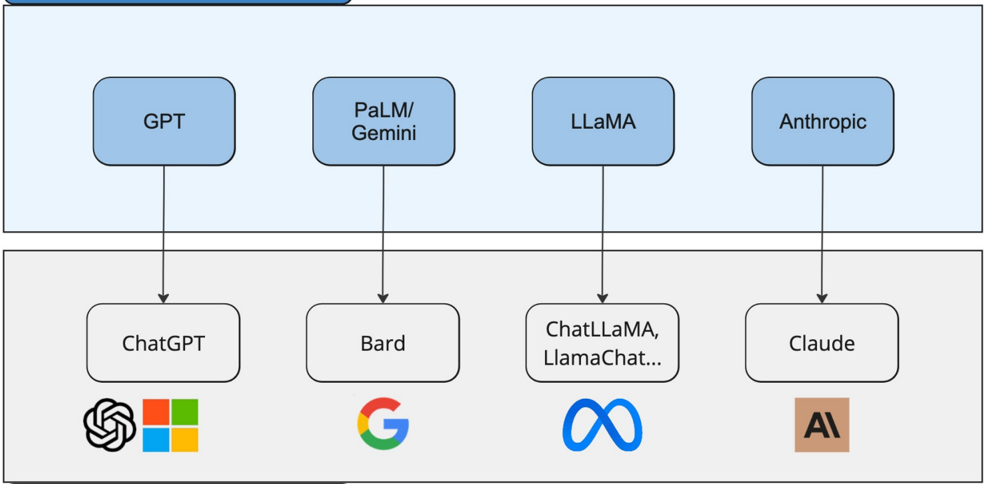
“LLMs come in different versions (such as GPT [29] created by OpenAI, Anthropic’s LLM 3 , PaLM [1] and Gemini [34] created by Google, and LLaMA [36] from Meta).”
Influence: The Psychology of Persuasion
Cialdini, R. B. (1993) · Cited by 2,563
Dhamija, R., Tygar, J. D., & Hearst, M. (2006) · Proceedings of the SIGCHI Conference on Human Factors in Computing Systems · doi:10.1145/1124772.1124861 · Cited by 1,376 · cited 2×
“We are also training an LLM to be specifically tuned for creating and detecting deceptive content by exposing it to the Cambridge Cybercrime Dataset 8 .”
Gemini: A Family of Highly Capable Multimodal Models
Gemini Team, Anil, R., Borgeaud, S., Alayrac, J.-B., Yu, J., Soricut, R., Schalkwyk, J., Dai, A. M., Hauth, A., Millican, K., et al. (2023) · arXiv · doi:10.48550/arxiv.2312.11805 · Cited by 990
Anil, R., Dai, A. M., Firat, O., Johnson, M., Lepikhin, D., Passos, A., Shakeri, S., Taropa, E., Bailey, P., Chen, Z., et al. (2023) · arXiv · doi:10.48550/arxiv.2305.10403 · Cited by 834 · cited 2×
“LLMs come in different versions (such as GPT [29] created by OpenAI, Anthropic’s LLM 3 , PaLM [1] and Gemini [34] created by Google, and LLaMA [36] from Meta).”
Puhakainen, P., & Siponen, M. (2010) · MIS Quarterly · doi:10.2307/25750704 · Cited by 638 · cited 1×
“Frequently mentioned problems include a lack of engagement, failure to personalize the content, irrelevant training material, and too infrequent training, [5], [3], [22, 5, 27, 30, 5, 27, 30, 5, 3].”
A comprehensive survey of AI-enabled phishing attacks detection techniques
Basit, A., Zafar, M., Liu, X., Javed, A. R., Jalil, Z., & Kifayat, K. (2021) · Telecommunication Systems · doi:10.1007/s11235-020-00733-2 · Cited by 429 · cited 1×
“For comparison, we also included a bar representing other ML-based phishing detection techniques that often reach an accuracy well above 95% [13, 2, 9].”
Social Engineering: The Science of Human Hacking
Hadnagy, C. (2018) · Wiley eBooks · doi:10.1002/9781119433729 · Cited by 331
Individual differences and Information Security Awareness
McCormac, A., Zwaans, T., Parsons, K., Calic, D., Butavicius, M., & Pattinson, M. (2017) · Computers in Human Behavior · doi:10.1016/j.chb.2016.11.065 · Cited by 300 · cited 1×
“Frequently mentioned problems include a lack of engagement, failure to personalize the content, irrelevant training material, and too infrequent training, [5], [3], [22, 5, 27, 30, 5, 27, 30, 5, 3].”
Deep Learning for Phishing Detection: Taxonomy, Current Challenges and Future Directions
Do, N. Q., Selamat, A., Krejcar, O., Herrera-Viedma, E., & Fujita, H. (2022) · IEEE Access · doi:10.1109/access.2022.3151903 · Cited by 221 · cited 1×
“For comparison, we also included a bar representing other ML-based phishing detection techniques that often reach an accuracy well above 95% [13, 2, 9].”
Research works printed but not linked: 5
- 6. Casino giant MGM expects $100 million hit from hack that led to data breach | Reuters. URL: https://www.re uters.com/business/mgm-expects-cybersecurity-issue -negatively-impact-third-quarter-earnings-2023-10-0 5/.
- 10. Email Marketing Benchmarks and Statistics for 2022 | Campaign Monitor. URL: https://www.campaignmonit or.com/resources/guides/email-marketing-benchmark s/.
- 11. Email Marketing Statistics & Benchmarks | Mailchimp. URL: https://mailchimp.com/resources/email-marketi ng-benchmarks/.
- 33. Security awareness training: Top challenges and what to do about them | Security Magazine. URL: https://ww w.securitymagazine.com/articles/96565-security-awa reness-training-top-challenges-and-what-to-do-about -them.
- 35. Positive Technologies. Cybersecurity threatscape: Q3 2022. 2022.
Cited by
A survey on large language model (LLM) security and privacy: The Good, The Bad, and The Ugly
Yao, Y., Duan, J., Xu, K., Cai, Y., Sun, Z., & Zhang, Y. (2024) · High-Confidence Computing · doi:10.1016/j.hcc.2024.100211 · Cited by 1,083
A survey on LLM-based multi-agent systems: Workflow, infrastructure, and challenges
Li, X., Wang, S., Zeng, S., Wu, Y., & Yang, Y. (2024) · Vicinagearth · doi:10.1007/s44336-024-00009-2 · Cited by 404
AI deception: A survey of examples, risks, and potential solutions
Park, P. S., Goldstein, S., O’Gara, A., Chen, M., & Hendrycks, D. (2024) · Patterns · doi:10.1016/j.patter.2024.100988 · Cited by 243
“44 These trends continue to increase the degree to which victims are vulnerable to scams, extortion, and other forms of fraud, and, in the words 27 illustratesthat,ineachgame played byanLLM-basedAIagent, thereisatext-based storythatisgeneratedadaptively as the agent observes the current text-based…”
Self-citationAI Deception: A Survey of Examples, Risks, and Potential Solutions
Park, P. S., Goldstein, S., O'Gara, A., Chen, M., & Hendrycks, D. (2023) · arXiv · doi:10.48550/arxiv.2308.14752 · Cited by 243
“44 These trends continue to increase the degree to which victims are vulnerable to scams, extortion, and other forms of fraud, and, in the words 27 illustratesthat,ineachgame played byanLLM-basedAIagent, thereisatext-based storythatisgeneratedadaptively as the agent observes the current text-based…”
Self-citationWhen LLMs meet cybersecurity: a systematic literature review
Zhang, J., Bu, H., Wen, H., Liu, Y., Fei, H., Xi, R., Li, L., Yang, Y., Zhu, H., & Meng, D. (2025) · Cybersecurity · doi:10.1186/s42400-025-00361-w · Cited by 383
Large Language Models for Cyber Security: A Systematic Literature Review
Xu, H., Wang, S., Li, N., Wang, K., Zhao, Y., Chen, K., Yu, T., Liu, Y., & Wang, H. (2025) · ACM Transactions on Software Engineering and Methodology · doi:10.1145/3769676 · Cited by 189
Generative AI in cybersecurity: A comprehensive review of LLM applications and vulnerabilities
Ferrag, M. A., Alwahedi, F., Battah, A., Cherif, B., Mechri, A., Tihanyi, N., Bisztray, T., & Debbah, M. (2025) · Internet of Things and Cyber-Physical Systems · doi:10.1016/j.iotcps.2025.01.001 · Cited by 148
Application of Large Language Models in Cybersecurity: A Systematic Literature Review
Hasanov, I., Virtanen, S., Hakkala, A., & Isoaho, J. (2024) · IEEE Access · doi:10.1109/access.2024.3505983 · Cited by 89
ChatSpamDetector: Leveraging Large Language Models for Effective Phishing Email Detection
Koide, T., Fukushi, N., Nakano, H., & Chiba, D. (2025) · Lecture notes of the Institute for Computer Sciences, Social Informatics and Telecommunications Engineering · doi:10.1007/978-3-031-94455-0_14 · Cited by 142
From Vulnerability to Defense: The Role of Large Language Models in Enhancing Cybersecurity
Kasri, W., Himeur, Y., Alkhazaleh, H. A., Tarapiah, S., Atalla, S., Mansoor, W., & Al-Ahmad, H. (2025) · Computation · doi:10.3390/computation13020030 · Cited by 70
Jaffal, N. O., Alkhanafseh, M., & Mohaisen, D. (2025) · AI · doi:10.3390/ai6090216 · Cited by 69
Protecting society from AI misuse: when are restrictions on capabilities warranted?
Anderljung, M., Hazell, J., & von Knebel, M. (2025) · AI & SOCIETY · doi:10.1007/s00146-024-02130-8 · Cited by 45
Evaluating spam filters and Stylometric Detection of AI-generated phishing emails
Opara, C., Modesti, P., & Golightly, L. (2025) · Expert Systems with Applications · doi:10.1016/j.eswa.2025.127044 · Cited by 81
Next-Generation Phishing: How LLM Agents Empower Cyber Attackers
Afane, K., Wei, W., Mao, Y., Farooq, J., & Chen, J. (2024) · IEEE International Conference on Big Data (BigData) · doi:10.1109/bigdata62323.2024.10825018 · Cited by 86
Advanced BERT and CNN-Based Computational Model for Phishing Detection in Enterprise Systems
Gupta, B. B., Gaurav, A., Arya, V., Attar, R. W., Bansal, S., Alhomoud, A., & Chui, K. T. (2024) · Computer Modeling in Engineering & Sciences · doi:10.32604/cmes.2024.056473 · Cited by 54
Ding, W., Abdel‐Basset, M., Ali, A. M., & Moustafa, N. (2024) · Applied Soft Computing · doi:10.1016/j.asoc.2024.112663 · Cited by 54
AI-Augmented Predictions: LLM Assistants Improve Human Forecasting Accuracy
Schoenegger, P., Park, P. S., Karger, E., Trott, S., & Tetlock, P. E. (2025) · ACM Transactions on Interactive Intelligent Systems · doi:10.1145/3707649 · Cited by 69
Self-citationFar, S. M. T., & Feyzi, F. (2025) · International Journal of Information Security · doi:10.1007/s10207-025-00992-7 · Cited by 50
Taghavi, S. M., & Feyzi, F. (2024) · Research Square · doi:10.21203/rs.3.rs-4387414/v1 · Cited by 37
Zhang, J., Wu, P., London, J., & Tenney, D. (2025) · IEEE Access · doi:10.1109/access.2025.3540075 · Cited by 51
LLMs in Cyber Security: Bridging Practice and Education
Atlam, H. F. (2025) · Big Data and Cognitive Computing · doi:10.3390/bdcc9070184 · Cited by 27
Weinz, M., Zannone, N., Allodi, L., & Apruzzese, G. (2025) · ACM Asia Conference on Computer and Communications Security (ASIA CCS) · doi:10.1145/3708821.3736195 · Cited by 44
Hussan, P. H., & Mangj, S. M. (2025) · Journal of Future Artificial Intelligence and Technologies · doi:10.62411/faith.3048-3719-71 · Cited by 22
“By analyzing linguistic patterns, grammatical structures, and contextual cues, NLP approaches can identify subtle indicators of malicious intent that traditional methods often miss[7] – [9].”
Zero-Shot Spam Email Classification Using Pre-trained Large Language Models
Rojas–Galeano, S. (2024) · Communications in computer and information science · doi:10.1007/978-3-031-74595-9_1 · Cited by 33
“They can not only identify these malicious messages, but also devise the content for a phishing email or a complete landing webpage according to Heiding et al. (2024) and Roy et al. (2023).”
BackgroundQi, Q., Luo, Y., Xu, Y., Guo, W., & Fang, Y. (2025) · Information Fusion · doi:10.1016/j.inffus.2025.103176 · Cited by 41
Nasution, A. H., Monika, W., Onan, A., & Murakami, Y. (2025) · Information · doi:10.3390/info16050366 · Cited by 20
PhishLang: A Real-Time, Fully Client-Side Phishing Detection Framework Using MobileBERT
Roy, S. S., & Nilizadeh, S. (2026) · Network and Distributed System Security Symposium · doi:10.14722/ndss.2026.231037 · Cited by 31
AI in phishing detection: a bibliometric review
Popescul, D., & Laura Diana, R. A. D. U. (2025) · Frontiers in Artificial Intelligence · doi:10.3389/frai.2025.1496580 · Cited by 27
On Data Leakage Prevention Maturity: Adapting the C2M2 Framework
Domnik, J., & Holland, A. (2024) · Journal of Cybersecurity and Privacy · doi:10.3390/jcp4020009 · Cited by 22
Syllaidopoulos, I., Ntalianis, K., & Salmon, I. (2025) · IEEE Access · doi:10.1109/access.2025.3572348 · Cited by 20
“In particular, LLMs such as GPT-4 achieve higher levels of malicious attack detection compared to human detection capabilities [90].”
Multimodal and Temporal Graph Fusion Framework for Advanced Phishing Website Detection
Kavya, S. P., & Sumathi, D. (2025) · IEEE Access · doi:10.1109/access.2025.3564530 · Cited by 13
“NLP is also used in phishing email creation and detection, as Heiding et al. [15] reported, where LLMs were used in developing phishing emails while simultaneously detecting them as an example of the two-sided nature of AI breakthroughs.”
Large Language Models for Security Operations Centers: A Comprehensive Survey
Habibzadeh, A., Feyzi, F., & Atani, R. E. (2026) · Journal of Electrical and Computer Engineering · doi:10.1155/jece/3383674 · Cited by 13
“Models such as GPT-4 have demonstrated exceptional accuracy and high confidence, and even in some instances surpassing human detection capabilities in identifying suspicious domains and social engineering tactics [237, 246].”
Large Language Models and Computer Security
Iyengar, A., & Kundu, A. (2023) · IEEE International Conference on Trust, Privacy and Security in Intelligent Systems and Applications (TPS-ISA) · doi:10.1109/tps-isa58951.2023.00045 · Cited by 16
What The Phish! Effects of AI on Phishing Attacks and Defense
Kumar, S., Menezes, A., Giri, S., & Kotikela, S. (2024) · Proceedings of the International Conference on AI Research. · doi:10.34190/icair.4.1.3224 · Cited by 10
“As predicted by Heiding et al. (2024), the reduced costs of AI-phishing have led to an influx of illegitimate emails across the globe.”
InfluentialSoK: On the Offensive Potential of AI
Schröer, S. L., Apruzzese, G., Human, S., Laskov, P., Anderson, H. S., Bernroider, E. W. N., Fass, A., Nassi, B., Rimmer, V., Roli, F., et al. (2025) · IEEE Conference on Secure and Trustworthy Machine Learning (SaTML) · doi:10.1109/satml64287.2025.00021 · Cited by 26
“For instance, using Large Language Models (LLM) to write phishing emails [15] is cheap and effective [16], and evidence shows that this is already happening [17, 18].”
LLMs beyond the lab: the ethics and epistemics of real-world AI research
Mollen, J. (2024) · Ethics and Information Technology · doi:10.1007/s10676-024-09819-w · Cited by 12
Assessing AI-Generated vs. Human-Authored Spear Phishing SMS Attacks: An Empirical Study
Francia, J., Hansen, D. L., Schooley, B. L., Taylor, M., Murray, S., Cornelius, R., & Snow, G. L. (2026) · Journal of Cybersecurity and Privacy · doi:10.3390/jcp6040129 · Cited by 20
Trad, F. S., & Chehab, A. (2025) · Communications in computer and information science · doi:10.1007/978-3-031-82150-9_13 · Cited by 39
Chat or Trap? Detecting Scams in Messaging Applications with Large Language Models
Chang, Y.-C., & Aı̈meur, E. (2024) · Cyber Security in Networking Conference (CSNet) · doi:10.1109/csnet64211.2024.10851753 · Cited by 8
“Heiding, Schneier, Vishwanath, Bernstein and Park [24] compared the performance of phishing emails crafted manually and generated by LLMs, and provided valuable insights into the effectiveness of LLMs in devising and detecting malicious intent.”
Meta GPT-Based Agent for Enhanced Phishing Email Detection
Ling, F., Yang, H., Xiao, Y., & Hu, L. (2024) · International Conference on Communication and Network Security (ICCNS) · doi:10.1145/3711618.3711619 · Cited by 9
Federated Learning Spam Detection Based on FedProx and Multi-Level Multi-Feature Fusion
Xiong, Y., Cao, J., & Guolian, C. (2025) · Informatics · doi:10.3390/informatics12030093 · Cited by 8
“Pre-trained models [25] and large language models [26,27] have also been extensively utilized in spam detection; however, their training costs present a substantial obstacle.”
A systematic literature review of large language models in phishing attack generation and detection
Sivaneswaran, D., Hewage, C. T. E. R., Herath, H. M. C. K. B., Rathore, R. S., Singh, V. K., & Jiang, W. (2026) · Array · doi:10.1016/j.array.2026.100775 · Cited by 14
Evaluating large language models’ ability to automate spear phishing
Heiding, F., Lermen, S., Kao, A., Verdun, C. M., Schneier, B., & Vishwanath, A. (2026) · Expert Systems with Applications · doi:10.1016/j.eswa.2026.131546 · Cited by 15
Self-citationLarge Language Models in Cyberattacks
Лебедь, С. В., Namiot, D., Zubareva, E. V., Хенкин, П. В., Воробьева, А. А., & Свичкарь, Д. А. (2024) · Doklady Mathematics · doi:10.1134/s1064562425700012 · Cited by 12
Large Language Models in jihadist terrorism and crimes
Puczyńska, J., Podhajski, M., Wojtasik, K., & Michalak, T. (2024) · Terroryzm · doi:10.4467/27204383ter.24.012.19400 · Cited by 8
Exploring the Use and Misuse of Large Language Models
Valdez, H. P. D., Abri, F., Webb, J. B., & Austin, T. H. (2025) · Information · doi:10.3390/info16090758 · Cited by 6
Generative AI and financial crimes: a quantitative systematic literature review
Tiwari, M., Zhou, Y., Lee, J. R., Naraspuram, K. N., Bewong, M., & Rathore, V. (2026) · Crime Science · doi:10.1186/s40163-026-00268-y · Cited by 8
You, J., Jang, H., Kang, M., Yang, S., & Yoon, S.-H. (2024) · IEEE Access · doi:10.1109/access.2024.3481442 · Cited by 5
“For instance, Heiding et al. [41] utilized LLMs to generate and detect phishing emails, while Sprint [42] employed the GPT-3.”
MethodEvaluating Phishing Email Efficacy
Olea, C., Christensen, A. P., Fazio, L. K., Cutting, L. E., Lieb, M., Phelan, J., Wise, A. F., & Tucker, H. (2025) · ACM SIGCPR Conference on Computer Personnel Research (SIGCPR) · doi:10.1145/3716489.3728437 · Cited by 6
Onwuegbuche, F. C., Titung, R., Rantanen, E. M., Jurcut, A. D., Alm, C. O., & Pasquale, L. (2025) · IEEE Access · doi:10.1109/access.2025.3615788 · Cited by 10
“The number of phishing attacks is expected to rise as advancements in artificial intelligence, particularly Large Language Models (LLMs), have significantly facilitated sophisticated phishing campaigns [10], [11], [12].”
Improving online anti-phishing training using cognitive large language models
Malloy, T., Fang, F., & González, C. (2025) · Computers in Human Behavior · doi:10.1016/j.chb.2025.108760 · Cited by 9
Yadav, T., & Masum, M. (2026) · Electronics · doi:10.3390/electronics15122606 · Cited by 4
The Rise of Sophisticated Phishing. How AI Fuels Cybercrime
Riurean, P., Bolog, G., & Riurean, S. M. (2024) · Journal of Digital Science · doi:10.33847/2686-8296.6.2_2 · Cited by 4
A Lightweight Approach for Phishing Email Detection in Turkish with LLMs
Körpe, H. E., Akıncı, H. Y., Çelik, B., Erdem, Ö. F., Gülserliler, E., & Bahtıyar, Ş. (2025) · Lecture notes in computer science · doi:10.1007/978-3-032-02060-4_13 · Cited by 5
Alotaibi, A. (2026) · Journal of Applied Data Sciences · doi:10.47738/jads.v7i1.1033 · Cited by 3
Ethical issues of large language models: a multi-level thematic synthesis of the academic literature
Pervez, H., Minkkinen, M., Jylhä, H., & Mäntymäki, M. (2026) · AI and Ethics · doi:10.1007/s43681-026-01173-5 · Cited by 5
“Its advanced text-gener-ation capabilities enable the creation of malicious content, automated attacks on security systems, and AI-generated scams [78, 106].”
WikiPhish: A Diverse Wikipedia-Based Dataset for Phishing Website Detection: Data/Toolset Paper
Loiseau, G., Lefils, V., Meyer, M., & Riquet, D. (2024) · ACM Conference on Data and Application Security and Privacy (CODASPY) · doi:10.1145/3626232.3653283 · Cited by 3
A Survey on Large Language Models in Phishing Detection
Şentürk, M. A., & Bahtıyar, Ş. (2025) · IFIP International Conference on New Technologies, Mobility and Security (NTMS) · doi:10.1109/ntms65597.2025.11076905 · Cited by 5
Sounds Vishy: Automating Vishing Attacks with AI-Powered Systems
Figueiredo, J., Carvalho, A., Castro, D., Gonçalves, D. J. V., & Santos, N. (2025) · ACM Asia Conference on Computer and Communications Security (ASIA CCS) · doi:10.1145/3708821.3733866 · Cited by 7
Do Spammers Dream of Electric Sheep? Characterizing the Prevalence of LLM-Generated Malicious Emails
Hao, W., Tran, V., Rideout, V., Wang, Z., Dasbach-Prisk, A., Afifi, M. H., Yang, J., Katz-Bassett, E., Ho, G., & Cidon, A. (2025) · ACM Internet Measurement Conference (IMC) · doi:10.1145/3730567.3732922 · Cited by 10
Harnessing the Benefits of Honesty for Individuals, Relationships, and Society
Le, B. M., & Chopik, W. J. (2025) · Policy Insights from the Behavioral and Brain Sciences · doi:10.1177/23727322251408075 · Cited by 2
“For example, AI-generated phishing emails have effectiveness rates that are comparable to human-generated emails, although the scale of AI-generated capabilities is much larger (Heiding et al., 2024).”
Chandaeng, T., Kosolsombat, S., & Ratanavilisagul, C. (2025) · International Conference on Computational Intelligence and Applications (ICCIA) · doi:10.1109/iccia67866.2025.00032 · Cited by 2
“Heiding et al. [17] highlighted the vulnerability of LLMs to such attacks, noting that phishing emails can be designed to confuse or bypass even advanced models.”
Temporal Analysis Based Exploratory Data Analysis for Phishing Email Detection via Machine Learning
Chanda, T., Mondal, B., Das, S., Banerjee, S., & Mondal, B. (2026) · Lecture notes in computer science · doi:10.1007/978-3-032-16632-6_21 · Cited by 2
User-Centric Phishing Detection: A RAG and LLM-Based Approach
Barwani, A. H. A., Korba, A. A., & Anwar, R. W. (2026) · International Conference on Consumer Electronics · doi:10.1109/icce67443.2026.11449651 · Cited by 2
“Heiding et al. [10] investigated the generation of phishing emails using LLMs, comparing GPT-4 generated emails with manually crafted emails using the V-Triad model.”
Zero-Training Fraud Detection in a Large Messaging Platform?
Schwarz, S. F., Fonseca, P. D. T., & Rocha, A. (2025) · IEEE/CVF Winter Conference on Applications of Computer Vision Workshops (WACVW) · doi:10.1109/wacvw65960.2025.00090 · Cited by 2
PhishLens: An Interactive Phishing Email Training Platform with Customizable Email Generation
Du, C., Ma, J., Chen, L., Huang, X., Zhuang, Y., & Xue, K. (2025) · IEEE/CIC International Conference on Communications in China (ICCC) · doi:10.1109/iccc65529.2025.11148790 · Cited by 2
“Heiding et al. [22] demonstrated that these models can quickly generate phishing emails, reducing the cost of attacks while performing well in identifying malicious intent.”
User Behavior Analytics for Insider Threat using Transformer Based Approach
Kumari Mahato, A., Pokhrel, R., & Prakash Mahato, O. (2026) · International Journal of Communication Systems and Network Technologies · doi:10.18486/ijcsnt/15.1.002 · Cited by 1
Plamowski, S., Chaber, P., Ławryńczuk, M., Nebeluk, R., Niewiadomska‐Szynkiewicz, E., Suchorab, J., Zarzycki, K., Kozakiewicz, A., & Stachurski, A. (2024) · Applied Sciences · doi:10.3390/app142311325 · Cited by 1
ChatGPT Through the Users’ Eyes: Sentiment Analysis of Privacy and Security Issues
Al-kfairy, M., Al-Adaileh, A., & Sendaba, O. (2025) · Lecture notes in computer science · doi:10.1007/978-981-96-3774-4_3 · Cited by 4
Basbas, M., Djamaa, B., & Senouci, M. R. (2026) · Security and Privacy · doi:10.1002/spy2.70223 · Cited by 2
“• The ethical aspect of dual-use risks related to LLMs’ generative capabilities, as they can be misused to deploy sophisticated phishing campaigns [73] or generate misleading synthetic CTI [89].”
Telecom Fraud Detection Based on Large Language Models: A Multi-Role, Multi-Layer Prompting Strategy
Ding, J., & Zhou, H. (2026) · Applied Sciences · doi:10.3390/app16010544 · Cited by 1
A Survey of Large Language Models (LLMs) for Cybersecurity: Opportunities and Directions
Rahman, M. A., Francia, G., Shahriar, H., Cuzzocrea, A., Mohamed, A., Khan, M. U., & Ahamed, S. I. (2025) · IEEE International Conference on Big Data (BigData) · doi:10.1109/bigdata66926.2025.11402639 · Cited by 2
Confident yet concerned: inconsistencies in computing students’ attitudes on cybersecurity
Adama, V., Biddle, R., Arachchilage, N. A. G., & Lottridge, D. M. (2026) · International Journal of Information Security · doi:10.1007/s10207-026-01276-4 · Cited by 2
“Students are not under the same demands as employees, yet we observed correlations of behaviour intentions and objective security knowledge to preparedness and confidence.”
AI-Driven Phishing: Techniques, Threats, and Defence Strategies
Shrestha, L., Balogun, H., & Khan, S. (2025) · Advanced sciences and technologies for security applications · doi:10.1007/978-3-031-82031-1_7 · Cited by 1
Sandya, K., Sharma, T. S. K., Reddy, G. V., & Kumar, M. H. (2025) · International Conference on Self Sustainable Artificial Intelligence Systems (ICSSAS) · doi:10.1109/icssas66150.2025.11081063 · Cited by 1
Bustamante, E. E. B., Rocha, A. M., Quincozes, S. E., Kazienko, J. F., & Quincozes, V. E. (2025) · Simpósio Brasileiro de Cibersegurança (SBSeg) · doi:10.5753/sbseg_estendido.2025.11793 · Cited by 1
I-Driven Solutions to Detect and Prevent Malware and Phishing Attacks
Iniyasudhan, S., Kavitha, A., Jeevanth, S., Saravanakumar, S., Ramkumar, A., & Rajesh, T. (2025) · Advances in intelligent systems and computing · doi:10.1007/978-981-96-8563-9_52 · Cited by 1
Human-Centered Artificial Intelligence in Cybersecurity
Chen, J., Garcia, K. R., Zhang, Y. “., Dudley, L. E., & Warren, A. D. (2025) · Springer eBooks · doi:10.1007/978-981-97-8440-0_99-1 · Cited by 1
Sivamayilvelan, K., Elakkiya, R., Subramaniyaswamy, V., Balachandran, S., Kotecha, K. V., & Kulkarni, A. (2026) · Journal Of Big Data · doi:10.1186/s40537-025-01351-y · Cited by 1
“Heiding et al. used Large Language Models to detect and identify phishing emails [31].”
Stemmer, M., Tauscher, J. S., Buck, B., Wedgeworth, P., Walk, O. J. B. D., Cohen, T., & Ben‐Zeev, D. (2026) · Digital Health · doi:10.1177/20552076261418807 · Cited by 3
“42,43 For participants requiring ongoing monitoring,AI-drivenapproachesmayhelp fl aglongitudinalsignals of fraudulent participation, such as patterned response behavior or inconsistencies over time.”
Kim, D., Zhao, H., Kim, D., & Hwang, S. (2026) · International World Wide Web Conference (WWW) · doi:10.1145/3774904.3792737 · Cited by 1
Phishing in the Era of AI: Detection and analysis using naïve bayes and logistic regression
Ajaegbu, C., Akwaronwu, B. G., Ajaegbu Ikechukwu, E., Yaa, A. G., & Idowu Samuel, O. (2026) · Global Journal of Engineering and Technology Advances · doi:10.30574/gjeta.2026.27.1.0074 · Cited by 1
Al-Ajlan, A., Almelaifi, L., Alharbi, R., Al-Hussain, S., Alfarraj, F., Altwaijry, Ν., & Al-Turaiki, I. M. (2026) · Computers, materials & continua/Computers, materials & continua (Print) · doi:10.32604/cmc.2026.076992 · Cited by 1
“Heiding et al. [19] investigated how large language models (LLMs) like GPT-4 can be used to create and detect phishing emails.”
Li, J., Wu, Y., Li, H., & Xu, L. (2026) · International Journal of Human-Computer Interaction · doi:10.1080/10447318.2026.2674290 · Cited by 1
Eskandarian, M., Rabbani, M., Kaniyamattam, A., Nejati, F., Mirani, M., Piya, G., Opushnyev, I., Ghorbani, A. A., & Dadkhah, S. (2026) · Journal of Information Security and Applications · doi:10.1016/j.jisa.2026.104552 · Cited by 1
Assessing Spear-Phishing Website Generation in Large Language Model Coding Agents
Malloy, T., & Bissyandé, T. F. (2026) · Lecture notes in computer science · doi:10.1007/978-3-032-29723-5_27 · Cited by 1
Cross-model evaluation of phishing detectors against LLM-generated emails
Gutierrez, R., Villegas-Ch, W. E., & Govea, J. (2026) · Frontiers in Big Data · doi:10.3389/fdata.2026.1883452 · Cited by 4
“Heiding et al. (2024) compared phishing emails crafted by GPT-4 with those produced by human red teamers in a controlled study with 112 participants, finding click-through rates of 30%–44%, comparable to or exceeding generic baselines.”
InfluentialEvaluating AI models’ capability to automate voice phishing attacks
Heiding, F., Verdun, C. M., Lermen, S., Kao, A., Albiero, V., Deason, L., Veliche, I.-E., & Lehane, C. M. (2026) · Expert Systems with Applications · doi:10.1016/j.eswa.2026.133620 · Cited by 5
Self-citationHybrid AI-Based Detection of LLM-Generated Phishing Emails
Ghawa, R., & Alhogail, A. A. (2026) · Electronics · doi:10.3390/electronics15153383 · Cited by 1
AI-Powered Cyberattacks: A Comprehensive Review and Analysis of Emerging Threats
Zdrojewski, K. (2025) · Advances in IT and Electrical Engineering · doi:10.7862/ra.2025.5 · Cited by 13
“[30].”
Duże modele językowe i możliwości ich wykorzystania w terroryzmie dżihadystycznym i przestępczości
Puczyńska, J., Podhajski, M., Wojtasik, K., & Michalak, T. (2024) · Terroryzm · doi:10.4467/27204383ter.24.004.19392 · Cited by 2
Unpacking AI Security Considerations
Veerasamy, N., Badenhorst, D., Ntshangase, M., Baloyi, E., Siphambili, N., & Mahlasela, O. (2024) · International Conference on Cyber Warfare and Security · doi:10.34190/iccws.19.1.2104 · Cited by 1
Defending and Disrupting - Dual Role of AI in Cybersecurity
Mathew, R. (2024) · doi:10.34074/ctz.243
Fine-Tuning Private GPT For Better Performance And Data Privacy
Aditya, S., Kalaiselvi, P., Esther, C., & Gomathy, G. (2024) · International Conference on Power, Energy, Control and Transmission Systems (ICPECTS) · doi:10.1109/icpects62210.2024.10780218
tratamiento del fraude informático
Bruno, G. M. A., & Vega, F. L. T. (2024) · La Voz Jurídica Revista de Derecho de la UARM · doi:10.53870/lvj.390
Italiano, G. F., Martino, A., & Piccardo, G. (2024) · Lecture notes in computer science · doi:10.1007/978-3-031-81404-4_1 · Cited by 2
From Phantoms to Firewalls: Securing Critical Infrastructures in the Age of Hybrid Threats
Nyarko, E. K. (2025) · NATO science for peace and security series. B, Physics and biophysics · doi:10.1007/978-94-024-2304-4_4
Active Social Engineering Defense Using Large Language Models
Stoll, F., Pottkamp, B., & Morgenstern, H. (2025) · Lecture notes in computer science · doi:10.1007/978-3-031-93724-8_20
A Hybrid Approach for Phishing Email Detection using AI and Cryptography
Diallo, K., & Thapar, P. (2025) · International Conference on Pervasive Computing and Social Networking (ICPCSN) · doi:10.1109/icpcsn65854.2025.11035457
“Heiding et al. [1] studied how attackers develop realistic phishing emails with the help of large language models such as GPT-4.”
Metadata
- Authors
- Heiding, F., Schneier, B., Vishwanath, A., Bernstein, J., & Park, P. S.
- Affiliations
- Harvard John A. Paulson School of Engineering And Applied Sciences, Harvard University, Cambridge, MA, USA
- Harvard University (US)
- Avant Research Group, Buffalo, NY, USA
- Massachusetts Institute of Technology (US)
- Venue
- IEEE Access
- Published
- 2024
- Volume
- 12
- Pages
- 42131-42146
- ISSN
- 2169-3536 (ISSN-L)
- OpenAlex
- W4392667162
- Cited by
- 123
- References
- 29
- Citations by year
- 2026: 61 · 2025: 46 · 2024: 16
- FWCI
- 46.25
- Type
- journal article
- Language
- en
- Open access
- gold
- doi.org
- Licence
- Locations
- IEEE Access (publishedVersion, cc-by-nc-nd)
- DOAJ (DOAJ: Directory of Open Access Journals) (submittedVersion, cc-by-sa)
- Topics
- Physical Sciences › Computer Science › Information Systems › Spam and Phishing Detection
- Social Sciences › Sociology and Political Science › Misinformation and Its Impacts
- Physical Sciences › Computer Science › Artificial Intelligence › Adversarial Robustness in Machine Learning
- Keywords
- phishing emails, large language models, GPT-4, phishing email detection, click-through rate, AI-generated phishing, spear phishing
About these checks
Registry, retraction, Cites and statistics results are computed, not judged, with one exception: a printed reference that no index lists is read once by a model before it counts as a citation error. Claims are extracted by a model and kept only when their quote appears verbatim in the text; each cited source is then checked, with a model’s help, for whether it says what the claim relies on. Those verdicts can be wrong — read the claim’s quote and the cited source before relying on one.
Statistics and arithmetic are recomputed, not judged.
Confidence bands are shown only for fields calibrated on our annotated test set. None is calibrated yet, so no band is shown.
What counts as a claim ›How we measure confidence ›How we check this ›
Are you an author, or do you see a problem with this page? Request a review
Data sources
Bibliographic data: Semantic Scholar, OpenAlex, Crossref.
Contains information from the Semantic Scholar Academic Graph Datasets, made available under the ODC Attribution License (ODC-BY 1.0).
Semantic Scholar’s data is described in: Kinney, R., et al. (2023). The Semantic Scholar Open Data Platform. arXiv:2301.10140.
