

SPEED+: Next-Generation Dataset for Spacecraft Pose Estimation across Domain Gap
Open accessThe DOI matches its Crossref record; 53 of the 54 references it cites were found in a registry or an index; 16 of the 32 sources its claims cite were checked for support.
Abstract
This paper describes the Stanford/ESA Spacecraft PosE Estimation Dataset Plus (SPEED+) dataset for next-generation spacecraft pose estimation across the synthetic-to-real domain gap, comprising synthetic images of the Tango spacecraft.
Overview
CoChat Summary
TL;DR
SPEED+ is a next-generation spacecraft pose estimation dataset built to study the synthetic-to-real domain gap, combining large-scale labeled synthetic imagery with unlabeled hardware-in-the-loop images from the TRON robotic testbed. Baseline CNNs trained only on synthetic images degrade sharply on the HIL domains, though oracle and PRISMA comparisons suggest the HIL images retain learnable features and can serve as surrogates for flight imagery.
Key findings
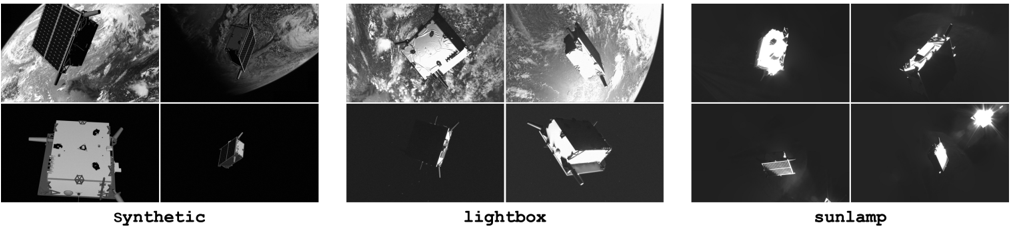
- SPEED+ contains 59,960 synthetic images split 80:20 for train/validation, plus 9,531 HIL images from TRON: 6,740 lightbox and 2,791 sunlamp test images. The abstract describes “60,000 synthetic images for training” and “9,531 hardware-in-the-loop images.”
- Synthetic-only baselines show a large domain gap. For KRN, errors rise from 0.14 m / 3.69° on synthetic to 2.25 m / 44.53° on lightbox and 14.64 m / 80.95° on sunlamp. HigherHRNet degrades less: 0.97 m / 34.71° on lightbox and 0.85 m / 47.75° on sunlamp.
- Domain-bridging helps but does not close the gap. For KRN on lightbox, synthetic-only gives 2.25 m / 44.53° / pose 1.12; style augmentation gives 1.06 m / 36.14° / 0.81; DANN gives 0.95 m / 33.62° / 0.74; oracle is 0.24 ± 0.04 m / 6.15 ± 0.61° / 0.15 ± 0.01. On sunlamp, synthetic-only gives 14.64 m / 80.95° / 3.73; style augmentation gives 1.32 m / 62.85° / 1.32; DANN gives 2.04 m / 65.37° / 1.47; oracle is 0.19 ± 0.02 m / 5.33 ± 0.36° / 0.13 ± 0.01.
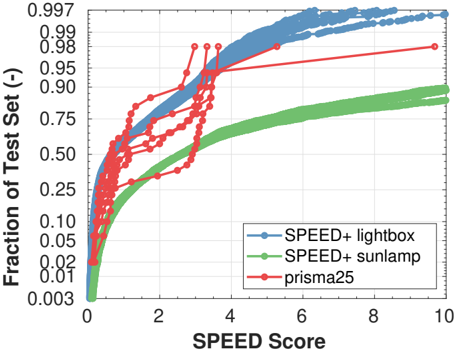
- The paper reports that SPEED+ HIL images retain learnable features, as shown by oracle performance, and that KRN SPEED-score distributions on PRISMA flight images “more or less overlap” with those on SPEED+ HIL images, supporting HIL images as surrogates for flight images in robustness analysis.
Methods
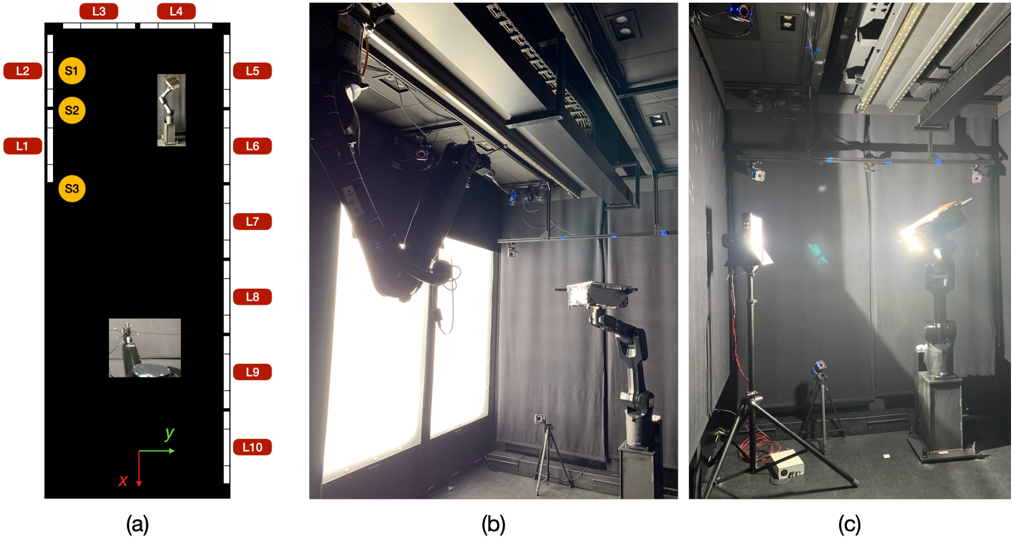
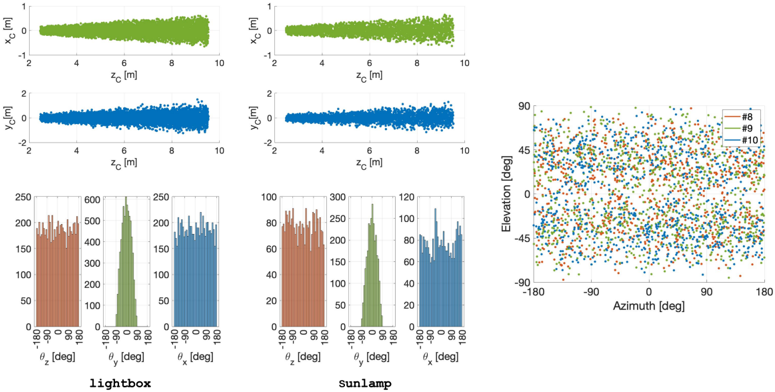
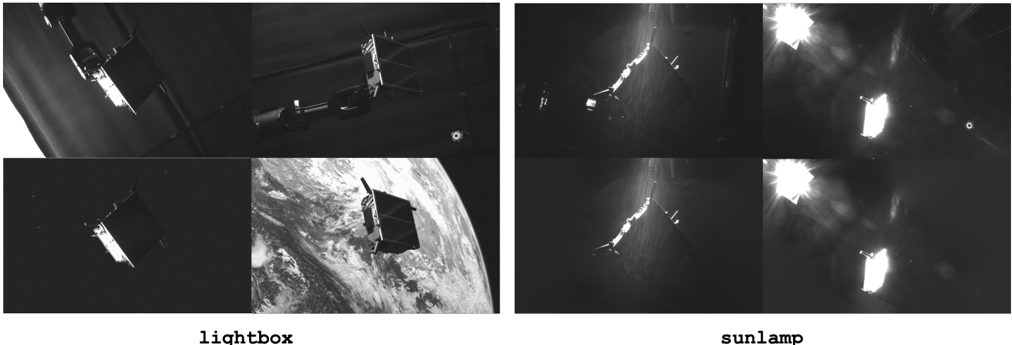
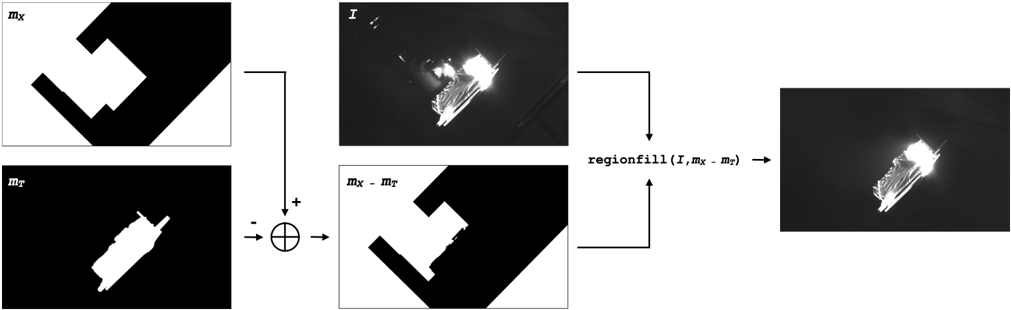
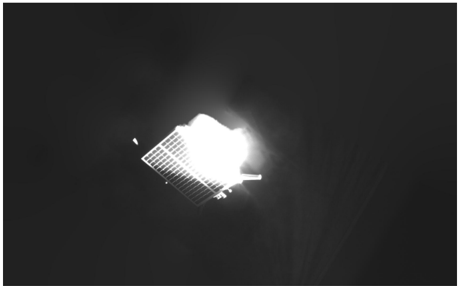
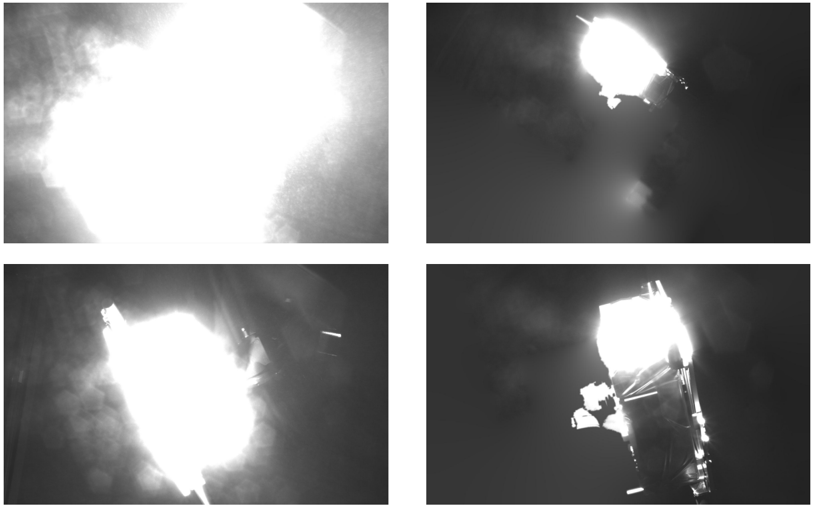
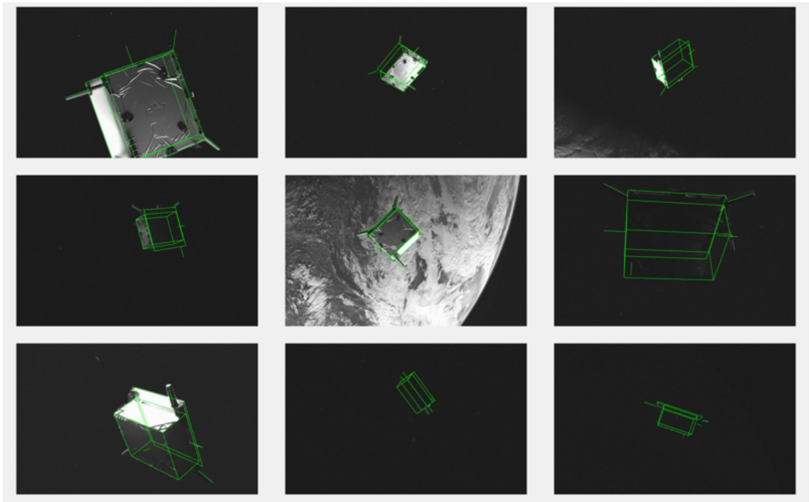
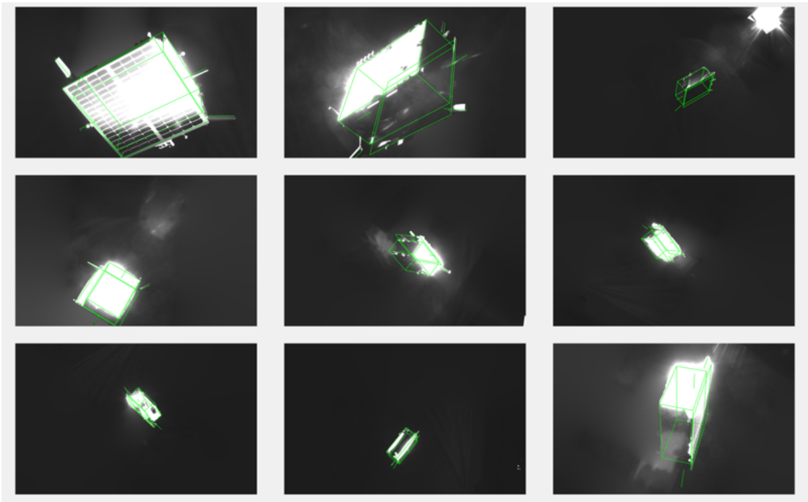
- Dataset construction: synthetic images were rendered with the OpenGL-based Optical Stimulator of SLAB’s multi-Satellite Software Simulator. HIL images were captured in the TRON facility using two KUKA robot arms, Vicon tracking, 10 Earth-albedo lightboxes, and a sun lamp, with a half-scale Tango spacecraft mockup. A total of 10,000 pose labels were generated, divided into 10 illumination configurations, post-processed, and manually filtered to leave 6,740 lightbox and 2,791 sunlamp images.
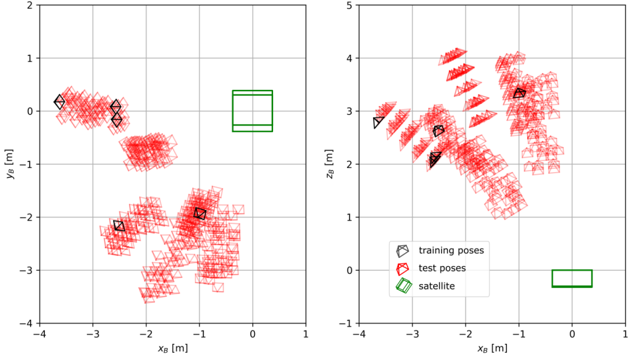
- Baseline experiments: three pose estimation CNNs—SPN, KRN, and HigherHRNet with EPnP—were trained on synthetic images and tested on HIL domains. DANN and style augmentation were applied to KRN as domain-bridging benchmarks. Oracle performance was approximated by 5-fold cross-validation on each HIL domain, and KRN was also evaluated on the 25-image prisma25 flight dataset.
- Metrics: position error, orientation error, and pose error/SPEED score. SPEC2021 uses a modified pose error with thresholds θ_q = 0.169° for orientation and θ_t = 2.173 mm/m for normalized translation.
Limitations
- The paper states that SPEED+ currently contains images of a single known target; future sequels will include more targets, and the KUKA robot arms will undergo a pending update to enable more accurate pose labeling with less human intervention for sample rejection.
- The paper states that in real missions the servicer typically does not have target images until rendezvous, but SPEC2021 makes unlabeled lightbox and sunlamp images public to encourage participation; these operational constraints are not enforced.
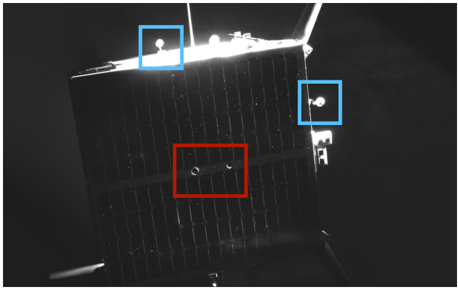
- The paper states that the baseline studies are intended to characterize the dataset rather than identify the best architecture or algorithm, with more comprehensive analysis planned after the competition. Evident from the text: HIL test images are unlabeled, manual sample rejection was required, retained artifacts include infrared markers, mounting holes, and unnatural surface glow, and calibration may allow up to centimeter-level position error beyond close range.
Model-written summary. Check it against the paper before relying on it.
Integrity signals
Registry
Cites
Statistics
Figures





Verification
Claims the paper makes
10 Valid · 7 Not valid · 5 Not checked · 37 Own results and interpretations
Every source the paper cites for this claim was checked and supports it.
In the paper
“TRON is a first-of-akind robotic testbed capable of capturing an arbitrary number of target images with accurate and maximally diverse pose labels and high-fidelity spaceborne illumination conditions.”
What the sources say
- Supportedcites [33] [33] T. H. Park, J. Bosse, and S. D'Amico, 'Robotic testbed for rendezvous and optical navigation: Multi-source calibration and machine learning use cases,' in 2021 AAS/AIAA Astrodynamics Specialist Conference, Big Sky, Vitrual , August 9-11 2021. - source
The Conclusion (p. 18) calls TRON a first-of-a-kind robotic testbed and says it can generate an arbitrary number of target images with maximally diverse pose distribution. It also reports millimeter-level position and millidegree-level orientation accuracy for the pose estimates and describes lighting that emulates diffuse and direct sources encountered in space. (LLM, conf=0.94)
plain- Asserted: passes — The authors put it forward as true.
- Checkable: passes — It can be checked against evidence.
- Load-bearing: passes — The paper’s conclusions depend on it.
- Based: passes — The paper gives a reason why it holds.
- Supported
Every source the paper cites for this claim was checked and supports it.
In the paper
“The measurements from both sources are used to jointly calibrate the facility, which allows the user to recover the true pose label of the target with respect to the camera from available measurements of an arbitrary sample with millimeter position and sub-degree orientation accuracies at close range.”
What the sources say
- Supportedcites [33] [33] T. H. Park, J. Bosse, and S. D'Amico, 'Robotic testbed for rendezvous and optical navigation: Multi-source calibration and machine learning use cases,' in 2021 AAS/AIAA Astrodynamics Specialist Conference, Big Sky, Vitrual , August 9-11 2021. - source
The Introduction (p. 4) says the calibration reconstructs the target’s pose from KUKA or Vicon measurements and that the resulting camera-relative poses achieve, on average, millimeter-level position and sub-degree orientation accuracy at close range. The Experiment (p. 12) describes validation on a trajectory of arbitrary relative poses. (LLM, conf=0.92)
plainstates a cause- Asserted: passes — The authors put it forward as true.
- Checkable: passes — It can be checked against evidence.
- Load-bearing: passes — The paper’s conclusions depend on it.
- Based: passes — The paper gives a reason why it holds.
- Supported
The cited sources support only part of this claim — read each source’s verdict below.
In the paper
“Existing datasets, such as Spacecraft PosE Estimation Dataset (SPEED), have so far mostly relied on synthetic images for both training and validation, which are easy to mass-produce but fail to resemble the visual features and illumination variability inherent to the target spaceborne images.”
What the sources say
- Partly supportedcites [16] [16] S. Sharma, T. H. Park, and S. D'Amico, 'Spacecraft pose estimation dataset (speed),' Stanford Digital Repository. Available at: https://doi.org/10.25740/dz692fn7184, 2019. - sourceExperimental — accuracy not yet measured
The Introduction (p. 1) and Table I (p. 4) show that SPEED relied predominantly on synthetic images for training and testing. The real-image comparison (p. 4) identifies differences in texture and illumination, but the synthetic-dataset section (p. 3) says SPEED closely emulated illumination in actual flight imagery. The categorical claim that its images fail to resemble spaceborne illumination therefore overstates the source; the paper also does not establish the claim for existing datasets generally. (LLM, conf=0.87)
plainstates a cause- Asserted: passes — The authors put it forward as true.
- Checkable: passes — It can be checked against evidence.
- Load-bearing: passes — The paper’s conclusions depend on it.
- Based: passes — The paper gives a reason why it holds.
- Partly supported
The cited sources that could be checked couldn’t confirm or dispute this claim.
In the paper
“Specifically, the light boxes [34] are designed and calibrated to provide a uniform maximum radiance of 14 W/m 2 sr, which corresponds to the mean radiance from the Earth for an albedo coefficient of 0.3 [35] and a solar irradiance of 1366 W/m 2 [36].”
What the sources say
- Not matchedcites [34] [34] 'Verification of light-box devices for earth albedo simulation,' Technical Note, Stanford Space Rendezvous Lab (SLAB), January (2016). -
We searched by its title and found no matching paper.
- Could not verifycites [35] [35] D. Bhanderi and T. Bak, 'Modeling earth albedo for satellites in earth orbit,' in Proceedings of AIAA Conference on Guidance, Navigation and Control . AIAA, 2005, null ; Conference date: 15-08-2005 Through 1808-2005. - sourceExperimental — accuracy not yet measured
The Texture Randomization section (p. 9) mentions laboratory testbeds and the difficulty of reproducing space lighting, but does not describe light boxes. Searches for light-box calibration, 14 W/m² sr, Earth albedo, and solar irradiance found no passage in our copy addressing the claim. (LLM, conf=0.72)
- Not matchedcites [36] [36] E. ASTM, '490, standard solar constant and zero air mass solar spectral irradiance tables,' in Space Simulation and Applications of Space Technology , 2000. -
We searched by its title and found no matching paper.
plain- Asserted: passes — The authors put it forward as true.
- Checkable: passes — It can be checked against evidence.
- Load-bearing: unclear — It is unclear whether the paper’s conclusions depend on it.
- Based: passes — The paper gives a reason why it holds.
- Not matched
The cited sources support only part of this claim — read each source’s verdict below.
In the paper
“To the best of the authors' knowledge, the only publicly available benchmark dataset on spacecraft pose estimation with fully labeled images from multiple sources is the Spacecraft PosE Estimation Dataset (SPEED) [16] which consists of 15,300 images of the Tango spacecraft from the PRISMA mission [17, 18].”
What the sources say
- Partly supportedcites [16] [16] S. Sharma, T. H. Park, and S. D'Amico, 'Spacecraft pose estimation dataset (speed),' Stanford Digital Repository. Available at: https://doi.org/10.25740/dz692fn7184, 2019. - sourceExperimental — accuracy not yet measured
Section III (p. 2) describes SPEED as the first publicly available spacecraft-pose-estimation dataset, with synthetic and real Tango images; it does not establish that SPEED is the only such benchmark. Table I and Section III.C (p. 4) list 15,303 images, approximately 15,300, but say only five real images are provided with training labels, so the claim that all images are fully labeled is not supported. (LLM, conf=0.88)
- Not checked — no full text of the sourcecites [17] [17] S. D'Amico, M. Benn, and J. L. Jørgensen, 'Pose estimation of an uncooperative spacecraft from actual space imagery,' International Journal of Space Science and Engineering , vol. 2, no. 2, p. 171, 2014. - source
- Not checked — no full text of the sourcecites [18] [18] S. D'Amico, P. Bodin, M. Delpech, and R. Noteborn, 'PRISMA,' in Distributed Space Missions for Earth System Monitoring Space Technology Library , M. D'Errico, Ed., 2013, vol. 31, ch. 21, pp. 599-637. - source
hedged- Asserted: passes — The authors put it forward as true.
- Checkable: passes — It can be checked against evidence.
- Load-bearing: passes — The paper’s conclusions depend on it.
- Based: passes — The paper gives a reason why it holds.
- Partly supported
14 more claims · 1 with their cited sources checked
Create a free account to see all 59 claims and to verify the 2 references still open.
- Probably not a substantial claim. 30
- It may state two separate claims as one. 19
- The quote only partly states this claim. 1
Claims other papers make about this one
Each is checked against this paper’s own text: does it say what the citing paper says it does?
The source backs part of the claim, not all of it — or backs it for a different population, condition or comparison.
In the citing paper
“The origin of the domain gap comes from the two main limitations of the image rendering tool used to generate the training set.”
From Domain Generalization for In-Orbit 6D Pose Estimation (2025) · cites this paper as [55]
Experimental — accuracy not yet measuredThe source backs part of the claim, not all of it — or backs it for a different population, condition or comparison.
In the citing paper
“For example, in the SPEED + dataset [55], the Multi-Layer Insulation (MLI) represented in the CAD model is over-simplified compared to the actual one, as illustrated in Figure 4.”
From Domain Generalization for In-Orbit 6D Pose Estimation (2025) · cites this paper as [55]
Experimental — accuracy not yet measuredThe cited source says what the claim attributes to it.
In the citing paper
“Fourth, the domain gap exists between real and synthetically generated space-borne datasets that affect the performance and accuracy of learning-based architectures [21,23].”
From Transformer Network-Aided Relative Pose Estimation for Non-cooperative Spacecraft Using Vision Sensor (2024) · cites this paper as [23]
The cited source says what the claim attributes to it.
In the citing paper
“The lightbox domain consists of 6,740 images of the half-scale mockup model of the Tango spacecraft illuminated with albedo lightboxes to simulate diffuse light in the Earth's orbit, whereas the sunlamp domain contains 2,791 images of the same model illuminated with a metal halide arc lamp to simulate direct sunlight.”
From Robust multi-task learning and online refinement for spacecraft pose estimation across domain gap (2024) · cites this paper as Park et al., 2022
The cited source says what the claim attributes to it.
In the citing paper
“In addition to the standard data augmentation techniques, style augmentation (Jackson et al., 2019) is employed to randomize the style and inherent texture of the synthetic spacecraft via neural style transfer (Ghiasi et al., 2017), as done in the SPEED + baseline studies (Park et al., 2022).”
From Robust multi-task learning and online refinement for spacecraft pose estimation across domain gap (2024) · cites this paper as Park et al., 2022
1 more claim about this paper
Create a free account to see every claim other papers make about this one.
Citations
Cites
ImageNet classification with deep convolutional neural networks
Krizhevsky, A., Sutskever, I., & Hinton, G. E. (2017) · Communications of the ACM · doi:10.1145/3065386 · Cited by 112,155
MobileNetV2: Inverted Residuals and Linear Bottlenecks
Sandler, M., Howard, A., Zhu, M., Zhmoginov, A., & Chen, L.-C. (2018) · 2018 IEEE/CVF Conference on Computer Vision and Pattern Recognition · doi:10.1109/cvpr.2018.00474 · Cited by 28,755
Are we ready for autonomous driving? The KITTI vision benchmark suite
Geiger, A., Lenz, P., & Urtasun, R. (2012) · 2012 IEEE Conference on Computer Vision and Pattern Recognition · doi:10.1109/cvpr.2012.6248074 · Cited by 14,897 · cited 1×
“…to the spaceborne navigation is the semantic segmentation for autonomous driving, in which the large-scale synthetic images from gaming engines such as GTA V [29] or SYNTHIA [30] are used for training, whereas real street images available from KITTI [31] or Cityscapes [32] are used for testing.”
The Cityscapes Dataset for Semantic Urban Scene Understanding
Cordts, M., Omran, M., Ramos, S., Rehfeld, T., Enzweiler, M., Benenson, R., Franke, U., Roth, S., & Schiele, B. (2016) · 2016 IEEE Conference on Computer Vision and Pattern Recognition (CVPR) · doi:10.1109/cvpr.2016.350 · Cited by 12,433
Domain-Adversarial Training of Neural Networks
Ganin, Y., Ustinova, E., Ajakan, H., Germain, P., Larochelle, H., Laviolette, F., Marchand, M., & Lempitsky, V. (2017) · Advances in Computer Vision and Pattern Recognition · doi:10.1007/978-3-319-58347-1_10 · Cited by 8,318
EPnP: An Accurate O(n) Solution to the PnP Problem
Lepetit, V., Moreno-Noguer, F., & Fua, P. (2009) · International Journal of Computer Vision · doi:10.1007/s11263-008-0152-6 · Cited by 3,298
Domain randomization for transferring deep neural networks from simulation to the real world
Tobin, J., Fong, R., Ray, A., Schneider, J., Zaremba, W., & Abbeel, P. (2017) · 2017 IEEE/RSJ International Conference on Intelligent Robots and Systems (IROS) · doi:10.1109/iros.2017.8202133 · Cited by 3,124 · cited 2×
“While it is possible to train a more domain-invariant CNN model using methods such as domain randomization [13,14] and texture randomization [4, 15], its use in space missions requires a validation of performance in a highly representative space environment prior to mission deployment.”
Adapting visual category models to new domains
Saenko, K., Kulis, B., Fritz, M., & Darrell, T. (2010) · Lecture Notes in Computer Science · doi:10.1007/978-3-642-15561-1_16 · Cited by 2,847 · cited 1×
“A number of datasets with emphasis on domain gap are available for terrestrial computer vision applications, such as Office-31 [26], Syn2Real [12, 27], and DomainNet [28] for various tasks such as classification, object detection and semantic segmentation.”
Unsupervised Domain Adaptation by Backpropagation
Ganin, Y., & Lempitsky, V. (2014) · arXiv (Cornell University) · doi:10.48550/arxiv.1409.7495 · Cited by 2,521
Ros, G., Sellart, L., Materzynska, J., Vazquez, D., & Lopez, A. M. (2016) · 2016 IEEE Conference on Computer Vision and Pattern Recognition (CVPR) · doi:10.1109/cvpr.2016.352 · Cited by 2,338
Analysis of Representations for Domain Adaptation
Ben-David, S., Blitzer, J., Crammer, K., & Pereira, F. (2007) · Advances in Neural Information Processing Systems 19 · doi:10.7551/mitpress/7503.003.0022 · Cited by 2,019 · cited 2×
“The phenomenon is known as domain gap in literature and is an active field of research in machine learning [11,12].”
Fixing Weight Decay Regularization in Adam
Loshchilov, I., & Hutter, F. (2018) · Cited by 1,996
Playing for Data: Ground Truth from Computer Games
Richter, S. R., Vineet, V., Roth, S., & Koltun, V. (2016) · Lecture Notes in Computer Science · doi:10.1007/978-3-319-46475-6_7 · Cited by 1,815 · cited 1×
“…to the spaceborne navigation is the semantic segmentation for autonomous driving, in which the large-scale synthetic images from gaming engines such as GTA V [29] or SYNTHIA [30] are used for training, whereas real street images available from KITTI [31] or Cityscapes [32] are used for testing.”
Moment Matching for Multi-Source Domain Adaptation
Peng, X., Bai, Q., Xia, X., Huang, Z., Saenko, K., & Wang, B. (2019) · 2019 IEEE/CVF International Conference on Computer Vision (ICCV) · doi:10.1109/iccv.2019.00149 · Cited by 1,621
An Introduction to Himawari-8/9— Japan’s New-Generation Geostationary Meteorological Satellites
BESSHO, K., DATE, K., HAYASHI, M., IKEDA, A., IMAI, T., INOUE, H., KUMAGAI, Y., MIYAKAWA, T., MURATA, H., OHNO, T., et al. (2016) · Journal of the Meteorological Society of Japan. Ser. II · doi:10.2151/jmsj.2016-009 · Cited by 1,512
Geirhos, R., Rubisch, P., Michaelis, C., Bethge, M., Wichmann, F. A., & Brendel, W. (2018) · arXiv · doi:10.48550/arxiv.1811.12231 · Cited by 1,490 · cited 1×
“While it is possible to train a more domain-invariant CNN model using methods such as domain randomization [13,14] and texture randomization [4, 15], its use in space missions requires a validation of performance in a highly representative space environment prior to mission deployment.”
HigherHRNet: Scale-Aware Representation Learning for Bottom-Up Human Pose Estimation
Cheng, B., Xiao, B., Wang, J., Shi, H., Huang, T. S., & Zhang, L. (2020) · 2020 IEEE/CVF Conference on Computer Vision and Pattern Recognition (CVPR) · doi:10.1109/cvpr42600.2020.00543 · Cited by 1,023
VisDA: The Visual Domain Adaptation Challenge
Peng, X., Usman, B., Kaushik, N., Hoffman, J., Wang, D., & Saenko, K. (2017) · arXiv (Cornell University) · doi:10.48550/arxiv.1710.06924 · Cited by 504
Exploring the structure of a real-time, arbitrary neural artistic stylization network
Ghiasi, G., Lee, H., Kudlur, M., Dumoulin, V., & Shlens, J. (2017) · Procedings of the British Machine Vision Conference 2017 · doi:10.5244/c.31.114 · Cited by 306
Satellite Pose Estimation Challenge: Dataset, Competition Design, and Results
Kisantal, M., Sharma, S., Park, T. H., Izzo, D., Martens, M., & D'Amico, S. (2020) · IEEE Transactions on Aerospace and Electronic Systems · doi:10.1109/taes.2020.2989063 · Cited by 304 · cited 1×
“The pose error, also known as the SPEED score, was the official competition metric used in SPEC2019, chosen as it has shown to properly balance the contribution of the position and orientation errors [5].”
Self-citationSpacecraft pose estimation dataset (speed)
Sharma, S., Park, T. H., & D'Amico, S. (2026) · Stanford Digital Repository · doi:10.25740/dz692fn7184 · Cited by 304
Self-citationDeep Learning for Spacecraft Pose Estimation from Photorealistic Rendering
Proenca, P. F., & Gao, Y. (2019) · arXiv · Cited by 251
Deep Learning for Spacecraft Pose Estimation from Photorealistic Rendering
Proenca, P. F., & Gao, Y. (2020) · 2020 IEEE International Conference on Robotics and Automation (ICRA) · doi:10.1109/icra40945.2020.9197244 · Cited by 229 · cited 3×
“Moreover, these images mostly lack accurate pose labels, which has forced the previous evaluations to be strictly qualitative [8] or based on hand-labeled pose annotations [10].”
RemoveDEBRIS: An in-orbit active debris removal demonstration mission
Forshaw, J. L., Aglietti, G. S., Navarathinam, N., Kadhem, H., Salmon, T., Pisseloup, A., Joffre, E., Chabot, T., Retat, I., Axthelm, R., et al. (2016) · Acta Astronautica · doi:10.1016/j.actaastro.2016.06.018 · Cited by 217 · cited 1×
“Autonomous navigation about a noncooperative Resident Space Object (RSO) is an enabling technology for future inorbit servicing and space logistics missions, such as refueling space assets [1] and active debris removal [2].”
Pose estimation for non-cooperative spacecraft rendezvous using convolutional neural networks
Sharma, S., Beierle, C., & D'Amico, S. (2018) · 2018 IEEE Aerospace Conference · doi:10.1109/aero.2018.8396425 · Cited by 207
Self-citationPose estimation for non-cooperative spacecraft rendezvous using convolutional neural networks
Sharma, S., Beierle, C., & D'Amico, S. (2018) · IEEE Aerospace Conference · doi:10.48550/arxiv.1809.07238 · Cited by 207
Self-citationSatellite Pose Estimation with Deep Landmark Regression and Nonlinear Pose Refinement
Chen, B., Cao, J., Parra, A., & Chin, T.-J. (2019) · 2019 IEEE/CVF International Conference on Computer Vision Workshop (ICCVW) · doi:10.1109/iccvw.2019.00343 · Cited by 203
Neural Network-Based Pose Estimation for Noncooperative Spacecraft Rendezvous
Sharma, S., & D'Amico, S. (2020) · IEEE Transactions on Aerospace and Electronic Systems · doi:10.1109/taes.2020.2999148 · Cited by 196 · cited 1×
“The post-processing procedure for lightbox images loosely follows that of the synthetic imagery of SPEED detailed in [3, 39].”
Self-citationVisDA: A Synthetic-to-Real Benchmark for Visual Domain Adaptation
Peng, X., Usman, B., Kaushik, N., Wang, D., Hoffman, J., & Saenko, K. (2018) · 2018 IEEE/CVF Conference on Computer Vision and Pattern Recognition Workshops (CVPRW) · doi:10.1109/cvprw.2018.00271 · Cited by 196
Shoemake, K. (1992) · Graphics Gems III (IBM Version) · doi:10.1016/b978-0-08-050755-2.50036-1 · Cited by 142
Pose estimation of an uncooperative spacecraft from actual space imagery
D', S., Amico, N. A., Benn, M., & Jørgensen, J. L. (2014) · International Journal of Space Science and Engineering · doi:10.1504/ijspacese.2014.060600 · Cited by 132
The Restore-L Servicing Mission
Reed, B. B., Smith, R. C., Naasz, B. J., Pellegrino, J. F., & Bacon, C. E. (2016) · AIAA SPACE 2016 · doi:10.2514/6.2016-5478 · Cited by 119 · cited 1×
“Autonomous navigation about a noncooperative Resident Space Object (RSO) is an enabling technology for future in-orbit servicing and space logistics missions, such as refueling space assets [1] and active debris removal [2].”
Playing for Data: Ground Truth from Computer Games
Richter, S. R., Vineet, V., Roth, S., & Koltun, V. (2016) · arXiv (Cornell University) · doi:10.48550/arxiv.1608.02192 · Cited by 118
Style Augmentation: Data Augmentation via Style Randomization
Jackson, P. T., Atapour–Abarghouei, A., Bonner, S., Breckon, T. P., & Obara, B. (2018) · Durham Research Online (Durham University) · doi:10.48550/arxiv.1809.05375 · Cited by 109
Zappulla, R., Virgili-Llop, J., Zagaris, C., Park, H., & Romano, M. (2017) · Journal of Spacecraft and Rockets · doi:10.2514/1.a33769 · Cited by 83
DeceptionNet: Network-Driven Domain Randomization
Zakharov, S., Kehl, W., & Ilic, S. (2019) · 2019 IEEE/CVF International Conference on Computer Vision (ICCV) · doi:10.1109/iccv.2019.00062 · Cited by 78
A Spacecraft Dataset for Detection, Segmentation and Parts Recognition
Dung, H. A., Chen, B., & Chin, T.-J. (2021) · 2021 IEEE/CVF Conference on Computer Vision and Pattern Recognition Workshops (CVPRW) · doi:10.1109/cvprw53098.2021.00229 · Cited by 69
Towards Robust Learning-Based Pose Estimation of Noncooperative Spacecraft
Park, T. H., Sharma, S., & D'Amico, S. (2019) · arXiv · doi:10.48550/arxiv.1909.00392 · Cited by 65 · cited 4×
“While it is possible to train a more domain-invariant CNN model using methods such as domain randomization [13,14] and texture randomization [4, 15], its use in space missions requires a validation of performance in a highly representative space environment prior to mission deployment.”
InfluentialSelf-citationA Six Degree-of-Freedom Spacecraft Dynamics Simulator for Formation Control Research
Nakka, Y. K., Foust, R., Lupu, E. S., Elliott, D. B., Crowell, I. S., Chung, S., & Hadaegh, F. Y. (2018) · CaltechAUTHORS (California Institute of Technology) · Cited by 55
Standard Solar Constant and Zero Air Mass Solar Spectral Irradiance Tables
E21 Committee (2008) · doi:10.1520/e0490 · Cited by 44
Pose Estimation for Non-Cooperative Rendezvous Using Neural Networks
Sharma, S., & D'Amico, S. (2019) · arXiv · Cited by 40
Self-citationSyn2Real: A New Benchmark forSynthetic-to-Real Visual Domain Adaptation
Peng, X., Usman, B., Saito, K., Kaushik, N., Hoffman, J., & Saenko, K. (2018) · arXiv (Cornell University) · doi:10.48550/arxiv.1806.09755 · Cited by 38
Modeling Earth Albedo for Satellites in Earth Orbit
(2005) · doi:10.2514/6.2005-6465 · Cited by 36
CNN-Based Pose Estimation System for Close-Proximity Operations Around Uncooperative Spacecraft
Pasqualetto Cassinis, L., Fonod, R., Gill, E., Ahrns, I., & Gil Fernandez, J. (2020) · AIAA Scitech 2020 Forum · doi:10.2514/6.2020-1457 · Cited by 36
Beierle, C., & D’Amico, S. (2019) · Journal of Spacecraft and Rockets · doi:10.2514/1.a34337 · Cited by 29 · cited 3×
“The readers are referred to Beierle [20] for more details.”
InfluentialSelf-citationDevelopment of the Stanford GNSS Navigation Testbed for Distributed Space Systems
Giralo, V., & D'Amico, S. (2018) · The International Technical Meeting of the The Institute of Navigation · doi:10.33012/2018.15544 · Cited by 27
Self-citationD’Amico, S., Bodin, P., Delpech, M., & Noteborn, R. (2013) · Distributed Space Missions for Earth System Monitoring · doi:10.1007/978-1-4614-4541-8_21 · Cited by 24
Self-citationReal-Time, Flight-Ready, Non-Cooperative Spacecraft Pose Estimation Using Monocular Imagery
Black, K., Shankar, S., Fonseka, D., Deutsch, J., Dhir, A., & Akella, M. R. (2021) · arXiv (Cornell University) · doi:10.48550/arxiv.2101.09553 · Cited by 20
Spacecraft Pose Estimation Dataset (SPEED)
Kisantal, M., Sharma, S. K., Park, T. H., Izzo, D., Märtens, M., & D’Amico, S. (2019) · Zenodo (CERN European Organization for Nuclear Research) · doi:10.5281/zenodo.6327546 · Cited by 18
Self-citationSpacecraft Pose Estimation Dataset (SPEED)
(2019) · doi:10.5281/zenodo.6327547 · Cited by 12
Self-citationNext Generation Spacecraft Pose Estimation Dataset (SPEED+)
Park, T. H., Märtens, M., Lécuyer, G., Izzo, D., & D’Amico, S. (2021) · Zenodo (CERN European Organization for Nuclear Research) · doi:10.25740/wv398fc4383 · Cited by 10
Self-citationPark, T. H., Bosse, J., & D'Amico, S. (2021) · arXiv · doi:10.48550/arxiv.2108.05529 · Cited by 10 · cited 4×
“Specifically, from the calibration results of the TRON facility [33], the following best-performance thresholds are determined: θ q = 0.169 ◦ for orientation and θ t = 2.173 mm/m for normalized translation.”
InfluentialSelf-citationOn-Ground Validation of a CNN-based Monocular Pose Estimation System for Uncooperative Spacecraft
Cassinis, L. P., Menicucci, A., Gill, E. K. A., Ahrns, I., & Fernandez, J. G. (2021) · European Conference on Space Debris · Cited by 7
Research works printed but not linked: 4
- [37] 'Vero: Compact super wide camera by vicon,' https:// www.vicon.com/hardware/cameras/vero/, accessed April 29, 2021. -
- [34] 'Verification of light-box devices for earth albedo simulation,' Technical Note, Stanford Space Rendezvous Lab (SLAB), January (2016). -
- [23] P. Tsiotras, 'Astros: A 5dof experimental facility for research in space proximity operations,' Advances in the Astronautical Sciences , vol. 151, pp. 717-730, 01 2014. -
- [3] S. Sharma and S. D'Amico, 'Pose estimation for noncooperative spacecraft rendezvous using neural networks,' in 2019 AAS/AIAA Space Flight Mechanics Meeting, Ka'anapali, Maui, HI , January 13-17 2019. -
Cited by
Robust multi-task learning and online refinement for spacecraft pose estimation across domain gap
Park, T. H., & D’Amico, S. (2024) · Advances in Space Research · doi:10.1016/j.asr.2023.03.036 · Cited by 125
“To address this issue, SPEED + (Park et al., 2021b, 2022) has been recently introduced with two distinct HIL image domains, lightbox and sunlamp , that are captured from the upgraded TRON facility at SLAB (Park et al., 2021a).”
BackgroundMethodResultInfluentialSelf-citationSatellite Pose Estimation Competition 2021: Results and Analyses
Park, T. H., Märtens, M., Jawaid, M., Wang, Z., Chen, B., Chin, T.-J., Izzo, D., & D’Amico, S. (2023) · Acta Astronautica · doi:10.1016/j.actaastro.2023.01.002 · Cited by 91
Self-citationWang, Z., Chen, M., Guo, Y., Li, Z., & Yu, Q. (2024) · IEEE Transactions on Aerospace and Electronic Systems · doi:10.1109/taes.2023.3250385 · Cited by 64
“Table I lists the experimental results of ours and 3 meth-ods reported by Park et al. [22].”
BackgroundMethodResultInfluentialPVSPE: A pyramid vision multitask transformer network for spacecraft pose estimation
Yang, H., Xiao, X., Yao, M., Xiong, Y., Cui, H., & Fu, Y. (2024) · Advances in Space Research · doi:10.1016/j.asr.2024.05.011 · Cited by 41
Zero-G Lab: A multi-purpose facility for emulating space operations
Olivares-Méndez, M. A., Makhdoomi, M. R., Yalçın, B. C., Bokal, Z. M., Muralidharan, V., del Castillo, M. O., Gaudillière, V., Pauly, L., Borgue, O., Alandihallaj, M. A., et al. (2023) · Journal of Space Safety Engineering · doi:10.1016/j.jsse.2023.09.003 · Cited by 35
Metadata
- Authors
- Park, T. H., Martens, M., Lecuyer, G., Izzo, D., & D'Amico, S.
- Affiliations
- Stanford University (US)
- Advanced Concepts Team European Space Agency,Noordwijk,AZ,The Netherlands,2201
- European Space Agency (FR)
- Stanford University,Department of Aeronautics & Astronautics,Stanford,CA,94305
- Venue
- 2022 IEEE Aerospace Conference (AERO)
- Publisher
- IEEE
- Published
- 2022-03-05
- Pages
- 1-15
- ISSN
- 1095-323X (ISSN-L)
- OpenAlex
- W3202897977
- Semantic Scholar
- c8c5228200f210669f35b65e4aab799baecc221d
- Cited by
- 170
- References
- 46
- Citations by year
- 2026: 32 · 2025: 64 · 2024: 40 · 2023: 31 · 2022: 3
- FWCI
- 60.27
- Type
- conference paper
- Language
- en
- Open access
- green
- arxiv.org
- Locations
- IEEE Aerospace Conference (AERO) (publishedVersion)
- arXiv (Cornell University) (submittedVersion)
- arXiv (Cornell University)
- Topics
- Physical Sciences › Engineering › Aerospace Engineering › Space Satellite Systems and Control
- Physical Sciences › Engineering › Aerospace Engineering › Spacecraft Dynamics and Control
- Physical Sciences › Computer Science › Computer Vision and Pattern Recognition › Advanced Neural Network Applications
- Keywords
- spacecraft pose estimation, spacecraft navigation, domain gap, synthetic images, illumination variation, on-orbit servicing, space logistics, visual navigation
About these checks
Registry, retraction, Cites and statistics results are computed, not judged, with one exception: a printed reference that no index lists is read once by a model before it counts as a citation error. Claims are extracted by a model and kept only when their quote appears verbatim in the text; each cited source is then checked, with a model’s help, for whether it says what the claim relies on. Those verdicts can be wrong — read the claim’s quote and the cited source before relying on one.
The claim verdicts this report counts are experimental: their accuracy is not yet measured.
A language model drew the claims from the paper on 2026-09-28, under version 3 of the claim definition (prompt extract-v3).
A second model labelled each claim on 2026-09-28 (model jev-1.13-20260917, definition revision gold-guideline-v0.2).
Cited sources are checked with a language model’s help (gpt-6-sol).
Statistics and arithmetic are recomputed, not judged.
Confidence bands are shown only for fields calibrated on our annotated test set. None is calibrated yet, so no band is shown.
What counts as a claim ›How we measure confidence ›How we check this ›
Are you an author, or do you see a problem with this page? Request a review
Data sources
Bibliographic data: Semantic Scholar, OpenAlex, Crossref.
Contains information from the Semantic Scholar Academic Graph Datasets, made available under the ODC Attribution License (ODC-BY 1.0).
Semantic Scholar’s data is described in: Kinney, R., et al. (2023). The Semantic Scholar Open Data Platform. arXiv:2301.10140.
