

Balancing of competitive two-player Game Levels with Reinforcement Learning
Open accessThe DOI matches its Crossref record; 27 of the 27 references it cites were found in a registry or an index.
Abstract
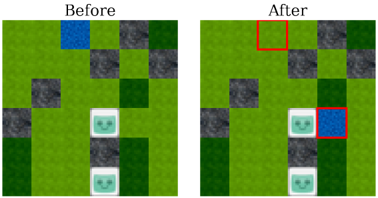
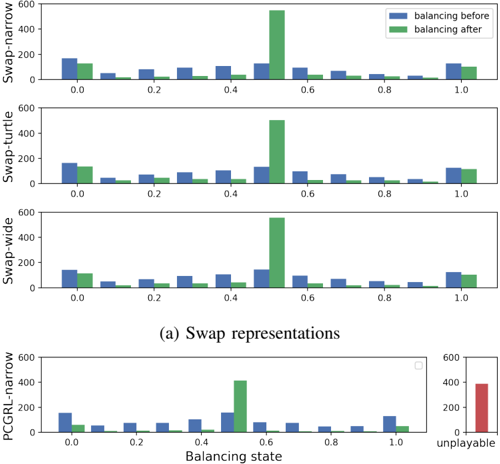
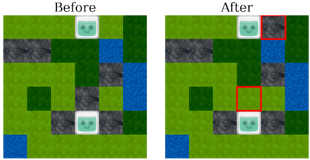
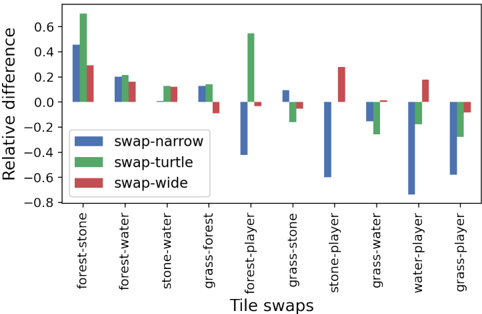
The balancing process for game levels in a competitive two-player context involves a lot of manual work and testing, particularly in non-symmetrical game levels. In this paper, we propose an architecture for automated balancing of tile-based levels within the recently introduced PCGRL framework (procedural content generation via reinforcement learning).Our architecture is divided into three parts: (1) a level generator, (2) a balancing agent and, (3) a reward modeling simulation. By playing the level in a simulation repeatedly, the balancing agent is rewarded for modifying it towards the same win rates for all players. To this end, we introduce a novel family of swap-based representations to increase robustness towards playability. We show that this approach is capable to teach an agent how to alter a level for balancing better and faster than plain PCGRL. In addition, by analyzing the agent’s swapping behavior, we can draw conclusions about which tile types influence the balancing most. We test and show our results using the Neural MMO (NMMO) environment in a competitive two-player setting.
Overview
The claims and statistics of this paper haven’t been checked yet.
Free: it reads the open-access text and checks the first 5 claims that cite a source we can check. Create a free account to check every claim.
Integrity signals
Registry
Cites
Statistics
Figures

Verification
Claims the paper makes
The claims and statistics of this paper haven’t been checked yet.
Free: it reads the open-access text and checks the first 5 claims that cite a source we can check. Create a free account to check every claim.
Claims other papers make about this one
Each is checked against this paper’s own text: does it say what the citing paper says it does?
The source backs part of the claim, not all of it — or backs it for a different population, condition or comparison.
In the citing paper
“In a direct comparison, the training using the smaller action space converges faster for all models and allows for higher rewards, resulting in overall better performance, in particular for type A vs. A (cf. Table 1 and also [12,13]).”
From Level the Level: Balancing Game Levels for Asymmetric Player Archetypes With Reinforcement Learning (2025) · cites this paper as [12]
Experimental — accuracy not yet measuredThe cited source says what the claim attributes to it.
In the citing paper
“Balancing is considered as a fine-tuning process for existing levels, which has been shown to converge faster as when levels are generated and balanced in a single step [12].”
From Level the Level: Balancing Game Levels for Asymmetric Player Archetypes With Reinforcement Learning (2025) · cites this paper as [12]
The cited source says what the claim attributes to it.
In the citing paper
“This approach is, however, limited by the fact that it only uses exactly the same archetype of agents playing against each other.”
From Level the Level: Balancing Game Levels for Asymmetric Player Archetypes With Reinforcement Learning (2025) · cites this paper as [12]
Experimental — accuracy not yet measured
Self-check
Percentages, sums and reported differences re-computed from the paper’s own numbers.
The self-check needs the paper’s full text.
Citations
Cites
Proximal Policy Optimization Algorithms
Schulman, J., Wolski, F., Dhariwal, P., Radford, A., & Klimov, O. (2017) · arXiv · doi:10.48550/arxiv.1707.06347 · Cited by 40,403 · cited 1×
“As RL algorithm, we apply PPO (proximal policy optimization) [28].”
MethodA general reinforcement learning algorithm that masters chess, shogi, and Go through self-play
Silver, D., Hubert, T., Schrittwieser, J., Antonoglou, I., Lai, M., Guez, A., Lanctot, M., Sifre, L., Kumaran, D., Graepel, T., et al. (2018) · Science · doi:10.1126/science.aar6404 · Cited by 3,562 · cited 1×
“In the games community, RL has been widely applied to play games [20], [21], but recently, it has also been used for PCG [9], [22], [23].”
MethodGrandmaster level in StarCraft II using multi-agent reinforcement learning
Vinyals, O., Babuschkin, I., Czarnecki, W. M., Mathieu, M., Dudzik, A., Chung, J., Choi, D. H., Powell, R., Ewalds, T., Georgiev, P., et al. (2019) · Nature · doi:10.1038/s41586-019-1724-z · Cited by 3,455 · cited 1×
“In the games community, RL has been widely applied to play games [20], [21], but recently, it has also been used for PCG [9], [22], [23].”
Method(1978) · Medical Entomology and Zoology · Cited by 1,199
Search-Based Procedural Content Generation: A Taxonomy and Survey
Togelius, J., Yannakakis, G. N., Stanley, K. O., & Browne, C. (2011) · IEEE Transactions on Computational Intelligence and AI in Games · doi:10.1109/tciaig.2011.2148116 · Cited by 706 · cited 3×
“PCG methods span over from dedicated algorithms [14], search based methods [3] up to the use of machine learning [15] and deep learning [16]–[19].”
BackgroundMethodProcedural Content Generation via Machine Learning (PCGML)
Summerville, A., Snodgrass, S., Guzdial, M., Holmgard, C., Hoover, A. K., Isaksen, A., Nealen, A., & Togelius, J. (2018) · IEEE Transactions on Games · doi:10.1109/tg.2018.2846639 · Cited by 425
PCGRL: Procedural Content Generation via Reinforcement Learning
Khalifa, A., Bontrager, P., Earle, S., & Togelius, J. (2020) · Proceedings of the AAAI Conference on Artificial Intelligence and Interactive Digital Entertainment · doi:10.1609/aiide.v16i1.7416 · Cited by 156
Deep learning for procedural content generation
Liu, J., Snodgrass, S., Khalifa, A., Risi, S., Yannakakis, G. N., & Togelius, J. (2021) · Neural Computing and Applications · doi:10.1007/s00521-020-05383-8 · Cited by 143
Dynamic Game Balancing: an Evaluation of User Satisfaction
Andrade, G., Ramalho, G., Gomes, A., & Corruble, V. (2006) · Proceedings of the AAAI Conference on Artificial Intelligence and Interactive Digital Entertainment · doi:10.1609/aiide.v2i1.18739 · Cited by 78 · cited 1×
“will result in boredom or frustration and players will quit playing [1], [2].”
BackgroundDOOM Level Generation Using Generative Adversarial Networks
Giacomello, E., Lanzi, P. L., & Loiacono, D. (2018) · IEEE Games, Entertainment, Media Conference (GEM) · doi:10.1109/gem.2018.8516539 · Cited by 68
Learning to Generate Levels From Nothing
Bontrager, P., & Togelius, J. (2021) · IEEE Conference on Games (CoG) · doi:10.1109/cog52621.2021.9619131 · Cited by 53 · cited 1×
“com/en-gb/news/dev/dev-balanceframework-update/ In the games community, RL has been widely applied to play games [20], [21], but recently, it has also been used for PCG [9], [22], [23].”
MethodTOAD-GAN: Coherent Style Level Generation from a Single Example
Awiszus, M., Schubert, F., & Rosenhahn, B. (2020) · Proceedings of the AAAI Conference on Artificial Intelligence and Interactive Digital Entertainment · doi:10.1609/aiide.v16i1.7401 · Cited by 52
Adversarial Reinforcement Learning for Procedural Content Generation
Gisslen, L., Eakins, A., Gordillo, C., Bergdahl, J., & Tollmar, K. (2021) · 2021 IEEE Conference on Games (CoG) · doi:10.1109/cog52621.2021.9619053 · Cited by 51 · cited 1×
“com/en-gb/news/dev/dev-balanceframework-update/ In the games community, RL has been widely applied to play games [20], [21], but recently, it has also been used for PCG [9], [22], [23].”
MethodControllable procedural map generation via multiobjective evolution
Togelius, J., Preuss, M., Beume, N., Wessing, S., Hagelbäck, J., Yannakakis, G. N., & Grappiolo, C. (2013) · Genetic Programming and Evolvable Machines · doi:10.1007/s10710-012-9174-5 · Cited by 48
Dungeons & Replicants: Automated Game Balancing via Deep Player Behavior Modeling
Pfau, J., Liapis, A., Volkmar, G., Yannakakis, G. N., & Malaka, R. (2020) · 2020 IEEE Conference on Games (CoG) · doi:10.1109/cog47356.2020.9231958 · Cited by 48
Neural MMO: A Massively Multiagent Game Environment for Training and Evaluating Intelligent Agents
Suárez, J., Du, Y., Isola, P., & Mordatch, I. (2019) · arXiv (Cornell University) · doi:10.48550/arxiv.1903.00784 · Cited by 41 · cited 2×
“As basis for our experiments, we use the NMMO environment [10].”
MethodLearning Controllable Content Generators
Earle, S., Edwards, M., Khalifa, A., Bontrager, P., & Togelius, J. (2021) · 2021 IEEE Conference on Games (CoG) · doi:10.1109/cog52621.2021.9619159 · Cited by 41
What is Game Balancing? - An Examination of Concepts
Becker, A., & Görlich, D. (2020) · ParadigmPlus · doi:10.55969/paradigmplus.v1n1a2 · Cited by 37
Learning Controllable 3D Level Generators
Jiang, Z., Earle, S., Green, M. C., & Togelius, J. (2022) · International Conference on the Foundations of Digital Games (FDG) · doi:10.1145/3555858.3563273 · Cited by 36 · cited 1×
“Other approaches use evolutionary strategies on top of the PCGRL framework to achieve more content diversity [25] or adapted the method for 3D environments [26].”
MethodUsing a Surrogate Model of Gameplay for Automated Level Design
Karavolos, D., Liapis, A., & Yannakakis, G. N. (2018) · IEEE Conference on Computational Intelligence and Games (CIG) · doi:10.1109/cig.2018.8490425 · Cited by 29 · cited 2×
“Several approaches have been proposed using procedural content generation (PCG) for level balancing in previous works, such as search-based approaches [3], [4], evolutionary algorithms [5]–[7] or graph grammars [8].”
MethodWorld-GAN: a Generative Model for Minecraft Worlds
Awiszus, M., Schubert, F., & Rosenhahn, B. (2021) · IEEE Conference on Games (CoG) · doi:10.1109/cog52621.2021.9619133 · Cited by 29
Evolving maps for match balancing in first person shooters
Lanzi, P. L., Loiacono, D., & Stucchi, R. (2014) · 2014 IEEE Conference on Computational Intelligence and Games · doi:10.1109/cig.2014.6932901 · Cited by 28 · cited 3×
“To automatically construct balanced levels with PCG, work has been introduced using evolutionary algorithms [5], [6].”
MethodOn balance and dynamism in procedural content generation with self-adaptive evolutionary algorithms
Lara-Cabrera, R., Cotta, C., & Fernández, A. J. (2014) · Natural Computing · doi:10.1007/s11047-014-9418-9 · Cited by 26 · cited 2×
“To automatically construct balanced levels with PCG, work has been introduced using evolutionary algorithms [5], [6].”
MethodPath of Destruction: Learning an Iterative Level Generator Using a Small Dataset
Siper, M., Khalifa, A., & Togelius, J. (2022) · IEEE Symposium Series on Computational Intelligence (SSCI) · doi:10.1109/ssci51031.2022.10022073 · Cited by 21 · cited 1×
“This repair is similar to the level fixing as in [27].”
ResultMutation Models: Learning to Generate Levels by Imitating Evolution
Khalifa, A., Togelius, J., & Green, M. C. (2022) · Proceedings of the 17th International Conference on the Foundations of Digital Games · doi:10.1145/3555858.3563267 · Cited by 13 · cited 1×
“Other approaches use evolutionary strategies on top of the PCGRL framework to achieve more content diversity [25] or adapted the method for 3D environments [26].”
MethodSorochan, K., & Guzdial, M. (2022) · arXiv (Cornell University) · doi:10.48550/arxiv.2212.03387 · Cited by 10 · cited 3×
“In [4] game entities are generated and balanced with a search-based method.”
BackgroundMethodStrategic Features and Terrain Generation for Balanced Heroes of Might and Magic III Maps
Kowalski, J., Miernik, R., Pytlik, P., Pawlikowski, M., Piecuch, K., & Sekowski, J. (2018) · IEEE Conference on Computational Intelligence and Games (CIG) · doi:10.1109/cig.2018.8490430 · Cited by 7 · cited 2×
“A different approach is the usage of graph grammars [8].”
Background
Research works printed but not linked: 1
- 14. Mojang. Mincraft. Mojang and Microsoft Studios, 2011.
Cited by
Simulation-Driven Balancing of Competitive Game Levels With Reinforcement Learning
Rupp, F., Eberhardinger, M., & Eckert, K. (2024) · IEEE Transactions on Games · doi:10.1109/tg.2024.3399536 · Cited by 11
Self-citationTan, W., & Huang, D. (2024) · IEEE Access · doi:10.1109/access.2024.3435949 · Cited by 11
“It has been widely used The associate editor coordinating the review of this manuscript and approving it for publication was Deepak Mishra . in various fields such as robot [3], [4], [5], autonomous vehicles [6], [7], supply chain optimization [8], [9] and game design [10], [11], and so on.”
MethodThe Trick is to Stay Behind?: Defining and Exploring the Design Space of Player Balancing Mechanics
Gonçalves, D., Barros, D., Pais, P., Guerreiro, J., Guerreiro, T., & Rodrigues, A. (2024) · CHI Conference on Human Factors in Computing Systems · doi:10.1145/3613904.3642441 · Cited by 9
GEEvo: Game Economy Generation and Balancing with Evolutionary Algorithms
Rupp, F., & Eckert, K. (2024) · 2024 IEEE Congress on Evolutionary Computation (CEC) · doi:10.1109/cec60901.2024.10612054 · Cited by 7
“Furthermore, reinforcement learning is also popular e.g., for difficulty balancing [25] or the generation of balanced levels [26].”
BackgroundMethodSelf-citationG-PCGRL: Procedural Graph Data Generation via Reinforcement Learning
Rupp, F., & Eckert, K. (2024) · IEEE Conference on Games (CoG) · doi:10.1109/cog60054.2024.10645633 · Cited by 14
“Rupp et al. propose to use PCGRL as a fine-tuning procedure for existing content using swapping representations and demonstrate this on a game balancing task [8], [30].”
MethodSelf-citation
Metadata
- Authors
- Rupp, F., Eberhardinger, M., & Eckert, K.
- Affiliations
- Technische Hochschule Mannheim (DE)
- Stuttgart Media University (DE)
- Venue
- 2023 IEEE Conference on Games (CoG)
- Publisher
- IEEE
- Published
- 2023-08-21
- Pages
- 1-8
- OpenAlex
- W4389296253
- Semantic Scholar
- 7d1f7d0ff9c2728c2cd1f172420fd3230cbe8f1e
- Cited by
- 10
- References
- 27
- Citations by year
- 2026: 1 · 2025: 2 · 2024: 7
- FWCI
- 1.78
- Type
- conference paper
- Language
- en
- Open access
- green
- arxiv.org
- Locations
- IEEE Conference on Games (CoG) (publishedVersion)
- arXiv (Cornell University) (submittedVersion, cc-by)
- arXiv (Cornell University) (cc-by)
- Funders
- Volkswagen Foundation
- Topics
- Physical Sciences › Computer Science › Artificial Intelligence › Artificial Intelligence in Games
- Physical Sciences › Computer Science › Artificial Intelligence › Reinforcement Learning in Robotics
- Social Sciences › Sociology and Political Science › Digital Games and Media
- Keywords
- procedural content generation, reinforcement learning, reward modeling
About these checks
Registry, retraction, Cites and statistics results are computed, not judged, with one exception: a printed reference that no index lists is read once by a model before it counts as a citation error. Claims are extracted by a model and kept only when their quote appears verbatim in the text; each cited source is then checked, with a model’s help, for whether it says what the claim relies on. Those verdicts can be wrong — read the claim’s quote and the cited source before relying on one.
Statistics and arithmetic are recomputed, not judged.
Confidence bands are shown only for fields calibrated on our annotated test set. None is calibrated yet, so no band is shown.
What counts as a claim ›How we measure confidence ›How we check this ›
Are you an author, or do you see a problem with this page? Request a review
Data sources
Bibliographic data: Semantic Scholar, OpenAlex, Crossref.
Contains information from the Semantic Scholar Academic Graph Datasets, made available under the ODC Attribution License (ODC-BY 1.0).
Semantic Scholar’s data is described in: Kinney, R., et al. (2023). The Semantic Scholar Open Data Platform. arXiv:2301.10140.
