

You Only Look Once: Unified, Real-Time Object Detection
Open accessThe DOI matches its Crossref record; 53 of the 53 references it cites were found in a registry or an index; 8 of the 25 sources its claims cite were checked for support.
Abstract
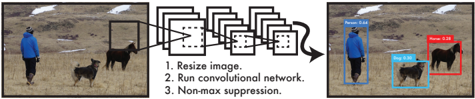
We present YOLO, a new approach to object detection. Prior work on object detection repurposes classifiers to perform detection. Instead, we frame object detection as a regression problem to spatially separated bounding boxes and associated class probabilities. A single neural network predicts bounding boxes and class probabilities directly from full images in one evaluation. Since the whole detection pipeline is a single network, it can be optimized end-to-end directly on detection performance. Our unified architecture is extremely fast. Our base YOLO model processes images in real-time at 45 frames per second. A smaller version of the network, Fast YOLO, processes an astounding 155 frames per second while still achieving double the mAP of other real-time detectors. Compared to state-of-the-art detection systems, YOLO makes more localization errors but is less likely to predict false positives on background. Finally, YOLO learns very general representations of objects. It outperforms other detection methods, including DPM and R-CNN, when generalizing from natural images to other domains like artwork.
Overview
CoChat Summary
TL;DR
YOLO reframes object detection as a single regression problem, using one convolutional network to predict bounding boxes and class probabilities directly from full images. It achieves real-time detection speeds while remaining competitive with, and complementary to, slower region-based detectors.
Key findings
- YOLO runs at 45 FPS on a Titan X GPU, and Fast YOLO runs at 155 FPS; Fast YOLO reaches 52.7% mAP on PASCAL VOC 2007, more than double prior real-time detectors, while YOLO reaches 63.4% mAP.
- On PASCAL VOC 2012, YOLO scores 57.9% mAP; combining Fast R-CNN with YOLO raises Fast R-CNN from 71.8% to 75.0% mAP on VOC 2007, a 3.2% gain.
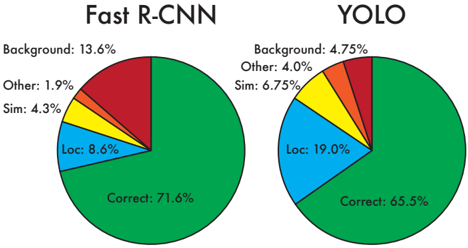
- YOLO makes fewer background false positives than Fast R-CNN: Fast R-CNN has 13.6% background false positives among top detections and is almost 3× more likely to predict background detections than YOLO.
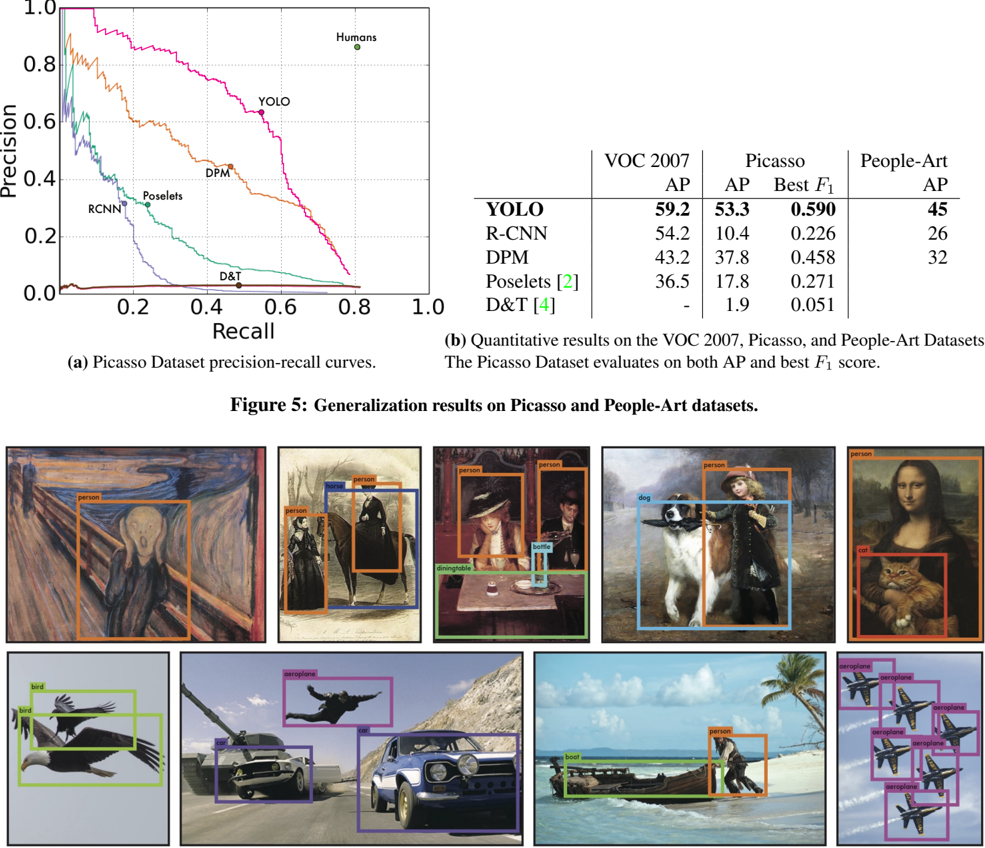
- YOLO generalizes better to artwork: on Picasso, YOLO gets 53.3 AP versus R-CNN’s 10.4 AP and DPM’s 37.8 AP; on People-Art, YOLO gets 45 AP versus R-CNN’s 26 AP and DPM’s 32 AP.
Methods
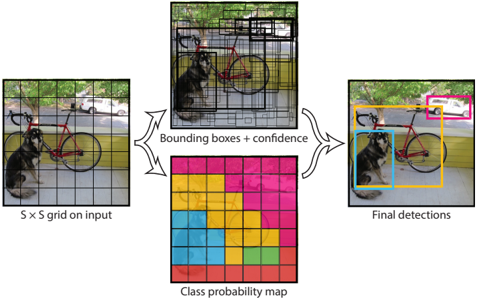
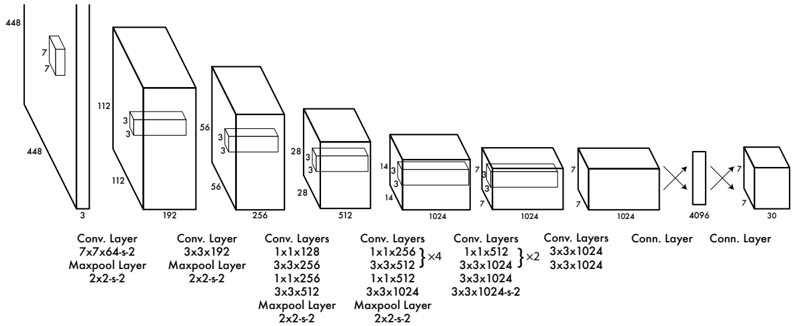
- Detection is modeled as a single CNN regression: the image is divided into an S×S grid; for PASCAL VOC, S=7, B=2, C=20, producing a 7×7×30 tensor of bounding boxes, confidence scores, and class probabilities.
- The base network has 24 convolutional layers followed by 2 fully connected layers; Fast YOLO uses 9 convolutional layers. Convolutional layers are pretrained on ImageNet at 224×224, then detection training uses 448×448 input.
- Training uses PASCAL VOC 2007 and 2012 for about 135 epochs, batch size 64, momentum 0.9, decay 0.0005, sum-squared error with λ_coord=5 and λ_noobj=0.5, dropout, and data augmentation.
Limitations
- The paper states YOLO imposes strong spatial constraints because each grid cell predicts only two boxes and one class, limiting nearby objects and struggling with small objects in groups such as flocks of birds.
- The paper states YOLO struggles to generalize to objects in new or unusual aspect ratios or configurations, uses relatively coarse features due to downsampling, and its loss treats small and large box errors equally; its main error source is incorrect localization.
- The paper states YOLO still lags state-of-the-art detection accuracy and struggles to precisely localize some objects, especially small ones.
Model-written summary. Check it against the paper before relying on it.
Integrity signals
Registry
Cites
Statistics
Figures
Verification
Claims the paper makes
6 Valid · 8 Not valid · 15 Not checked · 92 Own results and interpretations
The cited sources that could be checked couldn’t confirm or dispute this claim.
In the paper
“While it is much faster than R-CNN, it still falls short of real-time and takes a significant accuracy hit from not having good proposals.”
What the sources say
- Could not verifycites [20] [20] K. Lenc and A. Vedaldi. R-cnn minus r. arXiv preprint arXiv:1506.06981 , 2015. 5, 6 - sourceExperimental — accuracy not yet measured
The ConvNet-based Object Detection section identifies R-CNN minus R as a method that uses predefined regions instead of region proposals. It gives no runtime measurement or assessment of whether the method achieves real-time detection; searches for real-time performance and speed did not establish that claim. (LLM, conf=0.76)
plain- Asserted: passes — The authors put it forward as true.
- Checkable: passes — It can be checked against evidence.
- Load-bearing: passes — The paper’s conclusions depend on it.
- Based: passes — The paper gives a reason why it holds.
- Could not verify
The cited sources support only part of this claim — read each source’s verdict below.
In the paper
“To avoid overfitting we use dropout and extensive data augmentation.”
What the sources say
- Partly supportedcites [18] [18] G. E. Hinton, N. Srivastava, A. Krizhevsky, I. Sutskever, and R. R. Salakhutdinov. Improving neural networks by preventing co-adaptation of feature detectors. arXiv preprint arXiv:1207.0580 , 2012. 4 - sourceExperimental — accuracy not yet measured
The paper states that dropout reduces overfitting (p. 1) and describes using dropout with data augmentation for its ImageNet model (H Models for ImageNet, p. 18). It does not establish that YOLO uses either technique or describe YOLO’s augmentation as extensive. (LLM, conf=0.88)
plainstates a cause- Asserted: passes — The authors put it forward as true.
- Checkable: passes — It can be checked against evidence.
- Load-bearing: unclear — It is unclear whether the paper’s conclusions depend on it.
- Based: passes — The paper gives a reason why it holds.
- Partly supported
Every source the paper cites for this claim was checked and supports it.
In the paper
“However, only 30Hz DPM [31] actually runs in real-time.”
What the sources say
- Supportedcites [31] [31] M. A. Sadeghi and D. Forsyth. 30hz object detection with dpm v5. In Computer Vision-ECCV 2014 , pages 65-79. Springer, 2014. 5, 6 - source
The Introduction (p.1) states that 'except for certain objects including face, pedestrians and certain rigid objects, detectors do not currently run at video rate' and that the presented architecture detects the 20 PASCAL VOC categories simultaneously at 30Hz, i.e. at video/real-time rate. The Abstract (p.1) and Table 2 (Method) bound the comparison to other DPM speed-up efforts: reference DPM at 0.07Hz, the fastest GPU 'Vanilla DPM' at ~1Hz, FTVQ at 0.53s, and 'over an order of magnitude faster than the previous fastest DPM implementation', so none of the listed variants reaches real-time. Thus our copy supports both parts of the attribution: that this 30Hz DPM runs in real-time and that it is the only such DPM among the speed-up efforts compared. (LLM, conf=0.82)
plain- Asserted: passes — The authors put it forward as true.
- Checkable: passes — It can be checked against evidence.
- Load-bearing: unclear — It is unclear whether the paper’s conclusions depend on it.
- Based: passes — The paper gives a reason why it holds.
- Supported
The cited sources that could be checked couldn’t confirm or dispute this claim.
In the paper
“While it is much faster than R-CNN, it still falls short of real-time and takes a significant accuracy hit from not having good proposals.”
What the sources say
- Could not verifycites [20] [20] K. Lenc and A. Vedaldi. R-cnn minus r. arXiv preprint arXiv:1506.06981 , 2015. 5, 6 - sourceExperimental — accuracy not yet measured
The ConvNet-based Object Detection section identifies R-CNN minus R and says it uses predefined regions in an SPPnet system, but gives no speed comparison with R-CNN. A search for R-CNN minus R and speed found no passage in our copy establishing that it is much faster. (LLM, conf=0.73)
plainstates a cause- Asserted: passes — The authors put it forward as true.
- Checkable: passes — It can be checked against evidence.
- Load-bearing: unclear — It is unclear whether the paper’s conclusions depend on it.
- Based: passes — The paper gives a reason why it holds.
- Could not verify
The cited sources support only part of this claim — read each source’s verdict below.
In the paper
“While it is much faster than R-CNN, it still falls short of real-time and takes a significant accuracy hit from not having good proposals.”
What the sources say
- Partly supportedcites [20] [20] K. Lenc and A. Vedaldi. R-cnn minus r. arXiv preprint arXiv:1506.06981 , 2015. 5, 6 - sourceExperimental — accuracy not yet measured
The “ConvNet-based Object Detection” section (page unavailable) says R-CNN minus R uses predefined regions instead of region proposals. It does not say that this causes a significant accuracy loss; the paper’s discussion of low accuracy concerns a different system, naïve Faster R-CNN. (LLM, conf=0.83)
plainstates a cause- Asserted: passes — The authors put it forward as true.
- Checkable: passes — It can be checked against evidence.
- Load-bearing: unclear — It is unclear whether the paper’s conclusions depend on it.
- Based: passes — The paper gives a reason why it holds.
- Partly supported
84 more claims
Create a free account to see all 121 claims and to verify the 2 references still open.
- Probably not a substantial claim. 17
- It may state two separate claims as one. 15
Claims other papers make about this one
Each is checked against this paper’s own text: does it say what the citing paper says it does?
The source backs part of the claim, not all of it — or backs it for a different population, condition or comparison.
In the citing paper
“which was not thoroughly investigated in prevIoUs work such as YOLOv1 [20] and YOLOv2 [51] employing MSE/L2 loss (Mean Squared Error).”
From Object Detection in 20 Years: A Survey (2023) · cites this paper as [20]
Experimental — accuracy not yet measuredThe source backs part of the claim, not all of it — or backs it for a different population, condition or comparison.
In the citing paper
“the YOLO series models v2-v5 [144-147] are some of the most advanced object detection methods based on DNN, which have good performance in terms of speed and precision.”
From A survey of model compression strategies for object detection (2023) · cites this paper as [144]
Experimental — accuracy not yet measuredThe source backs part of the claim, not all of it — or backs it for a different population, condition or comparison.
In the citing paper
“As a typical and more widely used new form of applications [9], various deep learning-based intelligent services and applications have changed many aspects of people's lives due to the great advantages of Deep Learning (DL) in the fields of Computer Vision (CV) and Natural Language Processing (NLP) [10].”
From Convergence of Edge Computing and Deep Learning: A Comprehensive Survey (2020) · cites this paper as [9]
Experimental — accuracy not yet measuredThe cited source says what the claim attributes to it.
In the citing paper
“A convolutional neural network predicts the bounding boxes as well as class probabilities for all the objects depicted in an image.”
From Object detection using YOLO: challenges, architectural successors, datasets and applications (2023) · cites this paper as [56]
The cited source says what the claim attributes to it.
In the citing paper
“Authors of YOLO [56] have reframed the problem of object detection as a regression problem instead of classification problem.”
From Object detection using YOLO: challenges, architectural successors, datasets and applications (2023) · cites this paper as [56]
6 more claims about this paper
Create a free account to see every claim other papers make about this one.
Citations
Cites
Faster R-CNN: Towards Real-Time Object Detection with Region Proposal Networks
Ren, S., He, K., Girshick, R., & Sun, J. (2017) · IEEE Transactions on Pattern Analysis and Machine Intelligence · doi:10.1109/tpami.2016.2577031 · Cited by 73,472
Self-citationFaster R-CNN: Towards Real-Time Object Detection with Region Proposal Networks
Ren, S., He, K., Girshick, R., & Sun, J. (2015) · arXiv · doi:10.48550/arxiv.1506.01497 · Cited by 70,812
Self-citationGoing deeper with convolutions
Szegedy, C., Liu, W., Jia, Y., Sermanet, P., Reed, S., Anguelov, D., Erhan, D., Vanhoucke, V., & Rabinovich, A. (2015) · 2015 IEEE Conference on Computer Vision and Pattern Recognition (CVPR) · doi:10.1109/cvpr.2015.7298594 · Cited by 48,562
ImageNet Large Scale Visual Recognition Challenge
Russakovsky, O., Deng, J., Su, H., Krause, J., Satheesh, S., Ma, S., Huang, Z., Karpathy, A., Khosla, A., Bernstein, M., et al. (2015) · International Journal of Computer Vision · doi:10.1007/s11263-015-0816-y · Cited by 39,380 · cited 1×
“We pretrain our convolutional layers on the ImageNet 1000-class competition dataset [29].”
MethodHistograms of Oriented Gradients for Human Detection
Dalal, N., & Triggs, B. (2005) · 2005 IEEE Computer Society Conference on Computer Vision and Pattern Recognition (CVPR'05) · doi:10.1109/cvpr.2005.177 · Cited by 33,584 · cited 2×
“Detection pipelines generally start by extracting a set of robust features from input images (Haar [25], SIFT [23], HOG [4], convolutional features [6]).”
MethodRich Feature Hierarchies for Accurate Object Detection and Semantic Segmentation
Girshick, R., Donahue, J., Darrell, T., & Malik, J. (2014) · 2014 IEEE Conference on Computer Vision and Pattern Recognition · doi:10.1109/cvpr.2014.81 · Cited by 32,684 · cited 2×
“Then, classifiers [35, 21, 13, 10] or localizers [1, 31] are used to identify objects in the feature space.”
MethodSelf-citationGirshick, R. (2015) · 2015 IEEE International Conference on Computer Vision (ICCV) · doi:10.1109/iccv.2015.169 · Cited by 28,105
Self-citationDelving Deep into Rectifiers: Surpassing Human-Level Performance on ImageNet Classification
He, K., Zhang, X., Ren, S., & Sun, J. (2015) · 2015 IEEE International Conference on Computer Vision (ICCV) · doi:10.1109/iccv.2015.123 · Cited by 19,741 · cited 1×
“Convolutional neural networks (CNNs) achieve impressive performance on classification tasks at real-time speeds [13].”
Object recognition from local scale-invariant features
Lowe, D. G. (1999) · Proceedings of the Seventh IEEE International Conference on Computer Vision · doi:10.1109/iccv.1999.790410 · Cited by 16,472 · cited 1×
“Detection pipelines generally start by extracting a set of robust features from input images (Haar [25], SIFT [23], HOG [4], convolutional features [6]).”
MethodRobust Real-Time Face Detection
Viola, P., & Jones, M. J. (2004) · International Journal of Computer Vision · doi:10.1023/b:visi.0000013087.49260.fb · Cited by 14,097 · cited 1×
“Detectors for single classes like faces or people can be highly optimized since they have to deal with much less variation [36].”
Background
Cited by
Items 24,301–24,400 of 51,401
Meßmer, L.-M., Held, P., Bejan, A., Kunze, C., & Reich, C. (2024) · International Journal of Human-Computer Interaction · doi:10.1080/10447318.2024.2344913 · Cited by 8
Zhu, Q., Cen, Q., Wang, Y., Chen, W., & Liu, S. (2024) · The Visual Computer · doi:10.1007/s00371-024-03437-9 · Cited by 4
Training Acceleration Method Based on Parameter Freezing
Tang, H., Chen, J., Zhang, W., & Guo, Z. M. (2024) · Electronics · doi:10.3390/electronics13112140 · Cited by 6
Kılınç, M., Aydın, C., Aydın, G. E., et al. (2024) · The international archives of the photogrammetry, remote sensing and spatial information sciences/International archives of the photogrammetry, remote sensing and spatial information sciences · doi:10.5194/isprs-archives-xlviii-4-w10-2024-107-2024 · Cited by 4
Qiu, K., Poon, P., Zhao, S., Towey, D., & Yu, L. (2024) · Knowledge-Based Systems · doi:10.1016/j.knosys.2024.112027 · Cited by 5
Change-centric building damage assessment across multiple disasters using deep learning
Asif, A., Rafique, H., Jadoon, K. K., et al. (2024) · International Journal of Data Science and Analytics · doi:10.1007/s41060-024-00577-y · Cited by 4
Kothala, L. P., & Guntur, S. R. (2024) · Multimedia Tools and Applications · doi:10.1007/s11042-024-19393-4 · Cited by 10
Orgeira-Crespo, P., Gabín-Sánchez, C., Agelet, F. A., & Rey, G. (2024) · Applied Sciences · doi:10.3390/app14125113 · Cited by 4
Autonomous Visual Inspection of Industrial Plants Using Unmanned Aerial Vehicles
Scognamiglio, V., Caccavale, R., Merone, P., Crescenzo, A. D., Ruggiero, F., & Lippiello, V. (2024) · International Conference on Unmanned Aircraft Systems (ICUAS) · doi:10.1109/icuas60882.2024.10556996 · Cited by 4
Wang, Y., Zheng, Y., Chen, L., Yang, Z., & Cao, T. (2024) · Complex & Intelligent Systems · doi:10.1007/s40747-024-01522-z · Cited by 4
DAG-YOLO: A Context-Feature Adaptive fusion Rotating Detection Network in Remote Sensing Images
Guo, Z., He, X., Yang, Y. T., Qing, L., & Chen, H. (2024) · ACM Transactions on Multimedia Computing Communications and Applications · doi:10.1145/3674978 · Cited by 4
Hameed, M. A., & Khalaf, Z. A. (2024) · Basrah Researches Sciences · doi:10.56714/bjrs.50.1.5 · Cited by 9
A digital gauge reading algorithm based on an improved YOLOv8
Chen, Y., Wei, Y., Chen, X., et al. (2024) · IEEE Advanced Information Management, Communicates, Electronic and Automation Control Conference (IMCEC) · doi:10.1109/imcec59810.2024.10575756 · Cited by 4
A Real-Time Chart Explanation System for Visually Impaired Individuals
Song, Y., Jeong, S., Cho, W., et al. (2024) · Lecture notes in computer science · doi:10.1007/978-3-031-62846-7_37 · Cited by 4
A Human-in-the-Middle Attack Against Object Detection Systems
Wu, H., Rowlands, S., & Wahlström, J. (2024) · IEEE Transactions on Artificial Intelligence · doi:10.1109/tai.2024.3428520 · Cited by 4
Curbside Parking Occupancy Detection - Dashcam-Based Solutions
Li, J., Zhang, H., Hu, J., & Cheng, W. (2024) · IEEE International Conference on Mobile Data Management (MDM) · doi:10.1109/mdm61037.2024.00046 · Cited by 5
Video object detection via space–time feature aggregation and result reuse
Duan, L., Yang, R. L. T. X. W., Yue, K., Sun, Z., & Yuan, G. (2024) · IET Image Processing · doi:10.1049/ipr2.13179 · Cited by 4
Improved Algorithm for Tomato Disease Detection Based on YOLOv8
Yonggui, W., & Jing, H. (2024) · IEEE International Conference on Electronic Technology, Communication and Information (ICETCI) · doi:10.1109/icetci61221.2024.10594250 · Cited by 4
Moving Traffic Object Detection Based on Bayesian Theory Fusion
Sun, Y., Geng, K., Zhuang, W., Yin, G., Chen, X., Wang, J., & Ding, P. (2024) · Automotive Innovation · doi:10.1007/s42154-023-00245-0 · Cited by 5
Pedestrian Detection Method Based on FCOS-DEFPN Model
Chen, F., Gu, X., Gao, L., & Wang, J. (2024) · IEEE Access · doi:10.1109/access.2024.3434987 · Cited by 4
Robust FOD Detection using Frame Sequence-based DEtection TRansformer (DETR)
Qin, X., Song, S., Brengman, J., et al. (2024) · IEEE Conference on Artificial Intelligence (CAI) · doi:10.1109/cai59869.2024.00218 · Cited by 4
Changwang, S., Hu, S., Hai-fen, Z., Pan, F., Shan, C., & Hao, Q. (2024) · Journal of Construction Engineering and Management · doi:10.1061/jcemd4.coeng-14919 · Cited by 8
A Global Feature Reused Network for Defect Detection in Steel Images
Yang, C., Wang, Q., Liu, Z., & Cheng, Y. (2024) · Journal of Computing and Information Science in Engineering · doi:10.1115/1.4066170 · Cited by 4
Computer Vision Approaches for Automated Bee Counting Application
Bilík, Š., Janakova, I., Ligocki, A., et al. (2024) · IFAC-PapersOnLine · doi:10.1016/j.ifacol.2024.07.369 · Cited by 4
Glaucoma Abnormality Classification Using Yolo and Swin Transformer
Shaurya, M., Varma, A., & Agrawal, M. (2024) · IEEE International Symposium on Biomedical Imaging (ISBI) · doi:10.1109/isbi56570.2024.10635301 · Cited by 4
Interactive snow avalanche segmentation from webcam imagery: results, potential, and limitations
Hafner, E. D., Kontogianni, T., Daudt, R. C., Oberson, L., Wegner, J. D., Konrad Schindler, B., & Bühler, Y. (2024) · The Cryosphere · doi:10.5194/tc-18-3807-2024 · Cited by 8
Lightweight Algorithm for Rail Fastener Status Detection Based on YOLOv8n
Zhang, X., Shen, B., Li, J., & Ruan, J. (2024) · Electronics · doi:10.3390/electronics13173399 · Cited by 5
Recent Advances in Intelligent Harvesting Robots
Yun, Y., An, X., Li, D., & Ma, Z. (2024) · Smart agriculture · doi:10.1007/978-981-97-6441-9_5 · Cited by 4
Chen, N., Toosi, A. N., Javadi, B., Alqahtani, D. K., Aslanpour, M. S., & Xu, M. (2024) · IEEE International Conference on Edge Computing and Communications (EDGE) · doi:10.1109/edge62653.2024.00011 · Cited by 4
Zhao, K., Lai, R., Guo, B., Liu, L., He, L., & Zhao, Y. (2024) · Proceedings of the ACM on Interactive Mobile Wearable and Ubiquitous Technologies · doi:10.1145/3678537 · Cited by 9
BAIDet: remote sensing image object detector based on background and angle information
Yu, J., Sun, L., Song, S., Guo, G., & Chen, K. (2024) · Signal Image and Video Processing · doi:10.1007/s11760-024-03546-x · Cited by 5
YOLO Assisted A* Algorithm for Robust Line Segmentation of Degraded Document Images
Kundu, A., & Bhattacharya, U. (2024) · Lecture notes in computer science · doi:10.1007/978-3-031-70546-5_24 · Cited by 4
Road Object Detection Algorithm Based on Improved YOLOv8
Peng, J., Li, C., Jiang, A., et al. (2024) · IEEE Conference on Industrial Electronics and Applications (ICIEA) · doi:10.1109/iciea61579.2024.10664778 · Cited by 4
AFMSFFNet: An Anchor-Free-Based Feature Fusion Model for Ship Detection
Zhang, Y., Dong, C., Guo, L., Meng, X., Liu, Y., & Wei, Q. (2024) · Remote Sensing · doi:10.3390/rs16183465 · Cited by 5
Efficient Convolutional Neural Networks Utilizing Fine-Grained Fast Fourier Transforms
Zhang, Y., Li, F., Xu, H., Li, X., & Jiang, S. L. (2024) · Electronics · doi:10.3390/electronics13183765 · Cited by 5
H3Net: Irregular Posture Detection by Understanding Human Character and Core Structures
Noh, S., Bae, K., Bae, Y., & Lee, B.-D. (2024) · IEEE/CVF Conference on Computer Vision and Pattern Recognition Workshops (CVPRW) · doi:10.1109/cvprw63382.2024.00572 · Cited by 4
DHLA: Dynamic Hybrid Label Assignment for End-to-End Object Detection
Hu, Z., Chen, S., Yang, H., Wang, D., Zhu, S., & Yan, Y. (2024) · IEEE Transactions on Circuits and Systems for Video Technology · doi:10.1109/tcsvt.2024.3470230 · Cited by 8
Efficient Vision Transformers for Autonomous Off-Road Perception Systems
Faykus, M. H., Pickeral, A., Marquez, E., Smith, M. C., & Calhoun, J. C. (2024) · Journal of Computer and Communications · doi:10.4236/jcc.2024.129011 · Cited by 5
A Measurement Model for Aquatic Animals Based on Instance Segmentation and 3D Point Cloud
He, Z., Xu, X., Luo, J., et al. (2024) · IEEE Access · doi:10.1109/access.2024.3470791 · Cited by 4
Chinese Bayberry Detection in an Orchard Environment Based on an Improved YOLOv7-Tiny Model
Chen, Z., Qian, M., Zhang, X., & Zhu, J. (2024) · Agriculture · doi:10.3390/agriculture14101725 · Cited by 5
Ding, L. (2024) · International Conference on Internet of Things, Automation and Artificial Intelligence (IoTAAI) · doi:10.1109/iotaai62601.2024.10692510 · Cited by 4
Chan, S., Ni, S., Guo, B., Hu, J., Tang, T., Zhou, X., & Hao, P. (2024) · IEEE Transactions on Computational Social Systems · doi:10.1109/tcss.2024.3454321 · Cited by 5
Secondary vertex reconstruction with MaskFormers
Stroud, S. V., Pond, N. I., Hartman, N. M., Barr, J., Rettie, S., Facini, G. J., & Scanlon, T. (2024) · The European Physical Journal C · doi:10.1140/epjc/s10052-024-13374-5 · Cited by 14
Pig Behavior Detection Model Based on Improved RT-DETR
Shi, L., Hong, Y., Yang, P., et al. (2024) · International Conference on Electronic Engineering and Informatics (EEI) · doi:10.1109/eei63073.2024.10696250 · Cited by 4
MSI-RGB Dual-Source Multiscale Fusion-Based Solid Waste Object Detection
Liu, H., Yang, J., Fang, H., Ji, T., & Cai, Z. (2024) · IEEE Transactions on Instrumentation and Measurement · doi:10.1109/tim.2024.3480227 · Cited by 7
Object Detection in Historical Images: Transfer Learning and Pseudo Labelling
Kim, Y., Im, C., & Mandl, T. (2024) · Journal on Computing and Cultural Heritage · doi:10.1145/3699963 · Cited by 4
Deep Learning-Based Stopped Vehicle Detection Method Utilizing In-Vehicle Dashcams
Park, J., Lee, J., Park, Y., & Lim, Y. (2024) · Electronics · doi:10.3390/electronics13204097 · Cited by 4
SC-DiatomNet: An Efficient and Accurate Algorithm for Diatom Classification
Li, J., Jiang, C., Yao, L., & Zhang, S. (2024) · Journal of Marine Science and Engineering · doi:10.3390/jmse12101862 · Cited by 6
Corral-Sanz, P., Barreiro-Garrido, Á., Moreno, A. B., & Sánchez, Á. (2024) · PeerJ Computer Science · doi:10.7717/peerj-cs.2381 · Cited by 9
Automated monitoring of insulation by ultraviolet imaging employing deep learning
Rodrigues, G. A., Araújo, B. V. S., de Oliveira, J. H. P., Xavier, G. V. R., Lebre, U. D. E. D. S., Cordeiro, C. A., Freire, E. O., & Ferreira, T. V. (2024) · Measurement · doi:10.1016/j.measurement.2024.116018 · Cited by 4
ESFuse: Weak Edge Structure Perception Network for Infrared and Visible Image Fusion
Liu, W., Tan, H., Cheng, X., & Li, X. (2024) · Electronics · doi:10.3390/electronics13204115 · Cited by 5
Ayyıldız, H., Orhan, M., Bilgir, E., Çelik, Ö., & Bayrakdar, İ. Ş. (2024) · Clinical Oral Investigations · doi:10.1007/s00784-024-05999-3 · Cited by 6
Multi‐scale feature extraction for energy‐efficient object detection in remote sensing images
Wu, D., Liu, H., Xu, J., & Xie, F. (2024) · IET Computer Vision · doi:10.1049/cvi2.12317 · Cited by 5
Wild Animal Recognition using Deep Learning Models
Devi, E. M. R., Sedhumadhavan, V., Sudharsan, V., Rakesh, M., & Surendhar, D. N. (2024) · International Conference on Computing, Communication and Networking Technologies (ICCCNT) · doi:10.1109/icccnt61001.2024.10725145 · Cited by 4
A Survey on AI-Driven Mouse Behavior Analysis Applications and Solutions
Guo, C., Chen, Y., Ma, C., Hao, S., & Song, J. (2024) · Bioengineering · doi:10.3390/bioengineering11111121 · Cited by 10
Liu, J., Gao, B., Zhong, W., Lu, Y., & Han, S. (2024) · Computers & Electrical Engineering · doi:10.1016/j.compeleceng.2024.109785 · Cited by 10
Аспекти впровадження штучного інтелекту у військовій справі
Литвиненко, М. І., Ленець, В. Г., Гармаш, Н. В., & Шульга, В. В. (2024) · Збірник наукових праць Харківського національного університету Повітряних Сил · doi:10.30748/zhups.2024.80.02 · Cited by 9
Haining, 胡. H., Leiyang, 黄. H., Honggang, 杨. Y., et al. (2024) · Laser & Optoelectronics Progress · doi:10.3788/lop240670 · Cited by 4
Baker, O. F., Li, W., & Yuan, Q. (2024) · International Symposium on Networks, Computers and Communications (ISNCC) · doi:10.1109/isncc62547.2024.10758935 · Cited by 4
Enhanced Zero-Shot YOLOv10 for Multi-Class Tiny-Object Detection of Steel Surface Defects
Liu, T. (2024) · International Conference on Robotics and Computer Vision (ICRCV) · doi:10.1109/icrcv62709.2024.10758607 · Cited by 4
Wang, X., Zhang, L., Jiang, Y., et al. (2024) · Signal Image and Video Processing · doi:10.1007/s11760-024-03582-7 · Cited by 4
Contour-based object forecasting for autonomous driving
Jang, J., Kim, D., Jin, D., & Kim, C. (2024) · Journal of Visual Communication and Image Representation · doi:10.1016/j.jvcir.2024.104343 · Cited by 6
Metal sensor base defects detection using deep learning based YOLO network
Zhang, B., Zhu, X., Yu, J., Sun, Z., & Wang, Q. (2024) · Signal Image and Video Processing · doi:10.1007/s11760-024-03685-1 · Cited by 4
DS MYOLO: A Reliable Object Detector Based on SSMs for Driving Scenarios
Li, Y., & Xiao, J. (2024) · Lecture notes in computer science · doi:10.1007/978-3-031-78113-1_7 · Cited by 5
Quinn, E., & Corcoran, N. (2024) · Proceedings of the International Conference on AI Research. · doi:10.34190/icair.4.1.3031 · Cited by 4
RayEmb: Arbitrary Landmark Detection in X-Ray Images Using Ray Embedding Subspace
Shrestha, P., Xie, C., Yoshii, Y., & Kitahara, I. (2024) · Lecture notes in computer science · doi:10.1007/978-981-96-0901-7_15 · Cited by 9
Wei, F., & Wang, W. (2024) · International Conference on Control, Automation and Systems (ICCAS) · doi:10.23919/iccas63016.2024.10773283 · Cited by 5
An efficient 3D cutting scheme for detecting defects on products of complex geometry
Wang, R., Lu, J., Du, W., Jiang, Q., & Cao, Z. (2024) · Measurement · doi:10.1016/j.measurement.2024.116425 · Cited by 5
Improved YOLOv9 for underwater side scan sonar target detection
Yuan, X., Li, J., Wang, W., Zhou, X., Li, N., & Yu, C. (2024) · The Computer Journal · doi:10.1093/comjnl/bxae134 · Cited by 8
Effective Early Polyp Detection from Medical Images with YOLO-V7
Iakovidis, F., Akritidis, L., & Bozanis, P. (2024) · International Conference on Information, Intelligence, Systems & Applications (IISA) · doi:10.1109/iisa62523.2024.10786615 · Cited by 9
Deep Multi-Modal Ship Detection and Classification Network
Xu, F., Chen, C., Shang, Z., et al. (2025) · IEEE transactions on circuits and systems for video technology (Print) · doi:10.1109/tcsvt.2024.3519569 · Cited by 9
“However, single-modality approach (e.g., [4], [5], [6], [7], [8], [9], [10], [11], [12], [13]) is hard to deliver satisfied performance in various challenging maritime conditions often encountered in real life.”
Zhang, W., Jiang, W., Li, Q., Luo, Y., Zhang, H., Jiao, Q., Li, Y., & Jiang, H. (2024) · Big Earth Data · doi:10.1080/20964471.2024.2436230 · Cited by 5
Re-Identification of Individual Kākā: An Explainable DINO-Based Model
Maddigan, P., Ehrhardt, O., Lensen, A., & Shaw, R. C. (2024) · International Conference on Image and Vision Computing New Zealand (IVCNZ) · doi:10.1109/ivcnz64857.2024.10794473 · Cited by 6
Myopia Detection from Eye Fundus Images: New Screening Method Based on You Only Look Once Version 8
Rizzieri, N., Dall’Asta, L., & Ozolinsh, M. (2024) · Applied Sciences · doi:10.3390/app142411926 · Cited by 4
Combating Noisy Labels by Alleviating the Memorization of DNNs to Noisy Labels
Yuan, S. W., Li, X., Miao, Y., Zhang, H., Liu, X., & Deng, R. H. (2024) · IEEE Transactions on Multimedia · doi:10.1109/tmm.2024.3521722 · Cited by 8
Mask R-CNN assisted diagnosis of spinal tuberculosis
Li, W., Li, Y., Peng, H., & Liang, W. (2024) · Journal of X-Ray Science and Technology · doi:10.1177/08953996241290326 · Cited by 5
SGI-YOLOv9: an effective method for crucial components detection in the power distribution network
Yang, M., Chen, B., Lin, C., Yao, W., & Li, Y. (2024) · Frontiers in Physics · doi:10.3389/fphy.2024.1517177 · Cited by 7
FogROS2-FT: Fault Tolerant Cloud Robotics
Chen, K., Hari, K., Chung, T., Wang, M., Tian, N., Juette, C., Ichnowski, J., Ren, L., Kubiatowicz, J. D., Stoica, I. G., et al. (2024) · IEEE/RSJ International Conference on Intelligent Robots and Systems (IROS) · doi:10.1109/iros58592.2024.10802613 · Cited by 17
An Improved Method for Enhancing the Accuracy and Speed of Dynamic Object Detection Based on YOLOv8s
Liu, Z., Zhang, E., Ding, Q., Liao, W., & Wu, Z. (2024) · Sensors · doi:10.3390/s25010085 · Cited by 5
Design of New Traffic System YOLO-LIO: Light-Traffic Intercept and Observation
Muwardi, R., Zhang, H., Gao, H., et al. (2024) · International Conference on Radar, Antenna, Microwave, Electronics, and Telecommunications (ICRAMET) · doi:10.1109/icramet62801.2024.10809042 · Cited by 4
A study on multi-modal LLM reasoning for defect detection
Tulbure, A. A., Danciu, D.-P., Dulf, E. H., & Tulbure, A. A. (2024) · IEEE International Symposium for Design and Technology in Electronic Packaging (SIITME) · doi:10.1109/siitme63973.2024.10814831 · Cited by 8
Diao, H., Luo, H., Song, J., Xu, B., Wang, R., Wang, Y., & Tang, X. (2025) · IEEE Journal of Solid-State Circuits · doi:10.1109/jssc.2024.3522304 · Cited by 6
“D EEP learning based on neural networks (NNs) has achieved state-of-the-art performance in various tasks [1], [2], [3], [4], stimulating the rapid rise of edge AI.”
Enhancing Cerebral Microbleed Segmentation with Pretrained UNETR++
Kwon, J., Seo, S. W., & Park, H. (2024) · IEEE International Conference on Bioinformatics and Biomedicine (BIBM) · doi:10.1109/bibm62325.2024.10822393 · Cited by 7
Enhancing the function of the aids to navigation by practical usage of the deep learning algorithm
Sim, Y., & Chae, C.-J. (2024) · Journal of Navigation · doi:10.1017/s0373463324000353 · Cited by 8
Stutter-Solver: End-To-End Multi-Lingual Dysfluency Detection
Zhou, X., Cho, C. J., Sharma, A., Morin, B. T., Baquirin, D. P., Vonk, J. M. J., Ezzes, Z., Miller, Z., Tee, B. L., Gorno‐Tempini, M. L., et al. (2024) · IEEE Spoken Language Technology Workshop (SLT) · doi:10.1109/slt61566.2024.10832222 · Cited by 15
Foreign object detection in the inspection of cloud server center using separable self-attention
Jiang, Y., Li, Z., Zhao, B., Zhang, X., & Dong, X. (2025) · Intelligent Service Robotics · doi:10.1007/s11370-024-00580-z · Cited by 4
An Enhanced End-to-End Object Detector for Drone Aerial Imagery
Yu, Q., Tong, Q., Miao, L., Qi, L., & Liu, X. (2025) · IEEE Access · doi:10.1109/access.2025.3533037 · Cited by 5
DDH-Net: A Dual-Dynamic Head Network for Transmission Line Inspection
Yu, J., Mao, J., Wang, Y., He, Z., Yi, J., Tao, Z., Zhang, H., & Wang, S. (2025) · IEEE Transactions on Instrumentation and Measurement · doi:10.1109/tim.2025.3529547 · Cited by 5
Automated recognition and segmentation of lung cancer cytological images based on deep learning
Wang, Q., Luo, Y., Zhao, Y., Wang, S., Niu, Y., Di, J., Guo, J., Lan, G., Yang, L., Mao, Y. Q., et al. (2025) · PLoS ONE · doi:10.1371/journal.pone.0317996 · Cited by 4
DiffusionLoc: A diffusion model-based framework for crowd localization
Zhang, Q., Li, Y., Liu, Y., Zhou, Y., & Jiao, J. (2025) · Image and Vision Computing · doi:10.1016/j.imavis.2025.105439 · Cited by 4
Real-Time Face and Facial Landmark Joint Detection Based on End-to-End Deep Network
Wu, Q., Wang, X., Li, N., Fong, S. J., Zhang, L., & Yang, J. (2025) · IEEE Transactions on Instrumentation and Measurement · doi:10.1109/tim.2025.3541698 · Cited by 10
Park, S.-Y., Park, J. S., Lee, J., Lee, H., Kim, Y., Suh, D. I., & Kim, K. (2025) · Biomedical Signal Processing and Control · doi:10.1016/j.bspc.2025.107693 · Cited by 5
Infrared small target detection based on isolated hyperedge
Ge, X.-L., & Qian, W. (2025) · Infrared Physics & Technology · doi:10.1016/j.infrared.2025.105752 · Cited by 4
Deep Learning Framework for Food Item Recognition and Nutrition Assessment
Panindre, P., Thummalapalli, P. K., Mandal, T., et al. (2025) · International Conference on Mobile Computing and Sustainable Informatics (ICMCSI) · doi:10.1109/icmcsi64620.2025.10883519 · Cited by 4
Football Player Detection and Tracking Using Deep Learning Approach
Agrawal, J., Maheshwari, R., Nalode, S., et al. (2024) · doi:10.1109/icaiqsa64000.2024.10882213 · Cited by 4
Real time contaminants detection in wood panel manufacturing process using YOLO algorithms
Djedidi, M., Hassen, M. B., Mrad, H., & Koubaa, A. (2025) · Procedia Computer Science · doi:10.1016/j.procs.2025.01.184 · Cited by 6
Interactive image segmentation combining global seeding and sparse local reconstruction
Long, J., Liu, Y., Zhang, K., Chen, S., & Luo, Q. (2025) · Pattern Analysis and Applications · doi:10.1007/s10044-025-01432-x · Cited by 6
Li, Z., & Fan, H. (2025) · Electronics · doi:10.3390/electronics14051014 · Cited by 7
EnhanceCenter for improving point based tracking and rich feature representation
Yang, H., Park, S.-W., Jung, S.-H., & Sim, C.-B. (2025) · Scientific Reports · doi:10.1038/s41598-025-88924-2 · Cited by 4
Oghabian, Z., Ghaderi, R., Mohammadi, M., & Nikbakht, S. (2025) · Brain Topography · doi:10.1007/s10548-025-01111-4 · Cited by 4
Metadata
- Authors
- Redmon, J., Divvala, S., Girshick, R., & Farhadi, A.
- Affiliations
- University of Washington (US)
- Meta (United States) (US)
- Venue
- 2016 IEEE Conference on Computer Vision and Pattern Recognition (CVPR)
- Publisher
- IEEE
- Published
- 2016-06
- Pages
- 779-788
- ISSN
- 1063-6919 (ISSN-L)
- OpenAlex
- W1483870316
- Cited by
- 53,803
- References
- 42
- Citations by year
- 2026: 5347 · 2025: 8912 · 2024: 8953 · 2023: 8264 · 2022: 6785 · 2021: 5741 · 2020: 4223 · 2019: 3286 · 2018: 1560 · 2017: 635 · 2016: 90
- FWCI
- 644.23
- Type
- conference paper
- Language
- en
- Open access
- green
- arxiv.org
- Locations
- IEEE Computer Society Conference on Computer Vision and Pattern Recognition/Proceedings - IEEE Computer Society Conference on Computer Vision and Pattern Recognition/Proceedings (publishedVersion)
- arXiv (Cornell University) (submittedVersion)
- arXiv (Cornell University)
- Zenodo (CERN European Organization for Nuclear Research) (cc-by)
- Funders
- National Science Foundation (1338054)
- Office of Naval Research (N00014-13-1-0720, N00014)
- Topics
- Physical Sciences › Computer Science › Computer Vision and Pattern Recognition › Advanced Neural Network Applications
- Physical Sciences › Computer Science › Computer Vision and Pattern Recognition › Advanced Image and Video Retrieval Techniques
- Physical Sciences › Computer Science › Computer Vision and Pattern Recognition › Visual Attention and Saliency Detection
- Keywords
- object detection, YOLO, real-time detection, bounding box regression, end-to-end learning, false positive reduction, domain generalization
About these checks
Registry, retraction, Cites and statistics results are computed, not judged, with one exception: a printed reference that no index lists is read once by a model before it counts as a citation error. Claims are extracted by a model and kept only when their quote appears verbatim in the text; each cited source is then checked, with a model’s help, for whether it says what the claim relies on. Those verdicts can be wrong — read the claim’s quote and the cited source before relying on one.
The claim verdicts this report counts are experimental: their accuracy is not yet measured.
A language model drew the claims from the paper on 2026-10-10, under version 3 of the claim definition (model deepseek-v4.1-flash, prompt extract-v3).
A second model labelled each claim on 2026-10-10 (model jev-1.13-20260917, definition revision gold-guideline-v0.2).
Cited sources are checked with a language model’s help (gpt-6-sol and qwen3.8-omni-flash).
Statistics and arithmetic are recomputed, not judged.
Confidence bands are shown only for fields calibrated on our annotated test set. None is calibrated yet, so no band is shown.
What counts as a claim ›How we measure confidence ›How we check this ›
Are you an author, or do you see a problem with this page? Request a review
Data sources
Bibliographic data: Semantic Scholar, OpenAlex, Crossref.
Contains information from the Semantic Scholar Academic Graph Datasets, made available under the ODC Attribution License (ODC-BY 1.0).
Semantic Scholar’s data is described in: Kinney, R., et al. (2023). The Semantic Scholar Open Data Platform. arXiv:2301.10140.
