

Feature Pyramid Networks for Object Detection
The DOI matches its Crossref record; 49 of the 64 references it cites were found in a registry or an index, and 1 are not checked yet; 14 of the 44 sources its claims cite were checked for support.
Abstract
Feature pyramids are a basic component in recognition systems for detecting objects at different scales. But pyramid representations have been avoided in recent object detectors that are based on deep convolutional networks, partially because they are slow to compute and memory intensive. In this paper, we exploit the inherent multi-scale, pyramidal hierarchy of deep convolutional networks to construct feature pyramids with marginal extra cost. A top-down architecture with lateral connections is developed for building high-level semantic feature maps at all scales. This architecture, called a Feature Pyramid Network (FPN), shows significant improvement as a generic feature extractor in several applications. Using a basic Faster R-CNN system, our method achieves state-of-the-art single-model results on the COCO detection benchmark without bells and whistles, surpassing all existing single-model entries including those from the COCO 2016 challenge winners. In addition, our method can run at 5 FPS on a GPU and thus is a practical and accurate solution to multi-scale object detection. Code will be made publicly available.
Verified 2026-11-25 · 1 reference not checked yet
Overview
CoChat Summary
TL;DR
Feature Pyramid Networks (FPN) build in-network feature pyramids from a single-scale image using a top-down pathway and lateral connections, giving semantically strong features at all scales with marginal extra cost. FPN improves region proposal and object detection accuracy over strong single-scale baselines and achieves state-of-the-art single-model COCO results without image pyramids.
Key findings
- RPN with FPN improves COCO minival AR\(_{1k}\) to 56.3 from 48.3 for the single-scale C4 baseline (+8.0 points), and small-object AR\(_{1k}^s\) to 44.9 from 32.0 (+12.9 points).
- Fast R-CNN on fixed proposals improves AP to 33.9 with FPN versus 31.9 for the C4 baseline (+2.0) and 28.8 for the 2fc C5 baseline (+5.1); AP@0.5 is 56.9.
- Faster R-CNN with FPN reaches 33.9 AP and 56.9 AP@0.5 on minival, improving over a strong single-scale baseline by 2.3 AP and 3.8 AP@0.5. On COCO test-dev with ResNet-101, it reaches 36.2 AP and 59.1 AP@0.5, surpassing single-model competition winners such as G-RMI (34.7 AP) and AttractioNet (35.7 AP).
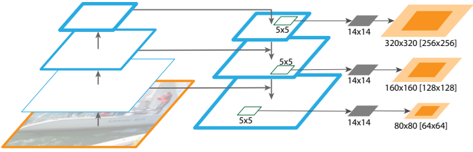
- For segmentation proposals, FPN with dual MLPs, 2× mask resolution, and 2× training schedule reaches 48.1 AR, outperforming DeepMask (37.1), SharpMask (39.8), and InstanceFCN (39.2) by over 8.3 points AR, while running at 6–7 FPS.
Methods
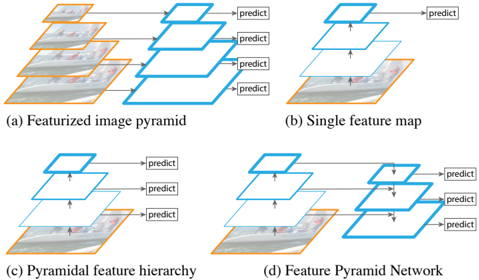
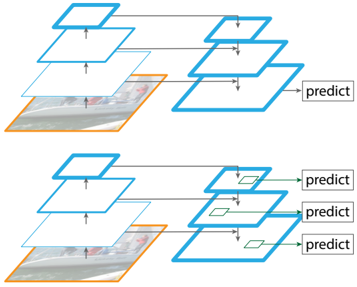
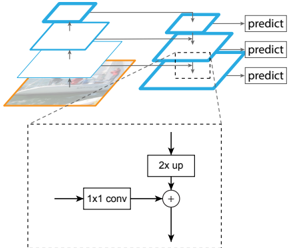
- FPN uses a bottom-up ResNet pathway (C2–C5), a top-down pathway that upsamples coarser maps by 2× with nearest-neighbor interpolation, and lateral 1×1 convolutions merged by element-wise addition; a 3×3 convolution is appended to each merged map. Detection uses d = 256 and pyramid levels P2–P5, with P6 added for RPN’s 512² anchor scale.
- For RPN, heads are attached to each pyramid level with single-scale anchors of areas {32², 64², 128², 256², 512²} on {P2, P3, P4, P5, P6} and aspect ratios {1:2, 1:1, 2:1}, totaling 15 anchors. For Fast R-CNN, RoIs are assigned to pyramid levels using the canonical 224² size and k₀ = 4, with shared heads and a 2fc MLP.
- Experiments use the 80-category COCO dataset, training on trainval35k (80k train + 35k val subset), ablating on minival (5k val images), and reporting test-std results. Backbones are ImageNet1k-pretrained ResNet-50/101; training uses synchronized SGD on 8 GPUs with input shorter side 800 pixels. RPN training takes about 8 hours and Fast R-CNN about 10 hours on COCO; inference is 0.148 s per image for ResNet-50 and 0.172 s for ResNet-101 on an NVIDIA M40 GPU.
Limitations
- The paper states that designing better connection modules is not its focus and opts for a simple design; more sophisticated blocks gave only marginally better results. It also notes that the ResNet-101 model was not sufficiently trained with the default schedule, and that the feature-sharing version of the COCO leaderboard model was not evaluated due to limited time.
- The paper states that its method does not exploit popular improvements such as iterative regression, hard negative mining, context modeling, or stronger data augmentation, which are complementary and could boost accuracy further.
- Evident from the text: there is no dedicated limitations section, and the empirical evaluation is limited to COCO detection and mask proposal generation, not full instance segmentation or other datasets.
Model-written summary. Check it against the paper before relying on it.
Integrity signals
Registry
Cites
Statistics
Figures
Verification
Claims the paper makes
8 Valid · 4 Not valid · 14 Not checked · 82 Own results and interpretations
The cited sources that could be checked couldn’t confirm or dispute this claim.
In the paper
“For these reasons, Fast and Faster R-CNN [11, 29] opt to not use featurized image pyramids under default settings.”
What the sources say
- Not matchedcites [11] [11] R. Girshick. Fast R-CNN. In ICCV , 2015. -
We searched by its title and found no matching paper.
- Could not verifycites [29] [29] S. Ren, K. He, R. Girshick, and J. Sun. Faster R-CNN: Towards real-time object detection with region proposal networks. In NIPS , 2015. - sourceExperimental — accuracy not yet measured
The Related Work section (p. 3) discusses multi-resolution features for semantic segmentation, and the results (p. 8) discuss multi-scale testing of the authors’ model. Neither passage addresses whether Fast or Faster R-CNN omit featurized image pyramids by default; searches for those models and that setting found no supporting passage in our copy. (LLM, conf=0.77)
plain- Asserted: passes — The authors put it forward as true.
- Checkable: passes — It can be checked against evidence.
- Load-bearing: passes — The paper’s conclusions depend on it.
- Based: passes — The paper gives a reason why it holds.
- Not matched
The cited sources support only part of this claim — read each source’s verdict below.
In the paper
“Recently, FPN has enabled new top results in all tracks of the COCO competition, including detection, instance segmentation, and keypoint estimation. See [14] for details.”
What the sources say
- Partly supportedcites [14] [14] K. He, G. Gkioxari, P. Doll´ ar, and R. Girshick. Mask r-cnn. arXiv:1703.06870 , 2017. - sourceExperimental — accuracy not yet measured
The paper reports strong COCO results using FPN backbones: its instance-segmentation model surpasses earlier winners (Section 4.1, p. 5), its detection model exceeds earlier single-model results (Section 4.3, p. 7), and its keypoint model exceeds the 2016 winner (Section 5, p. 8). But it does not establish that FPN enabled top competition results in all three tracks; Appendix B (p. 10) discusses 2017 winning teams only for instance segmentation and credits the Mask R-CNN framework. (LLM, conf=0.87)
plainstates a cause- Asserted: passes — The authors put it forward as true.
- Checkable: passes — It can be checked against evidence.
- Load-bearing: unclear — It is unclear whether the paper’s conclusions depend on it.
- Based: passes — The paper gives a reason why it holds.
- Partly supported
The sources with a verdict support this claim; the rest weren’t checked yet, have no full text we could read, or their verdicts aren’t rated yet.
In the paper
“All recent top entries in the ImageNet [33] and COCO [21] detection challenges use multi-scale testing on featurized image pyramids ( e.g ., [16, 35]).”
What the sources say
- Not checked yetcites [16] [16] K. He, X. Zhang, S. Ren, and J. Sun. Deep residual learning for image recognition. In CVPR , 2016. - source
Checked before — its earlier verdict is held back until a new check runs.
- Supportedcites [35] [35] A. Shrivastava, A. Gupta, and R. Girshick. Training regionbased object detectors with online hard example mining. In CVPR , 2016. - source
As an example citation, this paper supports the COCO part of the sentence. The Multi-scale (M) section (page unavailable) says it runs inference at all scales during testing, and the Ablation analysis (page unavailable) says a variant finished fourth in the 2015 COCO Detection Challenge. (LLM, conf=0.85)
plain- Asserted: passes — The authors put it forward as true.
- Checkable: passes — It can be checked against evidence.
- Load-bearing: passes — The paper’s conclusions depend on it.
- Based: passes — The paper gives a reason why it holds.
- Not checked yet
The cited sources support only part of this claim — read each source’s verdict below.
In the paper
“Existing mask proposal methods [27, 28, 4] are based on densely sampled image pyramids ( e.g ., scaled by 2 {-2:0 . 5:1 } in [27, 28]), making them computationally expensive.”
What the sources say
- Partly supportedcites [27] [27] P. O. Pinheiro, R. Collobert, and P. Dollar. Learning to segment object candidates. In NIPS , 2015. - sourceExperimental — accuracy not yet measured
The Introduction says prevalent object-detection methods use image or filter pyramids, and §3.3 says avoiding those pyramids saves running time. The paper does not establish that existing mask proposal methods rely on densely sampled image pyramids or document the specified scale sampling. (LLM, conf=0.86)
- Not matchedcites [28] [28] P. O. Pinheiro, T.-Y. Lin, R. Collobert, and P. Doll´ ar. Learning to refine object segments. In ECCV , 2016. -
More than one paper fits this citation.
- Not checked — no full text of the sourcecites [4] [4] J. Dai, K. He, Y. Li, S. Ren, and J. Sun. Instance-sensitive fully convolutional networks. In ECCV , 2016. -
plainstates a cause- Asserted: passes — The authors put it forward as true.
- Checkable: passes — It can be checked against evidence.
- Load-bearing: passes — The paper’s conclusions depend on it.
- Based: passes — The paper gives a reason why it holds.
- Partly supported
Every source the paper cites for this claim was checked and supports it.
In the paper
“The Single Shot Detector (SSD) [22] is one of the first attempts at using a ConvNet's pyramidal feature hierarchy as if it were a featurized image pyramid (Fig. 1(c)).”
What the sources say
- Supportedcites [22] [22] W. Liu, D. Anguelov, D. Erhan, C. Szegedy, and S. Reed. SSD: Single shot multibox detector. In ECCV , 2016. - source
Section 2.2 (p. 6) says SSD uses feature maps from several layers to mimic the effect of processing an image at different sizes. Section 2.1 (p. 3) describes progressively smaller feature layers for multi-scale detection, and the paper presents this as a contribution relative to earlier single-scale detectors. Together, these support the characterization of SSD as an early use of a ConvNet feature hierarchy in place of an image pyramid. (LLM, conf=0.88)
plain- Asserted: passes — The authors put it forward as true.
- Checkable: passes — It can be checked against evidence.
- Load-bearing: unclear — It is unclear whether the paper’s conclusions depend on it.
- Based: passes — The paper gives a reason why it holds.
- Supported
65 more claims · 4 with their cited sources checked
Create a free account to see all 108 claims and to verify the 9 references still open.
- It may state two separate claims as one. 23
- Probably not a substantial claim. 17
- The quote only partly states this claim. 3
Claims other papers make about this one
Each is checked against this paper’s own text: does it say what the citing paper says it does?
The source backs part of the claim, not all of it — or backs it for a different population, condition or comparison.
In the citing paper
“Feature Pyramid Network (FPN) [42] is one of the important two stage object detectors, tried to overcome few of the aforementioned challenges successfully by extracting features at multiple scales of an image in the object detection process.”
From Object detection using YOLO: challenges, architectural successors, datasets and applications (2023) · cites this paper as [42]
Experimental — accuracy not yet measuredThe source backs part of the claim, not all of it — or backs it for a different population, condition or comparison.
In the citing paper
“Its performance can be improved further by exploiting and enhancing the feature hierarchy of deep convolutional networks [80], employing non-local attention [81], and leveraging the reciprocal relationship between detection and segmentation via hybrid task cascade [82].”
From Empowering things with intelligence: a survey of the progress, challenges, and opportunities in artificial intelligence of things (2021) · cites this paper as [80]
Experimental — accuracy not yet measuredThe source backs part of the claim, not all of it — or backs it for a different population, condition or comparison.
In the citing paper
“To improve the accuracy of small defect detection, this paper uses SPP and FPN to increase the effect of multi-scale feature extraction.”
From Automatic Detection and Classification of Steel Surface Defect Using Deep Convolutional Neural Networks (2021) · cites this paper as [26]
Experimental — accuracy not yet measuredThe source backs part of the claim, not all of it — or backs it for a different population, condition or comparison.
In the citing paper
“YOLOv3 introduced a foundational generic architecture inspired by the Feature Pyramid Network (FPN) [22], integrating elements such as residual blocks, skip connections, and up-sampling.”
From YOLOv1 to v8: Unveiling Each Variant–A Comprehensive Review of YOLO (2024) · cites this paper as [22]
Experimental — accuracy not yet measuredThe cited source says what the claim attributes to it.
In the citing paper
“Unlike the word tokens that serve as the basic elements of processing in language Transformers, visual elements can vary substantially in scale, a problem that receives attention in tasks such as object detection [42, 53, 54].”
From Swin Transformer: Hierarchical Vision Transformer using Shifted Windows (2021) · cites this paper as [42]
14 more claims about this paper
Create a free account to see every claim other papers make about this one.
Self-check
Percentages, sums and reported differences re-computed from the paper’s own numbers.
Each contradiction between two passages listed here was confirmed by an independent check.
Rated minor: it would not touch a result — a value no result rests on, a p-value that stays on the same side of the significance level, or a conflict that is clerical, resolved elsewhere in the paper, or outside its own findings.
In the paper
§ 6.1. Segmentation Proposal Results · p. 8
“Our approach, based on FPNs, is substantially faster (our models run at 6 to 7 FPS).”
§ 6. Extensions: Segmentation Proposals · p. 8
“| + 2x train schedule | | 48.1 | 32.6 | 54.2 | 65.6 | 0.25 |”
Rated minor: it would not touch a result — a value no result rests on, a p-value that stays on the same side of the significance level, or a conflict that is clerical, resolved elsewhere in the paper, or outside its own findings.
In the paper
§ 5.1.1 Ablation Experiments · p. 5
“This architecture simulates the effect of reusing the pyramidal feature hierarchy (Fig. 1(b)).”
§ Feature Pyramid Networks for Object Detection · p. 1
“(b) Recent detection systems have opted to use only single scale features for faster detection. (c) An alternative is to reuse the pyramidal feature hierarchy computed by a ConvNet as if it were a featurized image pyramid.”
Citations
Cites
Deep Residual Learning for Image Recognition
He, K., Zhang, X., Ren, S., & Sun, J. (2016) · 2016 IEEE Conference on Computer Vision and Pattern Recognition (CVPR) · doi:10.1109/cvpr.2016.90 · Cited by 235,474 · cited 9×
“Analogous to the ResNet-based Faster R-CNN system [16] that uses C 4 as the single-scale feature map, we set k 0 to 4.”
BackgroundMethodResultInfluentialSelf-citationVery Deep Convolutional Networks for Large-Scale Image Recognition
Simonyan, K., & Zisserman, A. (2014) · arXiv · doi:10.48550/arxiv.1409.1556 · Cited by 114,148 · cited 2×
“But to avoid using low-level features SSD foregoes reusing already computed layers and instead builds the pyramid starting from high up in the network ( e.g ., conv4 3 of VGG nets [36]) and then by adding several new layers.”
BackgroundResultImageNet classification with deep convolutional neural networks
Krizhevsky, A., Sutskever, I., & Hinton, G. E. (2017) · Communications of the ACM · doi:10.1145/3065386 · Cited by 112,155 · cited 3×
“With the development of modern deep ConvNets [19], object detectors like OverFeat [34] and R-CNN [12] showed dramatic improvements in accuracy.”
MethodResultU-Net: Convolutional Networks for Biomedical Image Segmentation
Ronneberger, O., Fischer, P., & Brox, T. (2015) · Lecture notes in computer science · doi:10.1007/978-3-319-24574-4_28 · Cited by 99,404 · cited 1×
“rarchy without combining features or scores. There are recent methods exploiting lateral/skip connections that associate low-level feature maps across resolutions and semantic levels, including U-Net [31] and SharpMask [28] for segmentation, Recombinator networks [17] for face detection, and Stacked Hourglass networks…”
MethodFaster R-CNN: Towards Real-Time Object Detection with Region Proposal Networks
Ren, S., He, K., Girshick, R., & Sun, J. (2017) · IEEE Transactions on Pattern Analysis and Machine Intelligence · doi:10.1109/tpami.2016.2577031 · Cited by 73,472 · cited 10×
“For these reasons, Fast and Faster R-CNN [11, 29] opt to not use featurized image pyramids under default settings.”
BackgroundMethodInfluentialSelf-citationFaster R-CNN: Towards Real-Time Object Detection with Region Proposal Networks
Ren, S., He, K., Girshick, R., & Sun, J. (2015) · arXiv · doi:10.48550/arxiv.1506.01497 · Cited by 70,812 · cited 10×
“For these reasons, Fast and Faster R-CNN [11, 29] opt to not use featurized image pyramids under default settings.”
BackgroundMethodInfluentialSelf-citationDistinctive Image Features from Scale-Invariant Keypoints
Lowe, D. G. (2004) · International Journal of Computer Vision · doi:10.1023/b:visi.0000029664.99615.94 · Cited by 62,647
Microsoft COCO: Common Objects in Context
Lin, T.-Y., Maire, M., Belongie, S., Hays, J., Perona, P., Ramanan, D., Dollár, P., & Zitnick, C. L. (2014) · Lecture Notes in Computer Science · doi:10.1007/978-3-319-10602-1_48 · Cited by 45,460 · cited 6×
“All recent top entries in the ImageNet [33] and COCO [21] detection challenges use multi-scale testing on featurized image pyramids ( e.g ., [16, 35]).”
BackgroundMethodInfluentialSelf-citationImageNet Large Scale Visual Recognition Challenge
Russakovsky, O., Deng, J., Su, H., Krause, J., Satheesh, S., Ma, S., Huang, Z., Karpathy, A., Khosla, A., Bernstein, M., et al. (2015) · International Journal of Computer Vision · doi:10.1007/s11263-015-0816-y · Cited by 39,380 · cited 2×
“Thus we can adapt the assignment strategy of region-based detectors [15, 11] in the case when they are run on image pyramids.”
MethodFully convolutional networks for semantic segmentation
Long, J., Shelhamer, E., & Darrell, T. (2015) · 2015 IEEE Conference on Computer Vision and Pattern Recognition (CVPR) · doi:10.1109/cvpr.2015.7298965 · Cited by 38,834 · cited 1×
“FCN [24] sums partial scores for each category over multiple scales to compute semantic segmentations.”
Background
Research works printed but not linked: 1
- [1] E. H. Adelson, C. H. Anderson, J. R. Bergen, P. J. Burt, and J. M. Ogden. Pyramid methods in image processing. RCA engineer , 1984. -
Cited by
Items 1,001–1,100 of 29,875
UnionDet: Union-Level Detector Towards Real-Time Human-Object Interaction Detection
Kim, B., Choi, T., Kang, J., & Kim, H. J. (2020) · Lecture Notes in Computer Science · doi:10.1007/978-3-030-58555-6_30 · Cited by 170
“Our UnionDet is compatible with any one-stage object detectors such as SSD [20], RetinaNet [18], and STDN [34].”
MethodHierarchical Aggregation for 3D Instance Segmentation
Chen, S., Fang, J., Zhang, Q., Liu, W., & Wang, X. (2021) · 2021 IEEE/CVF International Conference on Computer Vision (ICCV) · doi:10.1109/iccv48922.2021.01518 · Cited by 170
An improved Yolov5 real-time detection method for small objects captured by UAV
Zhan, W., Sun, C., Wang, M., She, J., Zhang, Y., Zhang, Z., & Sun, Y. (2022) · Soft Computing · doi:10.1007/s00500-021-06407-8 · Cited by 170
“Lin et al.’s feature pyramid network (FPN) (Lin et al. 2017a) and Tan et al.’s BiFPN proposed in EfficientDet (Tan et al. 2020) all adopt the multiscale feature learning design idea to improve the detection performance of small objects.”
BackgroundFast forest fire smoke detection using MVMNet
Hu, Y., Zhan, J., Zhou, G., Chen, A., Cai, W., Guo, K., Hu, Y., & Li, L. (2022) · Knowledge-Based Systems · doi:10.1016/j.knosys.2022.108219 · Cited by 169
Deep Learning Based Detector YOLOv5 for Identifying Insect Pests
Ahmad, I., Yang, Y., Yue, Y., Ye, C., Hassan, M., Cheng, X., Wu, Y., & Zhang, Y. (2022) · Applied Sciences · doi:10.3390/app121910167 · Cited by 170
“YOLOv3 uses a feature pyramid network (FPN) [34,35] as a model neck.”
MethodGeoNeRF: Generalizing NeRF with Geometry Priors
Johari, M. M., Lepoittevin, Y., & Fleuret, F. (2022) · 2022 IEEE/CVF Conference on Computer Vision and Pattern Recognition (CVPR) · doi:10.1109/cvpr52688.2022.01782 · Cited by 170
“Network architecture of Feature Pyramid Network (FPN), where feat2, feat1, and feat0 are output feature pyramids.”
MethodInfluentialDelving Into the Devils of Bird’s-Eye-View Perception: A Review, Evaluation and Recipe
Li, H., Sima, C., Dai, J., Wang, W., Lu, L., Wang, H., Zeng, J., Li, Z., Yang, J., Deng, H., et al. (2024) · IEEE Transactions on Pattern Analysis and Machine Intelligence · doi:10.1109/tpami.2023.3333838 · Cited by 170
“state-of-the-art image feature extractor [171], global information interaction [172], multi-level feature fusion [79, 173] etc.”
BackgroundMethodInfluentialSkeleton-Based Online Action Prediction Using Scale Selection Network
Liu, J., Shahroudy, A., Wang, G., Duan, L.-Y., & Kot, A. C. (2020) · IEEE Transactions on Pattern Analysis and Machine Intelligence · doi:10.1109/tpami.2019.2898954 · Cited by 169
“In the domain of object detection [82], such as FastRCNN [83], the bounding box of the current object was shown to be accurately regressed by a learning scheme.”
MethodGuo, W., Yang, W., Zhang, H., & Hua, G. (2018) · Remote Sensing · doi:10.3390/rs10010131 · Cited by 169
“The proposed base network produces feature maps through multiple branches, starting from the last layer of bottom-up feedforward network, which has very high semantic information but poor localization performance due to the coarseness of the feature maps [48,49].”
BackgroundAli, S., Dmitrieva, M., Ghatwary, N., Bano, S., Polat, G., Temizel, A., Krenzer, A., Hekalo, A., Guo, Y. B., Matuszewski, B., et al. (2021) · Medical Image Analysis · doi:10.1016/j.media.2021.102002 · Cited by 169
Underwater Target Detection Algorithm Based on Improved YOLOv5
Lei, F., Tang, F., & Li, S. (2022) · Journal of Marine Science and Engineering · doi:10.3390/jmse10030310 · Cited by 169
“Neck network: Neck is located between backbone and prediction, adopting the structure of FPN connected PAN and aiming to further enhance the diversity of features for the purpose of improving the robustness of the model, which will be described in detail in Section 2.2.2.”
MethodInfluentialClassifying, Segmenting, and Tracking Object Instances in Video with Mask Propagation
Bertasius, G., & Torresani, L. (2020) · 2020 IEEE/CVF Conference on Computer Vision and Pattern Recognition (CVPR) · doi:10.1109/cvpr42600.2020.00976 · Cited by 164
Kim, D., Woo, S., Lee, J.-Y., & Kweon, I. S. (2020) · 2020 IEEE/CVF Conference on Computer Vision and Pattern Recognition (CVPR) · doi:10.1109/cvpr42600.2020.00988 · Cited by 165
Dot Distance for Tiny Object Detection in Aerial Images
Xu, C., Wang, J., Yang, W., & Yu, L. (2021) · 2021 IEEE/CVF Conference on Computer Vision and Pattern Recognition Workshops (CVPRW) · doi:10.1109/cvprw53098.2021.00130 · Cited by 169
“We use the ImageNet [25] pretrained ResNet-50 [7] with FPN [16] as the backbone, unless specified otherwise.”
BackgroundMethodInfluentialLanguage as Queries for Referring Video Object Segmentation
Wu, J., Jiang, Y., Sun, P., Yuan, Z., & Luo, P. (2022) · 2022 IEEE/CVF Conference on Computer Vision and Pattern Recognition (CVPR) · doi:10.1109/cvpr52688.2022.00492 · Cited by 169
“Second, comparing the second and last row of Table 4, we can see that the standard FPN has already achieved strong performance and the vision-language fusion process further helps to provide more accurate segmentation.”
MethodInfluentialAutomated estimation of cementitious sorptivity via computer vision
Kabir, H., Wu, J., Dahal, S., Joo, T., & Garg, N. (2024) · Nature Communications · doi:10.1038/s41467-024-53993-w · Cited by 170
“Our modi fi ed architecture reduced feature maps to 128 channels with 1×1 convolution, performed up-sampling, added them with corresponding bottom-up layers via skip connections, and passed them through a 14×14 MLP for dense segmentation 79 .”
Spatial Group-wise Enhance: Improving Semantic Feature Learning in Convolutional Networks
Li, X., Hu, X., & Yang, J. (2019) · arXiv (Cornell University) · doi:10.48550/arxiv.1905.09646 · Cited by 168
“The input images are resized with their shorter side being 800 pixels [21].”
BackgroundMethodDetFusion: A Detection-driven Infrared and Visible Image Fusion Network
Sun, Y., Cao, B., Zhu, P., & Hu, Q. (2022) · Proceedings of the 30th ACM International Conference on Multimedia · doi:10.1145/3503161.3547902 · Cited by 168
“ResNet-FPN [22] is used as the backbone network to extract features.”
MethodLei, T., Geng, X., Ning, H., Lv, Z., Gong, M., Jin, Y., & Nandi, A. K. (2023) · IEEE Transactions on Geoscience and Remote Sensing · doi:10.1109/tgrs.2023.3261273 · Cited by 168
“Different from popular multiscale feature extraction methods such as Inception [18], atrous spatial pyramid pooling (ASPP) [65], and feature pyramid network (FPN) [19], the MSDConv is more lightweight and efficient.”
Selective Refinement Network for High Performance Face Detection
Chi, C., Zhang, S., Xing, J., Lei, Z., Li, S. Z., & Zou, X. (2019) · Proceedings of the AAAI Conference on Artificial Intelligence · doi:10.1609/aaai.v33i01.33018231 · Cited by 171
End-to-End Referring Video Object Segmentation with Multimodal Transformers
Botach, A., Zheltonozhskii, E., & Baskin, C. (2022) · 2022 IEEE/CVF Conference on Computer Vision and Pattern Recognition (CVPR) · doi:10.1109/cvpr52688.2022.00493 · Cited by 168
“To accomplish this we use an FPN-like [21] spatial decoder and dynamically generated conditional convolution kernels [38, 42].”
MethodInfluentialXu, X., Feng, Z., Cao, C., Li, M., Wu, J., Wu, Z., Shang, Y., & Ye, S. (2021) · Remote Sensing · doi:10.3390/rs13234779 · Cited by 168
“On the basis of a feature pyramid network (FPN) [24], Tsung-Yi Lin et al. proposed Retinanet [25], which further improved the performance of the single-stage object detection algo-rithm.”
BackgroundCenterNet: Keypoint Triplets for Object DetectionPreprint
Duan, K., Bai, S., Xie, L., et al. (2019) · arXiv (Cornell University) · doi:10.48550/arxiv.1904.08189 · Cited by 168
Spatial Memory for Context Reasoning in Object Detection
Chen, X., & Gupta, A. (2017) · 2017 IEEE International Conference on Computer Vision (ICCV) · doi:10.1109/iccv.2017.440 · Cited by 167
“Of these two models, which one is more effective for modeling context? A quick glimpse on the current stateof-the-art approaches, the idea of single region classification [40, 49, 51, 53, 69] with deep ConvNets [33, 76] is still dominating object detection.”
BackgroundMulti-Person Pose Estimation With Enhanced Channel-Wise and Spatial Information
Su, K., Yu, D., Xu, Z., Geng, X., & Wang, C. (2019) · 2019 IEEE/CVF Conference on Computer Vision and Pattern Recognition (CVPR) · doi:10.1109/cvpr.2019.00582 · Cited by 167
“Moreover, the Feature Pyramid Network architecture [11] is integrated in the GlobalNet of the Cascaded Pyramid Network [3], to maintain both the high-level and low-level information from the feature maps of different scales.”
MethodGastrointestinal diseases segmentation and classification based on duo-deep architectures
Khan, M. A., Khan, M. A., Ahmed, F., Mittal, M., Goyal, L. M., Jude Hemanth, D., & Satapathy, S. C. (2020) · Pattern Recognition Letters · doi:10.1016/j.patrec.2019.12.024 · Cited by 167
Side-Aware Boundary Localization for More Precise Object Detection
Wang, J., Zhang, W., Cao, Y., Chen, K., Pang, J., Gong, T., Shi, J., Loy, C. C., & Lin, D. (2020) · Lecture Notes in Computer Science · doi:10.1007/978-3-030-58548-8_24 · Cited by 167
SwinTextSpotter: Scene Text Spotting via Better Synergy between Text Detection and Text Recognition
Huang, M., Liu, Y., Peng, Z., Liu, C., Lin, D., Zhu, S., Yuan, N., Ding, K., & Jin, L. (2022) · 2022 IEEE/CVF Conference on Computer Vision and Pattern Recognition (CVPR) · doi:10.1109/cvpr52688.2022.00455 · Cited by 167
“Considering the global modeling capability and computational efficiency, we choose Swin-Transformer [31] with a Feature Pyramid Network (FPN) [25] to build our backbone.”
MethodDisparity-Based Multiscale Fusion Network for Transportation Detection
Chen, J., Wang, Q., Peng, W., Xu, H., Li, X., & Xu, W. (2022) · IEEE Transactions on Intelligent Transportation Systems · doi:10.1109/tits.2022.3161977 · Cited by 166
YOLO-ACN: Focusing on Small Target and Occluded Object Detection
Li, Y., Li, S., Du, H., Chen, L., Zhang, D., & Li, Y. (2020) · IEEE Access · doi:10.1109/access.2020.3046515 · Cited by 166
“To improve the performance of detecting small targets, feature pyramid networks (FPNs) to predict in each layer was constructed [35].”
BackgroundSymmetry-Constrained Rectification Network for Scene Text Recognition
Yang, M., Guan, Y., Liao, M., He, X. J., Bian, K., Bai, S., Yao, C., & Bai, X. (2019) · IEEE/CVF International Conference on Computer Vision (ICCV) · doi:10.1109/iccv.2019.00924 · Cited by 175
NATS-Bench: Benchmarking NAS Algorithms for Architecture Topology and Size
Dong, X., Liu, L., Musial, K., & Gabrys, B. (2021) · IEEE Transactions on Pattern Analysis and Machine Intelligence · doi:10.1109/tpami.2021.3054824 · Cited by 165
Cas-VSwin transformer: A variant swin transformer for surface-defect detection
Gao, L., Zhang, J., Yang, C., & Zhou, Y. (2022) · Computers in Industry · doi:10.1016/j.compind.2022.103689 · Cited by 166
YOLO5Face: Why Reinventing a Face Detector
Qi, D., Tan, W., Yao, Q., & Liu, J. (2023) · Lecture Notes in Computer Science · doi:10.1007/978-3-031-25072-9_15 · Cited by 199
Recurrently Aggregating Deep Features for Salient Object Detection
Hu, X., Zhu, L., Qin, J., Fu, C.-W., & Heng, P.-A. (2018) · Proceedings of the AAAI Conference on Artificial Intelligence · doi:10.1609/aaai.v32i1.12298 · Cited by 164
“2016) and FPN (Lin et al. 2016), we re-train their models to detect salient objects.”
BackgroundMethodInfluentialYang, X., Sun, H., Sun, X., Yan, M., Guo, Z., & Fu, K. (2018) · IEEE Access · doi:10.1109/access.2018.2869884 · Cited by 164
Feature-Attentioned Object Detection in Remote Sensing Imagery
Li, C., Xu, C., Cui, Z., Wang, D., Zhang, T., & Yang, J. (2019) · 2019 IEEE International Conference on Image Processing (ICIP) · doi:10.1109/icip.2019.8803521 · Cited by 164
“Specifically, we firstly construct FA-FPN by employing channel-wise and pixel-wise attentions, which can fuse multi-scale features with different semantic and local information selectively.”
BackgroundMethodInfluentialA Comparative Study of State-of-the-Art Deep Learning Algorithms for Vehicle Detection
Wang, H., Yu, Y., Cai, Y., Chen, X., Chen, L., & Liu, Q. (2019) · IEEE Intelligent Transportation Systems Magazine · doi:10.1109/mits.2019.2903518 · Cited by 164
Ma, A., Wang, J., Zhong, Y., & Zheng, Z. (2022) · IEEE Transactions on Geoscience and Remote Sensing · doi:10.1109/tgrs.2021.3097148 · Cited by 164
“The FPN was first proposed for the object detection task by Liu et al. [45], who aimed to capture strong semantics at all scales.”
BackgroundMethodPer-Pixel Classification is Not All You Need for Semantic Segmentation
Cheng, B., Schwing, A. G., & Kirillov, A. (2021) · arXiv (Cornell University) · doi:10.48550/arxiv.2107.06278 · Cited by 164
“Therefore, for MaskFormer, we design a light-weight pixel decoder based on the popular FPN [24] architecture.”
Something-Else: Compositional Action Recognition With Spatial-Temporal Interaction Networks
Materzynska, J., Xiao, T., Herzig, R., Xu, H., Wang, X., & Darrell, T. (2020) · 2020 IEEE/CVF Conference on Computer Vision and Pattern Recognition (CVPR) · doi:10.1109/cvpr42600.2020.00113 · Cited by 161
MinneApple: A Benchmark Dataset for Apple Detection and Segmentation
Hani, N., Roy, P., & Isler, V. (2020) · IEEE Robotics and Automation Letters · doi:10.1109/lra.2020.2965061 · Cited by 164
“We added a ResNet-50 backbone, a Feature Pyramid (FPN) [18] head for region proposal to the network and trained it with focal loss [19].”
MethodAquaVision: Automating the detection of waste in water bodies using deep transfer learning
Panwar, H., Gupta, P. K., Siddiqui, M. K., Morales-Menendez, R., Bhardwaj, P., Sharma, S., & Sarker, I. H. (2020) · Case Studies in Chemical and Environmental Engineering · doi:10.1016/j.cscee.2020.100026 · Cited by 164
Mask Transfiner for High-Quality Instance Segmentation
Ke, L., Danelljan, M., Li, X., Tai, Y.-W., Tang, C.-K., & Yu, F. (2022) · 2022 IEEE/CVF Conference on Computer Vision and Pattern Recognition (CVPR) · doi:10.1109/cvpr52688.2022.00437 · Cited by 164
“Instead of using single-level FPN feature for each object [21], Mask Transfiner takes as input sequence the sparsely detected feature points in incoherent image regions across the RoI feature pyramid levels, and outputs the corresponding segmentation labels.”
InfluentialLite Vision Transformer with Enhanced Self-Attention
Yang, C., Wang, Y., Zhang, J., Zhang, H., Wei, Z., Lin, Z., & Yuille, A. (2022) · 2022 IEEE/CVF Conference on Computer Vision and Pattern Recognition (CVPR) · doi:10.1109/cvpr52688.2022.01169 · Cited by 164
“Multi-scale features are beneficial in detecting or segmenting the objects [35, 67].”
BackgroundZeng, Z., Liu, B., Fu, J., Chao, H., & Zhang, L. (2019) · 2019 IEEE/CVF International Conference on Computer Vision (ICCV) · doi:10.1109/iccv.2019.00838 · Cited by 163
Ship detection and classification from optical remote sensing images: A survey
LI, B., XIE, X., WEI, X., & TANG, W. (2021) · Chinese Journal of Aeronautics · doi:10.1016/j.cja.2020.09.022 · Cited by 163
A review of deep learning algorithms for computer vision systems in livestock
Borges Oliveira, D. A., Ribeiro Pereira, L. G., Bresolin, T., Pontes Ferreira, R. E., & Reboucas Dorea, J. R. (2021) · Livestock Science · doi:10.1016/j.livsci.2021.104700 · Cited by 163
“Regression-based networks for object detection were firstly proposed in OverFeat (Sermanet et al., 2014) and became very popular with YOLO (Redmon et al., 2015) and RetinaNet (Lin et al., 2017).”
Weakly supervised machine learning
Ren, Z., Wang, S., & Zhang, Y. (2023) · CAAI Transactions on Intelligence Technology · doi:10.1049/cit2.12216 · Cited by 163
A survey of small object detection based on deep learning in aerial images
Hua, W., & Chen, Q. (2025) · Artificial Intelligence Review · doi:10.1007/s10462-025-11150-9 · Cited by 166
Passion fruit detection and counting based on multiple scale faster R-CNN using RGB-D images
Tu, S., Pang, J., Liu, H., Zhuang, N., Chen, Y., Zheng, C., Wan, H., & Xue, Y. (2020) · Precision Agriculture · doi:10.1007/s11119-020-09709-3 · Cited by 163
“To construct the inherent multi-scale features of deep convolutional networks, the feature pyramid network (FPN) architecture that has rich semantics at all levels scale was exploited by (Lin et al. 2017), which showed significant improvement as a generic feature extractor in small objects detection applications (Le e…”
BackgroundMethodDeep Texture-Aware Features for Camouflaged Object Detection
Ren, J., Hu, X., Zhu, L., Xu, X., Xu, Y., Wang, W., Deng, Z., & Heng, P.-A. (2023) · IEEE Transactions on Circuits and Systems for Video Technology · doi:10.1109/tcsvt.2021.3126591 · Cited by 163
“We compare our method against 13 cutting-edge methods, including (1) FPN [20], (2) MaskRCNN [12], (3) PSPNet [40], (4) UNet++ [43], (5) PiCANet [21], (6) MSRCNN [14], (7) BASNet [26], (8) PFANet [42], (9) CPD [37], (10) HTC [2], (11) EGNet [41], (12)ANet-SRM [19], and (13) SINet [7].”
InfluentialDRBox-v2: An Improved Detector With Rotatable Boxes for Target Detection in SAR Images
An, Q., Pan, Z., Liu, L., & You, H. (2019) · IEEE Transactions on Geoscience and Remote Sensing · doi:10.1109/tgrs.2019.2920534 · Cited by 162
“The FPN utilizes lateral connections to merge multi-scale feature maps together for utilizing low resolution, semantically strong features with high resolution, semantically weak features to predict results [55].”
BackgroundSimultaneous Traffic Sign Detection and Boundary Estimation Using Convolutional Neural Network
Lee, H. S., & Kim, K. (2018) · IEEE Transactions on Intelligent Transportation Systems · doi:10.1109/tits.2018.2801560 · Cited by 162
PointRCNN: 3D Object Proposal Generation and Detection from Point CloudPreprint
Shi, S., Wang, X., & Li, H. (2018) · arXiv (Cornell University) · doi:10.48550/arxiv.1812.04244 · Cited by 162
MFP-Unet: A novel deep learning based approach for left ventricle segmentation in echocardiography
Moradi, S., Oghli, M. G., Alizadehasl, A., Shiri, I., Oveisi, N., Oveisi, M., Maleki, M., & Dhooge, J. (2019) · Physica Medica · doi:10.1016/j.ejmp.2019.10.001 · Cited by 164
A Late Fusion CNN for Digital Matting
Zhang, Y., Gong, L., Fan, L., Ren, P., Huang, Q., Bao, H., & Xu, W. (2019) · IEEE Computer Society Conference on Computer Vision and Pattern Recognition/Proceedings - IEEE Computer Society Conference on Computer Vision and Pattern Recognition/Proceedings · doi:10.1109/cvpr.2019.00765 · Cited by 193
Detecting soybean leaf disease from synthetic image using multi-feature fusion faster R-CNN
Zhang, K., Wu, Q., & Chen, Y. (2021) · Computers and Electronics in Agriculture · doi:10.1016/j.compag.2021.106064 · Cited by 161
Wang, S., Yu, H., Gan, Y., Wu, Z., Li, E., Li, X., Cao, J., Zhu, Y., Wang, L., Deng, H., et al. (2022) · The Lancet Digital Health · doi:10.1016/s2589-7500(22)00024-3 · Cited by 161
Cao, Y., Pang, D., Zhao, Q., Yan, Y., Jiang, Y., Tian, C., Wang, F., & Li, J. (2024) · Engineering Applications of Artificial Intelligence · doi:10.1016/j.engappai.2024.107866 · Cited by 165
DeeperLab: Single-Shot Image Parser
Yang, T.-J., Collins, M. D., Zhu, Y., Hwang, J.-J., Liu, T., Zhang, X., Sze, V., Papandreou, G., & Chen, L.-C. (2019) · arXiv (Cornell University) · doi:10.48550/arxiv.1902.05093 · Cited by 135
CornerNet-Lite: Efficient Keypoint Based Object Detection
Law, H., Teng, Y., Russakovsky, O., & Deng, J. (2019) · arXiv · doi:10.48550/arxiv.1904.08900 · Cited by 172
Scalable Image Coding for Humans and Machines
Choi, H., & Bajic, I. V. (2022) · IEEE Transactions on Image Processing · doi:10.1109/tip.2022.3160602 · Cited by 161
HAT: Hierarchical Aggregation Transformers for Person Re-identification
Zhang, G., Zhang, P., Qi, J., & Lu, H. (2021) · Proceedings of the 29th ACM International Conference on Multimedia · doi:10.1145/3474085.3475202 · Cited by 161
“Many works [4, 24, 33, 50] have explored effective methods to incorporate those information.”
BackgroundMethodInfluentialPOSTER: A Pyramid Cross-Fusion Transformer Network for Facial Expression Recognition
Zheng, C., Mendieta, M., & Chen, C. (2023) · 2023 IEEE/CVF International Conference on Computer Vision Workshops (ICCVW) · doi:10.1109/iccvw60793.2023.00339 · Cited by 161
“Furthermore, to solve the scale-sensitivity for FER, we incorporate a pyramid architecture [24] with the cross-fusion transformer network to capture various resolutions of the extracted feature maps with different information granularities.”
MethodPanoptic SegFormer: Delving Deeper into Panoptic Segmentation with Transformers
Li, Z., Wang, W., Xie, E., Yu, Z., Anandkumar, A., Alvarez, J. M., Luo, P., & Lu, T. (2022) · 2022 IEEE/CVF Conference on Computer Vision and Pattern Recognition (CVPR) · doi:10.1109/cvpr52688.2022.00134 · Cited by 161
“So that it uses an FPN-style [1,10] panoptic head to generate masks, which always suffer low-fidelity boundaries; (3) It handles things and stuff equally, yet representing them with bounding boxes, which may be suboptimal for stuff [2, 3].”
MethodGraininess-Aware Deep Feature Learning for Pedestrian Detection
Lin, C., Lu, J., Wang, G., & Zhou, J. (2018) · Lecture Notes in Computer Science · doi:10.1007/978-3-030-01240-3_45 · Cited by 160
HMS-Net: Hierarchical Multi-Scale Sparsity-Invariant Network for Sparse Depth Completion
Huang, Z., Fan, J., Cheng, S., Yi, S., Wang, X., & Li, H. (2020) · IEEE Transactions on Image Processing · doi:10.1109/tip.2019.2960589 · Cited by 160
Rehman, Z. U., Khan, M. A., Ahmed, F., Damaševičius, R., Naqvi, S. R., Nisar, W., & Javed, K. (2021) · IET Image Processing · doi:10.1049/ipr2.12183 · Cited by 160
“Feature pyramid network (FPN) [35] is employed to aid ResNet during the extraction of features.”
MethodRe-ID Driven Localization Refinement for Person Search
Han, C., Ye, J., Zhong, Y., Tan, X., Zhang, C., Gao, C., & Sang, N. (2019) · IEEE/CVF International Conference on Computer Vision (ICCV) · doi:10.1109/iccv.2019.00991 · Cited by 187
A Cascade Rotated Anchor-Aided Detector for Ship Detection in Remote Sensing Images
Yu, Y., Yang, X., Li, J., & Gao, X. (2021) · IEEE Transactions on Geoscience and Remote Sensing · doi:10.1109/tgrs.2020.3040273 · Cited by 160
“The backbone network adopts the FPN [12] architecture on the basis of ResNet [49] to extract multiscale features.”
Methodimg2pose: Face Alignment and Detection via 6DoF, Face Pose Estimation
Albiero, V., Chen, X., Yin, X. P., Pang, G., & Hassner, T. (2021) · IEEE Computer Society Conference on Computer Vision and Pattern Recognition/Proceedings - IEEE Computer Society Conference on Computer Vision and Pattern Recognition/Proceedings · doi:10.1109/cvpr46437.2021.00753 · Cited by 197
Transformer with Transfer CNN for Remote-Sensing-Image Object Detection
Li, Q., Chen, Y., & Zeng, Y. (2022) · Remote Sensing · doi:10.3390/rs14040984 · Cited by 160
“Therefore, the Faster RCNN with FPN is a relatively competitive baseline method for object detection in RSIs.”
MethodInfluentialReal-Time Object Detection Network in UAV-Vision Based on CNN and Transformer
Ye, T., Qin, W., Zhao, Z., Gao, X., Deng, X., & Ouyang, Y. (2023) · IEEE Transactions on Instrumentation and Measurement · doi:10.1109/tim.2023.3241825 · Cited by 160
“Lin et al. [40], Liu et al. [41], Ghiasi et al. [42], Kim et al. [43], and Zhao et al. [44] proved that the fusion of different level features and the use of different level feature maps to predict different scale objects can significantly improve the detection accuracy of multiscale objects.”
BackgroundPythia v0.1: the Winning Entry to the VQA Challenge 2018
Jiang, Y. L., Natarajan, V., Chen, X., Rohrbach, M., Batra, D., & Parikh, D. (2018) · arXiv (Cornell University) · doi:10.48550/arxiv.1807.09956 · Cited by 150
From Handcrafted to Deep Features for Pedestrian Detection: A Survey
Cao, J., Pang, Y., Xie, J., Khan, F. S., & Shao, L. (2022) · IEEE Transactions on Pattern Analysis and Machine Intelligence · doi:10.1109/tpami.2021.3076733 · Cited by 160
“On the left (before the red dotted line): different layers (P2, P3, and P4) of the feature pyramid network [109].”
BackgroundDynamic Region-Aware Convolution
Chen, J., Wang, X., Guo, Z., Zhang, X., & Sun, J. (2021) · 2021 IEEE/CVF Conference on Computer Vision and Pattern Recognition (CVPR) · doi:10.1109/cvpr46437.2021.00797 · Cited by 160
“Our goal is to assess the effect when we replace 1 × 1 standard convolutions in the backbone of DetNAS-300M and only two-layer in FPN of Mask R-CNN with DRConvs, so that any improvement on performance can be attributed to the effectiveness of our DRConv.”
MethodInfluentialSemantic-Guided Zero-Shot Learning for Low-Light Image/Video Enhancement
Zheng, S., & Gupta, G. (2022) · 2022 IEEE/CVF Winter Conference on Applications of Computer Vision Workshops (WACVW) · doi:10.1109/wacvw54805.2022.00064 · Cited by 160
“The USS will receive the enhanced image from RIE and utilize feature pyramid network [28] to calculate the segmentation loss.”
MethodOn Feature Normalization and Data Augmentation
Li, B., Wu, F., Lim, S.-N., Belongie, S., & Weinberger, K. Q. (2021) · 2021 IEEE/CVF Conference on Computer Vision and Pattern Recognition (CVPR) · doi:10.1109/cvpr46437.2021.01220 · Cited by 160
Self-citationPiCIE: Unsupervised Semantic Segmentation using Invariance and Equivariance in Clustering
Hyun Cho, J., Mall, U., Bala, K., & Hariharan, B. (2021) · 2021 IEEE/CVF Conference on Computer Vision and Pattern Recognition (CVPR) · doi:10.1109/cvpr46437.2021.01652 · Cited by 159
Self-citationAutomated glioma grading on conventional MRI images using deep convolutional neural networks
Zhuge, Y., Ning, H., Mathen, P., Cheng, J. Y., Krauze, A. V., Camphausen, K., & Miller, R. W. (2020) · Medical Physics · doi:10.1002/mp.14168 · Cited by 159
“ResNet architecture 28 with feature pyramid network (FPN) 29 is utilized, which combines both high resolution fine detail image features and low resolution high semantic features.”
MethodNorm-Aware Embedding for Efficient Person Search
Chen, D., Zhang, S., Yang, J. J., & Schiele, B. (2020) · IEEE Computer Society Conference on Computer Vision and Pattern Recognition/Proceedings - IEEE Computer Society Conference on Computer Vision and Pattern Recognition/Proceedings · doi:10.1109/cvpr42600.2020.01263 · Cited by 199
Mastering the game of Stratego with model-free multiagent reinforcement learning
Perolat, J., De Vylder, B., Hennes, D., Tarassov, E., Strub, F., de Boer, V., Muller, P., Connor, J. T., Burch, N., Anthony, T., et al. (2022) · Science · doi:10.1126/science.add4679 · Cited by 159
NuScenes-QA: A Multi-Modal Visual Question Answering Benchmark for Autonomous Driving Scenario
Qian, T., Chen, J., Zhuo, L., Jiao, Y., & Jiang, Y.-G. (2024) · Proceedings of the AAAI Conference on Artificial Intelligence · doi:10.1609/aaai.v38i5.28253 · Cited by 168
Geometry-based Distance Decomposition for Monocular 3D Object Detection
Shi, X., Ye, Q., Chen, X., Chen, C., Chen, Z., & Kim, T.-K. (2021) · 2021 IEEE/CVF International Conference on Computer Vision (ICCV) · doi:10.1109/iccv48922.2021.01489 · Cited by 158
“The backbone of MonoRCNN is ResNet-50 [16] with FPN [25] and is pre-trained on ImageNet [8].”
BackgroundMethodInfluentialUrbonas, A., Raudonis, V., Maskeliūnas, R., & Damaševičius, R. (2019) · Applied Sciences · doi:10.3390/app9224898 · Cited by 158
“For example, the segmentation map of the image can be fed into the network along with the raw image [40–42].”
BackgroundAutomatic Person Detection in Search and Rescue Operations Using Deep CNN Detectors
Sambolek, S., & Ivasic-Kos, M. (2021) · IEEE Access · doi:10.1109/access.2021.3063681 · Cited by 158
“Many detectors add extra layers between the backbone and head (neck), e.g., Feature Pyramid Network (FPN) [44] typically used to collect multiple feature maps, each with a different resolution, which is useful for recognizing objects at different scales.”
MethodDeep Learning in Forestry Using UAV-Acquired RGB Data: A Practical Review
Diez, Y., Kentsch, S., Fukuda, M., Caceres, M. L. L., Moritake, K., & Cabezas, M. (2021) · Remote Sensing · doi:10.3390/rs13142837 · Cited by 158
Learning to Detect Human-Object Interactions With Knowledge
Xu, B., Wong, Y., Li, J., Zhao, Q., & Kankanhalli, M. (2019) · IEEE Computer Society Conference on Computer Vision and Pattern Recognition/Proceedings - IEEE Computer Society Conference on Computer Vision and Pattern Recognition/Proceedings · doi:10.1109/cvpr.2019.00212 · Cited by 196
Building Extraction Based on U-Net with an Attention Block and Multiple Losses
Guo, M., Liu, H., Xu, Y., & Huang, Y. (2020) · Remote Sensing · doi:10.3390/rs12091400 · Cited by 158
“For semantic segmentation, top-down architectures such as UNet [27], SharpMask [28], SegNet [29], and the Feature Pyramid Network (FPN) [30] have been proposed to further improve the efficiency and performance.”
MethodBDCN: Bi-Directional Cascade Network for Perceptual Edge Detection
He, J., Zhang, S. S., Yang, M., Shan, Y., & Huang, T. (2020) · IEEE Transactions on Pattern Analysis and Machine Intelligence · doi:10.1109/tpami.2020.3007074 · Cited by 181
Xia, R., Chen, J., Huang, Z., Wan, H., Wu, B., Sun, L., Yao, B., Xiang, H., & Xing, M. (2022) · Remote Sensing · doi:10.3390/rs14061488 · Cited by 158
Lightweight object detection algorithm for robots with improved YOLOv5
Liu, G., Hu, Y., Chen, Z., Guo, J., & Ni, P. (2023) · Engineering Applications of Artificial Intelligence · doi:10.1016/j.engappai.2023.106217 · Cited by 176
R3Det: Refined Single-Stage Detector with Feature Refinement for Rotating ObjectPreprint
Yang, X., Yan, J., Feng, Z., et al. (2019) · arXiv (Cornell University) · doi:10.48550/arxiv.1908.05612 · Cited by 158
FocalMix: Semi-Supervised Learning for 3D Medical Image Detection
Wang, D., Zhang, Y., Zhang, K., & Wang, L. (2020) · 2020 IEEE/CVF Conference on Computer Vision and Pattern Recognition (CVPR) · doi:10.1109/cvpr42600.2020.00401 · Cited by 157
BorderDet: Border Feature for Dense Object Detection
Qiu, H., Ma, Y., Li, Z., Liu, S., & Sun, J. (2020) · Lecture notes in computer science · doi:10.1007/978-3-030-58452-8_32 · Cited by 191
Qu, Z., Cao, C., Liu, L., & Zhou, D. (2021) · IEEE Transactions on Neural Networks and Learning Systems · doi:10.1109/tnnls.2021.3062070 · Cited by 176
Interactive Self-Training with Mean Teachers for Semi-supervised Object Detection
Yang, Q., Wei, X., Wang, B., Hua, X., & Zhang, L. (2021) · IEEE Computer Society Conference on Computer Vision and Pattern Recognition/Proceedings - IEEE Computer Society Conference on Computer Vision and Pattern Recognition/Proceedings · doi:10.1109/cvpr46437.2021.00588 · Cited by 186
Speed/accuracy trade-offs for modern convolutional object detectorsPreprint
Huang, J., Rathod, V., Sun, C., et al. (2016) · arXiv (Cornell University) · doi:10.48550/arxiv.1611.10012 · Cited by 157
CADP: A Novel Dataset for CCTV Traffic Camera based Accident Analysis
Shah, A. P., Lamare, J.-B., Nguyen-Anh, T., & Hauptmann, A. G. (2018) · IEEE International Conference on Advanced Video and Signal Based Surveillance (AVSS) · doi:10.1109/avss.2018.8639160 · Cited by 212
Metadata
- Authors
- Lin, T.-Y., Dollar, P., Girshick, R., He, K., Hariharan, B., & Belongie, S.
- Affiliations
- Cornell University (US)
- Meta (United States) (US)
- Venue
- 2017 IEEE Conference on Computer Vision and Pattern Recognition (CVPR)
- Publisher
- IEEE
- Published
- 2017-07
- Pages
- 936-944
- ISSN
- 1063-6919 (ISSN-L)
- OpenAlex
- W2565639579
- Cited by
- 30,939
- References
- 64
- Citations by year
- 2026: 2864 · 2025: 4496 · 2024: 5179 · 2023: 5172 · 2022: 4516 · 2021: 3861 · 2020: 2506 · 2019: 1759 · 2018: 526 · 2017: 58
- FWCI
- 387.80
- Type
- conference paper
- Language
- en
- Open access
- closed
- Locations
- IEEE Computer Society Conference on Computer Vision and Pattern Recognition/Proceedings - IEEE Computer Society Conference on Computer Vision and Pattern Recognition/Proceedings (publishedVersion)
- Topics
- Physical Sciences › Computer Science › Computer Vision and Pattern Recognition › Advanced Neural Network Applications
- Physical Sciences › Computer Science › Computer Vision and Pattern Recognition › Advanced Image and Video Retrieval Techniques
- Physical Sciences › Computer Science › Computer Vision and Pattern Recognition › Visual Attention and Saliency Detection
- Keywords
- feature pyramid network, multi-scale object detection, lateral connections, Faster R-CNN, COCO benchmark, deep convolutional neural networks, feature extraction
About these checks
Registry, retraction, Cites and statistics results are computed, not judged, with one exception: a printed reference that no index lists is read once by a model before it counts as a citation error. Claims are extracted by a model and kept only when their quote appears verbatim in the text; each cited source is then checked, with a model’s help, for whether it says what the claim relies on. Those verdicts can be wrong — read the claim’s quote and the cited source before relying on one.
The claim verdicts this report counts are experimental: their accuracy is not yet measured.
A language model drew the claims from the paper on 2026-10-10, under version 3 of the claim definition (model deepseek-v4.1-flash, prompt extract-v3).
A second model labelled each claim on 2026-10-10 (model jev-1.13-20260917, definition revision gold-guideline-v0.2).
Cited sources are checked with a language model’s help (gpt-6-sol).
Statistics and arithmetic are recomputed, not judged.
Confidence bands are shown only for fields calibrated on our annotated test set. None is calibrated yet, so no band is shown.
What counts as a claim ›How we measure confidence ›How we check this ›
Are you an author, or do you see a problem with this page? Request a review
Data sources
Bibliographic data: Semantic Scholar, OpenAlex, Crossref.
Contains information from the Semantic Scholar Academic Graph Datasets, made available under the ODC Attribution License (ODC-BY 1.0).
Semantic Scholar’s data is described in: Kinney, R., et al. (2023). The Semantic Scholar Open Data Platform. arXiv:2301.10140.
