

Feature Pyramid Networks for Object Detection
The DOI matches its Crossref record; 49 of the 64 references it cites were found in a registry or an index, and 1 are not checked yet; 14 of the 44 sources its claims cite were checked for support.
Abstract
Feature pyramids are a basic component in recognition systems for detecting objects at different scales. But pyramid representations have been avoided in recent object detectors that are based on deep convolutional networks, partially because they are slow to compute and memory intensive. In this paper, we exploit the inherent multi-scale, pyramidal hierarchy of deep convolutional networks to construct feature pyramids with marginal extra cost. A top-down architecture with lateral connections is developed for building high-level semantic feature maps at all scales. This architecture, called a Feature Pyramid Network (FPN), shows significant improvement as a generic feature extractor in several applications. Using a basic Faster R-CNN system, our method achieves state-of-the-art single-model results on the COCO detection benchmark without bells and whistles, surpassing all existing single-model entries including those from the COCO 2016 challenge winners. In addition, our method can run at 5 FPS on a GPU and thus is a practical and accurate solution to multi-scale object detection. Code will be made publicly available.
Verified 2026-11-25 · 1 reference not checked yet
Overview
CoChat Summary
TL;DR
Feature Pyramid Networks (FPN) build in-network feature pyramids from a single-scale image using a top-down pathway and lateral connections, giving semantically strong features at all scales with marginal extra cost. FPN improves region proposal and object detection accuracy over strong single-scale baselines and achieves state-of-the-art single-model COCO results without image pyramids.
Key findings
- RPN with FPN improves COCO minival AR\(_{1k}\) to 56.3 from 48.3 for the single-scale C4 baseline (+8.0 points), and small-object AR\(_{1k}^s\) to 44.9 from 32.0 (+12.9 points).
- Fast R-CNN on fixed proposals improves AP to 33.9 with FPN versus 31.9 for the C4 baseline (+2.0) and 28.8 for the 2fc C5 baseline (+5.1); AP@0.5 is 56.9.
- Faster R-CNN with FPN reaches 33.9 AP and 56.9 AP@0.5 on minival, improving over a strong single-scale baseline by 2.3 AP and 3.8 AP@0.5. On COCO test-dev with ResNet-101, it reaches 36.2 AP and 59.1 AP@0.5, surpassing single-model competition winners such as G-RMI (34.7 AP) and AttractioNet (35.7 AP).
- For segmentation proposals, FPN with dual MLPs, 2× mask resolution, and 2× training schedule reaches 48.1 AR, outperforming DeepMask (37.1), SharpMask (39.8), and InstanceFCN (39.2) by over 8.3 points AR, while running at 6–7 FPS.
Methods
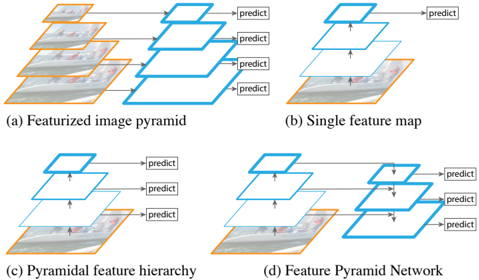
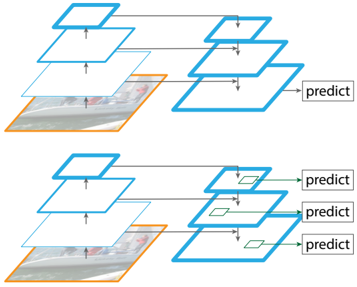
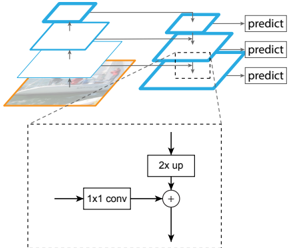
- FPN uses a bottom-up ResNet pathway (C2–C5), a top-down pathway that upsamples coarser maps by 2× with nearest-neighbor interpolation, and lateral 1×1 convolutions merged by element-wise addition; a 3×3 convolution is appended to each merged map. Detection uses d = 256 and pyramid levels P2–P5, with P6 added for RPN’s 512² anchor scale.
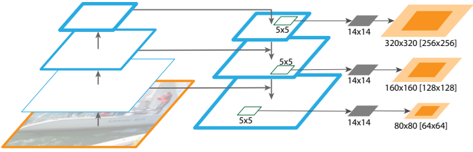
- For RPN, heads are attached to each pyramid level with single-scale anchors of areas {32², 64², 128², 256², 512²} on {P2, P3, P4, P5, P6} and aspect ratios {1:2, 1:1, 2:1}, totaling 15 anchors. For Fast R-CNN, RoIs are assigned to pyramid levels using the canonical 224² size and k₀ = 4, with shared heads and a 2fc MLP.
- Experiments use the 80-category COCO dataset, training on trainval35k (80k train + 35k val subset), ablating on minival (5k val images), and reporting test-std results. Backbones are ImageNet1k-pretrained ResNet-50/101; training uses synchronized SGD on 8 GPUs with input shorter side 800 pixels. RPN training takes about 8 hours and Fast R-CNN about 10 hours on COCO; inference is 0.148 s per image for ResNet-50 and 0.172 s for ResNet-101 on an NVIDIA M40 GPU.
Limitations
- The paper states that designing better connection modules is not its focus and opts for a simple design; more sophisticated blocks gave only marginally better results. It also notes that the ResNet-101 model was not sufficiently trained with the default schedule, and that the feature-sharing version of the COCO leaderboard model was not evaluated due to limited time.
- The paper states that its method does not exploit popular improvements such as iterative regression, hard negative mining, context modeling, or stronger data augmentation, which are complementary and could boost accuracy further.
- Evident from the text: there is no dedicated limitations section, and the empirical evaluation is limited to COCO detection and mask proposal generation, not full instance segmentation or other datasets.
Model-written summary. Check it against the paper before relying on it.
Integrity signals
Registry
Cites
Statistics
Figures
Verification
Claims the paper makes
8 Valid · 4 Not valid · 14 Not checked · 82 Own results and interpretations
The cited sources that could be checked couldn’t confirm or dispute this claim.
In the paper
“For these reasons, Fast and Faster R-CNN [11, 29] opt to not use featurized image pyramids under default settings.”
What the sources say
- Not matchedcites [11] [11] R. Girshick. Fast R-CNN. In ICCV , 2015. -
We searched by its title and found no matching paper.
- Could not verifycites [29] [29] S. Ren, K. He, R. Girshick, and J. Sun. Faster R-CNN: Towards real-time object detection with region proposal networks. In NIPS , 2015. - sourceExperimental — accuracy not yet measured
The Related Work section (p. 3) discusses multi-resolution features for semantic segmentation, and the results (p. 8) discuss multi-scale testing of the authors’ model. Neither passage addresses whether Fast or Faster R-CNN omit featurized image pyramids by default; searches for those models and that setting found no supporting passage in our copy. (LLM, conf=0.77)
plain- Asserted: passes — The authors put it forward as true.
- Checkable: passes — It can be checked against evidence.
- Load-bearing: passes — The paper’s conclusions depend on it.
- Based: passes — The paper gives a reason why it holds.
- Not matched
The cited sources support only part of this claim — read each source’s verdict below.
In the paper
“Recently, FPN has enabled new top results in all tracks of the COCO competition, including detection, instance segmentation, and keypoint estimation. See [14] for details.”
What the sources say
- Partly supportedcites [14] [14] K. He, G. Gkioxari, P. Doll´ ar, and R. Girshick. Mask r-cnn. arXiv:1703.06870 , 2017. - sourceExperimental — accuracy not yet measured
The paper reports strong COCO results using FPN backbones: its instance-segmentation model surpasses earlier winners (Section 4.1, p. 5), its detection model exceeds earlier single-model results (Section 4.3, p. 7), and its keypoint model exceeds the 2016 winner (Section 5, p. 8). But it does not establish that FPN enabled top competition results in all three tracks; Appendix B (p. 10) discusses 2017 winning teams only for instance segmentation and credits the Mask R-CNN framework. (LLM, conf=0.87)
plainstates a cause- Asserted: passes — The authors put it forward as true.
- Checkable: passes — It can be checked against evidence.
- Load-bearing: unclear — It is unclear whether the paper’s conclusions depend on it.
- Based: passes — The paper gives a reason why it holds.
- Partly supported
The sources with a verdict support this claim; the rest weren’t checked yet, have no full text we could read, or their verdicts aren’t rated yet.
In the paper
“All recent top entries in the ImageNet [33] and COCO [21] detection challenges use multi-scale testing on featurized image pyramids ( e.g ., [16, 35]).”
What the sources say
- Not checked yetcites [16] [16] K. He, X. Zhang, S. Ren, and J. Sun. Deep residual learning for image recognition. In CVPR , 2016. - source
Checked before — its earlier verdict is held back until a new check runs.
- Supportedcites [35] [35] A. Shrivastava, A. Gupta, and R. Girshick. Training regionbased object detectors with online hard example mining. In CVPR , 2016. - source
As an example citation, this paper supports the COCO part of the sentence. The Multi-scale (M) section (page unavailable) says it runs inference at all scales during testing, and the Ablation analysis (page unavailable) says a variant finished fourth in the 2015 COCO Detection Challenge. (LLM, conf=0.85)
plain- Asserted: passes — The authors put it forward as true.
- Checkable: passes — It can be checked against evidence.
- Load-bearing: passes — The paper’s conclusions depend on it.
- Based: passes — The paper gives a reason why it holds.
- Not checked yet
The cited sources support only part of this claim — read each source’s verdict below.
In the paper
“Existing mask proposal methods [27, 28, 4] are based on densely sampled image pyramids ( e.g ., scaled by 2 {-2:0 . 5:1 } in [27, 28]), making them computationally expensive.”
What the sources say
- Partly supportedcites [27] [27] P. O. Pinheiro, R. Collobert, and P. Dollar. Learning to segment object candidates. In NIPS , 2015. - sourceExperimental — accuracy not yet measured
The Introduction says prevalent object-detection methods use image or filter pyramids, and §3.3 says avoiding those pyramids saves running time. The paper does not establish that existing mask proposal methods rely on densely sampled image pyramids or document the specified scale sampling. (LLM, conf=0.86)
- Not matchedcites [28] [28] P. O. Pinheiro, T.-Y. Lin, R. Collobert, and P. Doll´ ar. Learning to refine object segments. In ECCV , 2016. -
More than one paper fits this citation.
- Not checked — no full text of the sourcecites [4] [4] J. Dai, K. He, Y. Li, S. Ren, and J. Sun. Instance-sensitive fully convolutional networks. In ECCV , 2016. -
plainstates a cause- Asserted: passes — The authors put it forward as true.
- Checkable: passes — It can be checked against evidence.
- Load-bearing: passes — The paper’s conclusions depend on it.
- Based: passes — The paper gives a reason why it holds.
- Partly supported
Every source the paper cites for this claim was checked and supports it.
In the paper
“The Single Shot Detector (SSD) [22] is one of the first attempts at using a ConvNet's pyramidal feature hierarchy as if it were a featurized image pyramid (Fig. 1(c)).”
What the sources say
- Supportedcites [22] [22] W. Liu, D. Anguelov, D. Erhan, C. Szegedy, and S. Reed. SSD: Single shot multibox detector. In ECCV , 2016. - source
Section 2.2 (p. 6) says SSD uses feature maps from several layers to mimic the effect of processing an image at different sizes. Section 2.1 (p. 3) describes progressively smaller feature layers for multi-scale detection, and the paper presents this as a contribution relative to earlier single-scale detectors. Together, these support the characterization of SSD as an early use of a ConvNet feature hierarchy in place of an image pyramid. (LLM, conf=0.88)
plain- Asserted: passes — The authors put it forward as true.
- Checkable: passes — It can be checked against evidence.
- Load-bearing: unclear — It is unclear whether the paper’s conclusions depend on it.
- Based: passes — The paper gives a reason why it holds.
- Supported
65 more claims · 4 with their cited sources checked
Create a free account to see all 108 claims and to verify the 11 references still open.
- It may state two separate claims as one. 23
- Probably not a substantial claim. 17
- The quote only partly states this claim. 3
Claims other papers make about this one
Each is checked against this paper’s own text: does it say what the citing paper says it does?
The source backs part of the claim, not all of it — or backs it for a different population, condition or comparison.
In the citing paper
“Feature Pyramid Network (FPN) [42] is one of the important two stage object detectors, tried to overcome few of the aforementioned challenges successfully by extracting features at multiple scales of an image in the object detection process.”
From Object detection using YOLO: challenges, architectural successors, datasets and applications (2023) · cites this paper as [42]
Experimental — accuracy not yet measuredThe source backs part of the claim, not all of it — or backs it for a different population, condition or comparison.
In the citing paper
“Its performance can be improved further by exploiting and enhancing the feature hierarchy of deep convolutional networks [80], employing non-local attention [81], and leveraging the reciprocal relationship between detection and segmentation via hybrid task cascade [82].”
From Empowering things with intelligence: a survey of the progress, challenges, and opportunities in artificial intelligence of things (2021) · cites this paper as [80]
Experimental — accuracy not yet measuredThe source backs part of the claim, not all of it — or backs it for a different population, condition or comparison.
In the citing paper
“To improve the accuracy of small defect detection, this paper uses SPP and FPN to increase the effect of multi-scale feature extraction.”
From Automatic Detection and Classification of Steel Surface Defect Using Deep Convolutional Neural Networks (2021) · cites this paper as [26]
Experimental — accuracy not yet measuredThe source backs part of the claim, not all of it — or backs it for a different population, condition or comparison.
In the citing paper
“YOLOv3 introduced a foundational generic architecture inspired by the Feature Pyramid Network (FPN) [22], integrating elements such as residual blocks, skip connections, and up-sampling.”
From YOLOv1 to v8: Unveiling Each Variant–A Comprehensive Review of YOLO (2024) · cites this paper as [22]
Experimental — accuracy not yet measuredThe cited source says what the claim attributes to it.
In the citing paper
“Unlike the word tokens that serve as the basic elements of processing in language Transformers, visual elements can vary substantially in scale, a problem that receives attention in tasks such as object detection [42, 53, 54].”
From Swin Transformer: Hierarchical Vision Transformer using Shifted Windows (2021) · cites this paper as [42]
14 more claims about this paper
Create a free account to see every claim other papers make about this one.
Self-check
Percentages, sums and reported differences re-computed from the paper’s own numbers.
Each contradiction between two passages listed here was confirmed by an independent check.
Rated minor: it would not touch a result — a value no result rests on, a p-value that stays on the same side of the significance level, or a conflict that is clerical, resolved elsewhere in the paper, or outside its own findings.
In the paper
§ 6.1. Segmentation Proposal Results · p. 8
“Our approach, based on FPNs, is substantially faster (our models run at 6 to 7 FPS).”
§ 6. Extensions: Segmentation Proposals · p. 8
“| + 2x train schedule | | 48.1 | 32.6 | 54.2 | 65.6 | 0.25 |”
Rated minor: it would not touch a result — a value no result rests on, a p-value that stays on the same side of the significance level, or a conflict that is clerical, resolved elsewhere in the paper, or outside its own findings.
In the paper
§ 5.1.1 Ablation Experiments · p. 5
“This architecture simulates the effect of reusing the pyramidal feature hierarchy (Fig. 1(b)).”
§ Feature Pyramid Networks for Object Detection · p. 1
“(b) Recent detection systems have opted to use only single scale features for faster detection. (c) An alternative is to reuse the pyramidal feature hierarchy computed by a ConvNet as if it were a featurized image pyramid.”
Citations
Cites
Deep Residual Learning for Image Recognition
He, K., Zhang, X., Ren, S., & Sun, J. (2016) · 2016 IEEE Conference on Computer Vision and Pattern Recognition (CVPR) · doi:10.1109/cvpr.2016.90 · Cited by 235,474 · cited 9×
“Analogous to the ResNet-based Faster R-CNN system [16] that uses C 4 as the single-scale feature map, we set k 0 to 4.”
BackgroundMethodResultInfluentialSelf-citationVery Deep Convolutional Networks for Large-Scale Image Recognition
Simonyan, K., & Zisserman, A. (2014) · arXiv · doi:10.48550/arxiv.1409.1556 · Cited by 114,148 · cited 2×
“But to avoid using low-level features SSD foregoes reusing already computed layers and instead builds the pyramid starting from high up in the network ( e.g ., conv4 3 of VGG nets [36]) and then by adding several new layers.”
BackgroundResultImageNet classification with deep convolutional neural networks
Krizhevsky, A., Sutskever, I., & Hinton, G. E. (2017) · Communications of the ACM · doi:10.1145/3065386 · Cited by 112,155 · cited 3×
“With the development of modern deep ConvNets [19], object detectors like OverFeat [34] and R-CNN [12] showed dramatic improvements in accuracy.”
MethodResultU-Net: Convolutional Networks for Biomedical Image Segmentation
Ronneberger, O., Fischer, P., & Brox, T. (2015) · Lecture notes in computer science · doi:10.1007/978-3-319-24574-4_28 · Cited by 99,404 · cited 1×
“rarchy without combining features or scores. There are recent methods exploiting lateral/skip connections that associate low-level feature maps across resolutions and semantic levels, including U-Net [31] and SharpMask [28] for segmentation, Recombinator networks [17] for face detection, and Stacked Hourglass networks…”
MethodFaster R-CNN: Towards Real-Time Object Detection with Region Proposal Networks
Ren, S., He, K., Girshick, R., & Sun, J. (2017) · IEEE Transactions on Pattern Analysis and Machine Intelligence · doi:10.1109/tpami.2016.2577031 · Cited by 73,472 · cited 10×
“For these reasons, Fast and Faster R-CNN [11, 29] opt to not use featurized image pyramids under default settings.”
BackgroundMethodInfluentialSelf-citationFaster R-CNN: Towards Real-Time Object Detection with Region Proposal Networks
Ren, S., He, K., Girshick, R., & Sun, J. (2015) · arXiv · doi:10.48550/arxiv.1506.01497 · Cited by 70,812 · cited 10×
“For these reasons, Fast and Faster R-CNN [11, 29] opt to not use featurized image pyramids under default settings.”
BackgroundMethodInfluentialSelf-citationDistinctive Image Features from Scale-Invariant Keypoints
Lowe, D. G. (2004) · International Journal of Computer Vision · doi:10.1023/b:visi.0000029664.99615.94 · Cited by 62,647
Microsoft COCO: Common Objects in Context
Lin, T.-Y., Maire, M., Belongie, S., Hays, J., Perona, P., Ramanan, D., Dollár, P., & Zitnick, C. L. (2014) · Lecture Notes in Computer Science · doi:10.1007/978-3-319-10602-1_48 · Cited by 45,460 · cited 6×
“All recent top entries in the ImageNet [33] and COCO [21] detection challenges use multi-scale testing on featurized image pyramids ( e.g ., [16, 35]).”
BackgroundMethodInfluentialSelf-citationImageNet Large Scale Visual Recognition Challenge
Russakovsky, O., Deng, J., Su, H., Krause, J., Satheesh, S., Ma, S., Huang, Z., Karpathy, A., Khosla, A., Bernstein, M., et al. (2015) · International Journal of Computer Vision · doi:10.1007/s11263-015-0816-y · Cited by 39,380 · cited 2×
“Thus we can adapt the assignment strategy of region-based detectors [15, 11] in the case when they are run on image pyramids.”
MethodFully convolutional networks for semantic segmentation
Long, J., Shelhamer, E., & Darrell, T. (2015) · 2015 IEEE Conference on Computer Vision and Pattern Recognition (CVPR) · doi:10.1109/cvpr.2015.7298965 · Cited by 38,834 · cited 1×
“FCN [24] sums partial scores for each category over multiple scales to compute semantic segmentations.”
Background
Research works printed but not linked: 1
- [1] E. H. Adelson, C. H. Anderson, J. R. Bergen, P. J. Burt, and J. M. Ogden. Pyramid methods in image processing. RCA engineer , 1984. -
Cited by
Items 20,901–21,000 of 29,875
Wu, R., Zhang, Y., Lan, R., et al. (2025) · SSRN Electronic Journal · doi:10.2139/ssrn.5257434 · Cited by 2
Perera, M., Tan, W., Yang, E., Jain, O., Aggarwal, M., Venugopal, H., Iskander, J., Berry, J. D., Leis, A. P., & Shakeel, S. (2026) · bioRxiv (Cold Spring Harbor Laboratory) · doi:10.64898/2026.01.23.700950 · Cited by 2
“The first is the advancement of dynamic architecture frameworks in machine learning, which allow model architectures to adapt during inference and detection, promising improved adaptability to varying image complexity 22 – 24 .”
Connecting the dots: deep learning-based automated model building methods in cryo-EM
Bansia, H., & des Georges, A. (2026) · Frontiers in Molecular Biosciences · doi:10.3389/fmolb.2025.1613399 · Cited by 2
Connecting the dots: deep learning-based automated model building methods in cryo-EM
Bansia, H., & des Georges, A. (2025) · doi:10.64898/2025.12.28.696775 · Cited by 2
Zero-shot quantization for object detection via scene-aware synthesis and instance-guided alignment
Li, X., Di, X., Liu, M., & Ye, S. (2026) · International Journal of Multimedia Information Retrieval · doi:10.1007/s13735-026-00412-z · Cited by 1
Nguyen, D. T., Je, H., Nguyen, T. N., Ryu, S., Lee, K., & Lee, H. (2022) · IEEE Transactions on Circuits and Systems I Regular Papers · doi:10.1109/tcsi.2022.3153288 · Cited by 60
What’s in the Black Box? The False Negative Mechanisms Inside Object Detectors
Miller, D., Moghadam, P., Cox, M., Wildie, M., & Jurdak, R. (2022) · IEEE Robotics and Automation Letters · doi:10.1109/lra.2022.3187831 · Cited by 28
Multiple Cues Association for Multiple Object Tracking Based on Convolutional Neural Network
Hu, R., Bouindour, S., Snoussi, H., Cherouat, A., & Chahla, C. (2019) · IEEE International Conference on Artificial Intelligence and Knowledge Engineering (AIKE) · doi:10.1109/aike.2019.00030 · Cited by 2
Improving Real-Time Performance of U-Nets for Machine Vision in Laser Process Control
Dolata, P., & Reiner, J. (2019) · Annals of Computer Science and Information Systems · doi:10.15439/2019f190 · Cited by 1
Feature reusing and semantic aggregation for single stage object detector
Jiang, Y., & Li, J. (2019) · International Conference on Artificial Intelligence, Information Processing and Cloud Computing (AIIPCC) · doi:10.1145/3371425.3371484 · Cited by 1
Detection of Ethnic Minority’s Symbols Based on Deep Learning
Feng, Y., Shi, Z., Kong, Q., Li, M., Yang, M., Zhang, M., & Zeng, S. (2020) · Journal of Physics Conference Series · doi:10.1088/1742-6596/1646/1/012033 · Cited by 1
Towards Robust Certification of Computer-Vision-Based Detect and Avoid in UAS
Sridhar, R., Murphy, M., & Lamprecht, A. (2020) · IEEE/AIAA Digital Avionics Systems Conference (DASC) · doi:10.1109/dasc50938.2020.9256697 · Cited by 1
Convolutional Neural Networks for Mobile Face Recognition with Hierarchical Feature integration
Li, X., Danyang, C., Yong-jie, L., Shuming, Y., Lan, L., & Xiangyu, Z. (2020) · IEEE International Conference on Information Technology, Big Data and Artificial Intelligence (ICIBA) · doi:10.1109/iciba50161.2020.9276966 · Cited by 2
SimpleNet: Hazardous-Object Detecting Neural Network in Low-Performance Devices
Jeong, J. (2020) · International Conference on Cybernetics and Intelligent System (ICORIS) · doi:10.1109/icoris50180.2020.9320799 · Cited by 1
Learning Richer Features in Deep CNN for Object Detection
Li, Y., He, X., Zheng, Z., & Chen, Y. (2020) · International Conference on Artificial Intelligence and Computer Engineering (ICAICE) · doi:10.1109/icaice51518.2020.00018 · Cited by 2
Common Methods of Image Panoptic Segmentation Based on Deep Learning
Wang, C. (2021) · International Conference on Bioinformatics and Intelligent Computing (BIC) · doi:10.1145/3448748.3448807 · Cited by 1
Surgical-Tools Tracking Based on Convolutional Neural Network and Long Short-Term Memory
Yu, Y., & Zhao, Z. (2021) · World Congress on Medical Physics and Biomedical Engineering, September 7 - 12, 2009, Munich, Germany · doi:10.1007/978-3-030-66169-4_3 · Cited by 1
Hierarchical Context Guided Aggregation Network for Stereo Matching
Peng, J., Xie, W., Huang, Z., et al. (2021) · IEEE International Conference on Acoustics Speech and Signal Processing · doi:10.1109/icassp39728.2021.9414381 · Cited by 1
RLST: A Reinforcement Learning Approach to Scene Text Detection Refinement
Peng, X., Huang, Z., Chen, K., Guo, J., & Qiu, W. (2021) · Proceedings - International Conference on Pattern Recognition/Proceedings/International Conference on Pattern Recognition · doi:10.1109/icpr48806.2021.9412276 · Cited by 2
LRP-DS: Lightweight RepPoints with Decoupled Sampling Point Set
Wang, J., Weng, L., & Gao, F. (2021) · Applied Sciences · doi:10.3390/app11135876 · Cited by 1
Cross-layer Navigation Convolutional Neural Network for Fine-grained Visual Classification
Guo, C., Xie, J., Liang, K., Sun, X., & Ma, Z. (2021) · ACM International Conference on Multimedia in Asia (MMAsia) · doi:10.1145/3469877.3490579 · Cited by 5
Web Components Template Generation from Web Screenshot
Anunphop, P., & Chongstitvatana, P. (2021) · Advances in Information Technology · doi:10.1145/3468784.3468787 · Cited by 1
A Multi-Level Feature Fusion Network For Scene Text Detection with Text Attention Mechanism
Liu, X., Chen, X., Kuang, H., & Ma, X. (2021) · IEEE Advanced Information Management, Communicates, Electronic and Automation Control Conference (IMCEC) · doi:10.1109/imcec51613.2021.9482108 · Cited by 1
GridTrack: Detection and Tracking of Multiple Objects in Dynamic Occupancy Grids
Erkent, Ö., González, D., Paigwar, A., & Laugier, C. (2021) · Lecture notes in computer science · doi:10.1007/978-3-030-87156-7_15 · Cited by 2
Gn, B., Braylovskaya, T. V., Fedosova, N. V., et al. (2021) · Parodontologiya · doi:10.33925/1683-3759-2021-26-3-188-196 · Cited by 1
A Multi-Scale Self-Attention Network for Diabetic Retinopathy Retrieval
Zeng, M., Fang, J., Miao, H., Zhang, T., & Liu, J. (2021) · International Conference on Control and Computer Vision (ICCCV) · doi:10.1145/3484274.3484290 · Cited by 1
RMF-Net: Improving Object Detection with Multi-Scale Strategy
Zhang, Y., Shen, M., & Yang, W. (2021) · IEICE Transactions on Communications · doi:10.1587/transcom.2021ebp3102 · Cited by 2
Road Roughness Estimation for Intelligent Vehicles Based on SNE and Semantic Segmentation
Xu, J., Gao, L., Ma, J., et al. (2021) · IEEE International Conference on Unmanned Systems (ICUS) · doi:10.1109/icus52573.2021.9641273 · Cited by 1
Result Weighting-Based Resnet Feature Pyramid Network Architecture for Surface Defect Detection
Üzen, H., Türkoğlu, M., & Hanbay, D. (2021) · Gazi Üniversitesi Fen Bilimleri Dergisi Part C Tasarım ve Teknoloji · doi:10.29109/gujsc.1021785 · Cited by 3
Small Object Detection in Aerial Images
Zhang, R., Jing, M., Fan, Y., et al. (2021) · IEEE International Conference on ASIC (ASICON) · doi:10.1109/asicon52560.2021.9620245 · Cited by 1
Yang, R., Peng, C., Wang, C., et al. (2021) · Conference proceedings/Conference proceedings - IEEE International Conference on Systems, Man, and Cybernetics · doi:10.1109/smc52423.2021.9658979 · Cited by 1
SSD Based Target Detection Algorithm for the Autonomous Driving Vision System
Tong, G., Cai, J. C., Huang, L., et al. (2021) · IEEE International Conference on Information Technology, Big Data and Artificial Intelligence (ICIBA) · doi:10.1109/iciba52610.2021.9688170 · Cited by 1
A Review of Convolutional Neural Network Development in Computer Vision
Zhang, H. (2022) · EAI Endorsed Transactions on Internet of Things · doi:10.4108/eetiot.v7i28.445 · Cited by 3
Multi-scale redistribution feature pyramid for object detection
Qian, H., Guo, J., & Zhou, X. (2022) · AI Communications · doi:10.3233/aic-210222 · Cited by 1
Bupleurum Seeds Recognition with Attention Mechanism
Chen, Z., Xin, J., Wu, J., et al. (2021) · China Automation Congress (CAC) · doi:10.1109/cac53003.2021.9727683 · Cited by 1
Automatic Localization and Identification of Thoracic Diseases from Chest X-rays with Deep Learning
Xin, X., Zhang, J., Wang, W., Zhang, B., Zhang, S., Tang, T., Peng, X., Zhang, Y., Yang, W. T., & Li, W. (2022) · Current Medical Imaging Formerly Current Medical Imaging Reviews · doi:10.2174/1573405618666220518110113 · Cited by 4
AspectNet: Aspect-Aware Anchor-Free Detector for Autonomous Driving
Liang, T., Bao, H., Pan, W., Fan, X., & Li, H. (2022) · Applied Sciences · doi:10.3390/app12125972 · Cited by 1
Self-supervised Depth Estimation with High Resolution Features and Non-local Information
Jing, R., & Liu, Y. (2022) · International Conference on Machine Learning and Computing (ICMLC) · doi:10.1145/3529836.3529907 · Cited by 1
Feature-Aware Network Based on Upper Triangular Interaction for Single Shot Detector
Dong, X. L., Li, F., Bai, H., & Zhao, Y. (2022) · Smart innovation, systems and technologies · doi:10.1007/978-981-19-1057-9_19 · Cited by 1
Detection of Respiratory Disease Patterns Using Mask R-CNN
Aguilar, E., Cruz, A. L., Albertti, R., Carnier, M., Gavidia, L., & Severeyn, É. (2022) · Lecture notes in networks and systems · doi:10.1007/978-981-19-1610-6_65 · Cited by 1
A Monocular Vision-Based Human-Following Approach for Mobile Robots
Tan, Y., Wu, S., Liu, W., Yang, X., & Sun, H. (2022) · Lecture notes in computer science · doi:10.1007/978-3-031-13841-6_65 · Cited by 1
Towards A Practical Pedestrian Detection Method for Supporting Autonomous Driving
Huang, Z., Sun, P., & Boukerche, A. (2022) · International Conference on Communications · doi:10.1109/icc45855.2022.9839149 · Cited by 2
Enhanced Semantic Head for Cascade Instance Segmentation
Huang, X., Su, L. P., Li, G., Zhang, X., Qing, L., & Huang, Q. (2022) · IEEE International Conference on Multimedia and Expo (ICME) · doi:10.1109/icme52920.2022.9860005 · Cited by 1
Hyun, S., Ryu, C. H., Kang, J. Y., Lim, H. J., & Han, T. H. (2022) · Electronics · doi:10.3390/electronics11172678 · Cited by 2
Automatic segmentation of intracytoplasmic sperm injection images
Kovalev, V., & Shishkin, A. G. (2022) · Computer Optics · doi:10.18287/2412-6179-co-1060 · Cited by 1
Container Damage Detection Algorithm Based on Fast-Solo
Wang, H., Liu, Q., & Zhang, G. (2022) · Lecture notes in electrical engineering · doi:10.1007/978-981-19-6226-4_13 · Cited by 3
Learning Balance Feature for Object Detection
Zhang, Z., Qiu, X., & Li, Y. (2022) · Electronics · doi:10.3390/electronics11172765 · Cited by 1
Exploring density rectification and domain adaption method for crowd counting
Peng, S., Yin, B., Yang, Q., He, Q., & Wang, L. (2022) · Neural Computing and Applications · doi:10.1007/s00521-022-07917-8 · Cited by 1
License Plate Detection with Attention-Guided Dual Feature Pyramid Networks in Complex Environments
Xiong, Y.-J., Gao, Y., Zhang, J.-Q., & Ren, J.-X. (2022) · Electronics · doi:10.3390/electronics11233895 · Cited by 1
Ouyang, C., Zhang, H., Hou, J., Li, Q., Yang, B., & Gao, F. (2022) · IEEE International Symposium on Product Compliance Engineering - Asia (ISPCE-ASIA) · doi:10.1109/ispce-asia57917.2022.9970963 · Cited by 2
Chang, C., Chen, H., & Lin, C. (2022) · doi:10.1109/ieem55944.2022.9989934 · Cited by 1
Ruan, Q., Jiang, F., Xiao, M., Lin, W.-M., & Weng, W. (2022) · doi:10.1145/3569966.3570061 · Cited by 1
YOLOX-based dynamic vehicle target detection
Wang, M., Zhuang, X., & Zhao, H. (2022) · IEEE International Conference on Civil Aviation Safety and Information Technology (ICCASIT) · doi:10.1109/iccasit55263.2022.9987008 · Cited by 2
Fierro-Radilla, A. N., Cacho, M. L. B., Daniel, K. R. P., Valle, A. A., Lopez-Figueroa, A., & Benítez-García, G. (2022) · Lecture notes in computer science · doi:10.1007/978-3-031-19493-1_27 · Cited by 1
CSU-Net: Contour Semantic Segmentation Self-Enhancement for Human Head Detection
Chouai, M., & Doležel, P. (2022) · IEEE Access · doi:10.1109/access.2022.3233419 · Cited by 1
Local Axial Scale-Attention for Universal Lesion Detection
Liu, C., Hou, Y., Zhao, P., Guo, Z., Li, Y., Zhang, H., & Zhou, J. (2023) · Journal of Imaging Informatics in Medicine · doi:10.1007/s10278-022-00748-y · Cited by 3
Empirical Study One-stage Object Detection methods for RoboCup Small Size League
Nguyen, K. T. T. M., Ngo, L. D., Huynh, K. T. V., & Nam, N. T. (2022) · NAFOSTED Conference on Information and Computer Science (NICS) · doi:10.1109/nics56915.2022.10013320 · Cited by 1
Object Detection in Aerial Images with Uncertainty-Aware Graph Network
Kim, J., Baek, J., & Hwang, S. J. (2023) · Lecture notes in computer science · doi:10.1007/978-3-031-25069-9_34 · Cited by 3
Violation Behavior Detection for Non-motor Vehicles
Jing, W.-Y. J. W.-Y., Jing, Z.-J. Z. W.-Y., Zhu, Y.-Q. B. Z.-J., et al. (2023) · 電腦學刊 · doi:10.53106/199115992023023401013 · Cited by 1
Robustizing Object Detection Networks Using Augmented Feature Pooling
Shibata, T., Tanaka, M., & Okutomi, M. (2023) · Lecture notes in computer science · doi:10.1007/978-3-031-26348-4_6 · Cited by 1
Bao, Z., Wang, Y., Huang, J., & Kang, G. (2022) · International Conference on Biomedical and Bioinformatics Engineering (ICBBE) · doi:10.1145/3574198.3574202 · Cited by 1
YOLOX-EC: A Pedestrian and Vehicle Detection Algorithm in Automatic Driving Scenes
Guo, D., Hu, J., & Yan, F. (2022) · International Conference on Electronic Information Technology and Computer Engineering (EITCE) · doi:10.1145/3573428.3573582 · Cited by 1
Real-Time Detection Method of Wood Defects Based on Deep Learning
Cheng, D., Cheng, G., & Wang, X. (2022) · IEEE International Conference on Computer and Communications (ICCC) · doi:10.1109/iccc56324.2022.10066017 · Cited by 3
Multi-view 3D reconstruction based on SFM and improved deep network
Li, X., Li, X., Zheng, C., et al. (2022) · doi:10.1109/icftic57696.2022.10075204 · Cited by 1
Jiaxin, 钱. Q., Pengfei, 余. Y., Haiyan, 李. L., & Hongsong, 李. L. (2023) · Laser & Optoelectronics Progress · doi:10.3788/lop212774 · Cited by 1
Vehicle Violation Detection System Based on Improved YOLOv5 Algorithm
Sun, X., Zhang, Y., Huang, X., et al. (2022) · International Conference on Computational Intelligence and Security (CIS) · doi:10.1109/cis58238.2022.00038 · Cited by 1
Evaluating Hyper-Parameter Optimization On Remote Sensing Object Detection
Li, S., Bai, Y., Zhang, T., & Wang, H. (2022) · International Conference on Algorithms, High Performance Computing and Artificial Intelligence (AHPCAI) · doi:10.1109/ahpcai57455.2022.10087803 · Cited by 2
CCN: Pavement Crack Detection with Context Contrasted Net
Zhu, Y., Sheng, Z., & Ruan, C. (2023) · Lecture notes in computer science · doi:10.1007/978-3-031-30111-7_8 · Cited by 3
Six-to-one: Cubemap-guided Feature Calibration for Panorama Object Detection
Miao, J., Liu, Y., Wang, K., Liu, J., Argyriou, A., Han, Y., & Xu, Z. (2022) · IEEE International Conference on Tools with Artificial Intelligence (ICTAI) · doi:10.1109/ictai56018.2022.00200 · Cited by 2
A Multiscale Instance Segmentation Method Based on Cleaning Rubber Ball Images
Su, E., Tian, Y., Wang, J., 梁二军, & Zhang, Y. (2023) · Sensors · doi:10.3390/s23094261 · Cited by 2
Feature Fusion and Information Supervision Consistency for Object Detection
Tang, X., & Zhao, M. (2023) · Electronics · doi:10.3390/electronics12092034 · Cited by 1
RIDEN: Neural-based Uniform Density Histogram for Distribution Shift Detection
Yonekawa, K., Saito, K., & Kurokawa, M. (2022) · International Conference on AI-ML Systems (AIMLSystems) · doi:10.1145/3564121.3564136 · Cited by 5
Tong, E., Grøvik, E., Emblem, K. E., Chen, K. T., Fan, A. P., Yu, Y., Zhu, G., Zhao, M. Y., Niri, S. G., & Zaharchuk, G. (2023) · Springer eBooks · doi:10.1007/978-3-031-10909-6_58 · Cited by 1
EOPSA-FACE: An Encoder-Only DETR for Classroom Face Detection
Wen, P., Sun, C., Zhang, S., et al. (2022) · International Conference on Information Systems and Computing Technology (ISCTech) · doi:10.1109/isctech58360.2022.00060 · Cited by 1
A New Strategy for Reducing Errors in Scene Text Detection
Chen, C., Zheng, F., Zhang, S., & Li, W. (2023) · International Conference on Computer Vision, Image and Deep Learning (CVIDL) · doi:10.1109/cvidl58838.2023.10166555 · Cited by 2
Merged Intersection Over Union: A Metric and a Loss for Aerial Images in Transmission Lines
Zhang, H., Du, J., Xie, C., et al. (2023) · International Conference on Intelligent Control, Measurement and Signal Processing (ICMSP) · doi:10.1109/icmsp58539.2023.10170859 · Cited by 1
Chen, W., Zou, B., Zheng, Q., Sun, H., Huang, C., Li, L., & Liu, J. (2023) · Coatings · doi:10.3390/coatings13071245 · Cited by 2
BCSR: toward arbitrarily oriented text image super-resolution via adaptive Bezier curve network
Shi, M., Tan, M., Kong, S., & Zao, B. (2023) · EURASIP Journal on Advances in Signal Processing · doi:10.1186/s13634-023-01028-9 · Cited by 1
Detection of Electric Component Based on Improved Faster-RCNN
Xiao, C., Zhang, D., & Sun, C. (2023) · doi:10.1109/ijcnn54540.2023.10191941 · Cited by 1
An Improved Two-Stage Network for Steel Surface Defect Detection
Zhang, Y., Zou, L., Wei, Y., & Dai, W. (2023) · International Conference on Computing and Artificial Intelligence (ICCAI) · doi:10.1145/3594315.3594653 · Cited by 1
Elevating Amodal Segmentation Using ASH-Net Architecture for Accurate Object Boundary Estimation
Raghavendra, S., Rao, D., Abhilash, S. K., Nookala, V. M., & Bharathi, P. G. (2023) · IEEE Access · doi:10.1109/access.2023.3301724 · Cited by 3
GCA-Net: Global Cross Aware Network for salient object detection
Zhang, Z., Shi, F., Geng, X., Tao, Y., & He, J. (2023) · International Conference on Multimedia and Image Processing (ICMIP) · doi:10.1145/3599589.3599594 · Cited by 1
Learning Monocular Depth in Dynamic Environment via Context-aware Temporal Attention
Wu, Z., Li, Z., Fan, Z., Wu, Y., Gan, Y., & Pu, J. (2023) · International Joint Conference on Artificial Intelligence · doi:10.24963/ijcai.2023/172 · Cited by 2
Generalization of Fine Granular Extractions from Charts
Paliwal, S. S., Patwardhan, M. S., & Vig, L. (2023) · Lecture notes in computer science · doi:10.1007/978-3-031-41679-8_6 · Cited by 1
Linear Object Detection in Document Images Using Multiple Object Tracking
Bernet, P., Chazalon, J., Carlinet, E., et al. (2023) · Lecture notes in computer science · doi:10.1007/978-3-031-41734-4_28 · Cited by 1
RC-Mask: Rotated-Count-Mask for Chromosome Segmentation
Hu, X., Li, W., & Xiao, H. (2023) · IEEE International Symposium on Biomedical Imaging (ISBI) · doi:10.1109/isbi53787.2023.10230648 · Cited by 1
Li, S., Liu, C., & Chen, L. (2023) · IET Intelligent Transport Systems · doi:10.1049/itr2.12421 · Cited by 2
USGG: Union Message Based Scene Graph Generation
Sun, S., Huang, D., Qin, Z., Tao, X., Pan, C., & Liu, G. (2023) · Proceedings - International Conference on Image Processing · doi:10.1109/icip49359.2023.10222408 · Cited by 2
Geometric Prior-Assisted Feature Presentation Enhancement for Object Detection in Aerial Images
Huang, R., Liu, Z., Chen, J., Shi, Y., & Xiao, G. (2023) · Proceedings - International Conference on Image Processing · doi:10.1109/icip49359.2023.10222806 · Cited by 2
An Investigation into Replacement of Washcare Labels with Cost Effective QR Code Labels
-, K. P. K., Nagarajan, L., K.Venkatehwarlu, -, T. N. B., -, M. V. K. K., & -, A. B. (2023) · International Journal For Multidisciplinary Research · doi:10.36948/ijfmr.2023.v05i05.6305 · Cited by 1
Transfer Learning and Ensemble Learning
Yan, W. Q. (2023) · Texts in computer science · doi:10.1007/978-981-99-4823-9_7 · Cited by 1
Liu, S., Xia, T., Chen, X., Li, H., Yuan, G., & Yang, D. (2023) · International Journal of Wavelets Multiresolution and Information Processing · doi:10.1142/s0219691323500480 · Cited by 1
Ms-AMPool: Down-Sampling Method for Dense Prediction Tasks
Yang, S., Zhang, X., Chen, Y., et al. (2023) · Lecture notes in computer science · doi:10.1007/978-3-031-44210-0_39 · Cited by 1
Robotic Sorting of Batteries Using Visual Few-shot Learning and Fusion with Depth Data
Keller, P., Mangler, J., Hügel, N., Besselmann, M. G., Roennau, A., & Dillmann, R. (2023) · International Conference on Electrical, Computer, Communications and Mechatronics Engineering (ICECCME) · doi:10.1109/iceccme57830.2023.10253347 · Cited by 2
Fetal Head Circumference Detection Based on Dlink-Net Model
Dai, W., & Zhai, J. (2023) · Lecture notes in electrical engineering · doi:10.1007/978-981-99-6886-2_3 · Cited by 1
Li, X., Lv, X., Sun, L., Zhang, J., & Lan, R. (2023) · Electronics · doi:10.3390/electronics12194180 · Cited by 1
Multiple Pedestrian Detection Depending on Faster Region-based Convolutional Neural Network (RCNN)
Shariha, G., Elmogy, M. M., El-Daydamony, E., & Atwan, A. (2019) · Mansoura Journal for Computer and Information Sciences · doi:10.21608/mjcis.2019.320866 · Cited by 1
Ding, P., Zhang, J., Zhang, P., & Li, G. (2023) · International Conference on Automation and Computing (ICAC) · doi:10.1109/icac57885.2023.10275202 · Cited by 4
Tobacco Information Extraction Based on UAV High Resolution Images
Liao, K., He, L., Li, Y., He, J., Gao, J., Yan, F., Zhang, J., Jian, S., Kang, H., Yu, Y., et al. (2023) · IEEE International Geoscience and Remote Sensing Symposium (IGARSS) · doi:10.1109/igarss52108.2023.10281920 · Cited by 2
Ensembling Voxel-Based and Box-Based Model Predictions for Robust Lesion Detection
Debs, N., Routier, A., Nader, C. A., Marcoux, A., Bône, A., & Rohé, M.-M. (2023) · Lecture notes in computer science · doi:10.1007/978-3-031-47076-9_5 · Cited by 1
Metadata
- Authors
- Lin, T.-Y., Dollar, P., Girshick, R., He, K., Hariharan, B., & Belongie, S.
- Affiliations
- Cornell University (US)
- Meta (United States) (US)
- Venue
- 2017 IEEE Conference on Computer Vision and Pattern Recognition (CVPR)
- Publisher
- IEEE
- Published
- 2017-07
- Pages
- 936-944
- ISSN
- 1063-6919 (ISSN-L)
- OpenAlex
- W2565639579
- Cited by
- 30,939
- References
- 64
- Citations by year
- 2026: 2864 · 2025: 4496 · 2024: 5179 · 2023: 5172 · 2022: 4516 · 2021: 3861 · 2020: 2506 · 2019: 1759 · 2018: 526 · 2017: 58
- FWCI
- 387.80
- Type
- conference paper
- Language
- en
- Open access
- closed
- Locations
- IEEE Computer Society Conference on Computer Vision and Pattern Recognition/Proceedings - IEEE Computer Society Conference on Computer Vision and Pattern Recognition/Proceedings (publishedVersion)
- Topics
- Physical Sciences › Computer Science › Computer Vision and Pattern Recognition › Advanced Neural Network Applications
- Physical Sciences › Computer Science › Computer Vision and Pattern Recognition › Advanced Image and Video Retrieval Techniques
- Physical Sciences › Computer Science › Computer Vision and Pattern Recognition › Visual Attention and Saliency Detection
- Keywords
- feature pyramid network, multi-scale object detection, lateral connections, Faster R-CNN, COCO benchmark, deep convolutional neural networks, feature extraction
About these checks
Registry, retraction, Cites and statistics results are computed, not judged, with one exception: a printed reference that no index lists is read once by a model before it counts as a citation error. Claims are extracted by a model and kept only when their quote appears verbatim in the text; each cited source is then checked, with a model’s help, for whether it says what the claim relies on. Those verdicts can be wrong — read the claim’s quote and the cited source before relying on one.
The claim verdicts this report counts are experimental: their accuracy is not yet measured.
A language model drew the claims from the paper on 2026-10-10, under version 3 of the claim definition (model deepseek-v4.1-flash, prompt extract-v3).
A second model labelled each claim on 2026-10-10 (model jev-1.13-20260917, definition revision gold-guideline-v0.2).
Cited sources are checked with a language model’s help (gpt-6-sol).
Statistics and arithmetic are recomputed, not judged.
Confidence bands are shown only for fields calibrated on our annotated test set. None is calibrated yet, so no band is shown.
What counts as a claim ›How we measure confidence ›How we check this ›
Are you an author, or do you see a problem with this page? Request a review
Data sources
Bibliographic data: Semantic Scholar, OpenAlex, Crossref.
Contains information from the Semantic Scholar Academic Graph Datasets, made available under the ODC Attribution License (ODC-BY 1.0).
Semantic Scholar’s data is described in: Kinney, R., et al. (2023). The Semantic Scholar Open Data Platform. arXiv:2301.10140.
