

Feature Pyramid Networks for Object Detection
The DOI matches its Crossref record; 49 of the 64 references it cites were found in a registry or an index, and 1 are not checked yet; 14 of the 44 sources its claims cite were checked for support.
Abstract
Feature pyramids are a basic component in recognition systems for detecting objects at different scales. But pyramid representations have been avoided in recent object detectors that are based on deep convolutional networks, partially because they are slow to compute and memory intensive. In this paper, we exploit the inherent multi-scale, pyramidal hierarchy of deep convolutional networks to construct feature pyramids with marginal extra cost. A top-down architecture with lateral connections is developed for building high-level semantic feature maps at all scales. This architecture, called a Feature Pyramid Network (FPN), shows significant improvement as a generic feature extractor in several applications. Using a basic Faster R-CNN system, our method achieves state-of-the-art single-model results on the COCO detection benchmark without bells and whistles, surpassing all existing single-model entries including those from the COCO 2016 challenge winners. In addition, our method can run at 5 FPS on a GPU and thus is a practical and accurate solution to multi-scale object detection. Code will be made publicly available.
Verified 2026-11-25 · 1 reference not checked yet
Overview
CoChat Summary
TL;DR
Feature Pyramid Networks (FPN) build in-network feature pyramids from a single-scale image using a top-down pathway and lateral connections, giving semantically strong features at all scales with marginal extra cost. FPN improves region proposal and object detection accuracy over strong single-scale baselines and achieves state-of-the-art single-model COCO results without image pyramids.
Key findings
- RPN with FPN improves COCO minival AR\(_{1k}\) to 56.3 from 48.3 for the single-scale C4 baseline (+8.0 points), and small-object AR\(_{1k}^s\) to 44.9 from 32.0 (+12.9 points).
- Fast R-CNN on fixed proposals improves AP to 33.9 with FPN versus 31.9 for the C4 baseline (+2.0) and 28.8 for the 2fc C5 baseline (+5.1); AP@0.5 is 56.9.
- Faster R-CNN with FPN reaches 33.9 AP and 56.9 AP@0.5 on minival, improving over a strong single-scale baseline by 2.3 AP and 3.8 AP@0.5. On COCO test-dev with ResNet-101, it reaches 36.2 AP and 59.1 AP@0.5, surpassing single-model competition winners such as G-RMI (34.7 AP) and AttractioNet (35.7 AP).
- For segmentation proposals, FPN with dual MLPs, 2× mask resolution, and 2× training schedule reaches 48.1 AR, outperforming DeepMask (37.1), SharpMask (39.8), and InstanceFCN (39.2) by over 8.3 points AR, while running at 6–7 FPS.
Methods
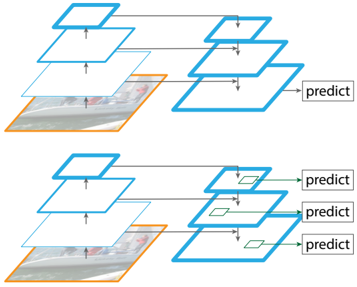
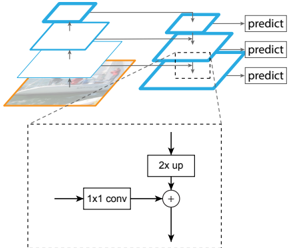
- FPN uses a bottom-up ResNet pathway (C2–C5), a top-down pathway that upsamples coarser maps by 2× with nearest-neighbor interpolation, and lateral 1×1 convolutions merged by element-wise addition; a 3×3 convolution is appended to each merged map. Detection uses d = 256 and pyramid levels P2–P5, with P6 added for RPN’s 512² anchor scale.
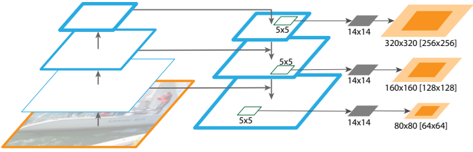
- For RPN, heads are attached to each pyramid level with single-scale anchors of areas {32², 64², 128², 256², 512²} on {P2, P3, P4, P5, P6} and aspect ratios {1:2, 1:1, 2:1}, totaling 15 anchors. For Fast R-CNN, RoIs are assigned to pyramid levels using the canonical 224² size and k₀ = 4, with shared heads and a 2fc MLP.
- Experiments use the 80-category COCO dataset, training on trainval35k (80k train + 35k val subset), ablating on minival (5k val images), and reporting test-std results. Backbones are ImageNet1k-pretrained ResNet-50/101; training uses synchronized SGD on 8 GPUs with input shorter side 800 pixels. RPN training takes about 8 hours and Fast R-CNN about 10 hours on COCO; inference is 0.148 s per image for ResNet-50 and 0.172 s for ResNet-101 on an NVIDIA M40 GPU.
Limitations
- The paper states that designing better connection modules is not its focus and opts for a simple design; more sophisticated blocks gave only marginally better results. It also notes that the ResNet-101 model was not sufficiently trained with the default schedule, and that the feature-sharing version of the COCO leaderboard model was not evaluated due to limited time.
- The paper states that its method does not exploit popular improvements such as iterative regression, hard negative mining, context modeling, or stronger data augmentation, which are complementary and could boost accuracy further.
- Evident from the text: there is no dedicated limitations section, and the empirical evaluation is limited to COCO detection and mask proposal generation, not full instance segmentation or other datasets.
Model-written summary. Check it against the paper before relying on it.
Integrity signals
Registry
Cites
Statistics
Figures
Verification
Claims the paper makes
8 Valid · 4 Not valid · 14 Not checked · 82 Own results and interpretations
The cited sources that could be checked couldn’t confirm or dispute this claim.
In the paper
“For these reasons, Fast and Faster R-CNN [11, 29] opt to not use featurized image pyramids under default settings.”
What the sources say
- Not matchedcites [11] [11] R. Girshick. Fast R-CNN. In ICCV , 2015. -
We searched by its title and found no matching paper.
- Could not verifycites [29] [29] S. Ren, K. He, R. Girshick, and J. Sun. Faster R-CNN: Towards real-time object detection with region proposal networks. In NIPS , 2015. - sourceExperimental — accuracy not yet measured
The Related Work section (p. 3) discusses multi-resolution features for semantic segmentation, and the results (p. 8) discuss multi-scale testing of the authors’ model. Neither passage addresses whether Fast or Faster R-CNN omit featurized image pyramids by default; searches for those models and that setting found no supporting passage in our copy. (LLM, conf=0.77)
plain- Asserted: passes — The authors put it forward as true.
- Checkable: passes — It can be checked against evidence.
- Load-bearing: passes — The paper’s conclusions depend on it.
- Based: passes — The paper gives a reason why it holds.
- Not matched
The cited sources support only part of this claim — read each source’s verdict below.
In the paper
“Recently, FPN has enabled new top results in all tracks of the COCO competition, including detection, instance segmentation, and keypoint estimation. See [14] for details.”
What the sources say
- Partly supportedcites [14] [14] K. He, G. Gkioxari, P. Doll´ ar, and R. Girshick. Mask r-cnn. arXiv:1703.06870 , 2017. - sourceExperimental — accuracy not yet measured
The paper reports strong COCO results using FPN backbones: its instance-segmentation model surpasses earlier winners (Section 4.1, p. 5), its detection model exceeds earlier single-model results (Section 4.3, p. 7), and its keypoint model exceeds the 2016 winner (Section 5, p. 8). But it does not establish that FPN enabled top competition results in all three tracks; Appendix B (p. 10) discusses 2017 winning teams only for instance segmentation and credits the Mask R-CNN framework. (LLM, conf=0.87)
plainstates a cause- Asserted: passes — The authors put it forward as true.
- Checkable: passes — It can be checked against evidence.
- Load-bearing: unclear — It is unclear whether the paper’s conclusions depend on it.
- Based: passes — The paper gives a reason why it holds.
- Partly supported
The sources with a verdict support this claim; the rest weren’t checked yet, have no full text we could read, or their verdicts aren’t rated yet.
In the paper
“All recent top entries in the ImageNet [33] and COCO [21] detection challenges use multi-scale testing on featurized image pyramids ( e.g ., [16, 35]).”
What the sources say
- Not checked yetcites [16] [16] K. He, X. Zhang, S. Ren, and J. Sun. Deep residual learning for image recognition. In CVPR , 2016. - source
Checked before — its earlier verdict is held back until a new check runs.
- Supportedcites [35] [35] A. Shrivastava, A. Gupta, and R. Girshick. Training regionbased object detectors with online hard example mining. In CVPR , 2016. - source
As an example citation, this paper supports the COCO part of the sentence. The Multi-scale (M) section (page unavailable) says it runs inference at all scales during testing, and the Ablation analysis (page unavailable) says a variant finished fourth in the 2015 COCO Detection Challenge. (LLM, conf=0.85)
plain- Asserted: passes — The authors put it forward as true.
- Checkable: passes — It can be checked against evidence.
- Load-bearing: passes — The paper’s conclusions depend on it.
- Based: passes — The paper gives a reason why it holds.
- Not checked yet
The cited sources support only part of this claim — read each source’s verdict below.
In the paper
“Existing mask proposal methods [27, 28, 4] are based on densely sampled image pyramids ( e.g ., scaled by 2 {-2:0 . 5:1 } in [27, 28]), making them computationally expensive.”
What the sources say
- Partly supportedcites [27] [27] P. O. Pinheiro, R. Collobert, and P. Dollar. Learning to segment object candidates. In NIPS , 2015. - sourceExperimental — accuracy not yet measured
The Introduction says prevalent object-detection methods use image or filter pyramids, and §3.3 says avoiding those pyramids saves running time. The paper does not establish that existing mask proposal methods rely on densely sampled image pyramids or document the specified scale sampling. (LLM, conf=0.86)
- Not matchedcites [28] [28] P. O. Pinheiro, T.-Y. Lin, R. Collobert, and P. Doll´ ar. Learning to refine object segments. In ECCV , 2016. -
More than one paper fits this citation.
- Not checked — no full text of the sourcecites [4] [4] J. Dai, K. He, Y. Li, S. Ren, and J. Sun. Instance-sensitive fully convolutional networks. In ECCV , 2016. -
plainstates a cause- Asserted: passes — The authors put it forward as true.
- Checkable: passes — It can be checked against evidence.
- Load-bearing: passes — The paper’s conclusions depend on it.
- Based: passes — The paper gives a reason why it holds.
- Partly supported
Every source the paper cites for this claim was checked and supports it.
In the paper
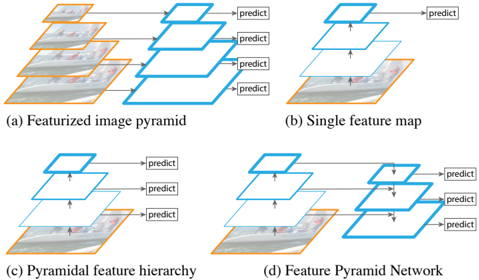
“The Single Shot Detector (SSD) [22] is one of the first attempts at using a ConvNet's pyramidal feature hierarchy as if it were a featurized image pyramid (Fig. 1(c)).”
What the sources say
- Supportedcites [22] [22] W. Liu, D. Anguelov, D. Erhan, C. Szegedy, and S. Reed. SSD: Single shot multibox detector. In ECCV , 2016. - source
Section 2.2 (p. 6) says SSD uses feature maps from several layers to mimic the effect of processing an image at different sizes. Section 2.1 (p. 3) describes progressively smaller feature layers for multi-scale detection, and the paper presents this as a contribution relative to earlier single-scale detectors. Together, these support the characterization of SSD as an early use of a ConvNet feature hierarchy in place of an image pyramid. (LLM, conf=0.88)
plain- Asserted: passes — The authors put it forward as true.
- Checkable: passes — It can be checked against evidence.
- Load-bearing: unclear — It is unclear whether the paper’s conclusions depend on it.
- Based: passes — The paper gives a reason why it holds.
- Supported
65 more claims · 4 with their cited sources checked
Create a free account to see all 108 claims and to verify the 11 references still open.
- It may state two separate claims as one. 23
- Probably not a substantial claim. 17
- The quote only partly states this claim. 3
Claims other papers make about this one
Each is checked against this paper’s own text: does it say what the citing paper says it does?
The source backs part of the claim, not all of it — or backs it for a different population, condition or comparison.
In the citing paper
“Feature Pyramid Network (FPN) [42] is one of the important two stage object detectors, tried to overcome few of the aforementioned challenges successfully by extracting features at multiple scales of an image in the object detection process.”
From Object detection using YOLO: challenges, architectural successors, datasets and applications (2023) · cites this paper as [42]
Experimental — accuracy not yet measuredThe source backs part of the claim, not all of it — or backs it for a different population, condition or comparison.
In the citing paper
“Its performance can be improved further by exploiting and enhancing the feature hierarchy of deep convolutional networks [80], employing non-local attention [81], and leveraging the reciprocal relationship between detection and segmentation via hybrid task cascade [82].”
From Empowering things with intelligence: a survey of the progress, challenges, and opportunities in artificial intelligence of things (2021) · cites this paper as [80]
Experimental — accuracy not yet measuredThe source backs part of the claim, not all of it — or backs it for a different population, condition or comparison.
In the citing paper
“To improve the accuracy of small defect detection, this paper uses SPP and FPN to increase the effect of multi-scale feature extraction.”
From Automatic Detection and Classification of Steel Surface Defect Using Deep Convolutional Neural Networks (2021) · cites this paper as [26]
Experimental — accuracy not yet measuredThe source backs part of the claim, not all of it — or backs it for a different population, condition or comparison.
In the citing paper
“YOLOv3 introduced a foundational generic architecture inspired by the Feature Pyramid Network (FPN) [22], integrating elements such as residual blocks, skip connections, and up-sampling.”
From YOLOv1 to v8: Unveiling Each Variant–A Comprehensive Review of YOLO (2024) · cites this paper as [22]
Experimental — accuracy not yet measuredThe cited source says what the claim attributes to it.
In the citing paper
“Unlike the word tokens that serve as the basic elements of processing in language Transformers, visual elements can vary substantially in scale, a problem that receives attention in tasks such as object detection [42, 53, 54].”
From Swin Transformer: Hierarchical Vision Transformer using Shifted Windows (2021) · cites this paper as [42]
14 more claims about this paper
Create a free account to see every claim other papers make about this one.
Self-check
Percentages, sums and reported differences re-computed from the paper’s own numbers.
Each contradiction between two passages listed here was confirmed by an independent check.
Rated minor: it would not touch a result — a value no result rests on, a p-value that stays on the same side of the significance level, or a conflict that is clerical, resolved elsewhere in the paper, or outside its own findings.
In the paper
§ 6.1. Segmentation Proposal Results · p. 8
“Our approach, based on FPNs, is substantially faster (our models run at 6 to 7 FPS).”
§ 6. Extensions: Segmentation Proposals · p. 8
“| + 2x train schedule | | 48.1 | 32.6 | 54.2 | 65.6 | 0.25 |”
Rated minor: it would not touch a result — a value no result rests on, a p-value that stays on the same side of the significance level, or a conflict that is clerical, resolved elsewhere in the paper, or outside its own findings.
In the paper
§ 5.1.1 Ablation Experiments · p. 5
“This architecture simulates the effect of reusing the pyramidal feature hierarchy (Fig. 1(b)).”
§ Feature Pyramid Networks for Object Detection · p. 1
“(b) Recent detection systems have opted to use only single scale features for faster detection. (c) An alternative is to reuse the pyramidal feature hierarchy computed by a ConvNet as if it were a featurized image pyramid.”
Citations
Cites
Deep Residual Learning for Image Recognition
He, K., Zhang, X., Ren, S., & Sun, J. (2016) · 2016 IEEE Conference on Computer Vision and Pattern Recognition (CVPR) · doi:10.1109/cvpr.2016.90 · Cited by 235,474 · cited 9×
“Analogous to the ResNet-based Faster R-CNN system [16] that uses C 4 as the single-scale feature map, we set k 0 to 4.”
BackgroundMethodResultInfluentialSelf-citationVery Deep Convolutional Networks for Large-Scale Image Recognition
Simonyan, K., & Zisserman, A. (2014) · arXiv · doi:10.48550/arxiv.1409.1556 · Cited by 114,148 · cited 2×
“But to avoid using low-level features SSD foregoes reusing already computed layers and instead builds the pyramid starting from high up in the network ( e.g ., conv4 3 of VGG nets [36]) and then by adding several new layers.”
BackgroundResultImageNet classification with deep convolutional neural networks
Krizhevsky, A., Sutskever, I., & Hinton, G. E. (2017) · Communications of the ACM · doi:10.1145/3065386 · Cited by 112,155 · cited 3×
“With the development of modern deep ConvNets [19], object detectors like OverFeat [34] and R-CNN [12] showed dramatic improvements in accuracy.”
MethodResultU-Net: Convolutional Networks for Biomedical Image Segmentation
Ronneberger, O., Fischer, P., & Brox, T. (2015) · Lecture notes in computer science · doi:10.1007/978-3-319-24574-4_28 · Cited by 99,404 · cited 1×
“rarchy without combining features or scores. There are recent methods exploiting lateral/skip connections that associate low-level feature maps across resolutions and semantic levels, including U-Net [31] and SharpMask [28] for segmentation, Recombinator networks [17] for face detection, and Stacked Hourglass networks…”
MethodFaster R-CNN: Towards Real-Time Object Detection with Region Proposal Networks
Ren, S., He, K., Girshick, R., & Sun, J. (2017) · IEEE Transactions on Pattern Analysis and Machine Intelligence · doi:10.1109/tpami.2016.2577031 · Cited by 73,472 · cited 10×
“For these reasons, Fast and Faster R-CNN [11, 29] opt to not use featurized image pyramids under default settings.”
BackgroundMethodInfluentialSelf-citationFaster R-CNN: Towards Real-Time Object Detection with Region Proposal Networks
Ren, S., He, K., Girshick, R., & Sun, J. (2015) · arXiv · doi:10.48550/arxiv.1506.01497 · Cited by 70,812 · cited 10×
“For these reasons, Fast and Faster R-CNN [11, 29] opt to not use featurized image pyramids under default settings.”
BackgroundMethodInfluentialSelf-citationDistinctive Image Features from Scale-Invariant Keypoints
Lowe, D. G. (2004) · International Journal of Computer Vision · doi:10.1023/b:visi.0000029664.99615.94 · Cited by 62,647
Microsoft COCO: Common Objects in Context
Lin, T.-Y., Maire, M., Belongie, S., Hays, J., Perona, P., Ramanan, D., Dollár, P., & Zitnick, C. L. (2014) · Lecture Notes in Computer Science · doi:10.1007/978-3-319-10602-1_48 · Cited by 45,460 · cited 6×
“All recent top entries in the ImageNet [33] and COCO [21] detection challenges use multi-scale testing on featurized image pyramids ( e.g ., [16, 35]).”
BackgroundMethodInfluentialSelf-citationImageNet Large Scale Visual Recognition Challenge
Russakovsky, O., Deng, J., Su, H., Krause, J., Satheesh, S., Ma, S., Huang, Z., Karpathy, A., Khosla, A., Bernstein, M., et al. (2015) · International Journal of Computer Vision · doi:10.1007/s11263-015-0816-y · Cited by 39,380 · cited 2×
“Thus we can adapt the assignment strategy of region-based detectors [15, 11] in the case when they are run on image pyramids.”
MethodFully convolutional networks for semantic segmentation
Long, J., Shelhamer, E., & Darrell, T. (2015) · 2015 IEEE Conference on Computer Vision and Pattern Recognition (CVPR) · doi:10.1109/cvpr.2015.7298965 · Cited by 38,834 · cited 1×
“FCN [24] sums partial scores for each category over multiple scales to compute semantic segmentations.”
Background
Research works printed but not linked: 1
- [1] E. H. Adelson, C. H. Anderson, J. R. Bergen, P. J. Burt, and J. M. Ogden. Pyramid methods in image processing. RCA engineer , 1984. -
Cited by
Items 21,101–21,200 of 29,875
Research on Target Detection Algorithm for UAV Images Based on Improved YOLOX-s
Wang, X., Li, C. W., Zhao, H., et al. (2024) · doi:10.1145/3677779.3677838 · Cited by 1
“This network is composed of a Feature Pyramid Network (FPN) [11] and a Path Aggregation Network (PAN) [12].”
Research on Detection Algorithm of Steel Surface Defects Based on GEC-YOLO Network Model
Zhao, C., Chen, X., Tan, J., Li, Q., & Fan, Y. (2024) · Lecture notes in electrical engineering · doi:10.1007/978-981-97-6937-7_35 · Cited by 1
Let Multi-classification Help Deep Imbalanced Regression
Lin, D., Peng, T., Chen, R., Xie, X., & Cui, Z. (2024) · Lecture notes in computer science · doi:10.1007/978-3-031-72338-4_29 · Cited by 2
KDNet: Leveraging Vision-Language Knowledge Distillation for Few-Shot Object Detection
Ma, M., Lin, Q., & Yin, H. (2024) · Lecture notes in computer science · doi:10.1007/978-3-031-72335-3_11 · Cited by 1
A Weakly Supervised Part Detection Method for Robust Fine-Grained Classification
Liu, Y., Le, J., Li, G., Ye, X., & Ouyang, Y. (2024) · Lecture notes in computer science · doi:10.1007/978-3-031-72335-3_1 · Cited by 1
Dunhuang Buddhist Art Object Recognition Based on CenterNet
Wang, S., & Liu, S. (2024) · IEEE Access · doi:10.1109/access.2024.3468722 · Cited by 3
Sensor Equivariance: A Framework for Semantic Segmentation with Diverse Camera Models
Reichert, H., Hetzel, M., Hubert, A., Doll, K., & Sick, B. (2024) · IEEE/CVF Conference on Computer Vision and Pattern Recognition Workshops (CVPRW) · doi:10.1109/cvprw63382.2024.00132 · Cited by 2
“The pyramid stages are then fed into a semantic segmentation head, as described in [10].”
MethodObject Detection Framework Using Multiple Tone Mappings on High-Dynamic-Range Images
Watanabe, T., Kawakami, R., Tanaka, M., & Okutomi, M. (2024) · Proceedings - International Conference on Image Processing · doi:10.1109/icip51287.2024.10647502 · Cited by 1
PoseSOR: Human Pose Can Guide Our Attention
Guan, H., & Lau, R. W. H. (2024) · Lecture notes in computer science · doi:10.1007/978-3-031-72649-1_20 · Cited by 3
Structural Highlight Network for Camouflaged Object Detection
Wang, Z., Zhao, J., Lai, B., & Zheng, X. (2024) · IEEE International Conference on Multimedia and Expo (ICME) · doi:10.1109/icme57554.2024.10688099 · Cited by 1
“Inspired by [19], we fuse features f i ( i ∈ Authorized licensed use limited to the terms of the applicable license agreement with IEEE.”
MethodEfficient Selective Image Fusion: A PCB Diagnosis Approach and Implementation
Wu, X., Chen, Y., Wang, Z., et al. (2024) · Journal of Electronic Testing · doi:10.1007/s10836-024-06142-6 · Cited by 1
Dual stream mask attention network to predict the LN metastasis for gastric cancer
Chen, Z., Tian, M., Tang, Z., Wang, X. J., & Yu, J. (2024) · International Conference on Computer Information Science and Application Technology (CISAT) · doi:10.1109/cisat62382.2024.10695206 · Cited by 1
“In previous studies, deep learning has emerged as a powerful technique for medical image analysis due to its ) [4] , ResNet [5] and U-Net [15] , each contributing uniquely to advancements in areas such as image segmentation and classification.. Deep learning has achieved expert-level performance…”
MethodDeep Learning Based Herbal Plant Recognition
Li, J., Sun, J., Zhang, X., et al. (2024) · International Conference on Electronic Engineering and Informatics (EEI) · doi:10.1109/eei63073.2024.10696459 · Cited by 1
“Feature Pyramid Network is a neural network architecture that is widely used in the field of multidimensional feature extraction and was proposed by Lin et al. in 2017 [7].”
MethodLiu, Y., & Zhang, L. (2024) · International Conference on Electronic Engineering and Informatics (EEI) · doi:10.1109/eei63073.2024.10696604 · Cited by 1
“DBNet extracts feature through backbone network (backbone) and fuses the features at each stage using the structure (neck) of FPN [12] in DB network to get the fused features.”
MethodYuan, Y., Li, F., Liu, X., et al. (2024) · Applied Sciences · doi:10.3390/app14199124 · Cited by 1
“The image pyramid is extensively used in feature extraction to adaptively extract features from objects at different scales within the image [31].”
Saleh, M. A., Abdouh, M., & Ramadan, M. K. (2024) · Big Data and Cognitive Computing · doi:10.3390/bdcc8100135 · Cited by 3
No-Extra Components Density Map Cropping Guided Object Detection in Aerial Images
Guo, Z., Bi, G., Lv, H., Feng, Y., Zhang, Y., & Sun, M. (2024) · IEEE Transactions on Geoscience and Remote Sensing · doi:10.1109/tgrs.2024.3481415 · Cited by 4
TB-FPN: Enhancing Tooth Segmentation with Cascade Boundary-Aware FPN
Cai, X., Zhang, Y., Guan, Z., et al. (2024) · Lecture notes in computer science · doi:10.1007/978-3-031-72396-4_2 · Cited by 1
GCNet: Global Context-Guided Uncertainty Boundary for Polyp Segmentation
Zhang, X., Chen, J., Gui, J., Du, X., & Sha, W. (2024) · Lecture notes in computer science · doi:10.1007/978-981-97-8499-8_14 · Cited by 1
MMR-Sleep: A Multi-Channel and Multi-Receptive Field Sleep Stage Recognition Model
Zheng, D., Zhu, H., Gao, R., Song, C., Zhang, W., & Jiang, F. (2024) · Lecture notes in computer science · doi:10.1007/978-981-97-8499-8_9 · Cited by 1
BladeWorks: A Novel Manufacturing-as-a-Service Platform for the Development of Customized Knives
Kladovasilakis, N., Charalampous, P., Pelekoudas, A. P., Kostavelis, I., Ioannidis, D., & Tzovaras, D. K. (2024) · Communications in computer and information science · doi:10.1007/978-3-031-69344-1_4 · Cited by 1
Rethinking the One-shot Object Detection: Cross-Domain Object Search
Zhang, Y., Zheng, S., Han, R., Feng, Y., Hou, J., Song, L., Feng, W., & Wan, L. (2024) · ACM International Conference on Multimedia (ACM MM) · doi:10.1145/3664647.3680671 · Cited by 6
“Specifically, as shown in Figure 4, the features of the target images are extracted using the Backbone_k, whichemploysmomentum-updatedparametersincombinationwith theFeaturePyramidNetwork(FPN)[20],asdescribedinfollowing”
Liu, Y., Feng, L., Jia, Q., Liu, Z., & Cao, Z. (2024) · ACM International Conference on Multimedia (ACM MM) · doi:10.1145/3664647.3680957 · Cited by 9
“Without loss of generality, we adopt FCOS [31] as a representative anchor-free detector and utilize ResNet-50 [9] and FPN [20] as the backbone for building our DTCG model.”
InfluentialWang, R., Hu, J., & Shang, M. (2024) · Journal of Electronic Imaging · doi:10.1117/1.jei.33.5.053061 · Cited by 1
“17 In FPN, the features at the lower layers are progressively sent into the higher layer, which is a long path.”
SemTrack: A Large-Scale Dataset for Semantic Tracking in the Wild
Wang, P., Hui, X., Wu, J., Yang, Z., Ong, K. E., Zhao, X., Lu, B., Huang, D., Ling, E., Chen, W., et al. (2024) · Lecture notes in computer science · doi:10.1007/978-3-031-72691-0_27 · Cited by 6
Wang, Y., Miao, C., Chu, Q., et al. (2024) · Lecture notes in computer science · doi:10.1007/978-981-97-8795-1_25 · Cited by 1
Continuity Preserving Online CenterLine Graph Learning
Han, Y., Yu, K., & Li, Z. (2024) · Lecture notes in computer science · doi:10.1007/978-3-031-73220-1_20 · Cited by 8
SOS: Segment Object System for Open-World Instance Segmentation with Object Priors
Wilms, C., Rolff, T., Hillemann, M., Johanson, R., & Frintrop, S. (2024) · Lecture notes in computer science · doi:10.1007/978-3-031-73383-3_10 · Cited by 3
Multi-view Depth Estimation with Adaptive Feature Extraction and Region-Aware Depth Prediction
Zhang, C. Y., Liang, L., Zhou, J., et al. (2024) · Lecture notes in computer science · doi:10.1007/978-981-97-8508-7_3 · Cited by 1
Focal Perception Transformer for Light Field Salient Object Detection
Zhao, L., Zhang, M., Piao, Y., Yin, J., & Lu, H. (2024) · Lecture notes in computer science · doi:10.1007/978-981-97-8685-5_1 · Cited by 2
GridMask: An Efficient Scheme for Real Time Curved Scene Text Detection
Ou, Z., Zhang, Y., Yao, S., & Song, M. (2024) · Lecture notes in computer science · doi:10.1007/978-981-97-8511-7_11 · Cited by 1
Crater Detection using YOLOv9 model
Deeksha, D., & Meenpal, T. (2024) · International Conference on Computing, Communication and Networking Technologies (ICCCNT) · doi:10.1109/icccnt61001.2024.10725707 · Cited by 1
Wang, L., Zhang, J., Wang, P., & Bai, Y. (2024) · IEEJ Transactions on Electrical and Electronic Engineering · doi:10.1002/tee.24231 · Cited by 1
“First, ResNet [15] with an attention mechanism is employed to generate four feature maps { X 2 , X 3 , X 4 , X 5 } , then they are fed into the feature pyramid network [16] with dual-branch convolutional feature scale module (DCFSM) for feature fusion.”
Regional dynamic point cloud completion network
Zhu, L., Yang, Y., Liu, K., Wu, S., Wang, B., & Chang, X. (2024) · Pattern Recognition Letters · doi:10.1016/j.patrec.2024.10.017 · Cited by 2
Urine Sediment Detection Algorithm Based on Channel Enhancement and Deformable Convolution
Zhang, S., Bao, X., Wang, Y., & Lin, F. (2024) · Journal of Imaging Informatics in Medicine · doi:10.1007/s10278-024-01321-5 · Cited by 1
“Specifically, to address the issue of feature map fusion ambiguity caused by FPN [13], we introduce CE-FPN [14] structure.”
An Improved YOLOv5 for Transmission Line Anomaly Detection
Zhu, X., Ai, J., Zhou, Z., et al. (2024) · International Conference on Intelligent Computing and Signal Processing (ICSP) · doi:10.1109/icsp62122.2024.10743310 · Cited by 1
Pei, S., Xin, Z., Tan, L., Dong, S., & Guo, J. (2024) · Asia Symposium on Image Processing (ASIP) · doi:10.1109/asip63198.2024.00012 · Cited by 3
“At the same time, the construction of the feature pyramid network (FPN)[11] can effectively solve the problem of multi-scale target detection by integrating the feature maps of different scales, and enhance the detection ability of the model to the targets of different sizes.”
BackgroundShang, S., Cao, J., Wang, Y., Wang, M., Zhao, Q., Song, Y., & Gao, H. (2024) · Biomimetics · doi:10.3390/biomimetics9110697 · Cited by 1
“Lin from Facebook [19] proposed the FPN algorithm, enhancing detection accuracy by fusing multi-scale feature maps and increasing information content.”
A Directional Enhanced Adaptive Detection Framework for Small Targets
Li, C., Chang, Y., Yang, S., Li, K., & Yin, G. (2024) · Electronics · doi:10.3390/electronics13224535 · Cited by 1
Salient object detection based on Pyramid Vision Transformer–gated network
Zhou, X., Huo, L., Wang, W., & Peng, H. (2024) · Journal of Electronic Imaging · doi:10.1117/1.jei.33.6.063021 · Cited by 1
“13 The U-shaped structure 8,9 has attracted significant attention due to its ability to generate rich feature maps through multi-level top-down pathways, thereby achieving strong performance.”
Wang, H., Liao, M., Xie, Z., Liu, W., & Bai, X. (2024) · IEEE Transactions on Pattern Analysis and Machine Intelligence · doi:10.1109/tpami.2024.3496576 · Cited by 3
“The network consists of a Feature Pyramid Network [40] for extracting feature maps, a text-line proposal module for generating proposals of text-line instances, and a word embedding module for embedding the query words to features.”
Spatial–Temporal Coherence in Extreme Video Retargeting for Consumer Screening Devices
Imani, H., & Islam, M. B. (2024) · IEEE Transactions on Consumer Electronics · doi:10.1109/tce.2024.3502422 · Cited by 1
“The encoder-decoder architecture corresponds to the feature pyramid network [43], whose top-level features are combined by upsampling with low-level features in the skip connection.”
Bingöl, E., Demirel, S., Urfalı, A., Bozkır, Ö. F., Çelikten, A., BUDAK, A., & KARATAŞ, H. (2024) · Muş Alparslan Üniversitesi Fen Bilimleri Dergisi · doi:10.18586/msufbd.1440119 · Cited by 1
DGeC: Dynamically and Globally Enhanced Convolution
Zhang, Z., Liu, Y., Zhou, Z., Yang, G., Liao, X., & Wu, Q. M. J. (2024) · IEEE Transactions on Artificial Intelligence · doi:10.1109/tai.2024.3502577 · Cited by 1
“All models are trained with FPN [41] for the 1 × schedule (12 epochs) and the same training recipe as in MMDetection [42] is employed except synchronized batch normalization used in our backbone.”
Natural Scene Text Detection With Multiscale Feature Augmentation and Attention Mechanisms
Wang, G., Wang, R., Liang, M., Wei, S., Zhao, X., Yang, D., & Wang, Z. (2024) · IEEE Access · doi:10.1109/access.2024.3502432 · Cited by 1
Estimation of Hand Pressure and Pose From RGB Images Based on Cross-Modal Cues
Tang, W., Shao, L., & Chen, X. (2024) · IEEE Sensors Journal · doi:10.1109/jsen.2024.3502449 · Cited by 3
“These features are fed into the FPN [27] to obtain the hand pressure map, and the hand joint positions can be obtained by the feature in Fig.”
Analysing the Effectiveness of YOLO Model in Detecting the Images Captured by the Drone
Ramzan, M. N., & Jahankhani, H. (2024) · Advanced sciences and technologies for security applications · doi:10.1007/978-3-031-72821-1_4 · Cited by 1
Zhang, T. J., Ma, C., & Wang, Y. (2024) · Electronics · doi:10.3390/electronics13234693 · Cited by 7
ReFocal: Addressing Learning Imbalances for Accurate Tiny Object Detection in Aerial Imagery
Chen, Z., Xu, C., Zhu, H., Li, Y., & Yang, W. T. (2024) · IEEE Geoscience and Remote Sensing Letters · doi:10.1109/lgrs.2024.3507209 · Cited by 1
DiaDet-R: A lightweight and accurate rotated detector for diatom detection in drowning diagnostics
Deng, J., Yang, J., Gu, G., Liu, C., Kang, X., Zheng, D., Shi, H., & Zhao, J. (2024) · Expert Systems with Applications · doi:10.1016/j.eswa.2024.125958 · Cited by 1
Annotation-Free Object Detection by Knowledge-Extraction Training From Visual-Language Models
Nagase, Y., Babazaki, Y., & Shibata, T. (2024) · Lecture notes in computer science · doi:10.1007/978-3-031-78447-7_10 · Cited by 4
Infrared and Visible Light Fusion for Object Detection with Low-light Enhancement
Li, Z., Li, X., Niu, Y., Rong, C., & Wang, Y. (2024) · IEEE International Conference on Information Systems and Computer Aided Education (ICISCAE) · doi:10.1109/iciscae62304.2024.10761622 · Cited by 1
“The network’s neck employs a Feature Pyramid Network (FPN) structure [12] , a neural network designed for object detection and semantic segmentation.”
Vietnamese Scene Text Detection via Edge Information and Text Region Feature Enhancement
Jiang, L., Shi, S., Huang, W., Xu, Z., Cù, V. L., & Wen, Y. (2024) · Lecture notes in computer science · doi:10.1007/978-3-031-78498-9_11 · Cited by 1
Supervised pyramid network based on semantic consistency for object detection
Dai, R., Xu, P., Li, J., et al. (2024) · Xibei Gongye Daxue Xuebao/Journal of Northwestern Polytechnical University · doi:10.1051/jnwpu/20244250959 · Cited by 1
Soiling Builds up Gradually : Soiling Semantic Segmentation
Kim, T., Lee, W., & Hwang, Y. (2024) · International Conference on Control, Automation and Systems (ICCAS) · doi:10.23919/iccas63016.2024.10773253 · Cited by 1
Improved high-precision UAV small object detection model based on YOLOv8
Huang, W. (2024) · International Conference on Image Processing, Machine Learning and Pattern Recognition (IPMLPR) · doi:10.1145/3700906.3700970 · Cited by 1
“The SSD [13] (2016) used multi-scale feature maps for different object sizes but struggled with tiny objects compared to multi-stage models like FPN [14].”
Multi-View Part-Based Few-Shot Object Detection
Ma, J., & Bai, S. (2024) · IEEE Transactions on Neural Networks and Learning Systems · doi:10.1109/tnnls.2024.3510391 · Cited by 4
“Two-stage general object detection methods [40], [41], [42] first generate region proposals with a region proposal network (RPN) and then perform category classification and box localization for objects in images based on the proposed regions.”
Dumbrique, J. I. S., Hernandez, R. B., Cruz, J. M. L., Pagdanganan, R. M., & Naval, P. C. (2024) · Frontiers in Radiology · doi:10.3389/fradi.2024.1424065 · Cited by 7
ERC-Fusion: Fusing Enhanced 4D Radar and Camera for 3D Object Detection
Fan, L., Wang, J., Wang, Y., Meng, Z., & Cao, D. (2024) · IEEE International Conference on Digital Twins and Parallel Intelligence (DTPI) · doi:10.1109/dtpi61353.2024.10778707 · Cited by 2
“In the image feature extraction module, we use ResNet50 [15] and FPN [16] to extract multi-scale image features, which include rich semantic features and high-resolution image information.”
Cable Segmentation Based on Mask2Former in Open-Pit Mining Area
Wang, L., Zhou, B., Yang, S., Liu, W., Li, H., & Sun, S. (2024) · IEEE International Conference on Industrial Informatics (INDIN) · doi:10.1109/indin58382.2024.10774442 · Cited by 1
“Create a feature pyramid [17] with low-and high-resolution feature maps, then feed the multi-scale feature maps to different Transformer decoder levels.”
Knowledge-Assisted Small Object Detection
Le, H. L., Nguyen, Q. V. H., Huy, N. T. V., & Jo, J. (2024) · Lecture notes in computer science · doi:10.1007/978-981-96-1242-0_30 · Cited by 1
Fine-Grained Food Image Segmentation Method Based on MS-Mask2Former
Zhang, J., Zhang, H., Xu, Y., & Li, H.-A. (2024) · International Conference on Artificial Intelligence of Things and Systems (AIoTSys) · doi:10.1109/aiotsys63104.2024.10780517 · Cited by 1
“As shown in Fig.4, we compare the heat map visualization of MEFPN and FPN [26] in the original model on the same food image.”
Sun, J., Wei, D., Xu, Z., Lu, D., Liu, H., Wang, H., Tsaftaris, S. A., McDonagh, S., Zheng, Y., & Wang, L. (2024) · IEEE Transactions on Medical Imaging · doi:10.1109/tmi.2024.3516954 · Cited by 4
“For abnormality detection, we employ RetinaNet [23] with ResNet-101 [64] pretrained on Ima-geNet [65] and FPN [66] as the backbone.”
An Approach for Dataset Extension for Object Detection in Artworks Using Open-Vocabulary Models
Yemelianenko, T., Tkachenko, I., Masclef, T., Scuturici, M., & Miguet, S. (2025) · Lecture notes in computer science · doi:10.1007/978-3-031-91572-7_18 · Cited by 3
Inversion-Based Face Swapping With Diffusion Model
Yoo, D., Lee, H.-C., & Kim, J. (2024) · IEEE Access · doi:10.1109/access.2024.3519163 · Cited by 6
Robust and Generable Vertebrae Instance Segmentation with Domain Adaptation
Gao, X., Tu, L., Huang, Y., et al. (2024) · doi:10.1109/embc53108.2024.10781610 · Cited by 1
“Research indicates that efficient domain adaptation strategies can aid models in adapting to the distribution of the target domain, thereby suppressing the domain shift issue and improving model efficacy [12].”
UPVIS: upsampled video query for offline video instance segmentation
Jo, J., Chung, H., Lee, J. S., et al. (2024) · Multimedia Tools and Applications · doi:10.1007/s11042-024-20533-z · Cited by 1
“In computer vision tasks, upsampling layers play a significant role in fusing multi-scale features [16, 23] or resizing the resolution of features [6, 15].”
Wang, Y., Zhu, S., & Liang, Z. (2024) · Signal Image and Video Processing · doi:10.1007/s11760-024-03763-4 · Cited by 1
DVT: Decoupled Dual-Branch View Transformation for Monocular Bird’s Eye View Semantic Segmentation
Du, J., Pan, X., Shen, M., Su, S., Yang, J., Liu, C., & Chen, Q. (2024) · IEEE/RSJ International Conference on Intelligent Robots and Systems (IROS) · doi:10.1109/iros58592.2024.10802126 · Cited by 1
“Monocular frontal view images are first fed into the backbone network and FPN [30] to obtain multi-scale PV features.”
Learning Gaussian Data Augmentation in Feature Space for One-shot Object Detection in Manga
Taniguchi, T., & Furuta, R. (2024) · ACM International Conference on Multimedia in Asia (MMAsia) · doi:10.1145/3696409.3700174 · Cited by 2
“The numbers of seen and unseen classes are 137 and 97 in total, respectively.”
Wang, Z., Han, S., Wang, X., Hao, J., Cao, X., & Zhang, B. (2024) · IET Cyber-Systems and Robotics · doi:10.1049/csy2.70002 · Cited by 3
TPS-YOLO: The Efficient Tiny Person Detection Network Based on Improved YOLOv8 and Model Pruning
Li, Y., Huang, Q., & Wan, Y. (2025) · Lecture notes in computer science · doi:10.1007/978-981-96-2071-5_18 · Cited by 1
Zhang, X., Wang, C., & Yang, X. (2025) · Journal of Circuits Systems and Computers · doi:10.1142/s021812662550197x · Cited by 2
LSCMNet: A Lightweight Segmentation Network Based on Co-Occurring Matrix for Seismic Image
Fan, L., Lu, W., & Wang, Y. (2025) · IEEE Geoscience and Remote Sensing Letters · doi:10.1109/lgrs.2025.3528036 · Cited by 1
Cardiovascular Classification Using Efficient Net on Electrocardiogram Images
Jothiaruna, N., Babu, B. P., Shaik, N. B., Devan, P. A. M., & Bingi, K. (2024) · Engineering Journal · doi:10.4186/ej.2024.28.12.67 · Cited by 2
He, Q., Luo, X., Liu, Y., You, X., & Chen, M. (2024) · IEEE International Conference on Civil Aviation Safety and Information Technology (ICCASIT) · doi:10.1109/iccasit62299.2024.10828054 · Cited by 1
Improving YOLOv8 for Microbial Object Detection in Microscope Images
Gao, H., Zuo, X., Huang, S., et al. (2024) · International Conference on Pattern Recognition and Artificial Intelligence (PRAI) · doi:10.1109/prai62207.2024.10826758 · Cited by 1
“For feature fusion, improved versions of PAN [16] or FPN [17] are commonly utilized as tools, followed by the use of an enhanced YOLOv3 [5] head or FCOS [18] head for prediction purposes.”
Binding double-head predictor with key context transformer for high performance tracking
Wang, B., Yu, H., Wan, W., Duan, Y., Gong, H., Jin, D., Xiu, Z., Song, Y. F., Wang, H., & Liu, G. (2025) · Neurocomputing · doi:10.1016/j.neucom.2025.129444 · Cited by 1
Disentangled Contrastive Learning From Synthetic Matching Pairs for Targeted Chest X-Ray Generation
Kim, E., Lee, S., & Lee, K. M. (2025) · IEEE Access · doi:10.1109/access.2025.3531366 · Cited by 4
Unified ViT-CNN for few-shot object counting
Quan, K.-A. C., Nguyen, V.-T., Nguyen, T., & Tran, M. (2025) · Signal Image and Video Processing · doi:10.1007/s11760-024-03792-z · Cited by 4
“First, for the exemplar feature extraction, we apply multi-scale ROIAlign [24] to extract semantic vectors according to given box coordinates to represent each exem-plar.”
Wang, Y., Liu, L., Yang, M., & Ji, H. (2024) · International Conference on Image, Vision and Computing (ICIVC) · doi:10.1109/icivc61627.2024.10837031 · Cited by 1
“FPN [21] constructs a feature pyramid across multiple scales to extract object features at different scales, thereby significantly improving object detection performance.”
FPRes-Net: Feature Pyramid-Based Residual Network for Alzheimer's Disease Diagnosis
Zhang, Y., Zhang, X., Li, Y., Wu, J., Liu, J., Zheng, C.-H., & Cui, X. (2024) · Conference proceedings/Conference proceedings - IEEE International Conference on Systems, Man, and Cybernetics · doi:10.1109/smc54092.2024.10831746 · Cited by 1
A Multi-scale Perception Enhancement Network for Underwater Waste Detection
Li, Y., & Zhang, X. (2024) · International Conference on Image, Vision and Computing (ICIVC) · doi:10.1109/icivc61627.2024.10837492 · Cited by 2
“In addition, the neck uses the feature pyramid network [23] to fuse low-level detail features with high-level semantic features, which helps provide more effective information for object detection.”
Duan, Y., Gong, H., Yu, H., Shi, K., Wang, B., Jin, D., Wan, W., Wang, Z., Liu, S., & Liu, G. (2025) · International Journal of Pattern Recognition and Artificial Intelligence · doi:10.1142/s021800142550003x · Cited by 1
Enhancing Prohibited Item Detection in X-Ray Images with Improved YOLOv8
Feng, H., Cao, W., Chang, F., & Zhang, H. (2024) · IEEE International Conference on Unmanned Systems (ICUS) · doi:10.1109/icus61736.2024.10840114 · Cited by 1
Maritime Ship Tracking Algorithm Based on Improved YOLOv8 and StrongSORT
Chen, W., Song, Y., & Ge, Q. (2024) · IEEE International Conference on Unmanned Systems (ICUS) · doi:10.1109/icus61736.2024.10839783 · Cited by 1
“…for fusing the output feature maps of different convolutional layers in the Backbone part, and through the cross-layer connection between the top-down PAN module[17] and the bottom-up FPN module[18], the feature fusion is made more adequate and enhance the detection ability of the network model.”
Hai, P. N. P., Quoc, B. B., & Hoang, T. (2025) · IEEE Access · doi:10.1109/access.2025.3532962 · Cited by 4
Secure Moving Object Detection Transformer in Compressed Video with Feature Fusion
Song, Y., Chen, Y., Zheng, P., Du, Y., & Luo, W. (2024) · Asia-Pacific Signal and Information Processing Association Annual Summit and Conference (APSIPA ASC) · doi:10.1109/apsipaasc63619.2025.10849038 · Cited by 1
“For instance, FPN [16] merges features at different scales to construct multi-layer feature maps, accommodating targets of different sizes.”
NeRF-FCM: Feature Calibration Mechanisms for NeRF-based 3D Object Detection
Goshu, H. L., Xiao, J., Chan, K. S., Zhang, C., Gemeda, M. T., & Lam, K. (2024) · Asia-Pacific Signal and Information Processing Association Annual Summit and Conference (APSIPA ASC) · doi:10.1109/apsipaasc63619.2025.10849009 · Cited by 3
“Before passing the extracted feature maps to the Feature Pyramid Network (FPN) [28], we integrate channel attention mechanisms to enhance feature representation.”
YOLOFLY: A Consumer-Centric Framework for Efficient Object Detection in UAV Imagery
Ma, P., Fei, H., Jia, D., Sun, Z., Lian, N., Wei, J., & Zhou, J. N. (2025) · Electronics · doi:10.3390/electronics14030498 · Cited by 1
Leveraging Deep Learning for Drowning and Swimming Prevention
Ünlü, T. T., Mahamat, A. L., & Turan, M. (2025) · WSEAS Transactions on Information Science and Applications archive · doi:10.37394/23209.2025.22.20 · Cited by 3
Rethinking Label Assignment and Sampling Strategies for Two-Stage Oriented Object Detection
Qian, J., Liu, C., Ai, Y., Zhao, G., & Qian, X. (2025) · IEEE Geoscience and Remote Sensing Letters · doi:10.1109/lgrs.2025.3538620 · Cited by 1
TQGDNet: Coronary artery calcium deposit detection on computed tomography
Wang, W.-C., Yu, C., Ahn, E., Pathan, S., Negishi, K., & Kim, J. (2025) · Computerized Medical Imaging and Graphics · doi:10.1016/j.compmedimag.2025.102503 · Cited by 1
Shared Vision Transformer Helps Scene Text Retrieval
Luo, H., Ibrayim, M., Hamdulla, A., & Deng, Q. (2025) · Lecture notes in computer science · doi:10.1007/978-981-97-8705-0_27 · Cited by 1
Exploring Dual Coupledness for Effective Pruning in Object Detection
Xiaohui, G., Wenzhuo, H., Yaguan, Q., & Sun, X. (2025) · Neural Processing Letters · doi:10.1007/s11063-024-11697-8 · Cited by 2
“FPN [19] can detect objects with a wide variety of scales by building a feature pyramid to semantics at all scales.”
An Improved Small Target Segmentation Model Based on Mask Dino
Yang, J., Chen, X., Guan, Y., Hu, Y., & Ge, G. (2025) · Applied Sciences · doi:10.3390/app15041832 · Cited by 1
Priyanka, P., Mohan, A., Singh, K., et al. (2025) · Communications in computer and information science · doi:10.1007/978-3-031-81336-8_4 · Cited by 1
Illumination Invariant Image Matching for Lunar TRN
Rothenberger, N. Z., Georgakis, G., Cheng, Y., et al. (2025) · AIAA SciTech Forum · doi:10.2514/6.2025-2073 · Cited by 1
Zhu, G., Qin, Z., Yu, L., et al. (2025) · IEEE Transactions on Medical Imaging · doi:10.1109/tmi.2025.3541433 · Cited by 1
“The designed deblurring module adopts the structure of GAN network and the generator of FPN [15] structure to deblur gastroscopy images.”
Transmission-Lines Foreign Objects Detection Using MSYOLO
HuXiaoHui, Fang, F., LiaoZhangJuan, HuangLinTao, HeChuang, & HuangWenLi (2024) · International Conference on Computer, Vision and Intelligent Technology (ICCVIT) · doi:10.1109/iccvit63928.2024.10872427 · Cited by 1
“Approaches such as Feature Pyramid Networks (FPN)[9] and Path Aggregation Networks (PANet)[10] adeptly merge the strengths of high and low-level features by creating feature maps at multiple scales.”
Metadata
- Authors
- Lin, T.-Y., Dollar, P., Girshick, R., He, K., Hariharan, B., & Belongie, S.
- Affiliations
- Cornell University (US)
- Meta (United States) (US)
- Venue
- 2017 IEEE Conference on Computer Vision and Pattern Recognition (CVPR)
- Publisher
- IEEE
- Published
- 2017-07
- Pages
- 936-944
- ISSN
- 1063-6919 (ISSN-L)
- OpenAlex
- W2565639579
- Cited by
- 30,939
- References
- 64
- Citations by year
- 2026: 2864 · 2025: 4496 · 2024: 5179 · 2023: 5172 · 2022: 4516 · 2021: 3861 · 2020: 2506 · 2019: 1759 · 2018: 526 · 2017: 58
- FWCI
- 387.80
- Type
- conference paper
- Language
- en
- Open access
- closed
- Locations
- IEEE Computer Society Conference on Computer Vision and Pattern Recognition/Proceedings - IEEE Computer Society Conference on Computer Vision and Pattern Recognition/Proceedings (publishedVersion)
- Topics
- Physical Sciences › Computer Science › Computer Vision and Pattern Recognition › Advanced Neural Network Applications
- Physical Sciences › Computer Science › Computer Vision and Pattern Recognition › Advanced Image and Video Retrieval Techniques
- Physical Sciences › Computer Science › Computer Vision and Pattern Recognition › Visual Attention and Saliency Detection
- Keywords
- feature pyramid network, multi-scale object detection, lateral connections, Faster R-CNN, COCO benchmark, deep convolutional neural networks, feature extraction
About these checks
Registry, retraction, Cites and statistics results are computed, not judged, with one exception: a printed reference that no index lists is read once by a model before it counts as a citation error. Claims are extracted by a model and kept only when their quote appears verbatim in the text; each cited source is then checked, with a model’s help, for whether it says what the claim relies on. Those verdicts can be wrong — read the claim’s quote and the cited source before relying on one.
The claim verdicts this report counts are experimental: their accuracy is not yet measured.
A language model drew the claims from the paper on 2026-10-10, under version 3 of the claim definition (model deepseek-v4.1-flash, prompt extract-v3).
A second model labelled each claim on 2026-10-10 (model jev-1.13-20260917, definition revision gold-guideline-v0.2).
Cited sources are checked with a language model’s help (gpt-6-sol).
Statistics and arithmetic are recomputed, not judged.
Confidence bands are shown only for fields calibrated on our annotated test set. None is calibrated yet, so no band is shown.
What counts as a claim ›How we measure confidence ›How we check this ›
Are you an author, or do you see a problem with this page? Request a review
Data sources
Bibliographic data: Semantic Scholar, OpenAlex, Crossref.
Contains information from the Semantic Scholar Academic Graph Datasets, made available under the ODC Attribution License (ODC-BY 1.0).
Semantic Scholar’s data is described in: Kinney, R., et al. (2023). The Semantic Scholar Open Data Platform. arXiv:2301.10140.
