

Feature Pyramid Networks for Object Detection
The DOI matches its Crossref record; 49 of the 64 references it cites were found in a registry or an index, and 1 are not checked yet; 14 of the 44 sources its claims cite were checked for support.
Abstract
Feature pyramids are a basic component in recognition systems for detecting objects at different scales. But pyramid representations have been avoided in recent object detectors that are based on deep convolutional networks, partially because they are slow to compute and memory intensive. In this paper, we exploit the inherent multi-scale, pyramidal hierarchy of deep convolutional networks to construct feature pyramids with marginal extra cost. A top-down architecture with lateral connections is developed for building high-level semantic feature maps at all scales. This architecture, called a Feature Pyramid Network (FPN), shows significant improvement as a generic feature extractor in several applications. Using a basic Faster R-CNN system, our method achieves state-of-the-art single-model results on the COCO detection benchmark without bells and whistles, surpassing all existing single-model entries including those from the COCO 2016 challenge winners. In addition, our method can run at 5 FPS on a GPU and thus is a practical and accurate solution to multi-scale object detection. Code will be made publicly available.
Verified 2026-11-25 · 1 reference not checked yet
Overview
CoChat Summary
TL;DR
Feature Pyramid Networks (FPN) build in-network feature pyramids from a single-scale image using a top-down pathway and lateral connections, giving semantically strong features at all scales with marginal extra cost. FPN improves region proposal and object detection accuracy over strong single-scale baselines and achieves state-of-the-art single-model COCO results without image pyramids.
Key findings
- RPN with FPN improves COCO minival AR\(_{1k}\) to 56.3 from 48.3 for the single-scale C4 baseline (+8.0 points), and small-object AR\(_{1k}^s\) to 44.9 from 32.0 (+12.9 points).
- Fast R-CNN on fixed proposals improves AP to 33.9 with FPN versus 31.9 for the C4 baseline (+2.0) and 28.8 for the 2fc C5 baseline (+5.1); AP@0.5 is 56.9.
- Faster R-CNN with FPN reaches 33.9 AP and 56.9 AP@0.5 on minival, improving over a strong single-scale baseline by 2.3 AP and 3.8 AP@0.5. On COCO test-dev with ResNet-101, it reaches 36.2 AP and 59.1 AP@0.5, surpassing single-model competition winners such as G-RMI (34.7 AP) and AttractioNet (35.7 AP).
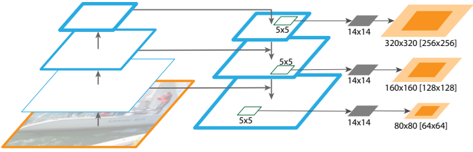
- For segmentation proposals, FPN with dual MLPs, 2× mask resolution, and 2× training schedule reaches 48.1 AR, outperforming DeepMask (37.1), SharpMask (39.8), and InstanceFCN (39.2) by over 8.3 points AR, while running at 6–7 FPS.
Methods
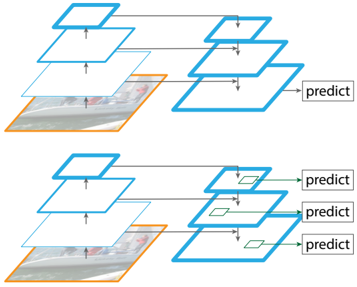
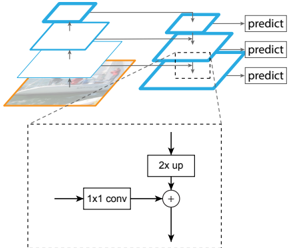
- FPN uses a bottom-up ResNet pathway (C2–C5), a top-down pathway that upsamples coarser maps by 2× with nearest-neighbor interpolation, and lateral 1×1 convolutions merged by element-wise addition; a 3×3 convolution is appended to each merged map. Detection uses d = 256 and pyramid levels P2–P5, with P6 added for RPN’s 512² anchor scale.
- For RPN, heads are attached to each pyramid level with single-scale anchors of areas {32², 64², 128², 256², 512²} on {P2, P3, P4, P5, P6} and aspect ratios {1:2, 1:1, 2:1}, totaling 15 anchors. For Fast R-CNN, RoIs are assigned to pyramid levels using the canonical 224² size and k₀ = 4, with shared heads and a 2fc MLP.
- Experiments use the 80-category COCO dataset, training on trainval35k (80k train + 35k val subset), ablating on minival (5k val images), and reporting test-std results. Backbones are ImageNet1k-pretrained ResNet-50/101; training uses synchronized SGD on 8 GPUs with input shorter side 800 pixels. RPN training takes about 8 hours and Fast R-CNN about 10 hours on COCO; inference is 0.148 s per image for ResNet-50 and 0.172 s for ResNet-101 on an NVIDIA M40 GPU.
Limitations
- The paper states that designing better connection modules is not its focus and opts for a simple design; more sophisticated blocks gave only marginally better results. It also notes that the ResNet-101 model was not sufficiently trained with the default schedule, and that the feature-sharing version of the COCO leaderboard model was not evaluated due to limited time.
- The paper states that its method does not exploit popular improvements such as iterative regression, hard negative mining, context modeling, or stronger data augmentation, which are complementary and could boost accuracy further.
- Evident from the text: there is no dedicated limitations section, and the empirical evaluation is limited to COCO detection and mask proposal generation, not full instance segmentation or other datasets.
Model-written summary. Check it against the paper before relying on it.
Integrity signals
Registry
Cites
Statistics
Figures
Verification
Claims the paper makes
8 Valid · 4 Not valid · 14 Not checked · 82 Own results and interpretations
The cited sources that could be checked couldn’t confirm or dispute this claim.
In the paper
“For these reasons, Fast and Faster R-CNN [11, 29] opt to not use featurized image pyramids under default settings.”
What the sources say
- Not matchedcites [11] [11] R. Girshick. Fast R-CNN. In ICCV , 2015. -
We searched by its title and found no matching paper.
- Could not verifycites [29] [29] S. Ren, K. He, R. Girshick, and J. Sun. Faster R-CNN: Towards real-time object detection with region proposal networks. In NIPS , 2015. - sourceExperimental — accuracy not yet measured
The Related Work section (p. 3) discusses multi-resolution features for semantic segmentation, and the results (p. 8) discuss multi-scale testing of the authors’ model. Neither passage addresses whether Fast or Faster R-CNN omit featurized image pyramids by default; searches for those models and that setting found no supporting passage in our copy. (LLM, conf=0.77)
plain- Asserted: passes — The authors put it forward as true.
- Checkable: passes — It can be checked against evidence.
- Load-bearing: passes — The paper’s conclusions depend on it.
- Based: passes — The paper gives a reason why it holds.
- Not matched
The cited sources support only part of this claim — read each source’s verdict below.
In the paper
“Recently, FPN has enabled new top results in all tracks of the COCO competition, including detection, instance segmentation, and keypoint estimation. See [14] for details.”
What the sources say
- Partly supportedcites [14] [14] K. He, G. Gkioxari, P. Doll´ ar, and R. Girshick. Mask r-cnn. arXiv:1703.06870 , 2017. - sourceExperimental — accuracy not yet measured
The paper reports strong COCO results using FPN backbones: its instance-segmentation model surpasses earlier winners (Section 4.1, p. 5), its detection model exceeds earlier single-model results (Section 4.3, p. 7), and its keypoint model exceeds the 2016 winner (Section 5, p. 8). But it does not establish that FPN enabled top competition results in all three tracks; Appendix B (p. 10) discusses 2017 winning teams only for instance segmentation and credits the Mask R-CNN framework. (LLM, conf=0.87)
plainstates a cause- Asserted: passes — The authors put it forward as true.
- Checkable: passes — It can be checked against evidence.
- Load-bearing: unclear — It is unclear whether the paper’s conclusions depend on it.
- Based: passes — The paper gives a reason why it holds.
- Partly supported
The sources with a verdict support this claim; the rest weren’t checked yet, have no full text we could read, or their verdicts aren’t rated yet.
In the paper
“All recent top entries in the ImageNet [33] and COCO [21] detection challenges use multi-scale testing on featurized image pyramids ( e.g ., [16, 35]).”
What the sources say
- Not checked yetcites [16] [16] K. He, X. Zhang, S. Ren, and J. Sun. Deep residual learning for image recognition. In CVPR , 2016. - source
Checked before — its earlier verdict is held back until a new check runs.
- Supportedcites [35] [35] A. Shrivastava, A. Gupta, and R. Girshick. Training regionbased object detectors with online hard example mining. In CVPR , 2016. - source
As an example citation, this paper supports the COCO part of the sentence. The Multi-scale (M) section (page unavailable) says it runs inference at all scales during testing, and the Ablation analysis (page unavailable) says a variant finished fourth in the 2015 COCO Detection Challenge. (LLM, conf=0.85)
plain- Asserted: passes — The authors put it forward as true.
- Checkable: passes — It can be checked against evidence.
- Load-bearing: passes — The paper’s conclusions depend on it.
- Based: passes — The paper gives a reason why it holds.
- Not checked yet
The cited sources support only part of this claim — read each source’s verdict below.
In the paper
“Existing mask proposal methods [27, 28, 4] are based on densely sampled image pyramids ( e.g ., scaled by 2 {-2:0 . 5:1 } in [27, 28]), making them computationally expensive.”
What the sources say
- Partly supportedcites [27] [27] P. O. Pinheiro, R. Collobert, and P. Dollar. Learning to segment object candidates. In NIPS , 2015. - sourceExperimental — accuracy not yet measured
The Introduction says prevalent object-detection methods use image or filter pyramids, and §3.3 says avoiding those pyramids saves running time. The paper does not establish that existing mask proposal methods rely on densely sampled image pyramids or document the specified scale sampling. (LLM, conf=0.86)
- Not matchedcites [28] [28] P. O. Pinheiro, T.-Y. Lin, R. Collobert, and P. Doll´ ar. Learning to refine object segments. In ECCV , 2016. -
More than one paper fits this citation.
- Not checked — no full text of the sourcecites [4] [4] J. Dai, K. He, Y. Li, S. Ren, and J. Sun. Instance-sensitive fully convolutional networks. In ECCV , 2016. -
plainstates a cause- Asserted: passes — The authors put it forward as true.
- Checkable: passes — It can be checked against evidence.
- Load-bearing: passes — The paper’s conclusions depend on it.
- Based: passes — The paper gives a reason why it holds.
- Partly supported
Every source the paper cites for this claim was checked and supports it.
In the paper
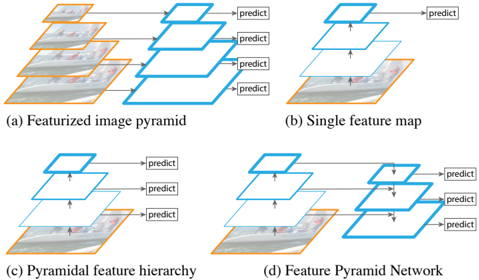
“The Single Shot Detector (SSD) [22] is one of the first attempts at using a ConvNet's pyramidal feature hierarchy as if it were a featurized image pyramid (Fig. 1(c)).”
What the sources say
- Supportedcites [22] [22] W. Liu, D. Anguelov, D. Erhan, C. Szegedy, and S. Reed. SSD: Single shot multibox detector. In ECCV , 2016. - source
Section 2.2 (p. 6) says SSD uses feature maps from several layers to mimic the effect of processing an image at different sizes. Section 2.1 (p. 3) describes progressively smaller feature layers for multi-scale detection, and the paper presents this as a contribution relative to earlier single-scale detectors. Together, these support the characterization of SSD as an early use of a ConvNet feature hierarchy in place of an image pyramid. (LLM, conf=0.88)
plain- Asserted: passes — The authors put it forward as true.
- Checkable: passes — It can be checked against evidence.
- Load-bearing: unclear — It is unclear whether the paper’s conclusions depend on it.
- Based: passes — The paper gives a reason why it holds.
- Supported
65 more claims · 4 with their cited sources checked
Create a free account to see all 108 claims and to verify the 9 references still open.
- It may state two separate claims as one. 23
- Probably not a substantial claim. 17
- The quote only partly states this claim. 3
Claims other papers make about this one
Each is checked against this paper’s own text: does it say what the citing paper says it does?
The source backs part of the claim, not all of it — or backs it for a different population, condition or comparison.
In the citing paper
“Feature Pyramid Network (FPN) [42] is one of the important two stage object detectors, tried to overcome few of the aforementioned challenges successfully by extracting features at multiple scales of an image in the object detection process.”
From Object detection using YOLO: challenges, architectural successors, datasets and applications (2023) · cites this paper as [42]
Experimental — accuracy not yet measuredThe source backs part of the claim, not all of it — or backs it for a different population, condition or comparison.
In the citing paper
“Its performance can be improved further by exploiting and enhancing the feature hierarchy of deep convolutional networks [80], employing non-local attention [81], and leveraging the reciprocal relationship between detection and segmentation via hybrid task cascade [82].”
From Empowering things with intelligence: a survey of the progress, challenges, and opportunities in artificial intelligence of things (2021) · cites this paper as [80]
Experimental — accuracy not yet measuredThe source backs part of the claim, not all of it — or backs it for a different population, condition or comparison.
In the citing paper
“To improve the accuracy of small defect detection, this paper uses SPP and FPN to increase the effect of multi-scale feature extraction.”
From Automatic Detection and Classification of Steel Surface Defect Using Deep Convolutional Neural Networks (2021) · cites this paper as [26]
Experimental — accuracy not yet measuredThe source backs part of the claim, not all of it — or backs it for a different population, condition or comparison.
In the citing paper
“YOLOv3 introduced a foundational generic architecture inspired by the Feature Pyramid Network (FPN) [22], integrating elements such as residual blocks, skip connections, and up-sampling.”
From YOLOv1 to v8: Unveiling Each Variant–A Comprehensive Review of YOLO (2024) · cites this paper as [22]
Experimental — accuracy not yet measuredThe cited source says what the claim attributes to it.
In the citing paper
“Unlike the word tokens that serve as the basic elements of processing in language Transformers, visual elements can vary substantially in scale, a problem that receives attention in tasks such as object detection [42, 53, 54].”
From Swin Transformer: Hierarchical Vision Transformer using Shifted Windows (2021) · cites this paper as [42]
14 more claims about this paper
Create a free account to see every claim other papers make about this one.
Self-check
Percentages, sums and reported differences re-computed from the paper’s own numbers.
Each contradiction between two passages listed here was confirmed by an independent check.
Rated minor: it would not touch a result — a value no result rests on, a p-value that stays on the same side of the significance level, or a conflict that is clerical, resolved elsewhere in the paper, or outside its own findings.
In the paper
§ 6.1. Segmentation Proposal Results · p. 8
“Our approach, based on FPNs, is substantially faster (our models run at 6 to 7 FPS).”
§ 6. Extensions: Segmentation Proposals · p. 8
“| + 2x train schedule | | 48.1 | 32.6 | 54.2 | 65.6 | 0.25 |”
Rated minor: it would not touch a result — a value no result rests on, a p-value that stays on the same side of the significance level, or a conflict that is clerical, resolved elsewhere in the paper, or outside its own findings.
In the paper
§ 5.1.1 Ablation Experiments · p. 5
“This architecture simulates the effect of reusing the pyramidal feature hierarchy (Fig. 1(b)).”
§ Feature Pyramid Networks for Object Detection · p. 1
“(b) Recent detection systems have opted to use only single scale features for faster detection. (c) An alternative is to reuse the pyramidal feature hierarchy computed by a ConvNet as if it were a featurized image pyramid.”
Citations
Cites
Deep Residual Learning for Image Recognition
He, K., Zhang, X., Ren, S., & Sun, J. (2016) · 2016 IEEE Conference on Computer Vision and Pattern Recognition (CVPR) · doi:10.1109/cvpr.2016.90 · Cited by 235,474 · cited 9×
“Analogous to the ResNet-based Faster R-CNN system [16] that uses C 4 as the single-scale feature map, we set k 0 to 4.”
BackgroundMethodResultInfluentialSelf-citationVery Deep Convolutional Networks for Large-Scale Image Recognition
Simonyan, K., & Zisserman, A. (2014) · arXiv · doi:10.48550/arxiv.1409.1556 · Cited by 114,148 · cited 2×
“But to avoid using low-level features SSD foregoes reusing already computed layers and instead builds the pyramid starting from high up in the network ( e.g ., conv4 3 of VGG nets [36]) and then by adding several new layers.”
BackgroundResultImageNet classification with deep convolutional neural networks
Krizhevsky, A., Sutskever, I., & Hinton, G. E. (2017) · Communications of the ACM · doi:10.1145/3065386 · Cited by 112,155 · cited 3×
“With the development of modern deep ConvNets [19], object detectors like OverFeat [34] and R-CNN [12] showed dramatic improvements in accuracy.”
MethodResultU-Net: Convolutional Networks for Biomedical Image Segmentation
Ronneberger, O., Fischer, P., & Brox, T. (2015) · Lecture notes in computer science · doi:10.1007/978-3-319-24574-4_28 · Cited by 99,404 · cited 1×
“rarchy without combining features or scores. There are recent methods exploiting lateral/skip connections that associate low-level feature maps across resolutions and semantic levels, including U-Net [31] and SharpMask [28] for segmentation, Recombinator networks [17] for face detection, and Stacked Hourglass networks…”
MethodFaster R-CNN: Towards Real-Time Object Detection with Region Proposal Networks
Ren, S., He, K., Girshick, R., & Sun, J. (2017) · IEEE Transactions on Pattern Analysis and Machine Intelligence · doi:10.1109/tpami.2016.2577031 · Cited by 73,472 · cited 10×
“For these reasons, Fast and Faster R-CNN [11, 29] opt to not use featurized image pyramids under default settings.”
BackgroundMethodInfluentialSelf-citationFaster R-CNN: Towards Real-Time Object Detection with Region Proposal Networks
Ren, S., He, K., Girshick, R., & Sun, J. (2015) · arXiv · doi:10.48550/arxiv.1506.01497 · Cited by 70,812 · cited 10×
“For these reasons, Fast and Faster R-CNN [11, 29] opt to not use featurized image pyramids under default settings.”
BackgroundMethodInfluentialSelf-citationDistinctive Image Features from Scale-Invariant Keypoints
Lowe, D. G. (2004) · International Journal of Computer Vision · doi:10.1023/b:visi.0000029664.99615.94 · Cited by 62,647
Microsoft COCO: Common Objects in Context
Lin, T.-Y., Maire, M., Belongie, S., Hays, J., Perona, P., Ramanan, D., Dollár, P., & Zitnick, C. L. (2014) · Lecture Notes in Computer Science · doi:10.1007/978-3-319-10602-1_48 · Cited by 45,460 · cited 6×
“All recent top entries in the ImageNet [33] and COCO [21] detection challenges use multi-scale testing on featurized image pyramids ( e.g ., [16, 35]).”
BackgroundMethodInfluentialSelf-citationImageNet Large Scale Visual Recognition Challenge
Russakovsky, O., Deng, J., Su, H., Krause, J., Satheesh, S., Ma, S., Huang, Z., Karpathy, A., Khosla, A., Bernstein, M., et al. (2015) · International Journal of Computer Vision · doi:10.1007/s11263-015-0816-y · Cited by 39,380 · cited 2×
“Thus we can adapt the assignment strategy of region-based detectors [15, 11] in the case when they are run on image pyramids.”
MethodFully convolutional networks for semantic segmentation
Long, J., Shelhamer, E., & Darrell, T. (2015) · 2015 IEEE Conference on Computer Vision and Pattern Recognition (CVPR) · doi:10.1109/cvpr.2015.7298965 · Cited by 38,834 · cited 1×
“FCN [24] sums partial scores for each category over multiple scales to compute semantic segmentations.”
Background
Research works printed but not linked: 1
- [1] E. H. Adelson, C. H. Anderson, J. R. Bergen, P. J. Burt, and J. M. Ogden. Pyramid methods in image processing. RCA engineer , 1984. -
Cited by
Items 28,501–28,600 of 29,875
Fu, B., & Xiong, H. (2026) · Image and Vision Computing · doi:10.1016/j.imavis.2026.106029
FIF-Net: feature interaction and fusion network for multiclass object change detection
Lu, T., Li, Y., Li, Z., Sun, Y., Wang, J., Yu, Q., & Pan, E. (2026) · Geo-spatial Information Science · doi:10.1080/10095020.2026.2675167 · Cited by 1
Zhao, J., Liang, J., Yang, R., & Zhang, J. (2026) · Communications in computer and information science · doi:10.1007/978-981-95-9507-5_32
Big Data Analytics for Natural Disaster Management
Militsis, N.-M., & Pitas, I. (2026) · Lecture notes in networks and systems · doi:10.1007/978-981-95-8497-0_26
A comparative study of deep learning-based retinal image registration methods
Dharmaseelan, T., Sinha, N., Ashraf, S., Daneshvar, K., John, A., Giannakis, P., Chan, Y. T., Chan, Y. W., & Pontikos, N. (2026) · Exploration of Digital Health Technologies · doi:10.37349/edht.2026.101194
Analysis of Deep Learning Based Vehicle Classification, Tracking and Speed Estimation System
Majumder, A., Anand, C., & Kundu, A. (2026) · Lecture notes in networks and systems · doi:10.1007/978-981-95-0497-8_27
ŞAHİN, N., Alpaslan, N., & Hanbay, D. (2026) · Electronics · doi:10.3390/electronics15112268
Shen, K., Zhou, X., & Liu, Z. (2026) · IEEE Internet of Things Journal · doi:10.1109/jiot.2026.3696801 · Cited by 1
“Unlike FPN [21], which employs a top-down pathway with skip connections for feature fusion, or BiFPN [22], which introduces learnable weights for cross-scale connections, the MIC module explicitly extracts multiscale representations through parallel pooling branches with exponentially increasing…”
LMFF-Net: Lightweight Multiscale Feature Fusion Object Detection for Underwater IoT Networks
Xu, X., Xie, Z., Li, Q., Shu, X., & Shao, C. (2026) · IEEE Internet of Things Journal · doi:10.1109/jiot.2026.3696742
“Against this backdrop, a core bottleneck in the field of small object detection lies in the gradual loss of fine-grained spatial information during deep feature extraction by convolutional neural networks, making it di ffi cult to e ff ectively capture the salient features of small objects [28].”
Solving Geometry Problems: A Text–Formula–Image Multimodal Parsing and Fusion Model
Jian, P., Song, Z., Song, T., & Wang, Y. (2026) · Symmetry · doi:10.3390/sym18050821
LMSD-Net : A lightweight multi-scale ship detection network based on RAPNet
Nan, W., Fan, R., Jiao, R., et al. (2026) · International Journal of Naval Architecture and Ocean Engineering · doi:10.1016/j.ijnaoe.2026.100772
Zhu, H., Wang, W., Yang, C., Xiang, Y., Li, J. J., & Xu, Y. (2026) · Signals · doi:10.3390/signals7030048
“The backbone extracts multi-scale features, the neck (based on a Feature Pyramid Network [27] with Path Aggregation [28]) fuses features across scales, and three detection heads predict bounding boxes at P3/8, P4/16, and P5/32 resolutions.”
Segmentation Network Enhancement Method Based on Homeomorphic Low-rank Manifold Mapping
ZHANG, Z., Wang, M., Jiale, N. I. U., & Luo, J. (2026) · Manned Spaceflight · doi:10.3724/zrht.1674-5825.2026015
“…技术的快速发展 [7-9] Net-work 图 DANet [12] 通过对通道或空间维度进行重标定强化 关键信息; PSPNet 采用金字塔池化整合全局上下 文 [13] , DeepLab 系列则通过 ASPP 提升模型对多 尺度目标的感知能力 [14] ; FPN [15] 与 EncNet [16] SegNet 利用池化索引辅助上采样,在保持边界信 息的同时减少了参数开销 [19] 。随后,结合 ResNet 等深层骨干网络的 U-Net 变体不断出现,推动了 编码端表征能力的持续增强 [20] 。从这一阶段的发 展脉络看,语义分割的性能提升很大程度上依赖…”
Research and Application of Artificial Intelligence in Pattern Recognition of Power Grid Connection
Ye, C., Ye, S., Zheng, H., et al. (2026) · doi:10.1109/icgeps69938.2026.11521932
Yao, Y., Huang, Z., Li, J. J., Sun, X., & Zang, Y. (2026) · Agriculture · doi:10.3390/agriculture16111160
EAFE‐OSOD: Efficient Attention Fusion Encoder for Open‐Set Object Detection in UAV Applications
Wang, Z., Pan, Z., Cai, Z., Zhou, H., Tang, Y., & Mao, Y. (2026) · IET Image Processing · doi:10.1049/ipr2.70396
Zhang, B., Wang, Y., Xie, X. X. X., You, S., Yu, X., Li, Q., Li, H., Du, S., Miao, C., Zhou, D. K., et al. (2026) · The Astrophysical Journal Supplement Series · doi:10.3847/1538-4365/ae5e76
Peng, J., Wang, L., Wu, D., Li, S., Yu, S., Guo, Z., Che, X., & Ma, C. (2026) · IEEE Internet of Things Journal · doi:10.1109/jiot.2026.3696521
“3) Experimental Details: In this article, ResNet-50 [51] is employed as the backbone, and FPN [41] is used as the 2-”
彭, 金., & Xu, Z. (2026) · International Conference on Mechatronics Technology and Intelligent Manufacturing (ICMTIM) · doi:10.1109/icmtim69588.2026.11525528
“Neck: The FreqFFPN structure follows the top-down and bottom-up dual-path paradigm of FPN [12].”
Ad Keyframe Extraction and Product Detection Framework in Short Video Advertising
Wang, H.-Y., Sheng, H., Hong, M., & Liu, Y.-C. (2026) · Concurrency and Computation · doi:10.1002/cpe.70771
The YOLOv8 Industrial Small Target Detection Method Integrating Dual Attention Mechanisms
Qi, Z., Lu, Q., Luo, L., et al. (2026) · International Conference on Mechatronics Technology and Intelligent Manufacturing (ICMTIM) · doi:10.1109/icmtim69588.2026.11525887
“The Neck adopts a bidirectional fusion architecture integrating Feature Pyramid Network (FPN) and Path Aggregation Network (PAN), enabling cross-scale fusion of deep semantic features with shallow detail features [8] .”
BYMSNet: Bridge Disease Semantic Segmentation Algorithm Based on Text-Image Multimodality
Liao, Y., Du, Y., & Yin, Y. (2026) · doi:10.1109/icnlp69856.2026.11527707
“…segmentation, the DeepLab series improved global context awareness using dilated convolution and multi-scale feature aggregation [10]; while the Feature Pyramid Network (FPN) extracts multi-scale semantic information in object detection and segmentation, balancing detail and semantics [11].”
A Morphology-Aware Spatial-Frequency Network for High-Precision Bearing Defect Detection
Chen, Q. (2026) · International Conference on Mechatronics Technology and Intelligent Manufacturing (ICMTIM) · doi:10.1109/icmtim69588.2026.11526064
CoMFE-YOLOv5: Coordinate Multi-Branch Feature Enhancement YOLOv5 for small object detection in UAVs
Xu, Z., Zeng, C., Pan, Y. C., et al. (2026) · Signal Processing Image Communication · doi:10.1016/j.image.2026.117610
Design and Control of Aerial Robots with Gimbal Stabilization and Autonomous Strike System
Changjian, L., Cao, S., & Yu, H. (2026) · Lecture notes in electrical engineering · doi:10.1007/978-981-95-7664-7_28
Real-time weld pool monitoring in laser cladding using object detection models
Segovia, G., Meruane, V., Wood, G., et al. (2026) · The International Journal of Advanced Manufacturing Technology · doi:10.1007/s00170-026-18379-w
“Fea - ture Pyramid Networks (FPN) were subsequently introduced to improve multi-scale feature fusion, enhancing detection capability for objects appearing at different scales [ 45].”
Jiang, S., Huang, Y., Yang, J., et al. (2026) · IEEE Transactions on Industrial Informatics · doi:10.1109/tii.2026.3688463
“Existing methods such as FPN [23], PANet [24], and BiFPN [25] perform top-down or bidirectional fusion; however, bridge defect images often contain millimeter-scale cracks, meter-scale spall, and complex background interference, under which static fusion may cause feature blurring.”
Cang, Y., Li, C., Zhang, X., Ma, J., & Zhou, Z. (2026) · Scientific Reports · doi:10.1038/s41598-026-51829-9
Multi-scale edge information fusion with 3D attention for ship detection in complex SAR imagery
Zhao, X., Liu, P., Fang, C., Liu, J., & Yan, B. (2026) · The Visual Computer · doi:10.1007/s00371-026-04529-4
“In recent years, multi-scale feature fusion techniques have achieved significant advances in the field of object detection [15].”
Few-shot object detection for automated tongue diagnosis: Localizing key features in tongue images
Bao, Z., & Liu, G. (2026) · Biomedical Signal Processing and Control · doi:10.1016/j.bspc.2026.110288
陈, 亚. (2026) · Computer Science and Application · doi:10.12677/csa.2026.165187
Prathom, C., Sato, R., Watanabe, S., Kondo, S., Sato, K., & Okada, Y. (2026) · Technologies · doi:10.3390/technologies14060326 · Cited by 1
Rethinking Object Detection and Tracking
Sharma, A., Wang, L., & Gao, Y. (2026) · International World Wide Web Conference (WWW) · doi:10.1145/3774905.3794677
“…progress in these areas has been largely driven by advances in deep learning architectures and large-scale benchmarks, resulting in remarkable performance improvements under controlled settings [22–25 , Recently, the field has entered a period of rapid diversification and conceptual transition.”
Research on Intelligent Detection Algorithm of Dental Diseases Based on YOLO Algorithm
Luo, J., Guo, Z., Huang, T., et al. (2026) · Journal of medicine and health science. · doi:10.62517/jmhs.202605121
Yazhou, Z., Peng, S., Zhou, Z., Wang, Y., Zhou, N., Zhou, B., & Shan, F. (2026) · Sensors · doi:10.3390/s26113428
“Traditional feature pyramids use equal weight stacking [19], which often causes high-level semantic information to overshadow the fine details of small obstacles in shallow layers.”
Bangyong, 孙. S., Zixuan, C., Yuanlin, 郑. Z., Jia, 刘. L., Xueji, 王. W., Tao, 于. Y., & Bingliang, 胡. H. (2026) · Laser & Optoelectronics Progress · doi:10.3788/lop252350
Wang, J., Wang, H., Li, J., Liu, T., Gu, T., & Xue, Y. (2026) · Remote Sensing · doi:10.3390/rs18111743
High-Quality Entity Segmentation and Grounding
Qi, L., Chen, Y., Zhang, T. B., Li, X., Yang, X., Du, B., & Yang, M.-H. (2026) · IEEE Transactions on Pattern Analysis and Machine Intelligence · doi:10.1109/tpami.2026.3698232 · Cited by 17
“Motivated by the success of transformers DETR [32] for detection tasks [33], [34], [35], [36], numerous methods, e.g ., Max-Deeplab [37] and Mask2Former [38], directly predict segmentation masks without the guidance of bounding boxes.”
Yingni, 段. D., Xiongzhi, W., Qiliang, 胡. H., Xilong, 李. L., Senlin, 杨. Y., & Haifeng, 张. Z. (2026) · Laser & Optoelectronics Progress · doi:10.3788/lop252546
Wang, L., Li, J., Song, Y., et al. (2026) · Electronics · doi:10.3390/electronics15112355
“In terms of feature fusion, although Feature Pyramid Networks (FPN) [38] can effectively address the challenges of scattered malware features and cross-scale distribution, their application in classification tasks faces the problem of spatial information loss in the backend.”
Yu, Y., Yuan, S., Liu, Z., et al. (2026) · Journal of Geophysics and Engineering · doi:10.1093/jge/gxag073
Chen, S., Chen, Y. Y., Li, J., & Yang, A. (2026) · Remote Sensing · doi:10.3390/rs18111745
Masood, R. F., & Taj, I. A. (2026) · Network Modeling Analysis in Health Informatics and Bioinformatics · doi:10.1007/s13721-026-00797-1
“Losses are combined via learnable coefficients c = ( c 1 , . . . , c M ) ∈ R M , parameterized as squared values with a floor: where α = 0 .”
InfluentialRPCANet$^{++}$: Deep Interpretable Robust PCA for Sparse Object Segmentation
Wu, F., Dai, Y., Zhang, T., Ding, Y., Yang, J. J., Cheng, M., & Peng, Z. (2026) · IEEE Transactions on Pattern Analysis and Machine Intelligence · doi:10.1109/tpami.2026.3697815 · Cited by 22
“2) “Black-Box” Nature of Standard DNNs: Recent deep neural networks (e.g., FPNs [17], U-Nets [18], Transformers [19], Segment Anything Model (SAM) [20]) achieve remarkable accuracy.”
Liu, Y., Zhang, T., Luo, Y., Zhou, L., Ding, L., & Li, Y. (2026) · Sensors · doi:10.3390/s26113468 · Cited by 1
“Therefore, it is more suitable for visual tasks, such as object detection and image segmentation, where multi-scale output feature maps are required [25].”
Qi, X., LaBella, D., Sanford, T., Turkbey, I. B., & Lee, M. P. (2026) · Cancers · doi:10.3390/cancers18111807
“We compared several representative and widely used efficient object detection models, including Faster R-CNN [31] with a ResNet-50 FPN backbone [32] and RT-DETR [33], shown in Table 1.”
ESF-3Det: Edge-Semantic Fusion With Uncertainty Awareness for Robust LiDAR-Based 3D Object Detection
Wang, H., Ma, J., Zhang, J., et al. (2026) · IEEE Robotics and Automation Letters · doi:10.1109/lra.2026.3699156
A Survey on Active Learning in Visual Semantic Segmentation: Significance, Challenges, and Prospects
Xu, Z., Li, Q., Zhao, S., Yuan, B., Gao, Z., Jiang, Y., Liu, J., Yang, B., Zhang, Q., Li, W., et al. (2026) · ACM Computing Surveys · doi:10.1145/3816242 · Cited by 1
Query-Driven Retinal Layer Segmentation in OCT Using Cross-Attentive Feature Learning
Sobahi, N. M., Özçelik, S. T. A., Atıla, O., Şengür, A., & Akpınar, M. H. (2026) · Diagnostics · doi:10.3390/diagnostics16111697
“We evaluated RetiQueryNet on the OCT5k retinal layer segmentation task and compared it against six strong baseline models: U-Net [24], U-Net++ [25], FPN [26], MAnet [27], DeepLabV3 [28], and SegFormer-B0 [7].”
Refined Deformable-DETR for Electric Pylon Detection Based on Optical Satellite Image
Yang, J., Sun, Y., Zhao, Y., Lu, D., Hao, Y., & Liu, X. H. (2026) · Sensors · doi:10.3390/s26113467
“At the feature level, Feature Pyramid Network (FPN) [19] and its variants, such as PANet [20] and BiFPN [21], enrich feature representations through cross-scale path aggregation.”
VisproVG: Confidence-Aware Visual Prompting for Remote Sensing Visual Grounding
Zhang, X., Jiao, L., Li, L., Sun, L., Liu, X. M., Liu, F., Wang, M., Ma, W., & Wu, Y. (2026) · IEEE Transactions on Geoscience and Remote Sensing · doi:10.1109/tgrs.2026.3698863
Rahman, M. S., & Cheng, H. (2026) · IEEE Conference on Artificial Intelligence (CAI) · doi:10.1109/cai68641.2026.11536209 · Cited by 1
“We also incorporate a Feature Pyramid Network (FPN) [11] decoder, with a Convolutional Block Attention Modules (CBAM) [12] and an auxiliary edge detection branch.”
Hwang, H., Hyun, Y., & Kim, H. (2026) · Applied Sciences · doi:10.3390/app16115492
AlRowaili, M. M., Belhi, A., Samara, M. A., et al. (2026) · doi:10.1109/icaiset66439.2026.11541792
“Multi-scale feature aggregation and IoU-aware localization are especially relevant here because adversarial patches can influence both class confidence and box quality [17], [18].”
DPA-Net: a real-time dual-pyramid attention network for UAV object detection
Cui, Y., Shi, J., & Guo, D. (2026) · Machine Vision and Applications · doi:10.1007/s00138-026-01846-5
“Feature Pyramid Networks (FPN) fuse multi-level features through top-down paths and lateral connections, establishing a foundation for multi-scale detection [15].”
Zhang, Y., Zeng, G., Huang, M. W., Zhang, Y., & Jin, Y. (2026) · IEEE Transactions on Industrial Informatics · doi:10.1109/tii.2026.3694517 · Cited by 1
Segmentation of cars covered with smoke
Ding, D., Liu, Y., & Zhao, J. (2025) · International Conference on Smart Multimedia (ICSM) · doi:10.1109/icsm64417.2025.11541547
“FPN (Feature Pyramid Network) [11] is a model for object detection.”
Object Detection in the Era of Deep Learning and Vision Transformers: A Survey
Ikmel, G., Saleh, S. M., Hardt, W., et al. (2025) · 2025 International Symposium on Computer Science and Educational Technology (ISCSET) · doi:10.1109/iscset65760.2025.11540505
“One of the most notable architectures in this area is the Feature Pyramid Network (FPN) [32], which builds a multi-level representation by merging high-level, low-resolution semantic features with low-level, high-resolution features.”
Droplet-YOLO: Rice Guttation Droplets Detection Based on YOLOv8 and Multi-Instance Learning
Gong, C., Wu, Q., Kang, C., & Zhou, C. (2026) · Applied Sciences · doi:10.3390/app16115418
Cross-Modality Deep Learning for Automated PET Segmentation
Brahim, H., Khachnaoui, H., Mabrouk, R., et al. (2026) · IEEE International Conference on Computing and Machine Intelligence (ICMI) · doi:10.1109/icmi68585.2026.11539840
“Among them, FPN demonstrated the strongest correlation between predicted and reference SUVR values, validating its effectiveness in quantification-aware PET segmentation and confirming that multi-scale feature integration is key for next-generation neuroimaging [15], [16].”
InfluentialGao, H., Zhang, Z., Zeng, L., Yin, Y., Xu, Y., & Guo, S. (2026) · IEEE Internet of Things Journal · doi:10.1109/jiot.2026.3699312 · Cited by 1
“Simple feature pyramids (FPN [8]) introduce background noise during multiscale fusion.”
Ye, A., Wang, X., Song, Y., Li, Y., Yu, S., & Zhang, D. (2026) · IEEE Transactions on Medical Robotics and Bionics · doi:10.1109/tmrb.2026.3699212 · Cited by 1
“The feature pyramid network (FPN) [41] is used to generate a set of feature maps with di ff erent scales, which adds extra convolutional layers to the backbone network and connects them to produce a hierarchical feature pyramid.”
AGFNet: A Dual-Branch Real-Time Semantic Segmentation Network Based on Attention-Guided Fusion
Wang, H., Li, H., & Song, H. (2026) · Communications in computer and information science · doi:10.1007/978-981-95-9504-4_2
Xue, P., & Hu, Q. (2026) · Integration · doi:10.1016/j.vlsi.2026.102772
Xie, J., Yuan, B., Li, H., & Tian, J. (2026) · IEEE Transactions on Aerospace and Electronic Systems · doi:10.1109/taes.2026.3699484
Zheng, Y., Li, T., & Luo, B. (2026) · Discover Artificial Intelligence · doi:10.1007/s44163-026-01571-y
“For each personnel archive image, MRDPA first obtains visual embeddings through a ResNeXt-FPN-based encoder [33, 34].”
Human-like scene graph generation and evaluation
Milewski, V., Moens, M., & Truşcǎ, M. M. (2026) · Multimedia Tools and Applications · doi:10.1007/s11042-026-21166-0
“We make use of the ResNeXt-101-FPN [22 , 47 ].”
Information Entropy-Guided Multi-Scale Feature Fusion for Crowd Density Estimation
Liu, Z., Yang, T., & Wang, Y. (2026) · Entropy · doi:10.3390/e28060617
A Multi-Agent System for Building-Age Cohort Mapping to Support Urban Energy Planning
Thota, K., Schlachter, T., & Hagenmeyer, V. (2026) · IEEE Conference on Technologies for Sustainability · doi:10.1109/sustech67720.2026.11536317
“Then it selects a construction year for each cluster of duplicates by a deterministic priority rule that prefers the most definitive source: The normalized construction year is then mapped into one of five age cohorts pre-1919, 1919–1950, 1951–1978, 1979–2000, post-2000).”
Subramanian, S., Prasheth, P., Logapriyan, R., et al. (2026) · doi:10.1109/iccsp68173.2026.11539187
Su, B., Lu, Y., & Lin, Y. (2026) · The Journal of Supercomputing · doi:10.1007/s11227-026-08633-z
“Feature pyramid networks (FPN) [25] and their variants improve cross-scale feature interaction by integrating hierarchical semantic information.”
Lin, Y., & Jia, S. (2026) · Sensors · doi:10.3390/s26113551
“First, images from all views are processed by a shared-weight CNN [42] backbone to extract image features, which are then fed into a feature pyramid network [43] to obtain multi-scale semantic representations.”
MDCR-Net: Multi-Scale Dilation Channel Refiner Network for Chinese Cuisine
Liu, Z., Wang, B., Lu, Y., et al. (2026) · International Conference on Software Engineering and Computer Science (CSECS) · doi:10.1109/csecs69124.2026.11541635
“Traditional detectors with fixed receptive fields struggle to capture fine details and global context, leading to omissions or mislocalization [2].”
Autonomous Navigation System for Library Service Robot Based on Unitree Go2 Edu
Li, A., Lv, H., Ou, B., Li, J., Li, Y., & Li, Z. (2026) · World Conference on Computer and Information Security (WCCIS) · doi:10.1109/wccis70285.2026.11650813
“This division of labor proved more stable than relying on either sensing mode alone.”
SD-YOLO: An Efficient Deep Learning Framework for Real-Time and Multiscale Pavement Crack Detection
Zhang, H., Liu, P., Zhang, X., Yang, Y., Liu, Y., & Wang, Q. (2026) · Journal of Infrastructure Systems · doi:10.1061/jitse4.iseng-2864
Utility of deep learning for degree calculation of aortic arch calcification in chest-X ray
Wu, C., Huang, C., Shen, T.-X., Tsai, Y., & Hsieh, J. (2026) · BMC Medical Imaging · doi:10.1186/s12880-026-02370-8
“For example, Tan et al. [26] proposed the BiFPN (Bidirectional Feature Pyramid Network) to improve the detection of small objects while maintaining high computational efficiency.”
Yao, Y., Xu, W., & Fan, H. (2026) · Research Square · doi:10.21203/rs.3.rs-9769980/v1
MSF-YOLO: A Multi-Scale Feature Enhanced Object Detection Network for Industrial Safety Scenarios
Ding, F., Chen, G., Zeng, Y., et al. (2026) · International Conference on Intelligent Computing and Signal Processing (ICSP) · doi:10.1109/icsp69961.2026.11540733
“As highlighted in classic Feature Pyramid Network (FPN) research [4], detecting objects across vastly different scales remains a fundamental difficulty.”
Han, J. (2026) · International Conference on Intelligent Computing and Signal Processing (ICSP) · doi:10.1109/icsp69961.2026.11540985
“Traditional FPNs and PANet suffer from detail loss in deep networks and computational redundancy, respectively [13].”
Research on Library Book Spine Segmentation and Recognition Based on Deep Learning
Tang, A., Zhang, Y., Wang, J., et al. (2026) · doi:10.1145/3811874.3812121
“Mask R-CNN[8] is an improved and extended version of Faster R-CNN.”
Hua, X., Jiang, H., Wang, H., & Shan, Y. (2026) · Symmetry · doi:10.3390/sym18060969
Adaptive Lightweight Convolution-Based Algorithm for Strip Steel Surface Defect Detection
Huang, H. (2026) · International Conference on Intelligent Computing and Signal Processing (ICSP) · doi:10.1109/icsp69961.2026.11540774
“In the feature pyramid architecture [15] for multi-scale feature extraction, feature maps exhibit distinct dimensional characteristics across levels.”
Lou, P., Wu, T., Ishikawa, M., et al. (2026) · ISPRS Journal of Photogrammetry and Remote Sensing · doi:10.1016/j.isprsjprs.2026.06.002
Gozho, A., & Bai, L. (2026) · International Conference on Intelligent Computing and Signal Processing (ICSP) · doi:10.1109/icsp69961.2026.11540957
“Existing CNN-Transformer hybrid approaches attempt to combine efficient local feature extraction, yet many of them introduce attention across multiple feature scales, resulting in considerable computational overhead [9] .”
Cao, Q., Xia, Y., & Li, Z. (2026) · International Conference on Intelligent Computing and Signal Processing (ICSP) · doi:10.1109/icsp69961.2026.11540762 · Cited by 1
“Existing studies have explored YOLOX [17], YOLOv5, YOLOv7 [14], and YOLOv8 variants with various enhancements including multi-scale feature fusion [6], attention mechanisms [7,15], and small-object-specific detection heads [8].”
Cao, P., & Cheng, J. (2026) · Machine Vision and Applications · doi:10.1007/s00138-026-01858-1
“Traditional top-down and bottom-up structures like FPN and PAFPN struggle to maintain adequate representation of small objects at deeper levels (e.g., P3, P4, and P5) [25, 26].”
Vehicle Detection in Drone Aerial Views Based on Lightweight YOLOv10-IAD
Zhang, L., Li, Z., & Yao, Y. (2026) · Sensors · doi:10.3390/s26113585 · Cited by 1
“Two-stage algorithms adopt a “region proposal + fine classification” framework, achieving high recall and precise localization [8,9].”
A Deep Learning System Based on YOLO for Finding Insects in Precision Agriculture
Raj, A., Vashisht, S., Sandeep, Yadav, B., Kumar, S., & Somvanshi, S. S. (2026) · International Conference on Intelligent Systems in Engineering, Secured Systems and Cybersecurity (ICISESSC) · doi:10.1109/icisessc68634.2026.11542773
Liu, Z., Zhang, Y., Yang, Y., et al. (2026) · Research Square · doi:10.21203/rs.3.rs-9756311/v1
Yu, W., Yu, S., Zhu, Q., & Ning, F. (2026) · Vehicles · doi:10.3390/vehicles8060127
“Lin et al. [16] proposed the Feature Pyramid Network (FPN) algorithm, which combines the semantic information of high-level features with the spatial details of low-level features through top-down paths and horizontal connections to construct a feature pyramid with multi-scale representation…”
Wang, H., Fan, R., Feng, R., Wu, B., Tian, F., Zhang, M., & Wu, F. (2026) · Remote Sensing Letters · doi:10.1080/2150704x.2026.2683128
DroneVision-Net: An Efficient Deep Learning-Based Drone Detection Algorithm
Zheng, J. (2026) · International Conference on Intelligent Computing and Signal Processing (ICSP) · doi:10.1109/icsp69961.2026.11540562
“Two-stage methods, such as Faster R-CNN [3] and Mask R-CNN [4], usually achieve high accuracy by generating region proposals before classification and regression, while FPN further improves multi-scale detection performance through feature fusion [5].”
Wang, T., Zhang, X., Chen, G., Wang, J., Liu, C., Tan, X., Guo, W., Li, X., Wang, X., & Wang, Z. (2026) · International Journal of Applied Earth Observation and Geoinformation · doi:10.1016/j.jag.2026.105378 · Cited by 4
Text-Guided Geometric Relation Parsing with Logic Regularization
Jian, P., Zhang, X., Wu, L., & Sun, Q. (2026) · Electronics · doi:10.3390/electronics15112460
He, Y., Kong, X., Zhao, T., Li, F., & Xiang, X. (2026) · International Conference on Intelligent Computing and Signal Processing (ICSP) · doi:10.1109/icsp69961.2026.11540757
“Early studies aimed to improve models' capability for perceiving objects of varying sizes by designing multi-scale feature pyramid networks, such as FPN [12].”
Robust Point Cloud Registration via Multi-Scale Perception and Geometric Support Weighted SVD
Cheng, Y., & Dong, L. (2026) · International Conference on Intelligent Computing and Signal Processing (ICSP) · doi:10.1109/icsp69961.2026.11540738
“Furthermore, without explicit supervision of overlapping regions [37] and rigid physical consistency constraints in the back-end, these models remain vulnerable to outlier interference in cluttered industrial or indoor environments.”
Guo, Y., Han, H., & Zhang, Y. (2026) · Journal of King Saud University - Computer and Information Sciences · doi:10.1007/s44443-026-00800-9
Strong Saddle-Shaped Geometry of Depth Maps Can Boost Multi-View Stereo
Gu, Z., Tan, T., Lu, Z., Xue, J., & Liao, Q. (2026) · IEEE Transactions on Circuits and Systems for Video Technology · doi:10.1109/tcsvt.2026.3700782
“A network, based on deformable convolution [38] and feature pyramid network (FPN) [39] with shared weights, is employed to extract feature maps from each image.”
Beyond One-Layer Decision: Hierarchical Multi-View Clustering With Progressive Cross-Layer Fusion
Zhou, K., Li, P., Zhang, J., Chang, D., Wang, Y., & Zhao, Y. (2026) · IEEE Transactions on Circuits and Systems for Video Technology · doi:10.1109/tcsvt.2026.3700140 · Cited by 1
“…convolutional neural networks (CNNs), feature pyramid networks and skip connections promote multi-scale feature preservation by aggregating shallow and deep representations [30], [31], while residual frameworks like ResNet [32] enhance representation reuse through explicit cross-layer connections.”
Chen, F., Wang, T. H., Chen, M., Jing, L., Liu, J., Qiu, H., & Lv, Z. (2026) · Proceedings of the Institution of Mechanical Engineers Part B Journal of Engineering Manufacture · doi:10.1177/09544054261451989
Metadata
- Authors
- Lin, T.-Y., Dollar, P., Girshick, R., He, K., Hariharan, B., & Belongie, S.
- Affiliations
- Cornell University (US)
- Meta (United States) (US)
- Venue
- 2017 IEEE Conference on Computer Vision and Pattern Recognition (CVPR)
- Publisher
- IEEE
- Published
- 2017-07
- Pages
- 936-944
- ISSN
- 1063-6919 (ISSN-L)
- OpenAlex
- W2565639579
- Cited by
- 30,939
- References
- 64
- Citations by year
- 2026: 2864 · 2025: 4496 · 2024: 5179 · 2023: 5172 · 2022: 4516 · 2021: 3861 · 2020: 2506 · 2019: 1759 · 2018: 526 · 2017: 58
- FWCI
- 387.80
- Type
- conference paper
- Language
- en
- Open access
- closed
- Locations
- IEEE Computer Society Conference on Computer Vision and Pattern Recognition/Proceedings - IEEE Computer Society Conference on Computer Vision and Pattern Recognition/Proceedings (publishedVersion)
- Topics
- Physical Sciences › Computer Science › Computer Vision and Pattern Recognition › Advanced Neural Network Applications
- Physical Sciences › Computer Science › Computer Vision and Pattern Recognition › Advanced Image and Video Retrieval Techniques
- Physical Sciences › Computer Science › Computer Vision and Pattern Recognition › Visual Attention and Saliency Detection
- Keywords
- feature pyramid network, multi-scale object detection, lateral connections, Faster R-CNN, COCO benchmark, deep convolutional neural networks, feature extraction
About these checks
Registry, retraction, Cites and statistics results are computed, not judged, with one exception: a printed reference that no index lists is read once by a model before it counts as a citation error. Claims are extracted by a model and kept only when their quote appears verbatim in the text; each cited source is then checked, with a model’s help, for whether it says what the claim relies on. Those verdicts can be wrong — read the claim’s quote and the cited source before relying on one.
The claim verdicts this report counts are experimental: their accuracy is not yet measured.
A language model drew the claims from the paper on 2026-10-10, under version 3 of the claim definition (model deepseek-v4.1-flash, prompt extract-v3).
A second model labelled each claim on 2026-10-10 (model jev-1.13-20260917, definition revision gold-guideline-v0.2).
Cited sources are checked with a language model’s help (gpt-6-sol).
Statistics and arithmetic are recomputed, not judged.
Confidence bands are shown only for fields calibrated on our annotated test set. None is calibrated yet, so no band is shown.
What counts as a claim ›How we measure confidence ›How we check this ›
Are you an author, or do you see a problem with this page? Request a review
Data sources
Bibliographic data: Semantic Scholar, OpenAlex, Crossref.
Contains information from the Semantic Scholar Academic Graph Datasets, made available under the ODC Attribution License (ODC-BY 1.0).
Semantic Scholar’s data is described in: Kinney, R., et al. (2023). The Semantic Scholar Open Data Platform. arXiv:2301.10140.
