

AMSwarm: An Alternating Minimization Approach for Safe Motion Planning of Quadrotor Swarms in Cluttered Environments
The DOI matches its Crossref record; 27 of the 27 references it cites were found in a registry or an index.
Abstract
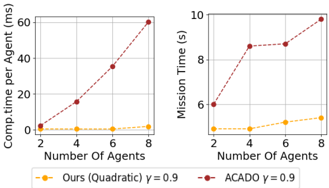
This paper presents a scalable online algorithm to generate safe and kinematically feasible trajectories for quadrotor swarms. Existing approaches rely on linearizing Euclidean distance-based collision constraints and on axis-wise decoupling of kinematic constraints to reduce the trajectory optimization problem for each quadrotor to a quadratic program (QP). This conservative approximation often fails to find a solution in cluttered environments. We present a novel alternative that handles collision constraints without linearization and kinematic constraints in their quadratic form while still retaining the QP form. We achieve this by reformulating the constraints in a polar form and applying an Alternating Minimization algorithm to the resulting problem. Through extensive simulation results, we demonstrate that, as compared to Sequential Convex Programming (SCP) baselines, our approach achieves on average, a 72% improvement in success rate, a 36% reduction in mission time, and a 42 times faster per-agent computation time. We also show that collision constraints derived from discrete-time barrier functions (BF) can be incorporated, leading to different safety behaviours without significant computational overhead. Moreover, our optimizer outperforms the state-of-the-art optimal control solver ACADO in handling BF constraints with a 31 times faster per-agent computation time and a 44% reduction in mission time on average. We experimentally validated our approach on a Crazyflie quadrotor swarm of up to 12 quadrotors. The code with supplementary material and video are released for reference.
Overview
The claims and statistics of this paper haven’t been checked yet.
Free: it reads the open-access text and checks the first 5 claims that cite a source we can check. Create a free account to check every claim.
Integrity signals
Registry
Cites
Statistics
Figures
Verification
Claims the paper makes
The claims and statistics of this paper haven’t been checked yet.
Free: it reads the open-access text and checks the first 5 claims that cite a source we can check. Create a free account to check every claim.
Claims other papers make about this one
Each is checked against this paper’s own text: does it say what the citing paper says it does?
The cited source says what the claim attributes to it.
In the citing paper
“In this work, similar to AMSwarm [38], we reparametrize the quadratic constraints in polar form and solve the distributed optimization problem using an alternating minimization scheme.This approach allows us to efficiently solve the problem in (8) in real-time, without relying on conservative approximations (e.g., linearizing the quadratic constraints as in [36], [39], [45]).”
From SwarmGPT: Combining Large Language Models With Safe Motion Planning for Drone Swarm Choreography (2025) · cites this paper as [38]
The cited source says what the claim attributes to it.
In the citing paper
“Computation times of our safety filter are around the same magnitude as other approaches in the literature [36], [38].”
From SwarmGPT: Combining Large Language Models With Safe Motion Planning for Drone Swarm Choreography (2025) · cites this paper as [38]
In the citing paper
“As compared to [38], our method additionally accounts for the drones' tracking dynamics and enforces continuity in the reference trajectories, which enables more faithful realization of the intended choreography.”
From SwarmGPT: Combining Large Language Models With Safe Motion Planning for Drone Swarm Choreography (2025) · cites this paper as [38]
Self-check
Percentages, sums and reported differences re-computed from the paper’s own numbers.
The self-check needs the paper’s full text.
Citations
Cites
Minimum snap trajectory generation and control for quadrotors
Mellinger, D., & Kumar, V. (2011) · 2011 IEEE International Conference on Robotics and Automation · doi:10.1109/icra.2011.5980409 · Cited by 2,367
ACADO toolkit—An open‐source framework for automatic control and dynamic optimization
Houska, B., Ferreau, H. J., & Diehl, M. (2011) · Optimal Control Applications and Methods · doi:10.1002/oca.939 · Cited by 984
Safety Barrier Certificates for Collisions-Free Multirobot Systems
Wang, L., Ames, A. D., & Egerstedt, M. (2017) · IEEE Transactions on Robotics · doi:10.1109/tro.2017.2659727 · Cited by 795
Variations and extension of the convex–concave procedure
Lipp, T., & Boyd, S. (2016) · Optimization and Engineering · doi:10.1007/s11081-015-9294-x · Cited by 744 · cited 1×
“However, satisfaction of a completely linearized version may not imply satisfaction of (4) [24].”
BackgroundA Survey on Aerial Swarm Robotics
Chung, S.-J., Paranjape, A. A., Dames, P., Shen, S., & Kumar, V. (2018) · IEEE Transactions on Robotics · doi:10.1109/tro.2018.2857475 · Cited by 672
Mixed integer programming for multi-vehicle path planning
Schouwenaars, T., De Moor, B., Feron, E., & How, J. (2001) · 2001 European Control Conference (ECC) · doi:10.23919/ecc.2001.7076321 · Cited by 566
Ghadimi, E., Teixeira, A., Shames, I., & Johansson, M. (2015) · IEEE Transactions on Automatic Control · doi:10.1109/tac.2014.2354892 · Cited by 437
Safety-Critical Model Predictive Control with Discrete-Time Control Barrier Function
Zeng, J., Zhang, B., & Sreenath, K. (2021) · 2021 American Control Conference (ACC) · doi:10.23919/acc50511.2021.9483029 · Cited by 390
Augugliaro, F., Schoellig, A. P., & D'Andrea, R. (2012) · 2012 IEEE/RSJ International Conference on Intelligent Robots and Systems · doi:10.1109/iros.2012.6385823 · Cited by 320
Self-citationTrajectory Planning for Quadrotor Swarms
Honig, W., Preiss, J. A., Kumar, T. K. S., Sukhatme, G. S., & Ayanian, N. (2018) · IEEE Transactions on Robotics · doi:10.1109/tro.2018.2853613 · Cited by 315
Fast, On-line Collision Avoidance for Dynamic Vehicles Using Buffered Voronoi Cells
Zhou, D., Wang, Z., Bandyopadhyay, S., & Schwager, M. (2017) · IEEE Robotics and Automation Letters · doi:10.1109/lra.2017.2656241 · Cited by 286
Luis, C. E., Vukosavljev, M., & Schoellig, A. P. (2020) · IEEE Robotics and Automation Letters · doi:10.1109/lra.2020.2964159 · Cited by 274
Self-citationChen, Y., Singletary, A., & Ames, A. D. (2020) · IEEE Control Systems Letters · doi:10.1109/lcsys.2020.3000748 · Cited by 225
EGO-Swarm: A Fully Autonomous and Decentralized Quadrotor Swarm System in Cluttered Environments
Zhou, X., Zhu, J., Zhou, H., Xu, C., & Gao, F. (2021) · 2021 IEEE International Conference on Robotics and Automation (ICRA) · doi:10.1109/icra48506.2021.9561902 · Cited by 222
Morgan, D., Subramanian, G. P., Chung, S.-J., & Hadaegh, F. Y. (2016) · The International Journal of Robotics Research · doi:10.1177/0278364916632065 · Cited by 189
Multi-UAV collaborative monocular SLAM
Schmuck, P., & Chli, M. (2017) · 2017 IEEE International Conference on Robotics and Automation (ICRA) · doi:10.1109/icra.2017.7989445 · Cited by 188
Predictive control of aerial swarms in cluttered environments
Soria, E., Schiano, F., & Floreano, D. (2021) · Nature Machine Intelligence · doi:10.1038/s42256-021-00341-y · Cited by 172
Mixed Integer Quadratic Program trajectory generation for a quadrotor with a cable-suspended payload
Tang, S., & Kumar, V. (2015) · Proceedings - IEEE International Conference on Robotics and Automation/Proceedings · doi:10.1109/icra.2015.7139492 · Cited by 163
Luis, C. E., & Schoellig, A. P. (2019) · IEEE Robotics and Automation Letters · doi:10.1109/lra.2018.2890572 · Cited by 160
Self-citationA model predictive controller for quadrocopter state interception
Mueller, M. W., & D’Andrea, R. (2013) · European Control Conference (ECC) · doi:10.23919/ecc.2013.6669415 · Cited by 142
Marconi, L., Melchiorri, C., Beetz, M., Pangercic, D., Siegwart, R., Leutenegger, S., Carloni, R., Stramigioli, S., Bruyninckx, H., Doherty, P., et al. (2012) · IEEE International Symposium on Safety, Security, and Rescue Robotics (SSRR) · doi:10.1109/ssrr.2012.6523905 · Cited by 138
Distributed Predictive Drone Swarms in Cluttered Environments
Soria, E., Schiano, F., & Floreano, D. (2021) · IEEE Robotics and Automation Letters · doi:10.1109/lra.2021.3118091 · Cited by 101
Park, J., Kim, D., Kim, G. C., Oh, D., & Kim, H. J. (2022) · IEEE Robotics and Automation Letters · doi:10.1109/lra.2022.3152702 · Cited by 75
Probabilistic guidance of distributed systems using sequential convex programming
Morgan, D., Subramanian, G. P., Bandyopadhyay, S., Chung, S., & Hadaegh, F. Y. (2014) · IEEE/RSJ International Conference on Intelligent Robots and Systems (IROS) · doi:10.1109/iros.2014.6943103 · Cited by 19
Mali, P., Harikumar, K., Singh, A. K., Krishna, K. M., & Sujit, P. B. (2021) · European Control Conference (ECC) · doi:10.23919/ecc54610.2021.9655081 · Cited by 12
Self-citationMotion Planning With Dynamic Obstacles Using Convexified Control Barrier Functions
Varun, V. P., Vinod, A. P., & Kolathaya, S. (2021) · Indian Control Conference · doi:10.1109/icc54714.2021.9703149 · Cited by 11
Adajania, V. K., Masnavi, H., Rastgar, F., Kruusamäe, K., & Singh, A. K. (2021) · IEEE/RSJ International Conference on Intelligent Robots and Systems (IROS) · doi:10.1109/iros51168.2021.9636337 · Cited by 4
Self-citation
Research works printed but not linked: 1
- G. Taylor, R. Burmeister, Z. Xu, B. Singh, A. Patel, and T. Goldstein, "Training neural networks without gradients: A scalable admm ap- proach," in Proc. of the International Conference on Machine Learning (ICML), 2016, pp. 2722-2731.
Cited by
SwarmGPT: Combining Large Language Models With Safe Motion Planning for Drone Swarm Choreography
Schuck, M., Dahanaggamaarachchi, D. O., Sprenger, B., Vyas, V., Zhou, S., & Schoellig, A. P. (2025) · IEEE Robotics and Automation Letters · doi:10.1109/lra.2025.3619745 · Cited by 18
“Prior work has approached grounding by predicting platform-specific affordances [11], using self-correcting inner monologues based on feedback [31], or fine-tuning on physical interactions to improve physical reasoning [32].”
InfluentialSelf-citation
Metadata
- Authors
- Adajania, V. K., Zhou, S., Singh, A. K., & Schoellig, A. P.
- Venue
- 2023 IEEE International Conference on Robotics and Automation (ICRA)
- Publisher
- IEEE
- Published
- 2023-05-29
- Pages
- 1421-1427
- Cited by
- 23
- References
- 27
About these checks
Registry, retraction, Cites and statistics results are computed, not judged, with one exception: a printed reference that no index lists is read once by a model before it counts as a citation error. Claims are extracted by a model and kept only when their quote appears verbatim in the text; each cited source is then checked, with a model’s help, for whether it says what the claim relies on. Those verdicts can be wrong — read the claim’s quote and the cited source before relying on one.
Statistics and arithmetic are recomputed, not judged.
Confidence bands are shown only for fields calibrated on our annotated test set. None is calibrated yet, so no band is shown.
What counts as a claim ›How we measure confidence ›How we check this ›
Are you an author, or do you see a problem with this page? Request a review
Data sources
Bibliographic data: Semantic Scholar, OpenAlex, Crossref.
Contains information from the Semantic Scholar Academic Graph Datasets, made available under the ODC Attribution License (ODC-BY 1.0).
Semantic Scholar’s data is described in: Kinney, R., et al. (2023). The Semantic Scholar Open Data Platform. arXiv:2301.10140.
