

Ditto in the House: Building Articulation Models of Indoor Scenes through Interactive Perception
Open accessThe DOI matches its Crossref record; 56 of the 56 references it cites were found in a registry or an index; 13 of the 24 sources its claims cite were checked for support.
Abstract
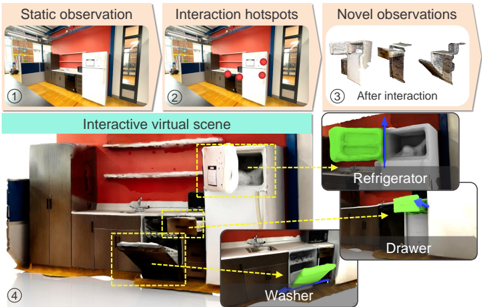
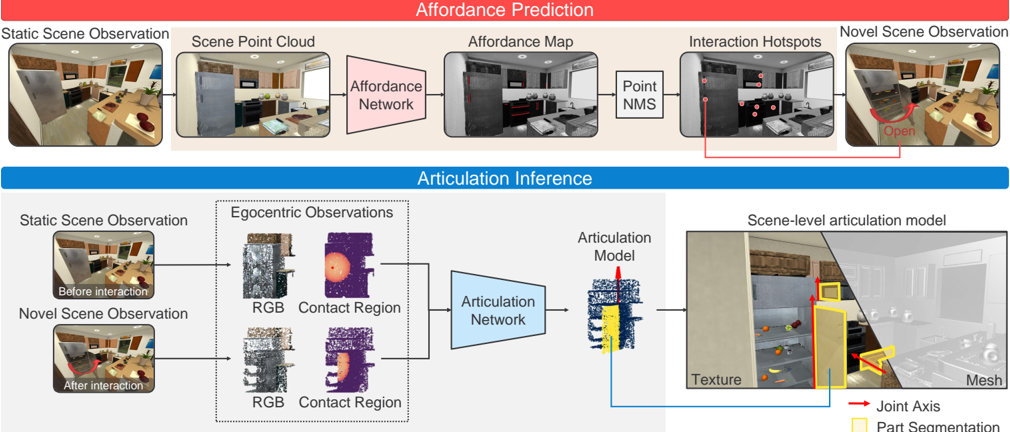
Virtualizing the physical world into virtual models has been a critical technique for robot navigation and planning in the real world. To foster manipulation with articulated objects in everyday life, this work explores building articulation models of indoor scenes through a robot's purposeful inter-actions in these scenes. Prior work on articulation reasoning primarily focuses on siloed objects of limited categories. To extend to room-scale environments, the robot has to efficiently and effectively explore a large-scale 3D space, locate articulated objects, and infer their articulations. We introduce an interactive perception approach to this task. Our approach, named Ditto in the House, discovers possible articulated objects through affordance prediction, interacts with these objects to produce articulated motions, and infers the articulation properties from the visual observations before and after each interaction. It tightly couples affordance prediction and articulation inference to improve both tasks. We demonstrate the effectiveness of our approach in both simulation and real-world scenes. Code and additional results are available at https://ut-austin-rpl.github.io/HouseDitto/
Overview
CoChat Summary
TL;DR
Ditto in the House builds scene-level articulation models of indoor scenes by predicting interaction hotspots, physically interacting with articulated objects, and inferring joint parameters from before/after visual observations, with iterative refinement coupling affordance prediction and articulation inference. It reports gains over baselines in simulation and demonstrates a real-world kitchen reconstruction.
Key findings
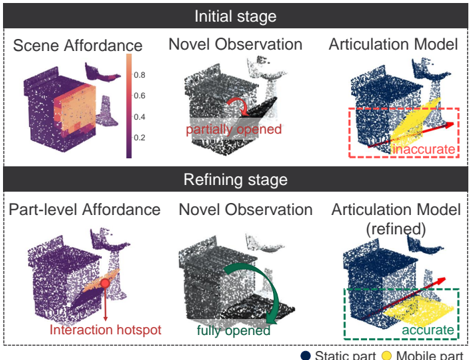
- Affordance prediction: the self-exploration-trained model without refinement achieved precision 0.66 and coverage 0.60 for prismatic joints, 0.72 for revolute joints >15°, and 0.10 for >30°, versus 3D AffordanceNet’s 0.56 precision, 0.23 prismatic coverage, 0.26 for >15°, and 0.03 for >30°. Iterative refinement raised revolute joints opened >30° from 10% to 55%.
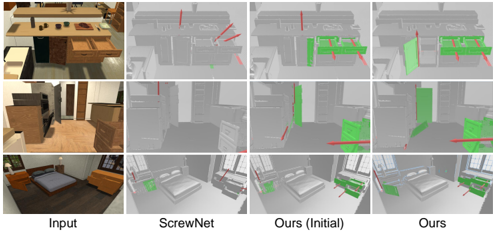
- Articulation inference: the full model achieved Mobile Seg. IoU 0.81, prismatic angle error 0.04, revolute angle error 25.2, and revolute position error 0.04, compared with ScrewNet’s 0.34, 0.28, 46.19, and 0.13, respectively. Ablations: without refinement, revolute angle error was 49.0 and position error 0.06; without contact-region regularity, 31.0 and 0.05.
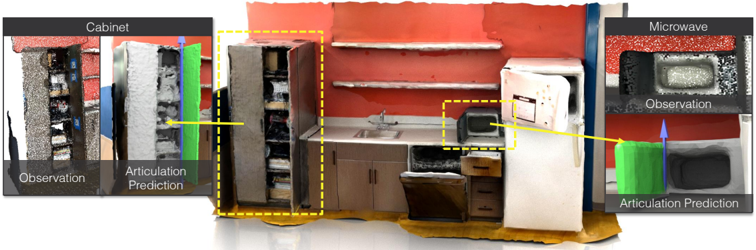
- Real-world evaluation: the approach was applied without modification to a real kitchen scene using an iPhone 12 Pro LiDAR/camera scan and human interactions, building a scene-level articulation model; no quantitative real-world numbers are reported.
- The abstract reports discovering around 40% more parts than the baseline with higher precision and a 45% absolute segmentation IoU boost compared with the baseline.
Methods
- Approach: an interactive perception pipeline with two stages: affordance prediction using PointNet++ for point-wise binary classification plus non-maximum suppression to extract interaction hotspots, and articulation inference using a Ditto-based network that takes before/after egocentric point clouds and contact-region heatmaps to output joint parameters and part segmentation. An iterative refinement step updates affordance from the estimated articulation model to produce larger articulated motions.
- Data/sample: trained and evaluated in simulation on CubiCasa5K with the iGibson simulator; 2,500 scenes were split into 1,500/500/500 for training, validation, and testing. After cleaning, the test set covers 1,030 objects with 1,736 mobile parts. Affordance supervision was collected by exploration-driven interactions with a simplified virtual robot (a floating ball) and labeled positive/negative based on whether articulated motion was successfully produced; the articulation network was trained with multi-view observations and simulator ground-truth articulation parameters.
- Baselines/metrics: compared against 3D AffordanceNet, ScrewNet, and ablations (without refinement, without regularity). Metrics include precision, coverage for prismatic and revolute joints (>15°, >30°), Mobile Seg. IoU, joint angle error, and joint position error. Real-world evaluation used an iPhone 12 Pro LiDAR/camera and human hands.
Limitations
- Stated: experiments use simulated robot grippers and human interactions to simplify exploration and manipulation. Exploration limitations: the robot is teleported between locations, abstracting away navigation and motion planning, and perfect odometry and depth estimation are assumed when reconstructing the static model. Interaction limitations: all interactions are performed by creating pseudo links between the robot and objects or by humans, and joint constraints or robot self-collisions are not considered.
- Evident from the text: the real-world evaluation does not use a physical robot; it uses an iPhone 12 Pro scan and human hands, so real robot navigation, manipulation, and collision constraints remain untested, and no quantitative real-world results are reported.
Model-written summary. Check it against the paper before relying on it.
Integrity signals
Registry
Cites
Statistics
Figures
Verification
Claims the paper makes
6 Valid · 2 Not valid · 6 Not checked · 38 Own results and interpretations
Every source the paper cites for this claim was checked and supports it.
In the paper
“Original Ditto takes the observations as input and does not know the actions that create the motion in the observation.”
What the sources say
- Supportedcites [15] [15] Z. Jiang, C.-C. Hsu, and Y. Zhu, "Ditto: Building digital twins of articulated objects from interaction," in Proceedings of the IEEE/CVF Conference on Computer Vision and Pattern Recognition, 2022, pp. 5616–5626. source
The Problem Formulation (Sec. 3) states that 'The input to our method is a pair of point cloud observations P1, P2 of the articulated object before and after an interaction,' and that the objective is to estimate the joint parameters 'and relative change of the joint states' — i.e., the motion is inferred from the two observations, not supplied. Sec. 4.2.2 reinforces this by defining the joint state c_p / c_r as 'the translation distance / rotation angle resulting from the interaction' to be predicted by the implicit decoders, and Sec. 5.7 (Limitations) notes the interactions are produced externally (by setting joint states in simulation or by a human), with autonomous acting left as future work. No passage in our copy gives Ditto the acting action as an input, so the claim's characterization matches the source. (LLM, conf=0.82)
plain- Asserted: passes — The authors put it forward as true.
- Checkable: passes — It can be checked against evidence.
- Load-bearing: passes — The paper’s conclusions depend on it.
- Based: passes — The paper gives a reason why it holds.
- Supported
Every source the paper cites for this claim was checked and supports it.
In the paper
“Given a pair of visual observations of an object before and after its articulated motion, Ditto simultaneously predicts the 3D geometry and articulation model of the object.”
What the sources say
- Supportedcites [15] [15] Z. Jiang, C.-C. Hsu, and Y. Zhu, "Ditto: Building digital twins of articulated objects from interaction," in Proceedings of the IEEE/CVF Conference on Computer Vision and Pattern Recognition, 2022, pp. 5616–5626. source
The Introduction (p.1) states Ditto 'jointly predicts part-level geometry and kinematic articulation between the parts' with input 'partial point cloud observations of an articulated object before and after interaction with one of its parts'. Section 4 (Method) confirms the two-stream encoder fusing two input point clouds and joint optimisation of geometry reconstruction and articulation estimation, and the Conclusion (p.6) restates it as 'jointly learns full-fledged geometry reconstruction and articulation estimation from two visual inputs before and after articulated motions'. (LLM, conf=0.93)
plainstates a cause- Asserted: passes — The authors put it forward as true.
- Checkable: passes — It can be checked against evidence.
- Load-bearing: passes — The paper’s conclusions depend on it.
- Based: passes — The paper gives a reason why it holds.
- Supported
A result the paper states — it cites no source for it, so there is none to check. The quote shows it is in the paper.
In the paper
“The extracted interaction hotspot can be close to the axis.”
plain- Asserted: passes — The authors put it forward as true.
- Checkable: passes — It can be checked against evidence.
- Load-bearing: passes — The paper’s conclusions depend on it.
- Based: passes — The paper gives a reason why it holds.
A result the paper reports from its own data — it cites no other source for it, so there is none to check. The quote shows it is in the paper.
In the paper
“Our approach also gives a 45% absolute segmentation IoU boost compared with the baseline.”
plainstates a cause- Asserted: passes — The authors put it forward as true.
- Checkable: passes — It can be checked against evidence.
- Load-bearing: passes — The paper’s conclusions depend on it.
- Based: passes — The paper gives a reason why it holds.
A result the paper states — it cites no source for it, so there is none to check. The quote shows it is in the paper.
In the paper
“In our experiments, only 10% of the revolute joints are opened up to > 30◦ during the initial interaction”
plain- Asserted: passes — The authors put it forward as true.
- Checkable: passes — It can be checked against evidence.
- Load-bearing: passes — The paper’s conclusions depend on it.
- Based: passes — The paper gives a reason why it holds.
13 more claims
Create a free account to see all 52 claims and to verify the 6 references still open.
- Probably not a substantial claim. 20
- It may state two separate claims as one. 16
- The quote only partly states this claim. 3
- Not yet classified. 1
Citations
Cites
Rich Feature Hierarchies for Accurate Object Detection and Semantic Segmentation
Girshick, R., Donahue, J., Darrell, T., & Malik, J. (2014) · 2014 IEEE Conference on Computer Vision and Pattern Recognition · doi:10.1109/cvpr.2014.81 · Cited by 32,684 · cited 2×
“Since dense affordance prediction may introduce too many potential locations to probe, we apply non-maximum suppression (NMS) [11] to extract peaks from each region as the interaction hotspots.”
MethodKinectFusion: Real-time dense surface mapping and tracking
Newcombe, R. A., Fitzgibbon, A., Izadi, S., Hilliges, O., Molyneaux, D., Kim, D., Davison, A. J., Kohi, P., Shotton, J., & Hodges, S. (2011) · 2011 10th IEEE International Symposium on Mixed and Augmented Reality · doi:10.1109/ismar.2011.6092378 · Cited by 4,008 · cited 1×
“Recent advances in structure sensors and SLAM algorithms [9, 29, 30] have offered ways to construct static replicas of realworld scenes at unprecedented fidelity.”
BackgroundPointNet++: Deep Hierarchical Feature Learning on Point Sets in a Metric Space
Qi, C. R., Yi, L., Su, H., & Guibas, L. J. (2017) · arXiv (Cornell University) · doi:10.48550/arxiv.1706.02413 · Cited by 2,114
DTAM: Dense tracking and mapping in real-time
Newcombe, R. A., Lovegrove, S. J., & Davison, A. J. (2011) · 2011 International Conference on Computer Vision · doi:10.1109/iccv.2011.6126513 · Cited by 2,078
StereoScan: Dense 3d reconstruction in real-time
Geiger, A., Ziegler, J., & Stiller, C. (2011) · 2011 IEEE Intelligent Vehicles Symposium (IV) · doi:10.1109/ivs.2011.5940405 · Cited by 1,089 · cited 1×
“Recent advances in structure sensors and SLAM algorithms [9, 29, 30] have offered ways to construct static replicas of realworld scenes at unprecedented fidelity.”
BackgroundDynamicFusion: Reconstruction and tracking of non-rigid scenes in real-time
Newcombe, R. A., Fox, D., & Seitz, S. M. (2015) · 2015 IEEE Conference on Computer Vision and Pattern Recognition (CVPR) · doi:10.1109/cvpr.2015.7298631 · Cited by 951 · cited 1×
“Recent advances in structure sensors and SLAM algorithms [9, 29, 30] have offered ways to construct static replicas of realworld scenes at unprecedented fidelity.”
BackgroundLearning Synergies Between Pushing and Grasping with Self-Supervised Deep Reinforcement Learning
Zeng, A., Song, S., Welker, S., Lee, J., Rodriguez, A., & Funkhouser, T. (2018) · 2018 IEEE/RSJ International Conference on Intelligent Robots and Systems (IROS) · doi:10.1109/iros.2018.8593986 · Cited by 606
Neural Body Fitting: Unifying Deep Learning and Model Based Human Pose and Shape Estimation
Omran, M., Lassner, C., Pons-Moll, G., Gehler, P., & Schiele, B. (2018) · International Conference on 3D Vision · doi:10.48550/arxiv.1808.05942 · Cited by 533
Neural Body Fitting: Unifying Deep Learning and Model Based Human Pose and Shape Estimation
Omran, M., Lassner, C., Pons-Moll, G., Gehler, P., & Schiele, B. (2018) · 2018 International Conference on 3D Vision (3DV) · doi:10.1109/3dv.2018.00062 · Cited by 498
The Ecological Approach to the Visual Perception of Pictures
Gibson, J. J. (1978) · Leonardo · doi:10.2307/1574154 · Cited by 456
Cited by
SceneFun3D: Fine-Grained Functionality and Affordance Understanding in 3D Scenes
Delitzas, A., Takmaz, A., Tombari, F., Sumner, R. W., Pollefeys, M., & Engelmann, F. (2024) · IEEE Computer Society Conference on Computer Vision and Pattern Recognition/Proceedings - IEEE Computer Society Conference on Computer Vision and Pattern Recognition/Proceedings · doi:10.1109/cvpr52733.2024.01377 · Cited by 134
“[26, 31, 36, 40, 53] explores the estimation of 3D motion and mobility of in-teractable elements.”
BackgroundPARIS: Part-level Reconstruction and Motion Analysis for Articulated Objects
Liu, J., Amiri, A. M., & Savva, M. (2023) · IEEE/CVF International Conference on Computer Vision (ICCV) · doi:10.1109/iccv51070.2023.00039 · Cited by 157
“Acquiring digital replicas of articulated objects [20, 16] also enables simulating object articulation in applications involving robotic agents and embodied AI [37, 41].”
BackgroundAffordanceLLM: Grounding Affordance from Vision Language Models
Qian, S., Chen, W., Bai, M., Zhou, X. H., Tu, Z., & Li, L. E. (2024) · IEEE/CVF Conference on Computer Vision and Pattern Recognition Workshops (CVPRW) · doi:10.1109/cvprw63382.2024.00754 · Cited by 142
“…usually available for an arbitrary image, fortunately, researchers have built a series of robust approaches to estimate the 3D of an image, ranging from surface normal estimation [15, 61], depth estimation [10, 33, 55, 68, 69], to 3D reconstruction [18, 35, 47] and few-image NeRF [5, 37, 52, 70].”
BackgroundRecent Trends in 3D Reconstruction of General Non‐Rigid Scenes
Yunus, R., Lenssen, J. E., Niemeyer, M., Liao, Y., Rupprecht, C., Theobalt, C., Pons‐Moll, G., Huang, J., Golyanik, V., & Ilg, E. (2024) · Computer Graphics Forum · doi:10.1111/cgf.15062 · Cited by 54
Neural Implicit Representation for Building Digital Twins of Unknown Articulated Objects
Weng, Y., Wen, B., Tremblay, J., Blukis, V., Fox, D., Guibas, L. J., & Birchfield, S. T. (2024) · IEEE Computer Society Conference on Computer Vision and Pattern Recognition/Proceedings - IEEE Computer Society Conference on Computer Vision and Pattern Recognition/Proceedings · doi:10.1109/cvpr52733.2024.00303 · Cited by 88
A Survey of Visual Affordance Recognition Based on Deep Learning
Chen, D., Kong, D., Li, J., Wang, S., & Yin, B. (2023) · IEEE Transactions on Big Data · doi:10.1109/tbdata.2023.3291558 · Cited by 30
Embodied AI: A Survey on the Evolution from Perceptive to Behavioral Intelligence
Yifan, C., Wei, M., Wang, X., Liu, Y., Wang, J., Song, H., Ma, L., Di, D., Sun, C., Liu, K., et al. (2025) · SmartBot · doi:10.1002/smb2.70003 · Cited by 46
Understanding 3D Object Interaction from a Single Image
Qian, S., & Fouhey, D. F. (2023) · IEEE/CVF International Conference on Computer Vision (ICCV) · doi:10.1109/iccv51070.2023.01988 · Cited by 42
“Researchers try to understand the 3D shapes, axes, movable parts and affordance on synthetic data [48, 70, 49, 29, 68, 37, 66], videos [53, 24, 21, 50, 45, 36] or point clouds [30, 28].”
BackgroundOPDMulti: Openable Part Detection for Multiple Objects
Sun, X., Jiang, H., Savva, M., & Chang, A. (2024) · International Conference on 3D Vision (3DV) · doi:10.1109/3dv62453.2024.00100 · Cited by 51
“Researchers have also started to investigate how to use predicted segmentation and motion parameters to automatically create articulated objects [14, 4], including in scenes [8].”
BackgroundInteraction-Driven Active 3D Reconstruction with Object Interiors
Yan, Z., Su, F., Wang, M., Hu, R., Zhang, H., & Huang, H. F. (2023) · ACM Transactions on Graphics · doi:10.1145/3618327 · Cited by 11
“Ditto [Jiang et al. 2022] is a framework that jointly predicts part-level geometry and joint parameters given two point cloud shapes exhibiting different articulation states.”
BackgroundStructure from Action: Learning Interactions for 3D Articulated Object Structure Discovery
Nie, N., Gadre, S. Y., Ehsani, K., & Song, S. (2023) · IEEE/RSJ International Conference on Intelligent Robots and Systems (IROS) · doi:10.1109/iros55552.2023.10342135 · Cited by 40
“More recently, Hsu et al. [13] propose Ditto in the House, which extends Ditto [18] for discovering many parts and joints in scenes, leveraging a learned interaction policy.”
BackgroundDRAWER: Digital Reconstruction and Articulation With Environment Realism
Xia, H., Su, E., Memmel, M., Jain, A., Yu, R., Mbiziwo-Tiapo, N., Farhadi, A., Gupta, A., Wang, S., & Ma, W.-C. (2025) · IEEE Computer Society Conference on Computer Vision and Pattern Recognition/Proceedings - IEEE Computer Society Conference on Computer Vision and Pattern Recognition/Proceedings · doi:10.1109/cvpr52734.2025.02028 · Cited by 50
“To address this challenge, researchers have proposed using automated tools, such as procedural generation [13, 70], or learning-based methods to directly model or approximate real-world environments [25, 30, 87, 95].”
Learning Environment-Aware Affordance for 3D Articulated Object Manipulation under Occlusions
Wu, R., Cheng, K., Shen, Y., Ning, C., Zhan, G., & Dong, H. (2023) · arXiv · doi:10.48550/arxiv.2309.07510 · Cited by 11
“Numerous research endeavors have been investigating articulated objects broadly, encompassing joint parameters estimation [40, 46], part pose estimation [22, 23], kinematic structure estimation [33, 32], digital twins generalization [13, 10], articulated part robotic manipulation [25, 43, 45, 4] and few-shot policy ad…”
Object-aware interactive perception for tabletop scene exploration
Koc, C., & Sarıel, S. (2024) · Robotics and Autonomous Systems · doi:10.1016/j.robot.2024.104674 · Cited by 5
Goldberg, A., Kondap, K., Qiu, T., Ma, Z., Fu, L., Kerr, J. H., Huang, H., Chen, K., Fang, K., & Goldberg, K. Y. (2025) · Proceedings - IEEE International Conference on Robotics and Automation/Proceedings · doi:10.1109/icra55743.2025.11127489 · Cited by 26
SpotLight: Robotic Scene Understanding Through Interaction and Affordance Detection
Engelbracht, T., Zurbrügg, R., Pollefeys, M., Blum, H., & Bauer, Z. (2025) · IEEE-RAS International Conference on Humanoid Robots (Humanoids) · doi:10.1109/humanoids65713.2025.11203097 · Cited by 14
OVA-Fields: Weakly Supervised Open-Vocabulary Affordance Fields for Robot Operational Part Detection
Su, H., Xie, M., Cao, N., Ding, Y., Shao, B., Long, X., Gu, F., & Chen, C. (2025) · IEEE/CVF International Conference on Computer Vision (ICCV) · doi:10.1109/iccv51701.2025.00602 · Cited by 8
“The second challenge is that existing affordance detection models often fail to handle complex user instructions effectively [1, 2, 9, 15, 19, 42, 44], limiting their practical use in real-world scenes.”
UAD: Unsupervised Affordance Distillation for Generalization in Robotic Manipulation
Tang, Y., Huang, W., Wang, Y., Li, C., Yuan, R., Zhang, R., Wu, J., & Fei-Fei, L. (2025) · Proceedings - IEEE International Conference on Robotics and Automation/Proceedings · doi:10.1109/icra55743.2025.11128868 · Cited by 39
“Abstract —Understanding fine-grained object affordances is imperative for robots to manipulate objects in unstructured environments given open-ended task instructions.”
Hu, S., Nagai, T., & Horii, T. (2025) · IEEE Robotics and Automation Letters · doi:10.1109/lra.2025.3598998 · Cited by 7
“In robotic systems, effective affordance extraction is crucial for enabling nuanced interactions with unstructured environments [5], [6].”
Mula, A., Młodzikowski, K., Gawron, P., & Belter, D. (2023) · Applied Sciences · doi:10.3390/app13158751 · Cited by 1
Tang, J., Gu, Q., Yu, J., Chen, S., Yi, T., Qiao, F., & Wang, Y. (2026) · IEEE Robotics and Automation Letters · doi:10.1109/lra.2026.3709647
Metadata
- Authors
- Hsu, C.-C., Jiang, Z., & Zhu, Y.
- Affiliations
- The University of Texas at Austin (US)
- Venue
- 2023 IEEE International Conference on Robotics and Automation (ICRA)
- Publisher
- IEEE
- Published
- 2023-05-29
- Pages
- 3933-3939
- ISSN
- 1050-4729 (ISSN-L)
- OpenAlex
- W4383109308
- Semantic Scholar
- 1ab84899c46ba785628de9dd64c896b9dcde6c9f
- Cited by
- 21
- References
- 54
- Citations by year
- 2026: 2 · 2025: 7 · 2024: 6 · 2023: 6
- FWCI
- 8.99
- Type
- conference paper
- Language
- en
- Open access
- green
- arxiv.org
- Locations
- Proceedings - IEEE International Conference on Robotics and Automation/Proceedings (publishedVersion)
- arXiv (Cornell University) (submittedVersion)
- arXiv (Cornell University)
- Funders
- NSF (CNS-1955523,FRR-2145283)
- Topics
- Physical Sciences › Engineering › Control and Systems Engineering › Robot Manipulation and Learning
- Physical Sciences › Computer Science › Artificial Intelligence › Reinforcement Learning in Robotics
- Physical Sciences › Computer Science › Computer Vision and Pattern Recognition › Robotics and Sensor-Based Localization
- Keywords
- indoor scene understanding, interactive perception, affordance prediction, robotic manipulation, robot exploration, 3D object modeling
About these checks
Registry, retraction, Cites and statistics results are computed, not judged, with one exception: a printed reference that no index lists is read once by a model before it counts as a citation error. Claims are extracted by a model and kept only when their quote appears verbatim in the text; each cited source is then checked, with a model’s help, for whether it says what the claim relies on. Those verdicts can be wrong — read the claim’s quote and the cited source before relying on one.
The claim verdicts this report counts are experimental: their accuracy is not yet measured.
A language model drew the claims from the paper on 2026-10-01, under version 3 of the claim definition (model deepseek-v4.1-flash, prompt extract-v3).
A second model labelled each claim on 2026-10-01 (model jev-1.13-20260917, definition revision gold-guideline-v0.2).
Cited sources are checked with a language model’s help (qwen3.8-omni-flash).
Statistics and arithmetic are recomputed, not judged.
Confidence bands are shown only for fields calibrated on our annotated test set. None is calibrated yet, so no band is shown.
What counts as a claim ›How we measure confidence ›How we check this ›
Are you an author, or do you see a problem with this page? Request a review
Data sources
Bibliographic data: Semantic Scholar, OpenAlex, Crossref.
Contains information from the Semantic Scholar Academic Graph Datasets, made available under the ODC Attribution License (ODC-BY 1.0).
Semantic Scholar’s data is described in: Kinney, R., et al. (2023). The Semantic Scholar Open Data Platform. arXiv:2301.10140.
