

The DOI matches its Crossref record; 93 of the 93 references it cites were found in a registry or an index.
WavCaps: A ChatGPT-Assisted Weakly-Labelled Audio Captioning Dataset for Audio-Language Multimodal Research
Open accessAbstract
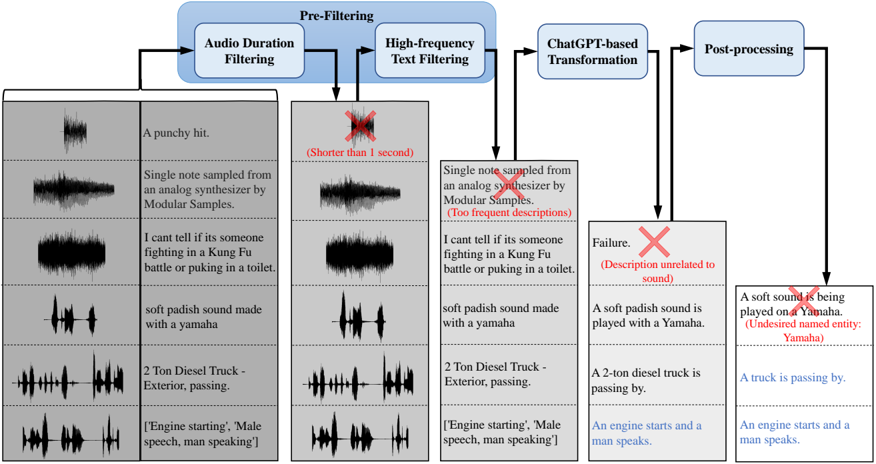
The advancement of audio-language (AL) multimodal learning tasks has been significant in recent years, yet the limited size of existing audio-language datasets poses challenges for researchers due to the costly and time-consuming collection process. To address this data scarcity issue, we introduceWavCaps, the first large-scale weakly-labelled audio captioning dataset, comprising approximately 400 k audio clips with paired captions. We sourced audio clips and their raw descriptions from web sources and a sound event detection dataset. However, the online-harvested raw descriptions are highly noisy and unsuitable for direct use in tasks such as automated audio captioning. To overcome this issue, we propose a three-stage processing pipeline for filtering noisy data and generating high-quality captions, where ChatGPT, a large language model, is leveraged to filter and transform raw descriptions automatically. We conduct a comprehensive analysis of the characteristics of WavCaps dataset and evaluate it on multiple downstream audio-language multimodal learning tasks. The systems trained on WavCaps outperform previous state-of-the-art (SOTA) models by a significant margin. Our aspiration is for the WavCaps dataset we have proposed to facilitate research in audio-language multimodal learning and demonstrate the potential of utilizing large language models (LLMs) to enhance academic research.
Overview
The claims and statistics of this paper haven’t been checked yet.
Run the check — free, no account needed. It reads the open-access text and checks the sources it cites.
Integrity signals
Registry
Cites
Statistics
Figures
Verification
Claims the paper makes
The claims and statistics of this paper haven’t been checked yet.
Run the check — free, no account needed. It reads the open-access text and checks the sources it cites.
Claims other papers make about this one
Each is checked against this paper’s own text: does it say what the citing paper says it does?
The source backs part of the claim, not all of it — or backs it for a different population, condition or comparison.
In the citing paper
“There have been similar and successful use cases of LLMs for general audio understanding [18] and music generation [19].”
From LP-MusicCaps: LLM-Based Pseudo Music Captioning (2023) · cites this paper as [18]
Experimental — accuracy not yet measuredThe cited source says what the claim attributes to it.
In the citing paper
“Finally, Mel et al.. [18] introduce WavCaps, a 400k audio captioning dataset using ChatGPT [23].”
From LP-MusicCaps: LLM-Based Pseudo Music Captioning (2023) · cites this paper as [18]
Self-check
Percentages, sums and reported differences re-computed from the paper’s own numbers.
The self-check needs the paper’s full text.
Citations
Cites
Vaswani, A., Shazeer, N., Parmar, N., Uszkoreit, J., Jones, L., Gomez, A. N., Kaiser, L., & Polosukhin, I. (2017) · arXiv · doi:10.48550/arxiv.1706.03762 · Cited by 120,404
Adam: A Method for Stochastic Optimization
Kingma, D. P., & Ba, J. (2014) · arXiv · doi:10.48550/arxiv.1412.6980 · Cited by 98,946
LeCun, Y., Bengio, Y., & Hinton, G. (2015) · Nature · doi:10.1038/nature14539 · Cited by 84,126
BERT: Pre-training of Deep Bidirectional Transformers for Language Understanding
Devlin, J., Chang, M.-W., Lee, K., & Toutanova, K. (2018) · arXiv · doi:10.48550/arxiv.1810.04805 · Cited by 73,173
ImageNet: A large-scale hierarchical image database
Deng, J., Dong, W., Socher, R., Li, L.-J., Li, K., & Fei-Fei, L. (2009) · 2009 IEEE Conference on Computer Vision and Pattern Recognition · doi:10.1109/cvpr.2009.5206848 · Cited by 65,333
Learning representations by back-propagating errors
Rumelhart, D. E., Hinton, G. E., & Williams, R. J. (1986) · Nature · doi:10.1038/323533a0 · Cited by 31,892
BLEU: a method for automatic evaluation of machine translation
Papineni, K., Roukos, S., Ward, T., & Zhu, W.-J. (2001) · Proceedings of the 40th Annual Meeting on Association for Computational Linguistics - ACL '02 · doi:10.3115/1073083.1073135 · Cited by 21,344
High-Resolution Image Synthesis with Latent Diffusion Models
Rombach, R., Blattmann, A., Lorenz, D., Esser, P., & Ommer, B. (2022) · 2022 IEEE/CVF Conference on Computer Vision and Pattern Recognition (CVPR) · doi:10.1109/cvpr52688.2022.01042 · Cited by 20,302
Learning Transferable Visual Models From Natural Language Supervision
Radford, A., Kim, J. W., Hallacy, C., Ramesh, A., Goh, G., Agarwal, S., Sastry, G., Askell, A., Mishkin, P., Clark, J., et al. (2021) · arXiv · doi:10.48550/arxiv.2103.00020 · Cited by 15,293
Exploring the Limits of Transfer Learning with a Unified Text-to-Text Transformer
Raffel, C., Shazeer, N., Roberts, A., Lee, K., Narang, S., Matena, M., Zhou, Y., Li, W., & Liu, P. J. (2019) · arXiv · doi:10.48550/arxiv.1910.10683 · Cited by 10,929
Research works printed but not linked: 4
- Kim, 2019, AudioCaps: Generating captions for audios in the wild, 119
- Martin, 2021, Diversity and bias in audio captioning datasets, 90
- 10.5555/3524938.3525087 · DOI
- Han, 2021, Automated audio captioning with weakly supervised pre-training and word selection methods, 6
Cited by
Sorted by citations
A Comprehensive Overview of Large Language Models
Naveed, H., Khan, A. U., Qiu, S., Saqib, M., Anwar, S., Usman, M., Akhtar, N., Barnes, N., & Mian, A. (2025) · ACM Transactions on Intelligent Systems and Technology · doi:10.1145/3744746 · Cited by 1,257
A survey on multimodal large language models
Yin, S., Fu, C., Zhao, S., Li, K., Sun, X., Xu, T., & Chen, E. (2024) · National Science Review · doi:10.1093/nsr/nwae403 · Cited by 893
A Survey of GPT-3 Family Large Language Models Including ChatGPT and GPT-4
Kalyan, K. S. (2024) · Natural Language Processing Journal · doi:10.1016/j.nlp.2023.100048 · Cited by 335
InternVideo2: Scaling Foundation Models for Multimodal Video Understanding
Wang, Y., Li, K., Li, X., Yu, J., He, Y., Chen, G., Pei, B., Zheng, R., Wang, Z., Shi, Y., et al. (2024) · Lecture notes in computer science · doi:10.1007/978-3-031-73013-9_23 · Cited by 427
AudioLDM 2: Learning Holistic Audio Generation With Self-Supervised Pretraining
Liu, H., Yuan, Y., Liu, X., Mei, X., Kong, Q., Tian, Q., Wang, Y.-P., Wang, W., Wang, Y., & Plumbley, M. D. (2024) · IEEE/ACM Transactions on Audio Speech and Language Processing · doi:10.1109/taslp.2024.3399607 · Cited by 352
Self-citation
Metadata
- Authors
- Mei, X., Meng, C., Liu, H., Kong, Q., Ko, T., Zhao, C., Plumbley, M. D., Zou, Y., & Wang, W.
- Affiliations
- University of Surrey (GB)
- Johns Hopkins University (US)
- Chinese University of Hong Kong (HK)
- ByteDance (China) (CN)
- Peking University (CN)
- ORCID
- Venue
- IEEE/ACM Transactions on Audio, Speech, and Language Processing
- Published
- 2024
- Volume
- 32
- Pages
- 3339-3354
- ISSN
- 2329-9290 (ISSN-L)
- 2329-9304
- OpenAlex
- W4400033239
- Cited by
- 150
- References
- 92
- Citations by year
- 2026: 38 · 2025: 61 · 2024: 47
- FWCI
- 20.44
- Type
- journal article
- Language
- en
- Open access
- green
- arxiv.org
- Licence
- Locations
- IEEE/ACM Transactions on Audio Speech and Language Processing (publishedVersion)
- arXiv (Cornell University) (submittedVersion, cc-by-nc-nd)
- arXiv (Cornell University)
- Funders
- Engineering and Physical Sciences Research Council (EP/T019751/1)
- Topics
- Physical Sciences › Computer Science › Computer Vision and Pattern Recognition › Multimodal Machine Learning Applications
- Physical Sciences › Computer Science › Signal Processing › Music and Audio Processing
- Physical Sciences › Computer Science › Artificial Intelligence › Speech Recognition and Synthesis
- Keywords
- audio captioning, ChatGPT, large language models, data filtering, sound event detection, data scarcity
About these checks
Registry, retraction, Cites and statistics results are computed, not judged, with one exception: a printed reference that no index lists is read once by a model before it counts as a citation error. Claims are extracted by a model and kept only when their quote appears verbatim in the text; each cited source is then checked, with a model’s help, for whether it says what the claim relies on. Those verdicts can be wrong — read the claim’s quote and the cited source before relying on one.
Statistics and arithmetic are recomputed, not judged.
Confidence bands are shown only for fields calibrated on our annotated test set. None is calibrated yet, so no band is shown.
What counts as a claim ›How we measure confidence ›How we check this ›
Are you an author, or do you see a problem with this page? Request a review
