

UBCL: A Reinforcement Learning Framework for Controllable and Diverse Player Behaviors
Open accessPublished version of a preprint
The DOI matches its Crossref record; 46 of the 47 references it cites were found in a registry or an index; 19 of the 33 sources its claims cite were checked for support.
Abstract
This paper introduces a reinforcement learning framework that enables controllable and diverse player behaviors without relying on human gameplay data. Existing approaches often require large-scale player trajectories, train separate models for different player types, or provide no direct mapping between interpretable behavioral parameters and the learned policy, limiting their scalability and controllability. We define player behavior in an N-dimensional continuous space and uniformly sample target behavior vectors from a region that encompasses the subset representing real human styles. During training, each agent receives both its current and target behavior vectors as input, and the reward is based on the normalized reduction in distance between them. This allows the policy to learn how actions influence behavioral statistics, enabling smooth control over attributes such as aggressiveness, mobility, and cooperativeness. A single PPO-based multi-agent policy can reproduce new or unseen play styles without retraining. Experiments conducted in a custom multi-player Unity game show that the proposed framework produces significantly greater behavioral diversity than a win-only baseline and matches specified behavior vectors across diverse targets, with highest accuracy on score-based dimensions and moderate degradation on cooperation and mobility. The method offers a scalable solution for automated playtesting, game balancing, human-like behavior simulation, and replacing disconnected players in online games.
Overview
CoChat Summary
TL;DR
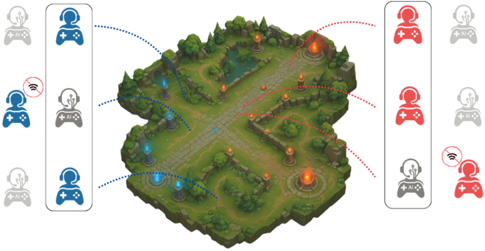
UBCL (Uniform Behavior Conditioned Learning) is a reinforcement learning framework that trains a single PPO policy to reproduce controllable, diverse player behaviors by conditioning agents on target behavior vectors sampled uniformly from an N-dimensional behavior space, without any human gameplay data. In a custom 2v2 Unity game, the policy matched specified behavior vectors across diverse targets and produced greater behavioral diversity than a win-only baseline, with highest accuracy on score-based dimensions and moderate degradation on cooperation and mobility.
Key findings
- The UBCL policy generally achieved its target behavior vectors across 50-session radar-chart evaluations of representative player types (offensive, collector, exploiter, explorer and variations), maintaining overall tendencies even when specific objectives failed due to limited in-game resources and conflicting player goals.
- Diversity: in a 2D PCA projection of 1,000 evaluation games, UBCL covered a broad region of the behavior space (interior and edges), CARI produced "directed but edge-dominated" behaviors, and the win-only policy clustered in a narrow region resembling collector-type behavior.
- Error analysis across 1,250 episodes (5,000 behavior vectors) showed low variance on score-related parameters, higher error on T-Distance (teammate coordination), and a positive, "considerably high" mean error on Mobility, attributed to infeasible targets in the Mobility sampling interval.
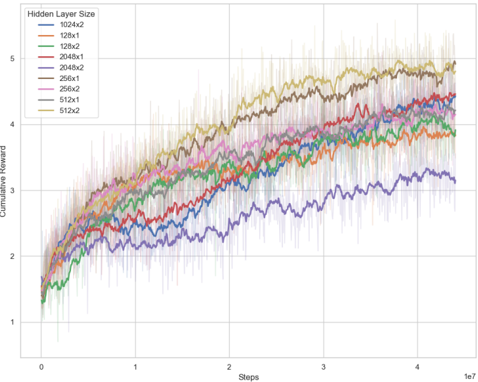
- Behavior-space correlations: strongest negative coupling D/S–K/S (−0.60) from the sum-to-one constraint; K/S–Dominance correlation negligible (0.10); error couplings K/S–Dominance (+0.47) and C/S–D/S (−0.48). Policies with 4, 5, and 6 behavioral dimensions showed comparable convergence.
Methods
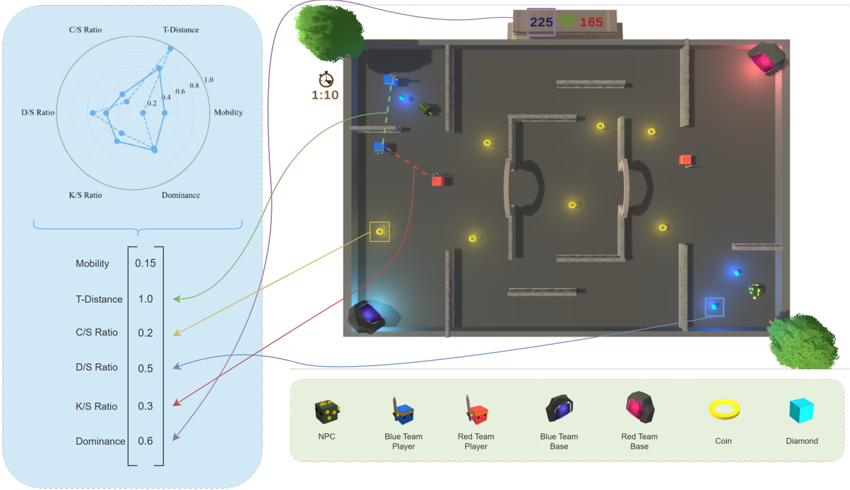
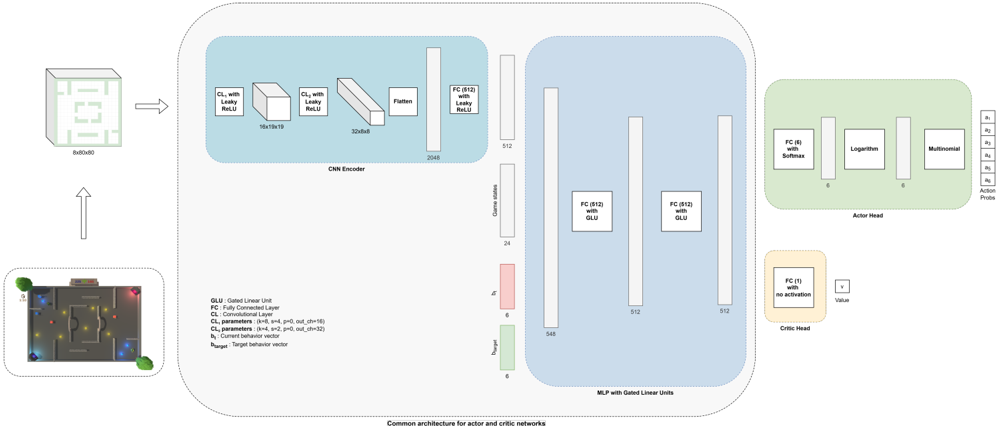
- Design: a single shared PPO actor-critic policy conditioned on a six-dimensional behavior vector (Mobility, T-Distance, C/S ratio, D/S ratio, K/S ratio, Dominance); each agent samples a target vector per episode and receives reward equal to the normalized reduction in Euclidean distance between current and target vectors (Eq. 1, λ scaling; max return = λ = 10).
- Environment and data: a custom 2v2 grid-based multiplayer game built in Unity with ML-Agents, where players collect coins/diamonds or eliminate opponents; agents observe an (8, 80, 80) grid tensor plus vector game states, current behavior vector, and target behavior vector. No human gameplay data used in training.
- Training/analysis: ~200 million time steps (≈5,500 hours of gameplay) on an RTX 3080 (12 GB), 32 GB RAM, Intel i5-13600KF, with 16 parallel environment instances; baselines were a win-only policy and a reimplemented CARI policy trained for 200M steps under identical conditions; evaluation used radar charts, PCA projection, per-dimension error box plots, and in-match error trajectories.
Limitations
- Stated: reliance on manually designed behavioral parameters — six dimensions inevitably constrain the representable play-style space, so generated styles are "discretized approximations of highly detailed human behaviors"; cooperation and long-term strategy remain challenging due to the short-horizon reward formulation; T-Distance error is consistently higher because per-agent distance-reduction reward averages out interaction patterns, giving insufficient signal for joint spatiotemporal control; the Mobility sampling interval includes infeasible targets.
- Stated as future work (i.e., not yet addressed): interaction-aware coordination objectives, learned latent behavior spaces via autoencoders, validation in continuous-action environments with alternative distance formulations, and a dedicated human study to validate reproduction of individual player styles.
- Evident from the text: all results come from one custom 2v2 grid game with discrete actions and six hand-chosen metrics, so generalization to other genres, continuous action spaces, or larger behavior-vector dimensionalities is untested; the paper also notes that growing dimensionality expands the target space exponentially and may require longer training or curriculum-based sampling.
Model-written summary. Check it against the paper before relying on it.
Integrity signals
Registry
Cites
Statistics
Figures



Verification
Claims the paper makes
11 Valid · 4 Not valid · 7 Not checked · 53 Own results and interpretations
At least one cited source doesn’t support this claim or points to a different paper, and none confirmed it — see the verdicts below.
In the paper
“Nonetheless, they lack specific methods for directing the learned policy to demonstrate a particular play style.”
What the sources say
- Could not verifycites [35] Ho, 2024, Towards human-like RL: Taming non-naturalistic behavior in deep RL via adaptive behavioral costs in 3D games sourceExperimental — accuracy not yet measured
The Introduction describes methods for making agents more human-like, and §2.1 says unconstrained RL does not guarantee human-like behavior. Neither passage says that human-likeness approaches lack methods for directing a learned policy toward a particular play style. Searches for play-style control and steering a policy did not find that claim in our copy. (LLM, conf=0.68)
- Not matchedcites [36] Glavin, 2011, Incorporating reinforcement learning into the creation of human-like autonomous agents in first person shooter games
Couldn’t be matched to a paper in Crossref, so it can’t be checked.
- Disputedcites [32] Arzate Cruz, 2018, HRLB2: A reinforcement learning based framework for believable bots, Appl. Sci. sourceExperimental — accuracy not yet measured
Section 4.2, “Hierarchical Decomposition” (page unavailable), describes a specific method for directing an RL bot toward a chosen playing style: designing reward functions for style-specific subtasks. It gives an aggressive fighting style as an example, contrary to the claim that such approaches lack a method for directing the learned policy. (LLM, conf=0.85)
Checked by a reasoning model — may be wrong.
plain- Asserted: passes — The authors put it forward as true.
- Checkable: passes — It can be checked against evidence.
- Load-bearing: passes — The paper’s conclusions depend on it.
- Based: passes — The paper gives a reason why it holds.
- Could not verify
Some cited sources support this claim and some don’t — read each source’s verdict below.
In the paper
“Although these studies aim to enhance behavioral diversity to improve test coverage, they lack mechanisms to control or direct the learned policy toward specific play styles.”
What the sources say
- Disputedcites [30] sourceExperimental — accuracy not yet measured
The Reinforcement Learning section (p. 1) says RL agents can be controlled through the reward signal to express a specific behavior. It explicitly gives defensive play as an example of a style that can be encouraged by changing the reward function, contrary to the claimed lack of such a mechanism. (LLM, conf=0.90)
Checked by a reasoning model — may be wrong.
- Partly supportedcites [29] sourceExperimental — accuracy not yet measured
The Introduction (page unavailable) says the paper uses curiosity-driven RL to improve exploration and coverage, and explicitly says its intent is not to optimize a behaviour policy. This supports the characterization of this approach, but the paper does not establish that RL-based playtesting studies generally lack mechanisms for directing policies toward specific play styles, or that behavioral diversity is their stated aim. (LLM, conf=0.78)
- Not matchedcites [31] Schnabl, 2024, AI-based playtesting with deep Q-networks: A case study with super Mario Bros
Couldn’t be matched to a paper in Crossref, so it can’t be checked.
plain- Asserted: passes — The authors put it forward as true.
- Checkable: passes — It can be checked against evidence.
- Load-bearing: passes — The paper’s conclusions depend on it.
- Based: passes — The paper gives a reason why it holds.
- Disputed
Every source the paper cites for this claim was checked and supports it.
In the paper
“UBCL is most accurately described as a form of Goal-Conditioned RL (GCRL) [42]: the agent receives a target point in a bounded, interpretable behavior space and is rewarded for reducing its distance to that point (Eq. 1).”
What the sources say
- Supportedcites [42] source
The Introduction defines GCRL as augmenting an agent’s observation with a goal it must achieve and describes goals as including points in a state-space subspace. “Sample Efficiency: Towards Sparse Rewards” gives a distance-based reward for approaching a desired goal. These passages support the citation’s use of GCRL to classify the target-and-distance-reward setup. (LLM, conf=0.88)
plainstates a cause- Asserted: passes — The authors put it forward as true.
- Checkable: passes — It can be checked against evidence.
- Load-bearing: passes — The paper’s conclusions depend on it.
- Based: passes — The paper gives a reason why it holds.
- Supported
Every source the paper cites for this claim was checked and supports it.
In the paper
“Using this setup, a policy was trained with Proximal Policy Optimization (PPO) [34] to produce consistent and distinguishable behaviors aligned with target behavior vectors.”
What the sources say
- Supportedcites [34] Schulman, 2017, Proximal policy optimization algorithms source
The citation identifies the training method, PPO, rather than attributing the citing authors’ behavior-vector results to this paper. The Abstract (p. 1) introduces proximal policy optimization as a family of policy-gradient methods, so the source supports that identification. (LLM, conf=0.93)
plainstates a cause- Asserted: passes — The authors put it forward as true.
- Checkable: passes — It can be checked against evidence.
- Load-bearing: passes — The paper’s conclusions depend on it.
- Based: passes — The paper gives a reason why it holds.
- Supported
The cited sources support only part of this claim — read each source’s verdict below.
In the paper
“However, such agents often converge to repetitive and non-human optimal behaviors.”
What the sources say
- Partly supportedcites [30] sourceExperimental — accuracy not yet measured
In “Game exploits and logical bugs” (p. 3), the paper reports that fully trained RL agents find a near-optimal path, including a shortcut through a wall. It does not say that agents often converge to repetitive behavior; “Reinforcement Learning” (p. 1) instead describes RL behavior as more closely resembling human players. (LLM, conf=0.78)
- Could not verifycites [29] sourceExperimental — accuracy not yet measured
The Introduction says the authors use curiosity to encourage exploration rather than optimize a game score, and Related Work discusses agents designed to mimic player archetypes. Neither section says that deep RL playtesting agents often converge to repetitive, non-human optimal behavior. Searches for “repetitive” and “non-human optimal behavior convergence” found no passage making that point; the Introduction uses “repetitive” to describe the work of maximizing playtesting coverage. (LLM, conf=0.72)
- Not matchedcites [31] Schnabl, 2024, AI-based playtesting with deep Q-networks: A case study with super Mario Bros
Couldn’t be matched to a paper in Crossref, so it can’t be checked.
plain- Asserted: passes — The authors put it forward as true.
- Checkable: passes — It can be checked against evidence.
- Load-bearing: passes — The paper’s conclusions depend on it.
- Based: passes — The paper gives a reason why it holds.
- Partly supported
31 more claims · 1 with their cited sources checked
Create a free account to see all 75 claims and every source verdict.
- It may state two separate claims as one. 25
- Probably not a substantial claim. 18
Self-check
Percentages, sums and reported differences re-computed from the paper’s own numbers.
Each contradiction between two passages listed here was confirmed by an independent check.
Rated minor: it would not touch a result — a value no result rests on, a p-value that stays on the same side of the significance level, or a conflict that is clerical, resolved elsewhere in the paper, or outside its own findings.
In the paper
§ IV. EXPERIMENTAL SETUP
“b6 = Nvisited Ntotal × 100”
§ IV. EXPERIMENTAL SETUP
“Each metric is normalized to the range [0, 1], which is also included in the equations above.”
Citations
Cites
Human-level control through deep reinforcement learning
Mnih, V., Kavukcuoglu, K., Silver, D., Rusu, A. A., Veness, J., Bellemare, M. G., Graves, A., Riedmiller, M., Fidjeland, A. K., Ostrovski, G., et al. (2015) · Nature · doi:10.1038/nature14236 · Cited by 30,357
Mastering the game of Go with deep neural networks and tree search
Silver, D., Huang, A., Maddison, C. J., Guez, A., Sifre, L., van den Driessche, G., Schrittwieser, J., Antonoglou, I., Panneershelvam, V., Lanctot, M., et al. (2016) · Nature · doi:10.1038/nature16961 · Cited by 15,612
Continuous control with deep reinforcement learning
Lillicrap, T. P., Hunt, J. J., Pritzel, A., Heess, N., Erez, T., Tassa, Y., Silver, D., & Wierstra, D. (2015) · arXiv · doi:10.48550/arxiv.1509.02971 · Cited by 10,782
Proximal Policy Optimization Algorithms
Schulman, J., Wolski, F., Dhariwal, P., Radford, A., & Klimov, O. (2017) · arXiv · doi:10.48550/arxiv.1707.06347 · Cited by 10,625
Soft actor-critic Off-policy maximum entropy deep reinforcement learning with a stochastic actor
Haarnoja, T., Zhou, A., Abbeel, P., & Levine, S. (2018) · arXiv · doi:10.48550/arxiv.1801.01290 · Cited by 5,594
Trust region policy optimization
Schulman, J., Levine, S., Moritz, P., Jordan, M. I., & Abbeel, P. (2015) · arXiv · doi:10.48550/arxiv.1502.05477 · Cited by 4,578
Grandmaster level in StarCraft II using multi-agent reinforcement learning
Vinyals, O., Babuschkin, I., Czarnecki, W. M., Mathieu, M., Dudzik, A., Chung, J., Choi, D. H., Powell, R., Ewalds, T., Georgiev, P., et al. (2019) · Nature · doi:10.1038/s41586-019-1724-z · Cited by 3,455 · cited 1×
“Notable studies [1], [2], [3], [4], [5] demonstrated impressive results in achieving superhuman game play.”
Generative Agents: Interactive Simulacra of Human Behavior
Park, J. S., O'Brien, J., Cai, C. J., Morris, M. R., Liang, P., & Bernstein, M. S. (2023) · Proceedings of the 36th Annual ACM Symposium on User Interface Software and Technology · doi:10.1145/3586183.3606763 · Cited by 2,187 · cited 1×
“If a player is disconnected, the AI model corresponding to that player can replace it until the player reconnects. like matchmaking [9], [10], temporarily replacing disconnected players in online multiplayer games [11], or any simulation scenario that requires human-like behavior [12], [13].”
Dota 2 with Large Scale Deep Reinforcement Learning
OpenAI, :, Berner, C., Brockman, G., Chan, B., Cheung, V., Dębiak, P., Dennison, C., Farhi, D., Fischer, Q., et al. (2019) · arXiv · doi:10.48550/arxiv.1912.06680 · Cited by 1,065 · cited 1×
“Notable studies [1], [2], [3], [4], [5] demonstrated impressive results in achieving superhuman game play.”
Review - Mastering the game of Go with deep neural networks and tree search
Babbar, S. (2017) · Unpublished · doi:10.13140/rg.2.2.18893.74727 · Cited by 929
Research works printed but not linked: 2
- Rttgers, 2024, Automatic matchmaking in two-versus-two sports, 458
- Glavin, 2011, Incorporating reinforcement learning into the creation of human-like autonomous agents in first person shooter games, 16
Cited by
MeepleLM: A Virtual Playtester Simulating Diverse Subjective Experiences
Li, Z., Li, C.-H., Wang, Y., et al. (2026) · Annual Meeting of the Association for Computational Linguistics · doi:10.48550/arxiv.2601.07251 · Cited by 2
“Recent extensions further combine multi-agent RL with curiosity-driven exploration for broader coverage (Ferdous et al., 2025; Cilan and Özgövde, 2025), or couple LLM-based self-play with game engines for automated balancing (Zeng et al., 2026).”
Metadata
- Authors
- Cilan, A., & Ozgovde, A.
- Affiliations
- Turkish Aerospace Industries (Turkey) (TR)
- Boğaziçi University
- Venue
- IEEE Transactions on Games
- Published
- 2026-09
- Volume
- 18
- Issue
- 3
- Pages
- 588-601
- ISSN
- 2475-1502 (ISSN-L)
- 2475-1510
- OpenAlex
- W7164478481
- Cited by
- 0
- References
- 30
- FWCI
- 0.00
- Type
- journal article
- Language
- en
- Open access
- green
- arxiv.org
- Licence
- Locations
- IEEE Transactions on Games (publishedVersion)
- arXiv (Cornell University) (submittedVersion)
- arXiv (Cornell University)
- Topics
- Physical Sciences › Computer Science › Artificial Intelligence › Artificial Intelligence in Games
- Physical Sciences › Computer Science › Artificial Intelligence › Reinforcement Learning in Robotics
- Physical Sciences › Computer Science › Artificial Intelligence › Psychiatry, Mental Health, Neuroscience
- Keywords
- behavioral diversity, reinforcement learning, multi-agent reinforcement learning, PPO, game balance
About these checks
Registry, retraction, Cites and statistics results are computed, not judged, with one exception: a printed reference that no index lists is read once by a model before it counts as a citation error. Claims are extracted by a model and kept only when their quote appears verbatim in the text; each cited source is then checked, with a model’s help, for whether it says what the claim relies on. Those verdicts can be wrong — read the claim’s quote and the cited source before relying on one.
The claim verdicts this report counts are experimental: their accuracy is not yet measured.
A language model drew the claims from the paper on 2026-10-01, under version 3 of the claim definition (model deepseek-v4.1-flash, prompt extract-v3).
A second model labelled each claim on 2026-10-01 (model jev-1.13-20260917, definition revision gold-guideline-v0.2).
Cited sources are checked with a language model’s help (gpt-6-sol).
Statistics and arithmetic are recomputed, not judged.
Confidence bands are shown only for fields calibrated on our annotated test set. None is calibrated yet, so no band is shown.
What counts as a claim ›How we measure confidence ›How we check this ›
Are you an author, or do you see a problem with this page? Request a review
How to cite
Cite CoChat for the checks on this page, and the paper for its own findings.
- This page
- CoChat. (2026). Citation check: UBCL: A Reinforcement Learning Framework for Controllable and Diverse Player Behaviors. https://app.cochat.ai/papers/10.1109/tg.2026.3703355
- The paper
- Cilan, A., & Ozgovde, A. (2026). UBCL: A Reinforcement Learning Framework for Controllable and Diverse Player Behaviors. IEEE Transactions on Games. https://doi.org/10.1109/tg.2026.3703355
Data sources
Bibliographic data: Semantic Scholar, OpenAlex, Crossref.
Contains information from the Semantic Scholar Academic Graph Datasets, made available under the ODC Attribution License (ODC-BY 1.0).
Semantic Scholar’s data is described in: Kinney, R., et al. (2023). The Semantic Scholar Open Data Platform. arXiv:2301.10140.
