

The DOI matches its Crossref record; 84 of the 84 references it cites were found in a registry or an index.
Student Perceptions of ChatGPT Use in a College Essay Assignment: Implications for Learning, Grading, and Trust in Artificial Intelligence
Open accessAbstract
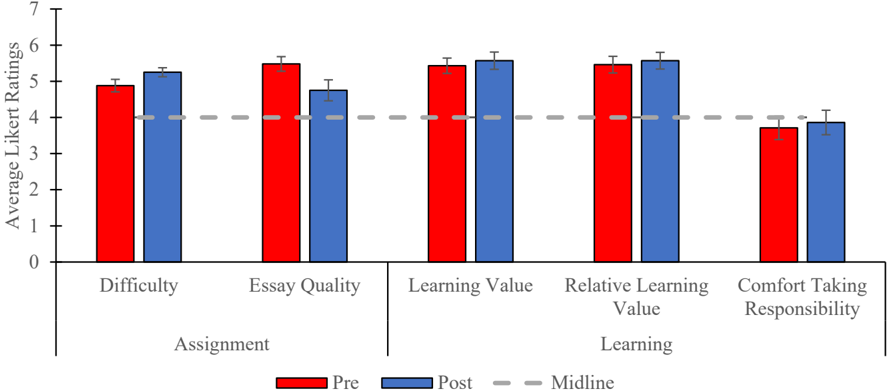
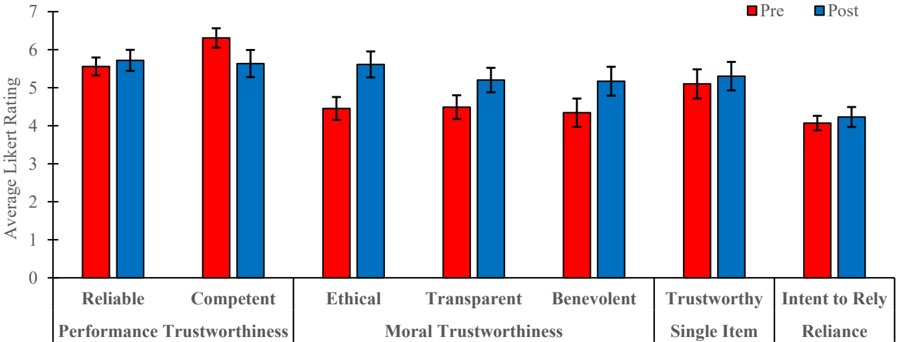
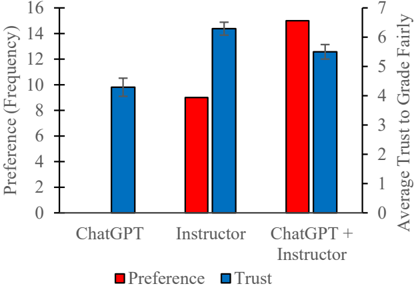
This study examined student experiences before and after an essay writing assignment that required the use of ChatGPT within an undergraduate engineering course. Utilizing a pre-post study design, we gathered data from 24 participants to evaluate ChatGPT's support for both completing and grading an essay assignment, exploring its educational value and impact on the learning process. Our quantitative and thematic analyses uncovered that ChatGPT did not simplify the writing process. Instead, the tool transformed the student learning experience yielding mixed responses. Participants reported finding ChatGPT valuable for learning, and their comfort with its ethical and benevolent aspects increased post-use. Concerns with ChatGPT included poor accuracy and limited feedback on the confidence of its output. Students preferred instructors to use ChatGPT to help grade their assignments, with appropriate oversight. They did not trust ChatGPT to grade by itself. Student views of ChatGPT evolved from a perceived “cheating tool” to a collaborative resource that requires human oversight and calibrated trust. Implications for writing, education, and trust in AI are discussed.
Overview
The claims and statistics of this paper haven’t been checked yet.
Run the check — free, no account needed. It reads the open-access text and checks the sources it cites.
Integrity signals
Registry
Cites
Statistics
Figures
Verification
Claims the paper makes
The claims and statistics of this paper haven’t been checked yet.
Run the check — free, no account needed. It reads the open-access text and checks the sources it cites.
Claims other papers make about this one
Each is checked against this paper’s own text: does it say what the citing paper says it does?
The source backs part of the claim, not all of it — or backs it for a different population, condition or comparison.
In the citing paper
“Student-centred AI feedback mechanisms involve tasks like reflection prompts, AI-use reports, or annotated submissions, encouraging students to critically evaluate how and why they used generative AI tools (Rawas, 2024; Tossell et al., 2024).”
From Six Institutional Intervention Areas to Support Ethical and Effective Student Use of Generative AI in Higher Education: A Narrative Review (2026) · cites this paper as Tossell et al., 2024
Experimental — accuracy not yet measuredThe cited source says what the claim attributes to it.
In the citing paper
“For example, Tossell et al. (2024) found perceived trustworthiness of ChatGPT predicted students' intent to rely upon it for future educational purposes.”
From College students’ literacy, ChatGPT activities, educational outcomes, and trust from a digital divide perspective (2026) · cites this paper as Tossell et al., 2024
The cited source says what the claim attributes to it.
In the citing paper
“students are using ChatGPT to complete their homework assignments [3]”
From Survey on Plagiarism Detection in Large Language Models: The Impact of ChatGPT and Gemini on Academic Integrity (2024) · cites this paper as [3]
In the citing paper
“This finding suggests that university students, in particular, value ChatGPT for its utility in completing academic tasks, such as writing assistance, research, and learning new concepts [1,7,20,65].”
From ChatGPT in Learning: Assessing Students’ Use Intentions through the Lens of Perceived Value and the Influence of AI Literacy (2024) · cites this paper as [20]
Self-check
Percentages, sums and reported differences re-computed from the paper’s own numbers.
The self-check needs the paper’s full text.
Citations
Cites
An integrative model of organizational trust
Mayer, R. C., Davis, J. H., & Schoorman, F. D. (1995) · The Academy of Management Review · doi:10.2307/258792 · Cited by 10,736
Cohen, J. (1992) · Psychological Bulletin · doi:10.1037//0033-2909.112.1.155 · Cited by 8,771
Trust in Automation: Designing for Appropriate Reliance
Lee, J. D., & See, K. A. (2004) · Human Factors: The Journal of the Human Factors and Ergonomics Society · doi:10.1518/hfes.46.1.50_30392 · Cited by 6,605 · cited 2×
“…responsibility for the essay produced with its help, this report provides the first comprehensive trust assessment for ChatGPT, which has strong validity due to the real vulnerability and consequences associated with this assignment; a requirement for accurate trust assessment [43], [48], [80].”
BackgroundMethodDwivedi, Y. K., Kshetri, N., Hughes, L., Slade, E. L., Jeyaraj, A., Kar, A. K., Baabdullah, A. M., Koohang, A., Raghavan, V., Ahuja, M., et al. (2023) · International Journal of Information Management · doi:10.1016/j.ijinfomgt.2023.102642 · Cited by 4,584
Humans and automation: Use, misuse, disuse, abuse
Parasuraman, R., & Riley, V. (1997) · Human Factors: The Journal of the Human Factors and Ergonomics Society · doi:10.1518/001872097778543886 · Cited by 4,554
A model for types and levels of human interaction with automation
Parasuraman, R., Sheridan, T. B., & Wickens, C. D. (2000) · IEEE Transactions on Systems, Man, and Cybernetics - Part A: Systems and Humans · doi:10.1109/3468.844354 · Cited by 4,195 · cited 2×
“…resultsuggeststhatstudentsunderstoodChatGPTs’capabilities butalsorealizedthattheycouldnotfullydependonitalone tocompletetheassignment;aconclusionconsistentwiththe decadesofhumanfactorsautomationresearchthatdemonstrates automationdoesnotreplacethehumanbutchangesthewaywe workwithtechnology[15],[77].”
MethodBAİDOO-ANU, D., & OWUSU ANSAH, L. (2023) · Journal of AI · doi:10.61969/jai.1337500 · Cited by 3,939
Baidoo-Anu, D., & Owusu Ansah, L. (2023) · doi:10.2139/ssrn.4337484 · Cited by 3,004
Human trust in artificial intelligence: Review of empirical research
Glikson, E., & Woolley, A. W. (2020) · Academy of Management Annals · doi:10.5465/annals.2018.0057 · Cited by 2,921
Trust in Automation: Integrating Empirical Evidence on Factors That Influence Trust
Hoff, K. A., & Bashir, M. (2015) · Human Factors: The Journal of the Human Factors and Ergonomics Society · doi:10.1177/0018720814547570 · Cited by 2,817
Research works printed but not linked: 4
- Heaven, 2023, ChatGPT is going to change education, not destroy it
- Teddlie, 2003, Major issues and controversies in the use of mixed methods in the social and behavioural sciences, 3
- 10.21428/cb6ab371.755e9cb7 · DOI
- McGovern, 2002, Processpedagogy, 81
Cited by
Sorted by citations
Items 101–200 of 219
Newen, C., Müller, E., & Newen, A. (2025) · Topoi · doi:10.1007/s11245-025-10287-0 · Cited by 6
From information evaluation to technology use: Generative AI adoption in Chinese business schools
Yu, T., Dai, J., Chen, X., & Wang, C. (2026) · The International Journal of Management Education · doi:10.1016/j.ijme.2026.101430 · Cited by 4
Mapping the landscape of AI-driven feedback in education: a scoping review
Lipnevich, A. A., Taranto, C. A., DeLuca, C., Nukpetsi, E., Rickey, N., Hopfenbeck, T. N., Carter, E., & McGrane, J. A. (2026) · Frontiers in Education · doi:10.3389/feduc.2026.1799346 · Cited by 5
When Do Undergraduate Students Prefer AI? Insights into AI Scoring and Feedback
Yildirim-erbasli, S., Dibek, M. İ., Thomas, M. L., & Lesoway, N. (2026) · Behavioral Science · doi:10.3390/bs16071196 · Cited by 2
Alignment in Decision-Making Attributes Predicts Trust and Delegation to AI Systems
Summerville, A. L., de Visser, E. J., McVay, J., Martí, L., Leung, A., & Widmer, C. L. (2025) · Journal of Cognitive Engineering and Decision Making · doi:10.1177/15553434251390012 · Cited by 4
Cai, B., He, Z., Fu, H. C., Zheng, Y., & Song, Y. (2025) · IEEE Transactions on Learning Technologies · doi:10.1109/tlt.2025.3547321 · Cited by 4
Guest Editorial Education in the World of ChatGPT and Generative AI
Tan, S. C., Wijekumar, K., Hong, H., Olmanson, J., Twomey, R., & Sinha, T. (2024) · IEEE Transactions on Learning Technologies · doi:10.1109/tlt.2024.3451050 · Cited by 3
Utilizing Generative AI to Develop Programming Skill Through Self-Directed and Interactive Learning
Puttajanyawong, N., Suamuang, W., & Chomsuwan, K. (2025) · IEEE Global Engineering Education Conference (EDUCON) · doi:10.1109/educon62633.2025.11016488 · Cited by 2
Yao, G. (2025) · Assessment & Evaluation in Higher Education · doi:10.1080/02602938.2025.2553104 · Cited by 2
Mapping the landscape: generative AI in higher education assessment (2020-2024) - a scoping review
Ng, S. H. S., Chan, H. Y., Wong, J. H. K., Sam, L. C. F., & Privitera, A. J. (2026) · Interactive Learning Environments · doi:10.1080/10494820.2026.2614079 · Cited by 9
Abolle-Okoyeagu, C. J., Ezenkwu, C. P., Ibeke, E., Onoja, O. P., & Ezeonwumelu, V. U. (2026) · Cogent Education · doi:10.1080/2331186x.2026.2614148 · Cited by 5
Al-Shamaileh, O., Hammady, R., Abdelrahman, M., & Mubin, O. (2026) · Computers in Human Behavior Reports · doi:10.1016/j.chbr.2026.100980 · Cited by 6
Shadiev, R., Nguyen, T.-R.-G., & Hwang, W. (2026) · Interactive Learning Environments · doi:10.1080/10494820.2026.2677725 · Cited by 2
Amin, M. A., Noh, M., & Kim, Y. S. (2026) · Quality & Quantity · doi:10.1007/s11135-026-02940-6 · Cited by 2
Tahiri, Z. (2024) · The Proceedings of the International Conference on Research in Teaching and Education. · doi:10.33422/rteconf.v1i1.171 · Cited by 2
Introducción de inteligencia artificial en la evaluación de asignaturas de teoría e historia
Nadal, M. F., & Mora, E. S. (2024) · Jornadas sobre Innovación Docente en Arquitectura (JIDA) · doi:10.5821/jida.2024.13259 · Cited by 3
ChatGPT and VARK Model in Education: A Systematic Literature Review
Gunawan, M., Maia, M., Klein, S., Meyliana, M., & Surjandy, S. (2024) · International Conference on Information Management and Technology (ICIMTech) · doi:10.1109/icimtech63123.2024.10780818 · Cited by 3
Work-in-Progress: Students' Prompting Strategies When Solving an Engineering Design Task
Reeping, D. P., & Shah, A. (2024) · IEEE Frontiers in Education Conference (FIE) · doi:10.1109/fie61694.2024.10893099 · Cited by 2
Emergence of LLMs: (Not-so-)Significant Delving in Essay Answers in a MOOC on the Ethics of AI
Leppänen, L., Aunimo, L., Hellas, A., Nurminen, J. K., & Mannila, L. (2025) · Lecture notes in computer science · doi:10.1007/978-3-031-98465-5_5 · Cited by 2
AI Conversational Agent Design for Supporting Learning and Well-Being of University StudentsPreprint
Wang, H., Tang, S., & Lei, C. (2024) · EdArXiv (OSF Preprints) · doi:10.35542/osf.io/w4rtf · Cited by 4
Gozali, M. R. A., Revel, D., & Christian, C. (2024) · International Conference on Information Management and Technology (ICIMTech) · doi:10.1109/icimtech63123.2024.10780832 · Cited by 1
Reinstating traditional sit-in exams to curb overreliance on artificial intelligence
Arhin, E. O. (2025) · World Journal of Advanced Science and Technology · doi:10.53346/wjast.2025.7.2.0015 · Cited by 1
An Investigation into ChatGPT-Based Instructional Feedback on Programming Projects
Alshammari, M. T. (2025) · International Conference on Computing and Information Technology (ICCIT) · doi:10.1109/iccit63348.2025.10989326 · Cited by 3
Application of Generative AI in Experimental Teaching of Communication Principles
Xu, Z., & Hei, X. (2025) · IEEE Global Engineering Education Conference (EDUCON) · doi:10.1109/educon62633.2025.11016291 · Cited by 1
(2025) · TESOL Communications · doi:10.58304/tc.20250502 · Cited by 2
A taxonomy of standardized terms for generative AI use in the composition classroom
D’Addario, M. (2025) · Discover Education · doi:10.1007/s44217-025-00655-8 · Cited by 3
The Role of Artificial Intelligence in Scientific Writing: A Higher Education Review
Almryad, A., & Musa, H. (2025) · Academic Platform Journal of Engineering and Smart Systems · doi:10.21541/apjess.1676506 · Cited by 8
Colclasure, B. C., Ruth, T. K., Beasley, V., & Granberry, T. (2025) · Trends in Higher Education · doi:10.3390/higheredu4040059 · Cited by 1
Investigating Experience of University Students in Using ChatGPT in English Learning Context
Devi, N. N. R. S., Santosa, M. H., & Kusuma, I. P. I. (2025) · Journal of Educational Study · doi:10.36663/joes.v5i2.1069 · Cited by 1
Colombari, R., Marimón, F., & Mas‐Machuca, M. (2026) · Computers in Human Behavior Reports · doi:10.1016/j.chbr.2026.101016 · Cited by 4
Interplay effects of AI feedback and individual differences on learners’ emotional responses
xiangming, L., & Wei, W. (2026) · Education and Information Technologies · doi:10.1007/s10639-026-13937-x · Cited by 4
Kalim, U., Irfan, S., Jamil, B., & Kanwar, A. S. (2026) · Discover Education · doi:10.1007/s44217-026-01370-8 · Cited by 3
Abbasi, S., & Rahmani, A. M. (2026) · Expert Systems · doi:10.1111/exsy.70244 · Cited by 1
Students’ psychological biases towards teacher and AI-generated feedback: an experimental study
Haiyan, Y. U. (2026) · BMC Psychology · doi:10.1186/s40359-026-04568-5 · Cited by 1
Shallari, I., Gallo, V., Carratù, M., Hussain, M., Krapohl, D., & Mousavirad, S. J. (2026) · Education Sciences · doi:10.3390/educsci16050803 · Cited by 1
Kaplar, M., Lužanin, Z., Vucic, M., Ivanović, L., & Kaplar, S. (2026) · IEEE Transactions on Education · doi:10.1109/te.2026.3694162 · Cited by 1
ChatGPT and higher education in Latin America: measuring perceived academic skills
George-Reyes, C. E., Romero, C. A., Mérida-Córdova, E. J., & Yeguas-Bolívar, E. (2026) · Frontiers in Research Metrics and Analytics · doi:10.3389/frma.2026.1816902 · Cited by 1
Xia, Q., Aldharman, N. S., & Chiu, T. K. F. (2026) · TechTrends · doi:10.1007/s11528-026-01203-3 · Cited by 2
Peng, R., Zhou, X., Duan, D., & Guo, H. (2026) · Buildings · doi:10.3390/buildings16142800 · Cited by 2
An empirical study of ChatGPT use in engineering education: Prompting and performance
Domínguez, L. G. I., Robles-Gómez, A., & Pastor-Vargas, R. (2026) · The Internet and Higher Education · doi:10.1016/j.iheduc.2026.101105 · Cited by 1
More than getting the answer: How students engage with generative AI in technical problem solving
Jaiswal, A., & Nanda, G. (2026) · International Journal of STEM Education · doi:10.1186/s40594-026-00646-7 · Cited by 2
Karaköse, T., & Polat, H. (2025) · Studies in computational intelligence · doi:10.1007/978-3-031-82915-4_18 · Cited by 1
Subjective and Objective Quality Assessments of AI-Generated Images for Language E-Learning
Onuoha, C., Dang, V. H., Nam, N. D., Hương, T. T., Nam, P. N., & Thang, T. C. (2025) · IEEE Access · doi:10.1109/access.2025.3578047 · Cited by 1
Ethical Considerations in Biomedical Engineering Research
Rebecca, C. F. (2025) · IAA Journal of Biological Sciences · doi:10.59298/iaajb/2025/1311622 · Cited by 1
Yaseen, K. N., & Dweikat, K. (2025) · Advances in computational intelligence and robotics book series · doi:10.4018/979-8-3693-9811-1.ch012
The Interactive Effects and Policy Direction of AI in the Teaching and Learning Process
Zhang, P., Tian, T., Qin, Z., Zhou, S., & Dong, Y. (2025) · Springer eBooks · doi:10.1007/978-981-13-2262-4_323-1
Language Course Writing Task and AI-Generated Writing Detection
Lau, Y. L., Bakar, A. L. A., Chau, S. K., Sik, R. Y., Yap, J. T. K., Yong, H. W., Tan, J. C., & Ambikapathy, A. (2025) · Advances in computational intelligence and robotics book series · doi:10.4018/979-8-3693-7260-9.ch012 · Cited by 1
Exploration of Sustainable Excellent Engineer Cultivation Path Based on Intelligent Augmentation
Xiao, L., Han, Z., Wei, Y., & Ye, Z. (2025) · International Conference on Educational and Information Technology · doi:10.1109/iceit64364.2025.10976002
Students’ Perceptions on Using ChatGPT® for Strategic Decision-Making
Leon, R.-D., Rodríguez, R. R., & Sáiz, J. J. A. (2025) · Lecture notes on data engineering and communications technologies · doi:10.1007/978-3-031-82334-3_5
Teaching AI in Communication Classes
Painter, D. L. (2025) · Advances in computational intelligence and robotics book series · doi:10.4018/979-8-3373-4576-5.ch003
Liu, S., & Kim, E. (2024) · International Conference on Modern Educational Technology (ICMET) · doi:10.1145/3729434.3729446
Retrieval-Augmented LLMs for Culturally Sensitive Learning Content in Refugee Education
Joseph, T., Hellen, N., & Marvin, G. (2025) · Lecture notes in networks and systems · doi:10.1007/978-981-96-2700-4_31
Long, C., & Hodkinson, B. (2025) · ASEE Rocky Mountain Section Conference · doi:10.18260/1-2-119.1128-55220
Trust, Risk Perception, and Usage Gaps between University Faculty and Students in Generative AIPreprint
Taguchi, S., & Tanaka, K. (2025) · SSRN Electronic Journal · doi:10.2139/ssrn.5349743
Comparison of Feedback from ChatGPT and Human Professors in Higher Education: A Systematic Review
Paniura, C. H. G., Luza, T. C., Cruz-Carpio, F. M., Díaz, R. R. I., Apaza-Paco, D. V., Rojas, N. R., Mamani-Mamani, B., Terrero-Pérez, Á., Yaedú, R. Y. F., & Peralta-Mamani, M. (2025) · Journal of Computer and Communications · doi:10.4236/jcc.2025.137013 · Cited by 1
Credibility Assessment of Human–Generative AI Interaction
Zhao, Y., Song, S., & Jing, Y. (2025) · Cambridge University Press eBooks · doi:10.1017/9781009587877.005
Halder, A. N., Sultana, S., Hasan, R., & Ahmed, S. (2025) · Indian Journal of Marketing · doi:10.17010/ijom/2025/v55/i10/175611
Navigating Challenges and Seizing Opportunities in AI-Driven Assessment
Ahmad, M., & Delda, M. J. M. (2025) · Advances in computational intelligence and robotics book series · doi:10.4018/979-8-3373-7057-6.ch002
Empowering Writing through AIGC in Higher Education: A Systematic Review
Hou, D., Tian, K., Zhang, W., Li, K., & Cheng, W. (2025) · International Conference on Distance Education and Learning (ICDEL) · doi:10.1109/icdel65868.2025.11193567 · Cited by 2
ASSESSING ARGUMENTATIVE WRITING USING THE TOULMIN MODEL, METACOGNITIVE AWARENESS, AND AI LITERACYPreprint
Stofiana, T., Sunendar, D., Mulyati, Y., & Sastromiharjo, A. (2025) · SSRN Electronic Journal · doi:10.2139/ssrn.5678887
Faria, P., Finn, P. D., & Marques, T. N. (2025) · International Conference on Educational Knowledge and Informatization (EKI) · doi:10.1145/3765325.3765332
Tovar, L. C. Á., González, G. R., Rogel, E. G., González, Á. E. R., & Escamilla-García, P. E. (2025) · Etic net Revista científica electrónica de Educación y Comunicación en la Sociedad del Conocimiento · doi:10.30827/eticanet.v25i2.31946
Bowen, T., Maddalena, K., & Whithaus, C. (2025) · Writing & Pedagogy · doi:10.3138/wap-2025-0004
Perception of Using ChatGPT in Academic Writing in Peruvian University Students
Núñez-Pacheco, R., Barreda-Parra, A., Vidal, E., Castro-Gutiérrez, E., & Turpo-Gebera, O. (2026) · Smart innovation, systems and technologies · doi:10.1007/978-3-032-09911-2_12
WIP: Profiling Digital Readiness Among Undergraduates: A Person-Centered Approach
Nguyen, T., & Helberg, A. J. (2025) · IEEE Frontiers in Education Conference (FIE) · doi:10.1109/fie63693.2025.11328239
Sunitha, G., Vaishnavi, M. S., Joshitha, V., Rajesh, M., Phani, V. A., & Amala, K. (2025) · International Conference on Applied Artificial Intelligence and Computing (ICAAIC) · doi:10.1109/icaaic64647.2025.11330583
Paul, A., Fakiyesi, V. O., Tahsin, M. U., Arinze, L., Moyaki, D., & Dunmoye, I. D. (2026) · Learning and analytics in intelligent systems · doi:10.1007/978-3-032-09058-4_5
GPT-Based Autograder: Enhancing Accuracy and Efficiency in Programming Assignment Evaluation
Kodagoda, N., Manathunga, K., Gunaratne, M., Perera, J., & Thilakarathna, T. (2025) · International Conference on Education Technology and Computer · doi:10.1109/icetc66579.2025.11387189
Martínez, J. H. A., & Martínez, E. P. (2026) · Trends in Higher Education · doi:10.3390/higheredu5010021
Pranoto, D. C. Y., Hussien, S. B., Sabariah, S., Bandono, A., & Bahrawi, A. (2026) · Research Square · doi:10.21203/rs.3.rs-8985839/v1
Gündoğdu, B., & Merç, A. (2026) · SSRN Electronic Journal · doi:10.2139/ssrn.6428286
Yoo, T.-A., Yang, H.-S., Kim, M., & Chung, J. (2026) · Interactive Learning Environments · doi:10.1080/10494820.2026.2646275 · Cited by 1
Alshammari, F. (2026) · Quality & Quantity · doi:10.1007/s11135-026-02699-w · Cited by 2
Trust Calibration in AI: Do Students Undertrust ChatGPT?Preprint
Fortes-Ferreira, M., Boni, M. D., Walker, R. D., & Walker, F. (2026) · SSRN Electronic Journal · doi:10.2139/ssrn.6539726
Trust Calibration in AI: Do Students Undertrust ChatGPT?Preprint
Fortes-Ferreira, M., Boni, M. D., Walker, R. D., & Walker, F. (2026) · SSRN Electronic Journal · doi:10.2139/ssrn.6547398
EvaluAId: Human-AI Collaborative Evaluation of Open-Ended Student Essays
Zhang, C., Ju, K. P., Lu, X., Yen, Y.-C. G., & Rzeszotarski, J. M. (2026) · CHI Conference on Human Factors in Computing Systems · doi:10.1145/3772318.3790814 · Cited by 2
Ibraeva, G. R., Sergeeva, O. V., ZHELTUKHINA, M. R., Gribova, Y. V., Kelina, K. G., & Sokolova, N. L. (2026) · Online Journal of Communication and Media Technologies · doi:10.30935/ojcmt/18492
AI-Enhanced Production-Oriented Approach for Feedback and Assessment in EFL Writing
Pan, W., Mao, M., & Cheng, N. (2026) · Communications in computer and information science · doi:10.1007/978-981-95-7731-6_7
Escalante, A. P. A., Cuenca, P. E. A., González, C. J. L., Torres, M. R., & Duarte, J. I. S. (2026) · ASCE MAGAZINE · doi:10.70577/asce.v5i2.823
Learning with AI: Student Intentions for Academic Use and Broader Perspectives on AI
Cho, M., Park, E. G., Lim, S., & Yu, H. (2026) · Technology Knowledge and Learning · doi:10.1007/s10758-026-09982-7
Face value: How avatar identity shapes epistemic trust in AI-mediated learning
Anthis, Z., & Kyriakidou-Zacharoudiou, A. (2026) · Computers and Education Artificial Intelligence · doi:10.1016/j.caeai.2026.100610 · Cited by 1
Beyond optimization: Emotional insights into human-AI interaction in a post-algorithmic society
Hossain, M. S. (2026) · Computers in Human Behavior Artificial Humans · doi:10.1016/j.chbah.2026.100319
Cooke, E. M., Kopf, S., Grace, M. M., & Keen, J. (2026) · Journal of Criminal Justice Education · doi:10.1080/10511253.2026.2667841
Jiang, Y., Wang, Z., Wang, Y., Zhang, Y., Xu, Y., & Wu, C. (2026) · International Conference on Educational and Information Technology · doi:10.1109/iceit68991.2026.11521608
Proactive predictive analytics in cybersecurity using machine learning models: A review study
Idris, S., & Hamd, H. (2026) · AIP conference proceedings · doi:10.1063/5.0318606
The Role of Trust in the Educational Integration of Social Robots and Artificial Intelligence
Cirasa, C., Høgsdal, H., & Conti, D. (2026) · Advances in computational intelligence and robotics book series · doi:10.4018/979-8-3373-6471-1.ch015
Fan, J., Huang, M., Zhao, X., Fang, Y., Zhang, H., & Lu, J. (2026) · TechTrends · doi:10.1007/s11528-026-01188-z · Cited by 1
LLM Chatbots in High School Programming: Exploring Behaviors and Interventions
Torre, M. V., Specht, M. M., & Oertel, C. (2026) · ACM Symposium on Applied Computing · doi:10.1145/3748522.3779870
Gazi, M. A. I., Shinwary, S. S., Khan, W., Alam, M. N., Hashim, F., Senathirajah, A. R. B. S., & Hossain, A. I. (2026) · Multidisciplinary Reviews · doi:10.31893/multirev.2026537
Artificial Intelligence Acceptance in Higher Education: Perceptions from Mexico, Spain, and Finland
George-Reyes, C. E., Mérida-Córdova, E. J., Yeguas-Bolívar, E., & Monzalvo-Serrano, L. (2026) · Information · doi:10.3390/info17060575
Akter, M., Spriha, A. B., Islam, S., Jahan, N., Rahman, N. Z., Arman, S. E., & Jamal, L. (2026) · International Conference on Information and Education Technology (ICIET) · doi:10.1109/iciet69664.2026.11561611
Pan, Y.-L., Yu, P.-F., Yin, X.-L., Hong-sheng, Y., Long, X., & Tong, Q. (2026) · Educational Technology Research and Development · doi:10.1007/s11423-026-10659-2 · Cited by 1
Future of Artificial Intelligence in chemical and process engineering
Aboughaly, M. (2026) · Elsevier eBooks · doi:10.1016/b978-0-443-33943-1.00006-x
Cross-Cultural Relations and Expatriate Online Inclusion
Lauring, J., & Jonasson, C. (2026) · Diversity and inclusion research · doi:10.1007/978-3-032-11922-3_5
From black box to pedagogical partner: Students’ sense-making of LLM-based automated assessment
Kara, A., & Yıldırım, S. (2026) · Participatory Educational Research · doi:10.17275/per.26.58.13.4
IeMaKT: Effective Knowledge Tracing Using Large Language Models and Improved Attention Networks
Zhong, W., Lin, J., Chen, J. Y., Cen, J., Zhou, D., Yang, A., & Zhou, Y. (2026) · International Conference on Computer Supported Cooperative Work in Design (CSCWD) · doi:10.1109/cscwd68734.2026.11581642
Calibrating Trust in ChatGPT for L2 Writers
유혜빈, Pecsok, M., & Pals, C. (2026) · Lecture notes in computer science · doi:10.1007/978-3-032-30784-2_10
van Heerden, K. (2026) · Springer eBooks · doi:10.1007/978-3-032-21685-4_12
Shaw, A., Jung, S., Dehbozorgi, N., Taasoobshirazi, G., Li, L., & Ji, Y. (2026) · Lecture notes in networks and systems · doi:10.1007/978-3-032-24807-7_28
Li, Z. Y., Huang, J. L., & Cui, Z. (2026) · Behavioral Sciences · doi:10.3390/bs16071256 · Cited by 1
Metadata
- Authors
- Tossell, C. C., Tenhundfeld, N. L., Momen, A., Cooley, K., & de Visser, E. J.
- Affiliations
- United States Air Force Academy (US)
- University of Alabama in Huntsville (US)
- Department of Behavioral Sciences and Leadership, United States Air Force Academy, Colorado Springs, CO, USA
- Venue
- IEEE Transactions on Learning Technologies
- Published
- 2024
- Volume
- 17
- Pages
- 1069-1081
- ISSN
- 1939-1382 (ISSN-L)
- 2372-0050
- OpenAlex
- W4390921168
- Cited by
- 218
- References
- 79
- Citations by year
- 2026: 80 · 2025: 90 · 2024: 48
- FWCI
- 81.97
- Type
- journal article
- Language
- en
- Open access
- hybrid
- doi.org
- Locations
- IEEE Transactions on Learning Technologies (publishedVersion, cc-by)
- Funders
- Air Force Office of Scientific Research (21USCOR004)
- Defense Advanced Research Projects Agency (FA8650-23-C-7318)
- Topics
- Social Sciences › Education › Artificial Intelligence in Education
- Health Sciences › Medicine › Health Informatics › Artificial Intelligence in Healthcare and Education
- Social Sciences › Education › Academic integrity and plagiarism
- Keywords
- ChatGPT, student perceptions, AI-assisted grading, trust in AI, academic integrity, human oversight of AI, engineering education, student learning experience
About these checks
Registry, retraction, Cites and statistics results are computed, not judged, with one exception: a printed reference that no index lists is read once by a model before it counts as a citation error. Claims are extracted by a model and kept only when their quote appears verbatim in the text; each cited source is then checked, with a model’s help, for whether it says what the claim relies on. Those verdicts can be wrong — read the claim’s quote and the cited source before relying on one.
Statistics and arithmetic are recomputed, not judged.
Confidence bands are shown only for fields calibrated on our annotated test set. None is calibrated yet, so no band is shown.
What counts as a claim ›How we measure confidence ›How we check this ›
Are you an author, or do you see a problem with this page? Request a review
