

Zero-Shot Medical Image Translation via Frequency-Guided Diffusion Models
Open accessThe DOI matches its Crossref record; 41 of the 41 references it cites were found in a registry or an index.
Abstract
Recently, the diffusion model has emerged as a superior generative model that can produce high quality and realistic images. However, for medical image translation, the existing diffusion models are deficient in accurately retaining structural information since the structure details of source domain images are lost during the forward diffusion process and cannot be fully recovered through learned reverse diffusion, while the integrity of anatomical structures is extremely important in medical images. For instance, errors in image translation may distort, shift, or even remove structures and tumors, leading to incorrect diagnosis and inadequate treatments. Training and conditioning diffusion models using paired source and target images with matching anatomy can help. However, such paired data are very difficult and costly to obtain, and may also reduce the robustness of the developed model to out-of-distribution testing data. We propose a frequency-guided diffusion model (FGDM) that employs frequency-domain filters to guide the diffusion model for structure-preserving image translation. Based on its design, FGDM allows zero-shot learning, as it can be trained solely on the data from the target domain, and used directly for source-to-target domain translation without any exposure to the source-domain data during training. We evaluated it on three cone-beam CT (CBCT)-to-CT translation tasks for different anatomical sites, and a cross-institutional MR imaging translation task. FGDM outperformed the state-of-the-art methods (GAN-based, VAE-based, and diffusion-based) in metrics of Fréchet Inception Distance (FID), Peak Signal-to-Noise Ratio (PSNR), and Structural Similarity Index Measure (SSIM), showing its significant advantages in zero-shot medical image translation.
Overview
The claims and statistics of this paper haven’t been checked yet.
Free: it reads the open-access text and checks the first 5 claims that cite a source we can check. Create a free account to check every claim.
Integrity signals
Registry
Cites
Statistics
Figures

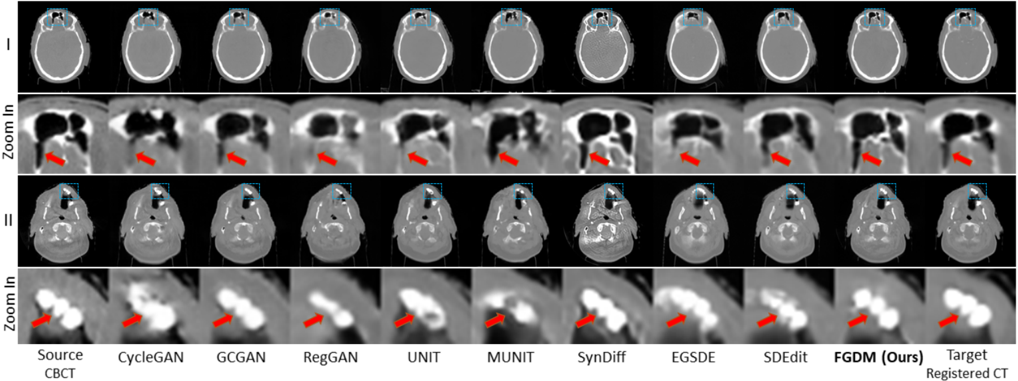
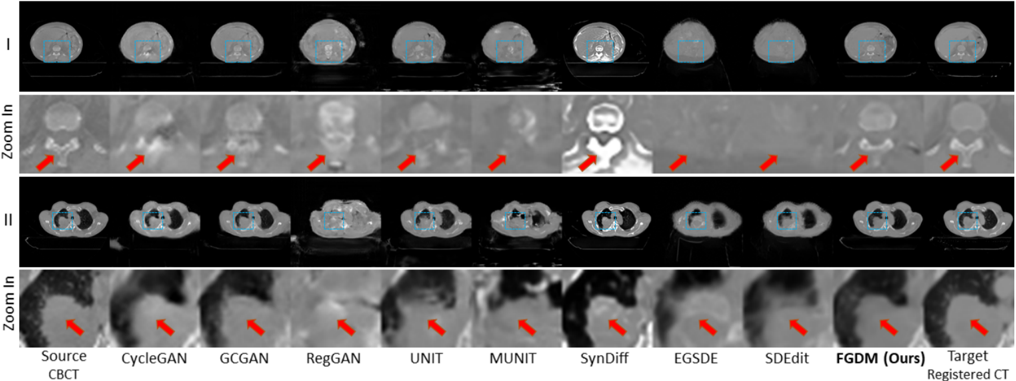
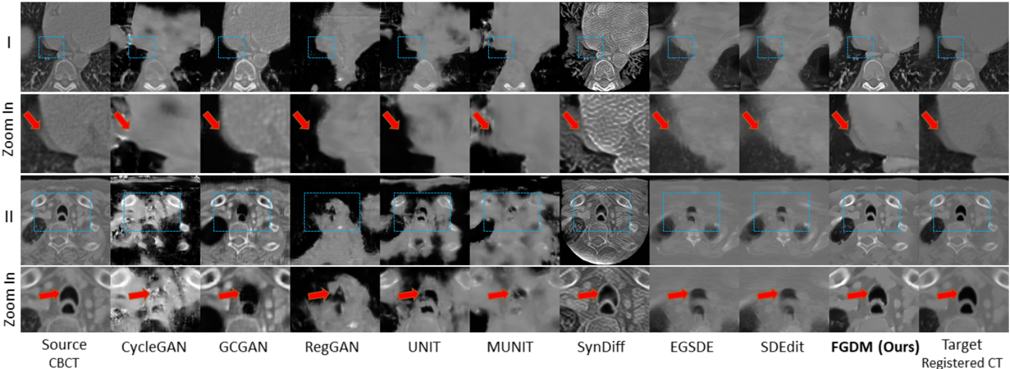
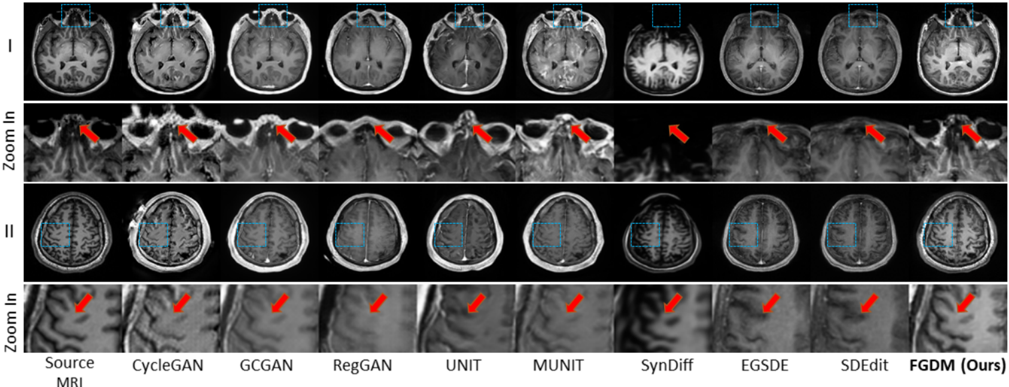
Verification
Claims the paper makes
The claims and statistics of this paper haven’t been checked yet.
Free: it reads the open-access text and checks the first 5 claims that cite a source we can check. Create a free account to check every claim.
Claims other papers make about this one
Each is checked against this paper’s own text: does it say what the citing paper says it does?
The check wasn’t confident either way, so it gives no verdict — never disputed.
In the citing paper
“Second, a pronounced domain gap exists between images and videos21–23.”
From Temporally consistent low-light face video enhancement via video-to-video conditional diffusion (2026) · cites this paper as [21]
Experimental — accuracy not yet measured
Self-check
Percentages, sums and reported differences re-computed from the paper’s own numbers.
The self-check needs the paper’s full text.
Citations
Cites
Image quality assessment: from error visibility to structural similarity
Wang, Z., Bovik, A. C., Sheikh, H. R., & Simoncelli, E. P. (2004) · IEEE Transactions on Image Processing · doi:10.1109/tip.2003.819861 · Cited by 57,892
Unpaired image-to-image translation using cycle-consistent adversarial networks
Zhu, J.-Y., Park, T., Isola, P., & Efros, A. A. (2017) · 2017 IEEE International Conference on Computer Vision (ICCV) · doi:10.1109/iccv.2017.244 · Cited by 23,602
Generative adversarial networks
Goodfellow, I., Pouget-Abadie, J., Mirza, M., Xu, B., Warde-Farley, D., Ozair, S., Courville, A., & Bengio, Y. (2020) · Communications of the ACM · doi:10.1145/3422622 · Cited by 18,384
Denoising Diffusion Probabilistic Models
Ho, J., Jain, A., & Abbeel, P. (2020) · arXiv · doi:10.48550/arxiv.2006.11239 · Cited by 8,712 · cited 3×
“In diffusion models [9], [10], [28], there is a forward diffusion process q ( · ) that gradually adds white Gaussian noise with constant variance σ 2 to the original data s 0 in T steps : where α 1 : t ∈ ( 0 , 1 ] T is a decreasing sequence, and the reverse denoising process p θ ( · ) is defined by…”
BackgroundGANs Trained by a Two Time-Scale Update Rule Converge to a Local Nash Equilibrium
Heusel, M., Ramsauer, H., Unterthiner, T., Nessler, B., & Hochreiter, S. (2017) · arXiv · doi:10.48550/arxiv.1706.08500 · Cited by 8,365
Elastix: a toolbox for intensity-based medical image registration
Klein, S., Staring, M., Murphy, K., Viergever, M. A., & Pluim, J. (2010) · IEEE Transactions on Medical Imaging · doi:10.1109/tmi.2009.2035616 · Cited by 4,311 · cited 1×
“For testing, an open-source deformable image registration toolbox [36] was used to align the CT to CBCT, and the registered CT images were used Authorized licensed use limited to the terms of the applicable license agreement with IEEE.”
MethodDiffusion Models Beat GANs on Image Synthesis
Dhariwal, P., & Nichol, A. (2021) · arXiv · doi:10.48550/arxiv.2105.05233 · Cited by 3,362 · cited 1×
“Recently, diffusion models are developed as a new type of generative AI method, which can generate images of very high quality with excellent Frechet Inception Distance (FID) [5], [6], [7], [8], [9].”
MethodDeep Unsupervised Learning using Nonequilibrium Thermodynamics
Sohl-Dickstein, J., Weiss, E. A., Maheswaranathan, N., & Ganguli, S. (2015) · arXiv · doi:10.48550/arxiv.1503.03585 · Cited by 2,637 · cited 1×
“In diffusion models [9], [10], [28], there is a forward diffusion process q ( · ) that gradually adds white Gaussian noise with constant variance σ 2 to the original data s 0 in T steps : where α 1 : t ∈ ( 0 , 1 ] T is a decreasing sequence, and the reverse denoising process p θ ( · ) is defined by…”
BackgroundAn Introduction to Variational Autoencoders
Kingma, D. P., & Welling, M. (2019) · Foundations and Trends® in Machine Learning · doi:10.1561/2200000056 · Cited by 2,609 · cited 15×
“Compared to GANs or VAEs, FGDM offers an additional benefit as it only uses the data from the target domain to train the diffusion model to learn the distribution at intermediate frequencies.”
MethodInfluentialDenoising Diffusion Implicit Models
Song, J., Meng, C., & Ermon, S. (2020) · arXiv · doi:10.48550/arxiv.2010.02502 · Cited by 2,507 · cited 2×
“Recently, diffusion models are developed as a new type of generative AI method, which can generate images of very high quality with excellent Frechet Inception Distance (FID) [5], [6], [7], [8], [9].”
BackgroundMethodMultimodal Unsupervised Image-to-Image Translation
Huang, X., Liu, M.-Y., Belongie, S., & Kautz, J. (2018) · Lecture Notes in Computer Science · doi:10.1007/978-3-030-01219-9_11 · Cited by 2,451
Score-Based Generative Modeling through Stochastic Differential Equations
Song, Y., Sohl-Dickstein, J., Kingma, D. P., Kumar, A., Ermon, S., & Poole, B. (2020) · arXiv · doi:10.48550/arxiv.2011.13456 · Cited by 1,953
Diffusion Models: A Comprehensive Survey of Methods and Applications
Yang, L., Zhang, Z., Song, Y., Hong, S., Xu, R., Zhao, Y., Zhang, W., Cui, B., & Yang, M.-H. (2024) · ACM Computing Surveys · doi:10.1145/3626235 · Cited by 1,704 · cited 1×
“Recently, diffusion models are developed as a new type of generative AI method, which can generate images of very high quality with excellent Frechet Inception Distance (FID) [5], [6], [7], [8], [9].”
MethodYang, Q., Yan, P., Zhang, Y., Yu, H., Shi, Y., Mou, X., Kalra, M. K., Zhang, Y., Sun, L., & Wang, G. (2018) · IEEE Transactions on Medical Imaging · doi:10.1109/tmi.2018.2827462 · Cited by 1,630 · cited 1×
“Medical Image translation has also been applied to low-dose CT imaging denoising [17], which translates low-dose CTs to those with image quality equivalent to high-dose CTs.”
MethodSelf-citationContrastive Learning for Unpaired Image-to-Image Translation
Park, T., Efros, A. A., Zhang, R., & Zhu, J.-Y. (2020) · Lecture Notes in Computer Science · doi:10.1007/978-3-030-58545-7_19 · Cited by 1,442
Design of an image edge detection filter using the Sobel operator
Kanopoulos, N., Vasanthavada, N., & Baker, R. L. (1988) · IEEE Journal of Solid-State Circuits · doi:10.1109/4.996 · Cited by 1,212
An Embarrassingly Simple Approach to Zero-Shot Learning
Romera-Paredes, B., & Torr, P. H. S. (2017) · Advances in Computer Vision and Pattern Recognition · doi:10.1007/978-3-319-50077-5_2 · Cited by 1,003 · cited 1×
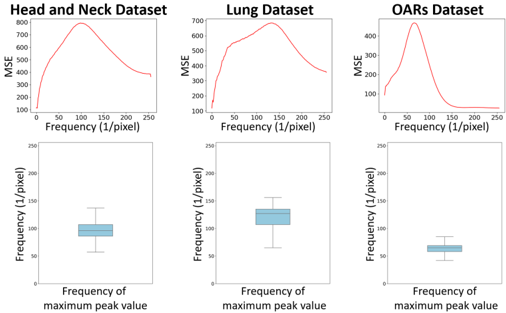
“…in the second row the box plot of the distribution of the frequencies corresponding to the maximum peak of MSE for the whole dataset. zero-shot translation [14], by which the model can be applied to source images in other domains or distributions without transfer learning or test-time re-training.”
BackgroundModelling the Power Spectra of Natural Images: Statistics and Information
van der Schaaf, A., & van Hateren, J. H. (1996) · Vision Research · doi:10.1016/0042-6989(96)00002-8 · Cited by 528 · cited 1×
“In general images, the power spectral density (PSD) is related to the spatial frequency as follows [32] and [33]: where k and a are scaling/modifying factors, which indicates that PSD ( u , v) I 1 u .”
BackgroundUnsupervised Medical Image Translation With Adversarial Diffusion Models
Özbey, M., Dalmaz, O., Dar, S. U. H., Bedel, H. A., Özturk, Ş., Güngör, A., & Çukur, T. (2023) · IEEE Transactions on Medical Imaging · doi:10.1109/tmi.2023.3290149 · Cited by 517 · cited 1×
“In the application of diffusion modeling for medical image translation, SynDiff [26] is proposed as a novel adversarial diffusion method for enhanced medical image translation.”
MethodAmplitude spectra of natural images
Tolhurst, D. J., Tadmor, Y., & Chao, T. (1992) · Ophthalmic and Physiological Optics · doi:10.1111/j.1475-1313.1992.tb00296.x · Cited by 496
Unsupervised Image-to-Image Translation Networks
Liu, M.-Y., Breuel, T. M., & Kautz, J. (2017) · arXiv (Cornell University) · doi:10.48550/arxiv.1703.00848 · Cited by 477 · cited 2×
“All methods implemented for comparison used their official open source codes [4], [11], [12], [22], [24], [25], where SDEdit and EGSDE started with a step count of 200.”
MethodSDEdit: Guided Image Synthesis and Editing with Stochastic Differential Equations
Meng, C., He, Y., Song, Y., Song, J., Wu, J., Zhu, J.-Y., & Ermon, S. (2021) · arXiv (Cornell University) · doi:10.48550/arxiv.2108.01073 · Cited by 297 · cited 4×
“All methods implemented for comparison used their official open source codes [4], [11], [12], [22], [24], [25], where SDEdit and EGSDE started with a step count of 200.”
BackgroundMethodInfluentialLiang, X., Chen, L., Nguyen, D., Zhou, Z., Gu, X., Yang, M., Wang, J., & Jiang, S. (2019) · Physics in Medicine & Biology · doi:10.1088/1361-6560/ab22f9 · Cited by 262 · cited 2×
“For instance, CBCT images that are acquired on medical linear accelerators are usually of degraded image quality due to hardware and scanning mode limitations and need to be translated to fan-beam CT-like images to allow accurate radiotherapy planning dose calculation [20].”
BackgroundSelf-citationBreaking the Dilemma of Medical Image-to-image TranslationPreprint
Kong, L., Lian, C., Huang, D., li, Z., Hu, Y., & Zhou, Q. (2021) · arXiv (Cornell University) · doi:10.48550/arxiv.2110.06465 · Cited by 246 · cited 1×
“In addition, RegGAN [23] has been proposed as a new unsupervised method for medical image translation, based on the “loss-correction” theory.”
MethodGeometry-Consistent Generative Adversarial Networks for One-Sided Unsupervised Domain Mapping
Fu, H., Gong, M., Wang, C., Batmanghelich, K., Zhang, K., & Tao, D. (2019) · 2019 IEEE/CVF Conference on Computer Vision and Pattern Recognition (CVPR) · doi:10.1109/cvpr.2019.00253 · Cited by 244 · cited 2×
“All methods implemented for comparison used their official open source codes [4], [11], [12], [22], [24], [25], where SDEdit and EGSDE started with a step count of 200.”
BackgroundMethodAutosegmentation for thoracic radiation treatment planning: A grand challenge at AAPM 2017
Yang, J., Veeraraghavan, H., Armato, S. G., Farahani, K., Kirby, J. S., Kalpathy‐Kramer, J., van Elmpt, W., Dekker, A., Han, X., Feng, X., et al. (2018) · Medical Physics · doi:10.1002/mp.13141 · Cited by 240 · cited 1×
“3) Organs at Risk (OARs) Dataset: To rigorously evaluate the performance under challenging and varied conditions, we utilized the Organs at Risk (OARs) dataset from the American Association of Physicists in Medicine (AAPM) thoracic auto-segmentation grand challenge [37], [38].”
MethodADN: Artifact Disentanglement Network for Unsupervised Metal Artifact Reduction
Liao, H., Lin, W.-A., Zhou, S. K., & Luo, J. (2020) · IEEE Transactions on Medical Imaging · doi:10.1109/tmi.2019.2933425 · Cited by 206 · cited 1×
“[19] used a deep learning network to translate metal artifacts-affected CT images to those free of metal artifacts, which significantly improved the CT image quality for further analysis.”
MethodConversion Between CT and MRI Images Using Diffusion and Score-Matching ModelsPreprint
Lyu, Q., & Wang, G. (2022) · arXiv (Cornell University) · doi:10.48550/arxiv.2209.12104 · Cited by 191 · cited 1×
“To preserve the structural information, some works [13] use paired images to develop diffusion models by feeding source images as a condition into the reverse diffusion process to constrain the solution of target domain images.”
MethodKazemifar, S., McGuire, S., Timmerman, R., Wardak, Z., Nguyen, D., Park, Y., Jiang, S., & Owrangi, A. (2019) · Radiotherapy and Oncology · doi:10.1016/j.radonc.2019.03.026 · Cited by 164 · cited 1×
“MR imaging is widely used in radiotherapy planning, but the MR planning images also need to be translated to CT images to provide accurate electron density information for dose calculation and treatment planning [21].”
MethodSelf-citationDiffusion Models: A Comprehensive Survey of Methods and ApplicationsPreprint
Yang, L. Q., Zhang, Z., Song, Y., et al. (2022) · arXiv (Cornell University) · doi:10.48550/arxiv.2209.00796 · Cited by 150 · cited 1×
“Recently, diffusion models are developed as a new type of generative AI method, which can generate images of very high quality with excellent Frechet Inception Distance (FID) [5], [6], [7], [8], [9].”
MethodMRI Cross-Modality Image-to-Image Translation
Yang, Q., Li, N., Zhao, Z., Fan, X., Chang, E. I.-C., & Xu, Y. (2020) · Scientific Reports · doi:10.1038/s41598-020-60520-6 · Cited by 148 · cited 1×
“For example, Yang et al. [15] utilized MRI cross-modal translation to improve segmentation performance by converting T1 MR images into T2 MR images.”
BackgroundTackling the Generative Learning Trilemma with Denoising Diffusion GANs
Xiao, Z., Kreis, K., & Vahdat, A. (2021) · arXiv (Cornell University) · doi:10.48550/arxiv.2112.07804 · Cited by 139 · cited 3×
“It can achieve a performance close to the original DDPM at an inference speed that is hundreds of times faster than the original DDPM [29].”
MethodA Comparison of Maxillofacial CBCT and Medical CT
Angelopoulos, C., Scarfe, W. C., & Farman, A. G. (2012) · Atlas of the Oral and Maxillofacial Surgery Clinics · doi:10.1016/j.cxom.2011.12.008 · Cited by 135 · cited 1×
“One of the applications is CBCT-to-CT translation [1], which is critical for radiotherapy applications, including image de-noising, dose calculation and accumulation, and treatment plan adaptation.”
BackgroundUnifying Diffusion Models' Latent Space, with Applications to CycleDiffusion and GuidancePreprint
Wu, C. H., & la Torre, F. D. (2022) · arXiv (Cornell University) · doi:10.48550/arxiv.2210.05559 · Cited by 92 · cited 1×
“The diffusion models can achieve higher image quality, i.e., higher realism, but reduced faithfulness [27].”
BackgroundEGSDE: Unpaired Image-To-Image Translation Via Energy-Guided Stochastic Differential Equations
Zhao, M., Bao, F., Li, C., & Zhu, J. (2022) · neural information processing systems · doi:10.52202/068431-0261 · Cited by 86
EGSDE: Unpaired Image-to-Image Translation via Energy-Guided Stochastic Differential EquationsPreprint
Zhao, M., Bao, F., Li, C., et al. (2022) · arXiv (Cornell University) · doi:10.48550/arxiv.2207.06635 · Cited by 70 · cited 4×
“All methods implemented for comparison used their official open source codes [4], [11], [12], [22], [24], [25], where SDEdit and EGSDE started with a step count of 200.”
BackgroundMethodInfluentialMultiscale Methods for Denoising and Compression
Nounou, M. N., & Bakshi, B. R. (2000) · Data handling in science and technology · doi:10.1016/s0922-3487(00)80030-1 · Cited by 46 · cited 1×
“The autocorrelation function (ACF) of white Gaussian noise can be defined as [31]: where τ 1 and τ 2 denote lags.”
BackgroundDahiya, N., Alam, S. R., Zhang, P., Zhang, S., Li, T., Yezzi, A., & Nadeem, S. (2021) · Medical Physics · doi:10.1002/mp.15083 · Cited by 46 · cited 1×
“3) Organs at Risk (OARs) Dataset: To rigorously evaluate the performance under challenging and varied conditions, we utilized the Organs at Risk (OARs) dataset from the American Association of Physicists in Medicine (AAPM) thoracic auto-segmentation grand challenge [37], [38].”
MethodSynthetic CT-aided MRI-CT image registration for head and neck radiotherapy
Fu, Y., Lei, Y., Zhou, J., Wang, T., Yu, D. S., Beitler, J. J., Curran, W. J., Liu, T., & Yang, X. (2020) · SPIE Medical Imaging: Biomedical Applications in Molecular, Structural, and Functional Imaging · doi:10.1117/12.2549092 · Cited by 22 · cited 1×
“For registration, Fu et al. [16] translated MR head and neck images into synthetic CT images to serve as a surrogate for MRI-CT registration, which showed reduced target registration errors when compared with direct MRI-CT registration.”
MethodLiu, Y., Liu, Y., Vanguri, R., Litwiller, D. V., Liu, M., Hsu, H.-Y., Ha, R., Shaish, H. A., & Jambawalikar, S. (2021) · Journal of Imaging Informatics in Medicine · doi:10.1007/s10278-021-00510-w · Cited by 21 · cited 1×
“Liu et al. [18] used medical image translation to generate super-resolution images from coarse images obtained from ultra-fast acquisitions, to save imaging time.”
BackgroundNon-saturating GAN training as divergence minimizationPreprint
Shannon, M., Poole, B., Mariooryad, S., Bagby, T., Battenberg, E., Kao, D., Stanton, D., & Skerry-Ryan, R. (2020) · arXiv (Cornell University) · doi:10.48550/arxiv.2010.08029 · Cited by 20 · cited 1×
“In our model, we choose a hybrid diffusion model, denoised diffusion GAN [29], as the backbone network, which employs a special f-divergence instance called softened reverse Kullback-Leibler divergence (SRKL) [35].”
Method
Research works printed but not linked: 1
- 8. Y. Song, J. Sohl-Dickstein, D. P. Kingma, A. Kumar, S. Ermon, and B. Poole, "Score-based generative modeling through stochastic differential equations," in International Conference on Learning Representations, 2021. [Online]. Available: https://openreview.net/ forum?id=PxTIG12RRHS
Cited by
Diffusion models in medical imaging: A comprehensive survey
Kazerouni, A., Aghdam, E. K., Heidari, M., Azad, R., Fayyaz, M., Hacihaliloglu, I., & Merhof, D. (2023) · Medical Image Analysis · doi:10.1016/j.media.2023.102846 · Cited by 765
“[89] introduce a novel approach for structure-preserving image translation using frequency-domain filters, the Frequency-Guided Diffusion Model (FGDM).”
MethodDiffusion Models in Low-Level Vision: A Survey
He, C., Shen, Y., Fang, C., Xiao, F., Tang, L., Zhang, Y., Zuo, W., Guo, Z., & Li, X. (2025) · IEEE Transactions on Pattern Analysis and Machine Intelligence · doi:10.1109/tpami.2025.3545047 · Cited by 212
“For example, Li et al. [125] propose the Frequency-Guided Diffusion Model (FGDM), which uses frequency-domain filters to preserve structure during image translation.”
Self-citationDiffBoost: Enhancing Medical Image Segmentation via Text-Guided Diffusion Model
Zhang, Z., Yao, L., Wang, B., Jha, D., Durak, G., Keleş, E., Medetalibeyoğlu, A., & Bağcı, U. (2024) · IEEE Transactions on Medical Imaging · doi:10.1109/tmi.2024.3519307 · Cited by 102
“Diffusion models are also used for image-to-image translation applications such as generating CT scans from MRIs [27], [28], [29].”
Mutual Information Guided Diffusion for Zero-Shot Cross-Modality Medical Image Translation
Wang, Z., Yang, Y., Chen, Y., Yuan, T., Sermesant, M., Delingette, H., & Wu, O. (2024) · IEEE Transactions on Medical Imaging · doi:10.1109/tmi.2024.3382043 · Cited by 85
“Huang et al. [33] introduced a diffusion guidance method based on frequency domain analysis for in-domain medical image translation, demonstrating outstanding results in tasks involving zero-shot image translation within the same modality, such as Cone-beam Computed Tomography systems (CBCT) to CT…”
MethodI-MedSAM: Implicit Medical Image Segmentation with Segment Anything
Wei, X., Cao, J., Jin, Y., Lu, M., Wang, G., & Zhang, S. (2024) · Lecture notes in computer science · doi:10.1007/978-3-031-72684-2_6 · Cited by 97
Metadata
- Authors
- Li, Y., Shao, H.-C., Liang, X., Chen, L., Li, R., Jiang, S., Wang, J., & Zhang, Y.
- Affiliations
- The University of Texas Southwestern Medical Center (US)
- Venue
- IEEE Transactions on Medical Imaging
- Published
- 2024-03
- Volume
- 43
- Issue
- 3
- Pages
- 980-993
- ISSN
- 0278-0062 (ISSN-L)
- 1558-254X
- PMC
- PMC11000254
- OpenAlex
- W4387757480
- Cited by
- 111
- References
- 39
- Citations by year
- 2026: 44 · 2025: 48 · 2024: 16
- FWCI
- 10.07
- Type
- journal article
- Language
- en
- Open access
- green
- www.ncbi.nlm.nih.gov
- Licence
- Locations
- IEEE Transactions on Medical Imaging (publishedVersion)
- PubMed (publishedVersion)
- PubMed Central (acceptedVersion)
- arXiv (Cornell University) (submittedVersion, cc-by)
- arXiv (Cornell University) (cc-by)
- Funders
- National Institutes of Health (R01 CA240808, R01 CA258987)
- Topics
- Physical Sciences › Computer Science › Computer Vision and Pattern Recognition › Generative Adversarial Networks and Image Synthesis
- Physical Sciences › Computer Science › Artificial Intelligence › Domain Adaptation and Few-Shot Learning
- Health Sciences › Medicine › Health Informatics › Artificial Intelligence in Healthcare and Education
- Keywords
- diffusion models, frequency domain filters, structure preservation, out-of-distribution robustness
- MeSH terms
- Image Processing, Computer-Assisted, Magnetic Resonance Imaging, Phantoms, Imaging, Cone-Beam Computed Tomography, Signal-To-Noise Ratio
About these checks
Registry, retraction, Cites and statistics results are computed, not judged, with one exception: a printed reference that no index lists is read once by a model before it counts as a citation error. Claims are extracted by a model and kept only when their quote appears verbatim in the text; each cited source is then checked, with a model’s help, for whether it says what the claim relies on. Those verdicts can be wrong — read the claim’s quote and the cited source before relying on one.
Statistics and arithmetic are recomputed, not judged.
Confidence bands are shown only for fields calibrated on our annotated test set. None is calibrated yet, so no band is shown.
What counts as a claim ›How we measure confidence ›How we check this ›
Are you an author, or do you see a problem with this page? Request a review
Data sources
Bibliographic data: Semantic Scholar, OpenAlex, Crossref.
Contains information from the Semantic Scholar Academic Graph Datasets, made available under the ODC Attribution License (ODC-BY 1.0).
Semantic Scholar’s data is described in: Kinney, R., et al. (2023). The Semantic Scholar Open Data Platform. arXiv:2301.10140.
