

The DOI matches its Crossref record; 42 of the 42 references it cites were found in a registry or an index.
Practical and Robust Federated Learning With Highly Scalable Regression Training
Open accessAbstract
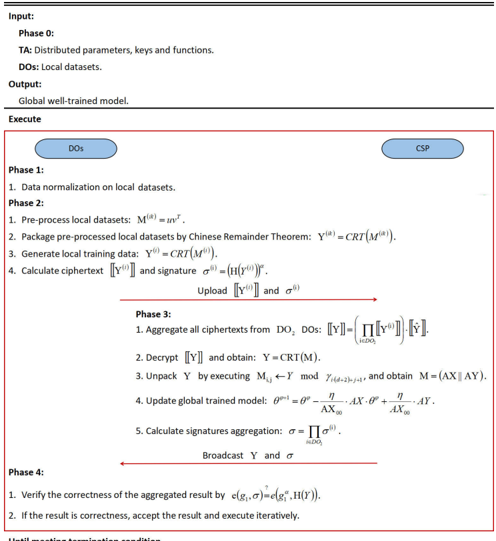
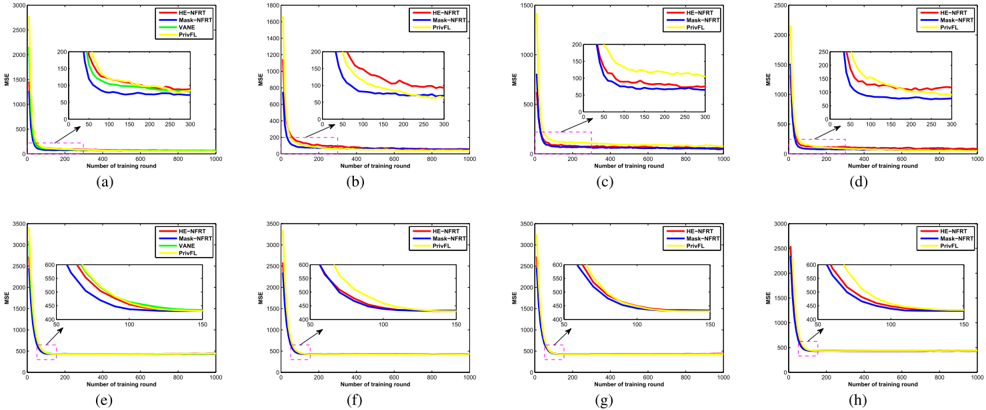
Privacy-preserving federated learning, as one of the privacy-preserving computation techniques, is a promising distributed and privacy-preserving machine learning (ML) approach for Internet of Medical Things (IoMT), due to its ability to train a regression model without collecting raw data of data owners (DOs). However, traditional interactive federated regression training (IFRT) schemes rely on multiple rounds of communication to train a global model and are still under various privacy and security threats. To overcome these problems, several noninteractive federated regression training (NFRT) schemes have been proposed and applied in a variety of scenarios. However, there are still several challenges: 1) how to protect the privacy of DOs' local dataset; 2) how to realize highly scalable regression training without linear dependence on sample dimension; 3) how to tolerate DOs' dropout; and 4) how to enable DOs to verify the correctness of aggregated results returned from the cloud service provider (CSP). In this article, we propose two practical noninteractive federated learning schemes with privacy-preserving for IoMT, named homomorphic encryption based NFRT (HE-NFRT) and double-masking protocol based NFRT (Mask-NFRT), respectively, which are based on a comprehensive consideration of NFRT, privacy concerns, high-efficiency, robustness, and verification mechanism. The security analyses display that our proposed schemes are able to protect the privacy of DOs' local training data, resist collusion attack, and support strong verification to each DO. The performance evaluation results demonstrate that our proposed HE-NFRT scheme is desirable for a high-dimensional and high-security IoMT application while Mask-NFRT scheme is desirable for a high-dimensional and large-scale IoMT application.
Overview
The claims and statistics of this paper haven’t been checked yet.
Run the check — free, no account needed. It reads the open-access text and checks the sources it cites.
Integrity signals
Registry
Cites
Statistics
Figures



Verification
Claims the paper makes
The claims and statistics of this paper haven’t been checked yet.
Run the check — free, no account needed. It reads the open-access text and checks the sources it cites.
Claims other papers make about this one
Each is checked against this paper’s own text: does it say what the citing paper says it does?
The cited source says what the claim attributes to it.
In the citing paper
“FL allows ML model training while preserving data privacy [35,36,37]”
From A Novel Blockchain-Based Deepfake Detection Method Using Federated and Deep Learning Models (2024) · cites this paper as [36]
Self-check
Percentages, sums and reported differences re-computed from the paper’s own numbers.
The self-check needs the paper’s full text.
Citations
Cites
Deep Residual Learning for Image Recognition
He, K., Zhang, X., Ren, S., & Sun, J. (2016) · 2016 IEEE Conference on Computer Vision and Pattern Recognition (CVPR) · doi:10.1109/cvpr.2016.90 · Cited by 235,474
Self-citationNew directions in cryptography
Diffie, W., & Hellman, M. (1976) · IEEE Transactions on Information Theory · doi:10.1109/tit.1976.1055638 · Cited by 14,713
Communication-Efficient Learning of Deep Networks from Decentralized Data
McMahan, H. B., Moore, E., Ramage, D., Hampson, S., & Arcas, B. A. Y. (2016) · arXiv · doi:10.48550/arxiv.1602.05629 · Cited by 14,215
Shamir, A. (1979) · Communications of the ACM · doi:10.1145/359168.359176 · Cited by 13,756
Practical Secure Aggregation for Privacy-Preserving Machine Learning
Bonawitz, K., Ivanov, V., Kreuter, B., Marcedone, A., McMahan, H. B., Patel, S., Ramage, D., Segal, A., & Seth, K. (2017) · Proceedings of the 2017 ACM SIGSAC Conference on Computer and Communications Security · doi:10.1145/3133956.3133982 · Cited by 3,956
Federated Learning: Strategies for Improving Communication Efficiency
Konečný, J., McMahan, H. B., Yu, F. X., Richtárik, P., Suresh, A. T., & Bacon, D. (2016) · arXiv · doi:10.48550/arxiv.1610.05492 · Cited by 3,766
Towards Federated Learning at Scale: System Design
Bonawitz, K., Eichner, H., Grieskamp, W., Huba, D., Ingerman, A., Ivanov, V., Kiddon, C., Konečný, J., Mazzocchi, S., McMahan, H. B., et al. (2019) · arXiv · doi:10.48550/arxiv.1902.01046 · Cited by 2,334
SecureML: A System for Scalable Privacy-Preserving Machine Learning
Mohassel, P., & Zhang, Y. (2017) · 2017 IEEE Symposium on Security and Privacy (SP) · doi:10.1109/sp.2017.12 · Cited by 1,936
Aggregate and Verifiably Encrypted Signatures from Bilinear Maps
Boneh, D., Gentry, C., Lynn, B., & Shacham, H. (2003) · Lecture Notes in Computer Science · doi:10.1007/3-540-39200-9_26 · Cited by 1,821
Robust and Communication-Efficient Federated Learning From Non-i.i.d. Data
Sattler, F., Wiedemann, S., Muller, K.-R., & Samek, W. (2020) · IEEE Transactions on Neural Networks and Learning Systems · doi:10.1109/tnnls.2019.2944481 · Cited by 1,725
Research works printed but not linked: 5
- Graf, 2011, Relative Location of CT Slices on Axial Axis Data Set
- Yann, 1998, The MNIST Database of Handwritten Digits
- Alex, 2009, The CIFAR-10 Dataset
- Lynn, 2000, Pairing-Based Cryptography (PBC) Library
- Huang, Cheetah: Lean and fast secure two-party deep neural network inference, 1
Cited by
Interpreting Black-Box Models: A Review on Explainable Artificial Intelligence
Hassija, V., Chamola, V., Mahapatra, A., Singal, A., Goel, D., Huang, K., Scardapane, S., Spinelli, I., Mahmud, M., & Hussain, A. (2024) · Cognitive Computation · doi:10.1007/s12559-023-10179-8 · Cited by 2,495
“So , along with a strong foundation, necessary amendments will always help in adding more to the structure of XAI, which will lead to a greater impact [94, 95].”
BackgroundA Novel Blockchain-Based Deepfake Detection Method Using Federated and Deep Learning Models
Heidari, A., Navimipour, N. J., Dag, H., Talebi, S., & Unal, M. (2024) · Cognitive Computation · doi:10.1007/s12559-024-10255-7 · Cited by 164
Denial of service attacks in edge computing layers: Taxonomy, vulnerabilities, threats and solutions
Uddin, R., Kumar, S., & Chamola, V. (2023) · Ad Hoc Networks · doi:10.1016/j.adhoc.2023.103322 · Cited by 101
Uddin, M. P., Xiang, Y., Hasan, M., Bai, J., Zhao, Y., & Gao, L. (2025) · ACM Computing Surveys · doi:10.1145/3727643 · Cited by 102
Hanafi, A. V., Ghaffari, A., Rezaei, H., Valipour, A., & Arasteh, B. (2023) · Cluster Computing · doi:10.1007/s10586-023-04102-x · Cited by 77
Metadata
- Authors
- Han, S., Ding, H., Zhao, S., Ren, S., Wang, Z., Lin, J., & Zhou, S.
- Affiliations
- Hangzhou City University (CN)
- Zhejiang Gongshang University (CN)
- Zhejiang University (CN)
- Zhejiang Ponshine Information Technology Company Ltd., Hangzhou, China
- Venue
- IEEE Transactions on Neural Networks and Learning Systems
- Published
- 2024-10
- Volume
- 35
- Issue
- 10
- Pages
- 13801-13815
- ISSN
- 2162-237X (ISSN-L)
- 2162-2388
- OpenAlex
- W4379805355
- Cited by
- 60
- References
- 42
- Citations by year
- 2026: 9 · 2025: 16 · 2024: 15
- FWCI
- 5.66
- Type
- journal article
- Language
- en
- Open access
- hybrid
- doi.org
- Locations
- IEEE Transactions on Neural Networks and Learning Systems (publishedVersion, cc-by)
- PubMed (publishedVersion)
- Funders
- National Natural Science Foundation of China (62072403, U20A20182, 61906167)
- Zhejiang Provincial Natural Science Foundation of China (LQ22F020001, LTY21F020001)
- Ministry of Education Humanities and Social Sciences General Project (22JDSZ3124)
- Scientific Research Fund of Zhejiang Provincial Education Department (Y202147355)
- Laboratory Work Research Project of Universities in Zhejiang (20220003)
- “Pioneer” and “Leading Goose” R&D Program of Zhejiang (2022C01243)
- Key Research and Development Program of Zhejiang Province (2020C01076)
- Topics
- Physical Sciences › Computer Science › Artificial Intelligence › Privacy-Preserving Technologies in Data
- Physical Sciences › Computer Science › Computer Networks and Communications › Cryptography and Data Security
- Physical Sciences › Computer Science › Information Systems › Cloud Data Security Solutions
- Keywords
- privacy-preserving federated learning, Internet of Medical Things, homomorphic encryption, collusion resistance, scalability, high-dimensional data, cloud service provider security
About these checks
Registry, retraction, Cites and statistics results are computed, not judged, with one exception: a printed reference that no index lists is read once by a model before it counts as a citation error. Claims are extracted by a model and kept only when their quote appears verbatim in the text; each cited source is then checked, with a model’s help, for whether it says what the claim relies on. Those verdicts can be wrong — read the claim’s quote and the cited source before relying on one.
Statistics and arithmetic are recomputed, not judged.
Confidence bands are shown only for fields calibrated on our annotated test set. None is calibrated yet, so no band is shown.
What counts as a claim ›How we measure confidence ›How we check this ›
Are you an author, or do you see a problem with this page? Request a review
How to cite
Cite CoChat for the checks on this page, and the paper for its own findings.
- This page
- CoChat. (2026). Citation check: Practical and Robust Federated Learning With Highly Scalable Regression Training. https://app.cochat.ai/papers/10.1109/tnnls.2023.3271859
- The paper
- Han, S., Ding, H., Zhao, S., Ren, S., Wang, Z., Lin, J., & Zhou, S. (2024). Practical and Robust Federated Learning With Highly Scalable Regression Training. IEEE Transactions on Neural Networks and Learning Systems. https://doi.org/10.1109/tnnls.2023.3271859
Data sources
Bibliographic data: Semantic Scholar, OpenAlex, Crossref.
Contains information from the Semantic Scholar Academic Graph Datasets, made available under the ODC Attribution License (ODC-BY 1.0).
Semantic Scholar’s data is described in: Kinney, R., et al. (2023). The Semantic Scholar Open Data Platform. arXiv:2301.10140.
