

Artificial Neural Networks for Space and Safety-Critical Applications: Reliability Issues and Potential Solutions
Open accessThe DOI matches its Crossref record; 165 of the 167 references it cites were found in a registry or an index.
Abstract
Machine Learning is among the greatest advancements in computer science and engineering and is today used to classify or detect objects, a key feature in autonomous vehicles. Since neural networks are heavily used in safety-critical applications, such as automotive and aerospace, their reliability must be paramount. However, the reliability evaluation of neural network systems is extremely challenging due to the complexity of the software, which is composed of hundreds of layers, and of the underlying hardware, typically a parallel device or an embedded accelerator. This paper reviews fundamental concepts of Artificial Intelligence, Deep Neural Network, and parallel computing device reliability. Then, the reliability studies that consider the radiation effects in the hardware, their propagation through the computing architecture, and their final impact on the software output are summarized. A detailed survey of the available strategies to measure the sensitivity of neural network frameworks and to observe fault propagation is given, together with a summary of the data obtained so far. Finally, a discussion on how to use the experimental evaluation to design effective and efficient hardening solutions for Artificial Neural Networks is provided. The available hardening solutions are critically reviewed, highlighting their benefits and drawbacks.
Overview
The claims and statistics of this paper haven’t been checked yet.
Free: it reads the open-access text and checks the first 5 claims that cite a source we can check. Create a free account to check every claim.
Integrity signals
Registry
Cites
Statistics
Figures
Verification
Claims the paper makes
The claims and statistics of this paper haven’t been checked yet.
Free: it reads the open-access text and checks the first 5 claims that cite a source we can check. Create a free account to check every claim.
Claims other papers make about this one
Each is checked against this paper’s own text: does it say what the citing paper says it does?
The source backs part of the claim, not all of it — or backs it for a different population, condition or comparison.
In the citing paper
“For safety-critical systems, explainability is not enough for a system to be trustworthy.Various requirements such as robustness, reliability, traceability, data quality, and other factors must be demonstrated [25,43,62,63].”
From A requirements model for AI algorithms in functional safety-critical systems with an explainable self-enforcing network from a developer perspective (2024) · cites this paper as [62]
Experimental — accuracy not yet measuredIn the citing paper
“As pointed out in previous works [11], [12], when radiation affected only the GPU, it usually only produced SDCs in the inference result of the image being processed but did not modify the result for the next image processed.”
From Reliability of Vision Transformers and CNNs on Edge AI Systems Under Neutron Radiation (2025) · cites this paper as [11]
In the citing paper
“Finally, as noted in studies like [11], DNNs are highly complex systems, and evaluating their reliability is a significant challenge.”
From Reliability of Vision Transformers and CNNs on Edge AI Systems Under Neutron Radiation (2025) · cites this paper as [11]
In the citing paper
“Therefore, how they are affected by the radiation and how the errors propagate through the different layers to the output is very dependent on the model design, implementation, and the hardware used [11].”
From Reliability of Vision Transformers and CNNs on Edge AI Systems Under Neutron Radiation (2025) · cites this paper as [11]
Self-check
Percentages, sums and reported differences re-computed from the paper’s own numbers.
The self-check needs the paper’s full text.
Citations
Cites
MobileNetV2: Inverted Residuals and Linear Bottlenecks
Sandler, M., Howard, A., Zhu, M., Zhmoginov, A., & Chen, L.-C. (2018) · 2018 IEEE/CVF Conference on Computer Vision and Pattern Recognition · doi:10.1109/cvpr.2018.00474 · Cited by 28,755 · cited 1×
“Building upon this function, several other ReLU-like activations have been developed, e.g., the scaled exponential linear unit (SELU) [27], the Gaussian error linear unit (GELU) [28], and ReLU6 [29].”
BackgroundAn introduction to ROC analysis
Fawcett, T. (2006) · Pattern Recognition Letters · doi:10.1016/j.patrec.2005.10.010 · Cited by 21,879 · cited 2×
“To evaluate error criticality for detection, it is necessary to consider the BB’s area, adopting the methodology used in the image processing community [61].”
MethodLarge-Scale Machine Learning with Stochastic Gradient Descent
Bottou, L. (2010) · Proceedings of COMPSTAT'2010 · doi:10.1007/978-3-7908-2604-3_16 · Cited by 5,795 · cited 1×
“Given the gradients, an optimizer, e.g., stochastic gradient descent [23], updates the weights in order to minimize the loss function.”
MethodBasic concepts and taxonomy of dependable and secure computing
Avizienis, A., Laprie, J.-C., Randell, B., & Landwehr, C. (2004) · IEEE Transactions on Dependable and Secure Computing · doi:10.1109/tdsc.2004.2 · Cited by 5,223 · cited 1×
“In this work, we will use the taxonomy defined by Avizienis et al. [60].”
MethodBackpropagation through time: what it does and how to do it
Werbos, P. J. (1990) · Proceedings of the IEEE · doi:10.1109/5.58337 · Cited by 4,879 · cited 1×
“ANNs are universal function approximators that, thanks to Backpropagation (short for backward propagation of errors) training [20], [21], [22] and sufficient network complexity, enable the solution of a variety of tasks, e.g., classification, detection, and regression.”
BackgroundGaussian Error Linear Units (GELUs)
Hendrycks, D., & Gimpel, K. (2016) · arXiv · doi:10.48550/arxiv.1606.08415 · Cited by 3,537 · cited 1×
“Building upon this function, several other ReLU-like activations have been developed, e.g., the scaled exponential linear unit (SELU) [27], the Gaussian error linear unit (GELU) [28], and ReLU6 [29].”
BackgroundDeep Learning using Rectified Linear Units (ReLU)
Agarap, A. F. (2018) · arXiv (Cornell University) · doi:10.48550/arxiv.1803.08375 · Cited by 2,399 · cited 1×
“…most computationally demanding and, thus, vulnerable to radiation), activation functions are used for ensuring a nonlinear input–output relationship in DNNs and are very often implemented through rectified linear units (ReLUs) [25] ReLU ( x ) = max ( 0 , x ), where x stands for the input tensor.”
MethodSelf-Normalizing Neural Networks
Klambauer, G., Unterthiner, T., Mayr, A., & Hochreiter, S. (2017) · arXiv · doi:10.48550/arxiv.1706.02515 · Cited by 2,267 · cited 1×
“Building upon this function, several other ReLU-like activations have been developed, e.g., the scaled exponential linear unit (SELU) [27], the Gaussian error linear unit (GELU) [28], and ReLU6 [29].”
BackgroundNVIDIA Tesla: A Unified Graphics and Computing Architecture
Lindholm, E., Nickolls, J., Oberman, S., & Montrym, J. (2008) · IEEE Micro · doi:10.1109/mm.2008.31 · Cited by 1,362 · cited 1×
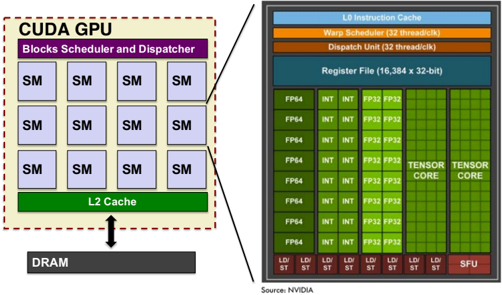
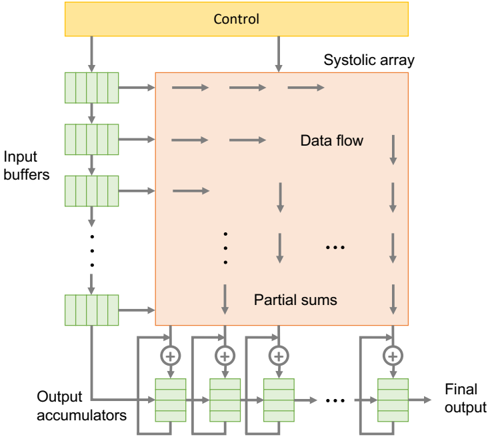
“Each basic computing unit (named CUDA core in NVIDIA devices) in the SM executes one thread with dedicated registers, avoiding complex resource sharing or the need for long pipelines [37] [see Fig.”
BackgroundPattern Recognition and Machine Learning
Maindonald, J. (2007) · Journal of Statistical Software · doi:10.18637/jss.v017.b05 · Cited by 1,349
Research works printed but not linked: 8
- NVIDIA, "NVIDIA Ampere GPU Whitepa- per." https://www.nvidia.com/content/PDF/ nvidia-ampere-ga-102-gpu-architecture-whitepaper-v2.pdf, 2023. Accessed: 2023-10-21.
- Q-engineering, "Google Coral Edge TPU explained in depth." https: //qengineering.eu/google-corals-tpu-explained.html. Accessed: 2023- 08-27.
- Y. Bengio, I. Goodfellow, and A. Courville, Deep learning, vol. 1. MIT press Cambridge, MA, USA, 2017.
- Xilinx, "Zynq-7000 all programmable soc." https://www.xilinx.com/ products/silicon-devices/soc/zynq-7000.html. Accessed: 2022-09-11.
- JEDEC, "Measurement and Reporting of Alpha Particle and Terrestrial Cosmic Ray-Induced Soft Errors in Semiconductor Devices," Tech. Rep. JESD89A, JEDEC Standard, 2006.
- J. F. Ziegler and H. Puchner, SER-history, Trends and Challenges: A Guide for Designing with Memory ICs. Cypress, 2004.
- ESA, "ESCC Basic Specification No. 22900." http://escies.org/escc- specs/published/22900.pdf, 2016. Accessed: 2022-09-11.
- E. J. Wyrwas and T. Wilcox, "Radiation Effects and Anal- ysis Lessons: a Scientist's Field Instruction to Explain Ra- diation Testing." "https://nepp.nasa.gov/workshops/etw2022/talks/16- JUN-THU/1600-Wyrwas-20220002512.pdf". Accessed: 2022-09-11.
Cited by
Friha, O., Amine Ferrag, M., Kantarci, B., Cakmak, B., Ozgun, A., & Ghoualmi-Zine, N. (2024) · IEEE Open Journal of the Communications Society · doi:10.1109/ojcoms.2024.3456549 · Cited by 189
Diana, L., & Dini, P. (2024) · Remote Sensing · doi:10.3390/rs16213957 · Cited by 57
Key Considerations for Real-Time Object Recognition on Edge Computing Devices
Surantha, N., & Sutisna, N. (2025) · Applied Sciences · doi:10.3390/app15137533 · Cited by 64
AdAM: Adaptive Approximate Multiplier for Fault Tolerance in DNN Accelerators
Taheri, M., Cherezova, N., Nazari, S., Azarpeyvand, A., Ghasempouri, T., Daneshtalab, M., Raik, J., & Jenihhin, M. (2024) · IEEE Transactions on Device and Materials Reliability · doi:10.1109/tdmr.2024.3523386 · Cited by 25
Reliability of Vision Transformers and CNNs on Edge AI Systems Under Neutron Radiation
Badia, J. M., Martin-Salinas, I., Leon, G., Amor-Martin, A., Frias-Dominguez, L., Belloch, J. A., Garcia-Valderas, M., Lindoso, A., Cazzaniga, C., & Entrena, L. (2025) · IEEE Transactions on Nuclear Science · doi:10.1109/tns.2025.3536519 · Cited by 11
“Several surveys summarize, analyze, and categorize many of these works [8], [11], [23], [24], [25], [26].”
InfluentialFPGA-Based Neural Network Accelerators for Space Missions: A Survey
Antunes, P., & Podobas, A. (2026) · ACM Computing Surveys · doi:10.1145/3857797 · Cited by 11
Klüver, C., Greisbach, A., Kindermann, M., & Püttmann, B. (2024) · Security and Safety · doi:10.1051/sands/2024020 · Cited by 8
“CHESSIoT, a model-driven environment for engineering industrial IoT systems (based on Fault Tree Analysis (FTA), CHESS, and Failure Propagation Transformation Calculus (FPTC)), enables the estimation of the failure behavior of the entire system [35].”
Approximate Fault-Tolerant Neural Network Systems
Traiola, M., Pappalardo, S., Piri, A., Ruospo, A., Deveautour, B., Sánchez, E., Bosio, A., Saeedi, S., Carpegna, A., Göğebakan, A. B., et al. (2024) · IEEE European Test Symposium (ETS) · doi:10.1109/ets61313.2024.10567290 · Cited by 12
“For a more complete overview of the existing literature on the Reliability of NNs, we refer the reader to existing surveys [99]–[104].”
BackgroundImpact of Radiation-Induced Effects on Embedded GPUs Executing Large Machine Learning Models
Coelho, B. L., dos Santos, F. F., Saveriano, M., Allen, G. R., Daniel, A. C., Guertin, S. M., Vartanian, S., Wyrwas, E. J., Frost, C. D., & Rech, P. (2025) · IEEE Transactions on Nuclear Science · doi:10.1109/tns.2025.3528764 · Cited by 9
“In particular, we consider application or device crashes , and silent data corruptions (SDCs), which silently cause the application to generate a corrupted output [1], [11].”
Self-citationAhsaei, S., & Raji, M. (2025) · Journal of Systems Architecture · doi:10.1016/j.sysarc.2025.103623 · Cited by 8
Probabilistic Robustness in Deep Learning: A Concise Yet Comprehensive Guide
Zhao, X. (2026) · Springer eBooks · doi:10.1007/978-3-031-99447-0_15 · Cited by 9
Radiation Reliability of System Reboots in Commercial Off-the-Shelf SoC
Frias-Dominguez, L., León, G., Badía, J. M., Belloch, J. A., García-Valderas, M., Lindoso, A., & Entrena, L. (2025) · IEEE Transactions on Nuclear Science · doi:10.1109/tns.2025.3539942 · Cited by 7
“Some recent works have analyzed the radiation sensitivity of neural networks on this type of devices [32].”
Vision Transformer Reliability Evaluation on the Coral Edge TPU
Loureiro Coelho, B., Rafael Bodmann, P., Cavagnero, N., Frost, C., & Rech, P. (2025) · IEEE Transactions on Nuclear Science · doi:10.1109/tns.2024.3513774 · Cited by 5
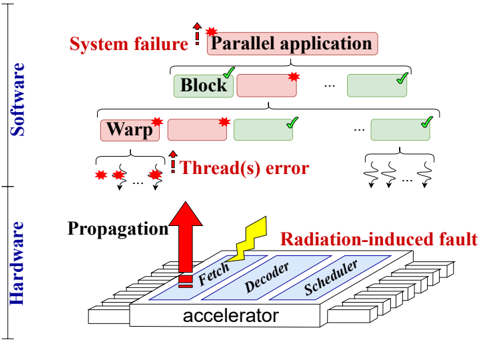
“…thus requiring a restart of the application or the device; 2) the fault propagates through the stack of system layers and leads to silent data corruption (SDC), affecting the application output; or 3) the application is unaffected (i.e., the fault is masked, or the corrupted data is not used) [11].”
Self-citationWilson, D., Dempsey, R., Xiao, T. P., Spear, M. E., Hughart, D. R., Bennett, C. H., Agrawal, V. S., Puchner, H., Agarwal, S., & Marinella, M. J. (2025) · IEEE Transactions on Nuclear Science · doi:10.1109/tns.2025.3543349 · Cited by 5
“Digital accelerator implementation can utilize a technique known as selective hardening, where critical layers and neurons can be selectively hardened against radiation or other sources of error through additional software or hardware [22], [23].”
SimPRIVE: A Simulation Framework for Physical Robot Interaction with Virtual Environments
Nesti, F., D'Amico, G., Marinoni, M., & Buttazzo, G. (2025) · IEEE International Conference on Intelligent Transportation Systems (ITSC) · doi:10.1109/itsc60802.2025.11423662 · Cited by 5
“However, including AI in CPS presents several hurdles that must be overcome before deploying AI-based controllers in the wild [1], [2].”
Comparing Application-Level Hardening Techniques for Neural Networks on GPUs
Esposito, G., Guerrero-Balaguera, J.-D., Condia, J. E. R., & Reorda, M. S. (2025) · Electronics · doi:10.3390/electronics14051042 · Cited by 4
Bernstein, J. B., Avraham, T., & Wang, B. (2026) · Micromachines · doi:10.3390/mi17030320 · Cited by 4
“In semiconductors, however, each mechanism (BTI, TDDB, HCI, electromigration, etc.) follows a distinct kinetic law with its own stress sensitivity [28].”
Lee, D., & Na, J. (2025) · Aerospace · doi:10.3390/aerospace12020118 · Cited by 4
HMR-NEureka: Hybrid Modular Redundancy DNN Acceleration in Heterogeneous RISC-V SoCs
Ghionda, L., Tedeschi, R., Tortorella, Y., Prasad, A. S., Rossi, D., Benini, L., & Conti, F. (2025) · IEEE Computer Society Annual Symposium on VLSI · doi:10.1109/isvlsi65124.2025.11130209 · Cited by 4
“As artificial neural networks become increasingly prevalent in advanced space applications [1], [2], there is a clear need for specialized solutions that accelerate AI work-loads and operate in a fault-tolerant mode, ensuring reliable performance in harsh space environments [3].”
Zhang, J., Li, J., & Oehmen, J. (2023) · SSRN Electronic Journal · doi:10.2139/ssrn.4513915 · Cited by 4
Tian, H., Ibrahim, Y., Sharma, M., Belev, G. S., Wen, S.-J., & Chen, L. (2025) · Microelectronics Reliability · doi:10.1016/j.microrel.2025.115929 · Cited by 3
Dynamic Hardware Defense for High-Centrality Nodes in Graph Convolutional Networks
Cai, C., Li, P., Wen, W., Huang, Z., Peng, Y., Hu, M., Wu, Z., Shen, L., & Zhang, J. (2025) · IEEE Transactions on Nuclear Science · doi:10.1109/tns.2025.3595388 · Cited by 3
Zhang, H. (2025) · Journal of Computing and Electronic Information Management · doi:10.54097/5eqd7y93 · Cited by 25
“Their research established best practices for enforcing electromagnetic boundary conditions within neural network frameworks while ensuring numerical stability and convergence reliability across diverse problem configurations [34].”
Hybrid Convolutional Neural Networks with Reliability Guarantee
Doran, H. D., & Veljanovska, S. (2024) · International Conference on Dependable Systems and Networks workshops · doi:10.1109/dsn-w60302.2024.00023 · Cited by 3
“Methods to ensure correct execution, on various platforms, of an AI algorithm regardless of any model considerations are well summarized, along with fault modes, in [9].”
BackgroundIn Situ Analog In-Memory Computing Under Ionizing Radiation Exposure
Xiao, T. P., Siath, M., Spear, M. E., Wilson, D., Bennett, C. H., Feinberg, B., Hughart, D. R., Neuendank, J., Brown, W. E., Barnaby, H., et al. (2025) · IEEE Transactions on Nuclear Science · doi:10.1109/tns.2025.3537985 · Cited by 3
“There are now a number of commercially available, special-purpose accelerators that are designed to efficiently process the matrix operations that dominate ML workloads [2], [3], [4], [5], and there have been efforts to assess their reliability in space environments [6], [7].”
Hardware Error Detection with In-Situ Monitoring of Control Flow-Related Specifications
Tanaka, T., Uezono, T., Suenaga, K., & Hashimoto, M. (2025) · Asia and South Pacific Design Automation Conference (ASP-DAC) · doi:10.1145/3658617.3697744 · Cited by 2
Key Variables in the Reliability of ML Models Exposed to Neutrons, Protons, and Heavy Ions
Coelho, B. L., Saveriano, M., Tali, M., Frost, C. D., Donetti, M., Pullia, M. G., Verroi, E., Tommasino, F., Bounasser, S., Poivey, C. F., et al. (2025) · IEEE Transactions on Nuclear Science · doi:10.1109/tns.2025.3637553 · Cited by 3
Self-citationgptPromptFuzz: LLM Prompt Engineering Based Seed Generation for Effective Fuzzing
Lohiya, D., Yelleti, V., Godboley, S., & Krishna, P. R. (2025) · IEEE Region 10 Conference (TENCON) · doi:10.1109/tencon66050.2025.11375417 · Cited by 2
“This becomes more particular in the organizations where safety and privacy are of paramount [2].”
Strategic Input Selection for Deep Neural Networks Reliability Evaluation
Roquet, L., dos Santos, F. F., Kastriotou, M., & Kritikakou, A. S. (2026) · IEEE Transactions on Nuclear Science · doi:10.1109/tns.2026.3675927 · Cited by 2
Reliability of CNN Execution - A Novel Application of the Single Protected Channel Pattern
Doran, H. D., & Veljanovska, S. (2024) · IEEE International Conference on Emerging Technologies and Factory Automation (ETFA) · doi:10.1109/etfa61755.2024.10710935 · Cited by 2
“In our work we focus on the field programmable gate array (FPGA) [15], [16] noting that similar arguments apply to neuromorphic and GPU accelerators [17].”
Background赵, X. 旭. Z., 杜, X. 雪. D., 马, C. 超. M., 胡, Z. 志. H., 杨, W. 卫. Y., & 郑, B. 波. Z. (2024) · Chinese Physics B · doi:10.1088/1674-1056/ad8b38 · Cited by 2
Badía, J. M., León, G., García-Valderas, M., Belloch, J. A., Lindoso, A., & Entrena, L. (2024) · Sustainable Computing Informatics and Systems · doi:10.1016/j.suscom.2024.101049 · Cited by 3
Fault injection analysis of Real NVP normalising flow model for satellite anomaly detection
Greco, G., Cena, C., Albertin, U., Martini, M., & Chiaberge, M. (2025) · IEEE International Joint Conference on Neural Network · doi:10.1109/ijcnn64981.2025.11227924 · Cited by 1
“In fact, while offering advantages such as lower costs, better controllability, and easier deployment for developers, the commonly adopted fault model (typically bit flip) [13, 14, 15, 16] may be accurate for main memory structures but less realistic for faults within computing cores or control…”
Superscalar Time-Triggered Versatile-Tensor Accelerator
Bebawy, Y., Ezekiel, A. M., & Obermaisser, R. (2025) · IEEE Transactions on Computer-Aided Design of Integrated Circuits and Systems · doi:10.1109/tcad.2025.3528355 · Cited by 2
刘, Q. 清. L., 程, H. 浩. C., 姚, X. 骧. Y., Zhang, Z., Hu, Z., & Bi, D. (2025) · Chinese Physics B · doi:10.1088/1674-1056/adacd1 · Cited by 1
A Fault Injection Method for Evaluating Single Event Soft Errors in Deep Neural Networks
Lyu, H., Mei, B., Xue, P., Wang, B., Mo, R., Yuan, Q., & Gao, W. (2025) · International Conference on Radiation Effects of Electronic Devices (ICREED) · doi:10.1109/icreed65908.2025.11036247 · Cited by 1
“The fault injection methods include hardware based simulation and software based system level fault injection [12].”
Machine learning application for particle accelerator optimization-a review
Rachmawati, I. D., Effendy, N., & Taufik, T. (2025) · IAES International Journal of Artificial Intelligence · doi:10.11591/ijai.v14.i4.pp3014-3021 · Cited by 1
Tanaka, T., Uezono, T., Suenaga, K., & Hashimoto, M. (2026) · IEEE Transactions on Computer-Aided Design of Integrated Circuits and Systems · doi:10.1109/tcad.2026.3691284 · Cited by 2
Automated Graph-level Passes for TinyML Fault Tolerance
Kappes, J., Geier, J., van Kempen, P., Mueller-Gritschneder, D., & Schlichtmann, U. (2025) · International Joint Conference on Neural Networks (IJCNN) · doi:10.1109/ijcnn64981.2025.11227379 · Cited by 1
“Because of that, there exist no low-cost and generalizable hardware methods [8] [9].”
Cheng, Q., Zhang, H., Liang, C.-H., Zhang, M., Liou, J.-J., Xiong, J., Lin, L., & Hashimoto, M. (2025) · doi:10.1109/iccad66269.2025.11240869 · Cited by 1
“In silicon-based systems, especially those deployed in safety-critical environments (e.g., space tasks, autonomous driving), cosmic rays present a significant challenge to system reliability [1], [2].”
Tang, C., Qiang, H., Geng, T., Wang, X., & Zhang, F. (2025) · Structures · doi:10.1016/j.istruc.2025.110699 · Cited by 1
Roquet, L., dos Santos, F. F., Carro, L., & Kritikakou, A. S. (2026) · IEEE Latin American Test Symposium (LATS) · doi:10.1109/lats70329.2026.11480414 · Cited by 1
“Faults induced by radiation, temperature, voltage fluctuations, or material defects can propagate through the computation and disrupt the model’s inference [1], [2].”
Liu, X., & Fang, Q. (2026) · Alexandria Engineering Journal · doi:10.1016/j.aej.2026.01.037 · Cited by 1
Characterization of Sub-20 nm FinFET-Based AI Chips Under Single-Event Effects
Feng, S., Liang, B., Tao, M., Yang, J., Chi, Y., Chen, J., Luo, D., Yu, G., Qiao, G., Wang, X., et al. (2026) · IEEE Transactions on Nuclear Science · doi:10.1109/tns.2026.3665046 · Cited by 1
Analysis of single event induced bit faults in a deep neural network accelerator pipeline
Jonckers, N., Vinck, T., Karsmakers, P., & Prinzie, J. (2026) · Journal of Instrumentation · doi:10.1088/1748-0221/21/02/c02021 · Cited by 1
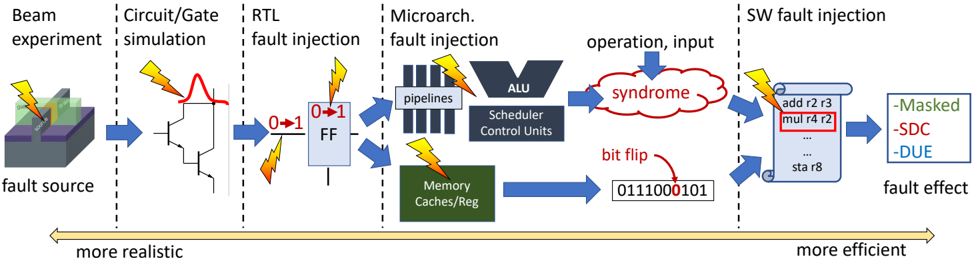
“While beam tests offer a more accurate representation of real-world conditions [8], they provide limited insights into fault propagation within the accelerator logic due to physically limited on-chip signal observation.”
Adaptive Soft Error Protection for Neural Network Processing
Xue, X., Liu, C., Feng, M., Li, H., Zhang, K., & Han, Y. (2026) · IEEE Transactions on Computer-Aided Design of Integrated Circuits and Systems · doi:10.1109/tcad.2026.3667089 · Cited by 2
Memory efficient soft error mitigation for CNN accelerators exploiting nonmonotonic bit sensitivity
Yang, S., Li, J., Yu, G., Xu, T., Lv, Z., Wang, C., Gong, Y., Chen, J., & Su, X. (2026) · Microelectronics Reliability · doi:10.1016/j.microrel.2026.116106 · Cited by 3
Dependability analysis and hardening of vision transformers against soft errors
Frias-Dominguez, L., Badía, J. M., León, G., Amor-Martín, A., & Belloch, J. A. (2026) · The Journal of Supercomputing · doi:10.1007/s11227-026-08373-0 · Cited by 2
Towards Resilient Transformer-Encoders: Fault Injection and Hardware Agnostic Error Mitigation
Thomas, V., Zahid, U., Gambardella, G., Sapkal, S., Stratigopoulos, H., & Clerkin, B. (2026) · IEEE European Test Symposium (ETS) · doi:10.1109/ets69887.2026.11591952 · Cited by 1
Reachability-Based Formal Verification of Graph Neural Networks with Node and Edge Features
Tumlin, A. M., Wooding, B., Shao, Z., Lopez, D. M., Derr, T., & Johnson, T. (2026) · Lecture notes in computer science · doi:10.1007/978-3-032-32357-6_13 · Cited by 1
“Together, these Matrix Representation challenges motivate continued research into formal verification techniques tailored to NNs [26].”
Effective and Memory-Efficient Alternatives to ECC for Reliable Large-Scale DNNs
Ahmadilivani, M. H., Roots, M., Restifo, M., Loorits, S.-M., di Mauro, L., & Raik, J. (2026) · IEEE International On-Line Testing Symposium (IOLTS) · doi:10.1109/iolts69666.2026.11633759 · Cited by 2
“In this context, even infrequent errors occurring during computation or data movement can be amplified throughout the inference process, ultimately leading to incorrect or unreliable outputs [2], [3].”
Analysis and Mitigation of Soft-errors in GPU-accelerated Hyperspectral Image Classifiers
Abed, S.-M., Guerrero-Balaguera, J.-D., Condia, J. E. R., Lucia, G. D., Lapegna, M., & Reorda, M. S. (2025) · IEEE International Symposium on Design and Diagnostics of Electronic Circuits & Systems (DDECS) · doi:10.1109/ddecs63720.2025.11006812 · Cited by 1
Safe-NEureka: a Hybrid Modular Redundant DNN Accelerator for On-board Satellite AI ProcessingPreprint
Tedeschi, R., Ghionda, L., Nadalini, A., Tortorella, Y., Prasad, A. S., Benini, L., Rossi, D., & Conti, F. (2026) · arXiv (Cornell University) · doi:10.48550/arxiv.2602.04803 · Cited by 3
Proton Irradiation Characterization of an Open-Source ML Accelerator on a Zynq UltraScale+ MPSoCPreprint
Memon, S., Graczyk, R., Swakoń, J., Grzanka, L., Kusyk, S., & Papadakis, M. (2026) · arXiv (Cornell University) · doi:10.48550/arxiv.2609.05249 · Cited by 1
“Radiation and fault-injection studies of FPGA accelerators have examined quantization, architectural parallelism, redundancy, and scrubbing [9]–[13].”
Characterization and Understanding of Cosmic Ray-Induced Soft Errors in SRAMs
Hashimoto, M. (2024) · IEEE International Meeting for Future of Electron Devices, Kansai (IMFEDK) · doi:10.1109/imfedk64776.2024.10814208
“A comprehensive survey of this research domain can be found in [8].”
A Hierarchical Spatiotemporal Graph-Based Fault Diagnosis for Deep Neural NetworksPreprint
Liu, J., Ai, J., & Shi, T. (2025) · SSRN Electronic Journal · doi:10.2139/ssrn.5246327
Anand, J., & Kumar, A. (2025) · International Conference on Computer and Automation Engineering · doi:10.1109/iccae64891.2025.10980597
“The reliability studies that consider the radiation effects in the hardware implementing the neural network, their propagation through the computing architecture, and their final impact on the software output are summarized [18].”
A Convolutional Neural Network Reinforcement Framework Based on Neural Network Interpretability
Song, H., Yu, P., Ou, J., Li, W., & Gu, J. (2025) · International Conference on Generative Artificial Intelligence and Information Security (GAIIS) · doi:10.1145/3728725.3728817
On Architectural Tactics for Resource-Constrained and Safety-Critical AI-Based Systems
Straub, P., Decker, C., & Kuhrmann, M. (2025) · Lecture notes in computer science · doi:10.1007/978-3-032-04200-2_16 · Cited by 1
Gharaibeh, M. A. (2025) · Engineering Computations · doi:10.1108/ec-06-2025-0585
Hmede, R., Vinchon, T., Ducasse, Q., Alaya, M. Z., Monange, W., Bez, J., Lelièvre, R., & Trompier, F. (2025) · IEEE Transactions on Nuclear Science · doi:10.1109/tns.2025.3634685
Dankworth, R., & Schwalbe, G. (2025) · arXiv (Cornell University) · doi:10.48550/arxiv.2510.03320
“Neural Networks (NNs) excel in processing subsymbolic inputs like images, and are increasingly being considered for use in safety-critical domains [1].”
Fault-tolerant CNN accelerator with reconfigurable capabilities
Syed, R. T. (2025) · publish.UP (University of Potsdam) · doi:10.25932/publishup-68754
Achaq, S., Pouget, V., Artola, L., Manni, F., Dufour, A., & Boch, J. (2024) · European Conference on Radiation and Its Effects on Components and Systems · doi:10.1109/radecs61970.2024.11298599
“…GPU-like architecture or using a configurable array of cores like the one available in the AMD Xilinx Versal AICore device [8], [9], which provides an interesting flexibility for acceleration optimization [10], [11] as well as possibly for radiation hardening of space applications [12], [13].”
Tian, H., Ibrahim, Y., Sharma, M., Belev, G. S., Wen, S., & Chen, L. T. J. (2024) · European Conference on Radiation and Its Effects on Components and Systems · doi:10.1109/radecs61970.2024.11298613
“Additionally, some review papers [4], [20] in the area of neural network reliability on GPUs highlight common themes.”
Gharaibeh, M. A. (2026) · Journal of the Mechanical Behavior of Materials · doi:10.1515/jmbm-2025-0093
Wang, X., Hu, A., Liu, X., & Wang, B. (2026) · Communications in computer and information science · doi:10.1007/978-981-95-5294-8_36
Scalable Reliability Assessment of DNNs through Simultaneous Fault Injection
Tonetto, R. B., Traiola, M., Fernandes, F., & Kritikakou, A. S. (2026) · ACM/IEEE Design Automation Conference (DAC) · doi:10.1145/3770743.3804161
Zhang, J., Li, P., Xie, Z., Zheng, X., Wen, W., Ge, J., Hu, M., Dang, Z., & Cai, C. (2026) · Swarm and Evolutionary Computation · doi:10.1016/j.swevo.2026.102366
Nisa, A. K., & Budi, E. S. (2025) · MANAGERE Indonesian Journal of Educational Management · doi:10.52627/managere.v7i4.1091
“The limited facilities not only hinder the learning process but also impede the development of religious practices that require specialized spaces and devices (Rech, 2024; Sun et al., 2022).”
RapidNet: Software-Based Virtual RapidIO for Containerized Intra-Satellite Serving Network
Liu, M., Gu, J., & Zhao, T. (2026) · Lecture notes in computer science · doi:10.1007/978-981-95-8414-7_13
Reliability Assessment of Deep Neural Networks and Accelerators Across Design Stages
Ahmadilivani, M. H., Cherezova, N., Glaß, M., Guerrero-Balaguera, J.-D., Jenihhin, M., Kritikakou, A. S., Sierra, R. L., Poelhs, L. B., Raik, J., Roquet, L., et al. (2026) · IEEE Latin American Test Symposium (LATS) · doi:10.1109/lats70329.2026.11480274 · Cited by 1
“Notably, this is a very optimistic assumption [30], [31], as testing complex devices might yield zero events even after a long period of beam testing [32].”
InfluentialCheng, Q., Li, Q., Dong, W.-K., Zhang, M., Zhang, R., Huang, M., Yu, H., Shi, Y., Awano, H., Sato, T., et al. (2026) · IEEE Transactions on Computers · doi:10.1109/tc.2026.3688989
Single-Event Effects: Modeling, Prediction, Testing and Radiation Hardening
de Aguiar, Y. Q., & Martinella, C. (2026) · Electronics · doi:10.3390/electronics15091903
Reliability-critical gate identification based on sensitivity and stochastic computing
Ding, C., & Wang, Z. (2026) · Microelectronics Reliability · doi:10.1016/j.microrel.2026.116168
Special Session: Optimizing Edge AI - Current Challenges and the Neuromorphic Outlook
Dincic, M. R., Perić, Z., Bertozzi, D., Bizzarri, A., Syed, R. T., Jones, E. G., Zese, R., Andjelkovic, M. S., Vargas, F. L., Krstic, M. D., et al. (2026) · IEEE International Symposium on Design and Diagnostics of Electronic Circuits & Systems (DDECS) · doi:10.1109/ddecs69233.2026.11521015
DPAM: A Dual-Path Protected Approximate Multiplier for Reliable Neural Network Acceleration
Chen, C., Lin, Y., Haoan, Y. I. N., Zhang, J., Li, Y. H., & Zeng, X. (2026) · IEEE International Symposium on Circuits and Systems proceedings · doi:10.1109/iscas66217.2026.11561966
“As frequently used and sizable combinational blocks, multipliers are highly vulnerable to transient faults that can propagate critical errors [10].”
bashi, F. N. K., Khairullah, S. S., & Dawwd, S. A. (2026) · Digital · doi:10.3390/digital6030054
“Safety-critical systems place strict requirements on determinism, reliability, and fault containment, and such deployments need limited failure rates and verifiable operational guarantees to achieve safe system behavior [103,104].”
Shravan Kumar, B., & Kumar, V. N. (2026) · Discover Computing · doi:10.1007/s10791-026-10321-8
“Rech [23] explains with respect to Nomura et al. In contrast to ANNs, Chen et al. [24] proved adversarial robustness with time-to-first-spike encoding.”
Thinking Inside the Box: Injecting Realistic Radiation Faults in ML Accelerators
Coelho, B. L., Sadati, M., Chan, A., Hands, A. D. P., Pattabiraman, K., & Rech, P. (2026) · International Conference on Dependable Systems & Networks/Proceedings · doi:10.1109/dsn69566.2026.00017 · Cited by 1
“Google’s Coral Edge TPU is a highly energy-and cost-efficient alternative to hardware accelerators such as GPUs [1], [10].”
InfluentialSelf-citationDennis, W., & Pope, J. (2026) · Lecture notes in computer science · doi:10.1007/978-3-032-25032-2_10
Versal ACAP AI Engine Heavy-Ion Testing With Spill Synchronization
Smith, G., Price, C., Morgan, B., Wilcox, E. P., Allen, G. R., & Wirthlin, M. (2026) · IEEE Transactions on Nuclear Science · doi:10.1109/tns.2026.3714665
The Effect of Heavy Ions on Inference Performance on the IBM NorthPole
Viramontes, F. O., Vergara, V. M., Romero, A. E., Spear, M. E., Slater, W. S., & Quinn, H. (2026) · IEEE Transactions on Nuclear Science · doi:10.1109/tns.2026.3715116
Systematic Literature Review: GPU, TPU, FPGA dalam Akselerasi AI
Fitriani, S., Budiman, E., Fadli, M., & Amarudin, A. (2026) · Progresif Jurnal Ilmiah Komputer · doi:10.35889/progresif.v22i2.3481
OrbitGuard: Hierarchical Orbit-Aware Runtime for Spaceborne LLM Inference
Yang, H., Hou, X., Liu, J., Zhu, X., & Li, C. (2026) · Lecture notes in computer science · doi:10.1007/978-981-92-4805-6_40
On the Efficacy of Vector Retrieval System Under Hardware Faults
Thomas, V., Zahid, U., Gambardella, G., Stratigopoulos, H., & Clerkin, B. (2026) · Proceedings · doi:10.1109/dft70440.2026.11763243
Flip-MoE: Characterizing the Fault Resilience of Mixture-of-Experts DNNs
Shende, O. B., Traiola, M., & Ananthanarayanan, G. (2026) · Proceedings · doi:10.1109/dft70440.2026.11763295
Moreddu, R., Greulich, P., Baumgartner, C., Borghi, F., & Levin, M. (2026) · Research Square · doi:10.21203/rs.3.rs-10895632/v1
Fault Prediction of Safety Critical Systems using Artificial Intelligence – A Review
Singh, P., Thennarasu, P. N., & Singh, L. K. (2026) · IEEE International Conference on Sustainable Energy and Future Electric Transportation (SEFET) · doi:10.1109/sefet69291.2026.11687697
Sica, L. U. R. (2026) · Progress in Nuclear Energy · doi:10.1016/j.pnucene.2026.106622
Chetti, S. C., & B, V. M. (2026) · International Journal of Artificial Intelligence and Machine Learning · doi:10.51483/ijaiml.6.11s.2026.1418-1437
Magliano, E., Esposito, G., Shahdadian, A., Kodamanchili, R. M., Guerrero-Balaguera, J.-D., Condia, J. E. R., Ruospo, A., Siciliano, R., Carlo, S. D., Jenihhin, M., et al. (2026) · Proceedings · doi:10.1109/dft70440.2026.11763248
Madhushankara, M., & Aneesha Acharya, K. (2026) · IEEE Access · doi:10.1109/access.2026.3741901
“Redundancy and scrubbing often lead to area, power, and latency overheads [15], [16], [17].”
Gunda, S. K. (2026) · International Conference on Computational Intelligence Systems and Devices (ICCISD) · doi:10.1109/iccisd69924.2026.11731939
Zou, F., Wang, B., Qiu, Y., Wang, C., & Wang, Z. (2026) · International Symposium of Electronics Design Automation (ISEDA) · doi:10.1109/iseda70083.2026.11751440
“Quantitative evaluation of deep neural network (DNN) reliability under radiation exposure has therefore become essential for space-grade AI hardware [10].”
EdgeAI Energy Optimization and Edge Server Resource Allocation Based on LODCO
Zhou, T. (2026) · International Conference on Computer Engineering and Application (ICCEA) · doi:10.1109/iccea69962.2026.11743567
“It sinks computation and intelligence from the central cloud to the network edge near data sources, demonstrating significant advantages in reducing end-to-end latency, saving core network bandwidth, and enhancing privacy protection through cloud-edge-end collaboration [2, 7, 8].”
Reliability Improvement Strategies for Airborne Intelligent Autonomous Systems
Sun, D., An, S., Xu, N., & Guo, Y. (2026) · doi:10.1145/3846279.3846344
Metadata
- Authors
- Rech, P.
- Affiliations
- University of Trento (IT)
- Corresponding author
- Rech, Paolo
- ORCID
- Rech, Paolo
- Venue
- IEEE Transactions on Nuclear Science
- Published
- 2024-04
- Volume
- 71
- Issue
- 4
- Pages
- 377-404
- ISSN
- 0018-9499 (ISSN-L)
- 1558-1578
- OpenAlex
- W4390576801
- Cited by
- 75
- References
- 165
- Citations by year
- 2026: 33 · 2025: 29 · 2024: 12
- FWCI
- 7.65
- Type
- journal article
- Language
- en
- Open access
- hybrid
- doi.org
- Licence
- Locations
- IEEE Transactions on Nuclear Science (publishedVersion, cc-by-nc-nd)
- Institutional Research Information System (Università degli Studi di Trento) (submittedVersion)
- ePubs (Science and Technology Facilities Council, Research Councils UK) (submittedVersion, cc-by-nc-nd)
- Funders
- U.S. Department of Energy
- Università degli Studi di Trento
- Universidade Federal do Rio Grande do Sul
- Los Alamos National Laboratory
- Topics
- Physical Sciences › Engineering › Electrical and Electronic Engineering › Radiation Effects in Electronics
- Physical Sciences › Computer Science › Software › Software Reliability and Analysis Research
- Physical Sciences › Computer Science › Hardware and Architecture › VLSI and Analog Circuit Testing
- Keywords
- artificial neural networks, deep neural network, reliability, safety-critical systems, space applications, radiation effects, fault propagation, fault tolerance, hardware reliability, fault sensitivity analysis, autonomous vehicles, aerospace
About these checks
Registry, retraction, Cites and statistics results are computed, not judged, with one exception: a printed reference that no index lists is read once by a model before it counts as a citation error. Claims are extracted by a model and kept only when their quote appears verbatim in the text; each cited source is then checked, with a model’s help, for whether it says what the claim relies on. Those verdicts can be wrong — read the claim’s quote and the cited source before relying on one.
Statistics and arithmetic are recomputed, not judged.
Confidence bands are shown only for fields calibrated on our annotated test set. None is calibrated yet, so no band is shown.
What counts as a claim ›How we measure confidence ›How we check this ›
Are you an author, or do you see a problem with this page? Request a review
Data sources
Bibliographic data: Semantic Scholar, OpenAlex, Crossref.
Contains information from the Semantic Scholar Academic Graph Datasets, made available under the ODC Attribution License (ODC-BY 1.0).
Semantic Scholar’s data is described in: Kinney, R., et al. (2023). The Semantic Scholar Open Data Platform. arXiv:2301.10140.
