

Faster R-CNN: Towards Real-Time Object Detection with Region Proposal Networks
Open accessThe DOI matches its Crossref record; 56 of the 60 references it cites were found in a registry or an index; 15 of the 27 sources its claims cite were checked for support.
Abstract
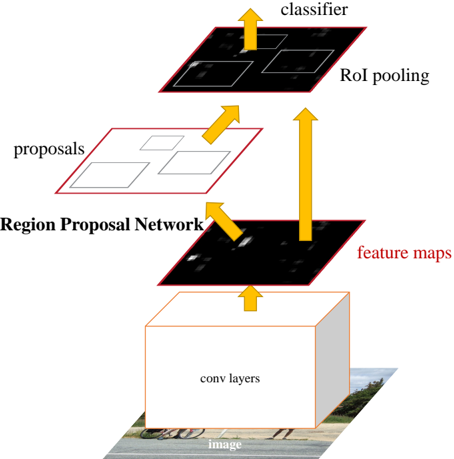
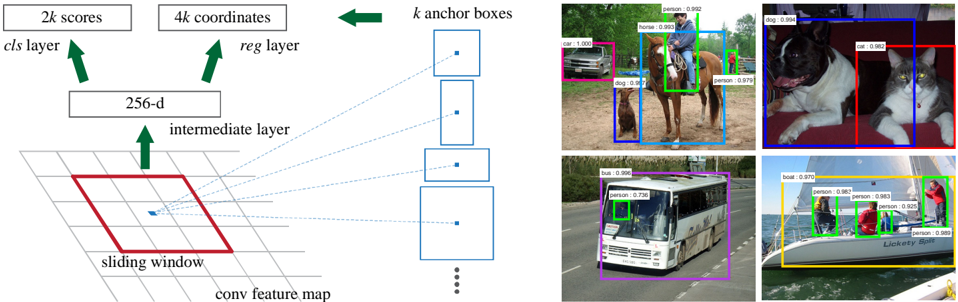
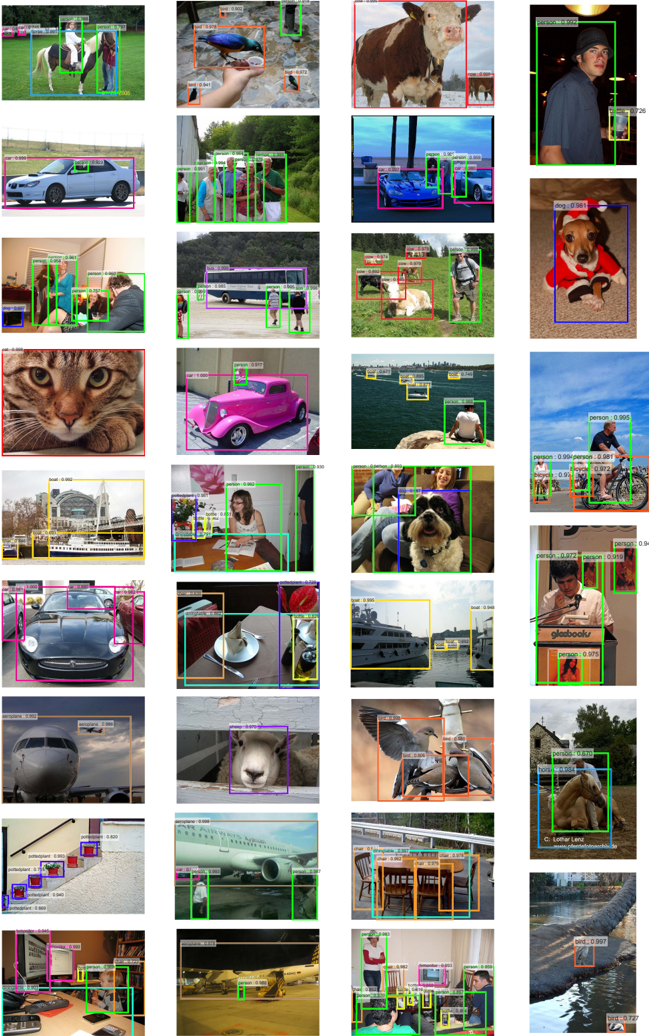
State-of-the-art object detection networks depend on region proposal algorithms to hypothesize object locations. Advances like SPPnet [1] and Fast R-CNN [2] have reduced the running time of these detection networks, exposing region proposal computation as a bottleneck. In this work, we introduce a Region Proposal Network (RPN) that shares full-image convolutional features with the detection network, thus enabling nearly cost-free region proposals. An RPN is a fully convolutional network that simultaneously predicts object bounds and objectness scores at each position. The RPN is trained end-to-end to generate high-quality region proposals, which are used by Fast R-CNN for detection. We further merge RPN and Fast R-CNN into a single network by sharing their convolutional features-using the recently popular terminology of neural networks with 'attention' mechanisms, the RPN component tells the unified network where to look. For the very deep VGG-16 model [3] , our detection system has a frame rate of 5 fps (including all steps) on a GPU, while achieving state-of-the-art object detection accuracy on PASCAL VOC 2007, 2012, and MS COCO datasets with only 300 proposals per image. In ILSVRC and COCO 2015 competitions, Faster R-CNN and RPN are the foundations of the 1st-place winning entries in several tracks. Code has been made publicly available.
Overview
CoChat Summary
TL;DR
Faster R-CNN introduces a Region Proposal Network (RPN) that shares convolutional features with Fast R-CNN, making region proposals nearly cost-free and enabling a unified object detection system. It achieves near real-time detection with state-of-the-art accuracy on PASCAL VOC and MS COCO.
Key findings
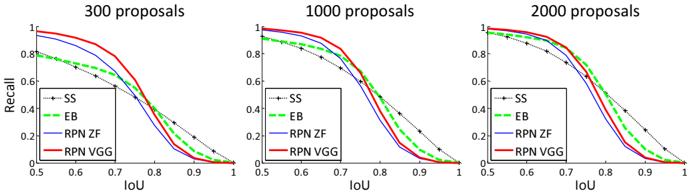
- With VGG-16 and shared features, Faster R-CNN reaches 69.9% mAP on PASCAL VOC 2007 test using 300 proposals, 73.2% with VOC07+12 training, 70.4% on VOC 2012 with 07++12, and 78.8% on VOC 2007 with COCO+07+12.
- Runtime: VGG-16 RPN + Fast R-CNN takes 198 ms total (5 fps), with RPN proposals costing 10 ms; ZF runs at 59 ms total (17 fps), versus SS + Fast R-CNN at 1830 ms (0.5 fps).
- Ablations: sharing features improves ZF mAP from 58.7% (unshared) to 59.9%; removing the reg layer drops mAP to 52.1%, and removing cls with 100 proposals drops it to 44.6%.
- On MS COCO test-dev, Faster R-CNN with VGG-16 and COCO train reaches 42.1% mAP@0.5 and 21.5% mAP@[.5,.95]; with COCO trainval it reaches 42.7% and 21.9%.
Methods
- The RPN is a fully convolutional network that slides a 3×3 window over shared conv features and predicts objectness scores and box regressions relative to anchors; default anchors use 3 scales (128², 256², 512²) and 3 aspect ratios (1:1, 1:2, 2:1), giving k = 9 anchors per position.
- Training uses a 4-step alternating scheme with ImageNet-pretrained ZF or VGG-16, SGD, single-scale images (shorter side s = 600), NMS at IoU 0.7, and 300 proposals at test time; evaluation is on PASCAL VOC 2007/2012 and MS COCO.
- Main metrics are detection mAP on PASCAL VOC and mAP@0.5 / mAP@[.5,.95] on MS COCO, with timing measured on a K40 GPU.
Limitations
- Stated in the paper: non-approximate joint training would require a differentiable RoI pooling/warping layer and is beyond the paper’s scope; the approximate joint training ignores gradients with respect to proposal box coordinates.
- Stated in the paper: cross-boundary anchors are ignored during training, and multi-scale feature extraction may improve accuracy but does not offer a good speed-accuracy trade-off.
- Evident from the text: the main experiments focus on PASCAL VOC and MS COCO with ZF/VGG-16 backbones, so generalization to other datasets, backbones, or detection regimes is not extensively characterized.
Model-written summary. Check it against the paper before relying on it.
Integrity signals
Registry
Cites
Statistics
Figures

Verification
Claims the paper makes
12 Valid · 5 Not valid · 8 Not checked · 83 Own results and interpretations
Every source the paper cites for this claim was checked and supports it.
In the paper
“Only by replacing VGG-16 with a 101layer residual net (ResNet-101) [18], the Faster R-CNN system increases the mAP from 41.5%/21.2% (VGG16) to 48.4%/27.2% (ResNet-101) on the COCO val set.”
What the sources say
- Supportedcites [18] [18] K. He, X. Zhang, S. Ren, and J. Sun, 'Deep residual learning for image recognition,' arXiv:1512.03385 , 2015. - source
Table 8 (p. 8) reports the exact COCO validation-set mAP values for baseline Faster R-CNN with VGG-16 and ResNet-101. Section 4.3 (p. 8) says the detection implementation was the same for both models and attributes the gain to replacing VGG-16 with ResNet-101. (LLM, conf=0.95)
plainstates a cause- Asserted: passes — The authors put it forward as true.
- Checkable: passes — It can be checked against evidence.
- Load-bearing: passes — The paper’s conclusions depend on it.
- Based: passes — The paper gives a reason why it holds.
- Supported
Every source the paper cites for this claim was checked and supports it.
In the paper
“This observation is still valid even when one increases the depth substantially to over 100 layers [18].”
What the sources say
- Supportedcites [18] [18] K. He, X. Zhang, S. Ren, and J. Sun, 'Deep residual learning for image recognition,' arXiv:1512.03385 , 2015. - source
In ImageNet Classification (p. 7), the paper reports that 101- and 152-layer ResNets outperform the 34-layer model, with no observed degradation. Its CIFAR-10 analysis (p. 7) also reports that a 110-layer ResNet converges well. These results support the stated extension to over 100 layers, although the isolated sentence does not specify what “this observation” refers to. (LLM, conf=0.87)
plain- Asserted: passes — The authors put it forward as true.
- Checkable: passes — It can be checked against evidence.
- Load-bearing: unclear — It is unclear whether the paper’s conclusions depend on it.
- Based: passes — The paper gives a reason why it holds.
- Supported
The cited sources support only part of this claim — read each source’s verdict below.
In the paper
“In ILSVRC and COCO 2015 competitions, Faster R-CNN and RPN are the basis of several 1st-place entries [18] in the tracks of ImageNet detection, ImageNet localization, COCO detection, and COCO segmentation.”
What the sources say
- Partly supportedcites [18] [18] K. He, X. Zhang, S. Ren, and J. Sun, 'Deep residual learning for image recognition,' arXiv:1512.03385 , 2015. - sourceExperimental — accuracy not yet measured
Section 4.3 (p. 8) lists first-place finishes in all four tracks, and the Object Detection Baselines (p. 10) describe a Faster R-CNN system using an RPN. The ImageNet Localization section (p. 12) also identifies its RPN-based method. But the copy attributes the entries collectively to deep residual nets; it does not establish that Faster R-CNN and RPN underpinned the COCO segmentation entry. (LLM, conf=0.86)
plainstates a cause- Asserted: passes — The authors put it forward as true.
- Checkable: passes — It can be checked against evidence.
- Load-bearing: unclear — It is unclear whether the paper’s conclusions depend on it.
- Based: passes — The paper gives a reason why it holds.
- Partly supported
The cited sources that could be checked couldn’t confirm or dispute this claim.
In the paper
“Yet when compared to efficient detection networks [2], Selective Search is an order of magnitude slower, at 2 seconds per image in a CPU implementation.”
What the sources say
- Could not verifycites [4] [4] J. R. Uijlings, K. E. van de Sande, T. Gevers, and A. W. Smeulders, 'Selective search for object recognition,' International Journal of Computer Vision (IJCV) , 2013. - sourceExperimental — accuracy not yet measured
The computational discussion in §5.3 (pp. 12–13) gives timings for complete object-recognition pipelines, not a two-second CPU runtime for Selective Search. The comparisons in §5.2.1 (p. 11) concern other object-location methods, not efficient detection networks. Searches for a two-second per-image runtime and a network comparison found neither claim in our copy. (LLM, conf=0.73)
- Not checked — no full text of the sourcecites [2] [2] R. Girshick, 'Fast R-CNN,' in IEEE International Conference on Computer Vision (ICCV) , 2015. - source
plainstates an association- Asserted: passes — The authors put it forward as true.
- Checkable: passes — It can be checked against evidence.
- Load-bearing: passes — The paper’s conclusions depend on it.
- Based: passes — The paper gives a reason why it holds.
- Could not verify
Every source the paper cites for this claim was checked and supports it.
In the paper
“We comprehensively evaluate our method on the PASCAL VOC detection benchmarks [11] where RPNs with Fast R-CNNs produce detection accuracy better than the strong baseline of Selective Search with Fast R-CNNs.”
What the sources say
- Supportedcites [11] [11] M. Everingham, L. Van Gool, C. K. I. Williams, J. Winn, and A. Zisserman, 'The PASCAL Visual Object Classes Challenge 2007 (VOC2007) Results,' 2007. - source
The citation is attached to “PASCAL VOC detection benchmarks,” not to the citing authors’ comparison of RPNs and Selective Search. Sections 5.2 and 6.2 describe the VOC detection task, its submitted methods, and its results, confirming the benchmark identification. (LLM, conf=0.92)
plainstates a cause- Asserted: passes — The authors put it forward as true.
- Checkable: passes — It can be checked against evidence.
- Load-bearing: passes — The paper’s conclusions depend on it.
- Based: passes — The paper gives a reason why it holds.
- Rests on an assumption not shown here.
- Supported
56 more claims
Create a free account to see all 108 claims and to verify the 2 references still open.
- Probably not a substantial claim. 11
- It may state two separate claims as one. 40
- The quote only partly states this claim. 1
Claims other papers make about this one
Each is checked against this paper’s own text: does it say what the citing paper says it does?
The source backs part of the claim, not all of it — or backs it for a different population, condition or comparison.
In the citing paper
“Unlike the original paper [19] that adopted stage-wise training regarding RPN, we use an improved implementation with end-to-end joint training similar to [37], which leads to higher baselines than [19].”
From Non-local Neural Networks (2018) · cites this paper as [37]
Experimental — accuracy not yet measuredThe source backs part of the claim, not all of it — or backs it for a different population, condition or comparison.
In the citing paper
“Faster RCNN is the first near-realtime deep learning detector (COCO mAP@.5=42.7%, VOC07 mAP=73.2%, 17fps with ZF-Net [48]).”
From Object Detection in 20 Years: A Survey (2023) · cites this paper as [19]
Experimental — accuracy not yet measuredThe source backs part of the claim, not all of it — or backs it for a different population, condition or comparison.
In the citing paper
“Faster RCNN is the first near-realtime deep learning detector (COCO mAP@.5=42.7%, VOC07 mAP=73.2%, 17fps with ZF-Net [48]).”
From Object Detection in 20 Years: A Survey (2023) · cites this paper as [47]
Experimental — accuracy not yet measuredThe source backs part of the claim, not all of it — or backs it for a different population, condition or comparison.
In the citing paper
“In the deep learning era, due to the increase of computing power, bootstrap was shortly discarded in object detection during 2014-2016 [16-20].”
From Object Detection in 20 Years: A Survey (2023) · cites this paper as [19]
Experimental — accuracy not yet measuredThe source backs part of the claim, not all of it — or backs it for a different population, condition or comparison.
In the citing paper
“The most commonly used idea to reduce the feature computational redundancy is to compute the feature map of the whole image only once [18, 19, 124], which have achieved tens or even hundreds of times of acceleration.”
From Object Detection in 20 Years: A Survey (2023) · cites this paper as [19]
Experimental — accuracy not yet measured
21 more claims about this paper
Create a free account to see every claim other papers make about this one.
Citations
Cites
Deep Residual Learning for Image Recognition
He, K., Zhang, X., Ren, S., & Sun, J. (2016) · 2016 IEEE Conference on Computer Vision and Pattern Recognition (CVPR) · doi:10.1109/cvpr.2016.90 · Cited by 235,474 · cited 7×
“to propose regions from data, and thus can easily benefit from deeper and more expressive features (such as the 101layer residual nets adopted in [18]).”
BackgroundInfluentialSelf-citationVery Deep Convolutional Networks for Large-Scale Image Recognition
Simonyan, K., & Zisserman, A. (2014) · arXiv · doi:10.48550/arxiv.1409.1556 · Cited by 114,148
ImageNet classification with deep convolutional neural networks
Krizhevsky, A., Sutskever, I., & Hinton, G. E. (2017) · Communications of the ACM · doi:10.1145/3065386 · Cited by 112,155 · cited 1×
“For the regression loss, we use L where R is the robust loss function (smooth L 1 ) defined in [5].”
MethodGoing deeper with convolutions
Szegedy, C., Liu, W., Jia, Y., Sermanet, P., Reed, S., Anguelov, D., Erhan, D., Vanhoucke, V., & Rabinovich, A. (2015) · 2015 IEEE Conference on Computer Vision and Pattern Recognition (CVPR) · doi:10.1109/cvpr.2015.7298594 · Cited by 48,562 · cited 1×
“1× 10(6) parameters (1536 × (4 + 1) × 800 for GoogleNet [34] in MultiBox [27]).”
Microsoft COCO: Common Objects in Context
Lin, T.-Y., Maire, M., Belongie, S., Hays, J., Perona, P., Ramanan, D., Dollár, P., & Zitnick, C. L. (2014) · Lecture Notes in Computer Science · doi:10.1007/978-3-319-10602-1_48 · Cited by 45,460 · cited 1×
“Region proposal methods typically rely on inexpensive features and economical inference schemes.”
MethodImageNet Large Scale Visual Recognition Challenge
Russakovsky, O., Deng, J., Su, H., Krause, J., Satheesh, S., Ma, S., Huang, Z., Karpathy, A., Khosla, A., Bernstein, M., et al. (2015) · International Journal of Computer Vision · doi:10.1007/s11263-015-0816-y · Cited by 39,380 · cited 1×
“, the shared convolutional layers) are initialized by pre-training a model for ImageNet classification [36], as is standard practice [5].”
MethodFully convolutional networks for semantic segmentation
Long, J., Shelhamer, E., & Darrell, T. (2015) · 2015 IEEE Conference on Computer Vision and Pattern Recognition (CVPR) · doi:10.1109/cvpr.2015.7298965 · Cited by 38,834 · cited 5×
“Our RPNs are thus a kind of fully-convolutional network (FCN) [14] and they can be trained end-to-end specifically for the task for generating detection proposals.”
BackgroundMethodInfluentialRich Feature Hierarchies for Accurate Object Detection and Semantic Segmentation
Girshick, R., Donahue, J., Darrell, T., & Malik, J. (2014) · 2014 IEEE Conference on Computer Vision and Pattern Recognition · doi:10.1109/cvpr.2014.81 · Cited by 32,684 · cited 7×
“, Selective Search [4] object detectors, RCNN [5], and Fast R-CNN [2]).”
BackgroundMethodInfluentialSelf-citationGirshick, R. (2015) · 2015 IEEE International Conference on Computer Vision (ICCV) · doi:10.1109/iccv.2015.169 · Cited by 28,105
Self-citationThe pascal visual object classes (VOC) challenge
Everingham, M., Van Gool, L., Williams, C. K. I., Winn, J., & Zisserman, A. (2010) · International Journal of Computer Vision · doi:10.1007/s11263-009-0275-4 · Cited by 19,599
Research works printed but not linked: 1
- [10] S. Ren, K. He, R. Girshick, and J. Sun, 'Faster R-CNN: Towards real-time object detection with region proposal networks,' in Neural Information Processing Systems (NIPS) , 2015. -
Cited by
Items 46,101–46,200 of 56,411
A Fast and Accurate Object Detection Algorithm on Humanoid Marathon Robot
Jamzuri, E. R., Mandala, H., & Baltes, J. (2020) · Indonesian Journal of Electrical Engineering and Informatics (IJEEI) · doi:10.11591/ijeei.v8i1.1960 · Cited by 2
Toward the Development of a Cognitive Agent for Wide-Area Search
Purman, B., Messing, J., & Crossman, J. (2019) · IEEE National Aerospace and Electronics Conference (NAECON) · doi:10.1109/naecon46414.2019.9058210
Effective Pipeline for Compressing Deep Object Detectors
Yao, Y., Fang, Z., Dong, B., et al. (2020) · IEEE International Conference on Acoustics Speech and Signal Processing · doi:10.1109/icassp40776.2020.9054502
Adaptive Selection of Optimal Feature for Object Detection
Yang, X., Wang, L., Li, Y., Li, H., & Huang, W. (2019) · IEEE International Conference on Electronics and Communication Engineering (ICECE) · doi:10.1109/icece48499.2019.9058513
A Deep Neural Network Object Detection Method Using Multiscale Poisson Fusion
Liu, B., Chen, H., Yun-zhi, Y., & Wang, C.-Y. (2019) · International Computer Conference on Wavelet Active Media Technology and Information Processing (ICCWAMTIP) · doi:10.1109/iccwamtip47768.2019.9067605
Selected and refined local attention module for object detection
Luo, X., & Hu, H. (2020) · Electronics Letters · doi:10.1049/el.2020.0182
Deep learning-based Region of Interest Extraction for Finger Vein Images
Yang, K., Fang, P., & Wu, J. Y. (2020) · IOP Conference Series Materials Science and Engineering · doi:10.1088/1757-899x/782/3/032056
A Deep Motion Vector Approach to Video Object Segmentation
Garg, V. (2019) · OakTrust (Texas A&M University Libraries)
Spatial Feature Collaborative Network for Trademark Image Retrieval
Tao, Z., Wang, B., Wang, W., et al. (2019) · IEEE International Conference on Cloud Computing and Intelligence Systems (CCIS) · doi:10.1109/ccis48116.2019.9073730
Object Detection Approach Using Single Shot Multibox Detector for Sprinting Movement Recognition
Kamarudin, M. K., Satria, M. H., Latip, H. F. M., et al. (2020) · Lecture notes in bioengineering · doi:10.1007/978-981-15-3270-2_33
Human Outline Reconstruction in Depth Prediction
Li, X., & Cheng, S. S. M. (2019) · International Conference on Security, Pattern Analysis, and Cybernetics (SPAC) · doi:10.1109/spac49953.2019.237867
Diverse Visuo-Lingustic Question Answering (DVLQA) ChallengePreprint
Sampat, S. K., Yang, Y., & Baral, C. R. (2020) · arXiv (Cornell University) · Cited by 1
Object Discovery and Acknowledgment in Images
Karwasra, J. K., & Dadhich, P. (2019) · International Journal on Recent and Innovation Trends in Computing and Communication · doi:10.17762/ijritcc.v7i12.5383
Improving the Visibility of Nighttime Images for Pedestrian Recognition using In-Vehicle Camera
Ogura, R., Nagasaki, T., & Matsubara, H. (2020) · IEEJ Transactions on Electronics Information and Systems · doi:10.1541/ieejeiss.140.531
Bjerge, K., Schougaard, J. H., & Larsen, D. E. (2020) · arXiv (Cornell University)
ProbaNet: Proposal-balanced Network for Object DetectionPreprint
Wu, J., Zhang, X., Zhou, M., & Zhu, C. (2020) · arXiv (Cornell University) · doi:10.48550/arxiv.2005.02699
Towards bio-inspired fruit detection for agriculture
Hobbs, Z., Duckett, T., Pearson, S., et al. (2020) · Journal of robotics & autonomous systems · doi:10.31256/le4ce5s
Towards coordinated multi-agent exploration problem via segmentation and reinforcement learning
Chen, Z. (2019) · DR-NTU (Nanyang Technological University) · doi:10.32657/10356/137152
Candidate region correlation for video action detection
Li, Y., Zhang, M., Hu, L., Li, J., & Wang, D. (2020) · Journal of Visual Communication and Image Representation · doi:10.1016/j.jvcir.2020.102818
Deep Transfer Learning For Plant Center LocalizationPreprint
Cai, E., Baireddy, S., Yang, C., et al. (2020) · arXiv (Cornell University) · doi:10.48550/arxiv.2004.13973
Termografia em um contexto de manutenção industrial eficiente
Dinardi, P. T., da Costa, K. S., & Torné, I. G. (2020) · Editora Poisson eBooks · doi:10.36229/978-65-86127-20-1.cap.05
Hertlein, F., Münch, D., & Arens, M. (2020) · IEEE/CVF Winter Conference on Applications of Computer Vision Workshops (WACVW) · doi:10.1109/wacvw50321.2020.9096934 · Cited by 1
TV Guidance Simulation Platform Based on Deep Learning
Yu, Z., Chen, W., Chen, Z., et al. (2019) · IEEE International Conference on Cybernetics and Intelligent Systems and IEEE Conference on Robotics, Automation and Mechatronics (CIS-RAM) · doi:10.1109/cis-ram47153.2019.9095814
Semantic Segmentation of Human Body using Generative Adversarial Neural Networks
Pathak, P., Narendra, P., Mathanky, S. R., & Murthy, H. V. S. (2018) · doi:10.1109/icinpro43533.2018.9096774
Neural Network Model Of Message Passing in Team Cooperation
Tan, T., & Zhao, Y. Z. (2020) · International Conference on Computer Engineering and Application (ICCEA) · doi:10.1109/iccea50009.2020.00092 · Cited by 1
Discrete Intelligible Recognition Network
Mei, S., Zhang, L., & Wang, Y. (2020) · International Conference on Mathematics and Artificial Intelligence (ICMAI) · doi:10.1145/3395260.3395285
Learn to navigate through deep neural networks
Wu, K. (2020) · DR-NTU (Nanyang Technological University) · doi:10.32657/10356/139680
Multi-task Learning for Bi-temporal Remote Sensing Scene Parsing via Patch-pixel Representation
Fu, C., Bao, T., Lv, L., Sirajidin, S., Fang, T., & Huo, H. (2020) · International Conference on Machine Learning and Computing (ICMLC) · doi:10.1145/3383972.3384032
O’Boyle, P., Galloway, M., & White, A. (2020) · ACM Southeast Conference (ACMSE) · doi:10.1145/3374135.3385303
Zhang, Y., Wang, M., & Li, Z. (2020) · ACM International Conference on Computing Frontiers (CF) · doi:10.1145/3387902.3392620 · Cited by 1
Object Detection with Task Description Only
Sun, Y., Chen, W., & Chen, C. (2019) · International Conference on Intelligent Robotics and Control Engineering (IRCE) · doi:10.1109/irce.2019.00030
CNN feature or handcrafted feature in DCF object tracker?
Zhou, Y., Guo, H., & Wang, D. (2020) · Engineering Science and Technology an International Journal · doi:10.1016/j.jestch.2020.05.003
MASC-Net: Multi-scale Anisotropic Sparse Convolutional Network for Sparse Depth Densification
Ryu, S., Cho, J.-H., & Kunnath, N. X. (2020) · Canadian Conference on Computer and Robot Vision · doi:10.1109/crv50864.2020.00023
Real-time Head Detection for Automated Passenger Counting in Embedded Systems
Kim, H., Lee, S., & Sohn, M. (2019) · International Symposium on Computer Science and Intelligent Control (ISCSIC) · doi:10.1145/3386164.3389086
An Object Detection Algorithm Based on Improved Network Structure
Du, H., Li, S., & Li, Y. (2019) · International Conference on Information Science and Control Engineering · doi:10.1109/icisce48695.2019.00039
Alongshore Ship Detection Based On Multiscale Feature Fusion of Rotation Region Proposal Networks
Dou, H., Mao, J., & Pan, Z. (2020) · Journal of Physics Conference Series · doi:10.1088/1742-6596/1544/1/012148
Semantic Segmentation Of Rocks On Lunar Surface Using Convolutional Neural Networks
Prasad, M. V. D., Ahammad, S. H., Tarani, D., et al. (2020) · International journal of scientific and technology research
An accurate and fast detection method for railway lightning protection component
Wu, S., Li, B., Wang, Z., Chen, X., Shi, L. X., & Tan, S. (2020) · IOP Conference Series Materials Science and Engineering · doi:10.1088/1757-899x/792/1/012010
STRUCTURAL HEALTH MONITORING OF CABLES USING SMART SENSORS IN CABLE-STAYED BRIDGES
Jeong, S. (2020) · Scholarworks@UNIST (Ulsan National Institute of Science and Technology)
Lee, J. T., Lim, Y. K., & Han, J. Y. (2020) · ACM/IEEE International Conference on Information Processing in Sensor Networks (IPSN) · doi:10.1109/ipsn48710.2020.00-17
Klaas, T. A., Lambrecht, J., & Funk, E. (2020) · IEEE International Conference on Factory Communication Systems (WFCS) · doi:10.1109/wfcs47810.2020.9114454
Empirical Analysis for Earlier Diagnosis of Alzheimer’s Disease Using Deep Learning
Sun, S. (2020) · Tuwhera (Auckland University of Technology) · Cited by 4
Extraction of Thermos Cup Contour Based on Optimized Edge Feature and Line Detection
Wang, G., & Yang, H. (2020) · International Conference on Intelligent Transportation, Big Data & Smart City (ICITBS) · doi:10.1109/icitbs49701.2020.00192
Ren, J., Du, Y., Chen, Z., Xiao, F., Jia, C., & Bao, H. (2020) · IEEE International Conference on Multimedia & Expo Workshops (ICMEW) · doi:10.1109/icmew46912.2020.9105978
A Unified Method for Vision Aided Navigation of Autonomous Systems
Wee, L.-B., Wei, S. X., Lee, E., & Yu, H. (2020) · IEEE/ION Position Location and Navigation Symposium · doi:10.1109/plans46316.2020.9110206
Estimation of the Number of Vehicles by Regression Based on Parts Detection
Shinmura, F., Kawanishi, Y., Deguchi, D., et al. (2020) · Journal of Japan Society for Fuzzy Theory and Intelligent Informatics · doi:10.3156/jsoft.32.3_705
Eklund, H. (2019) · DiVA at Umeå University (Umeå University)
Visualizing and Understanding Vision SystemPreprint
Qi, F., & Jiang, G. (2020) · arXiv (Cornell University) · doi:10.48550/arxiv.2006.11413
SomethingFinder: Localizing undefined regions using referring expressions
Eum, S., Han, D. K., & Briggs, G. (2020) · IEEE/CVF Conference on Computer Vision and Pattern Recognition Workshops (CVPRW) · doi:10.1109/cvprw50498.2020.00198
Probing for Artifacts: Detecting Imagenet Model Evasions
Rounds, J., Kingsland, A., Henry, M. J., & Duskin, K. (2020) · IEEE/CVF Conference on Computer Vision and Pattern Recognition Workshops (CVPRW) · doi:10.1109/cvprw50498.2020.00403 · Cited by 1
Research on Low Altitude Object Detection Based on Deep Convolution Neural Network
Qi, Y., Gu, J., Tian, Z., Dengchao, F., & Su, Y. (2020) · Studies in distributed intelligence · doi:10.1007/978-3-030-45099-1_13
Obtaining Deep Learning Models for Automatic Classification of Leukocytes
Rodrigues, P. J., Igrejas, G., & Beato, R. F. (2020) · Advances in computer and electrical engineering book series · doi:10.4018/978-1-7998-3095-5.ch001
Infrared target detecting in severe jamming using detector based on Deep Learning
Hu, Y., Xiao, M., Liu, Z., et al. (2019) · doi:10.1109/icusai47366.2019.9124788
Anegawa, R., & Aritsugi, M. (2020) · arXiv (Cornell University) · doi:10.48550/arxiv.2006.14808
Pedestrian and Lane Detection using Computer Vision
Srija, R., & Kumar, K. C. A. (2019) · International Journal of Innovative Research in Applied Sciences and Engineering · doi:10.29027/ijirase.v3.i11.2019.416-419
Neighbouring Relationship Exploration Based on Graph Convolutional Network for Object Detection
Du, Z., Ji, J., Wang, J., Hu, Q., Gao, S., & Zhang, X. (2019) · IEEE International Conference on Unmanned Systems and Artificial Intelligence (ICUSAI) · doi:10.1109/icusai47366.2019.9124840
Improving Applications of Systems of Systems using Ultra Fast Instance Segmentation
DeMoor, M. G., & Prevost, J. J. (2020) · International Conference on System of Systems Engineering · doi:10.1109/sose50414.2020.9130537
Research on Situation System Based on Big Data Image -- Taking Road Traffic as an Example
Zhu, Y., Zhao, J., Li, X., et al. (2020) · Journal of Physics Conference Series · doi:10.1088/1742-6596/1549/2/022037
Pham, V.-A., Hoang, D.-H., Chung-Nguyen, H.-H., et al. (2020) · Informatica · doi:10.31449/inf.v44i2.3090
Target Tracking Algorithm Based on Density Clustering
Chen, J., Zeng, Q., & Qin, X. (2020) · Lecture notes in computer science · doi:10.1007/978-3-030-53956-6_51
Sparse Graph to Sequence Learning for Vision Conditioned Long Textual Sequence GenerationPreprint
Mogadala, A., Mosbach, M., & Klakow, D. (2020) · arXiv (Cornell University) · doi:10.48550/arxiv.2007.06077
EOLO: Deep Machine Learning Algorithm for Embedded Object Segmentation that Only Looks Once
Zeng, L., & Mohammed, S. (2020) · International Journal of Multimedia and Ubiquitous Engineering · doi:10.21742/ijmue.2020.15.1.04
Design of intelligent surveillance system based on wireless ad-hoc network under special conditions
Han, Y., Li, G., & Chen, T. (2020) · Journal of Ambient Intelligence and Humanized Computing · doi:10.1007/s12652-020-02140-6
Three Simple Approaches to Combining Neural Networks with Algorithms
Osokin, A. (2020) · Communications in computer and information science · doi:10.1007/978-3-030-51913-1_1
Various OCT Segmentation and Classification Techniques
Joy, N. (2020) · International Journal of Information Systems and Computer Sciences · doi:10.30534/ijiscs/2020/05932020
Top-Related Meta-Learning Method for Few-Shot Detection.Preprint
Li, Q., Guo, N., Wang, D., et al. (2020) · arXiv (Cornell University)
Towards Learning Obstacles to Avoid Collisions in Autonomous Robot Navigation
Sánchez-García, Á. J., Ríos-Figueroa, H. V., Limón, X., García, J. A. S., & Cortés-Verdín, K. (2019) · International Conference on Mechatronics, Electronics and Automotive Engineering (ICMEAE) · doi:10.1109/icmeae.2019.00012
Accurate Object Detection in Smart Transportation Using Multiple Cameras
Qiao, Z., Sansom, A., McGuire, M., Kalaani, A., Ma, X., Yang, Q. X., & Fu, S. (2020) · International Conference on Connected and Autonomous Driving (MetroCAD) · doi:10.1109/metrocad48866.2020.00011
Optical coherence tomography and deep learning for ophthalmology
Heisler, M. (2020) · Summit (Simon Fraser University)
Reconstruction Regularized Deep Metric Learning for Multi-label Image ClassificationPreprint
Li, C., Liu, C., Duan, L., et al. (2020) · arXiv (Cornell University) · doi:10.48550/arxiv.2007.13547
Computer vision based smoke and fire detection for outdoor environments
Alamgir, N. (2020) · Queensland University of Technology · doi:10.5204/thesis.eprints.201654
Towards Computationally-Efficient Cognitive Sensor Systems for Autonomous Vehicles
Rajanarayana, S. M., Kumar, S. S., Zjajo, A., & van Leuken, R. (2019) · IEEE International Conference on Cognitive Informatics & Cognitive Computing (ICCI*CC) · doi:10.1109/iccicc46617.2019.9146070 · Cited by 2
Learning deep structured models for visual understanding
Deng, Z. (2019) · Summit (Simon Fraser University)
Efficient generative model for motion deblurring
Han, X., Sang, H., Sun, L., & Zhao, Y. J. (2020) · The Journal of Engineering · doi:10.1049/joe.2019.1163
Research and Implementation of Violation Monitoring System for Electric Customer Service Hall
Dong, S., Wu, P., & Qiao, J. (2020) · International Conference on Graphics and Signal Processing (ICGSP) · doi:10.1145/3406971.3406986
Threat Detection with Facial Expression and Suspicious Weapon
Kamble, K. P., Sontakke, S., Mundada, P. D., & Pawar, A. (2020) · Advances in intelligent systems and computing · doi:10.1007/978-981-15-4029-5_39
Accuracy-Relevance trade-off in Transfer Learning for Object Detection
Parikh, D., & Sachdev, S. (2020) · International Conference for Emerging Technology (INCET) · doi:10.1109/incet49848.2020.9154086 · Cited by 1
Low-dimensional representation of visual dynamics towards animal/human behavior monitoring
Rezaei, B. (2020) · Digital Repository Service (Northeastern University) · doi:10.17760/d20382831
Real-World Object Recognition for Robot Based on Lightweight Deep Multimodal Distance Learning
Zhang, X., Xue, B., & Feng, J. (2020) · Asia-Pacific Conference on Intelligent Robot Systems (ACIRS) · doi:10.1109/acirs49895.2020.9162600
Key-Nets: Optical Transformation Convolutional Networks for Privacy Preserving Vision Sensors
Byrne, J., DeCann, B., & Bloom, S. (2020) · British Machine Vision Conference (BMVC) · doi:10.5244/c.34.27 · Cited by 5
Flow-Guided Single Object Tracking Framework in UAV Aerial Video
Zhu, W., Yu, X., & Meng, J. (2020) · Chinese Control and Decision Conference (CCDC) · doi:10.1109/ccdc49329.2020.9164380
Deep Representation Learning for Visually-Grounded Dialog
강기천 (2020) · Seoul National University Open Repository (Seoul National University)
Mahdavi, M. (2020) · RIT Scholar Works (Rochester Institute of Technology)
Text Detection by Fusing Text Edge Semantics in Arbitrary Shapes
Gao, Z., Peng, B., & Li, T. (2019) · IEEE International Conference on Intelligent Systems and Knowledge Engineering · doi:10.1109/iske47853.2019.9170424
An Integrated Detection and Tracking System Applied to Unmanned Surface Vehicles
Zhou, Z., Wang, Q., Zhao, J. H., & Qu, C. (2019) · IEEE International Conference on Signal, Information and Data Processing (ICSIDP) · doi:10.1109/icsidp47821.2019.9173123
In-House Deep Environmental Sentience for Smart Homecare Solutions Toward Ageing Society
Easom, P., Bouridane, A., Qiang, F., Zhang, L., Downs, C., & Jiang, R. (2020) · International Conference on Machine Learning and Cybernetics · doi:10.1109/icmlc51923.2020.9469531 · Cited by 1
Multi-Scale Real-Time Object Detection With Densely Connected Network
Jiang, D., Bai, Z., & Li, Q. (2019) · IEEE International Conference on Signal, Information and Data Processing (ICSIDP) · doi:10.1109/icsidp47821.2019.9173386
OBJECT DETECTION WITH THE HIGH-FREQUENCY CHANGE OF OBJECTS CLASSES
Lou, L., Zhang, S., & Zhang, S. (2020) · The international archives of the photogrammetry, remote sensing and spatial information sciences/International archives of the photogrammetry, remote sensing and spatial information sciences · doi:10.5194/isprs-archives-xliii-b3-2020-125-2020
Ground Target Automatic Recognition and Tracking in Complex Battlefield Environment
Wu, C., Tang, L., & Duan, C. (2019) · IEEE International Conference on Signal, Information and Data Processing (ICSIDP) · doi:10.1109/icsidp47821.2019.9173072
Learning Single-Shot Detector with Mask Prediction and Gate Mechanism
Chen, J., Pan, H., Cui, Q., Yang, D., & He, S. (2020) · Communications in computer and information science · doi:10.1007/978-981-15-7981-3_23
PSIG-GAN: A Parameterized Synthetic Image Generator Optimized via Non-Differentiable GAN
Khajanchi, H. I., Bezold, J., Kilcher, M., Benasutti, A., Rentsch, B., Pearlstein, L., & Maxwell, S. (2019) · IEEE Applied Imagery Pattern Recognition Workshop · doi:10.1109/aipr47015.2019.9174588
Using Robust Networks to Inform Lightweight Models in Semi-Supervised Learning for Object Detection
Worobey, J., Recker, S., & Gribble, C. (2019) · IEEE Applied Imagery Pattern Recognition Workshop · doi:10.1109/aipr47015.2019.9174592
Applying Ternary Net Weights to the R-Mask Neural Network to Identify Bronchopulmonary Lung Segments
Francis, N., Francis, N. J., Axyonov, S. V., Saqib, M., Xu, Y., & Aljasar, S. A. (2020) · Journal of Physics Conference Series · doi:10.1088/1742-6596/1611/1/012061
Towards Autonomous Driving: a Multi-Modal 360$^{\circ}$ Perception ProposalPreprint
Beltrán, J., Guindel, C., Cortés, I., et al. (2020) · arXiv (Cornell University) · doi:10.48550/arxiv.2008.09672
Multi Stage Common Vector Space for Multimodal Embeddings
Gopalakrishnan, S., Udaiyar, P., Sah, S., & Ptucha, R. (2019) · IEEE Applied Imagery Pattern Recognition Workshop · doi:10.1109/aipr47015.2019.9174583
Wickert, L. M., Bogen, M. A., & Richter, M. (2020) · The international archives of the photogrammetry, remote sensing and spatial information sciences/International archives of the photogrammetry, remote sensing and spatial information sciences · doi:10.5194/isprs-archives-xliii-b3-2020-233-2020
Moderately supervised learning: definition and framework.Preprint
Yang, Y., & Zheng, Z. (2020) · arXiv (Cornell University)
Object Detection Using Convolutional Neural Network Trained on Synthetic Images
Vi, M. (2018) · KTH Publication Database DiVA (KTH Royal Institute of Technology)
Finding Action Tubes with a Sparse-to-Dense FrameworkPreprint
Li, Y., Lin, W., Wang, T., et al. (2020) · arXiv (Cornell University) · doi:10.48550/arxiv.2008.13196
Metadata
- Authors
- Ren, S., He, K., Girshick, R., & Sun, J.
- Affiliations
- University of Science and Technology of China (CN)
- Visual Computing Group, Microsoft Research, Beijing, China
- Meta (United States) (US)
- ORCID
- Venue
- IEEE Transactions on Pattern Analysis and Machine Intelligence
- Published
- 2017-06-01
- Volume
- 39
- Issue
- 6
- Pages
- 1137-1149
- ISSN
- 0162-8828 (ISSN-L)
- 2160-9292
- 1939-3539
- OpenAlex
- W639708223
- Cited by
- 73,472
- References
- 60
- Citations by year
- 2026: 5632 · 2025: 9233 · 2024: 9699 · 2023: 9795 · 2022: 9251 · 2021: 9857 · 2020: 7617 · 2019: 6376 · 2018: 3729 · 2017: 1740
- FWCI
- 2215.09
- Type
- journal article
- Language
- en
- Open access
- green
- arxiv.org
- Licence
- Locations
- IEEE Transactions on Pattern Analysis and Machine Intelligence (publishedVersion)
- PubMed (publishedVersion)
- arXiv (Cornell University) (submittedVersion)
- arXiv (Cornell University)
- neural information processing systems
- Funders
- Microsoft Research
- Topics
- Physical Sciences › Computer Science › Computer Vision and Pattern Recognition › Advanced Neural Network Applications
- Physical Sciences › Computer Science › Computer Vision and Pattern Recognition › Visual Attention and Saliency Detection
- Physical Sciences › Computer Science › Computer Vision and Pattern Recognition › Advanced Image and Video Retrieval Techniques
- Keywords
- Faster R-CNN, region proposal network, real-time object detection, Fast R-CNN, bounding box regression, VGG16, attention mechanism, end-to-end learning, Pascal VOC, MS COCO
About these checks
Registry, retraction, Cites and statistics results are computed, not judged, with one exception: a printed reference that no index lists is read once by a model before it counts as a citation error. Claims are extracted by a model and kept only when their quote appears verbatim in the text; each cited source is then checked, with a model’s help, for whether it says what the claim relies on. Those verdicts can be wrong — read the claim’s quote and the cited source before relying on one.
The claim verdicts this report counts are experimental: their accuracy is not yet measured.
A language model drew the claims from the paper on 2026-10-10, under version 3 of the claim definition (model deepseek-v4.1-flash, prompt extract-v3).
A second model labelled each claim on 2026-10-10 (model jev-1.13-20260917, definition revision gold-guideline-v0.2).
Cited sources are checked with a language model’s help (gpt-6-sol).
Statistics and arithmetic are recomputed, not judged.
Confidence bands are shown only for fields calibrated on our annotated test set. None is calibrated yet, so no band is shown.
What counts as a claim ›How we measure confidence ›How we check this ›
Are you an author, or do you see a problem with this page? Request a review
Data sources
Bibliographic data: Semantic Scholar, OpenAlex, Crossref.
Contains information from the Semantic Scholar Academic Graph Datasets, made available under the ODC Attribution License (ODC-BY 1.0).
Semantic Scholar’s data is described in: Kinney, R., et al. (2023). The Semantic Scholar Open Data Platform. arXiv:2301.10140.
