

Faster R-CNN: Towards Real-Time Object Detection with Region Proposal Networks
Open accessThe DOI matches its Crossref record; 56 of the 60 references it cites were found in a registry or an index; 15 of the 27 sources its claims cite were checked for support.
Abstract
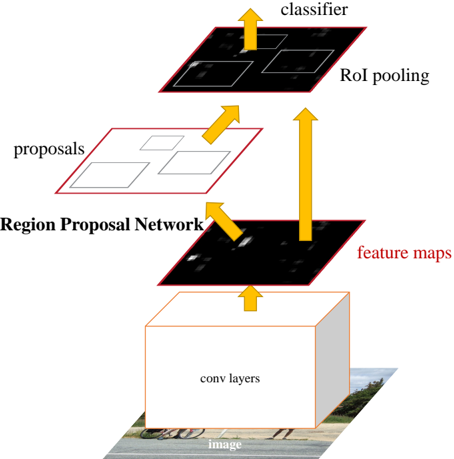
State-of-the-art object detection networks depend on region proposal algorithms to hypothesize object locations. Advances like SPPnet [1] and Fast R-CNN [2] have reduced the running time of these detection networks, exposing region proposal computation as a bottleneck. In this work, we introduce a Region Proposal Network (RPN) that shares full-image convolutional features with the detection network, thus enabling nearly cost-free region proposals. An RPN is a fully convolutional network that simultaneously predicts object bounds and objectness scores at each position. The RPN is trained end-to-end to generate high-quality region proposals, which are used by Fast R-CNN for detection. We further merge RPN and Fast R-CNN into a single network by sharing their convolutional features-using the recently popular terminology of neural networks with 'attention' mechanisms, the RPN component tells the unified network where to look. For the very deep VGG-16 model [3] , our detection system has a frame rate of 5 fps (including all steps) on a GPU, while achieving state-of-the-art object detection accuracy on PASCAL VOC 2007, 2012, and MS COCO datasets with only 300 proposals per image. In ILSVRC and COCO 2015 competitions, Faster R-CNN and RPN are the foundations of the 1st-place winning entries in several tracks. Code has been made publicly available.
Overview
CoChat Summary
TL;DR
Faster R-CNN introduces a Region Proposal Network (RPN) that shares convolutional features with Fast R-CNN, making region proposals nearly cost-free and enabling a unified object detection system. It achieves near real-time detection with state-of-the-art accuracy on PASCAL VOC and MS COCO.
Key findings
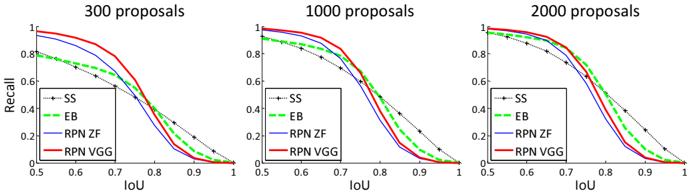
- With VGG-16 and shared features, Faster R-CNN reaches 69.9% mAP on PASCAL VOC 2007 test using 300 proposals, 73.2% with VOC07+12 training, 70.4% on VOC 2012 with 07++12, and 78.8% on VOC 2007 with COCO+07+12.
- Runtime: VGG-16 RPN + Fast R-CNN takes 198 ms total (5 fps), with RPN proposals costing 10 ms; ZF runs at 59 ms total (17 fps), versus SS + Fast R-CNN at 1830 ms (0.5 fps).
- Ablations: sharing features improves ZF mAP from 58.7% (unshared) to 59.9%; removing the reg layer drops mAP to 52.1%, and removing cls with 100 proposals drops it to 44.6%.
- On MS COCO test-dev, Faster R-CNN with VGG-16 and COCO train reaches 42.1% mAP@0.5 and 21.5% mAP@[.5,.95]; with COCO trainval it reaches 42.7% and 21.9%.
Methods
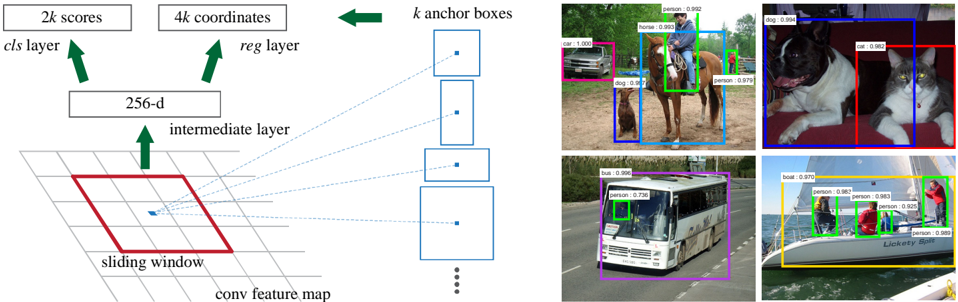
- The RPN is a fully convolutional network that slides a 3×3 window over shared conv features and predicts objectness scores and box regressions relative to anchors; default anchors use 3 scales (128², 256², 512²) and 3 aspect ratios (1:1, 1:2, 2:1), giving k = 9 anchors per position.
- Training uses a 4-step alternating scheme with ImageNet-pretrained ZF or VGG-16, SGD, single-scale images (shorter side s = 600), NMS at IoU 0.7, and 300 proposals at test time; evaluation is on PASCAL VOC 2007/2012 and MS COCO.
- Main metrics are detection mAP on PASCAL VOC and mAP@0.5 / mAP@[.5,.95] on MS COCO, with timing measured on a K40 GPU.
Limitations
- Stated in the paper: non-approximate joint training would require a differentiable RoI pooling/warping layer and is beyond the paper’s scope; the approximate joint training ignores gradients with respect to proposal box coordinates.
- Stated in the paper: cross-boundary anchors are ignored during training, and multi-scale feature extraction may improve accuracy but does not offer a good speed-accuracy trade-off.
- Evident from the text: the main experiments focus on PASCAL VOC and MS COCO with ZF/VGG-16 backbones, so generalization to other datasets, backbones, or detection regimes is not extensively characterized.
Model-written summary. Check it against the paper before relying on it.
Integrity signals
Registry
Cites
Statistics
Figures

Verification
Claims the paper makes
12 Valid · 5 Not valid · 8 Not checked · 83 Own results and interpretations
Every source the paper cites for this claim was checked and supports it.
In the paper
“Only by replacing VGG-16 with a 101layer residual net (ResNet-101) [18], the Faster R-CNN system increases the mAP from 41.5%/21.2% (VGG16) to 48.4%/27.2% (ResNet-101) on the COCO val set.”
What the sources say
- Supportedcites [18] [18] K. He, X. Zhang, S. Ren, and J. Sun, 'Deep residual learning for image recognition,' arXiv:1512.03385 , 2015. - source
Table 8 (p. 8) reports the exact COCO validation-set mAP values for baseline Faster R-CNN with VGG-16 and ResNet-101. Section 4.3 (p. 8) says the detection implementation was the same for both models and attributes the gain to replacing VGG-16 with ResNet-101. (LLM, conf=0.95)
plainstates a cause- Asserted: passes — The authors put it forward as true.
- Checkable: passes — It can be checked against evidence.
- Load-bearing: passes — The paper’s conclusions depend on it.
- Based: passes — The paper gives a reason why it holds.
- Supported
Every source the paper cites for this claim was checked and supports it.
In the paper
“This observation is still valid even when one increases the depth substantially to over 100 layers [18].”
What the sources say
- Supportedcites [18] [18] K. He, X. Zhang, S. Ren, and J. Sun, 'Deep residual learning for image recognition,' arXiv:1512.03385 , 2015. - source
In ImageNet Classification (p. 7), the paper reports that 101- and 152-layer ResNets outperform the 34-layer model, with no observed degradation. Its CIFAR-10 analysis (p. 7) also reports that a 110-layer ResNet converges well. These results support the stated extension to over 100 layers, although the isolated sentence does not specify what “this observation” refers to. (LLM, conf=0.87)
plain- Asserted: passes — The authors put it forward as true.
- Checkable: passes — It can be checked against evidence.
- Load-bearing: unclear — It is unclear whether the paper’s conclusions depend on it.
- Based: passes — The paper gives a reason why it holds.
- Supported
The cited sources support only part of this claim — read each source’s verdict below.
In the paper
“In ILSVRC and COCO 2015 competitions, Faster R-CNN and RPN are the basis of several 1st-place entries [18] in the tracks of ImageNet detection, ImageNet localization, COCO detection, and COCO segmentation.”
What the sources say
- Partly supportedcites [18] [18] K. He, X. Zhang, S. Ren, and J. Sun, 'Deep residual learning for image recognition,' arXiv:1512.03385 , 2015. - sourceExperimental — accuracy not yet measured
Section 4.3 (p. 8) lists first-place finishes in all four tracks, and the Object Detection Baselines (p. 10) describe a Faster R-CNN system using an RPN. The ImageNet Localization section (p. 12) also identifies its RPN-based method. But the copy attributes the entries collectively to deep residual nets; it does not establish that Faster R-CNN and RPN underpinned the COCO segmentation entry. (LLM, conf=0.86)
plainstates a cause- Asserted: passes — The authors put it forward as true.
- Checkable: passes — It can be checked against evidence.
- Load-bearing: unclear — It is unclear whether the paper’s conclusions depend on it.
- Based: passes — The paper gives a reason why it holds.
- Partly supported
The cited sources that could be checked couldn’t confirm or dispute this claim.
In the paper
“Yet when compared to efficient detection networks [2], Selective Search is an order of magnitude slower, at 2 seconds per image in a CPU implementation.”
What the sources say
- Could not verifycites [4] [4] J. R. Uijlings, K. E. van de Sande, T. Gevers, and A. W. Smeulders, 'Selective search for object recognition,' International Journal of Computer Vision (IJCV) , 2013. - sourceExperimental — accuracy not yet measured
The computational discussion in §5.3 (pp. 12–13) gives timings for complete object-recognition pipelines, not a two-second CPU runtime for Selective Search. The comparisons in §5.2.1 (p. 11) concern other object-location methods, not efficient detection networks. Searches for a two-second per-image runtime and a network comparison found neither claim in our copy. (LLM, conf=0.73)
- Not checked — no full text of the sourcecites [2] [2] R. Girshick, 'Fast R-CNN,' in IEEE International Conference on Computer Vision (ICCV) , 2015. - source
plainstates an association- Asserted: passes — The authors put it forward as true.
- Checkable: passes — It can be checked against evidence.
- Load-bearing: passes — The paper’s conclusions depend on it.
- Based: passes — The paper gives a reason why it holds.
- Could not verify
Every source the paper cites for this claim was checked and supports it.
In the paper
“We comprehensively evaluate our method on the PASCAL VOC detection benchmarks [11] where RPNs with Fast R-CNNs produce detection accuracy better than the strong baseline of Selective Search with Fast R-CNNs.”
What the sources say
- Supportedcites [11] [11] M. Everingham, L. Van Gool, C. K. I. Williams, J. Winn, and A. Zisserman, 'The PASCAL Visual Object Classes Challenge 2007 (VOC2007) Results,' 2007. - source
The citation is attached to “PASCAL VOC detection benchmarks,” not to the citing authors’ comparison of RPNs and Selective Search. Sections 5.2 and 6.2 describe the VOC detection task, its submitted methods, and its results, confirming the benchmark identification. (LLM, conf=0.92)
plainstates a cause- Asserted: passes — The authors put it forward as true.
- Checkable: passes — It can be checked against evidence.
- Load-bearing: passes — The paper’s conclusions depend on it.
- Based: passes — The paper gives a reason why it holds.
- Rests on an assumption not shown here.
- Supported
56 more claims
Create a free account to see all 108 claims and to verify the 2 references still open.
- Probably not a substantial claim. 11
- It may state two separate claims as one. 40
- The quote only partly states this claim. 1
Claims other papers make about this one
Each is checked against this paper’s own text: does it say what the citing paper says it does?
The source backs part of the claim, not all of it — or backs it for a different population, condition or comparison.
In the citing paper
“Unlike the original paper [19] that adopted stage-wise training regarding RPN, we use an improved implementation with end-to-end joint training similar to [37], which leads to higher baselines than [19].”
From Non-local Neural Networks (2018) · cites this paper as [37]
Experimental — accuracy not yet measuredThe source backs part of the claim, not all of it — or backs it for a different population, condition or comparison.
In the citing paper
“Faster RCNN is the first near-realtime deep learning detector (COCO mAP@.5=42.7%, VOC07 mAP=73.2%, 17fps with ZF-Net [48]).”
From Object Detection in 20 Years: A Survey (2023) · cites this paper as [19]
Experimental — accuracy not yet measuredThe source backs part of the claim, not all of it — or backs it for a different population, condition or comparison.
In the citing paper
“Faster RCNN is the first near-realtime deep learning detector (COCO mAP@.5=42.7%, VOC07 mAP=73.2%, 17fps with ZF-Net [48]).”
From Object Detection in 20 Years: A Survey (2023) · cites this paper as [47]
Experimental — accuracy not yet measuredThe source backs part of the claim, not all of it — or backs it for a different population, condition or comparison.
In the citing paper
“In the deep learning era, due to the increase of computing power, bootstrap was shortly discarded in object detection during 2014-2016 [16-20].”
From Object Detection in 20 Years: A Survey (2023) · cites this paper as [19]
Experimental — accuracy not yet measuredThe source backs part of the claim, not all of it — or backs it for a different population, condition or comparison.
In the citing paper
“The most commonly used idea to reduce the feature computational redundancy is to compute the feature map of the whole image only once [18, 19, 124], which have achieved tens or even hundreds of times of acceleration.”
From Object Detection in 20 Years: A Survey (2023) · cites this paper as [19]
Experimental — accuracy not yet measured
21 more claims about this paper
Create a free account to see every claim other papers make about this one.
Citations
Cites
Deep Residual Learning for Image Recognition
He, K., Zhang, X., Ren, S., & Sun, J. (2016) · 2016 IEEE Conference on Computer Vision and Pattern Recognition (CVPR) · doi:10.1109/cvpr.2016.90 · Cited by 235,474 · cited 7×
“to propose regions from data, and thus can easily benefit from deeper and more expressive features (such as the 101layer residual nets adopted in [18]).”
BackgroundInfluentialSelf-citationVery Deep Convolutional Networks for Large-Scale Image Recognition
Simonyan, K., & Zisserman, A. (2014) · arXiv · doi:10.48550/arxiv.1409.1556 · Cited by 114,148
ImageNet classification with deep convolutional neural networks
Krizhevsky, A., Sutskever, I., & Hinton, G. E. (2017) · Communications of the ACM · doi:10.1145/3065386 · Cited by 112,155 · cited 1×
“For the regression loss, we use L where R is the robust loss function (smooth L 1 ) defined in [5].”
MethodGoing deeper with convolutions
Szegedy, C., Liu, W., Jia, Y., Sermanet, P., Reed, S., Anguelov, D., Erhan, D., Vanhoucke, V., & Rabinovich, A. (2015) · 2015 IEEE Conference on Computer Vision and Pattern Recognition (CVPR) · doi:10.1109/cvpr.2015.7298594 · Cited by 48,562 · cited 1×
“1× 10(6) parameters (1536 × (4 + 1) × 800 for GoogleNet [34] in MultiBox [27]).”
Microsoft COCO: Common Objects in Context
Lin, T.-Y., Maire, M., Belongie, S., Hays, J., Perona, P., Ramanan, D., Dollár, P., & Zitnick, C. L. (2014) · Lecture Notes in Computer Science · doi:10.1007/978-3-319-10602-1_48 · Cited by 45,460 · cited 1×
“Region proposal methods typically rely on inexpensive features and economical inference schemes.”
MethodImageNet Large Scale Visual Recognition Challenge
Russakovsky, O., Deng, J., Su, H., Krause, J., Satheesh, S., Ma, S., Huang, Z., Karpathy, A., Khosla, A., Bernstein, M., et al. (2015) · International Journal of Computer Vision · doi:10.1007/s11263-015-0816-y · Cited by 39,380 · cited 1×
“, the shared convolutional layers) are initialized by pre-training a model for ImageNet classification [36], as is standard practice [5].”
MethodFully convolutional networks for semantic segmentation
Long, J., Shelhamer, E., & Darrell, T. (2015) · 2015 IEEE Conference on Computer Vision and Pattern Recognition (CVPR) · doi:10.1109/cvpr.2015.7298965 · Cited by 38,834 · cited 5×
“Our RPNs are thus a kind of fully-convolutional network (FCN) [14] and they can be trained end-to-end specifically for the task for generating detection proposals.”
BackgroundMethodInfluentialRich Feature Hierarchies for Accurate Object Detection and Semantic Segmentation
Girshick, R., Donahue, J., Darrell, T., & Malik, J. (2014) · 2014 IEEE Conference on Computer Vision and Pattern Recognition · doi:10.1109/cvpr.2014.81 · Cited by 32,684 · cited 7×
“, Selective Search [4] object detectors, RCNN [5], and Fast R-CNN [2]).”
BackgroundMethodInfluentialSelf-citationGirshick, R. (2015) · 2015 IEEE International Conference on Computer Vision (ICCV) · doi:10.1109/iccv.2015.169 · Cited by 28,105
Self-citationThe pascal visual object classes (VOC) challenge
Everingham, M., Van Gool, L., Williams, C. K. I., Winn, J., & Zisserman, A. (2010) · International Journal of Computer Vision · doi:10.1007/s11263-009-0275-4 · Cited by 19,599
Research works printed but not linked: 1
- [10] S. Ren, K. He, R. Girshick, and J. Sun, 'Faster R-CNN: Towards real-time object detection with region proposal networks,' in Neural Information Processing Systems (NIPS) , 2015. -
Cited by
Items 46,501–46,600 of 56,410
Video Surveillance for Road Traffic MonitoringPreprint
Albacar, P., Lorente, Ò., Mainou, E., et al. (2021) · arXiv (Cornell University) · doi:10.48550/arxiv.2105.04908
Plot and Rework: Modeling Storylines for Visual StorytellingPreprint
Hsu, C.-Y., Chu, Y.-W., Huang, T.-H., et al. (2021) · arXiv (Cornell University) · doi:10.48550/arxiv.2105.06950
Research on Application of Machine Vision in Robots for Live-Power Lines
Wu, H., Huang, J., Lin, S., Liu, B., Fan, Y., & Chen, H. (2021) · E3S Web of Conferences · doi:10.1051/e3sconf/202125701046
Ju, C., & Wang, G. (2021) · Communications in computer and information science · doi:10.1007/978-981-16-1194-0_4
Intelligent power equipment identification model based on grid topology analysis
Shi, S., Yang, J. J., Zhang, C., et al. (2021) · E3S Web of Conferences · doi:10.1051/e3sconf/202126002001
Interrelated information pair extraction algorithm of visual attention for form documents
Yang, Q., & Yuan, X. (2021) · IEEE Asia-Pacific Conference on Image Processing, Electronics and Computers (IPEC) · doi:10.1109/ipec51340.2021.9421311
Seismic Fault Segmentation via 3D-CNN Training by a Few 2D Slices Labels.Preprint
Dou, Y., Li, K., Zhu, J., et al. (2021) · arXiv (Cornell University)
How saccadic vision might help with theinterpretability of deep networksPreprint
Sereda, I., & Osipov, G. V. (2021) · arXiv (Cornell University) · doi:10.48550/arxiv.2105.13264
Type III solar radio burst detection and classification: A deep learning approachPreprint
Scully, J., Flynn, R., Carley, E., et al. (2021) · arXiv (Cornell University) · doi:10.48550/arxiv.2105.13387
Semantic Compositional Network with Top-Down Attention for Product Title Generation from Image
Wijaya, N. R., & Widyantoro, D. H. (2020) · International Conference on Advanced Informatics: Concepts, Theory and Applications (ICAICTA) · doi:10.1109/icaicta49861.2020.9429031
3D Object Detection Based on Feature Pyramid Network
Zhao, Y., Liu, Y., Zheng, Y., & Tang, T. (2020) · International Conference on Advances in Image Processing (ICAIP) · doi:10.1145/3441250.3441257
Region based object detectors for recognizing birds in aerial images
Castagnola, C., & Jesús, P. (2019)
Ueki, K., & Kojima, T. (2020) · International Conference on Advances in Image Processing (ICAIP) · doi:10.1145/3441250.3441255
Detection Of Replication Forks In Em Images Using Faster R-Cnn
Zhao, W., Manolika, E. M., Chaudhuri, A. R., & Smal, I. (2021) · IEEE International Symposium on Biomedical Imaging (ISBI) · doi:10.1109/isbi48211.2021.9434123
A Fast Positioning Technology for Compensation Hole of Automobile Brake Master Cylinder
Zhao, C., Ding, H., Cao, G., et al. (2021) · E3S Web of Conferences · doi:10.1051/e3sconf/202125201018
Intelligent Robust Base-Station Research in Harsh Outdoor Wilderness Environments for Wildsense
Ahn, J., Mysore, A., Zybko, K., Krumm, C. E., Lee, D., Kim, D., Han, R. Y., Mishra, S., & Hobbs, N. T. (2021) · KSII Transactions on Internet and Information Systems · doi:10.3837/tiis.2021.03.001
Quantifying atherosclerosis in vasculature using ultrasound imaging
Azzopardi, C. (2020) · ORCA Online Research @Cardiff (Cardiff University) · Cited by 1
Improvement of intelligent methods for pedestrian detection in far-infrared radiation images
Tumas, P. (2021) · doi:10.20334/2021-030-m · Cited by 1
Computational Framework for Visually Impaired
Chandankhede, P., & Kumar, A. (2021) · Lecture notes in networks and systems · doi:10.1007/978-981-16-1395-1_27
A Crowd Flow Segmentation Method based on Deep Motion Transformation Network
Zhang, X., Ni, Q., Chen, S., et al. (2021) · International Conference on Multimedia and Image Processing (ICMIP) · doi:10.1145/3449388.3449396
A Key Point-Based License Plate Detection with Pyramid Network Structure
Kong, L., Bao, Y., Cao, L., et al. (2021) · Information Communication Technologies Conference (ICTC) · doi:10.1109/ictc51749.2021.9441496
Wallet Operation Evaluation System Using Deep Learning
Yamawaki, J., Yoshitomi, Y., Tabuse, M., et al. (2021) · Proceedings of International Conference on Artificial Life and Robotics · doi:10.5954/icarob.2021.os2-4
SGE net: Video object detection with squeezed GRU and information entropy mapPreprint
Su, R., Huang, W., Ma, H., et al. (2021) · arXiv (Cornell University) · doi:10.48550/arxiv.2106.07224
Hands-On Guidance for Distilling Object Detectors
Qin, Y., Ling, H., He, Z., Shi, Y., & Wu, L. (2021) · IEEE International Conference on Multimedia and Expo (ICME) · doi:10.1109/icme51207.2021.9428248
Social Video Advertisement Replacement and its Evaluation in Convolutional Neural Networks
Yang, C., Yu, X., Sangaiah, A. K., Ali, G. G. M. N., Chong, P. H. J., & Lam, P. (2021) · ELCVIA Electronic Letters on Computer Vision and Image Analysis · doi:10.5565/rev/elcvia.1347 · Cited by 1
A Few Shot Object Detection Method Based on Feature Pyramid Network and Graph Neural Network
Li, X., Li, X., Jin, J., Guan, S., & Ge, Y. (2021) · International Conference on Image and Graphics Processing (ICIGP) · doi:10.1145/3447587.3447592 · Cited by 1
High-performance and energy-efficient irregular graph processing on GPU architectures
Segura, A. (2021) · UPCommons institutional repository (Universitat Politècnica de Catalunya) · doi:10.5821/dissertation-2117-344358
Nutritional Values of Fruit through Image Processing
Dongre, P. S. P. (2021) · International Journal for Research in Applied Science and Engineering Technology · doi:10.22214/ijraset.2021.34877
A Deep End-to-end Hand Detection Application On Mobile Device Based On Web Of Things
Ma, L., & Zhang, F. (2021) · International World Wide Web Conference (WWW) · doi:10.1145/3442442.3451141
Global Two-Stream Network for Temporal Action Proposal Generation
Zhou, L., Wang, J., Chen, S., & Niu, D. (2021) · Journal of Physics Conference Series · doi:10.1088/1742-6596/1920/1/012063 · Cited by 1
Faster R-CNN Based Defect Detection of Micro-precision Glass Insulated Terminals
Liu, Q., Wang, M., Liu, Z., Su, B., & HANAJIMA, N. (2021) · Proceedings of International Conference on Artificial Life and Robotics · doi:10.5954/icarob.2021.os6-1
Data Generation Methods for Multi-Label Images of LEGO Bricks
de Kam, B. (2020) · Research Repository (Delft University of Technology)
Vergleichende Bewertung von Algorithmen zur Lokalisierung von Flammen und Glut
Stoller, F., Kümmerlen, F., & Fay, A. (2021) · tm - Technisches Messen · doi:10.1515/teme-2021-0014
Noise Reconstruction & Removal Network: A New Architecture to Denoise FIB-SEM ImagesPreprint
Giannios, K., Chaurasia, A., Thibault, G., Riesterer, J. L., Stempinski, E., Lo, T. P., DeLaRosa, B., & Gray, J. W. (2021) · bioRxiv (Cold Spring Harbor Laboratory) · doi:10.1101/2021.05.27.446051
Прогнозування попиту на пасажирські перевезення таксі методами нейронної мережі
Zghoba, M. I., & Hrytsiuk, Y. I. (2021) · Науковий вісник НЛТУ України · doi:10.36930/40310317
MRI Kardiyak MR Görüntülerinde Sol Kulakçık Bölütlenmesi İçin Derin Öğrenme Tabanlı Hibrit Model
Öksüz, İ. (2020) · Turkish Studies - Information Technologies and Applied Sciences · doi:10.47844/turkishstudies.45551
Global-Affine and Local-Specific Generative Adversarial Network for semantic-guided image generation
Zhang, S., Ni, J., Hou, L., Zhou, Z., Hou, J., & Gao, F. (2021) · Mathematical Foundations of Computing · doi:10.3934/mfc.2021009
Top-Related Meta-Learning Method for Few-Shot Object DetectionPreprint
Li, Q., Guo, N., Ye, X., Wang, D., Fan, D., & Tang, Z. (2020) · arXiv (Cornell University) · doi:10.48550/arxiv.2007.06837
Casero, R., Westerberg, H., Horner, N., Yon, M. A., Aberdeen, A., Grau, V., Cox, R., Rittscher, J., & Mallon, A. (2021) · bioRxiv (Cold Spring Harbor Laboratory) · doi:10.1101/2021.06.03.444997
Fruit Detection Using CenterNet
Zhao, K. (2021) · Tuwhera (Auckland University of Technology) · Cited by 8
3D Anchor Generating Network:3D Object Detection via Learned Anchor
Li, H., & Xie, Y. (2021) · Lecture notes in electrical engineering · doi:10.1007/978-981-15-8411-4_144
Research on Simplified Mesh Deformation Based on Differentiable Computation
Shi, Z., Zeng, S., & Luo, X. (2021) · International Conference on Information Science and Technology · doi:10.1109/icist52614.2021.9440622
Instance Segmentation of Microscopic ForaminiferaPreprint
Johansen, T. H., Sørensen, S. A., Møllersen, K., et al. (2021) · Preprints.org · doi:10.20944/preprints202105.0641.v1
A Center-Based Light and Simple Method for Multi-Object Tracking
Zhao, T., Yang, J., Zhu, Q., & Zheng, C. (2021) · International Conference on Cloud Computing and Big Data Analytics (ICCCBDA) · doi:10.1109/icccbda51879.2021.9442537
Domain Consistency Regularization for Unsupervised Multi-source Domain Adaptive ClassificationPreprint
Luo, Z., Zhang, X., Lu, S., et al. (2021) · arXiv (Cornell University) · doi:10.48550/arxiv.2106.08590
A Refined NMS Scheme Based on Center Distance and Corner Distribution
Yang, S., Liu, X., Hu, L., Zhao, H., Zhang, H., Li, L., & Mei, B. (2021) · International Conference on Cloud Computing and Big Data Analytics (ICCCBDA) · doi:10.1109/icccbda51879.2021.9442493
Concept Towards Segmenting Arm Areas for Robot-Based Dermatological In Vivo Measurements
Szymański, M., van de Sand, R., Tauscher, E., Rieckmann, O., & Stolpmann, A. (2021) · TH Wildau Engineering and Natural Sciences Proceedings · doi:10.52825/thwildauensp.v1i.34
Representation Learning with Adversarial Latent Autoencoders
Pidhorskyi, S. (2020) · The Research Repository @ WVU (West Virginia University) · doi:10.33915/etd.7810
AUTOMATIC OBJECT SEGMENTATION TO SUPPORT CRISIS MANAGEMENT OF LARGE-SCALE EVENTS
Azimi, S. M., Kiefl, R., Gstaiger, V., Bahmanyar, R., Merkle, N., Henry, C., Rosenbaum, D., & Kurz, F. (2021) · The international archives of the photogrammetry, remote sensing and spatial information sciences/International archives of the photogrammetry, remote sensing and spatial information sciences · doi:10.5194/isprs-archives-xliii-b2-2021-433-2021 · Cited by 2
Deep learning approaches for object co-segmentation and one-shot segmentation
Li, G. (2021) · DR-NTU (Nanyang Technological University) · doi:10.32657/10356/149937
Shao, J., Li, J., Kong, W., Liu, S., Wu, J., & Wu, H. (2021) · Journal of Physics Conference Series · doi:10.1088/1742-6596/1955/1/012037 · Cited by 1
Mukherjee, M., Mudassar, B. A., Lee, M., et al. (2021) · IEEE Sensors Journal · doi:10.1109/jsen.2021.3091877
Hardhat Detection Using IR and Depth Frames
Swaroop, S., & Prabhakar, D. (2021) · Journal of University of Shanghai for Science and Technology · doi:10.51201/jusst/21/05310
Hand disambiguation using attention neural networks in the egocentric perspective
Gomez, S. R. C., & Chan, A. B. (2021) · International Conference on Digital Image Processing · doi:10.1117/12.2599666
Automated movement assessment in stroke rehabilitationPreprint
Ahmed, T., Thopalli, K., Rikakis, T., et al. (2021) · bioRxiv (Cold Spring Harbor Laboratory) · doi:10.1101/2021.06.25.449936
Hyperspectral image classification based on multiscale convolutional network
Ju, Y. W. (2021) · Journal of Physics Conference Series · doi:10.1088/1742-6596/1955/1/012041
Designing adversarial signals against three deep learning and non-deep learning methods
Huang, Y. (2021) · DR-NTU (Nanyang Technological University) · doi:10.32657/10356/151718
Detection of Irregularities and Abnormal Behaviour in Extreme-Scale Data Streams
Demestichas, K. P., Alexakis, T., Πεππές, Ν., et al. (2021) · Security informatics and law enforcement · doi:10.1007/978-3-030-69460-9_8
Attention-based Neural Network for Driving Environment Complexity PerceptionPreprint
Zhang, C., Eskandarian, A., & Du, X. (2021) · arXiv (Cornell University) · doi:10.48550/arxiv.2106.11277
Cheng, Z., Maji, S., & Sheldon, D. R. (2021) · XRDS Crossroads The ACM Magazine for Students · doi:10.1145/3466859 · Cited by 1
SSA2D: Single Shot Actor-Action Detection in Videos (Student Abstract)
Rana, A. J., & Rawat, Y. S. (2021) · Proceedings of the AAAI Conference on Artificial Intelligence · doi:10.1609/aaai.v35i18.17934
A Coarse-to-Fine Instance Segmentation Network with Learning Boundary RepresentationPreprint
Luo, F., Gao, B.-B., Yan, J., et al. (2021) · arXiv (Cornell University) · doi:10.48550/arxiv.2106.10213
Collaborative Dual-Stream Modeling for Video Understanding
Wang, X. (2021) · UTS ePRESS (University of Technology Sydney)
Bridging the Gap Between Object Detection and User Intent via Query-ModulationPreprint
Fornoni, M., Yan, C., Luo, L., Wilber, M. J., Stark, A., Cui, Y., Gong, B., & Howard, A. (2021) · arXiv (Cornell University) · doi:10.48550/arxiv.2106.10258 · Cited by 2
A Fusion Method with Image Preprocessing and Improved YOLOv3 for SAR Image Ship Target Detection
Jia, X., Wang, H., Wang, M., & Wang, L. (2021) · Lecture notes on data engineering and communications technologies · doi:10.1007/978-3-030-70665-4_204
GAIA: A Transfer Learning System of Object Detection that Fits Your NeedsPreprint
Bu, X., Peng, J., Yan, J., Tan, T. N., & Zhang, Z. (2021) · arXiv (Cornell University) · doi:10.48550/arxiv.2106.11346
A Survey on Data Augmentation Methods Based on GAN in Computer Vision
Su, X. (2021) · Lecture notes on data engineering and communications technologies · doi:10.1007/978-3-030-70665-4_92 · Cited by 2
Hand Detection for Safety to Avoid Accidents
Chaithanya, E. K. (2021) · International Journal for Research in Applied Science and Engineering Technology · doi:10.22214/ijraset.2021.35743
Improve the Robustness of Deep Learning Models against Adversarial Attacks in Judicial Field
Liao, Y., Zhuang, W., Huang, L., & Liu, N. (2020) · International Conference on Digital Home (ICDH) · doi:10.1109/icdh51081.2020.00041 · Cited by 2
CrossNet: Computing-Friendly Lightweight Anchor-Free Detector
Yao, Y., Wang, Q., Mai, J., & Yang, W. (2021) · International Conference on Artificial Intelligence and Big Data (ICAIBD) · doi:10.1109/icaibd51990.2021.9459032 · Cited by 1
A Hierarchical Scene Text Detector Concerning Hard Examples
Yang, J. J., Zhang, Z., & Li, J. (2021) · Lecture notes on data engineering and communications technologies · doi:10.1007/978-3-030-70665-4_13
Dube, S. (2021) · Springer eBooks · doi:10.1007/978-3-030-68624-6_9
Real Time Face Mask Identification using AI-Deep Learning Neural Network
K, A. B. (2021) · International Journal for Research in Applied Science and Engineering Technology · doi:10.22214/ijraset.2021.35280
Content-Aware Convolutional Neural NetworksPreprint
Guo, Y. F., Chen, Y., Tan, M., et al. (2021) · arXiv (Cornell University) · doi:10.48550/arxiv.2106.15797
Mask-based Object Pose Estimation with Domain Transfer
Ying, Y., & Liu, S. (2021) · IEEE Data Driven Control and Learning Systems Conference (DDCLS) · doi:10.1109/ddcls52934.2021.9455635
Object Detection and Instance Segmentation in Chest X-rays for Tuberculosis Screening
Griffin, T., Cao, Y., Liu, B., Brunette, M., & Sun, X. (2021) · International Journal of Transdisciplinary Artificial Intelligence · doi:10.35708/tai1870-126250
Learning to recognize objects by adaptive knowledge transfer
Tao, Q. (2021) · DR-NTU (Nanyang Technological University) · doi:10.32657/10356/151507
Object Detection with Convolution Neural Networks and Custom-SmallerVGGNet
Tran, Q. N., & Nuchitprasitchai, S. (2021) · Lecture notes in networks and systems · doi:10.1007/978-3-030-79757-7_15
An implementation methodology for Neural Network on a Low-end FPGA Board
Wei, K., Honda, K., & Amano, H. (2021) · International Journal of Networking and Computing · doi:10.15803/ijnc.11.2_172 · Cited by 2
Adversarial Defense Networks via Gaussian Noise and RBF
Li, J., Gao, J., Jiang, Q., & He, G. (2021) · Lecture notes in computer science · doi:10.1007/978-3-030-78609-0_42 · Cited by 1
Fast Self-Attention Deep Detection Network Based on Weakly Differentiated Plant NematodesPreprint
Zhuang, J., Liu, Y., Xu, N., et al. (2021) · Research Square · doi:10.21203/rs.3.rs-671493/v1
Building extraction based on improved message passing network
Zhang, M., Guo, X., & Bao, Y. (2021) · Journal of Physics Conference Series · doi:10.1088/1742-6596/1961/1/012010
A Novel Non-maximum Suppression Algorithm Based on Affinity Propagation Clustering
Xu, G., & Huang, S. (2021) · IEEE International Conference on Industrial Cyber-Physical Systems (ICPS) · doi:10.1109/icps49255.2021.9468162 · Cited by 1
Object and Instance Detection Within Image ScenesPreprint
Adenisimi, D. (2021) · medRxiv · doi:10.1101/2021.07.03.21258850 · Cited by 2
Towards Accurate Localization by Instance Search
Hong, Y.-G., Xiao, H.-C., & Zhao, W.-L. (2021) · ACM International Conference on Multimedia (ACM MM) · doi:10.1145/3474085.3475530 · Cited by 3
Karamcheti, S., Krishna, R., Fei-Fei, L., & Manning, C. D. (2021) · arXiv (Cornell University) · doi:10.48550/arxiv.2107.02331 · Cited by 26
Surgical Instruction Generation with TransformersPreprint
Zhang, J., Nie, Y., Chang, J. M., et al. (2021) · arXiv (Cornell University) · doi:10.48550/arxiv.2107.06964
Empowering cyberphysical systems of systems with intelligencePreprint
Nousias, S., Piperigkos, N., Arvanitis, G., Fournaris, A. P., Lalos, A. S., & Μουστάκας, Κ. (2021) · arXiv (Cornell University) · doi:10.48550/arxiv.2107.02264 · Cited by 6
Confidence Conditioned Knowledge DistillationPreprint
Mishra, S., & Sundaram, S. (2021) · arXiv (Cornell University) · doi:10.48550/arxiv.2107.06993 · Cited by 3
Audio-visual Broadcast Transcription System Using Artificial Neural Networks
Chaloupka, J., Paleček, K., & Červa, P. (2021) · IEEE International Workshop of Electronics, Control, Measurement, Signals and their Application to Mechatronics (ECMSM) · doi:10.1109/ecmsm51310.2021.9468830 · Cited by 1
Revathi, B. S., & Kowshalya, A. M. (2021) · Research Square · doi:10.21203/rs.3.rs-618868/v1
Multi Object Detection Using Deep Neural Network
Das, S., Devaraj Verma, C., & Jvn, L. (2019) · Journal of Emerging Technologies and Innovative Research
Sánchez, S., Morales, A. D., Arroyo, M., et al. (2021) · IOP Conference Series Materials Science and Engineering · doi:10.1088/1757-899x/1154/1/012013
Multi-Object Tracking with Hallucinated and Unlabeled VideosPreprint
McKee, D., Shuai, B., Berneshawi, A., Wang, M., Modolo, D., Lazebnik, S., & Tighe, J. (2021) · arXiv (Cornell University) · doi:10.48550/arxiv.2108.08836 · Cited by 8
Simulation and Detection of Small Drones/Suspicious UAVs in Drone Grid
Gupta, A. K. (2021) · International Journal for Research in Applied Science and Engineering Technology · doi:10.22214/ijraset.2021.36144
Metadata
- Authors
- Ren, S., He, K., Girshick, R., & Sun, J.
- Affiliations
- University of Science and Technology of China (CN)
- Visual Computing Group, Microsoft Research, Beijing, China
- Meta (United States) (US)
- ORCID
- Venue
- IEEE Transactions on Pattern Analysis and Machine Intelligence
- Published
- 2017-06-01
- Volume
- 39
- Issue
- 6
- Pages
- 1137-1149
- ISSN
- 0162-8828 (ISSN-L)
- 2160-9292
- 1939-3539
- OpenAlex
- W639708223
- Cited by
- 73,472
- References
- 60
- Citations by year
- 2026: 5632 · 2025: 9233 · 2024: 9699 · 2023: 9795 · 2022: 9251 · 2021: 9857 · 2020: 7617 · 2019: 6376 · 2018: 3729 · 2017: 1740
- FWCI
- 2215.09
- Type
- journal article
- Language
- en
- Open access
- green
- arxiv.org
- Licence
- Locations
- IEEE Transactions on Pattern Analysis and Machine Intelligence (publishedVersion)
- PubMed (publishedVersion)
- arXiv (Cornell University) (submittedVersion)
- arXiv (Cornell University)
- neural information processing systems
- Funders
- Microsoft Research
- Topics
- Physical Sciences › Computer Science › Computer Vision and Pattern Recognition › Advanced Neural Network Applications
- Physical Sciences › Computer Science › Computer Vision and Pattern Recognition › Visual Attention and Saliency Detection
- Physical Sciences › Computer Science › Computer Vision and Pattern Recognition › Advanced Image and Video Retrieval Techniques
- Keywords
- Faster R-CNN, region proposal network, real-time object detection, Fast R-CNN, bounding box regression, VGG16, attention mechanism, end-to-end learning, Pascal VOC, MS COCO
About these checks
Registry, retraction, Cites and statistics results are computed, not judged, with one exception: a printed reference that no index lists is read once by a model before it counts as a citation error. Claims are extracted by a model and kept only when their quote appears verbatim in the text; each cited source is then checked, with a model’s help, for whether it says what the claim relies on. Those verdicts can be wrong — read the claim’s quote and the cited source before relying on one.
The claim verdicts this report counts are experimental: their accuracy is not yet measured.
A language model drew the claims from the paper on 2026-10-10, under version 3 of the claim definition (model deepseek-v4.1-flash, prompt extract-v3).
A second model labelled each claim on 2026-10-10 (model jev-1.13-20260917, definition revision gold-guideline-v0.2).
Cited sources are checked with a language model’s help (gpt-6-sol).
Statistics and arithmetic are recomputed, not judged.
Confidence bands are shown only for fields calibrated on our annotated test set. None is calibrated yet, so no band is shown.
What counts as a claim ›How we measure confidence ›How we check this ›
Are you an author, or do you see a problem with this page? Request a review
Data sources
Bibliographic data: Semantic Scholar, OpenAlex, Crossref.
Contains information from the Semantic Scholar Academic Graph Datasets, made available under the ODC Attribution License (ODC-BY 1.0).
Semantic Scholar’s data is described in: Kinney, R., et al. (2023). The Semantic Scholar Open Data Platform. arXiv:2301.10140.
