

Faster R-CNN: Towards Real-Time Object Detection with Region Proposal Networks
Open accessThe DOI matches its Crossref record; 56 of the 60 references it cites were found in a registry or an index; 15 of the 27 sources its claims cite were checked for support.
Abstract
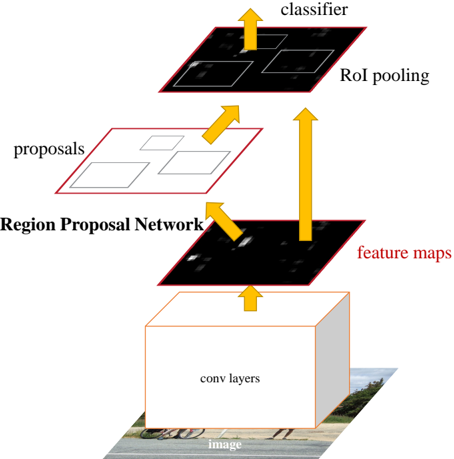
State-of-the-art object detection networks depend on region proposal algorithms to hypothesize object locations. Advances like SPPnet [1] and Fast R-CNN [2] have reduced the running time of these detection networks, exposing region proposal computation as a bottleneck. In this work, we introduce a Region Proposal Network (RPN) that shares full-image convolutional features with the detection network, thus enabling nearly cost-free region proposals. An RPN is a fully convolutional network that simultaneously predicts object bounds and objectness scores at each position. The RPN is trained end-to-end to generate high-quality region proposals, which are used by Fast R-CNN for detection. We further merge RPN and Fast R-CNN into a single network by sharing their convolutional features-using the recently popular terminology of neural networks with 'attention' mechanisms, the RPN component tells the unified network where to look. For the very deep VGG-16 model [3] , our detection system has a frame rate of 5 fps (including all steps) on a GPU, while achieving state-of-the-art object detection accuracy on PASCAL VOC 2007, 2012, and MS COCO datasets with only 300 proposals per image. In ILSVRC and COCO 2015 competitions, Faster R-CNN and RPN are the foundations of the 1st-place winning entries in several tracks. Code has been made publicly available.
Overview
CoChat Summary
TL;DR
Faster R-CNN introduces a Region Proposal Network (RPN) that shares convolutional features with Fast R-CNN, making region proposals nearly cost-free and enabling a unified object detection system. It achieves near real-time detection with state-of-the-art accuracy on PASCAL VOC and MS COCO.
Key findings
- With VGG-16 and shared features, Faster R-CNN reaches 69.9% mAP on PASCAL VOC 2007 test using 300 proposals, 73.2% with VOC07+12 training, 70.4% on VOC 2012 with 07++12, and 78.8% on VOC 2007 with COCO+07+12.
- Runtime: VGG-16 RPN + Fast R-CNN takes 198 ms total (5 fps), with RPN proposals costing 10 ms; ZF runs at 59 ms total (17 fps), versus SS + Fast R-CNN at 1830 ms (0.5 fps).
- Ablations: sharing features improves ZF mAP from 58.7% (unshared) to 59.9%; removing the reg layer drops mAP to 52.1%, and removing cls with 100 proposals drops it to 44.6%.
- On MS COCO test-dev, Faster R-CNN with VGG-16 and COCO train reaches 42.1% mAP@0.5 and 21.5% mAP@[.5,.95]; with COCO trainval it reaches 42.7% and 21.9%.
Methods
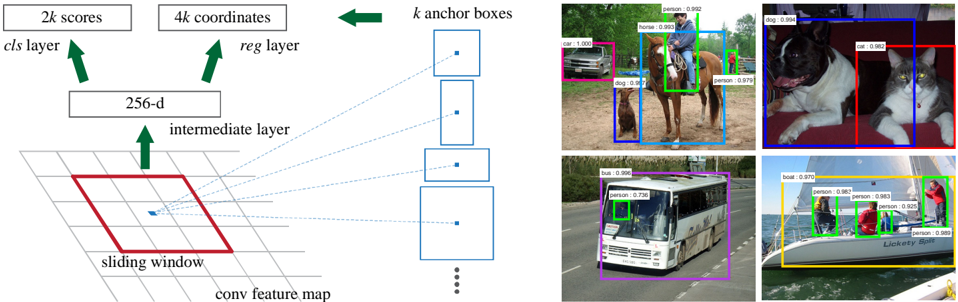
- The RPN is a fully convolutional network that slides a 3×3 window over shared conv features and predicts objectness scores and box regressions relative to anchors; default anchors use 3 scales (128², 256², 512²) and 3 aspect ratios (1:1, 1:2, 2:1), giving k = 9 anchors per position.
- Training uses a 4-step alternating scheme with ImageNet-pretrained ZF or VGG-16, SGD, single-scale images (shorter side s = 600), NMS at IoU 0.7, and 300 proposals at test time; evaluation is on PASCAL VOC 2007/2012 and MS COCO.
- Main metrics are detection mAP on PASCAL VOC and mAP@0.5 / mAP@[.5,.95] on MS COCO, with timing measured on a K40 GPU.
Limitations
- Stated in the paper: non-approximate joint training would require a differentiable RoI pooling/warping layer and is beyond the paper’s scope; the approximate joint training ignores gradients with respect to proposal box coordinates.
- Stated in the paper: cross-boundary anchors are ignored during training, and multi-scale feature extraction may improve accuracy but does not offer a good speed-accuracy trade-off.
- Evident from the text: the main experiments focus on PASCAL VOC and MS COCO with ZF/VGG-16 backbones, so generalization to other datasets, backbones, or detection regimes is not extensively characterized.
Model-written summary. Check it against the paper before relying on it.
Integrity signals
Registry
Cites
Statistics
Figures


Verification
Claims the paper makes
12 Valid · 5 Not valid · 8 Not checked · 83 Own results and interpretations
Every source the paper cites for this claim was checked and supports it.
In the paper
“Only by replacing VGG-16 with a 101layer residual net (ResNet-101) [18], the Faster R-CNN system increases the mAP from 41.5%/21.2% (VGG16) to 48.4%/27.2% (ResNet-101) on the COCO val set.”
What the sources say
- Supportedcites [18] [18] K. He, X. Zhang, S. Ren, and J. Sun, 'Deep residual learning for image recognition,' arXiv:1512.03385 , 2015. - source
Table 8 (p. 8) reports the exact COCO validation-set mAP values for baseline Faster R-CNN with VGG-16 and ResNet-101. Section 4.3 (p. 8) says the detection implementation was the same for both models and attributes the gain to replacing VGG-16 with ResNet-101. (LLM, conf=0.95)
plainstates a cause- Asserted: passes — The authors put it forward as true.
- Checkable: passes — It can be checked against evidence.
- Load-bearing: passes — The paper’s conclusions depend on it.
- Based: passes — The paper gives a reason why it holds.
- Supported
Every source the paper cites for this claim was checked and supports it.
In the paper
“This observation is still valid even when one increases the depth substantially to over 100 layers [18].”
What the sources say
- Supportedcites [18] [18] K. He, X. Zhang, S. Ren, and J. Sun, 'Deep residual learning for image recognition,' arXiv:1512.03385 , 2015. - source
In ImageNet Classification (p. 7), the paper reports that 101- and 152-layer ResNets outperform the 34-layer model, with no observed degradation. Its CIFAR-10 analysis (p. 7) also reports that a 110-layer ResNet converges well. These results support the stated extension to over 100 layers, although the isolated sentence does not specify what “this observation” refers to. (LLM, conf=0.87)
plain- Asserted: passes — The authors put it forward as true.
- Checkable: passes — It can be checked against evidence.
- Load-bearing: unclear — It is unclear whether the paper’s conclusions depend on it.
- Based: passes — The paper gives a reason why it holds.
- Supported
The cited sources support only part of this claim — read each source’s verdict below.
In the paper
“In ILSVRC and COCO 2015 competitions, Faster R-CNN and RPN are the basis of several 1st-place entries [18] in the tracks of ImageNet detection, ImageNet localization, COCO detection, and COCO segmentation.”
What the sources say
- Partly supportedcites [18] [18] K. He, X. Zhang, S. Ren, and J. Sun, 'Deep residual learning for image recognition,' arXiv:1512.03385 , 2015. - sourceExperimental — accuracy not yet measured
Section 4.3 (p. 8) lists first-place finishes in all four tracks, and the Object Detection Baselines (p. 10) describe a Faster R-CNN system using an RPN. The ImageNet Localization section (p. 12) also identifies its RPN-based method. But the copy attributes the entries collectively to deep residual nets; it does not establish that Faster R-CNN and RPN underpinned the COCO segmentation entry. (LLM, conf=0.86)
plainstates a cause- Asserted: passes — The authors put it forward as true.
- Checkable: passes — It can be checked against evidence.
- Load-bearing: unclear — It is unclear whether the paper’s conclusions depend on it.
- Based: passes — The paper gives a reason why it holds.
- Partly supported
The cited sources that could be checked couldn’t confirm or dispute this claim.
In the paper
“Yet when compared to efficient detection networks [2], Selective Search is an order of magnitude slower, at 2 seconds per image in a CPU implementation.”
What the sources say
- Could not verifycites [4] [4] J. R. Uijlings, K. E. van de Sande, T. Gevers, and A. W. Smeulders, 'Selective search for object recognition,' International Journal of Computer Vision (IJCV) , 2013. - sourceExperimental — accuracy not yet measured
The computational discussion in §5.3 (pp. 12–13) gives timings for complete object-recognition pipelines, not a two-second CPU runtime for Selective Search. The comparisons in §5.2.1 (p. 11) concern other object-location methods, not efficient detection networks. Searches for a two-second per-image runtime and a network comparison found neither claim in our copy. (LLM, conf=0.73)
- Not checked — no full text of the sourcecites [2] [2] R. Girshick, 'Fast R-CNN,' in IEEE International Conference on Computer Vision (ICCV) , 2015. - source
plainstates an association- Asserted: passes — The authors put it forward as true.
- Checkable: passes — It can be checked against evidence.
- Load-bearing: passes — The paper’s conclusions depend on it.
- Based: passes — The paper gives a reason why it holds.
- Could not verify
Every source the paper cites for this claim was checked and supports it.
In the paper
“We comprehensively evaluate our method on the PASCAL VOC detection benchmarks [11] where RPNs with Fast R-CNNs produce detection accuracy better than the strong baseline of Selective Search with Fast R-CNNs.”
What the sources say
- Supportedcites [11] [11] M. Everingham, L. Van Gool, C. K. I. Williams, J. Winn, and A. Zisserman, 'The PASCAL Visual Object Classes Challenge 2007 (VOC2007) Results,' 2007. - source
The citation is attached to “PASCAL VOC detection benchmarks,” not to the citing authors’ comparison of RPNs and Selective Search. Sections 5.2 and 6.2 describe the VOC detection task, its submitted methods, and its results, confirming the benchmark identification. (LLM, conf=0.92)
plainstates a cause- Asserted: passes — The authors put it forward as true.
- Checkable: passes — It can be checked against evidence.
- Load-bearing: passes — The paper’s conclusions depend on it.
- Based: passes — The paper gives a reason why it holds.
- Rests on an assumption not shown here.
- Supported
56 more claims
Create a free account to see all 108 claims and to verify the 2 references still open.
- Probably not a substantial claim. 11
- It may state two separate claims as one. 40
- The quote only partly states this claim. 1
Claims other papers make about this one
Each is checked against this paper’s own text: does it say what the citing paper says it does?
The source backs part of the claim, not all of it — or backs it for a different population, condition or comparison.
In the citing paper
“Unlike the original paper [19] that adopted stage-wise training regarding RPN, we use an improved implementation with end-to-end joint training similar to [37], which leads to higher baselines than [19].”
From Non-local Neural Networks (2018) · cites this paper as [37]
Experimental — accuracy not yet measuredThe source backs part of the claim, not all of it — or backs it for a different population, condition or comparison.
In the citing paper
“Faster RCNN is the first near-realtime deep learning detector (COCO mAP@.5=42.7%, VOC07 mAP=73.2%, 17fps with ZF-Net [48]).”
From Object Detection in 20 Years: A Survey (2023) · cites this paper as [19]
Experimental — accuracy not yet measuredThe source backs part of the claim, not all of it — or backs it for a different population, condition or comparison.
In the citing paper
“Faster RCNN is the first near-realtime deep learning detector (COCO mAP@.5=42.7%, VOC07 mAP=73.2%, 17fps with ZF-Net [48]).”
From Object Detection in 20 Years: A Survey (2023) · cites this paper as [47]
Experimental — accuracy not yet measuredThe source backs part of the claim, not all of it — or backs it for a different population, condition or comparison.
In the citing paper
“In the deep learning era, due to the increase of computing power, bootstrap was shortly discarded in object detection during 2014-2016 [16-20].”
From Object Detection in 20 Years: A Survey (2023) · cites this paper as [19]
Experimental — accuracy not yet measuredThe source backs part of the claim, not all of it — or backs it for a different population, condition or comparison.
In the citing paper
“The most commonly used idea to reduce the feature computational redundancy is to compute the feature map of the whole image only once [18, 19, 124], which have achieved tens or even hundreds of times of acceleration.”
From Object Detection in 20 Years: A Survey (2023) · cites this paper as [19]
Experimental — accuracy not yet measured
21 more claims about this paper
Create a free account to see every claim other papers make about this one.
Citations
Cites
Deep Residual Learning for Image Recognition
He, K., Zhang, X., Ren, S., & Sun, J. (2016) · 2016 IEEE Conference on Computer Vision and Pattern Recognition (CVPR) · doi:10.1109/cvpr.2016.90 · Cited by 235,474 · cited 7×
“to propose regions from data, and thus can easily benefit from deeper and more expressive features (such as the 101layer residual nets adopted in [18]).”
BackgroundInfluentialSelf-citationVery Deep Convolutional Networks for Large-Scale Image Recognition
Simonyan, K., & Zisserman, A. (2014) · arXiv · doi:10.48550/arxiv.1409.1556 · Cited by 114,148
ImageNet classification with deep convolutional neural networks
Krizhevsky, A., Sutskever, I., & Hinton, G. E. (2017) · Communications of the ACM · doi:10.1145/3065386 · Cited by 112,155 · cited 1×
“For the regression loss, we use L where R is the robust loss function (smooth L 1 ) defined in [5].”
MethodGoing deeper with convolutions
Szegedy, C., Liu, W., Jia, Y., Sermanet, P., Reed, S., Anguelov, D., Erhan, D., Vanhoucke, V., & Rabinovich, A. (2015) · 2015 IEEE Conference on Computer Vision and Pattern Recognition (CVPR) · doi:10.1109/cvpr.2015.7298594 · Cited by 48,562 · cited 1×
“1× 10(6) parameters (1536 × (4 + 1) × 800 for GoogleNet [34] in MultiBox [27]).”
Microsoft COCO: Common Objects in Context
Lin, T.-Y., Maire, M., Belongie, S., Hays, J., Perona, P., Ramanan, D., Dollár, P., & Zitnick, C. L. (2014) · Lecture Notes in Computer Science · doi:10.1007/978-3-319-10602-1_48 · Cited by 45,460 · cited 1×
“Region proposal methods typically rely on inexpensive features and economical inference schemes.”
MethodImageNet Large Scale Visual Recognition Challenge
Russakovsky, O., Deng, J., Su, H., Krause, J., Satheesh, S., Ma, S., Huang, Z., Karpathy, A., Khosla, A., Bernstein, M., et al. (2015) · International Journal of Computer Vision · doi:10.1007/s11263-015-0816-y · Cited by 39,380 · cited 1×
“, the shared convolutional layers) are initialized by pre-training a model for ImageNet classification [36], as is standard practice [5].”
MethodFully convolutional networks for semantic segmentation
Long, J., Shelhamer, E., & Darrell, T. (2015) · 2015 IEEE Conference on Computer Vision and Pattern Recognition (CVPR) · doi:10.1109/cvpr.2015.7298965 · Cited by 38,834 · cited 5×
“Our RPNs are thus a kind of fully-convolutional network (FCN) [14] and they can be trained end-to-end specifically for the task for generating detection proposals.”
BackgroundMethodInfluentialRich Feature Hierarchies for Accurate Object Detection and Semantic Segmentation
Girshick, R., Donahue, J., Darrell, T., & Malik, J. (2014) · 2014 IEEE Conference on Computer Vision and Pattern Recognition · doi:10.1109/cvpr.2014.81 · Cited by 32,684 · cited 7×
“, Selective Search [4] object detectors, RCNN [5], and Fast R-CNN [2]).”
BackgroundMethodInfluentialSelf-citationGirshick, R. (2015) · 2015 IEEE International Conference on Computer Vision (ICCV) · doi:10.1109/iccv.2015.169 · Cited by 28,105
Self-citationThe pascal visual object classes (VOC) challenge
Everingham, M., Van Gool, L., Williams, C. K. I., Winn, J., & Zisserman, A. (2010) · International Journal of Computer Vision · doi:10.1007/s11263-009-0275-4 · Cited by 19,599
Research works printed but not linked: 1
- [10] S. Ren, K. He, R. Girshick, and J. Sun, 'Faster R-CNN: Towards real-time object detection with region proposal networks,' in Neural Information Processing Systems (NIPS) , 2015. -
Cited by
Items 52,101–52,200 of 56,407
Atyabi, M., Ayar, F., & Javanmardi, M. (2025) · doi:10.1109/icee67339.2025.11213894
Exploiting implicit knowledge for streaming perception object detection
Tang, Q., Guo, J., Zhou, X., Li, Y., Yang, M., & Liu, Y. (2025) · Engineering Applications of Artificial Intelligence · doi:10.1016/j.engappai.2025.113100 · Cited by 1
Runtime Monitoring Abnormalities in Object Detection With Spatial and Temporal Abstractions
Yan, R., Li, C., Zheng, R., et al. (2025) · Software Practice and Experience · doi:10.1002/spe.70031
Few-Shot Object Detection for Remote Sensing Images Based on Fine-Tuning
Yang, J. T., & Li, S. (2025) · IEEE International Conference on Intelligent Rail Transportation (ICIRT) · doi:10.1109/icirt66379.2025.11216716
“Wang et al. [11] introduced a two-stage fine-tuning approach (TFA), demonstrating that even simple fine-tuning of the last layer of a Faster R-CNN [12] detector can yield relatively better performance compared to previous methods.”
Improved RT-DETR for Passenger Flow Detection in Subway Stations
Pan, H., Gao, X., & Su, S. (2025) · IEEE International Conference on Intelligent Rail Transportation (ICIRT) · doi:10.1109/icirt66379.2025.11216752
QGCMA: A Framework for Knowledge-Based Visual Question Answering
Li, W., & Li, Z. (2025) · ACM International Conference on Information and Knowledge Management (CIKM) · doi:10.1145/3746252.3761407
“Visual feature extraction is performed using a pre-trained Faster R-CNN [27] with a ResNet-101 backbone, pretrained on the COCO dataset [18].”
MSFENet: Multi-Scale Feature Enhancement Network for Small Object Detection in UAV ImageryPreprint
Xia, N., Xue, Z., & Yu, J. M. (2025) · SSRN Electronic Journal · doi:10.2139/ssrn.5719535
LWCNet:一种基于深度学习的轻量级高效家庭垃圾检测与分类算法Preprint
Zhou, Z., Zhang, Y., Liu, C., & Sun, A. (2025) · SSRN Electronic Journal · doi:10.2139/ssrn.5719534
ETF-MNet:A Multi-Scale Fusion Network for Enhancing Target Features for Remote Sensing Images
Shan, H., Wang, S., Hu, Y., Chen, X., Wu, X., & Zhang, Y. (2025) · Photogrammetric Engineering & Remote Sensing · doi:10.14358/pers.25-00082r3
Lv, L., Zhao, Y., Li, X., Yu, J., Song, M., Huang, L., Mao, F., & Du, H. (2025) · Ecological Indicators · doi:10.1016/j.ecolind.2025.114389
Kim, D. B., Rho, J., Wee, S.-Y., et al. (2025) · bioRxiv (Cold Spring Harbor Laboratory) · doi:10.1101/2025.11.06.687107
Chen, Y., Yang, N., Cai, H., & Shao, G. (2025) · Communications in computer and information science · doi:10.1007/978-981-95-3739-6_13
TE-Net: remote sensing image detection network with resistance to background
Wang, Y., Li, Z., Zhu, S., et al. (2025) · Remote Sensing Letters · doi:10.1080/2150704x.2025.2586471
“Qian et al. (S. K. Ren et al. 2017) proposed the ARFFE module to extract multi-scale features.”
PDS-YOLO: An Improved Insulator Defect Detection Model Based on YOLOv8
Li, J., & Sun, H. (2025) · Lecture notes in computer science · doi:10.1007/978-981-95-4378-6_9
RefineFuse: Light-Adaptive Cross-Spectrum Feature Integration for Night Vision Enhancement
Gao, W., Wei, Y., Zhang, Y., et al. (2025) · Lecture notes in computer science · doi:10.1007/978-981-95-4378-6_17
Towards Feature Enhanced Small Object Recognition in X-ray Safety Inspection
Yang, J., Kan, H. Y., & Lyu, E. (2025) · Lecture notes in computer science · doi:10.1007/978-981-95-4378-6_16
Nearly Time-Optimal Online Pick and Place Trajectory Computation using Quadratic Programming
Marauli, T., Gratt, F., Gattringer, H., et al. (2025) · IFAC-PapersOnLine · doi:10.1016/j.ifacol.2025.10.233
Ye, Z., & Zhou, P. (2025) · Remote Sensing · doi:10.3390/rs17223671
Intelligent detection of Shu embroidery fabric stitches based on DDW YOLOv8
Song, C., Li, W., Liu, D., Zhang, X., He, Y., Li, J., Zheng, H., Yin, W., & Yiling, W. (2025) · Textile Research Journal · doi:10.1177/00405175251385539
An, J., Chen, W., Ni, Y., & Chang, F. (2025) · Journal of Real-Time Image Processing · doi:10.1007/s11554-025-01801-z · Cited by 1
“Representative two-stage methods include R-CNN [6], Faster R-CNN [7], and Mask R-CNN [8].”
Song, Y., Yuan, S., Tian, T., Tian, J., Zhao, T., & Liu, Y. (2025) · IEEE Journal of Selected Topics in Applied Earth Observations and Remote Sensing · doi:10.1109/jstars.2025.3631549 · Cited by 1
Locating Method Using Collective Intelligence and Specific Object Recognition
Ishimaru, S., & Miwa, H. (2025) · Lecture notes on data engineering and communications technologies · doi:10.1007/978-3-032-10344-4_18
Real-Time Detection of Road Defects Using YOLO Architectures: A Comparative Study
Khlifati, O., Baba, K., Kostali, Z. E., et al. (2025) · doi:10.1109/ipta66025.2025.11222038
“Convolutional Neural Networks (CNNs) have been found particularly effective on complex visual recognition tasks, eliminating the need for hand-crafted feature extraction [12].”
Akram, M. W., Siddique, A., Vannucci, M., et al. (2025) · doi:10.1109/ipta66025.2025.11222055
“Two-stage detectors, such as Faster RCNN [3], Mask RCNN [4], and Cascade RCNN [5], are a category of object detection models that first generate region proposals where objects are likely to be located and then classify and refine these proposals in a second stage.”
Label Correction of Icing Degree Images based on CNN Misclassification Mechanism
Wang, H., Gao, W., Wang, B., et al. (2025) · doi:10.1109/pesgm52009.2025.11225326
YOLO-MAG: An improved surface defect detection system for transformer magnets
Tang, C., Dong, C., Hu, W., & Xu, T. (2025) · Engineering Research Express · doi:10.1088/2631-8695/ae13d9
MIDFE: Multi-image differential feature enhancement based on misalignment
Lu, J., Pan, Y., Zhou, Z., & Sun, M.-J. (2025) · Optics & Laser Technology · doi:10.1016/j.optlastec.2025.114142 · Cited by 1
Developing an Object Detection Algorithm in Traffic Light Signal
Thi, T., Van, T. T., Xuan, D. V., et al. (2025) · Lecture notes in networks and systems · doi:10.1007/978-981-95-1746-6_7
Detection of Peripheral Blood Cells Using Various Deep Learning Networks
Vu, M. N., Nguyen, H. H., & Bui, V. N. (2025) · Lecture notes in networks and systems · doi:10.1007/978-981-95-1746-6_72
Research on Bearing Defect Recognition Based on YOLOv5-CBAM
Qiu, Y., Wei, X., Jia, X., et al. (2025) · Lecture notes in networks and systems · doi:10.1007/978-981-96-5006-4_12
Harmonizing Classification and Localization in Small Object Detection
Chai, E., Chen, L., Liu, W., & Cui, T. (2025) · Communications in computer and information science · doi:10.1007/978-981-95-4097-6_29 · Cited by 2
A Category-Guided Keypoint Detection Framework for Industrial Binary Images
Ni, T., Chen, Y., Wen, X., et al. (2025) · Communications in computer and information science · doi:10.1007/978-981-95-4097-6_19
Bubble Detection in Gas–Solid Separation Fluidized Beds Based on Deep Learning
Wei-Jie, W. E. I., Li, K., Gao, L., Zhang, X., Cui, S., Bao, G., Chen, T., & Xu, X. (2025) · ACS Omega · doi:10.1021/acsomega.5c09389
AI-Powered Application for Classifying Recyclable Materials
Çakır, Ş. N., & Altay, E. V. (2025) · International Artificial Intelligence and Data Processing Symposium (IDAP) · doi:10.1109/idap68205.2025.11222312
“In real-time garbage detection scenarios, object recognition frameworks such as YOLOv3/v5 [12], [13] and Faster R-CNN [14] have been used, particularly for automatic sorting systems or UAV-based environmental monitoring [6].”
Exploring the Use of Synthetic Data to Improve Pedestrian Detection in CNN
Montanha, R., & Musse, S. R. (2025) · SIBGRAPI Conference on Graphics, Patterns and Images (SIBGRAPI) · doi:10.1109/sibgrapi67909.2025.11223354 · Cited by 1
Diversity-Informed Fusion for Sclerotinia Sclerotiorum and White Mold Detection
Pereira, R. D. C., Borges, D. L., Lobo, M., Torres, R. D. S., & Pedrini, H. (2025) · SIBGRAPI Conference on Graphics, Patterns and Images (SIBGRAPI) · doi:10.1109/sibgrapi67909.2025.11223383 · Cited by 3
“These include the Single-Shot Detector (SSD) [18], Detection Transformer (DETR) [19], the Faster R-CNN [20], and three detectors from the YOLO family [21]–[24]: YOLOv8, YOLOv9, and YOLOv10.”
Steel surface defect detection based on dynamic receptive field and multi-scale features fusion
Zhang, H., Song, X., Yao, Y., Fan, X., Chen, J., Chan, S., Li, C., & Zhou, X. (2026) · Scientific Reports · doi:10.1038/s41598-026-70164-7
Object detection algorithm for eggs of Pomacea canaliculata in a paddy field environment
Wang, G. Q., He, J., Hu, R. N., et al. (2025) · Frontiers in Plant Science · doi:10.3389/fpls.2025.1683763
An Improved CenterNet2 Model for Long-Arm Engineering Vehicle Object Detection
Li, Y., Hua, J., Wang, Z., Li, X., & Tian, F. (2025) · International Joint Conference on Neural Networks (IJCNN) · doi:10.1109/ijcnn64981.2025.11229314
MPFDAN: Multi-Perspective Feature Dynamic Adaptation Network for Domain Adaptive Object Detection
Yang, H., Liu, K., Weng, W., Dai, W., Cichocki, A. S., & Kong, W. (2025) · International Joint Conference on Neural Networks (IJCNN) · doi:10.1109/ijcnn64981.2025.11229255 · Cited by 1
Wang, Y., Sun, B., Li, H., Ma, X., Wang, Z., & Wang, Z. (2025) · IEEE Transactions on Multimedia · doi:10.1109/tmm.2025.3632670 · Cited by 2
Lin, M. (2025) · International Conference on Computers, Information Processing and Advanced Education (CIPAE) · doi:10.1109/cipae66821.2025.00048
“Two-stage methods (e.g., R-CNN [1], Fast R-CNN [2], Faster R-CNN [3], Mask R-CNN [4]) first generate Region of Interest (RoI) proposals, followed by classification and localization.”
Ivanova, E. I., & Gerov, D. S. (2025) · International Scientific Conference on Computer Science (COMSCI) · doi:10.1109/comsci67172.2025.11224987
“Previous research has extensively explored object detection models like YOLO [4], SSD [5], and Faster R-CNN [6].”
CharDetNet: Lightweight Ancient Character Detection with Mixed Attention
Song, Y., Zhang, C., & Wu, M. (2025) · doi:10.1109/ijcnn64981.2025.11228720
Learning from the Best: High-Quality Sample Guidance for Oriented Object Detection
Pan, Y., Wu, Q., Shen, H., Chen, Z., Liu, Y., Fan, S., & Zhou, H. (2025) · International Joint Conference on Neural Networks (IJCNN) · doi:10.1109/ijcnn64981.2025.11227343
“Oriented object detection (OOD), an extension of horizontal object detection [1]–[3], is able to detect objects in arbitrary orientations in complex images.”
DPSNet: A Dual-Path Hazy Object Detection Network with Dehazing Supervision
Pang, Y. K., Wang, F., Zhou, R., & Li, X. (2025) · International Joint Conference on Neural Networks (IJCNN) · doi:10.1109/ijcnn64981.2025.11228315
“Although deep learning-based object detection algorithms [1]–[5] perform well under normal weather conditions, their performance often declines under adverse conditions, including rain, haze, and snow, particularly in hazy environments common in driving scenarios.”
NeckLymphNet: An Efficient Neck Lymph Node Detection Network for Ultrasound Images
Tan, W., & Zhang, Y. (2025) · International Joint Conference on Neural Networks (IJCNN) · doi:10.1109/ijcnn64981.2025.11227401
Yin, X., Yuan, W., Wu, X., Fu, L., & Huang, D. (2025) · International Joint Conference on Neural Networks (IJCNN) · doi:10.1109/ijcnn64981.2025.11227672 · Cited by 1
“…proposed algorithm design for YOLOv7-X (Baseline) [11] 0.039 25.65 YOLOv3 [8] 0.036 27.48 YOLOv4 [9] 0.042 23.61 SSD [13] 0.021 48.35 Faster R-CNN [5] 0.060 16.56 YOLOv8-L [12] 0.039 25.36 YOLOv7-Tiny [11] 0.015 63.34 TACR-YOLO (ours) 0.040 24.88 abnormal behavior detection in natural scenarios…”
InfluentialResearch on a PCB Defect Detection Algorithm Based on Improved YOLOv8n
Guo, P., & Chen, Y. (2025) · International Conference on Electronic Information Technology (EIT) · doi:10.1109/eit67313.2025.11231915
“Instead, there are two-stage algorithms, like Faster R-CNN [7] , which generate region proposals and then classify regions.”
Latent Space Semantic Alignment Network Based on Momentum Contrast for Image-Text Retrieval
Lu, B., Wu, X., Zhu, H., et al. (2025) · doi:10.1109/ijcnn64981.2025.11227703
“Following reference SCAN, giving an image I, we first use Faster R-CNN [20] to detect the bounding boxes and select the top-K region proposals according to the confidence scores.”
LJ-DETR: LightWeight RT-DETR Algorithm with Joint Encoder for Steel Surface Defect Detection
Wang, C., Wang, T., Li, H., Wang, M., Xia, J., & Liu, X. (2025) · International Joint Conference on Neural Networks (IJCNN) · doi:10.1109/ijcnn64981.2025.11228421
“Despite these advancements, challenges such as large model sizes, limited real-time performance, and insufficient precision for small objects and complex backgrounds persist [7].”
Injecting Commonsense into Object Detection Algorithms
Jiang, D. (2025) · International Joint Conference on Neural Networks (IJCNN) · doi:10.1109/ijcnn64981.2025.11228656
“Two-stage models, exemplified by Faster R-CNN [9], generate region proposals to localize objects before performing classification and refinement.”
Enhancing Multi-Object Tracking with Spatiotemporal Graph Convolution and Trajectory Recovery
Gao, L., & Qiu, C. (2025) · International Joint Conference on Neural Networks (IJCNN) · doi:10.1109/ijcnn64981.2025.11228762
“Tracking-by Detection: With significant improvements in target detection [1], the tracking-by-detection paradigm, which relies on detection and embedding, has emerged.”
A Novel Forgetting Mitigation Approach for YOLOv7-Enabled Incremental Object Detection
Wang, Q., Liu, F., Yue, J., Dai, Q., & Shi, X. (2025) · International Joint Conference on Neural Networks (IJCNN) · doi:10.1109/ijcnn64981.2025.11228454
“Most IOD methods rely on detectors like Generalized Focal Loss (GFL) [9], Single Shot MultiBox Detector (SSD) [10], and Faster R-CNN [11].”
DMIMHD: Dynamic Modality Interaction for Multi-Modal Human Desire Understanding
Zhang, X. (2025) · International Joint Conference on Neural Networks (IJCNN) · doi:10.1109/ijcnn64981.2025.11227376
“Global features capture the overall context and structure of the image, while local features provide fine-grained details about specific regions [13].”
MCRO-YOLO: An evolved Version of YOLO for Small Object Detection
Li, J., Shi, Q., Yang, F. O., Fu, S., & Hou, F. (2025) · International Joint Conference on Neural Networks (IJCNN) · doi:10.1109/ijcnn64981.2025.11227312 · Cited by 2
“FLOPs(G) Params(M) Faster R-CNN [28] 31”
Detecting Large Aspect Ratio Objects with Geometry-Aware in Remote Sensing Images
Song, P., Yang, Y., & Wang, C. (2025) · International Joint Conference on Neural Networks (IJCNN) · doi:10.1109/ijcnn64981.2025.11229040
“Early classical methods include R-CNN series [1], [2], YOLO series [3], [4], etc.”
Traffic Sign Small Object Detection Algorithm Based on Lightweight Structure Design
Chen, S., An, P., Zeng, S., Lin, C., Wu, Z., & Ke, Z. (2025) · International Joint Conference on Neural Networks (IJCNN) · doi:10.1109/ijcnn64981.2025.11228472
“Among them, the two-stage detection algorithm is mainly R-CNN series[7-9].”
STPYOLO: A Lightweight and Efficient Model for Small Target Pest Detection
Wang, J., Jia, Z., Zhou, G., et al. (2025) · doi:10.1109/ijcnn64981.2025.11227202
“…Traps dataset or maintaining the highest mAP50 is 0.522 on the Rice Field Insect Detection dataset, STPYOLO demonstrates excellent Faster RCNN [14] 0.521 0.855 0.862 0.224 0.331 0.217 YOLOv5n [15] 0.889 0.907 0.918 0.645 0.479 0.514 YOLOv7n [16] 0.810 0.815 0.824 0.642 0.606 0.511 YOLOv8n…”
InfluentialYu, Y., Bao, R., Gu, J., et al. (2025) · doi:10.1109/ijcnn64981.2025.11229226
DSE-YOLO: An Improved Road Damage Detection Model Based on YOLOv8
Zhang, D., & Jin, Q. (2025) · doi:10.1109/ijcnn64981.2025.11229002
“Although algorithms such as YOLO [6], [7] and R-CNN [8], [9] have achieved notable success in general object detection tasks, their performance in road damage detection remains constrained due to their design being optimized for natural image processing.”
Bao, Z., & Ibrayim, M. (2025) · International Joint Conference on Neural Networks (IJCNN) · doi:10.1109/ijcnn64981.2025.11229105
“Text detection extends general object detection methods like Faster R-CNN [3], YOLO [4], and SSD [5].”
MAF-DETR: Defect Detection with Multi-Scale Adaptive Feature Fusion
Zhang, C., Wu, W., Niu, H., et al. (2025) · doi:10.1109/ijcnn64981.2025.11227633
“FollowingR-CNN [6], object detection models like Faster R-CNN [7], YOLO [8], and RT-DETR [9] have advanced defect detection.”
NR-DETR: A Lightweight Real-Time Fabric Defect Detection Model with Multi-Scale Enhancement
Hao, H., Xu, L., Gao, C., et al. (2025) · doi:10.1109/ijcnn64981.2025.11229106
“Faster R-CNN [4] excels in accuracy with its Region Proposal Network (RPN), but its two-stage architecture results in slower inference, making it more suitable for non-real-time tasks requiring high accuracy.”
DyFusion-YOLO: An Enhanced Model for Small Object Detection in Aerial Imagery
Wang, X., Wang, Y., Liu, T., et al. (2025) · doi:10.1109/ijcnn64981.2025.11228116
“…Intersection over Union (CIoU) [6], which reduces the impact of low-quality samples on the model. represented by the RCNN family (e.g., Faster RCNN [7] and Mask RCNN [8]), which have a strong advantage in detection accuracy in complex backgrounds by generating candidate regions and progressively…”
Enhanced YOLOv7 for UAV Platforms: Achieving High Precision with Low Resource Utilization
Sui, C., Zhang, J., Jin, L., Lu, Q., & Chen, J. (2025) · International Joint Conference on Neural Networks (IJCNN) · doi:10.1109/ijcnn64981.2025.11228323
“Faster R-CNN [18], for example, effectively improves detection speed and accuracy by introducing a Region Proposal Network (RPN), but its two-stage structure results in high model complexity and computational overhead.”
HSDNet: Hybrid Super-Resolution Assisted Detection Network for Surface Defect Detection
Lin, X., Yang, X., Sun, Y., et al. (2025) · doi:10.1109/ijcnn64981.2025.11227791
“However, due to the high parameter count and computational cost, researchers have incorporated additional optimization strategies in subsequent models including Fast RCNN [21] and Faster RCNN [19].”
Low-visibility Crop Detection in Agricultural Scenes via Point Cloud Guidance
Chen, W., Jin, T., Yang, J., Wang, F., & Zheng, F. (2025) · International Joint Conference on Neural Networks (IJCNN) · doi:10.1109/ijcnn64981.2025.11227360
“…task in computer vision, object detection holds significant importance, encompassing those ameliorated methods based on region proposals [9] and single-stage regression [10], as well as continuously optimized techniques like Saliency Object Detection (SOD) [11]–[13] and Camouflaged…”
Chain of Thoughts Based Prompting for Incident Detection Using Large Language Model
Chambers, L., Udokisai, A., Mahmoud, H., Ismail, K. J. A., Mohammed, N., Cervantes, W., Gaber, M. M., & Bhana, R. (2025) · International Joint Conference on Neural Networks (IJCNN) · doi:10.1109/ijcnn64981.2025.11229199
“This negates the need for region proposal stages used in two-stage detectors such as Faster R-CNN [20].”
DDYOLO: Efficient Rainy Scene Object Detection with Deraining Guidance
Chen, X., Yan, T., Wang, C., Liu, J., Zhang, Z., & Huang, W. (2025) · International Joint Conference on Neural Networks (IJCNN) · doi:10.1109/ijcnn64981.2025.11228916
“The former includes R-CNN [14], Fast R-CNN [15], and Faster R-CNN [3].”
YOLO-FEE: An Improved Fabric Defect Detection Model Based on YOLOv11s
Wen, Z., Pan, W., Dong, Z., Wang, J., Su, J., Guo, F., Wu, X., & Zhou, Y. (2025) · International Joint Conference on Neural Networks (IJCNN) · doi:10.1109/ijcnn64981.2025.11229236 · Cited by 1
“Especially, deep learning-based object detection algorithms such as YOLO [3]–[8] (You Only Look Once) series, RCNN [9], [10] (Region-based Convolutional Neural Networks) series, and SSD [11] (Single Shot MultiBox Detector) have gained widespread use in this field due to their excellent performance.”
DS-YOLO: A Vehicle Detection Model for UAV Aerial Photography Based on Improved YOLO11n
Zhou, X., Zhang, H., Yi, H. J., et al. (2025) · doi:10.1109/ijcnn64981.2025.11229021
“Currently, the most popular deep learning-based target detection techniques can be primarily separated into two-stage algorithms, represented by R-CNN [1]–[5] series algorithms, and single-stage algorithms, represented by SSD [6], [7] and YOLO [8]–[16] series algorithms.”
Liu, J., Yan, T., Chen, X., et al. (2025) · doi:10.1109/ijcnn64981.2025.11227737
“Small object detection methods are different from conventional object detection methods [13].”
Li, Z., & Zhou, X. (2025) · International Joint Conference on Neural Networks (IJCNN) · doi:10.1109/ijcnn64981.2025.11228299
PD-YOLOv11s: An End-to-End Paper Surface Detection for Specific Visible Angle Defect
Li, S., Zhu, H., Zhong, X., Jiu, M., Guo, W. J., Chen, Y., & Xu, M. (2025) · International Joint Conference on Neural Networks (IJCNN) · doi:10.1109/ijcnn64981.2025.11228291
“Meanwhile, Faster R-CNN [17], [18], which was designed by Shaoqing Ren et al., is a two-stage detector that uses region proposal networks for object detection.”
Multimodal Object Detection by Adaptive Channel Enhancement and Attention Fusion
Mei, Y., Zhang, T., & Tan, H. (2025) · International Joint Conference on Neural Networks (IJCNN) · doi:10.1109/ijcnn64981.2025.11227959
“…Neural Networks (CNNs), researchers began exploring the application of CNNs in object detection, leading to the development of deep learning-based frameworks, including two-stage methods (R-CNN [19], Fast R-CNN [20], Faster R-CNN [21]) and one-stage methods (SSD [22], YOLO series [23, 24, 25]).”
YOLO-fungi: Detection Method for the Growth Stages of Edible Fungi under Complex Environments
Zhang, W., Wang, X., Huang, J., & Yang, H. (2025) · International Joint Conference on Neural Networks (IJCNN) · doi:10.1109/ijcnn64981.2025.11227700 · Cited by 1
“The two-stage detection algorithm, such as Faster R-CNN [7], Mask R-CNN [8], has higher detection precision, but phased operations bring about larger computation and slower recognition speed, limiting its suitability for real-time applications [9]–[11].”
From Perception to Distance: A Lightweight RGB-D Pipeline for Adaptive Cruise Control
Fathy, Y. M., Ibrahim, H. H., & Shehata, O. M. (2025) · Novel Intelligent and Leading Emerging Sciences Conference (NILES) · doi:10.1109/niles68063.2025.11231963
“Various detection models have been developed over the years, including YOLO [6], Faster R-CNN [7], and EfficientDet [9], each offering trade-offs between accuracy, speed, and computational efficiency.”
Yang, X., Lin, X., Wang, Y., Sun, Y., & Qi, L. (2025) · International Joint Conference on Neural Networks (IJCNN) · doi:10.1109/ijcnn64981.2025.11228273
A Robust Multimodal Model with Context-Rich Prompts for Traffic Light State Detection
Zheng, J., Murphey, Y. L., Giordani, B., Persad, C. C., & Maher, A. (2025) · International Joint Conference on Neural Networks (IJCNN) · doi:10.1109/ijcnn64981.2025.11228651
“DetMM integrates several key components: • Faster Region-based Convolutional Neural Network (Faster R-CNN) [4] for efficient and precise traffic light detection and localization.”
FLEX-YOLO: A Feedback-Driven Lightweight and Enhanced Exchange Network for UAV Aerial Images
Ding, N., Li, X., Ma, J., Huan, R., & Zhao, X. (2025) · International Joint Conference on Neural Networks (IJCNN) · doi:10.1109/ijcnn64981.2025.11227786
“Two-stage methods, such as Faster R-CNN [5] and Cascade R-CNN [6], achieve high accuracy but are computationally expensive and struggle with real-time detection of small objects.”
Chen, Y., Wang, Z., Wang, Y., et al. (2025) · doi:10.1109/ijcnn64981.2025.11228444
DMP-DETR: Dilation Multi-Scale and Partial Channel Gated Fusion Attention For Steel Defect Detection
Zhao, S., Wu, C., & Yu, F. (2025) · International Joint Conference on Neural Networks (IJCNN) · doi:10.1109/ijcnn64981.2025.11229140
“The comparison experiments were modeled with the two-step detector: Faster-RCNN [4], the one-step detectors: YOLOV8m [23], YOLOV9m [24], YOLOV10m [25], and YOLOV11m [26], as well as the Transformer detectors: Deformable-Detr [27], DINO [28], DDQ [29], RT-DETR-R18 [11]. the YOLO series one-stage…”
Aspect-Oriented Semantic Enhancement Network For Aspect-Level Multimodal Sentiment Analysis
Ji, X. B., Li, N., & Han, R. (2025) · International Joint Conference on Neural Networks (IJCNN) · doi:10.1109/ijcnn64981.2025.11228718
“These benchmark methods can be broadly divided into three categories: The first category is the visual-only method, including ResNet-Aspect [33], and Faster R-CNN-Aspect [34].”
Dual-level Concept-aware Network for Video Captioning with Augmented Semantics
Lu, S., Guo, Y., Chen, X., & Ma, L. (2025) · International Joint Conference on Neural Networks (IJCNN) · doi:10.1109/ijcnn64981.2025.11228308
Enhance Object Detection via Instance Transformation Between Categories Using Diffusion Models
Ma, H., & Ren, J. (2025) · International Joint Conference on Neural Networks (IJCNN) · doi:10.1109/ijcnn64981.2025.11227834
“Automated detection using deep learning models like Faster R-CNN [1], YOLO [2], and DINO [3] has shown significant progress.”
LW-DETR: Vision Transformer-Based Network for Transmission Line Fittings Defect Detection
Liu, D., & Liu, P. (2025) · International Joint Conference on Neural Networks (IJCNN) · doi:10.1109/ijcnn64981.2025.11229094
DQ3D: Depth-guided Query for Transformer-Based 3D Object Detection in Traffic Scenarios
Wang, Z., Li, W., & Wu, J. (2025) · International Joint Conference on Neural Networks (IJCNN) · doi:10.1109/ijcnn64981.2025.11227159 · Cited by 1
“Faster-RCNN [14] serves as 2D detector in our experiments.”
GAC-DETR: A Transformer-Based Model for Small Target Detection in UAV Imagery
Gu, H., Jia, Y., Hu, J. P., Tang, Y., & Yang, H. (2025) · International Joint Conference on Neural Networks (IJCNN) · doi:10.1109/ijcnn64981.2025.11228918
“Two-stage methods, such as R-CNN [2], Faster R-CNN [3], and Mask R-CNN [4], are renowned for their high detection accuracy but often struggle to meet real-time requirements due to their high model complexity and computational demands.”
NP4Q: Nice Point for Post-training Quantization of Object Detection Models
Zhou, S., Jiang, J., Xu, J., Li, L., & Zhu, M. (2025) · International Joint Conference on Neural Networks (IJCNN) · doi:10.1109/ijcnn64981.2025.11228181
Detection of Small UAV Objects with Density Information
He, F., Yao, W., Jiang, X., & Liu, B. (2025) · International Joint Conference on Neural Networks (IJCNN) · doi:10.1109/ijcnn64981.2025.11229160 · Cited by 1
Ding, J., & Gu, J. (2025) · doi:10.1109/ijcnn64981.2025.11227335
“With the continuous development of deep learning, modern target detection methods for remote sensing images have increasingly used neural networks, especially convolutional neural networks [6] [7].”
Zhou, X., Xie, C., Li, Y., & Li, C. (2025) · International Joint Conference on Neural Networks (IJCNN) · doi:10.1109/ijcnn64981.2025.11227614 · Cited by 1
“The two-stage methods mainly consist of the Region-based Convolutional Neural Network (R-CNN) series [4].”
Prior-Guided Feature Fusion Network for Driving Obstacle Detection in Foggy Weather
Zhang, D., Geng, X., & He, M. (2025) · International Joint Conference on Neural Networks (IJCNN) · doi:10.1109/ijcnn64981.2025.11227356
“For example, Faster-RCNN proposed by S et al. [5] and CascadeRCNN introduced by Cai et al. [6].”
Zhou, Z., Fu, S., Cao, C., Tao, F., Zhang, Q., & Sun, J. (2025) · International Joint Conference on Neural Networks (IJCNN) · doi:10.1109/ijcnn64981.2025.11227215
Self-citationLOVD: Open-Vocabulary Object Detection Based on LLM-Enhanced Agents
Li, X., & Xu, J. (2025) · International Joint Conference on Neural Networks (IJCNN) · doi:10.1109/ijcnn64981.2025.11227349
“Region-based methods [10] [11], such as Faster R-CNN [7], adopt a two-stage framework for candidate region generation and Region-of-Interest-based classification and regression.”
Optimized YOLO11 for Accurate Wind Turbine Blade Defect Detection
Liu, C., Liu, N., Zhuang, X., Liu, Y., Huo, B., Shang, W., & Liu, G. (2025) · International Joint Conference on Neural Networks (IJCNN) · doi:10.1109/ijcnn64981.2025.11227383
“CNN-based methods, including the two-stage R-CNN series [9] [10] [11], are highly precise but often involve complex computations and slower detection speeds, making them unsuitable for real-time tasks such as defect detection on wind turbine blades.”
Zhao, A., Yin, J., Wang, W., Guo, Z., & Zhu, L. (2025) · Electronics · doi:10.3390/electronics14132702
Real Time Object Detection Tracking Using YOLO and Deep Sort
Hemashree, C., S, P. B., Pruthvi, H. N., Shivaganga, M. S., & Santhosh Kumar, S. (2025) · International Journal of Advanced Research in Science Communication and Technology · doi:10.48175/ijarsct-29912
Aminuddin, J., Pratiwi, U., Wijayanto, M. P., Vita, T. A., Shokib, M., Azmi, U., Saputra, D. R., Nurhayati, N., Pratikno, B., Anggraini, E. I., et al. (2025) · Springer proceedings in earth and environmental sciences · doi:10.1007/978-981-95-3075-5_58
Metadata
- Authors
- Ren, S., He, K., Girshick, R., & Sun, J.
- Affiliations
- University of Science and Technology of China (CN)
- Visual Computing Group, Microsoft Research, Beijing, China
- Meta (United States) (US)
- ORCID
- Venue
- IEEE Transactions on Pattern Analysis and Machine Intelligence
- Published
- 2017-06-01
- Volume
- 39
- Issue
- 6
- Pages
- 1137-1149
- ISSN
- 0162-8828 (ISSN-L)
- 2160-9292
- 1939-3539
- OpenAlex
- W639708223
- Cited by
- 73,472
- References
- 60
- Citations by year
- 2026: 5632 · 2025: 9233 · 2024: 9699 · 2023: 9795 · 2022: 9251 · 2021: 9857 · 2020: 7617 · 2019: 6376 · 2018: 3729 · 2017: 1740
- FWCI
- 2215.09
- Type
- journal article
- Language
- en
- Open access
- green
- arxiv.org
- Licence
- Locations
- IEEE Transactions on Pattern Analysis and Machine Intelligence (publishedVersion)
- PubMed (publishedVersion)
- arXiv (Cornell University) (submittedVersion)
- arXiv (Cornell University)
- neural information processing systems
- Funders
- Microsoft Research
- Topics
- Physical Sciences › Computer Science › Computer Vision and Pattern Recognition › Advanced Neural Network Applications
- Physical Sciences › Computer Science › Computer Vision and Pattern Recognition › Visual Attention and Saliency Detection
- Physical Sciences › Computer Science › Computer Vision and Pattern Recognition › Advanced Image and Video Retrieval Techniques
- Keywords
- Faster R-CNN, region proposal network, real-time object detection, Fast R-CNN, bounding box regression, VGG16, attention mechanism, end-to-end learning, Pascal VOC, MS COCO
About these checks
Registry, retraction, Cites and statistics results are computed, not judged, with one exception: a printed reference that no index lists is read once by a model before it counts as a citation error. Claims are extracted by a model and kept only when their quote appears verbatim in the text; each cited source is then checked, with a model’s help, for whether it says what the claim relies on. Those verdicts can be wrong — read the claim’s quote and the cited source before relying on one.
The claim verdicts this report counts are experimental: their accuracy is not yet measured.
A language model drew the claims from the paper on 2026-10-10, under version 3 of the claim definition (model deepseek-v4.1-flash, prompt extract-v3).
A second model labelled each claim on 2026-10-10 (model jev-1.13-20260917, definition revision gold-guideline-v0.2).
Cited sources are checked with a language model’s help (gpt-6-sol).
Statistics and arithmetic are recomputed, not judged.
Confidence bands are shown only for fields calibrated on our annotated test set. None is calibrated yet, so no band is shown.
What counts as a claim ›How we measure confidence ›How we check this ›
Are you an author, or do you see a problem with this page? Request a review
Data sources
Bibliographic data: Semantic Scholar, OpenAlex, Crossref.
Contains information from the Semantic Scholar Academic Graph Datasets, made available under the ODC Attribution License (ODC-BY 1.0).
Semantic Scholar’s data is described in: Kinney, R., et al. (2023). The Semantic Scholar Open Data Platform. arXiv:2301.10140.
