

Faster R-CNN: Towards Real-Time Object Detection with Region Proposal Networks
Open accessThe DOI matches its Crossref record; 56 of the 60 references it cites were found in a registry or an index; 15 of the 27 sources its claims cite were checked for support.
Abstract
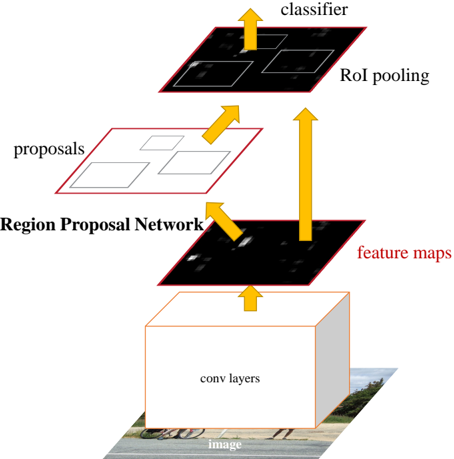
State-of-the-art object detection networks depend on region proposal algorithms to hypothesize object locations. Advances like SPPnet [1] and Fast R-CNN [2] have reduced the running time of these detection networks, exposing region proposal computation as a bottleneck. In this work, we introduce a Region Proposal Network (RPN) that shares full-image convolutional features with the detection network, thus enabling nearly cost-free region proposals. An RPN is a fully convolutional network that simultaneously predicts object bounds and objectness scores at each position. The RPN is trained end-to-end to generate high-quality region proposals, which are used by Fast R-CNN for detection. We further merge RPN and Fast R-CNN into a single network by sharing their convolutional features-using the recently popular terminology of neural networks with 'attention' mechanisms, the RPN component tells the unified network where to look. For the very deep VGG-16 model [3] , our detection system has a frame rate of 5 fps (including all steps) on a GPU, while achieving state-of-the-art object detection accuracy on PASCAL VOC 2007, 2012, and MS COCO datasets with only 300 proposals per image. In ILSVRC and COCO 2015 competitions, Faster R-CNN and RPN are the foundations of the 1st-place winning entries in several tracks. Code has been made publicly available.
Overview
CoChat Summary
TL;DR
Faster R-CNN introduces a Region Proposal Network (RPN) that shares convolutional features with Fast R-CNN, making region proposals nearly cost-free and enabling a unified object detection system. It achieves near real-time detection with state-of-the-art accuracy on PASCAL VOC and MS COCO.
Key findings
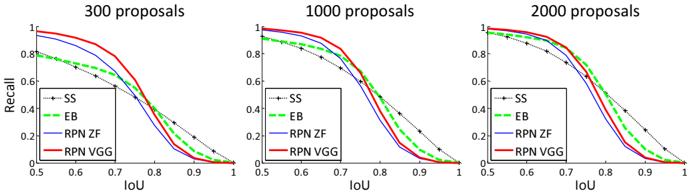
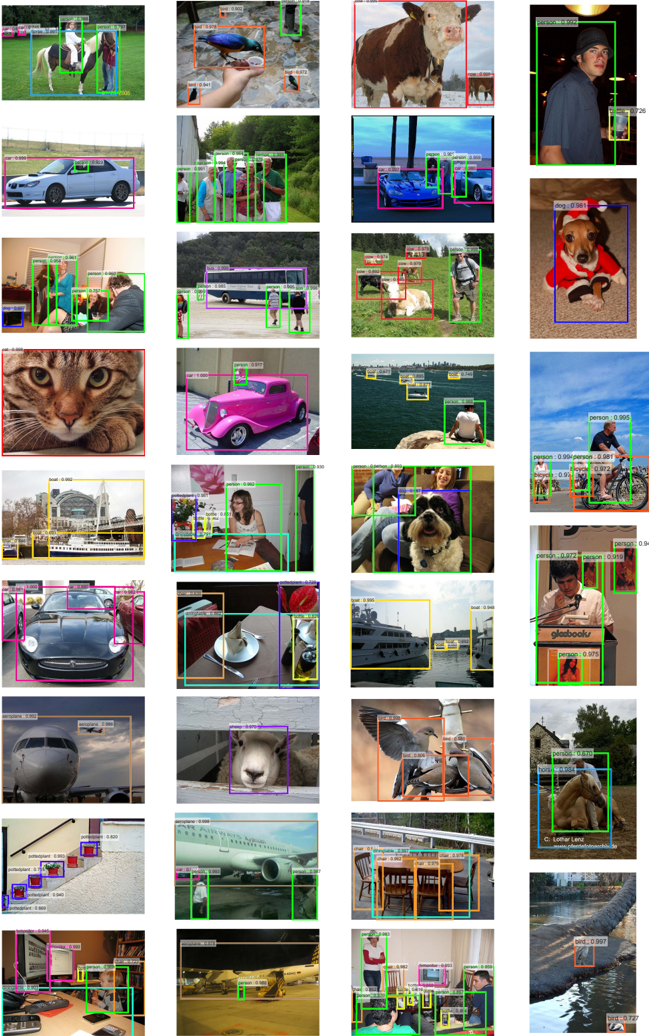
- With VGG-16 and shared features, Faster R-CNN reaches 69.9% mAP on PASCAL VOC 2007 test using 300 proposals, 73.2% with VOC07+12 training, 70.4% on VOC 2012 with 07++12, and 78.8% on VOC 2007 with COCO+07+12.
- Runtime: VGG-16 RPN + Fast R-CNN takes 198 ms total (5 fps), with RPN proposals costing 10 ms; ZF runs at 59 ms total (17 fps), versus SS + Fast R-CNN at 1830 ms (0.5 fps).
- Ablations: sharing features improves ZF mAP from 58.7% (unshared) to 59.9%; removing the reg layer drops mAP to 52.1%, and removing cls with 100 proposals drops it to 44.6%.
- On MS COCO test-dev, Faster R-CNN with VGG-16 and COCO train reaches 42.1% mAP@0.5 and 21.5% mAP@[.5,.95]; with COCO trainval it reaches 42.7% and 21.9%.
Methods
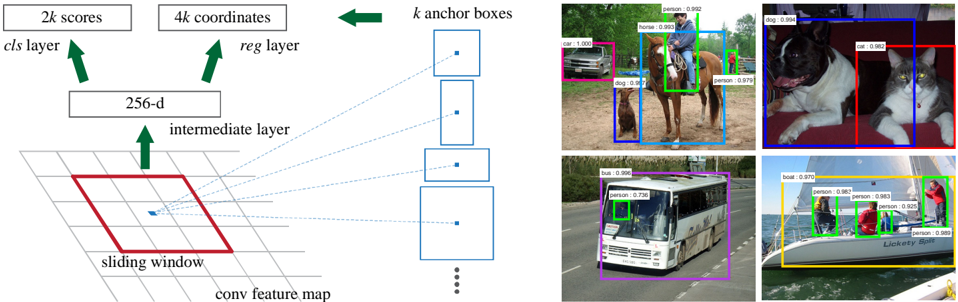
- The RPN is a fully convolutional network that slides a 3×3 window over shared conv features and predicts objectness scores and box regressions relative to anchors; default anchors use 3 scales (128², 256², 512²) and 3 aspect ratios (1:1, 1:2, 2:1), giving k = 9 anchors per position.
- Training uses a 4-step alternating scheme with ImageNet-pretrained ZF or VGG-16, SGD, single-scale images (shorter side s = 600), NMS at IoU 0.7, and 300 proposals at test time; evaluation is on PASCAL VOC 2007/2012 and MS COCO.
- Main metrics are detection mAP on PASCAL VOC and mAP@0.5 / mAP@[.5,.95] on MS COCO, with timing measured on a K40 GPU.
Limitations
- Stated in the paper: non-approximate joint training would require a differentiable RoI pooling/warping layer and is beyond the paper’s scope; the approximate joint training ignores gradients with respect to proposal box coordinates.
- Stated in the paper: cross-boundary anchors are ignored during training, and multi-scale feature extraction may improve accuracy but does not offer a good speed-accuracy trade-off.
- Evident from the text: the main experiments focus on PASCAL VOC and MS COCO with ZF/VGG-16 backbones, so generalization to other datasets, backbones, or detection regimes is not extensively characterized.
Model-written summary. Check it against the paper before relying on it.
Integrity signals
Registry
Cites
Statistics
Figures


Verification
Claims the paper makes
12 Valid · 5 Not valid · 8 Not checked · 83 Own results and interpretations
Every source the paper cites for this claim was checked and supports it.
In the paper
“Only by replacing VGG-16 with a 101layer residual net (ResNet-101) [18], the Faster R-CNN system increases the mAP from 41.5%/21.2% (VGG16) to 48.4%/27.2% (ResNet-101) on the COCO val set.”
What the sources say
- Supportedcites [18] [18] K. He, X. Zhang, S. Ren, and J. Sun, 'Deep residual learning for image recognition,' arXiv:1512.03385 , 2015. - source
Table 8 (p. 8) reports the exact COCO validation-set mAP values for baseline Faster R-CNN with VGG-16 and ResNet-101. Section 4.3 (p. 8) says the detection implementation was the same for both models and attributes the gain to replacing VGG-16 with ResNet-101. (LLM, conf=0.95)
plainstates a cause- Asserted: passes — The authors put it forward as true.
- Checkable: passes — It can be checked against evidence.
- Load-bearing: passes — The paper’s conclusions depend on it.
- Based: passes — The paper gives a reason why it holds.
- Supported
Every source the paper cites for this claim was checked and supports it.
In the paper
“This observation is still valid even when one increases the depth substantially to over 100 layers [18].”
What the sources say
- Supportedcites [18] [18] K. He, X. Zhang, S. Ren, and J. Sun, 'Deep residual learning for image recognition,' arXiv:1512.03385 , 2015. - source
In ImageNet Classification (p. 7), the paper reports that 101- and 152-layer ResNets outperform the 34-layer model, with no observed degradation. Its CIFAR-10 analysis (p. 7) also reports that a 110-layer ResNet converges well. These results support the stated extension to over 100 layers, although the isolated sentence does not specify what “this observation” refers to. (LLM, conf=0.87)
plain- Asserted: passes — The authors put it forward as true.
- Checkable: passes — It can be checked against evidence.
- Load-bearing: unclear — It is unclear whether the paper’s conclusions depend on it.
- Based: passes — The paper gives a reason why it holds.
- Supported
The cited sources support only part of this claim — read each source’s verdict below.
In the paper
“In ILSVRC and COCO 2015 competitions, Faster R-CNN and RPN are the basis of several 1st-place entries [18] in the tracks of ImageNet detection, ImageNet localization, COCO detection, and COCO segmentation.”
What the sources say
- Partly supportedcites [18] [18] K. He, X. Zhang, S. Ren, and J. Sun, 'Deep residual learning for image recognition,' arXiv:1512.03385 , 2015. - sourceExperimental — accuracy not yet measured
Section 4.3 (p. 8) lists first-place finishes in all four tracks, and the Object Detection Baselines (p. 10) describe a Faster R-CNN system using an RPN. The ImageNet Localization section (p. 12) also identifies its RPN-based method. But the copy attributes the entries collectively to deep residual nets; it does not establish that Faster R-CNN and RPN underpinned the COCO segmentation entry. (LLM, conf=0.86)
plainstates a cause- Asserted: passes — The authors put it forward as true.
- Checkable: passes — It can be checked against evidence.
- Load-bearing: unclear — It is unclear whether the paper’s conclusions depend on it.
- Based: passes — The paper gives a reason why it holds.
- Partly supported
The cited sources that could be checked couldn’t confirm or dispute this claim.
In the paper
“Yet when compared to efficient detection networks [2], Selective Search is an order of magnitude slower, at 2 seconds per image in a CPU implementation.”
What the sources say
- Could not verifycites [4] [4] J. R. Uijlings, K. E. van de Sande, T. Gevers, and A. W. Smeulders, 'Selective search for object recognition,' International Journal of Computer Vision (IJCV) , 2013. - sourceExperimental — accuracy not yet measured
The computational discussion in §5.3 (pp. 12–13) gives timings for complete object-recognition pipelines, not a two-second CPU runtime for Selective Search. The comparisons in §5.2.1 (p. 11) concern other object-location methods, not efficient detection networks. Searches for a two-second per-image runtime and a network comparison found neither claim in our copy. (LLM, conf=0.73)
- Not checked — no full text of the sourcecites [2] [2] R. Girshick, 'Fast R-CNN,' in IEEE International Conference on Computer Vision (ICCV) , 2015. - source
plainstates an association- Asserted: passes — The authors put it forward as true.
- Checkable: passes — It can be checked against evidence.
- Load-bearing: passes — The paper’s conclusions depend on it.
- Based: passes — The paper gives a reason why it holds.
- Could not verify
Every source the paper cites for this claim was checked and supports it.
In the paper
“We comprehensively evaluate our method on the PASCAL VOC detection benchmarks [11] where RPNs with Fast R-CNNs produce detection accuracy better than the strong baseline of Selective Search with Fast R-CNNs.”
What the sources say
- Supportedcites [11] [11] M. Everingham, L. Van Gool, C. K. I. Williams, J. Winn, and A. Zisserman, 'The PASCAL Visual Object Classes Challenge 2007 (VOC2007) Results,' 2007. - source
The citation is attached to “PASCAL VOC detection benchmarks,” not to the citing authors’ comparison of RPNs and Selective Search. Sections 5.2 and 6.2 describe the VOC detection task, its submitted methods, and its results, confirming the benchmark identification. (LLM, conf=0.92)
plainstates a cause- Asserted: passes — The authors put it forward as true.
- Checkable: passes — It can be checked against evidence.
- Load-bearing: passes — The paper’s conclusions depend on it.
- Based: passes — The paper gives a reason why it holds.
- Rests on an assumption not shown here.
- Supported
56 more claims
Create a free account to see all 108 claims and to verify the 2 references still open.
- Probably not a substantial claim. 11
- It may state two separate claims as one. 40
- The quote only partly states this claim. 1
Claims other papers make about this one
Each is checked against this paper’s own text: does it say what the citing paper says it does?
The source backs part of the claim, not all of it — or backs it for a different population, condition or comparison.
In the citing paper
“Unlike the original paper [19] that adopted stage-wise training regarding RPN, we use an improved implementation with end-to-end joint training similar to [37], which leads to higher baselines than [19].”
From Non-local Neural Networks (2018) · cites this paper as [37]
Experimental — accuracy not yet measuredThe source backs part of the claim, not all of it — or backs it for a different population, condition or comparison.
In the citing paper
“Faster RCNN is the first near-realtime deep learning detector (COCO mAP@.5=42.7%, VOC07 mAP=73.2%, 17fps with ZF-Net [48]).”
From Object Detection in 20 Years: A Survey (2023) · cites this paper as [19]
Experimental — accuracy not yet measuredThe source backs part of the claim, not all of it — or backs it for a different population, condition or comparison.
In the citing paper
“Faster RCNN is the first near-realtime deep learning detector (COCO mAP@.5=42.7%, VOC07 mAP=73.2%, 17fps with ZF-Net [48]).”
From Object Detection in 20 Years: A Survey (2023) · cites this paper as [47]
Experimental — accuracy not yet measuredThe source backs part of the claim, not all of it — or backs it for a different population, condition or comparison.
In the citing paper
“In the deep learning era, due to the increase of computing power, bootstrap was shortly discarded in object detection during 2014-2016 [16-20].”
From Object Detection in 20 Years: A Survey (2023) · cites this paper as [19]
Experimental — accuracy not yet measuredThe source backs part of the claim, not all of it — or backs it for a different population, condition or comparison.
In the citing paper
“The most commonly used idea to reduce the feature computational redundancy is to compute the feature map of the whole image only once [18, 19, 124], which have achieved tens or even hundreds of times of acceleration.”
From Object Detection in 20 Years: A Survey (2023) · cites this paper as [19]
Experimental — accuracy not yet measured
21 more claims about this paper
Create a free account to see every claim other papers make about this one.
Citations
Cites
Deep Residual Learning for Image Recognition
He, K., Zhang, X., Ren, S., & Sun, J. (2016) · 2016 IEEE Conference on Computer Vision and Pattern Recognition (CVPR) · doi:10.1109/cvpr.2016.90 · Cited by 235,474 · cited 7×
“to propose regions from data, and thus can easily benefit from deeper and more expressive features (such as the 101layer residual nets adopted in [18]).”
BackgroundInfluentialSelf-citationVery Deep Convolutional Networks for Large-Scale Image Recognition
Simonyan, K., & Zisserman, A. (2014) · arXiv · doi:10.48550/arxiv.1409.1556 · Cited by 114,148
ImageNet classification with deep convolutional neural networks
Krizhevsky, A., Sutskever, I., & Hinton, G. E. (2017) · Communications of the ACM · doi:10.1145/3065386 · Cited by 112,155 · cited 1×
“For the regression loss, we use L where R is the robust loss function (smooth L 1 ) defined in [5].”
MethodGoing deeper with convolutions
Szegedy, C., Liu, W., Jia, Y., Sermanet, P., Reed, S., Anguelov, D., Erhan, D., Vanhoucke, V., & Rabinovich, A. (2015) · 2015 IEEE Conference on Computer Vision and Pattern Recognition (CVPR) · doi:10.1109/cvpr.2015.7298594 · Cited by 48,562 · cited 1×
“1× 10(6) parameters (1536 × (4 + 1) × 800 for GoogleNet [34] in MultiBox [27]).”
Microsoft COCO: Common Objects in Context
Lin, T.-Y., Maire, M., Belongie, S., Hays, J., Perona, P., Ramanan, D., Dollár, P., & Zitnick, C. L. (2014) · Lecture Notes in Computer Science · doi:10.1007/978-3-319-10602-1_48 · Cited by 45,460 · cited 1×
“Region proposal methods typically rely on inexpensive features and economical inference schemes.”
MethodImageNet Large Scale Visual Recognition Challenge
Russakovsky, O., Deng, J., Su, H., Krause, J., Satheesh, S., Ma, S., Huang, Z., Karpathy, A., Khosla, A., Bernstein, M., et al. (2015) · International Journal of Computer Vision · doi:10.1007/s11263-015-0816-y · Cited by 39,380 · cited 1×
“, the shared convolutional layers) are initialized by pre-training a model for ImageNet classification [36], as is standard practice [5].”
MethodFully convolutional networks for semantic segmentation
Long, J., Shelhamer, E., & Darrell, T. (2015) · 2015 IEEE Conference on Computer Vision and Pattern Recognition (CVPR) · doi:10.1109/cvpr.2015.7298965 · Cited by 38,834 · cited 5×
“Our RPNs are thus a kind of fully-convolutional network (FCN) [14] and they can be trained end-to-end specifically for the task for generating detection proposals.”
BackgroundMethodInfluentialRich Feature Hierarchies for Accurate Object Detection and Semantic Segmentation
Girshick, R., Donahue, J., Darrell, T., & Malik, J. (2014) · 2014 IEEE Conference on Computer Vision and Pattern Recognition · doi:10.1109/cvpr.2014.81 · Cited by 32,684 · cited 7×
“, Selective Search [4] object detectors, RCNN [5], and Fast R-CNN [2]).”
BackgroundMethodInfluentialSelf-citationGirshick, R. (2015) · 2015 IEEE International Conference on Computer Vision (ICCV) · doi:10.1109/iccv.2015.169 · Cited by 28,105
Self-citationThe pascal visual object classes (VOC) challenge
Everingham, M., Van Gool, L., Williams, C. K. I., Winn, J., & Zisserman, A. (2010) · International Journal of Computer Vision · doi:10.1007/s11263-009-0275-4 · Cited by 19,599
Research works printed but not linked: 1
- [10] S. Ren, K. He, R. Girshick, and J. Sun, 'Faster R-CNN: Towards real-time object detection with region proposal networks,' in Neural Information Processing Systems (NIPS) , 2015. -
Cited by
Items 53,501–53,600 of 56,407
Research on Automatic Annotation of Spatial Targets Based on Multimodal Large Language Models
Zheng, D., Chen, L., & Sun, Q. (2025) · International Academic Exchange Conference on Science and Technology Innovation (IAECST) · doi:10.1109/iaecst68792.2025.11415196
“Deep learning methods enable automatic feature learning: two-stage models (Faster R-CNN [10] , Mask R-CNN [11] ) achieve high accuracy but demand massive annotated data; single-stage models (YOLO series [12,13] ) balance speed and performance but lack recall for dim targets [14] .”
Research on Hole Detection Technology in Electrical Scenarios Based on YOLOv11
Wang, B., Peng, W., Dong, L., et al. (2025) · International Academic Exchange Conference on Science and Technology Innovation (IAECST) · doi:10.1109/iaecst68792.2025.11415261
“Although improvements like Faster R-CNN [4] have optimized the proposal stage, balancing speed and efficiency remains a challenge.”
Masykuroh, K., Hendrawan, & Mulyana, E. (2026) · ETRI Journal · doi:10.4218/etrij.2025-0363
“Among DNN-based object detectors, region-based methods such as Fast R-CNN [20,21] and single-stage detectors such as YOLO [22] and Efficient-Det [23] have been widely adopted based on their ability to balance detection accuracy and computational efficiency.”
Shi, E., Xiong, X., Li, L., Zhou, G., Liu, R., Wan, F., & Zhao, B. (2026) · Remote Sensing · doi:10.3390/rs18060860 · Cited by 1
Robust Detection of Small Aerial Targets Using an Adaptive Time-Delayed Feedback Neural Network
Ouerteteni, M. E. H., Mouelhi, A., Delleji, T., Zaafouri, A., Bouchouicha, M., & Sayadi, M. (2026) · IEEE Mediterranean Electrotechnical Conference (MELECON) · doi:10.1109/melecon64486.2026.11418857
“Well-known models like R-CNN [4], Faster R-CNN [5], and YOLO [6] have been especially influential in advancing small object detection.”
Lightweight WSSG-YOLO for efficient and accurate steel surface defect detection
Peng, Y., He, S. T., Li, Z., Liu, J., Qian, Y., & Liu, B. (2026) · Multimedia Systems · doi:10.1007/s00530-026-02256-3
“The quantitative comparison includes represen - tative two-stage detectors (Faster R-CNN [ 14 ]), one-stage detectors (SSD [ 18 ]), and mainstream YOLO-based methods (YOLOv3 [ 21 ], YOLOv5L [ 23 ], YOLOX [ 44], YOLOv7 [ 24 ], YOLOv8n [ 25 ], YOLOv9-C [ 41], YOLOv10n [ 47 ], and YOLOv11n [ 48 ]).”
Wang, S., Min, B., Li, G., Gao, D., Qiu, J., & Hong, Y. (2026) · Electronics · doi:10.3390/electronics15061160 · Cited by 4
Enhancing joint human–machine image compression via Chebyshev space modulation
Ma, Z., An, P., Wang, S., Yang, C., & Huang, X. (2026) · Multimedia Systems · doi:10.1007/s00530-026-02255-4
Sagaran, E., Ha, M., Molla, O., et al. (2025) · IEEE ... International Conference on Data Mining workshops · doi:10.1109/icdmw69685.2025.00362
“A. Machine Learning Models 1) Faster Region-based Convolutional Neural Network (R-CNN): Faster R-CNN incorporates the region proposal network to reduce the computation cost required for previous region proposal methods [16].”
A Weight‐Complementary Confusing Background Network for Industrial Defect Detection
Zhu, Y., Bai, S., Wan, G., et al. (2026) · Concurrency and Computation Practice and Experience · doi:10.1002/cpe.70656
FLIRL-Net: fuzzy logic-driven important relationship learning for scene graph generation
Wang, J., Yang, Z., Xu, J., & Wu, S. (2026) · Multimedia Systems · doi:10.1007/s00530-026-02272-3
“For VG150, we use the same pre-trained object detector, Faster R-CNN (backbone: ResNeXt-101-FPN) [ 29 , 35 , 39 ].”
GDP-YOLO:A Lightweight Nighttime Infrared Ship Detection NetworkPreprint
Wang, J. X., Fu, R., Huang, J., et al. (2026) · Research Square · doi:10.21203/rs.3.rs-8384672/v1
Li, L., Hao, S., & Wu, W. (2026) · Electronics · doi:10.3390/electronics15061165
A method for detecting abnormal heating in switchgear based on SAHDA
Wang, H., Han, J., Yuan, J., et al. (2026) · Journal of Engineering and Applied Science · doi:10.1186/s44147-026-00963-2
Mobility-Aware Sensing Data Orchestration for Communication-Efficient Cooperative Perception
Hou, P., Ding, Y., Li, M., & Cheng, Y. (2026) · 2026 International Conference on Computing, Networking and Communications (ICNC) · doi:10.1109/icnc68183.2026.11416959
“Object detection is performed using Faster R-CNN [13], which generates the CMs for each vehicle and serves as the basis for our evaluation.”
Shape-guided Instance Segmentation of Cell Nuclei
Zheng, H., Huang, Z., & Luo, X. (2026) · International Conference on Intelligent Control and Information Processing · doi:10.1109/icicip67436.2026.11417543
High-resolution fluorescence microscopy dataset for neuron segmentation and morphological analysis
Alnemri, B., Basbrain, A., & Basabrain, M. S. (2026) · Biomedical Signal Processing and Control · doi:10.1016/j.bspc.2026.110005
Cui, M., Lu, L., & Li, H. C. (2026) · Applied Optics · doi:10.1364/ao.588957
Bhosale, A., Phapale, S., Ali, Z., Sapsod, G., Mishra, G., Kurhekar, M. P., & Agarwal, A. (2026) · Applied Soft Computing · doi:10.1016/j.asoc.2026.115035
Zeng, N., & Lu, J. (2026) · Applied Sciences · doi:10.3390/app16062710
Luo, J., Sun, J., Hao, X., et al. (2026) · Insects · doi:10.3390/insects17030305
“The Inception modules utilize 1 × 1 convolutions and replace traditional pooling layers with global average pooling, reducing computational complexity and model parameters [28,29].”
Self-citationYao, T., Zhao, H., & Hu, Q. X. (2026) · IEEE Geoscience and Remote Sensing Letters · doi:10.1109/lgrs.2026.3673211
Automated Capsicum Grading Using Color-Edge Analysis and Machine Learning
Revathi, G. P., Usman, Z., Kamatagi, V. C., Matagunde, T., Raviprakash, & Honnavalli, P. B. (2025) · International Conference on Robotics, Automation and Artificial Intelligence (RAAI) · doi:10.1109/raai67517.2025.11423330
Lightweight Small Target Detection for PV Panel Surface DefectsPreprint
Pang, H. (2026) · SSRN Electronic Journal · doi:10.2139/ssrn.6396534
A hierarchical knowledge-embedded fine-grained network for pipeline weak defect detection
Liu, J., Wang, Q., Zhao, H. M., et al. (2026) · Expert Systems with Applications · doi:10.1016/j.eswa.2026.132036
Overcoming Dual Incremental Challenges in Continual Person Search via Adapter and Prototype
Yang, X., Zhou, H., Cheng, D., & Wang, N. (2026) · IEEE Transactions on Image Processing · doi:10.1109/tip.2026.3671581
“These multi-scale feature maps are generated at scales of , , , , and are subsequently passed to the Region Proposal Network (RPN [34]) to generate bounding boxes and foreground confidences.”
Two-stage framework for ultra-close-range spacecraft pose measurement
he, Z., Zhang, H., Wu, J., Ai, H., Zhu, H., Wu, X., Li, W., Chen, W., & Mei, C. (2026) · Applied Optics · doi:10.1364/ao.586483
Prompt-Driven Knowledge Distillation for Remote Sensing Object Detection
Yang, X., Zhang, H., Zhang, S., & Wang, N. (2026) · IEEE Transactions on Image Processing · doi:10.1109/tip.2026.3671649 · Cited by 1
“Current mainstream deep learning-based object detection frameworks are predominantly categorized into two-stage [12], [13], [14], [15], [16], [17] and single-stage detectors [18], [19], [20], [21], [22].”
SDDC-YOLO: A Diagnostic Framework for Defect Detection in Industrial Materials
Gao, M., Shim, E., & Zhu, M. (2026) · Annual Reliability and Maintainability Symposium (RAMS) · doi:10.1109/rams50514.2026.11424433
“Modern object detection frameworks, such as You Only Look Once (YOLO) [9-12], RetinaNet [13], and the Region-based CNN (R-CNN) family [14-16], support end-to-end learning and eliminate the need for handcrafted features, enabling broader deployment in industrial inspection.”
AI-Driven Real-Time Workplace Safety Monitoring System for Industrial Environments
Anondi, T. A. (2025) · International Conference on Robotics, Automation and Artificial Intelligence (RAAI) · doi:10.1109/raai67517.2025.11423210 · Cited by 2
“Two-stage detectors such as Faster R-CNN achieve higher accuracy than YOLO by first generating region proposals and then refining predictions with classification layers [5].”
Asali, E., Li, G., Liu, T., Chen, C., Saeidifar, M., Bodempudi, V. U. C., Oso, O. M., Mandiga, A., Kota, S. A. R., & Liu, T. (2026) · Journal Of Big Data · doi:10.1186/s40537-026-01408-6
Wang, Y., Yu, C., Wang, Y., Shi, H., & Yu, W. (2026) · Engineering Applications of Artificial Intelligence · doi:10.1016/j.engappai.2026.114431
Liu, H., Fu, Q., Wang, H., Zhou, H., Li, Y., & Jiang, H. (2026) · Sensors · doi:10.3390/s26061786
“Two-stage detectors, such as Faster R-CNN [6], offer high accuracy but suffer from low inference speed and high computational cost, which limits their application on resource-constrained aerial platforms [7].”
Li, C., Wen, Q., Xu, F., Luo, R., Du, Z., Liu, Z., & Wu, D. (2026) · Forests · doi:10.3390/f17030355
Kidu, T., Legese, Y., Abraha, Y., Gebrekidan, H., Ramakrishnan, A. B., & Tesfaye, T. (2025) · International Conference on Computers and Artificial Intelligence Technology (CAIT) · doi:10.1109/cait68620.2025.11424821
LaPOD: Latency Prediction for Real-Time LiDAR Object Detection
Xie, W., Ren, T., Wu, J., Xue, C. J., & Guan, N. (2026) · Asia and South Pacific Design Automation Conference (ASP-DAC) · doi:10.1109/asp-dac66049.2026.11420467
“The predictor is trained using the Smooth L1 loss function [20], defined as:”
A Semantic-Prototype Guided Method for LongTailed Object Detection
Yin, W., Yang, Z., Lian, Z., et al. (2025) · International Conference on Computers and Artificial Intelligence Technology (CAIT) · doi:10.1109/cait68620.2025.11424827
“Representative of the two-stage paradigm is Faster R-CNN [12], which first uses a Region Proposal Network (RPN) to generate candidate boxes.”
Han, C., Xiong, Z., Liu, Y., & Wang, R. (2026) · Scientific Reports · doi:10.1038/s41598-026-43357-3
Shi, C., Li, X., Lyu, X., Zhang, X., Li, X., Gong, C., Yan, H., Liu, J., Liu, F., & Gao, H. (2026) · IEEE Geoscience and Remote Sensing Letters · doi:10.1109/lgrs.2026.3673615
MFOG-net: Optimized video object detection network based on multi-scale spatiotemporal features
Xiao, G., Wan, S., Lv, C., & Ke, R. (2026) · Neurocomputing · doi:10.1016/j.neucom.2026.133354
ADIL: Adaptive Dual Imitation Learning for Real-Time Object Detection in Remote Sensing Images
Li, L., Luo, W., Zhang, Y.-J., et al. (2026) · IEEE Transactions on Geoscience and Remote Sensing · doi:10.1109/tgrs.2026.3673827
Deep Learning Based Steel Plate Surface Defect Detection with Precise RoI Pooling
Jung, H., Lee, W., & Hur, Y. (2025) · Journal of the Korean society for quality management · doi:10.7469/jksqm.2025.53.3.249 · Cited by 2
Enhancing Mask R-CNN to Improve Camouflaged Object Detection
Zubaşcu, M., & Vancea, C. (2025) · IEEE International Conference on Intelligent Computer Communication and Processing (ICCP) · doi:10.1109/iccp68926.2025.11427110
“Compared to its previous version (Faster R-CNN [19]), Mask R-CNN introduces an additional branch which predicts binary masks for each detected instance, in parallel with existing branches for classification and bounding box regression.”
An adaptive multi-scale lightweight network for long-distance small traffic sign detection
Liang, R., Qu, W., & Li, S. (2026) · Scientific Reports · doi:10.1038/s41598-026-43920-y
Andro, R., & Vancea, C. (2025) · IEEE International Conference on Intelligent Computer Communication and Processing (ICCP) · doi:10.1109/iccp68926.2025.11427119
“While classification models detect disease presence, object detection frameworks like Faster R-CNN [17] and YOLO [18] enable spatial localization of abnormalities in radiographs.”
Advances in computer vision for recognizing microstructure images of metallic materials
Dong, X., Xu, P., Bai, B., Jia, L., He, X., & Yang, W. (2026) · Materials Today Communications · doi:10.1016/j.mtcomm.2026.114989
Overview of computer vision techniques for object detection, tracking, and recognition
Sharma, R., Sharma, B. B., Rasheed, J., Farooq, M. S., & Umer, T. (2026) · Elsevier eBooks · doi:10.1016/b978-0-443-36408-2.00018-7
History-aware adaptive teacher for cross-domain object detection
Jin, H., Hu, Y., Liu, X., Niu, A., Yan, Q., Sun, J., & Zhang, Y. (2026) · Expert Systems with Applications · doi:10.1016/j.eswa.2026.132060 · Cited by 2
Self-citationDong, S., Guo, Y., Wu, Z., Xie, G., Xie, W., Gu, Y., & Xu, W. (2026) · Engineering Applications of Artificial Intelligence · doi:10.1016/j.engappai.2026.114484
Ma, J., Wang, C., Liu, K., Jia, J., & Ma, X. (2026) · Digital Signal Processing · doi:10.1016/j.dsp.2026.106059
Pezzati, N., Guadagno, M., Berzi, L., & Delogu, M. (2026) · Machines · doi:10.3390/machines14030331
Dynamic dual teacher matching and adaptive thresholds for enhanced 3D object detection
Xu, S., Xu, S., & Chen, J. (2026) · Pattern Analysis and Applications · doi:10.1007/s10044-026-01650-x
“In 2D object detection, mainstream approaches include one-stage detectors [19–21] and two-stage detectors [22–24].”
Robust Traffic Light Detection and Stopline Release by HD-Map Association
Fehler, R., Rösch, K., Immel, F., & Stiller, C. (2025) · IEEE International Conference on Intelligent Transportation Systems (ITSC) · doi:10.1109/itsc60802.2025.11423750
“We use a Faster-RCNN [5] detector with a ResNet50 [6] backbone, trained on the Microsoft COCO dataset [7], which contains diverse views of annotated traffic lights in suffi-ciently large numbers.”
Transferable Lane Detection via Adjacency-Guided Instance Interaction and Label Reassignment
Wang, Y., Yang, Y., & Lei, Z. (2025) · IEEE International Conference on Intelligent Transportation Systems (ITSC) · doi:10.1109/itsc60802.2025.11423285
“…in Section III-D. the loss each assigned prediction is given by: ( where denotes the lane classification loss formulated with focal loss [27], represents the lane point regression loss based on Smooth L1 loss [28], and corresponds to the adjacency prediction loss using binary cross-entropy.”
Practical weakly supervised object detection: benchmark and method
Cao, H., & Chen, Z. (2026) · Neural Computing and Applications · doi:10.1007/s00521-026-11842-5
Towards Remote Aircraft Detection via an Audio-Assisted Architecture
Qin, Q., & Zhu, Y. (2025) · IEEE International Conference on Information, Communication and Networks (ICICN) · doi:10.1109/icicn67355.2025.11430445
“Addressing the limited availability of annotated data, Zhang et al. [35] developed a weakly supervised learning approach using coupled CNNs, integrating a candidate region proposal network [36] and a localization network to detect aircraft using only image-level annotations.”
Yang, H., Xiong, W., Zhang, J., et al. (2026) · IEEE Transactions on Geoscience and Remote Sensing · doi:10.1109/tgrs.2026.3674235
Nie, J., Liu, Q., Li, T., Lu, X. C., & Zhang, L. (2026) · Sensors · doi:10.3390/s26061863 · Cited by 1
“The subsequent shift toward detection-based approaches, particularly adaptations of Faster R-CNN architectures and YOLO variants, marked a substantial advancement by leveraging region proposal networks and anchor-based mechanisms [7,20].”
Chronic myeloid leukaemia: have basophils gone the way of the Dodo bird?
Turcsanyi, L., Zhang, X.-S., Kudělka, M., Kubikova, K., Radvanský, M., Yang, S., Kriegová, E., Juráňová, J., Mayer, J., Klamová, H., et al. (2026) · Leukemia · doi:10.1038/s41375-026-02910-9
Zhang, L., Wang, Q., Wang, H., et al. (2026) · Ain Shams Engineering Journal · doi:10.1016/j.asej.2026.104094
Eagle-DEIM:Dual-Stream Decoupled Transformer for Air-to-Air Tiny UAV DetectionPreprint
Ma, S., Wang, Y., Zhang, Y., et al. (2026) · SSRN Electronic Journal · doi:10.2139/ssrn.6427616
Decision Support Model for Enterprise Digital Transformation Based on Big Data Analytics
Xie, Z. (2025) · International Conference on Economic Data Analytics and Artificial Intelligence (EDAAI) · doi:10.1145/3789297.3789371 · Cited by 1
Occlusion-Resistant Object Detection for Dual-View Airborne Platforms
Zhao, H., Shi, Z., Zhang, Y., Zhang, Y., Li, Y., & Wang, Q. (2026) · IEEE Transactions on Geoscience and Remote Sensing · doi:10.1109/tgrs.2026.3674762 · Cited by 1
Accessible parking spot location using satellite images
Arjona, J., Catasús, O., Montero, J., et al. (2026) · Transportation research procedia · doi:10.1016/j.trpro.2026.02.065
Mallick, A. K., Rakshit, S., Kumar, G. S., Gupta, S. K., & Sakrikar, R. (2026) · Journal of The Institution of Engineers (India) Series C · doi:10.1007/s40032-026-01354-5
“Both methods have their own advantages and disadvantages: R-CNN [6], Fast R-CNN [8], and Faster R-CNN [21 ] have high precision and efficiency in object detection, but their architecture is complex and require more data for training [22].”
Design Strategy Decision-Making Framework Based on Intelligent Economic Big Data Analytics
Cai, Z. (2025) · International Conference on Economic Data Analytics and Artificial Intelligence (EDAAI) · doi:10.1145/3789297.3789339 · Cited by 1
“…work will proceed in three phases: Phase 1 (Months 1–12) will integrate visual data (e.g., product images) using advanced computer vision models [9] or Vision Transformers to capture aesthetic and ergonomic cues; Phase 2 (Months 6–18) will employ reinforcement learning for adaptive, real-time…”
Lightweight Dual‐Path Fusion Network for Wide Field and Long Range Target Detection
Cai, W., Xu, T., Cheng, Y., et al. (2026) · IET Intelligent Transport Systems · doi:10.1049/itr2.70168
Contour awareness for few-shot X-ray prohibited item detection with optimal distribution transfer
Du, Y., Huang, L. F., Peng, Z., Chen, F., & Cai, Q. (2026) · Nondestructive Testing And Evaluation · doi:10.1080/10589759.2026.2644403
Improved YOLOv7 enhances identification of Hylurgus ligniperda in traps
Li, Z., Zhang, X., & Tao, J. (2026) · Frontiers in Plant Science · doi:10.3389/fpls.2026.1740965
Xiong, T., Gu, J., Yang, Q., Lv, Z., Shen, Z., Liu, J., & Xi, Y. (2026) · Displays · doi:10.1016/j.displa.2026.103439
Sajjay, A., Krithik Krishna, K., Biju, N., & Balasubramaniam, K. (2026) · Insight - Non-Destructive Testing and Condition Monitoring · doi:10.1784/insi.2026.68.3.154
Zhu, B., Xv, J., Cao, Y., Hou, D., Huang, P., & Zhang, G. (2026) · Engineering Research Express · doi:10.1088/2631-8695/ae5394
BlotDx: A deep learning tool for Western blot-based diagnostics
Liu, L. J., Sathees, S., Sobel, A., Pepper, G., Greninger, A. L., Jerome, K. R., Fong, Y., & Roychoudhury, P. (2026) · Journal of Virological Methods · doi:10.1016/j.jviromet.2026.115385 · Cited by 1
Research on Synthetic Data Methods and Detection Models for Micro-Cracks
Jiang, Y., WANG, T., Chen, X., & Liang, J. (2026) · Sensors · doi:10.3390/s26061883 · Cited by 1
“We choose Faster R-CNN [20] as a representative two-stage method, using ResNet-18 [37] as the backbone.”
Improving Fabric Defect Classification via Automatic Mining and Leveraging of Category Hierarchy
Duan, X., Lu, W., Cai, W., Tong, F., Mao, Y., & Xu, W. (2026) · IEEE Transactions on Instrumentation and Measurement · doi:10.1109/tim.2026.3671939
YOLOv8-CGS: A Lightweight Steel Defect Detection Algorithm Based on Improved YOLOv8
Zhang, L., Zheng, M., Chen, S., et al. (2025) · doi:10.1109/aicsip65423.2025.11427204
TME: Tree-of-Thought Enhanced Multimodal Reasoning for Visual Question Answering
Li, S., Wang, X., Zhang, H., Liao, F., & Hou, Z. (2025) · IEEE International Conference on Artificial Intelligence, Computer Science and Information Processing (AICSIP) · doi:10.1109/aicsip65423.2025.11427194
Zhou, X., Wang, M., Kong, Y., & Ning, B. (2026) · IEEE Journal of Oceanic Engineering · doi:10.1109/joe.2026.3659748
“Among meta-learning based approaches, Meta R-CNN [14] introduces a predictor-head remodeling network to perform meta-learning on RoI features, successfully converting Faster R-CNN [24] into a meta-learner suitable for few-shot detection.”
Hao, S., Mao, S., Ma, X., et al. (2026) · Measurement Science and Technology · doi:10.1088/1361-6501/ae537b
“While classic two-stage detectors [7] achieve high accuracy, they suffer from limited multi-scale adaptability and lower inference speed.”
Liu, B., Meng, X., Chen, B., Gu, Y., zhu, W., Gao, L., & Chen, L. (2026) · Measurement Science and Technology · doi:10.1088/1361-6501/ae531f
HAB-Net: A heterogeneous augmentation based network for weld defect detection
Dai, J., Chen, Z., Li, S., Wu, T. X., Wang, L., & Chen, Z. (2026) · Results in Engineering · doi:10.1016/j.rineng.2026.110130
Improved Weakly Supervised Logo Detection Using Semantic Domain Adaptation and Regularization
Jain, R. K., Sato, T., Ruan, X., & Chen, Y.-W. (2026) · IEEE Transactions on Emerging Topics in Computational Intelligence · doi:10.1109/tetci.2026.3670694
UAV small object detection based on density map prediction and segmentation
Ni, J., Huang, J., Tang, G., Shi, P., & Gu, Y. (2026) · Measurement Science and Technology · doi:10.1088/1361-6501/ae5379 · Cited by 2
“In contrast, two-stage models, such as SSD [11, 12], R-CNN [13], and Faster R-CNN [14], achieve higher detection accuracy by generating candidate regions and refining object localization.”
PABW-RTDETR: An Improved Defect Detection Algorithm on Solar Panel Images
Zhu, D., Zhu, Y., Zhang, J., & Feng, C. (2026) · IEEE Sensors Journal · doi:10.1109/jsen.2026.3672930
“Faster R-CNN [6] has been improved by optimizing feature enhancement and model adaptability, thereby increasing its capacity for scene adaptation and generalization [7], [8], [9].”
Impact of Background Removal and Pose on Deep Learning Industrial Action Recognition
Yang, C.-L., Liang, S.-H., Lin, P. T., Hsiao, Z.-S., & Yen, T.-Y. (2026) · International Conference on Knowledge and Smart Technology · doi:10.1109/kst67832.2026.11432375
Fine-Grained Tobacco Impurity Detection by Encoding Global Contextual and Local Information
Zheng, Q., Xie, J., Wang, M., et al. (2026) · International Journal of Pattern Recognition and Artificial Intelligence · doi:10.1142/s0218001426500126
Yu, L., & Han, Z. (2026) · International Journal of Remote Sensing · doi:10.1080/01431161.2026.2646583
“Representative models such as Faster R-CNN (Ren et al. 2017) and the YOLO series (Khanam and Hussain 2024; C. Li et al. 2022; Redmon et al. 2016; Varghese and Sambath 2024; A. Wang et al. 2024) have been extensively employed for object detection in high-resolution remote sensing imagery.”
Turanov, S. V. (2026) · Russian Journal of Marine Biology · doi:10.1134/s1063074025700658
Phenotype-Aware Imitation Learning for Small, Oriented Object Detection in Remote Sensing
Niu, T., Teng, Q., He, X., Chen, H., Qing, L., & He, S. (2026) · IEEE Transactions on Geoscience and Remote Sensing · doi:10.1109/tgrs.2026.3675321 · Cited by 1
Ouerteteni, M. E. H., Delleji, T., Zaafouri, A., et al. (2026) · Aerospace Science and Technology · doi:10.1016/j.ast.2026.112112
MLETI-P: a lightweight traffic information detection model for advanced driving assistance system
Li, C., Wang, D., Guan, J., & Zhou, X. (2026) · Engineering Research Express · doi:10.1088/2631-8695/ae5460
guo, G., Delin, H., Dexian, W., & Jinghui, Y. (2026) · SSRN Electronic Journal · doi:10.2139/ssrn.6444280
Yingbo, 王. W., & Weichen, 朱. Z. (2026) · Laser & Optoelectronics Progress · doi:10.3788/lop251936
A Novel Evaluation Metric for Object Detection in Traffic Scenarios
Huang, L., Cai, X., Feng, S., Li, H., Masood, V., Ying, S., Zhou, B., Jia, W., Liu, H., Zhang, L., et al. (2026) · IEEE Sensors Journal · doi:10.1109/jsen.2026.3673625
An Autonomous, Privacy-Preserving Emergency Response System Using on-Device AI
Umanesan, R., Harikrishnan, J., Lal, Y., & Jagadeesh, S. (2026) · International Conference on Electronics, Materials Engineering & Nano-Technology (IEMENTech) · doi:10.1109/iementech202669403.2026.11434369
“YOLO then made detection fast enough for real-time video by treating it as one big prediction task [3, 5].”
Automated Aging Building Defect Recognition and Analysis Using Transformers
Dang, L. M., Fayaz, M., To, Q. B., Lee, G., Song, H., Lee, K. S., & Moon, H. (2026) · Journal of Computing in Civil Engineering · doi:10.1061/jccee5.cpeng-6797
OwlSight: An Effective Bird Deterrent Solution
Nguyen, X.-T., Tong, V.-S., Mac, T. T., et al. (2025) · International Conference on Health Science and Technology (ICHST) · doi:10.1109/ichst66555.2025.11428382
Yang, S., Wen, Z., Zhou, M., et al. (2026) · Mining Metallurgy & Exploration · doi:10.1007/s42461-025-01442-7
Wang, L., Gao, Y., Cai, G., & Shen, C. (2026) · World Electric Vehicle Journal · doi:10.3390/wevj17030156 · Cited by 2
DSTD-YOLOv8: Enhanced YOLOv8 with Dense Small Target Detection Model for UAV Aerial Images
Huang, Z., Lin, G., Li, L., et al. (2025) · International Conference on Computational Intelligence and Security (CIS) · doi:10.1109/cis69366.2025.11433849
“Traditional target detection methods such as the R-CNN series[1] have high accuracy but slow speed.”
Metadata
- Authors
- Ren, S., He, K., Girshick, R., & Sun, J.
- Affiliations
- University of Science and Technology of China (CN)
- Visual Computing Group, Microsoft Research, Beijing, China
- Meta (United States) (US)
- ORCID
- Venue
- IEEE Transactions on Pattern Analysis and Machine Intelligence
- Published
- 2017-06-01
- Volume
- 39
- Issue
- 6
- Pages
- 1137-1149
- ISSN
- 0162-8828 (ISSN-L)
- 2160-9292
- 1939-3539
- OpenAlex
- W639708223
- Cited by
- 73,472
- References
- 60
- Citations by year
- 2026: 5632 · 2025: 9233 · 2024: 9699 · 2023: 9795 · 2022: 9251 · 2021: 9857 · 2020: 7617 · 2019: 6376 · 2018: 3729 · 2017: 1740
- FWCI
- 2215.09
- Type
- journal article
- Language
- en
- Open access
- green
- arxiv.org
- Licence
- Locations
- IEEE Transactions on Pattern Analysis and Machine Intelligence (publishedVersion)
- PubMed (publishedVersion)
- arXiv (Cornell University) (submittedVersion)
- arXiv (Cornell University)
- neural information processing systems
- Funders
- Microsoft Research
- Topics
- Physical Sciences › Computer Science › Computer Vision and Pattern Recognition › Advanced Neural Network Applications
- Physical Sciences › Computer Science › Computer Vision and Pattern Recognition › Visual Attention and Saliency Detection
- Physical Sciences › Computer Science › Computer Vision and Pattern Recognition › Advanced Image and Video Retrieval Techniques
- Keywords
- Faster R-CNN, region proposal network, real-time object detection, Fast R-CNN, bounding box regression, VGG16, attention mechanism, end-to-end learning, Pascal VOC, MS COCO
About these checks
Registry, retraction, Cites and statistics results are computed, not judged, with one exception: a printed reference that no index lists is read once by a model before it counts as a citation error. Claims are extracted by a model and kept only when their quote appears verbatim in the text; each cited source is then checked, with a model’s help, for whether it says what the claim relies on. Those verdicts can be wrong — read the claim’s quote and the cited source before relying on one.
The claim verdicts this report counts are experimental: their accuracy is not yet measured.
A language model drew the claims from the paper on 2026-10-10, under version 3 of the claim definition (model deepseek-v4.1-flash, prompt extract-v3).
A second model labelled each claim on 2026-10-10 (model jev-1.13-20260917, definition revision gold-guideline-v0.2).
Cited sources are checked with a language model’s help (gpt-6-sol).
Statistics and arithmetic are recomputed, not judged.
Confidence bands are shown only for fields calibrated on our annotated test set. None is calibrated yet, so no band is shown.
What counts as a claim ›How we measure confidence ›How we check this ›
Are you an author, or do you see a problem with this page? Request a review
Data sources
Bibliographic data: Semantic Scholar, OpenAlex, Crossref.
Contains information from the Semantic Scholar Academic Graph Datasets, made available under the ODC Attribution License (ODC-BY 1.0).
Semantic Scholar’s data is described in: Kinney, R., et al. (2023). The Semantic Scholar Open Data Platform. arXiv:2301.10140.
