

Faster R-CNN: Towards Real-Time Object Detection with Region Proposal Networks
Open accessThe DOI matches its Crossref record; 56 of the 60 references it cites were found in a registry or an index; 15 of the 27 sources its claims cite were checked for support.
Abstract
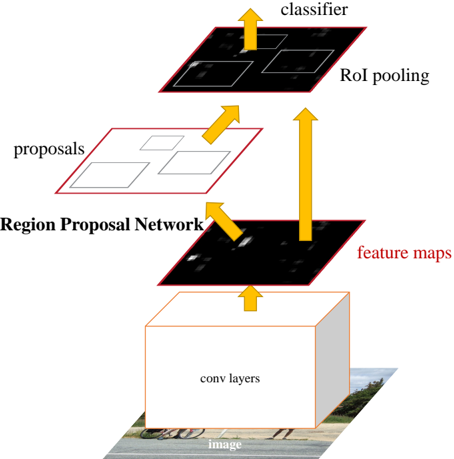
State-of-the-art object detection networks depend on region proposal algorithms to hypothesize object locations. Advances like SPPnet [1] and Fast R-CNN [2] have reduced the running time of these detection networks, exposing region proposal computation as a bottleneck. In this work, we introduce a Region Proposal Network (RPN) that shares full-image convolutional features with the detection network, thus enabling nearly cost-free region proposals. An RPN is a fully convolutional network that simultaneously predicts object bounds and objectness scores at each position. The RPN is trained end-to-end to generate high-quality region proposals, which are used by Fast R-CNN for detection. We further merge RPN and Fast R-CNN into a single network by sharing their convolutional features-using the recently popular terminology of neural networks with 'attention' mechanisms, the RPN component tells the unified network where to look. For the very deep VGG-16 model [3] , our detection system has a frame rate of 5 fps (including all steps) on a GPU, while achieving state-of-the-art object detection accuracy on PASCAL VOC 2007, 2012, and MS COCO datasets with only 300 proposals per image. In ILSVRC and COCO 2015 competitions, Faster R-CNN and RPN are the foundations of the 1st-place winning entries in several tracks. Code has been made publicly available.
Overview
CoChat Summary
TL;DR
Faster R-CNN introduces a Region Proposal Network (RPN) that shares convolutional features with Fast R-CNN, making region proposals nearly cost-free and enabling a unified object detection system. It achieves near real-time detection with state-of-the-art accuracy on PASCAL VOC and MS COCO.
Key findings
- With VGG-16 and shared features, Faster R-CNN reaches 69.9% mAP on PASCAL VOC 2007 test using 300 proposals, 73.2% with VOC07+12 training, 70.4% on VOC 2012 with 07++12, and 78.8% on VOC 2007 with COCO+07+12.
- Runtime: VGG-16 RPN + Fast R-CNN takes 198 ms total (5 fps), with RPN proposals costing 10 ms; ZF runs at 59 ms total (17 fps), versus SS + Fast R-CNN at 1830 ms (0.5 fps).
- Ablations: sharing features improves ZF mAP from 58.7% (unshared) to 59.9%; removing the reg layer drops mAP to 52.1%, and removing cls with 100 proposals drops it to 44.6%.
- On MS COCO test-dev, Faster R-CNN with VGG-16 and COCO train reaches 42.1% mAP@0.5 and 21.5% mAP@[.5,.95]; with COCO trainval it reaches 42.7% and 21.9%.
Methods
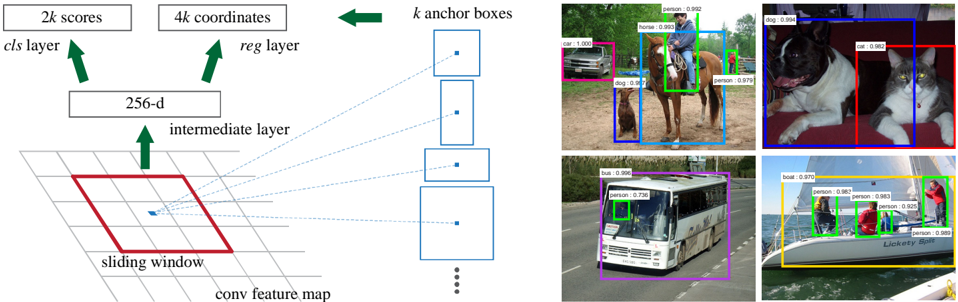
- The RPN is a fully convolutional network that slides a 3×3 window over shared conv features and predicts objectness scores and box regressions relative to anchors; default anchors use 3 scales (128², 256², 512²) and 3 aspect ratios (1:1, 1:2, 2:1), giving k = 9 anchors per position.
- Training uses a 4-step alternating scheme with ImageNet-pretrained ZF or VGG-16, SGD, single-scale images (shorter side s = 600), NMS at IoU 0.7, and 300 proposals at test time; evaluation is on PASCAL VOC 2007/2012 and MS COCO.
- Main metrics are detection mAP on PASCAL VOC and mAP@0.5 / mAP@[.5,.95] on MS COCO, with timing measured on a K40 GPU.
Limitations
- Stated in the paper: non-approximate joint training would require a differentiable RoI pooling/warping layer and is beyond the paper’s scope; the approximate joint training ignores gradients with respect to proposal box coordinates.
- Stated in the paper: cross-boundary anchors are ignored during training, and multi-scale feature extraction may improve accuracy but does not offer a good speed-accuracy trade-off.
- Evident from the text: the main experiments focus on PASCAL VOC and MS COCO with ZF/VGG-16 backbones, so generalization to other datasets, backbones, or detection regimes is not extensively characterized.
Model-written summary. Check it against the paper before relying on it.
Integrity signals
Registry
Cites
Statistics
Figures

Verification
Claims the paper makes
12 Valid · 5 Not valid · 8 Not checked · 83 Own results and interpretations
Every source the paper cites for this claim was checked and supports it.
In the paper
“Only by replacing VGG-16 with a 101layer residual net (ResNet-101) [18], the Faster R-CNN system increases the mAP from 41.5%/21.2% (VGG16) to 48.4%/27.2% (ResNet-101) on the COCO val set.”
What the sources say
- Supportedcites [18] [18] K. He, X. Zhang, S. Ren, and J. Sun, 'Deep residual learning for image recognition,' arXiv:1512.03385 , 2015. - source
Table 8 (p. 8) reports the exact COCO validation-set mAP values for baseline Faster R-CNN with VGG-16 and ResNet-101. Section 4.3 (p. 8) says the detection implementation was the same for both models and attributes the gain to replacing VGG-16 with ResNet-101. (LLM, conf=0.95)
plainstates a cause- Asserted: passes — The authors put it forward as true.
- Checkable: passes — It can be checked against evidence.
- Load-bearing: passes — The paper’s conclusions depend on it.
- Based: passes — The paper gives a reason why it holds.
- Supported
Every source the paper cites for this claim was checked and supports it.
In the paper
“This observation is still valid even when one increases the depth substantially to over 100 layers [18].”
What the sources say
- Supportedcites [18] [18] K. He, X. Zhang, S. Ren, and J. Sun, 'Deep residual learning for image recognition,' arXiv:1512.03385 , 2015. - source
In ImageNet Classification (p. 7), the paper reports that 101- and 152-layer ResNets outperform the 34-layer model, with no observed degradation. Its CIFAR-10 analysis (p. 7) also reports that a 110-layer ResNet converges well. These results support the stated extension to over 100 layers, although the isolated sentence does not specify what “this observation” refers to. (LLM, conf=0.87)
plain- Asserted: passes — The authors put it forward as true.
- Checkable: passes — It can be checked against evidence.
- Load-bearing: unclear — It is unclear whether the paper’s conclusions depend on it.
- Based: passes — The paper gives a reason why it holds.
- Supported
The cited sources support only part of this claim — read each source’s verdict below.
In the paper
“In ILSVRC and COCO 2015 competitions, Faster R-CNN and RPN are the basis of several 1st-place entries [18] in the tracks of ImageNet detection, ImageNet localization, COCO detection, and COCO segmentation.”
What the sources say
- Partly supportedcites [18] [18] K. He, X. Zhang, S. Ren, and J. Sun, 'Deep residual learning for image recognition,' arXiv:1512.03385 , 2015. - sourceExperimental — accuracy not yet measured
Section 4.3 (p. 8) lists first-place finishes in all four tracks, and the Object Detection Baselines (p. 10) describe a Faster R-CNN system using an RPN. The ImageNet Localization section (p. 12) also identifies its RPN-based method. But the copy attributes the entries collectively to deep residual nets; it does not establish that Faster R-CNN and RPN underpinned the COCO segmentation entry. (LLM, conf=0.86)
plainstates a cause- Asserted: passes — The authors put it forward as true.
- Checkable: passes — It can be checked against evidence.
- Load-bearing: unclear — It is unclear whether the paper’s conclusions depend on it.
- Based: passes — The paper gives a reason why it holds.
- Partly supported
The cited sources that could be checked couldn’t confirm or dispute this claim.
In the paper
“Yet when compared to efficient detection networks [2], Selective Search is an order of magnitude slower, at 2 seconds per image in a CPU implementation.”
What the sources say
- Could not verifycites [4] [4] J. R. Uijlings, K. E. van de Sande, T. Gevers, and A. W. Smeulders, 'Selective search for object recognition,' International Journal of Computer Vision (IJCV) , 2013. - sourceExperimental — accuracy not yet measured
The computational discussion in §5.3 (pp. 12–13) gives timings for complete object-recognition pipelines, not a two-second CPU runtime for Selective Search. The comparisons in §5.2.1 (p. 11) concern other object-location methods, not efficient detection networks. Searches for a two-second per-image runtime and a network comparison found neither claim in our copy. (LLM, conf=0.73)
- Not checked — no full text of the sourcecites [2] [2] R. Girshick, 'Fast R-CNN,' in IEEE International Conference on Computer Vision (ICCV) , 2015. - source
plainstates an association- Asserted: passes — The authors put it forward as true.
- Checkable: passes — It can be checked against evidence.
- Load-bearing: passes — The paper’s conclusions depend on it.
- Based: passes — The paper gives a reason why it holds.
- Could not verify
Every source the paper cites for this claim was checked and supports it.
In the paper
“We comprehensively evaluate our method on the PASCAL VOC detection benchmarks [11] where RPNs with Fast R-CNNs produce detection accuracy better than the strong baseline of Selective Search with Fast R-CNNs.”
What the sources say
- Supportedcites [11] [11] M. Everingham, L. Van Gool, C. K. I. Williams, J. Winn, and A. Zisserman, 'The PASCAL Visual Object Classes Challenge 2007 (VOC2007) Results,' 2007. - source
The citation is attached to “PASCAL VOC detection benchmarks,” not to the citing authors’ comparison of RPNs and Selective Search. Sections 5.2 and 6.2 describe the VOC detection task, its submitted methods, and its results, confirming the benchmark identification. (LLM, conf=0.92)
plainstates a cause- Asserted: passes — The authors put it forward as true.
- Checkable: passes — It can be checked against evidence.
- Load-bearing: passes — The paper’s conclusions depend on it.
- Based: passes — The paper gives a reason why it holds.
- Rests on an assumption not shown here.
- Supported
56 more claims
Create a free account to see all 108 claims and to verify the 2 references still open.
- Probably not a substantial claim. 11
- It may state two separate claims as one. 40
- The quote only partly states this claim. 1
Claims other papers make about this one
Each is checked against this paper’s own text: does it say what the citing paper says it does?
The source backs part of the claim, not all of it — or backs it for a different population, condition or comparison.
In the citing paper
“Unlike the original paper [19] that adopted stage-wise training regarding RPN, we use an improved implementation with end-to-end joint training similar to [37], which leads to higher baselines than [19].”
From Non-local Neural Networks (2018) · cites this paper as [37]
Experimental — accuracy not yet measuredThe source backs part of the claim, not all of it — or backs it for a different population, condition or comparison.
In the citing paper
“Faster RCNN is the first near-realtime deep learning detector (COCO mAP@.5=42.7%, VOC07 mAP=73.2%, 17fps with ZF-Net [48]).”
From Object Detection in 20 Years: A Survey (2023) · cites this paper as [19]
Experimental — accuracy not yet measuredThe source backs part of the claim, not all of it — or backs it for a different population, condition or comparison.
In the citing paper
“Faster RCNN is the first near-realtime deep learning detector (COCO mAP@.5=42.7%, VOC07 mAP=73.2%, 17fps with ZF-Net [48]).”
From Object Detection in 20 Years: A Survey (2023) · cites this paper as [47]
Experimental — accuracy not yet measuredThe source backs part of the claim, not all of it — or backs it for a different population, condition or comparison.
In the citing paper
“In the deep learning era, due to the increase of computing power, bootstrap was shortly discarded in object detection during 2014-2016 [16-20].”
From Object Detection in 20 Years: A Survey (2023) · cites this paper as [19]
Experimental — accuracy not yet measuredThe source backs part of the claim, not all of it — or backs it for a different population, condition or comparison.
In the citing paper
“The most commonly used idea to reduce the feature computational redundancy is to compute the feature map of the whole image only once [18, 19, 124], which have achieved tens or even hundreds of times of acceleration.”
From Object Detection in 20 Years: A Survey (2023) · cites this paper as [19]
Experimental — accuracy not yet measured
21 more claims about this paper
Create a free account to see every claim other papers make about this one.
Citations
Cites
Deep Residual Learning for Image Recognition
He, K., Zhang, X., Ren, S., & Sun, J. (2016) · 2016 IEEE Conference on Computer Vision and Pattern Recognition (CVPR) · doi:10.1109/cvpr.2016.90 · Cited by 235,474 · cited 7×
“to propose regions from data, and thus can easily benefit from deeper and more expressive features (such as the 101layer residual nets adopted in [18]).”
BackgroundInfluentialSelf-citationVery Deep Convolutional Networks for Large-Scale Image Recognition
Simonyan, K., & Zisserman, A. (2014) · arXiv · doi:10.48550/arxiv.1409.1556 · Cited by 114,148
ImageNet classification with deep convolutional neural networks
Krizhevsky, A., Sutskever, I., & Hinton, G. E. (2017) · Communications of the ACM · doi:10.1145/3065386 · Cited by 112,155 · cited 1×
“For the regression loss, we use L where R is the robust loss function (smooth L 1 ) defined in [5].”
MethodGoing deeper with convolutions
Szegedy, C., Liu, W., Jia, Y., Sermanet, P., Reed, S., Anguelov, D., Erhan, D., Vanhoucke, V., & Rabinovich, A. (2015) · 2015 IEEE Conference on Computer Vision and Pattern Recognition (CVPR) · doi:10.1109/cvpr.2015.7298594 · Cited by 48,562 · cited 1×
“1× 10(6) parameters (1536 × (4 + 1) × 800 for GoogleNet [34] in MultiBox [27]).”
Microsoft COCO: Common Objects in Context
Lin, T.-Y., Maire, M., Belongie, S., Hays, J., Perona, P., Ramanan, D., Dollár, P., & Zitnick, C. L. (2014) · Lecture Notes in Computer Science · doi:10.1007/978-3-319-10602-1_48 · Cited by 45,460 · cited 1×
“Region proposal methods typically rely on inexpensive features and economical inference schemes.”
MethodImageNet Large Scale Visual Recognition Challenge
Russakovsky, O., Deng, J., Su, H., Krause, J., Satheesh, S., Ma, S., Huang, Z., Karpathy, A., Khosla, A., Bernstein, M., et al. (2015) · International Journal of Computer Vision · doi:10.1007/s11263-015-0816-y · Cited by 39,380 · cited 1×
“, the shared convolutional layers) are initialized by pre-training a model for ImageNet classification [36], as is standard practice [5].”
MethodFully convolutional networks for semantic segmentation
Long, J., Shelhamer, E., & Darrell, T. (2015) · 2015 IEEE Conference on Computer Vision and Pattern Recognition (CVPR) · doi:10.1109/cvpr.2015.7298965 · Cited by 38,834 · cited 5×
“Our RPNs are thus a kind of fully-convolutional network (FCN) [14] and they can be trained end-to-end specifically for the task for generating detection proposals.”
BackgroundMethodInfluentialRich Feature Hierarchies for Accurate Object Detection and Semantic Segmentation
Girshick, R., Donahue, J., Darrell, T., & Malik, J. (2014) · 2014 IEEE Conference on Computer Vision and Pattern Recognition · doi:10.1109/cvpr.2014.81 · Cited by 32,684 · cited 7×
“, Selective Search [4] object detectors, RCNN [5], and Fast R-CNN [2]).”
BackgroundMethodInfluentialSelf-citationGirshick, R. (2015) · 2015 IEEE International Conference on Computer Vision (ICCV) · doi:10.1109/iccv.2015.169 · Cited by 28,105
Self-citationThe pascal visual object classes (VOC) challenge
Everingham, M., Van Gool, L., Williams, C. K. I., Winn, J., & Zisserman, A. (2010) · International Journal of Computer Vision · doi:10.1007/s11263-009-0275-4 · Cited by 19,599
Research works printed but not linked: 1
- [10] S. Ren, K. He, R. Girshick, and J. Sun, 'Faster R-CNN: Towards real-time object detection with region proposal networks,' in Neural Information Processing Systems (NIPS) , 2015. -
Cited by
Items 53,101–53,200 of 56,407
Challenges of Object Detection and Localization
Elhanashi, A., & Saponara, S. (2026) · Springer eBooks · doi:10.1007/978-981-95-4846-0_8
基于多尺度注意力网络的火星亚马逊平原尘卷风季节-空间分布及盛行风关联研究
施, 琳., 刘, 干., 赖, 嘉., 马, 旭., 崔, 飞., 张, 小., 徐, 懿., & 杨, 其. (2026) · SCIENTIA SINICA Terrae · doi:10.1360/n072025-0377
FMF‐DETR: A Frequency‐Aware Multi‐Scale Fusion DETR for Small Object Detection
Li, L., Mei, Y., Zhao, X., Shao, X., Zhu, Z., Diao, S., & Xu, M. (2026) · Concurrency and Computation Practice and Experience · doi:10.1002/cpe.70597
Parale, M., Patil, C. H., & Mali, S. M. (2026) · Multimedia Tools and Applications · doi:10.1007/s11042-026-21330-6 · Cited by 1
“Ren et al. [ 34 ] introduced Faster R-CNN, an RPN detection network that utilizes convolutional features extracted from the entire image.”
A Comparative Study of Automatic Number Plate Recognition (ANPR) Methods
Belhamri, Z. H., Goumiri, S., Chergui, S., et al. (2025) · International Conference on Applied Automation and Industrial Diagnostics (ICAAID) · doi:10.1109/icaaid68975.2025.11358377
“Mask R-CNN achieve strong localization in complex backgrounds using RPNs, but their speed (¡10 FPS) limits real-time use [22], [26].”
Choi, Y., & Kong, S.-H. (2026) · Multimedia Tools and Applications · doi:10.1007/s11042-026-21222-9
“SiamRPN enhanced this approach by incorporating region proposal networks [18, 19].”
Navhelp: A Navigation Help Model for Visually Impaired People Using Computer Vision
Kumari, N., Jain, B., & Kaur, N. (2026) · Lecture notes in networks and systems · doi:10.1007/978-3-032-08859-8_19
A Reinforcement-Learning Logic Synthesis Framework and Its Integration into the EDA Flow
Duan, Y. (2025) · International Conference on Electrical Engineering and Control Science (IC2ECS) · doi:10.1109/ic2ecs68700.2025.11361649
“If a project’s priorities shift—say, timing becomes the first constraint—weights can tilt toward delay without retraining the whole system [1]–[4], [10]–[12].”
AI-Powered 3D Printing Error Detection: A YOLOv5 and IoT-Based Alert System
Vedula, N. V., & Brinson, M. (2026) · Lecture notes in networks and systems · doi:10.1007/978-3-032-08859-8_14
Liu, Y., Wu, L., Wu, T., Zhang, Z., Chen, L., Hong, W., Dong, B., Yuan, J., Wang, H., Li, Z., et al. (2026) · International Journal of Imaging Systems and Technology · doi:10.1002/ima.70304
Exploring Real‐Time Tracking of Vocal Fold Polyps in Video‐Stroboscopy Using Deep Learning
Kaza, S., Mohanty, A. S., Serpedin, A., Yau, J., Kim, Y. E., Kutler, R. B., Elemento, O., Sulica, L., Khosravi, P., & Rameau, A. (2026) · The Laryngoscope · doi:10.1002/lary.70396
“This was followed by higher performing methods involving convolution neural networks (CNNs) like R-CNN, Fast R-CNN, and Faster CNN [13–15].”
An AI-Driven Multimodal Feature Fusion Framework for Integrated Circuit Fault Diagnosis
Xie, H. (2025) · International Conference on Electrical Engineering and Control Science (IC2ECS) · doi:10.1109/ic2ecs68700.2025.11362036
“…work in analog-circuit diagnosis, industrial electronics, and process systems has shown that fusing time, frequency, and time–frequency cues boosts robustness, and that deep networks—CNNs, temporal transformers, and state-space variants—can learn how to combine them [2], [3], [5], [8]–[10], [12].”
Submerged Hazard Identification and Processing Using Augmented Image-Based Detection (SHIP-AID)
Jean, R., & Walker, M. (2026) · Remote Sensing · doi:10.3390/rs18172884
GPEA: Grad-CAM-Guided Perceptibility-Reduced Ensemble Attack in Object Detection
Li, Z., Xia, H., Zhang, R., et al. (2025) · IEEE International Conference on Trust, Security and Privacy in Computing and Communications (TrustCom) · doi:10.1109/trustcom66490.2025.00316
“To evaluate the effectiveness of GPEA, we test it on a variety of object detectors from the MMDetection [16] code repository, including YOLOX [17], SSD [18], RetinaNet [19], Libra R-CNN [20], Faster R-CNN [14], Grid R-CNN [21], FCOS [22], DETR [23], Deformable DETR [24] and YOLOv10 [25].”
Huang, R., Tian, Y., Dong, A., & Wang, Z. (2026) · Multimedia Systems · doi:10.1007/s00530-025-02175-9
“…years, data-driven Deep Neural Networks (DNNs), which are trained in an end-to-end manner, have achieved remarkable progresses in the field of computer vision, such as image classification [ 15, 16 ], object detection [ 17, 18 ], semantic segmantation [ 19, 20 ] and image retrieval [ 21, 22 ].”
Intelligent Recognition Method and System for Power Grid Flood based on Ground Monitoring Video
Dong, S., Yue, G., Zhang, S., et al. (2025) · International Conference on Electrical Engineering and Control Science (IC2ECS) · doi:10.1109/ic2ecs68700.2025.11362058
“Although standard YOLO architectures achieve a favorable trade-off between inference speed and detection accuracy[10], they tend to face challenges in handling floodwater regions with irregular boundaries and variable scales in complex power grid scenarios[11].”
Vision-to-Words: A Resource-Efficient Transformer-Based Approach for Image Captioning
Hanchinale, N. B., Patil, P., Anigolkar, S. B., et al. (2026) · Lecture notes in networks and systems · doi:10.1007/978-981-95-2878-3_26
Han, J., Liu, K., Li, W., Lin, M., & Li, W. (2026) · IEEE Transactions on Geoscience and Remote Sensing · doi:10.1109/tgrs.2026.3660139
Wu, P., Zeng, N., Liu, Q., et al. (2026) · Scientia Sinica Technologica · doi:10.1360/sst-2025-0371
A dual roi feature fusion for 3D object detection
Meng, Q., Tong, J., Yang, S., Xie, T., Du, S., & Li, W. (2026) · Multimedia Systems · doi:10.1007/s00530-025-02169-7
“Point-RCNN combines the point-based approach with the classical 2D object detection method, Faster-RCNN [ 33 ], and proposes a two-stage method.”
Chang, L., Xu, B., Zhang, X., Wang, J., Shi, T., Guo, R., & Du, Y. (2026) · Engineering Applications of Artificial Intelligence · doi:10.1016/j.engappai.2026.113997
Duan, S. (2025) · International Conference on Electrical Engineering and Control Science (IC2ECS) · doi:10.1109/ic2ecs68700.2025.11362083
“We position the work in the context of recent time-series architectures [1]–[5], solar forecasting reviews and hybrids [6], [10], [11], quantile-based probabilistic forecasting, and grid-oriented spatiotemporal modeling.”
Lin, C.-W., Zhou, S., & Zhu, L. (2026) · Multimedia Systems · doi:10.1007/s00530-025-02134-4
“The earliest instance segmentation methods were region-based [ 18 , 19 , 21 , 36 ], first locating each tar-get’s bounding box and then performing pixel-level segmentation within those boxes.”
Tran, T. D., Danh, H. M., & Hoang, L. D. (2025) · RIVF International Conference on Computing and Communication Technologies (RIVF) · doi:10.1109/rivf68649.2025.11365135
“3) Main Loss Functions: Faster R-CNN is trained by jointly optimizing multiple loss components [4] [5] [6], each corresponding to a key stage in the model: • RPN Classification Loss (L rpncls ): Binary cross-entropy loss measures the accuracy of classifying anchor boxes as object or background,…”
MFE-YOLO for Overlapping LPI Radar Signal Modulation Recognition and Parameter Extraction
Feng, K., Yu, X., Wang, M., Huang, Y., Yi, W., & Kong, L. (2026) · IEEE Transactions on Instrumentation and Measurement · doi:10.1109/tim.2026.3660450
SceneScribe: IoT-Enabled AI Audio Narration for the Visually Impaired
Nadesan, J., & Hajari, N. (2025) · Conference proceedings - Canadian Conference on Electrical and Computer Engineering · doi:10.1109/ccece64018.2025.11364359
Geng, H., Fang, L., Wang, Y. J., Liu, Z., & Fan, Z. (2026) · IET Image Processing · doi:10.1049/ipr2.70294 · Cited by 1
A Robust Two-Tier Computer Vision System for Energy-Efficient Fire Detection
Chen, T., Li, L., Wang, R., Wang, P., Gao, Y., & Aibin, M. (2025) · Conference proceedings - Canadian Conference on Electrical and Computer Engineering · doi:10.1109/ccece64018.2025.11364433
Niu, Z., Cheng, P., Zhao, L., Zhang, W., Guo, Z., & Wang, Z. (2026) · IEEE Transactions on Geoscience and Remote Sensing · doi:10.1109/tgrs.2026.3660842 · Cited by 1
HSU-YOLO: High-Precision Small Object Detection for UAV Imagery
Sun, M., Liu, Y., Zhao, X., Wang, B., & Liu, D. (2025) · International Conference on Sensing, Measurement & Data Analytics in the era of Artificial Intelligence (ICSMD) · doi:10.1109/icsmd67131.2025.11365453
“Small object detection in UAV imagery is typically addressed through two algorithmic approaches[5].”
A didactic overview of Transformer applications: model variations and user guidelines
Cabrera-Bermejo, M. I., Germán, M., de la Rosa, D., Jesus, M. D., Rivera, A., Elizondo, D. A., Charte, F., & Godoy, P. (2026) · Logic Journal of IGPL · doi:10.1093/jigpal/jzaf040
Comic Image Detection Based on MA‐YOLOv8s
Xin, H., Li, X., Li, D., & Jin, X. (2026) · International Journal of Intelligent Systems · doi:10.1155/int/8859427
Zhai, M., Xiao, B., Pan, H., & He, W. (2025) · International Conference on Sensing, Measurement & Data Analytics in the era of Artificial Intelligence (ICSMD) · doi:10.1109/icsmd67131.2025.11365378
“Compared to classic target detection methods, such as Yolo8 [17], Faster RCNN [18], CNN-CBAM [19], the proposed ResNet model can achieve the optimal classification accuracy for multiscale damages, indicating that it has the potential to be a general and effective paradigm for real-time THz characterization of complex…”
Ventricle Detection Case Study: Comparison of Current Deep Learning Architecture Performances
Gençtürk, T. H., Gülağız, F. K., & Kaya, İ. (2026) · Academic Platform Journal of Engineering and Smart Systems · doi:10.21541/apjess.1771865
TBGA: Tripartite and Bipartite Graph Attention for Multi-modal Video Question Answering
Kim, J. (2025) · International Conference on Electrical, Control and Instrumentation Engineering (ICECIE) · doi:10.1109/icecie66637.2025.11363814
“Building upon object-centric representations, Anderson et al. [26] employed object proposals extracted via Faster R-CNN [27], using the question to attend selectively to these proposals for more precise reasoning.”
Tea Leaf Diseases Detection using YOLOv8-CBAM by enhancing Channel and Spatial Features
Halder, S., De, S., Sarkar, P., et al. (2025) · International Conference on Research in Computational Intelligence and Communication Networks (ICRCICN) · doi:10.1109/icrcicn68210.2025.11364642
“By curating a large annotated dataset of tea leaves across diverse conditions, and benchmarking against state-of-the-art models such as YOLOv5 [19], YOLOv6 [18], and Faster R-CNN [17], our study demonstrates superior precision, recall, and robustness.”
Gupta, A., & Laurent, K. (2026) · AIAA SciTech Forum · doi:10.2514/6.2026-2095
Learning modality knowledge with proxy for RGB-Infrared object detection
Ma, Y., Chai, L., Mao, S., & Zhang, Y. (2026) · Pattern Recognition · doi:10.1016/j.patcog.2026.113227
YOLD: You Only Look Denseness for Tiny Object Detection in Aerial Images
Gao, G., Shang, Y., Gao, J., Guo, H., Dong, Y., & Li, C. (2026) · IEEE Transactions on Geoscience and Remote Sensing · doi:10.1109/tgrs.2026.3660635 · Cited by 11
Miao, X., Yu, H., Zhang, B., Qixuan, D. O. N. G., Zhang, R., Xu, X., Jiang, X., ZHANG, D., Yingying, P. A. N., & Pan, M. (2026) · IEICE Transactions on Information and Systems · doi:10.1587/transinf.2025edp7078 · Cited by 1
Exploring deep learning for sorting shredded end-of-life wind turbine blades
Linder, C., Rechsteiner, F., & Eiler, S. (2026) · Clean Technologies and Recycling · doi:10.3934/ctr.2026005
Chauhan, A. S., & Nehra, V. (2025) · doi:10.1109/iemecon69302.2025.11365634
“[7][8] 3) YOLO (YOLOv8): YOLOv8 breaks new ground in real-time detection, exploring recent advancements in object detection architecture in a single unified system with enhanced backbone design, Anchor-free detection as well as transformer-based modules that improve speed, accuracy, and flexibility.”
Contour thinning for text detection in Mongolian handwritten historical documents
Ding, L., & Liu, Y. (2026) · International Journal on Document Analysis and Recognition (IJDAR) · doi:10.1007/s10032-026-00569-7
“The overall regression loss L regress is defined as follows: where l 1 denotes the smooth − L 1 loss used for regression[33], and F − 1 ( • ) denotes the inverse Fourier transform (IFT) operation as defined in Eq.”
DeepPanda: A Video-Based Framework for Automatic Behavior Recognition of Giant Pandas
Luo, S., Chen, S., Li, G., Xu, S., Cheng, J., Cai, N., & Wei, R. (2026) · Applied Sciences · doi:10.3390/app16031579
Box-guided class-contextual representation learning for self-visual lung nodule detection
Zhao, K., Zhang, L., Yi, L., et al. (2026) · Biomedical Signal Processing and Control · doi:10.1016/j.bspc.2026.109731
Lv, R., Teng, Z., Zhang, B., et al. (2026) · SSRN Electronic Journal · doi:10.2139/ssrn.6177597
CCFF‐Net: Cross‐Channel Feature Fusion Network for Underwater Object Detection
Chen, Z., Zhou, M., Zhu, Y., et al. (2026) · IET Image Processing · doi:10.1049/ipr2.70299
Improving Music Recommendation With Fine-Grained Content-Based Behavior Retrieval
Fan, W., Liu, Y., Zhang, S., Zhu, J., Li, M., Qian, X., Zhao, Z., Dong, Z., Tang, R., & Wu, F. Q. (2026) · IEEE Transactions on Cybernetics · doi:10.1109/tcyb.2026.3651813
“Technically, we resort to the region proposal network (RPN) [71], and devise a 1-”
Lightweight Insulator Flaw Detection Using Enhanced YOLOv8
Li, J., & Wu, Y. (2025) · IEEE International Conference on Computational Intelligence and Communication Networks (CICN) · doi:10.1109/cicn67655.2025.11368033
“The prevailing two-stage algorithms comprise the regional convolutional neural network Faster-RCNN[7], which initially extracts the object region and subsequently classifies the region for identification.”
An Integrated Framework for Border Surveillance Using Hybrid Detection Models and Transformers
Saxena, S., Kaur, H., Mishra, R., Patidar, R., Tahilramani, N., & Saxena, S. (2025) · International Conference on Computational Intelligence and Communication Networks (CICN) · doi:10.1109/cicn67655.2025.11368143
“Faster R-CNN [26] replaced Selective Search with a RPN, improving speed but still lagging behind one-shot detectors.”
Zu, B., Li, X., Li, Y., Li, J., & Wang, H. (2026) · Applied Soft Computing · doi:10.1016/j.asoc.2026.114774
Mussabek, M., Zumanov, Z., & Amirgaliyev, B. (2025) · International Conference on Information & Communication Technology and System (ICTS) · doi:10.1109/icts67612.2025.11369565
“BR24992852 “Intelligent models and methods of Smart City digital ecosystem for sustainable development and the citizens’ quality of life improvement”). frequent false positives or missed detections due to poor generalization outside of their training domain [5], [6].”
Integrating Trustworthy Artificial Intelligence with Energy-Efficient Robotic Arms for Waste Sorting
Kure, H. I., Retnakumari, J., Nwajana, A. O., Ismail, U. M., Romo, B. A., & Egho-Promise, E. (2025) · International Conference on Control, Mechatronics and Automation (ICCMA) · doi:10.1109/iccma67641.2025.11369681
“To solve this, AI and robotics offer a faster and more accurate way to automate waste sorting [2], [3].”
Zhang, X., Li, W., Liu, Z., et al. (2026) · Lecture notes in computer science · doi:10.1007/978-981-95-6960-1_5
Azad, M. A., & Nahid, M. M. H. (2025) · doi:10.1109/sti69347.2025.11367538
“This dataset has been used in research to improve defect detection methods, such as a multi-stage pipeline that refines the Region Proposal Network (RPN) anchor mechanism and enhances feature fusion [12].”
Few-Shot Object Detection via Superclass-Guided Feature Enhancement
Xu, H., Liao, H., & Qin, Y. (2026) · Lecture notes in computer science · doi:10.1007/978-981-95-5758-5_20
Autonomous Driving Test Scenario Generation and Integration Using UAV-Based Visual Data
Li, T. T., Carstens, B., & Liu-Henke, X. (2025) · IEEE International Symposium on Systems Engineering · doi:10.1109/isse65546.2025.11369991 · Cited by 2
“Common object detection frameworks include Faster R-CNN [26], YOLO [27], and SSD [28], among which YOLO is particularly prevalent in traffic-related applications due to its high speed and computational efficiency.”
A Lightweight and Accurate Detector for Small Floating Objects in Complex Water Surface EnvironmentsPreprint
Zhu, Y., Zhang, M., & Qiu, T. (2026) · SSRN Electronic Journal · doi:10.2139/ssrn.6183769
Zhong, L., Huang, J., Qin, Y., et al. (2026) · Agronomy · doi:10.3390/agronomy16030387
“As evidenced by Table 4, compared to the traditional multi-stage detection model Faster R-CNN [30], the YOLO series of single-stage detection models demonstrate remarkable performance advantages.”
Wu, X., Shi, G., He, X., Xue, D., & Zhang, K. (2026) · Lecture notes in computer science · doi:10.1007/978-981-95-5758-5_33
Wu, J. (2025) · International Conference on Information Management and Engineering (ICIME) · doi:10.1109/icime66598.2025.00022
“GFLOPS Params Ap Ap50 APs APm Cascade-RCNN [14] 236.0 69.3 19.7 32.6 9.9 30.9 Faster-RCNN [2] 208.0 41.4 19.4 32.9 9.5 30.9 RetinaNet [15] 210.0 36.5 16.4 27.6 6.0 27.4 GFL [16] 206.0 32.”
InfluentialVariational Box Representation with Normalizing Flows for Pedestrian Detection
He, H. (2026) · Lecture notes in computer science · doi:10.1007/978-981-95-5758-5_28
刘, 新. (2026) · Computer Science and Application · doi:10.12677/csa.2026.162048
Repeated pattern detection on fabric: A survey and novel approach
Ayyurek, E., Marcuzzo, M., Zangari, A., Giudice, L. D., Bigaglia, G., Pistellato, M., Albarelli, A., & Gasparetto, A. (2026) · PLoS ONE · doi:10.1371/journal.pone.0340797 · Cited by 1
“Some of the most notable meth-ods include R-CNN, which integrates region proposals with Convolutional Neural Network (CNN) [11], as well as its later advancements Fast R-CNN [12] and Faster R-CNN [13].”
Decoupled Channel Collaboration and Littoral Priors for Synthetic Aperture Radar Ship DetectionPreprint
Chen, Y., Liu, J., Wang, Q., & Feng, G. (2026) · SSRN Electronic Journal · doi:10.2139/ssrn.6183766
Multi-worm Tracking with Hierarchical Cues in Complex Microenvironments
Wang, L., Jin, Z., & Shen, Q. (2026) · Lecture notes in computer science · doi:10.1007/978-981-95-5758-5_7
FMA-Det: Inter-frame Motion-Aware Network for Anti-UAV Small Target Detection
Wei, Y., Jiang, Z., Zhang, J., Wang, G., & Wang, Y. (2026) · Lecture notes in computer science · doi:10.1007/978-981-95-5758-5_24
Zhang, M., Huang, N., He, Q., Song, W., Zhang, Y., & Mei, H. (2026) · Lecture notes in computer science · doi:10.1007/978-981-95-5758-5_18
A Dual-Branch Framework Based on Large Vision Models for Underwater Object Detection
Xiao, F., Han, P., Cao, Y., Hildre, H. P., & Zhang, H. (2025) · International Conference on Control, Mechatronics and Automation (ICCMA) · doi:10.1109/iccma67641.2025.11369497
“In underwater scenarios, CNN-based models such as Faster R-CNN [6] and YOLO [7] have been employed to mitigate issues caused by light scattering and color attenuation, often through the integration of image enhancement techniques, multi-scale feature fusion [8]–[12], or attention-based modules.”
Lightweight real-time detection network for fuel tank truck filling ports in complex scenarios
lin, Y. 林., Shen, Y., Gu, T., et al. (2026) · Measurement Science and Technology · doi:10.1088/1361-6501/ae425f
“The experimental results were compared with those of Faster R-CNN [24], SSD [25], EfficientDet-D0 [26], CenterNet [27], RetinaNet [28], RT-DETR-r18 [29], YOLOX-Tiny [30], YOLOv5n [31], YOLOv6n [32], YOLOv8n [33], YOLOv9t [34], YOLOv10n [35], YOLOv12n [36], YOLOv13n [37], RT-DETRv2 [38], DFINE-n…”
Overlapping Pyramid Vision Enables Instance-Level Sar Ship Detection and ClassificationPreprint
Sun, Z., Ma, J., Meng, C., Zhao, L., Li, T., Huo, L., Zhang, Z., & Chang, S. (2025) · SSRN Electronic Journal · doi:10.2139/ssrn.5392123
Zhang, W., Zhongyan, L., Wang, J., & Su, H. (2025) · SSRN Electronic Journal · doi:10.2139/ssrn.5343861
Edhsw-Yolov8n Model for the Detection of Surface Defects on Fiberglass Insulation SleevesPreprint
Xu, S., Tang, W., guo, S., & Liu, J. (2025) · SSRN Electronic Journal · doi:10.2139/ssrn.5343325
Zhang, W., Zhongyan, L., Wang, J., & Su, H. (2025) · SSRN Electronic Journal · doi:10.2139/ssrn.5343857
Shi, L., Liu, G., Lai, J., Ma, X., Cui, F., Zhang, X., Xu, Y., & Yang, Q. (2026) · Science China Earth Sciences · doi:10.1007/s11430-025-1792-2
“Table 1 presents a performance comparison between the proposed DTFA-Net model and other classical and cutting-edge methods (including Faster R-CNN (Ren et al., 2017), SSD (Liu et al., 2016), CenterNet (Duan et al., 2019), RetinaNet (Lin et al., 2017), YOLOX (Ge et al., 2021), YOLOv5, YOLOv7 (Wang et al., 2023), YOLOv8…”
InfluentialA Method for Identification of Humans From Dorsal Hand Sub-Images Using Siamese Network Models
Alghamdi, M. S., & Pellicer, A. L. (2026) · IEEE Access · doi:10.1109/access.2026.3661846
Liu, R., Wu, C., Zhang, Y., Song, H., Yuan, F., Dai, W., Li, W. J., & Liu, J. (2026) · IEEE Transactions on Automation Science and Engineering · doi:10.1109/tase.2026.3661872 · Cited by 1
Domain Adaptation for Object Detection Based on Domain-Aware Prompting in Remote Sensing Imagery
Zhang, X., Yao, X., Cheng, G., & Han, J. (2026) · IEEE Transactions on Geoscience and Remote Sensing · doi:10.1109/tgrs.2026.3661721 · Cited by 3
ANBI-UAV: A Framework for Automated Noise Barrier Inspection Using UAV Imagery in High-Speed Railway
Hua, Y., Liu, X., Chen, B., Yang, Y., Jiang, W., & Zhu, J. (2026) · IEEE Journal of Selected Topics in Applied Earth Observations and Remote Sensing · doi:10.1109/jstars.2026.3662000
A Model Incorporating Hierarchical Attention Networks for Internal Hollow Cylindrical Parts
Zhu, S., Huang, J., Gao, L., Geng, J., Guo, L., Qiang, H., & Zhang, H. (2026) · IEEE Sensors Journal · doi:10.1109/jsen.2026.3659211
“The following algorithms are included: the two-stage algorithm Fast-RCNN [9], the single-stage algorithm SSD [15], M-SSD [3], and the YOLO series (YOLOv5, YOLOv8 [35], YOLOv9-m [36], YOLOv11-l [28], and YOLOv11-n [28]), and RE-DETR-ResNet50 [16].”
ShellNet++: A Dynamic Shell Convolution-Based Framework for LIDAR Point Cloud Pedestrian Detection
Lahmyed, R., Ansari, M. E., Koutti, L., & Rida, Z. (2026) · IEEE Access · doi:10.1109/access.2026.3661235
A 5G-enabled fog framework for real-time robotic grasping
Wan, N.-Y., Peng, L.-P., Yao, G.-X., & Wang, Y.-M. (2026) · Pattern Recognition Letters · doi:10.1016/j.patrec.2026.02.006
A Comprehensive Review of Object Classification and Detection in Autonomous Driving Systems
Kumari, A., Khurana, M., Bhalla, V. K., & Rana, P. S. (2026) · Lecture notes in networks and systems · doi:10.1007/978-3-032-15398-2_29
Computer vision-based prediction of quality and mechanical properties of wooden lamellae
Achatz, J., Speigl, L., Elsener, R., Burgert, I., Rigling, A., & Schubert, M. (2026) · Advanced Engineering Informatics · doi:10.1016/j.aei.2026.104363 · Cited by 2
BF-DETR: A Lightweight and Adjustable Model Based on RT-DETR
Xu, Q., Qi, X., Wang, W., Huang, Y., & Zou, K. (2026) · IEEE Access · doi:10.1109/access.2026.3662346
Communicating vessels detection network for small object detection in realistic scenario
Pang, W., & Tan, Z. (2026) · Engineering Applications of Artificial Intelligence · doi:10.1016/j.engappai.2026.114062
Stable Vision-Based Robot Kinematic Control With Deep Learning-Based Oriented Object Detector
Li, S., Liu, C., Matsuno, K., et al. (2026) · IEEE Robotics and Automation Letters · doi:10.1109/lra.2026.3662576
Wang, L., Li, T., Wang, G., Cui, S., Wang, H., & Yu, L. (2026) · Lecture notes in computer science · doi:10.1007/978-981-95-6957-1_17
Class-Incremental Learning via Discriminative Representation Learning with Parallel AdaptersPreprint
Zhan, J., Liu, J., Peng, J., Chen, X., Gao, B.-B., Liu, Y., & Wang, C. (2026) · SSRN Electronic Journal · doi:10.2139/ssrn.6205841
A Multi-Task Detection Approach with Multi-Scale Attention Aggregation and Feature Enhancement
Wu, X., Yang, K., Zhao, W., Wang, Y., Chen, W., & Zhao, C. (2026) · Agronomy · doi:10.3390/agronomy16040419 · Cited by 3
A Multiple Aircraft Tracking Dataset for Airport Traffic Surveillance
Zhang, X., Li, T., Tang, Z., Wang, G., & Huang, R. (2026) · IEEE Transactions on Intelligent Transportation Systems · doi:10.1109/tits.2026.3658559 · Cited by 2
“The initial SORT [26] uses Intersection over Union (IoU) to measure the motion similarity between the prediction by the Kalman filter and the detection from the Faster-RCNN [27], and then adopts the Hungarian algorithm to find the best association result.”
Semantic-Aware Remote Sensing Visual Question Answering via Segmentation-Guided Learning
Wen, S., Mao, A., Yi, R., & Liu, Y. (2026) · IEEE Transactions on Geoscience and Remote Sensing · doi:10.1109/tgrs.2026.3663435
Zheng, W., Zhang, H., Zhang, Y., et al. (2026) · Expert Systems with Applications · doi:10.1016/j.eswa.2026.131509
Foreign object detection on photovoltaic panels based on DHLNet
Jin, H., Li, M., Lv, X., & Peng, J. (2026) · Scientific Reports · doi:10.1038/s41598-026-39074-6 · Cited by 2
Dual-Branch Semantic Segmentation Network for Water Surface Images Based on CNN and TransformerPreprint
詹, 小., 詹, 小., Lu, Y., et al. (2026) · SSRN Electronic Journal · doi:10.2139/ssrn.6206929
A Multi-modal Information Interaction-based Detection Method for Substation Equipment Using YOLOv11Preprint
Pan, Z., & Yuanbin, W. A. N. G. (2026) · SSRN Electronic Journal · doi:10.2139/ssrn.6207127
A Helmet Wearing Detection Method in Complex Cable Tunnels Based on HT-YOLO Model
Ma, X., Zhao, Y., Guo, T., et al. (2026) · Lecture notes in electrical engineering · doi:10.1007/978-981-95-6841-3_61
YOLOv8-FOD: a lightweight foreign object detection algorithm for power transmission lines
Liu, W., Yang, T., Shi, D., et al. (2026) · Frontiers in Energy Research · doi:10.3389/fenrg.2026.1745369
“Compared with other detection models such as SSD, Faster R-CNN and Retina Net, the YOLO series detection models require relatively small computing resources (Liu et al., 2016; Maduako et al., 2022; Ren et al., 2017; Yan et al., 2025; Lin et al., 2017).”
Zhang, X., Sun, H., Sun, H., Liu, Q., Sun, X., & Yao, X. (2026) · IEEE Journal of Selected Topics in Applied Earth Observations and Remote Sensing · doi:10.1109/jstars.2026.3662714 · Cited by 2
A domain knowledge and cognitive law driven approach to anti-vibration hammer defect detection
Niu, H., Ge, X., Zhao, X., Yang, K., Wang, Q., Zhai, Y., & Hu, Z. (2026) · Engineering Applications of Artificial Intelligence · doi:10.1016/j.engappai.2026.114100
Metadata
- Authors
- Ren, S., He, K., Girshick, R., & Sun, J.
- Affiliations
- University of Science and Technology of China (CN)
- Visual Computing Group, Microsoft Research, Beijing, China
- Meta (United States) (US)
- ORCID
- Venue
- IEEE Transactions on Pattern Analysis and Machine Intelligence
- Published
- 2017-06-01
- Volume
- 39
- Issue
- 6
- Pages
- 1137-1149
- ISSN
- 0162-8828 (ISSN-L)
- 2160-9292
- 1939-3539
- OpenAlex
- W639708223
- Cited by
- 73,472
- References
- 60
- Citations by year
- 2026: 5632 · 2025: 9233 · 2024: 9699 · 2023: 9795 · 2022: 9251 · 2021: 9857 · 2020: 7617 · 2019: 6376 · 2018: 3729 · 2017: 1740
- FWCI
- 2215.09
- Type
- journal article
- Language
- en
- Open access
- green
- arxiv.org
- Licence
- Locations
- IEEE Transactions on Pattern Analysis and Machine Intelligence (publishedVersion)
- PubMed (publishedVersion)
- arXiv (Cornell University) (submittedVersion)
- arXiv (Cornell University)
- neural information processing systems
- Funders
- Microsoft Research
- Topics
- Physical Sciences › Computer Science › Computer Vision and Pattern Recognition › Advanced Neural Network Applications
- Physical Sciences › Computer Science › Computer Vision and Pattern Recognition › Visual Attention and Saliency Detection
- Physical Sciences › Computer Science › Computer Vision and Pattern Recognition › Advanced Image and Video Retrieval Techniques
- Keywords
- Faster R-CNN, region proposal network, real-time object detection, Fast R-CNN, bounding box regression, VGG16, attention mechanism, end-to-end learning, Pascal VOC, MS COCO
About these checks
Registry, retraction, Cites and statistics results are computed, not judged, with one exception: a printed reference that no index lists is read once by a model before it counts as a citation error. Claims are extracted by a model and kept only when their quote appears verbatim in the text; each cited source is then checked, with a model’s help, for whether it says what the claim relies on. Those verdicts can be wrong — read the claim’s quote and the cited source before relying on one.
The claim verdicts this report counts are experimental: their accuracy is not yet measured.
A language model drew the claims from the paper on 2026-10-10, under version 3 of the claim definition (model deepseek-v4.1-flash, prompt extract-v3).
A second model labelled each claim on 2026-10-10 (model jev-1.13-20260917, definition revision gold-guideline-v0.2).
Cited sources are checked with a language model’s help (gpt-6-sol).
Statistics and arithmetic are recomputed, not judged.
Confidence bands are shown only for fields calibrated on our annotated test set. None is calibrated yet, so no band is shown.
What counts as a claim ›How we measure confidence ›How we check this ›
Are you an author, or do you see a problem with this page? Request a review
Data sources
Bibliographic data: Semantic Scholar, OpenAlex, Crossref.
Contains information from the Semantic Scholar Academic Graph Datasets, made available under the ODC Attribution License (ODC-BY 1.0).
Semantic Scholar’s data is described in: Kinney, R., et al. (2023). The Semantic Scholar Open Data Platform. arXiv:2301.10140.
