

Detecting Developers' Task Switches and Types
Open accessThe DOI matches its Crossref record, with a small difference in title or year; 86 of the 89 references it cites were found in a registry or an index; 6 of the 106 sources its claims cite were checked for support.
Abstract
Developers work on a broad variety of tasks during their workdays and constantly switch between them. While these task switches can be beneficial, they can also incur a high cognitive burden on developers, since they have to continuously remember and rebuild the task context–the artifacts and applications relevant to the task. Researchers have therefore proposed to capture task context more explicitly and use it to provide better task support, such as task switch reduction or task resumption support. Yet, these approaches generally require the developer tomanuallyidentify task switches. Automatic approaches for predicting task switches have so far been limited in their accuracy, scope, evaluation, and the time discrepancy between predicted and actual task switches. In our work, we examine the use ofautomaticallycollected computer interaction data for detecting developers’ task switches as well as task types. In two field studies–a 4h observational study and a multi-day study with experience sampling–we collected data from a total of 25 professional developers. Our study results show that we are able to use temporal and semantic features from developers’ computer interaction data to detect task switches and types in the field with high accuracy of 84 percent and 61 percent respectively, and within a short time window of less than 1.6 minutes on average from the actual task switch. We discuss our findings and their practical value for a wide range of applications in real work settings.
Overview
CoChat Summary
TL;DR
The paper studies whether developers’ task switches and task types can be automatically detected from computer interaction data. Using two field studies with 25 professional developers, the authors report 84% accuracy for task-switch detection and 61% accuracy for task-type detection, with task switches detected on average within 1.6 minutes of the actual switch.
Key findings
- Task-switch detection reached 84% averaged accuracy with individual models (precision 62%, recall 35%, kappa 0.34); the general model reached 73% accuracy (precision 46%, recall 55%, kappa 0.27).
- The average task-switch prediction error was 2.79 application-switches, which the paper translates to 4.46 minutes before/after the actual switch using the average application-segment length of 1.6 minutes.
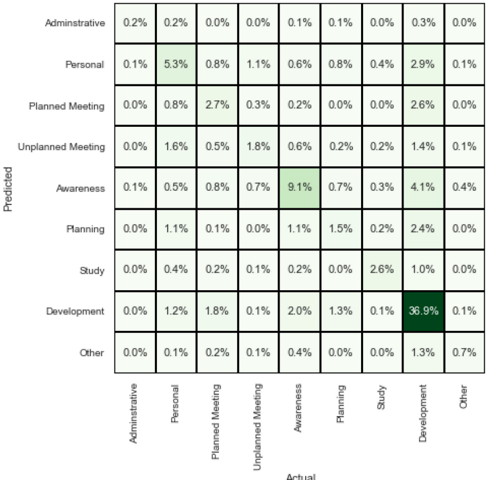
- For task-type detection, individual models outperformed the general model: 61% accuracy for individual models versus 50% for the general model; for all task types combined, the table reports 59% precision / 61% recall for individual models and 44% precision / 50% recall for general models.
- Feature importance was highest for user input features for task switches (45.8%) and task types (47.6% for all features); lexical features were weakest, contributing 8.2% for switches and 0% for task types.
Methods
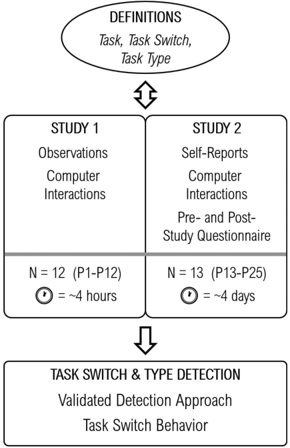
- Two field studies with professional software developers: a 4-hour observational study with 12 participants and a multi-day experience-sampling study with 13 participants; the paper states 25 professional developers in total.
- Data sources included observed or self-reported ground truth plus automatically tracked computer interaction data from a monitoring tool; the paper extracted 109 temporal and semantic features overall and used 84 features for task-switch detection and 25 features for task-type detection.
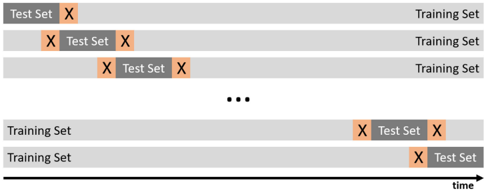
- Main analysis used RandomForest classifiers with 500 estimators, evaluated with 10-fold cross-validation for individual models and a leave-one-participant-out style general model; task-switch data were additionally handled with SMOTE due to class imbalance, while task-type detection used penalized classification.
Limitations
- The paper states that task-switch detection is limited to application-switch granularity, so it cannot detect switches within an application and misses very short switches; it also notes an average delay of 1.6 minutes due to this granularity.
- The paper states that self-reports may be inaccurate or burdensome, and that the study relied only on computer interaction data, which limits visibility into cases with no computer input; it explicitly notes this as a limitation.
- Evident from the text: the observational study covered only one workday per participant, and the generalizability of the results is constrained by the sample sizes and recruitment from a small number of companies; the paper itself notes this as a threat to external validity.
Model-written summary. Check it against the paper before relying on it.
Integrity signals
Registry
Cites
Statistics
Figures
Verification
Claims the paper makes
6 Valid · 2 Not valid · 51 Not checked · 104 Own results and interpretations
The cited sources support only part of this claim — read each source’s verdict below.
In the paper
“which can account for 39 percent up to 91 percent of the time developers spend at work [1], [3], [19], [20], [21].”
What the sources say
- Not checked — no full text of the sourcecites [1] [1] D. E. Perry, N. Staudenmayer, and L. G. Votta, 'People, organizations, and process improvement,' IEEE Softw. , vol. 11, no. 4, pp. 36-45, Jul. 1994. - source
- Not checked — no full text of the sourcecites [3] [3] A. N. Meyer, L. E. Barton, G. C. Murphy, T. Zimmermann, and T. Fritz, 'The work life of developers: Activities, switches, and perceived productivity,' IEEE Trans. Softw. Eng. , vol. 43, no. 12, pp. 1178-1193, Dec. 2017. - source
- Partly supportedcites [19] [19] M. K. Gonc ¸alves, L. de Souza, and V. M. Gonz alez, 'Collaboration, information seeking and communication: An observational study of software developers' work practices,' J. Universal Comput. Sci. , vol. 17, no. 14, pp. 1913-1930, 2011. - sourceExperimental — accuracy not yet measured
Section 4.1 reports that collaborative activities took about 45% of observed developers’ time, supporting the broader point that substantial work time was spent outside individual activities such as coding. It does not classify all collaborative work as non-development work or report the claimed 39%–91% range. (LLM, conf=0.84)
plain- Asserted: passes — The authors put it forward as true.
- Checkable: passes — It can be checked against evidence.
- Load-bearing: passes — The paper’s conclusions depend on it.
- Based: passes — The paper gives a reason why it holds.
The cited sources support only part of this claim — read each source’s verdict below.
In the paper
“as SMOTE has significant drawbacks when the minority classes have a limited number of samples [58].”
What the sources say
- Partly supportedcites [58] [58] G. H. Nguyen, A. Bouzerdoum, and S. L. Phung, 'Learning pattern classification tasks with imbalanced data sets,' Pattern Recognition , Oct. 2009. - sourceExperimental — accuracy not yet measured
Section 3.3 (Advanced sampling methods; page not provided) says that inadequate minority-class examples can make distribution estimates inaccurate, but it identifies this as a drawback of generative over-sampling, a variation of SMOTE. It does not establish that SMOTE itself has this drawback. (LLM, conf=0.82)
plainstates a cause- Asserted: passes — The authors put it forward as true.
- Checkable: passes — It can be checked against evidence.
- Load-bearing: passes — The paper’s conclusions depend on it.
- Based: passes — The paper gives a reason why it holds.
- Partly supported
The sources with a verdict support this claim; the rest weren’t checked yet, have no full text we could read, or their verdicts aren’t rated yet.
In the paper
“Most of our task type categories are consistent with previous work that investigated knowledge workers' tasks [32], [60], [61], [62].”
What the sources say
- Supportedcites [32] [32] S. Koldijk, M. van Staalduinen, M. Neerincx, and W. Kraaij, 'Realtime task recognition based on knowledge workers' computer activities,' in Proc. 30th Eur. Conf. Cognitive Ergonom. , 2012, pp. 152-159. - source
The Task Labels section describes a questionnaire about the tasks knowledge workers perform and lists the resulting task categories. This makes the paper a relevant example of previous work investigating knowledge workers’ tasks, which is the role of this citation among the four cited sources. (LLM, conf=0.87)
- Not checked — no full text of the sourcecites [60] [60] M. Czerwinski, E. Horvitz, and S. Wilhite, 'A diary study of task switching and interruptions,' in Proc. SIGCHI Conf. Hum. Factors Comput. Syst. , 2004, pp. 175-182. - source
- Not checked — no full text of the sourcecites [61] [61] W. Reinhardt, B. Schmidt, P. Sloep, and H. Drachsler, 'Knowledge worker roles and actions - results of two empirical studies,' Knowl. Process Manage. , vol. 18, no. 3, pp. 150-174, 2011. - source
plainstates an association- Asserted: passes — The authors put it forward as true.
- Checkable: passes — It can be checked against evidence.
- Load-bearing: unclear — It is unclear whether the paper’s conclusions depend on it.
- Based: passes — The paper gives a reason why it holds.
- Supported
The cited sources support only part of this claim — read each source’s verdict below.
In the paper
“We have been able to find only very little work on automatically detecting, characterizing and summarizing (developers) tasks yet [22], [32], [33].”
What the sources say
- Not checked — no full text of the sourcecites [22] [22] L. Bao, Z. Xing, X. Xia, D. Lo, and A. E. Hassan, 'Inference of development activities from interaction with uninstrumented applications,' Empir. Softw. Eng. , vol. 23, no. 3, pp. 1313-1351, 2018. - source
- Partly supportedcites [32] [32] S. Koldijk, M. van Staalduinen, M. Neerincx, and W. Kraaij, 'Realtime task recognition based on knowledge workers' computer activities,' in Proc. 30th Eur. Conf. Cognitive Ergonom. , 2012, pp. 152-159. - sourceExperimental — accuracy not yet measured
The Introduction (page unavailable) describes automatic recognition of knowledge workers’ tasks as a new research domain, and the paper presents a system that recognizes tasks and provides overviews. This supports the citation as an example of related work, but our copy does not establish that the participants were developers or that very little work existed on detecting, characterizing, and summarizing developers’ tasks specifically. (LLM, conf=0.82)
- Not checked — no full text of the sourcecites [33] [33] H. T. Mirza, L. Chen, I. Hussain, A. Majid, and G. Chen, 'A study on automatic classification of users' desktop interactions,' Cybern. Syst. , vol. 46, no. 5, pp. 320-341, 2015. - source
plain- Asserted: passes — The authors put it forward as true.
- Checkable: passes — It can be checked against evidence.
- Load-bearing: unclear — It is unclear whether the paper’s conclusions depend on it.
- Based: passes — The paper gives a reason why it holds.
A result the paper reports from its own data — it cites no other source for it, so there is none to check. The quote shows it is in the paper.
In the paper
“within a short time window of less than 1.6 minutes on average from the actual task switch.”
- Also stated in: § 1 INTRODUCTION · plain
“within a short time window of less than 1.6 minutes of the actual task switch.”
plainstates an association- Asserted: passes — The authors put it forward as true.
- Checkable: passes — It can be checked against evidence.
- Load-bearing: passes — The paper’s conclusions depend on it.
- Based: passes — The paper gives a reason why it holds.
- Also stated in: § 1 INTRODUCTION · plain
79 more claims
Create a free account to see all 163 claims and to verify the 16 references still open.
- Probably not a substantial claim. 51
- It may state two separate claims as one. 46
- The quote only partly states this claim. 1
Self-check
Percentages, sums and reported differences re-computed from the paper’s own numbers.
Each contradiction between two passages listed here was confirmed by an independent check.
Rated major: it would touch a result — a value a result rests on, reported and recomputed p-values on opposite sides of the significance level, two passages that conflict with no sign which is right, or a cited work retracted before this paper was published.
In the paper
§ Detecting Developers' Task Switches and Types
“Our study results show that we are able to use temporal and semantic features from developers' computer interaction data to detect task switches and types in the field with high accuracy of 84 percent and 61 percent respectively, and within a short time window of less than 1.6 minutes on average from the actual task switch.”
§ 1 INTRODUCTION
“Our analysis of the data shows we can use the automatically logged computer interaction data to train machine learning classifiers and predict task switches with a high accuracy of 87 percent, and within a short time window of less than 1.6 minutes of the actual task switch.”
Citations
Cites
Using thematic analysis in psychology
Braun, V., & Clarke, V. (2006) · Qualitative Research in Psychology · doi:10.1191/1478088706qp063oa · Cited by 194,414
Breiman, L. (2001) · Machine Learning · doi:10.1023/a:1010933404324 · Cited by 133,538
Scikit-learn: Machine Learning in Python
Pedregosa, F., Varoquaux, G., Gramfort, A., Michel, V., Thirion, B., Grisel, O., Blondel, M., Müller, A., Nothman, J., Louppe, G., et al. (2012) · arXiv · doi:10.48550/arxiv.1201.0490 · Cited by 71,016 · cited 1×
“These common steps in a machine learning pipeline can improve a classifier’s performance [56].”
BackgroundScikit-learn: Machine Learning in Python
(2011) · Journal of Machine Learning Research · doi:10.5555/1953048.2078195 · Cited by 8,539
The Psychology of Survey Response
Tourangeau, R., Rips, L. J., & Rasinski, K. (2000) · doi:10.1017/cbo9780511819322 · Cited by 4,734
Detection of Abrupt Changes: Theory and Application
Riedel, K. S. (1994) · Technometrics · doi:10.1080/00401706.1994.10485821 · Cited by 3,518
Imbalanced-learn: A Python Toolbox to Tackle the Curse of Imbalanced Datasets in Machine Learning
Lemaître, G., Nogueira, F., & Aridas, C. K. (2016) · arXiv (Cornell University) · doi:10.48550/arxiv.1609.06570 · Cited by 1,514 · cited 1×
“For the task switch detection , we further apply Lemaˆıtre’s implementation of SMOTE, which is a method for oversampling and can considerably boost a classifier’s performance in the case of an imbalanced dataset such as ours [57].”
MethodDetection of Abrupt Changes: Theory and Application
Riedel, K. S., Basseville, M., Nikiforov, I. V., et al. (1994) · Technometrics · doi:10.2307/1269388 · Cited by 1,330
Adaptive Filtering and Change Detection
Gustafsson, F. (2001) · Wiley eBooks · doi:10.1002/0470841613 · Cited by 1,217
A diary study of task switching and interruptions
Czerwinski, M., Horvitz, E., & Wilhite, S. (2004) · Proceedings of the SIGCHI Conference on Human Factors in Computing Systems · doi:10.1145/985692.985715 · Cited by 830 · cited 1×
“Most of our task type categories are consistent with previous work that investigated knowledge workers’ tasks [32], [60], [61], [62].”
Result
Research works printed but not linked: 4
- [26] B. Bruegge and A. H. Dutoit, Object-Oriented Software Engineering Using UML, Patterns and Java-(Required) . Englewood Cliffs, NJ, USA: Prentice Hall, 2004, vol. 2004. -
- 10.1023/A:I0I0933404324 · doi:10.1023/a:i0i0933404324
- [55] A. Liaw et al. , 'Classification and regression by randomforest,' R News , vol. 2, no. 3, pp. 18-22, 2002. -
- [85] TimeDoctor, retrieved March 19, 2020, 2020. [Online]. Available: https://timedoctor.com <!-- image --> Andr e N. Meyer received the PhD degree in somputer science from the University of Zurich, Switzerland, supervised by Professor Thomas Fritz. His research interests lie in developers' productivity and work, and in creating tools that foster productive work by using persuasive technologies such as self-monitoring, self-reflection and goal-setting. He also works in the information technology industry as an application developer and consultant. For more information, please visit https://andre-meyer.ch. <!-- image --> <!-- image --> <!-- image --> Chris Satterfield is currently working toward the MSc degree in the University of British Columbia, co-supervised by Dr. Gail C. Murphy and Dr. Thomas Fritz. His research interests are in software engineering, specifically in investigating how machine learning powered tools can be used to improve developer productivity. He is also interested in how biometric monitoring can improve our understanding of a developers emotional state in real time, and how that may impact productivity. Manuela Z € uger received the PhD degree in computer science from the University of Zurich, Switzerland, supervised by Professor Thomas Fritz. She is a consultant in the Swiss information technology industry. She has a strong interest in how knowledge workers (in particular, software developers) can be supported in handling interruptions at the workplace by measuring their flow state and developing tool support to reduce costly interruptions. Katja Kevic received the PhD degree from the University of Zurich. She is a software engineer with Microsoft, UK. Her research interests include various aspects around continuously deploying software. <!-- image --> Gail C. Murphy received the BSc degree in computing science from the University of Alberta, and the MS and PhD degrees in computer science and engineering from the University of Washington. She is a professor of computer science and associate dean (Research and Graduate Programs) with the Faculty of Science at the University of British Columbia. She is also a co-founder and chief scientist at Tasktop Technologies, Inc. Her research interests include software developer productivity and software evolution. She is a fellow of the Royal Society of Canada and a member of the IEEE Computer Society. <!-- image --> Thomas Zimmermann received the PhD degree from Saarland University, in Germany. He is a senior researcher with Microsoft Research. His research interests include software productivity, software analytics, and recommender systems. He is a member of the IEEE Computer Society. For more information, please visit http://thomaszimmermann.com. <!-- image --> Thomas Fritz received the Diploma degree from the Ludwig-Maximilians-University Munich, Germany, in 2005, and the PhD degree from the University of British Columbia, Canada. He is a professor with the Department of Informatics at the University of Zurich, Switzerland. His research focuses on empirically studying software developers and on using personal and biometric data to improve developers' productivity. He is a member of the IEEE Computer Society and currently a Member-at-Large of IEEE TCSE. " For more information on this or any other computing topic, please visit our Digital Library at www.computer.org/csdl.
Cited by
Zhu, R. H., Liang, S., Song, Y., & Cai, Z. (2023) · Proceedings of the ACM on Interactive Mobile Wearable and Ubiquitous Technologies · doi:10.1145/3610876 · Cited by 20
Talypova, D., Visuri, A., Shahu, A., Wang, A. Y., & Wintersberger, P. (2025) · Annual Symposium on Human-Computer Interaction for Work (CHIWORK) · doi:10.1145/3729176.3729198 · Cited by 6
“Later, automated logging systems emerged, providing fine-grained data on digital multitasking behaviors such as program and device switching [10, 21, 37, 54, 57, 75].”
Identifying and describing information seeking tasks
Satterfield, C., Fritz, T., & Murphy, G. C. (2020) · IEEE/ACM International Conference on Automated Software Engineering (ASE) · doi:10.1145/3324884.3416537 · Cited by 6
Self-citationData Collection of Real-Life Knowledge Work in Context: The RLKWiC Dataset
Bakhshizadeh, M., Jilek, C., Schröder, M., Maus, H., & Dengel, A. R. (2024) · Communications in computer and information science · doi:10.1007/978-3-031-64359-0_22 · Cited by 4
“The observation periods range from a few hours per participant [15]–[18], [21] to around two months [19], [20].”
BackgroundTask estimation for software company employees based on computer interaction logs
Pellegrin, F., Yücel, Z., Monden, A., & Leelaprute, P. (2021) · Empirical Software Engineering · doi:10.1007/s10664-021-10006-4 · Cited by 3
“In addition, Meyer et al. suggest that task detection serves for actively reducing task switching, which has an impact on reducing interruptions and stress (Meyer et al. 2020).”
BackgroundCosine Similarity Preserving Curse of Dimensionality Reduction for Managing Computational Complexity
Kgosietsile, T. (2025) · Lecture notes in networks and systems · doi:10.1007/978-981-97-5703-9_21 · Cited by 3
Enhancing Task In-Progress Time Predictions through Affective and Personality Factors
Silva, L., Barreto, C. A. D. S., de Lima, M. P., & Madeira, H. (2026) · ACM Transactions on Software Engineering and Methodology · doi:10.1145/3749984 · Cited by 2
“Meyer et al. [63] demonstrated that temporal and semantic features from developers’ computer interactions could detect task switches with 84% accuracy and task types with 61% accuracy in field studies involving 25 developers.”
When Help Hurts: Verification Load and Fatigue with AI Coding Assistants
Fan, G. F., Liu, D., Pan, L., & Zhang, R. (2026) · CHI Conference on Human Factors in Computing Systems · doi:10.1145/3772318.3791176 · Cited by 11
Leveraging the Power of Images: Image Recommendation to Enhance Issue Reports
Tan, X., Gengiti, D., & Nayebi, M. (2025) · Software Practice and Experience · doi:10.1002/spe.70010 · Cited by 2
Brandebusemeyer, C., Zunic, K., Zimmermann, T., Schimmer, T., & Arnrich, B. (2026) · ACM Transactions on Software Engineering and Methodology · doi:10.1145/3847122 · Cited by 5
Self-citationSalin, H., Klotins, E., & Zabardast, E. (2025) · Lecture notes in computer science · doi:10.1007/978-3-032-12092-2_8 · Cited by 1
Poreba, F., & Sobernig, S. (2026) · Empirical Software Engineering · doi:10.1007/s10664-025-10739-6 · Cited by 1
“Meyer et al. (2022) used computer interaction data to identify task types and switches.”
InfluentialTaskSnap: One Task at a Time With Snapshots
Souza, J., Egloff, R., Fritz, T., & Meyer, A. N. (2026) · IEEE Transactions on Software Engineering · doi:10.1109/tse.2026.3656405
“Additionally, beyond curating task contexts, mechanisms for inferring task switches [28], [78], [79] could be leveraged for automated grouping of task-related artifacts, by continuously monitoring the relevance of artifacts throughout the execution of a task, instead of at the moment of a task…”
Self-citationDear Diary, so far so good—The application works perfectly
Sáenz, J. P., & Russis, L. D. (2026) · International Journal of Human-Computer Studies · doi:10.1016/j.ijhcs.2026.103943
Metadata
- Authors
- Meyer, A. N., Satterfield, C., Zuger, M., Kevic, K., Murphy, G. C., Zimmermann, T., & Fritz, T.
- Affiliations
- University of British Columbia (CA)
- Microsoft (United States) (US)
- University of Zurich (CH)
- Venue
- IEEE Transactions on Software Engineering
- Published
- 2022-01-01
- Volume
- 48
- Issue
- 1
- Pages
- 225-240
- ISSN
- 0098-5589 (ISSN-L)
- 1939-3520
- 2326-3881
- OpenAlex
- W3017224552
- Semantic Scholar
- 0963c1988141f256ab1864772d41bbb0842a4da2
- Cited by
- 14
- References
- 89
- Citations by year
- 2026: 5 · 2025: 5 · 2024: 1 · 2023: 1
- FWCI
- 0.71
- Type
- journal article
- Language
- en
- Open access
- hybrid
- doi.org
- Locations
- IEEE Transactions on Software Engineering (publishedVersion, cc-by)
- Zurich Open Repository and Archive (University of Zurich) (acceptedVersion, cc-by)
- Zurich Open Repository and Archive (University of Zurich) (submittedVersion, cc-by)
- Zurich Open Repository and Archive (University of Zurich)
- Topics
- Physical Sciences › Computer Science › Information Systems › Software Engineering Research
- Social Sciences › Decision Sciences › Information Systems and Management › Personal Information Management and User Behavior
- Physical Sciences › Computer Science › Information Systems › Software Engineering Techniques and Practices
- Keywords
- task type, task context, cognitive burden, temporal features, semantic features, professional developers
About these checks
Registry, retraction, Cites and statistics results are computed, not judged, with one exception: a printed reference that no index lists is read once by a model before it counts as a citation error. Claims are extracted by a model and kept only when their quote appears verbatim in the text; each cited source is then checked, with a model’s help, for whether it says what the claim relies on. Those verdicts can be wrong — read the claim’s quote and the cited source before relying on one.
The claim verdicts this report counts are experimental: their accuracy is not yet measured.
A language model drew the claims from the paper on 2026-10-10, under version 3 of the claim definition (model deepseek-v4.1-flash, prompt extract-v3).
A second model labelled each claim on 2026-10-10 (model jev-1.13-20260917, definition revision gold-guideline-v0.2).
Cited sources are checked with a language model’s help (gpt-6-sol).
Statistics and arithmetic are recomputed, not judged.
Confidence bands are shown only for fields calibrated on our annotated test set. None is calibrated yet, so no band is shown.
What counts as a claim ›How we measure confidence ›How we check this ›
Are you an author, or do you see a problem with this page? Request a review
Data sources
Bibliographic data: Semantic Scholar, OpenAlex, Crossref.
Contains information from the Semantic Scholar Academic Graph Datasets, made available under the ODC Attribution License (ODC-BY 1.0).
Semantic Scholar’s data is described in: Kinney, R., et al. (2023). The Semantic Scholar Open Data Platform. arXiv:2301.10140.
