

Soft Error Reliability Analysis of Vision Transformers
Open accessThe DOI matches its Crossref record; 66 of the 67 references it cites were found in a registry or an index; 3 of the 17 sources its claims cite were checked for support.
Abstract
Vision transformers (ViTs) that leverage self-attention mechanism have shown superior performance on many classical vision tasks compared to convolutional neural networks (CNNs) and gain increasing popularity recently. Existing ViTs’ works mainly optimize performance and accuracy, but ViTs’ reliability issues induced by soft errors in large-scale VLSI designs have generally been overlooked. In this work, we mainly study the reliability of ViTs and investigate the vulnerability from different architecture granularities ranging from models, layers, modules, and patches for the first time. The investigation reveals that ViTs with the self-attention mechanism are generally more resilient on linear computing including general matrix–matrix multiplication (GEMM) and full connection (FC) and show a relatively even vulnerability distribution across the patches. ViTs involve more fragile non-linear computing such as softmax and GELU compared to typical CNNs. With the above observations, we propose a lightweight block-wise algorithm-based fault-tolerance (LB-ABFT) approach to protect the linear computing implemented with distinct sizes of GEMM and apply a range-based protection scheme to mitigate soft errors in non-linear computing. According to our experiments, the proposed fault-tolerant approaches enhance ViTs’ accuracy significantly with minor computing overhead in the presence of various soft errors.
Overview
CoChat Summary
TL;DR
This paper analyzes soft-error reliability of Vision Transformers at model, layer, module, and patch granularities, finding ViTs generally more resilient than CNNs but with distinct vulnerabilities in non-linear operations and patch distribution. It proposes lightweight block-wise ABFT for linear operations and range-based protection for non-linear operations, recovering accuracy with minor overhead.
Key findings
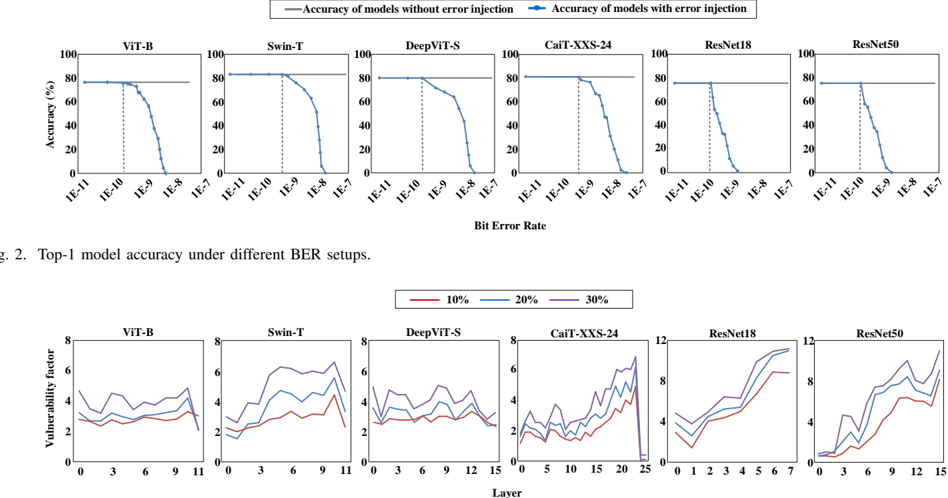
- ViTs are generally more resilient than ResNet under the same bit error rate: ResNet18 starts to drop at BER 3E-10, while Swin-T and CaiT-XXS-24 start to drop around 9E-10; ResNet accuracy degradation curves are sharper, while ViT curves are smoother.
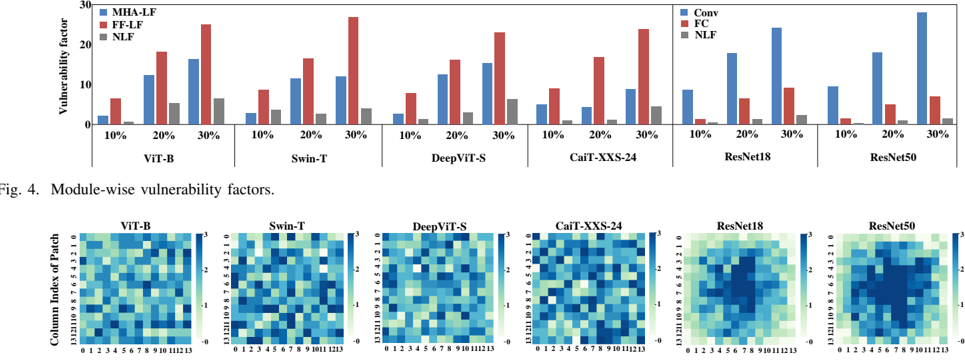
- Module-wise, FF is the most fragile ViT component; MHA has much lower vulnerability because softmax limits outputs to 0–1 and suppresses errors. Non-linear functions in ViTs show non-trivial vulnerability despite taking only a fraction of overall operations, unlike ResNet.
- Patch-wise vulnerability factors are relatively evenly distributed across ViT input patches, whereas ResNet vulnerability is concentrated in center patches because ImageNet objects are usually centered.
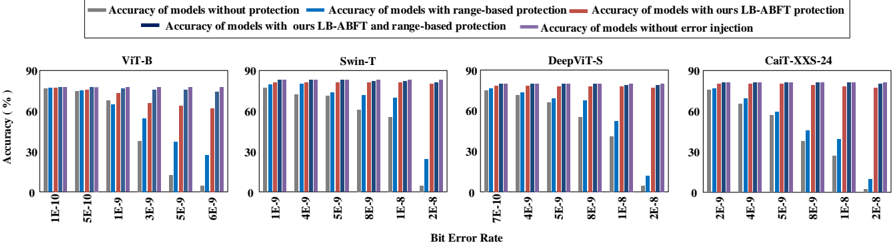
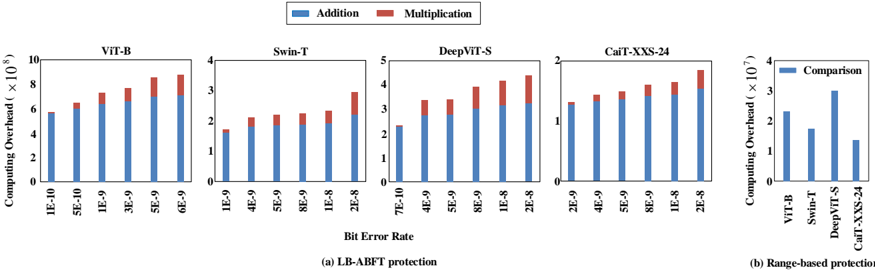
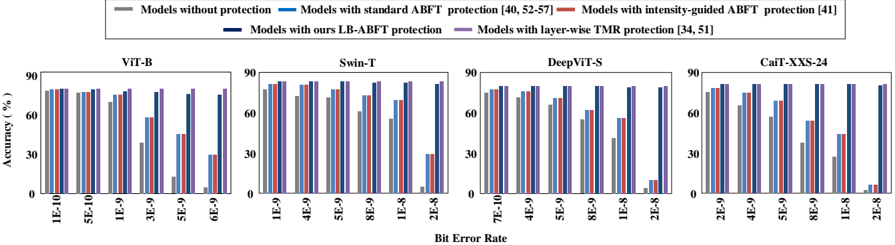
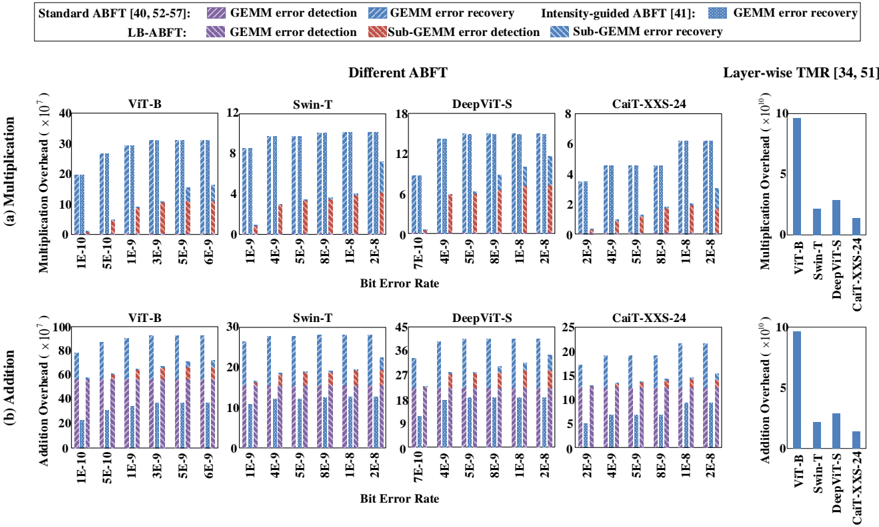
- The proposed LB-ABFT plus range-based protection can almost fully recover accuracy even when unprotected accuracy drops by more than 50%; evaluation targets accuracy loss below 2% and maximum computing overhead of 2% normalized to total ViT computing. LB-ABFT achieves comparable accuracy to layer-wise TMR with much smaller overhead and higher accuracy than standard ABFT and intensity-guided ABFT under all tested BER setups.
Methods
- Reliability evaluation uses ImageNet-1K with 10,000 randomly selected 256×256 images, int8-quantized models ViT-B, Swin-T, DeepViT-S, CaiT-XXS-24, and ResNet18/ResNet50, with BER from 1E-11 to 1E-7. Fault injection is operation-wise bit-flip injection on multiplication and addition outputs, covering linear and non-linear functions. Vulnerability factor is the accuracy difference between a model with only the target component perfectly protected and the model without protection.
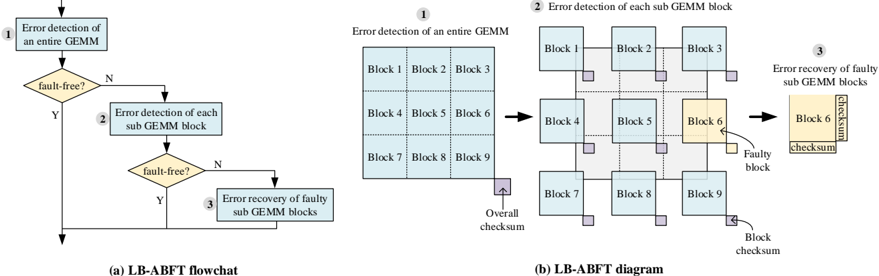
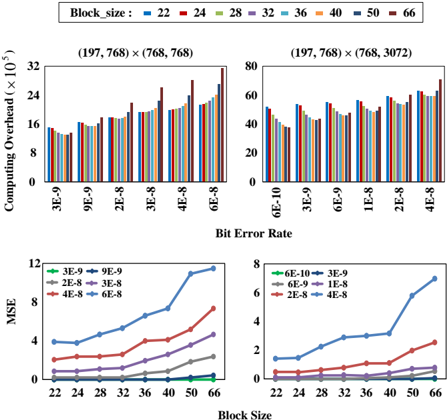
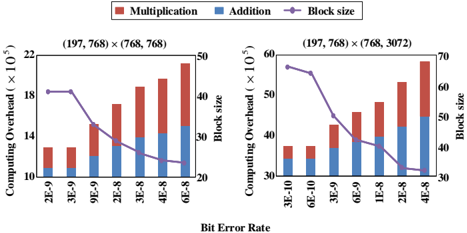
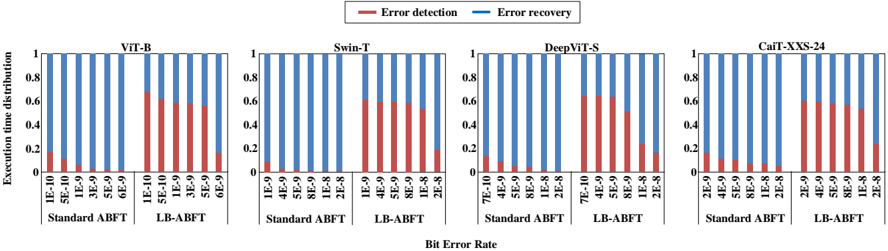
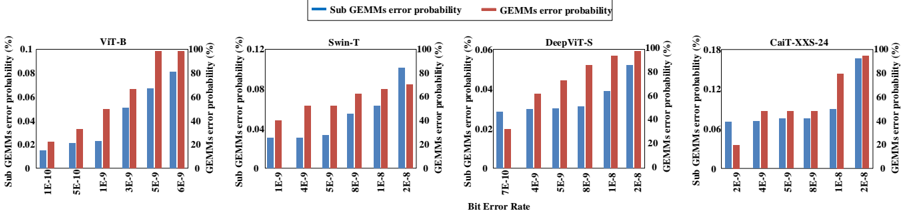
- Fault-tolerant design: LB-ABFT protects GEMM/FC linear operations by dividing large GEMMs into sub-GEMMs and using OptBlockSizeSelection to choose block size under different BERs and models; range-based protection suppresses out-of-range outputs for softmax and GELU. Evaluation compares against standard ABFT, intensity-guided ABFT, and layer-wise TMR.
Limitations
- The paper does not state a dedicated limitations section.
- Evident from the text: reliability evaluation is limited to ImageNet-1K with a 10,000-image subset, int8-quantized models, four ViT variants and two ResNets, and BER from 1E-11 to 1E-7; fault injection is an operation-wise approximate bit-flip model rather than hardware-level fault injection.
- Evident from the text: LB-ABFT block-size optimization assumes an even error distribution across GEMMs, and the GELU range-based protection uses α = 0.02 from prior work with min/max obtained by sampling inputs.
Model-written summary. Check it against the paper before relying on it.
Integrity signals
Registry
Cites
Statistics
Figures
Verification
Claims the paper makes
1 Valid · 5 Not valid · 7 Not checked · 79 Own results and interpretations
At least one cited source doesn’t support this claim or points to a different paper, and none confirmed it — see the verdicts below.
In the paper
“Despite the different application scenarios of ABFT, [40] [52]-[57] essentially utilize standard ABFT approaches.”
What the sources say
- Disputedcites [40] [41] J. Kosaian and K. Rashmi, 'Arithmetic-intensity-guided fault tolerance for neural network inference on gpus,' in Proceedings of the International Conference for High Performance Computing, Networking, Storage and Analysis , pp. 1-15, 2021. - sourceExperimental — accuracy not yet measured
Our copy of Kosaian et al. positions the work as a departure from standard ABFT, not an instance of it: the Related Work section ('ABFT for NNs.') states that prior ABFT-for-NN works 'all focus on employing a single ABFT scheme across all linear layers of a NN,' that this work is 'unique in multiple aspects,' and that it 'presents the first thread-level approach to ABFT for NNs on GPUs,' with an adaptive, intensity-guided selection between thread-level and global ABFT (§5, §5.1). The Introduction likewise characterizes existing ABFT techniques as ones that 'typically only assume that computations being protected are compute bound' and calls such 'one-size-fits-all approaches inefficient' for NNs containing bandwidth-bound layers. The only sense in which the paper uses standard ABFT is that it adopts Hari et al.'s global ABFT (§2.4-§2.5) as one component of its scheme, which does not support describing the work itself as essentially a standard ABFT approach. (LLM, conf=0.72)
Checked by a reasoning model — may be wrong.
- Not matchedcites [52]-[57]
A range of references, not one source.
plain- Asserted: passes — The authors put it forward as true.
- Checkable: passes — It can be checked against evidence.
- Load-bearing: unclear — It is unclear whether the paper’s conclusions depend on it.
- Based: passes — The paper gives a reason why it holds.
- Disputed
A result the paper reports from its own data — it cites no other source for it, so there is none to check. The quote shows it is in the paper.
In the paper
“It shows that the distribution of the vulnerability factors of ViTs and ResNet are quite different.”
plain- Asserted: passes — The authors put it forward as true.
- Checkable: passes — It can be checked against evidence.
- Load-bearing: passes — The paper’s conclusions depend on it.
- Based: passes — The paper gives a reason why it holds.
A result the paper reports from its own data — it cites no other source for it, so there is none to check. The quote shows it is in the paper.
In the paper
“model architecture poses substantial influence and results in different accuracy degradation.”
plainstates a cause- Asserted: passes — The authors put it forward as true.
- Checkable: passes — It can be checked against evidence.
- Load-bearing: passes — The paper’s conclusions depend on it.
- Based: passes — The paper gives a reason why it holds.
A result the paper reports from its own data — it cites no other source for it, so there is none to check. The quote shows it is in the paper.
In the paper
“FF with a large number of operations in ViTs model turns out to be the most fragile part”
plainstates a cause- Asserted: passes — The authors put it forward as true.
- Checkable: passes — It can be checked against evidence.
- Load-bearing: passes — The paper’s conclusions depend on it.
- Based: passes — The paper gives a reason why it holds.
A result the paper states — it cites no source for it, so there is none to check. The quote shows it is in the paper.
In the paper
“MHA generally has much lower vulnerability factor than FF, despite the non-trivial amount of operations.”
plainstates an association- Asserted: passes — The authors put it forward as true.
- Checkable: passes — It can be checked against evidence.
- Load-bearing: passes — The paper’s conclusions depend on it.
- Based: passes — The paper gives a reason why it holds.
37 more claims
Create a free account to see all 92 claims and to verify the 6 references still open.
- It may state two separate claims as one. 39
- Probably not a substantial claim. 16
Claims other papers make about this one
Each is checked against this paper’s own text: does it say what the citing paper says it does?
The source backs part of the claim, not all of it — or backs it for a different population, condition or comparison.
In the citing paper
“However, studies specifically targeting the fault resilience of ViTs under hardware errors are still in their infancy, with existing works limited to basic simulation and lacking fine-grained analysis [32,33].”
From Fine-Grained Fault Sensitivity Analysis of Vision Transformers Under Soft Errors (2025) · cites this paper as [33]
Experimental — accuracy not yet measuredIn the citing paper
“Most reliability evaluations of DNNs have been carried out on CNNs. More recently, these evaluations have been extended to Transformer models.”
From Reliability of Vision Transformers and CNNs on Edge AI Systems Under Neutron Radiation (2025) · cites this paper as [28]
Citations
Cites
Deep Residual Learning for Image Recognition
He, K., Zhang, X., Ren, S., & Sun, J. (2016) · 2016 IEEE Conference on Computer Vision and Pattern Recognition (CVPR) · doi:10.1109/cvpr.2016.90 · Cited by 235,474 · cited 2×
“2) ViTs’ Models: We select four representative ViTs’ models as the benchmark for reliability evaluation, and select ResNet18 and ResNet50 [17] for comparison.”
BackgroundMethodImageNet: A large-scale hierarchical image database
Deng, J., Dong, W., Socher, R., Li, L.-J., Li, K., & Fei-Fei, L. (2009) · 2009 IEEE Conference on Computer Vision and Pattern Recognition · doi:10.1109/cvpr.2009.5206848 · Cited by 65,333 · cited 1×
“1) Dataset: We take the well-known ImageNet-1K as the dataset [48] and randomly select 10 000 images for the accuracy evaluation.”
MethodAn Image is Worth 16x16 Words: Transformers for Image Recognition at Scale
Dosovitskiy, A., Beyer, L., Kolesnikov, A., Weissenborn, D., Zhai, X., Unterthiner, T., Dehghani, M., Minderer, M., Heigold, G., Gelly, S., et al. (2020) · arXiv · doi:10.48550/arxiv.2010.11929 · Cited by 47,472
Swin Transformer: Hierarchical Vision Transformer using Shifted Windows
Liu, Z., Lin, Y., Cao, Y., Hu, H., Wei, Y., Zhang, Z., Lin, S., & Guo, B. (2021) · 2021 IEEE/CVF International Conference on Computer Vision (ICCV) · doi:10.1109/iccv48922.2021.00986 · Cited by 35,534 · cited 3×
“Swin transformer [16] is a hierarchical transformer that has representation computed with shifted windows to provide a flexible modeling at various scales with linear computational complexity of image sizes.”
BackgroundDeep Residual Learning for Image Recognition
He, K., Zhang, X., Ren, S., & Sun, J. (2015) · arXiv · doi:10.48550/arxiv.1512.03385 · Cited by 4,196
ImageNet: A large-scale hierarchical image database
Deng, J. H., Dong, W. F., Socher, R., Li, L.-J., Li, K., & Fei-Fei, L. (2009) · IEEE Computer Society Conference on Computer Vision and Pattern Recognition/Proceedings - IEEE Computer Society Conference on Computer Vision and Pattern Recognition/Proceedings · doi:10.1109/cvprw.2009.5206848 · Cited by 2,714
CvT: Introducing Convolutions to Vision Transformers
Wu, H., Xiao, B., Codella, N., Liu, M., Dai, X., Yuan, L., & Zhang, L. (2021) · 2021 IEEE/CVF International Conference on Computer Vision (ICCV) · doi:10.1109/iccv48922.2021.00009 · Cited by 2,444 · cited 1×
“Motivated by the success of ViT [1], numerous variants have been proposed to improve ViTs from different angles such as novel training strategies [2], [3], effective self-attention mechanisms [4], [5], and combining with classical neural network layers [6], [7], [8].”
MethodSelf-citationTokens-to-Token ViT: Training Vision Transformers from Scratch on ImageNet
Yuan, L., Chen, Y., Wang, T., Yu, W., Shi, Y., Jiang, Z., Tay, F. E. H., Feng, J., & Yan, S. (2021) · 2021 IEEE/CVF International Conference on Computer Vision (ICCV) · doi:10.1109/iccv48922.2021.00060 · Cited by 2,415 · cited 1×
“T2T-ViT [23] proposed a tokens-to-tokens module (T2T module) to learn patch partitioning and reduce model size.”
MethodTokens-to-Token ViT: Training Vision Transformers from Scratch on ImageNet
Yuan, L., Chen, Y., Wang, T., Yu, W., Shi, Y., Jiang, Z., Tay, F. E., Feng, J., & Yan, S. (2021) · arXiv · doi:10.48550/arxiv.2101.11986 · Cited by 2,415
Radiation-induced soft errors in advanced semiconductor technologies
Baumann, R. C. (2005) · IEEE Transactions on Device and Materials Reliability · doi:10.1109/tdmr.2005.853449 · Cited by 1,549 · cited 1×
“On the other hand, the occurrence of soft errors per chip increases continuously [11], [12] due to the increasing transistor density and shrinking feature sizes of a single transistor, which makes soft errors almost inevitable for large-scale VLSI designs supporting ViTs.”
Background
Cited by
FT-Transformer: Resilient and Reliable Transformer with End-to-End Fault Tolerant Attention
Dai, H., Wu, S., Huang, J., Jian, Z., Zhu, Y., Hu, H., & Chen, Z. (2025) · International Conference for High Performance Computing, Networking, Storage and Analysis (SC) · doi:10.1145/3712285.3759853 · Cited by 41
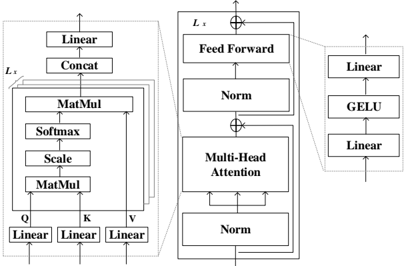
“Linear Linear Linear , where end-to-end fault tolerant attention protects both linear and nonlinear computations within a single kernel, and the feed forward module is safeguarded using strided ABFT.”
Reliability of Vision Transformers and CNNs on Edge AI Systems Under Neutron Radiation
Badia, J. M., Martin-Salinas, I., Leon, G., Amor-Martin, A., Frias-Dominguez, L., Belloch, J. A., Garcia-Valderas, M., Lindoso, A., Cazzaniga, C., & Entrena, L. (2025) · IEEE Transactions on Nuclear Science · doi:10.1109/tns.2025.3536519 · Cited by 11
“Xue et al. [28] investigated the reliability of ViTs at different levels, including models, layers, modules, and patches.”
MRFI: An Open-Source Multiresolution Fault Injection Framework for Neural Network Processing
Huang, H., Liu, C., Xue, X., Liu, B., Li, H., & Li, X. (2024) · IEEE Transactions on Very Large Scale Integration (VLSI) Systems · doi:10.1109/tvlsi.2024.3384404 · Cited by 15
“…model to simulate the influence of hardware errors on neural network processing, but they do not model any specific hardware architectures, and the correlation between the neuron-wise fault injection and realistic hardware-based fault injection remains unclear [8], [9], [10], [13], [14], [15].”
BackgroundSelf-citationImpact of Radiation-Induced Effects on Embedded GPUs Executing Large Machine Learning Models
Coelho, B. L., dos Santos, F. F., Saveriano, M., Allen, G. R., Daniel, A. C., Guertin, S. M., Vartanian, S., Wyrwas, E. J., Frost, C. D., & Rech, P. (2025) · IEEE Transactions on Nuclear Science · doi:10.1109/tns.2025.3528764 · Cited by 9
“…to characterizing the DUT, our experimental results shown in Section IV-C revealed that the ViT architecture is more susceptible to radiation-induced errors than CNNs. Results from related work confirm this and also show that the criticality of the two ML model architectures are similar [26], [27].”
Vision Transformer Reliability Evaluation on the Coral Edge TPU
Loureiro Coelho, B., Rafael Bodmann, P., Cavagnero, N., Frost, C., & Rech, P. (2025) · IEEE Transactions on Nuclear Science · doi:10.1109/tns.2024.3513774 · Cited by 5
Fine-Grained Fault Sensitivity Analysis of Vision Transformers Under Soft Errors
He, J., Liu, Y., Xu, C., Liao, X., & Yang, Y. (2025) · Electronics · doi:10.3390/electronics14122418 · Cited by 4
Ahsaei, S., & Raji, M. (2025) · Journal of Systems Architecture · doi:10.1016/j.sysarc.2025.103623 · Cited by 8
Tian, H., Ibrahim, Y., Sharma, M., Belev, G. S., Wen, S.-J., & Chen, L. (2025) · Microelectronics Reliability · doi:10.1016/j.microrel.2025.115929 · Cited by 3
Zero Memory Overhead Approach for Protecting Vision Transformer Parameters Against Bit-Flip Faults
Baradaran, F., Raji, M., Baradaran, A., Baradaran, A., & Akbarifard, R. (2025) · International Computer Conference, Computer Society of Iran (CSICC) · doi:10.1109/csicc65765.2025.10967400 · Cited by 5
ReIPE: Recycling Idle PEs in CNN Accelerator for Vulnerable Filters Soft-Error Detection
Wei, X., Wang, C., Yue, H., Tan, J., Guan, Z., Jiang, N., Zheng, X., Zhao, J., & Qiu, M. (2024) · ACM Transactions on Architecture and Code Optimization · doi:10.1145/3674909 · Cited by 4
“Besides, except for reliability discrepancies within the encoder, recent work [49] also found that different transformer encoders (i.e., layers) of ViT also exhibit vulnerability discrepancies.”
Comparing Application-Level Hardening Techniques for Neural Networks on GPUs
Esposito, G., Guerrero-Balaguera, J.-D., Condia, J. E. R., & Reorda, M. S. (2025) · Electronics · doi:10.3390/electronics14051042 · Cited by 4
Ahmadilivani, M. H., Roots, M., Restifo, M., Loorits, S.-M., di Mauro, L., & Raik, J. (2026) · Design, Automation, and Test in Europe · doi:10.23919/date69613.2026.11539549 · Cited by 2
“Such low-level faults can silently corrupt attention weights or intermediate activations, thereby compromising the integrity of the entire inference process [5].”
Retracted: Reliable Fault Tolerance and Recovery for VLSI Systems
Shukla, M., Kumar, A., & Mahajan, P. (2024) · doi:10.1109/icocwc60930.2024.10470561 · Cited by 1
“As technology advances, the number of packages for VLSI structures is increasing extensively, and for that reason, structures ought to be designed to be tolerant to extraordinary varieties of faults. functions to permit restoration from faults are important[1].”
BackgroundRetractedRetracted: Exploring the Behavior of Soft-Error Rate Reduction Algorithms in Digital Circuits
Menaka, C., Saraswat, N., & Bhagwan, S. (2024) · doi:10.1109/icocwc60930.2024.10470803
“Next, let's have a look at blunders-correction code (ECC) algorithms [3].”
BackgroundRetractedComplex Network Theory-based Deep Neural Network Degradation Analysis in the Context of Bit Attack
Shao, Q., Yang, S., Zhou, Y., Lu, D. Z., & Yao, Q. (2024) · IEEE International Conference on Software Quality, Reliability and Security Companion (QRS-C) · doi:10.1109/qrs-c63300.2024.00040
“The threat of soft errors on the reliability of Vision Transformers is investigated from different architecture granularities ranging from models, layers, modules, and patches [7].”
BackgroundZhu, J., Conde, J., Gao, Z., Reviriego, P., Liu, S., & Lombardi, F. (2025) · IEEE Transactions on Computers · doi:10.1109/tc.2025.3603682 · Cited by 2
“The dependability of large-scale machine learning models such as vision transformers [21], diffusion models [22] or LLMs [23] is currently being studied; as new models are introduced, dependability evaluations are also conducted.”
Toward Exploring Fault-Tolerant Neural Architectures: A Hierarchical Codesign Optimization Framework
Chen, C., Wang, L., Li, Y., & Zeng, X. (2025) · IEEE Transactions on Computer-Aided Design of Integrated Circuits and Systems · doi:10.1109/tcad.2025.3610732 · Cited by 1
“This threshold is an obvious boundary of performance degradation and may induce severe outcomes in safety-critical applications [15].”
Tian, H., Ibrahim, Y., Sharma, M., Belev, G. S., Wen, S., & Chen, L. T. J. (2024) · European Conference on Radiation and Its Effects on Components and Systems · doi:10.1109/radecs61970.2024.11298613
“One of the few studies specifically addressing the reliability of Transformer models on GPU platforms is [14].”
Ogawa, K., Saikawa, Y., Tomioka, Y., & Saito, H. (2025) · Conference proceedings/Conference proceedings - IEEE International Conference on Systems, Man, and Cybernetics · doi:10.1109/smc58881.2025.11342788
“Similarly, Xue et al. [22] analyzed fault resilience from model-wise, layer-wise, and module-wise perspectives.”
Shi, Y., Ma, S., Li, T., Wang, B., Luo, S., Zhao, Y., Zhang, J., & Wu, L. (2026) · ACM Transactions on Design Automation of Electronic Systems · doi:10.1145/3801976
“Examples include studies focused on the CLIP model [66], Vision Transformers ( ViT ) [67], autonomous driving scenarios [68], and robotic applications [69].”
Dependability analysis and hardening of vision transformers against soft errors
Frias-Dominguez, L., Badía, J. M., León, G., Amor-Martín, A., & Belloch, J. A. (2026) · The Journal of Supercomputing · doi:10.1007/s11227-026-08373-0 · Cited by 2
AM5: Bulk Logic-in-Memory Using MRAM NAND Crossbar
Mosquera, C., Garzón, E., Lanuzza, M., Teman, A., & Yavits, L. (2026) · IEEE Journal on Emerging and Selected Topics in Circuits and Systems · doi:10.1109/jetcas.2026.3689530
“Adopting the soft-error sensitivity analysis of Xue et al. [68], which establishes that software-equivalent ViT accuracy is preserved only at BER ≤ 10 − 9 –10 − 10 .”
Lightweight Algorithm-Based Fault Tolerance (ABFT) for Resilient Machine Learning Systems
Chai, D., Xue, X., Pei, S., & Liu, C. (2026) · Springer eBooks · doi:10.1007/978-3-032-17948-7_5
Self-citationSENTRY: Statistical Reliability Analysis of Vision Transformers Under Soft Errors
Bhaduri, P. K., Taheri, M., Nazari, S., Jenihhin, M., Herglotz, C., & Hübner, M. (2026) · IEEE International Conference on Edge Computing and Communications (EDGE) · doi:10.1109/edge72783.2026.00016 · Cited by 1
“In [16], it is observed that ViTs are more resilient in linear components due to softmax stabilization but more sensitive in non-linear operations.”
GRADE: A Scalable Framework for Quantitative Reliability Assessment of Deep Neural Networks
Nazari, S., Azarpeyvand, A., & Afsharchi, M. (2026) · IEEE Transactions on Reliability · doi:10.1109/tr.2026.3704288
“While previous studies have explored fault tolerance and sensitivity analysis for CNNs [6] and, more recently, ViTs [7], significant limitations remain.”
ReSafe-ViT: A Reconfigurable and Reliable Accelerator for Vision Transformer Inference
春原, 慎., Wang, K., & Yang, L. (2026) · ACM Great Lakes Symposium on VLSI (GLSVLSI) · doi:10.1145/3787109.3815277
“For existing ViT fault-tolerance schemes[22, 29, 30], most are algorithm-level approaches that introduce limitations such as relying on post-computation error checking and being restricted to handling only numerical errors.”
Thinking Inside the Box: Injecting Realistic Radiation Faults in ML Accelerators
Coelho, B. L., Sadati, M., Chan, A., Hands, A. D. P., Pattabiraman, K., & Rech, P. (2026) · International Conference on Dependable Systems & Networks/Proceedings · doi:10.1109/dsn69566.2026.00017 · Cited by 1
Towards Resilient Transformer-Encoders: Fault Injection and Hardware Agnostic Error Mitigation
Thomas, V., Zahid, U., Gambardella, G., Sapkal, S., Stratigopoulos, H., & Clerkin, B. (2026) · IEEE European Test Symposium (ETS) · doi:10.1109/ets69887.2026.11591952 · Cited by 1
“Proposed lightweight fault tolerance approaches adapted to transformers are based on Algorithm-Based Fault Tolerance (ABFT) [8], [10], preventing the propagation of corrupted values [9], [11], and bit redundancy [12].”
BN-Guard: Batch-Normalization-Guided Activation Bounding for Reliable CNN Inference
Qian, Y., Xing, M., & Wu, Y. (2026) · Lecture notes in computer science · doi:10.1007/978-981-92-3410-3_14
Effective and Memory-Efficient Alternatives to ECC for Reliable Large-Scale DNNs
Ahmadilivani, M. H., Roots, M., Restifo, M., Loorits, S.-M., di Mauro, L., & Raik, J. (2026) · IEEE International On-Line Testing Symposium (IOLTS) · doi:10.1109/iolts69666.2026.11633759 · Cited by 2
“Multiple research works have shown that the accuracy of CNNs and ViTs can be significantly influenced by faults in memory, using radiation [14]–[16] or simulation [17], [18].”
Cherezova, N., Jutman, A., & Jenihhin, M. (2026) · IEEE International On-Line Testing Symposium (IOLTS) · doi:10.1109/iolts69666.2026.11633827
“We also compare the reliability of ViTs with CNNs, namely ResNet-50, following previous works [1], [5], [6].”
Cao, A., Yan, X., Zhao, Y., Zhang, Y., Yang, J., & Liu, R. (2026) · IEEE Transactions on Network and Service Management · doi:10.1109/tnsm.2026.3734530
“SBFA [26] and related reliability studies on Transformer architectures (including ViTs) [34], [35] motivate the same sensitivity-driven view.”
Metadata
- Authors
- Xue, X., Liu, C., Wang, Y., Yang, B., Luo, T., Zhang, L., Li, H., & Li, X.
- Affiliations
- Chinese Academy of Sciences (CN)
- Department of Computer Science and Technology, Harbin University of Science and Technology, Harbin, China
- Agency for Science, Technology and Research (SG)
- Venue
- IEEE Transactions on Very Large Scale Integration (VLSI) Systems
- Published
- 2023-12
- Volume
- 31
- Issue
- 12
- Pages
- 2126-2136
- ISSN
- 1063-8210 (ISSN-L)
- 1557-9999
- OpenAlex
- W4387385773
- Semantic Scholar
- 8847bd8617f072fc9d00381b65c6e25b230677b2
- Cited by
- 35
- References
- 67
- Citations by year
- 2026: 16 · 2025: 11 · 2024: 7 · 2023: 1
- FWCI
- 2.59
- Type
- journal article
- Language
- en
- Open access
- green
- arxiv.org
- Licence
- Locations
- IEEE Transactions on Very Large Scale Integration (VLSI) Systems (publishedVersion)
- arXiv (Cornell University) (submittedVersion)
- arXiv (Cornell University)
- Funders
- National Natural Science Foundation of China (62174162)
- Space Trusted Computing and Electronic Information Technology Laboratory of BICE (OBCandETL-2022-07)
- Topics
- Physical Sciences › Engineering › Electrical and Electronic Engineering › Radiation Effects in Electronics
- Physical Sciences › Computer Science › Hardware and Architecture › VLSI and Analog Circuit Testing
- Physical Sciences › Engineering › Electrical and Electronic Engineering › Low-power high-performance VLSI design
- Keywords
- vision transformer, soft errors, fault tolerance, reliability analysis, self-attention, GELU, softmax, matrix-matrix multiplication, hardware fault tolerance, VLSI design
About these checks
Registry, retraction, Cites and statistics results are computed, not judged, with one exception: a printed reference that no index lists is read once by a model before it counts as a citation error. Claims are extracted by a model and kept only when their quote appears verbatim in the text; each cited source is then checked, with a model’s help, for whether it says what the claim relies on. Those verdicts can be wrong — read the claim’s quote and the cited source before relying on one.
The claim verdicts this report counts are experimental: their accuracy is not yet measured.
A language model drew the claims from the paper on 2026-10-10, under version 3 of the claim definition (model deepseek-v4.1-flash, prompt extract-v3).
A second model labelled each claim on 2026-10-10 (model jev-1.13-20260917, definition revision gold-guideline-v0.2).
Cited sources are checked with a language model’s help (qwen3.8-omni-flash).
Statistics and arithmetic are recomputed, not judged.
Confidence bands are shown only for fields calibrated on our annotated test set. None is calibrated yet, so no band is shown.
What counts as a claim ›How we measure confidence ›How we check this ›
Are you an author, or do you see a problem with this page? Request a review
Data sources
Bibliographic data: Semantic Scholar, OpenAlex, Crossref.
Contains information from the Semantic Scholar Academic Graph Datasets, made available under the ODC Attribution License (ODC-BY 1.0).
Semantic Scholar’s data is described in: Kinney, R., et al. (2023). The Semantic Scholar Open Data Platform. arXiv:2301.10140.
