

Soft Error Reliability Analysis of Vision Transformers
Open accessThe DOI matches its Crossref record; 64 of the 67 references it cites were found in a registry or an index; 3 of the 17 sources its claims cite were checked for support.
Abstract
Vision transformers (ViTs) that leverage self-attention mechanism have shown superior performance on many classical vision tasks compared to convolutional neural networks (CNNs) and gain increasing popularity recently. Existing ViTs’ works mainly optimize performance and accuracy, but ViTs’ reliability issues induced by soft errors in large-scale VLSI designs have generally been overlooked. In this work, we mainly study the reliability of ViTs and investigate the vulnerability from different architecture granularities ranging from models, layers, modules, and patches for the first time. The investigation reveals that ViTs with the self-attention mechanism are generally more resilient on linear computing including general matrix–matrix multiplication (GEMM) and full connection (FC) and show a relatively even vulnerability distribution across the patches. ViTs involve more fragile non-linear computing such as softmax and GELU compared to typical CNNs. With the above observations, we propose a lightweight block-wise algorithm-based fault-tolerance (LB-ABFT) approach to protect the linear computing implemented with distinct sizes of GEMM and apply a range-based protection scheme to mitigate soft errors in non-linear computing. According to our experiments, the proposed fault-tolerant approaches enhance ViTs’ accuracy significantly with minor computing overhead in the presence of various soft errors.
Overview
CoChat Summary
TL;DR
This paper analyzes soft-error reliability of Vision Transformers at model, layer, module, and patch granularities, finding ViTs generally more resilient than CNNs but with distinct vulnerabilities in non-linear operations and patch distribution. It proposes lightweight block-wise ABFT for linear operations and range-based protection for non-linear operations, recovering accuracy with minor overhead.
Key findings
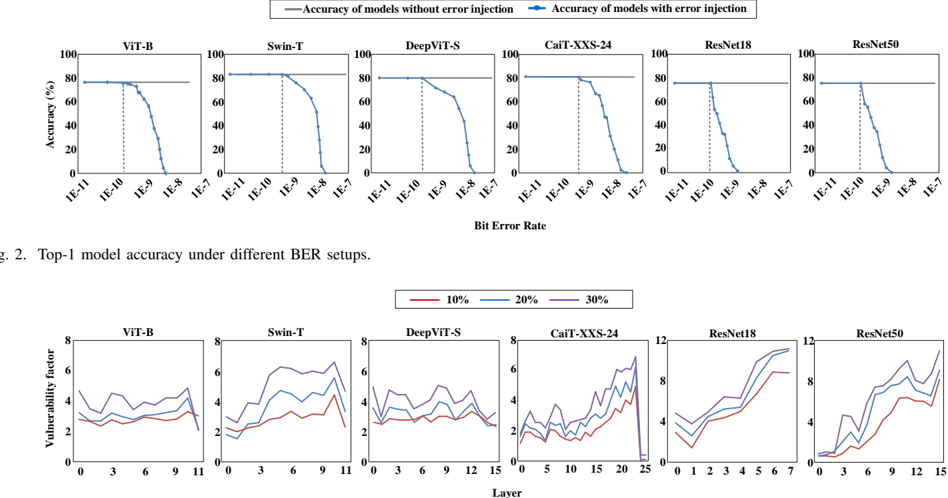
- ViTs are generally more resilient than ResNet under the same bit error rate: ResNet18 starts to drop at BER 3E-10, while Swin-T and CaiT-XXS-24 start to drop around 9E-10; ResNet accuracy degradation curves are sharper, while ViT curves are smoother.
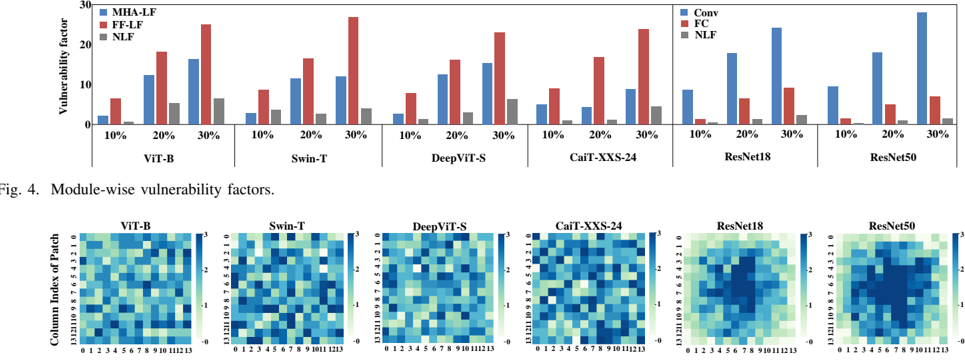
- Module-wise, FF is the most fragile ViT component; MHA has much lower vulnerability because softmax limits outputs to 0–1 and suppresses errors. Non-linear functions in ViTs show non-trivial vulnerability despite taking only a fraction of overall operations, unlike ResNet.
- Patch-wise vulnerability factors are relatively evenly distributed across ViT input patches, whereas ResNet vulnerability is concentrated in center patches because ImageNet objects are usually centered.
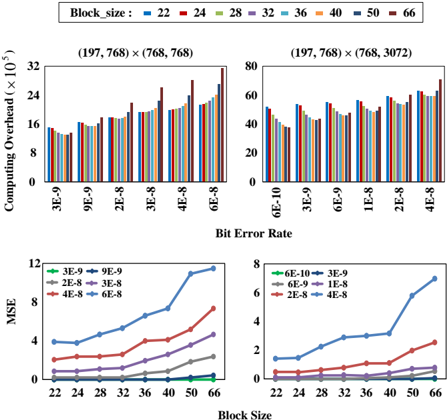
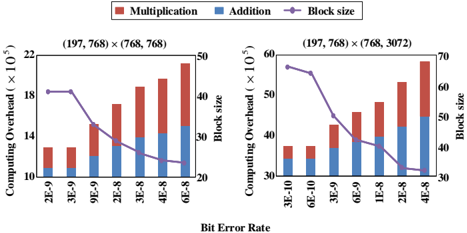
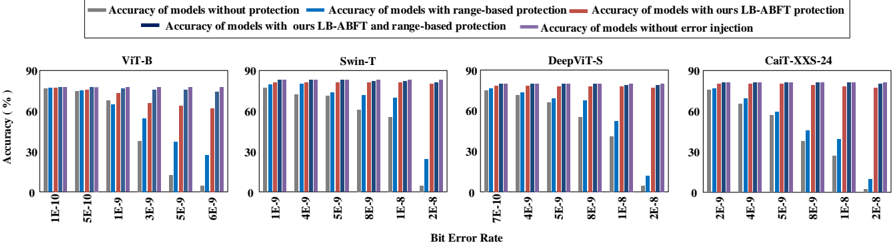
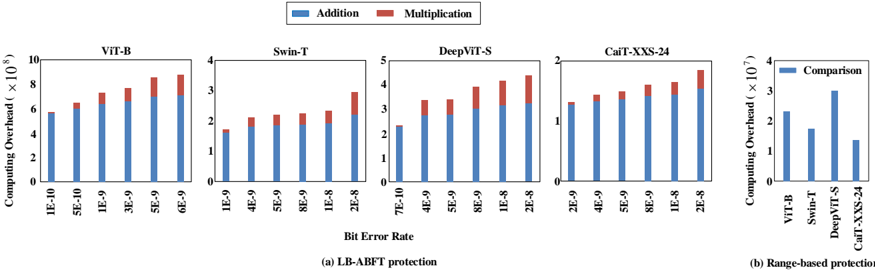
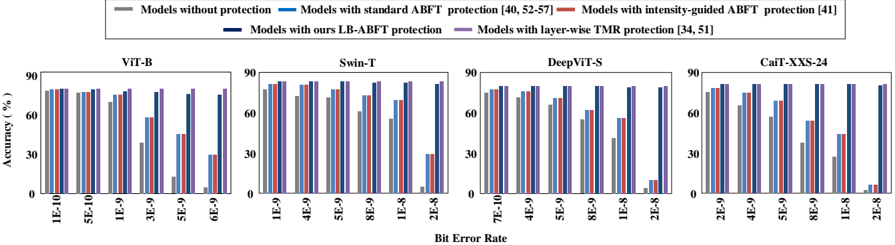
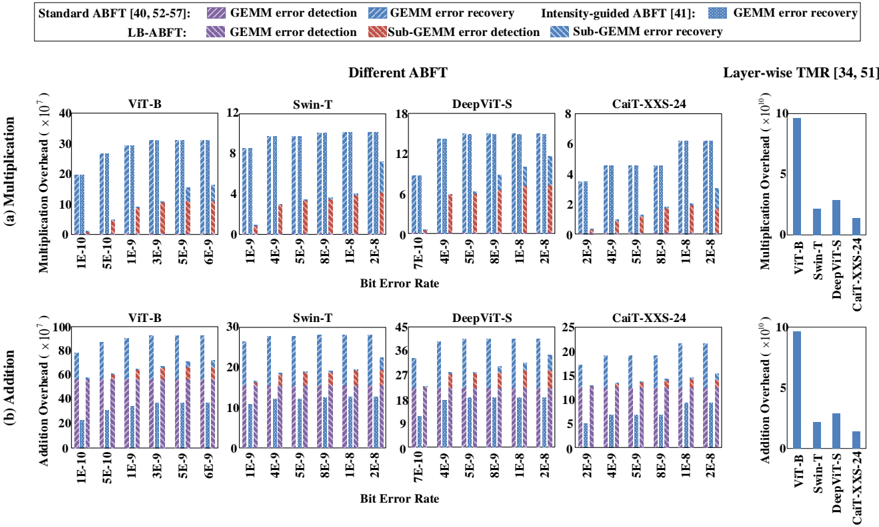
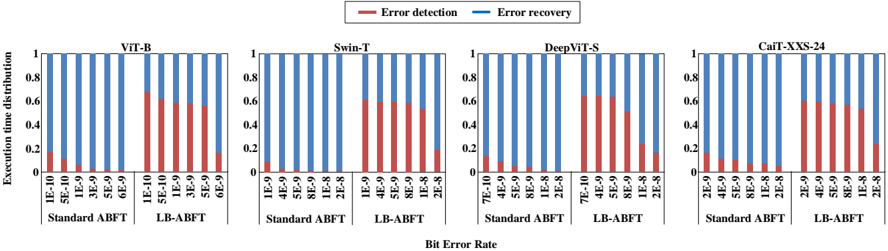
- The proposed LB-ABFT plus range-based protection can almost fully recover accuracy even when unprotected accuracy drops by more than 50%; evaluation targets accuracy loss below 2% and maximum computing overhead of 2% normalized to total ViT computing. LB-ABFT achieves comparable accuracy to layer-wise TMR with much smaller overhead and higher accuracy than standard ABFT and intensity-guided ABFT under all tested BER setups.
Methods
- Reliability evaluation uses ImageNet-1K with 10,000 randomly selected 256×256 images, int8-quantized models ViT-B, Swin-T, DeepViT-S, CaiT-XXS-24, and ResNet18/ResNet50, with BER from 1E-11 to 1E-7. Fault injection is operation-wise bit-flip injection on multiplication and addition outputs, covering linear and non-linear functions. Vulnerability factor is the accuracy difference between a model with only the target component perfectly protected and the model without protection.
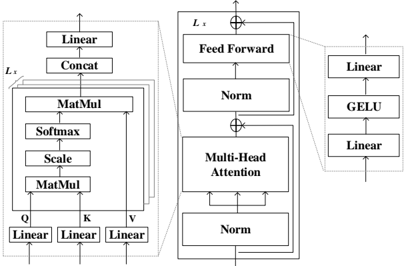
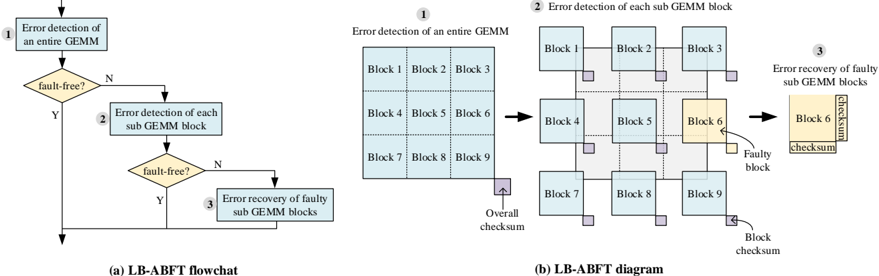
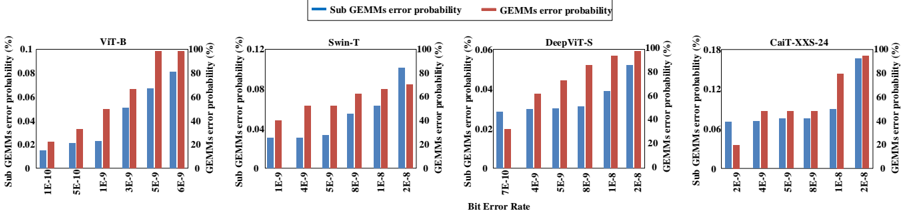
- Fault-tolerant design: LB-ABFT protects GEMM/FC linear operations by dividing large GEMMs into sub-GEMMs and using OptBlockSizeSelection to choose block size under different BERs and models; range-based protection suppresses out-of-range outputs for softmax and GELU. Evaluation compares against standard ABFT, intensity-guided ABFT, and layer-wise TMR.
Limitations
- The paper does not state a dedicated limitations section.
- Evident from the text: reliability evaluation is limited to ImageNet-1K with a 10,000-image subset, int8-quantized models, four ViT variants and two ResNets, and BER from 1E-11 to 1E-7; fault injection is an operation-wise approximate bit-flip model rather than hardware-level fault injection.
- Evident from the text: LB-ABFT block-size optimization assumes an even error distribution across GEMMs, and the GELU range-based protection uses α = 0.02 from prior work with min/max obtained by sampling inputs.
Model-written summary. Check it against the paper before relying on it.
Integrity signals
Registry
Cites
Statistics
Figures
Verification
Claims the paper makes
1 Valid · 5 Not valid · 7 Not checked · 79 Own results and interpretations
At least one cited source doesn’t support this claim or points to a different paper, and none confirmed it — see the verdicts below.
In the paper
“Despite the different application scenarios of ABFT, [40] [52]-[57] essentially utilize standard ABFT approaches.”
What the sources say
- Disputedcites [40] [41] J. Kosaian and K. Rashmi, 'Arithmetic-intensity-guided fault tolerance for neural network inference on gpus,' in Proceedings of the International Conference for High Performance Computing, Networking, Storage and Analysis , pp. 1-15, 2021. - sourceExperimental — accuracy not yet measured
Our copy of Kosaian et al. positions the work as a departure from standard ABFT, not an instance of it: the Related Work section ('ABFT for NNs.') states that prior ABFT-for-NN works 'all focus on employing a single ABFT scheme across all linear layers of a NN,' that this work is 'unique in multiple aspects,' and that it 'presents the first thread-level approach to ABFT for NNs on GPUs,' with an adaptive, intensity-guided selection between thread-level and global ABFT (§5, §5.1). The Introduction likewise characterizes existing ABFT techniques as ones that 'typically only assume that computations being protected are compute bound' and calls such 'one-size-fits-all approaches inefficient' for NNs containing bandwidth-bound layers. The only sense in which the paper uses standard ABFT is that it adopts Hari et al.'s global ABFT (§2.4-§2.5) as one component of its scheme, which does not support describing the work itself as essentially a standard ABFT approach. (LLM, conf=0.72)
Checked by a reasoning model — may be wrong.
- Not matchedcites [52]-[57]
A range of references, not one source.
plain- Asserted: passes — The authors put it forward as true.
- Checkable: passes — It can be checked against evidence.
- Load-bearing: unclear — It is unclear whether the paper’s conclusions depend on it.
- Based: passes — The paper gives a reason why it holds.
- Disputed
A result the paper reports from its own data — it cites no other source for it, so there is none to check. The quote shows it is in the paper.
In the paper
“It shows that the distribution of the vulnerability factors of ViTs and ResNet are quite different.”
plain- Asserted: passes — The authors put it forward as true.
- Checkable: passes — It can be checked against evidence.
- Load-bearing: passes — The paper’s conclusions depend on it.
- Based: passes — The paper gives a reason why it holds.
A result the paper reports from its own data — it cites no other source for it, so there is none to check. The quote shows it is in the paper.
In the paper
“model architecture poses substantial influence and results in different accuracy degradation.”
plainstates a cause- Asserted: passes — The authors put it forward as true.
- Checkable: passes — It can be checked against evidence.
- Load-bearing: passes — The paper’s conclusions depend on it.
- Based: passes — The paper gives a reason why it holds.
A result the paper reports from its own data — it cites no other source for it, so there is none to check. The quote shows it is in the paper.
In the paper
“FF with a large number of operations in ViTs model turns out to be the most fragile part”
plainstates a cause- Asserted: passes — The authors put it forward as true.
- Checkable: passes — It can be checked against evidence.
- Load-bearing: passes — The paper’s conclusions depend on it.
- Based: passes — The paper gives a reason why it holds.
A result the paper states — it cites no source for it, so there is none to check. The quote shows it is in the paper.
In the paper
“MHA generally has much lower vulnerability factor than FF, despite the non-trivial amount of operations.”
plainstates an association- Asserted: passes — The authors put it forward as true.
- Checkable: passes — It can be checked against evidence.
- Load-bearing: passes — The paper’s conclusions depend on it.
- Based: passes — The paper gives a reason why it holds.
37 more claims
Create a free account to see all 92 claims and to verify the 6 references still open.
- It may state two separate claims as one. 39
- Probably not a substantial claim. 16
Claims other papers make about this one
Each is checked against this paper’s own text: does it say what the citing paper says it does?
The source backs part of the claim, not all of it — or backs it for a different population, condition or comparison.
In the citing paper
“However, studies specifically targeting the fault resilience of ViTs under hardware errors are still in their infancy, with existing works limited to basic simulation and lacking fine-grained analysis [32,33].”
From Fine-Grained Fault Sensitivity Analysis of Vision Transformers Under Soft Errors (2025) · cites this paper as [33]
Experimental — accuracy not yet measuredIn the citing paper
“Most reliability evaluations of DNNs have been carried out on CNNs. More recently, these evaluations have been extended to Transformer models.”
From Reliability of Vision Transformers and CNNs on Edge AI Systems Under Neutron Radiation (2025) · cites this paper as [28]
Citations
Cites
Deep Residual Learning for Image Recognition
He, K., Zhang, X., Ren, S., & Sun, J. (2016) · 2016 IEEE Conference on Computer Vision and Pattern Recognition (CVPR) · doi:10.1109/cvpr.2016.90 · Cited by 235,474 · cited 2×
“2) ViTs’ Models: We select four representative ViTs’ models as the benchmark for reliability evaluation, and select ResNet18 and ResNet50 [17] for comparison.”
BackgroundMethodImageNet: A large-scale hierarchical image database
Deng, J., Dong, W., Socher, R., Li, L.-J., Li, K., & Fei-Fei, L. (2009) · 2009 IEEE Conference on Computer Vision and Pattern Recognition · doi:10.1109/cvpr.2009.5206848 · Cited by 65,333 · cited 1×
“1) Dataset: We take the well-known ImageNet-1K as the dataset [48] and randomly select 10 000 images for the accuracy evaluation.”
MethodAn Image is Worth 16x16 Words: Transformers for Image Recognition at Scale
Dosovitskiy, A., Beyer, L., Kolesnikov, A., Weissenborn, D., Zhai, X., Unterthiner, T., Dehghani, M., Minderer, M., Heigold, G., Gelly, S., et al. (2020) · arXiv · doi:10.48550/arxiv.2010.11929 · Cited by 47,472
Swin Transformer: Hierarchical Vision Transformer using Shifted Windows
Liu, Z., Lin, Y., Cao, Y., Hu, H., Wei, Y., Zhang, Z., Lin, S., & Guo, B. (2021) · 2021 IEEE/CVF International Conference on Computer Vision (ICCV) · doi:10.1109/iccv48922.2021.00986 · Cited by 35,534 · cited 3×
“Swin transformer [16] is a hierarchical transformer that has representation computed with shifted windows to provide a flexible modeling at various scales with linear computational complexity of image sizes.”
BackgroundDeep Residual Learning for Image Recognition
He, K., Zhang, X., Ren, S., & Sun, J. (2015) · arXiv · doi:10.48550/arxiv.1512.03385 · Cited by 4,196
ImageNet: A large-scale hierarchical image database
Deng, J. H., Dong, W. F., Socher, R., Li, L.-J., Li, K., & Fei-Fei, L. (2009) · IEEE Computer Society Conference on Computer Vision and Pattern Recognition/Proceedings - IEEE Computer Society Conference on Computer Vision and Pattern Recognition/Proceedings · doi:10.1109/cvprw.2009.5206848 · Cited by 2,714
CvT: Introducing Convolutions to Vision Transformers
Wu, H., Xiao, B., Codella, N., Liu, M., Dai, X., Yuan, L., & Zhang, L. (2021) · 2021 IEEE/CVF International Conference on Computer Vision (ICCV) · doi:10.1109/iccv48922.2021.00009 · Cited by 2,444 · cited 1×
“Motivated by the success of ViT [1], numerous variants have been proposed to improve ViTs from different angles such as novel training strategies [2], [3], effective self-attention mechanisms [4], [5], and combining with classical neural network layers [6], [7], [8].”
MethodSelf-citationTokens-to-Token ViT: Training Vision Transformers from Scratch on ImageNet
Yuan, L., Chen, Y., Wang, T., Yu, W., Shi, Y., Jiang, Z., Tay, F. E. H., Feng, J., & Yan, S. (2021) · 2021 IEEE/CVF International Conference on Computer Vision (ICCV) · doi:10.1109/iccv48922.2021.00060 · Cited by 2,415 · cited 1×
“T2T-ViT [23] proposed a tokens-to-tokens module (T2T module) to learn patch partitioning and reduce model size.”
MethodTokens-to-Token ViT: Training Vision Transformers from Scratch on ImageNet
Yuan, L., Chen, Y., Wang, T., Yu, W., Shi, Y., Jiang, Z., Tay, F. E., Feng, J., & Yan, S. (2021) · arXiv · doi:10.48550/arxiv.2101.11986 · Cited by 2,415
Radiation-induced soft errors in advanced semiconductor technologies
Baumann, R. C. (2005) · IEEE Transactions on Device and Materials Reliability · doi:10.1109/tdmr.2005.853449 · Cited by 1,549 · cited 1×
“On the other hand, the occurrence of soft errors per chip increases continuously [11], [12] due to the increasing transistor density and shrinking feature sizes of a single transistor, which makes soft errors almost inevitable for large-scale VLSI designs supporting ViTs.”
BackgroundBorkar, S. (2005) · IEEE Micro · doi:10.1109/mm.2005.110 · Cited by 1,320 · cited 1×
“On the other hand, the occurrence of soft errors per chip increases continuously [11], [12] due to the increasing transistor density and shrinking feature sizes of a single transistor, which makes soft errors almost inevitable for large-scale VLSI designs supporting ViTs.”
BackgroundAlgorithm-Based Fault Tolerance for Matrix Operations
Huang, K.-H., & Abraham, J. A. (1984) · IEEE Transactions on Computers · doi:10.1109/tc.1984.1676475 · Cited by 1,283 · cited 1×
“Algorithm-based fault-tolerance (ABFT) techniques [37], [38], [39], [40], originally developed for matrix–matrix multiplication based on checksum, have also been explored to detect and recover faults in deep learning without model modification, which are particularly suitable for…”
BackgroundGoing deeper with Image Transformers
Touvron, H., Cord, M., Sablayrolles, A., Synnaeve, G., & Jegou, H. (2021) · 2021 IEEE/CVF International Conference on Computer Vision (ICCV) · doi:10.1109/iccv48922.2021.00010 · Cited by 1,259 · cited 2×
“The detailed configurations of these models such as the number of layers, number of heads, embedding dimension, and patches are summarized in Table I. ViTs include ViT-B [1], Swin-T [16], DeepViT-S [21], and CaiT-XXS-24 [22].”
BackgroundSelf-Supervised Pre-Training of Swin Transformers for 3D Medical Image Analysis
Tang, Y., Yang, D., Li, W., Roth, H. R., Landman, B., Xu, D., Nath, V., & Hatamizadeh, A. (2022) · 2022 IEEE/CVF Conference on Computer Vision and Pattern Recognition (CVPR) · doi:10.1109/cvpr52688.2022.02007 · Cited by 849 · cited 1×
“Motivated by the success of ViT [1], numerous variants have been proposed to improve ViTs from different angles such as novel training strategies [2], [3], effective self-attention mechanisms [4], [5], and combining with classical neural network layers [6], [7], [8].”
MethodBeyond Self-Attention: External Attention Using Two Linear Layers for Visual Tasks
Guo, M.-H., Liu, Z.-N., Mu, T.-J., & Hu, S.-M. (2022) · IEEE Transactions on Pattern Analysis and Machine Intelligence · doi:10.1109/tpami.2022.3211006 · Cited by 668 · cited 1×
“Motivated by the success of ViT [1], numerous variants have been proposed to improve ViTs from different angles such as novel training strategies [2], [3], effective self-attention mechanisms [4], [5], and combining with classical neural network layers [6], [7], [8].”
MethodUnderstanding error propagation in deep learning neural network (DNN) accelerators and applications
Li, G., Hari, S. K. S., Sullivan, M., Tsai, T., Pattabiraman, K., Emer, J., & Keckler, S. W. (2017) · Proceedings of the International Conference for High Performance Computing, Networking, Storage and Analysis · doi:10.1145/3126908.3126964 · Cited by 492
Edgenext: Efficiently amalgamated CNN-transformer architecture for mobile vision applications
Maaz, M., Shaker, A., Cholakkal, H., Khan, S., Zamir, S. W., Anwer, R. M., & Shahbaz Khan, F. (2023) · Lecture Notes in Computer Science · doi:10.1007/978-3-031-25082-8_1 · Cited by 407
DeepViT: Towards Deeper Vision Transformer
Zhou, D., Kang, B., Jin, X., Yang, L., Lian, X., Jiang, Z., Hou, Q., & Feng, J. (2021) · arXiv · doi:10.48550/arxiv.2103.11886 · Cited by 398 · cited 2×
“Deeper ViT (DeepViT) [21] proposed to re-generate the attention maps to increase their diversity at different layers and enable deeper scaling.”
BackgroundWortsman, M., Ilharco, G., Gadre, S. Y., Roelofs, R., Gontijo-Lopes, R., Morcos, A. S., Namkoong, H., Farhadi, A., Carmon, Y., Kornblith, S., et al. (2022) · arXiv · doi:10.48550/arxiv.2203.05482 · Cited by 307 · cited 1×
“While these ViTs’ works mainly optimize performance and accuracy [9], [10], the reliability issues induced by soft errors remain overlooked generally.”
Background 3: Accelerating attention mechanisms in neural networks with approximation
Ham, T. J., Jung, S. J., Kim, S., Oh, Y. H., Park, Y., Song, Y., Park, J.-H., Lee, S., Park, K., Lee, J. W., et al. (2020) · 2020 IEEE International Symposium on High Performance Computer Architecture (HPCA) · doi:10.1109/hpca47549.2020.00035 · Cited by 242 · cited 1×
“While these ViTs works mainly optimize performance and accuracy [9] [10], reliability issues induced by soft”
BackgroundAres: a framework for quantifying the resilience of deep neural networks
Reagen, B., Gupta, U., Pentecost, L., Whatmough, P., Lee, S. K., Mulholland, N., Brooks, D., & Wei, G.-Y. (2018) · Proceedings of the 55th Annual Design Automation Conference · doi:10.1145/3195970.3195997 · Cited by 228
Ares: A framework for quantifying the resilience of deep neural networks
Reagen, B., Gupta, U., Pentecost, L., Whatmough, P., Lee, S. K., Mulholland, N., Brooks, D., & Wei, G.-Y. (2018) · 2018 55th ACM/ESDA/IEEE Design Automation Conference (DAC) · doi:10.1109/dac.2018.8465834 · Cited by 189
Training data-efficient image transformers & distillation through attention
Touvron, H., Cord, M., Douze, M., Massa, F., Sablayrolles, A., & Jégou, H. (2020) · arXiv · doi:10.48550/arxiv.2012.12877 · Cited by 182
A survey on modeling and improving reliability of DNN algorithms and accelerators
Mittal, S. (2020) · Journal of Systems Architecture · doi:10.1016/j.sysarc.2019.101689 · Cited by 175 · cited 1×
“More reliability evaluation study of deep learning can be found in recent surveys [15], [36].”
BackgroundSelective Hardening for Neural Networks in FPGAs
Libano, F., Wilson, B., Anderson, J., Wirthlin, M. J., Cazzaniga, C., Frost, C., & Rech, P. (2019) · IEEE Transactions on Nuclear Science · doi:10.1109/tns.2018.2884460 · Cited by 145 · cited 1×
“Some of the reliability evaluation work further explored the reliability difference among components of deep-learning models such that they can be utilized to guide selective protection with less protection overhead [28], [29], [30], [31].”
BackgroundPyTorchFI: A Runtime Perturbation Tool for DNNs
Mahmoud, A., Aggarwal, N., Nobbe, A., Vicarte, J. R. S., Adve, S. V., Fletcher, C. W., Frosio, I., & Hari, S. K. S. (2020) · 2020 50th Annual IEEE/IFIP International Conference on Dependable Systems and Networks Workshops (DSN-W) · doi:10.1109/dsn-w50199.2020.00014 · Cited by 140 · cited 2×
“Index Terms —ABFT, fault-tolerance, soft errors, vision trans-formers (ViTs), vulnerability analysis.”
BackgroundMethodAlgorithm-Based Fault Tolerance for Convolutional Neural Networks
Zhao, K., Di, S., Li, S., Liang, X., Zhai, Y., Chen, J., Ouyang, K., Cappello, F., & Chen, Z. (2021) · IEEE Transactions on Parallel and Distributed Systems · doi:10.1109/tpds.2020.3043449 · Cited by 119 · cited 4×
“Algorithm-based fault-tolerance (ABFT) techniques [37], [38], [39], [40], originally developed for matrix–matrix multiplication based on checksum, have also been explored to detect and recover faults in deep learning without model modification, which are particularly suitable for…”
BackgroundMethodInfluentialPale Transformer: A General Vision Transformer Backbone with Pale-Shaped Attention
Wu, S., Wu, T., Tan, H., & Guo, G. (2022) · Proceedings of the AAAI Conference on Artificial Intelligence · doi:10.1609/aaai.v36i3.20176 · Cited by 111 · cited 1×
“Motivated by the success of ViT [1], numerous variants have been proposed to improve ViTs from different angles such as novel training strategies [2], [3], effective self-attention mechanisms [4], [5], and combining with classical neural network layers [6], [7], [8].”
MethodA Low-cost Fault Corrector for Deep Neural Networks through Range Restriction
Chen, Z., Li, G., & Pattabiraman, K. (2021) · 2021 51st Annual IEEE/IFIP International Conference on Dependable Systems and Networks (DSN) · doi:10.1109/dsn48987.2021.00018 · Cited by 104 · cited 3×
“…approaches that usually keep deep-learning models intact, many prior approaches explored the inherent fault tolerance of deep-learning models with distinct strategies such as model architecture design [41], model parameter retraining [42], [43], [44], and quantization restriction [45], [46], [47].”
BackgroundMethodInfluentialTensorFI: A Flexible Fault Injection Framework for TensorFlow Applications
Chen, Z., Narayanan, N., Fang, B., Li, G., Pattabiraman, K., & DeBardeleben, N. (2020) · 2020 IEEE 31st International Symposium on Software Reliability Engineering (ISSRE) · doi:10.1109/issre5003.2020.00047 · Cited by 93 · cited 1×
“According to our experiments, the proposed LB-ABFT achieves great advantages on both accuracy and computing overhead over the standard ABFT at various BER setups.”
MethodFIdelity: Efficient Resilience Analysis Framework for Deep Learning Accelerators
He, Y., Balaprakash, P., & Li, Y. (2020) · 2020 53rd Annual IEEE/ACM International Symposium on Microarchitecture (MICRO) · doi:10.1109/micro50266.2020.00033 · Cited by 83 · cited 1×
“Deeper ViT (DeepViT) [21] proposed to re-generate the attention maps to increase their diversity at different layers and enable deeper scaling.”
BackgroundSanity-Check: Boosting the Reliability of Safety-Critical Deep Neural Network Applications
Ozen, E., & Orailoglu, A. (2019) · 2019 IEEE 28th Asian Test Symposium (ATS) · doi:10.1109/ats47505.2019.000-8 · Cited by 74 · cited 1×
“Algorithm-based fault tolerance (ABFT) techniques [38]–[41], originally developed for matrix-matrix multiplication based on checksum, have also been explored to detect and recover faults in deep learning without model modification, which are particularly suitable for commercial-off-the-shelf computing engines.”
BackgroundOptimizing Selective Protection for CNN Resilience
Mahmoud, A., Hari, S. K. S., Fletcher, C. W., Adve, S. V., Sakr, C., Shanbhag, N. R., Molchanov, P. A., Sullivan, M. B., Tsai, T. K., & Keckler, S. W. (2021) · Proceedings/Proceedings - International Symposium on Software Reliability Engineering · doi:10.1109/issre52982.2021.00025 · Cited by 69 · cited 1×
“Some of the reliability evaluation work further explored the reliability difference among components of deep-learning models such that they can be utilized to guide selective protection with less protection overhead [28], [29], [30], [31].”
BackgroundSchorn, C., Guntoro, A., & Ascheid, G. (2018) · 2018 Design, Automation & Test in Europe Conference & Exhibition (DATE) · doi:10.23919/date.2018.8342151 · Cited by 68 · cited 2×
“…[20] investigated the reliability difference among the different operations and layers, [32] explored the reliability difference among the different channels, and [33] explored the reliability difference among the different neurons with a classical layer-wise relevance propagation technique.”
BackgroundReliability Evaluation and Analysis of FPGA-Based Neural Network Acceleration System
Xu, D., Zhu, Z., Liu, C., Wang, Y., Zhao, S., Zhang, L., Liang, H., Li, H., & Cheng, K.-T. T. (2021) · IEEE Transactions on Very Large Scale Integration (VLSI) Systems · doi:10.1109/tvlsi.2020.3046075 · Cited by 57 · cited 2×
“The reliability of CNNs has been explored comprehensively in prior works [13], [14], [15], while there is still a lack of reliability analysis of ViTs that are constructed with transformer blocks and differ substantially from CNNs. Specifically, ViTs [1], [16] with the self-attention mechanism…”
BackgroundSelf-citationEfficient Error-Tolerant Quantized Neural Network Accelerators
Gambardella, G., Kappauf, J., Blott, M., Doehring, C., Kumm, M., Zipf, P., & Vissers, K. (2019) · Proceedings · doi:10.1109/dft.2019.8875314 · Cited by 57 · cited 1×
“…approaches that usually keep deep-learning models intact, many prior approaches explored the inherent fault tolerance of deep-learning models with distinct strategies such as model architecture design [41], model parameter retraining [42], [43], [44], and quantization restriction [45], [46], [47].”
BackgroundArithmetic-intensity-guided fault tolerance for neural network inference on GPUs
Kosaian, J., & Rashmi, K. V. (2021) · Proceedings of the International Conference for High Performance Computing, Networking, Storage and Analysis · doi:10.1145/3458817.3476184 · Cited by 53 · cited 4×
“Algorithm-based fault-tolerance (ABFT) techniques [37], [38], [39], [40], originally developed for matrix–matrix multiplication based on checksum, have also been explored to detect and recover faults in deep learning without model modification, which are particularly suitable for…”
BackgroundInfluentialSemi-supervised Vision Transformers
Weng, Z., Yang, X., Li, A., Wu, Z., & Jiang, Y. (2022) · Lecture notes in computer science · doi:10.1007/978-3-031-20056-4_35 · Cited by 51 · cited 1×
“Motivated by the success of ViT [1], numerous variants have been proposed to improve ViTs from different angles such as novel training strategies [2], [3], effective self-attention mechanisms [4], [5], and combining with classical neural network layers [6], [7], [8].”
MethodFault-Tolerant Neural Network Accelerators With Selective TMR
Bertoa, T. G., Gambardella, G., Fraser, N. J., Blott, M., & McAllister, J. (2022) · IEEE Design and Test · doi:10.1109/mdat.2022.3174181 · Cited by 48 · cited 2×
“…redundancy (TMR) can potentially alleviate the influence of soft errors, but straightforward DMR or TMR require substantial computing overhead and they are usually combined with vulnerability analysis such that fragile components can be selectively protected to reduce the overhead [13], [33], [34].”
BackgroundHarDNN: Feature Map Vulnerability Evaluation in CNNsPreprint
Mahmoud, A., Hari, S. K. S., Fletcher, C. W., Adve, S. V., Sakr, C., Shanbhag, N. R., Molchanov, P. A., Sullivan, M. B., Tsai, T. K., & Keckler, S. W. (2020) · arXiv (Cornell University) · doi:10.48550/arxiv.2002.09786 · Cited by 48
FitAct: Error Resilient Deep Neural Networks via Fine-Grained Post-Trainable Activation Functions
Ghavami, B., Sadati, M., Fang, Z., & Shannon, L. (2022) · Design, Automation, and Test in Europe · doi:10.23919/date54114.2022.9774635 · Cited by 46 · cited 2×
“…approaches that usually keep deep-learning models intact, many prior approaches explored the inherent fault tolerance of deep-learning models with distinct strategies such as model architecture design [41], model parameter retraining [42], [43], [44], and quantization restriction [45], [46], [47].”
BackgroundMethodEvaluating Fault Resiliency of Compressed Deep Neural Networks
Sabbagh, M., Gongye, C., Fei, Y., & Wang, Y. (2019) · 2019 IEEE International Conference on Embedded Software and Systems (ICESS) · doi:10.1109/icess.2019.8782505 · Cited by 42 · cited 1×
“Sabbagh et al. [25] mainly evaluated the impact of model compression especially pruning and quantization on the resilience of CNNs. Xu et al. [14], [26] leveraged FPGA-based fault injection to evaluate the influence of persistent faults on neural network models and particularly investigated the…”
BackgroundSelf-citationImproving Fault Tolerance for Reliable DNN Using Boundary-Aware Activation
Zhan, J., Sun, R., Jiang, W., Jiang, Y., Yin, X., & Zhuo, C. (2021) · IEEE Transactions on Computer-Aided Design of Integrated Circuits and Systems · doi:10.1109/tcad.2021.3129114 · Cited by 42 · cited 1×
“…approaches that usually keep deep-learning models intact, many prior approaches explored the inherent fault tolerance of deep-learning models with distinct strategies such as model architecture design [41], model parameter retraining [42], [43], [44], and quantization restriction [45], [46], [47].”
BackgroundSelective Hardening of Critical Neurons in Deep Neural Networks
Ruospo, A., Gavarini, G., Bragaglia, I., Traiola, M., Bosio, A., & Sánchez, E. (2022) · IEEE International Symposium on Design and Diagnostics of Electronic Circuits & Systems (DDECS) · doi:10.1109/ddecs54261.2022.9770168 · Cited by 41 · cited 1×
“Some of the reliability evaluation work further explored the reliability difference among components of deep-learning models such that they can be utilized to guide selective protection with less protection overhead [28], [29], [30], [31].”
BackgroundGreenMM: energy efficient GPU matrix multiplication through undervolting
Zamani, H., Liu, Y., Tripathy, D., Bhuyan, L. N., & Chen, Z. (2019) · International Conference on Supercomputing · doi:10.1145/3330345.3330373 · Cited by 40 · cited 3×
“Computing overhead comparison between LB-ABFT and standard ABFT [39], [51], [52], [53], [54], [55], [56], intensity-guided ABFT [40], and layer-wise TMR [13], [57]. increases, more computing errors will occur and error recovery will be invoked more frequently.”
BackgroundMethodTraining Modern Deep Neural Networks for Memory-Fault Robustness
Hacene, G. B., Leduc-Primeau, F., Soussia, A. B., Gripon, V., & Gagnon, F. (2019) · IEEE International Symposium on Circuits and Systems proceedings · doi:10.1109/iscas.2019.8702382 · Cited by 39 · cited 1×
“…approaches that usually keep deep-learning models intact, many prior approaches explored the inherent fault tolerance of deep-learning models with distinct strategies such as model architecture design [41], model parameter retraining [42], [43], [44], and quantization restriction [45], [46], [47].”
BackgroundFault Tolerance for RRAM-Based Matrix Operations
Liu, M., Xia, L., Wang, Y., & Chakrabarty, K. (2018) · IEEE International Test Conference (ITC) · doi:10.1109/test.2018.8624687 · Cited by 38 · cited 3×
“Computing overhead comparison between LB-ABFT and standard ABFT [39], [51], [52], [53], [54], [55], [56], intensity-guided ABFT [40], and layer-wise TMR [13], [57]. increases, more computing errors will occur and error recovery will be invoked more frequently.”
BackgroundMethodSelf-citationFitAct: Error Resilient Deep Neural Networks via Fine-Grained Post-Trainable Activation Functions
Ghavami, B., Sadati, M., Fang, Z.-M., & Shannon, L. (2021) · Design, Automation and Test in Europe · doi:10.48550/arxiv.2112.13544 · Cited by 37
SERN: Modeling and Analyzing the Soft Error Reliability of Convolutional Neural Networks
Ping, L., Tan, J., & Yan, K. (2020) · ACM Great Lakes Symposium on VLSI (GLSVLSI) · doi:10.1145/3386263.3406938 · Cited by 23 · cited 1×
“These approaches generally enable more fine-grained selective protection compared to prior layer-wise protection in [13], [34], and [35].”
BackgroundCodeNet: Training Large Scale Neural Networks in Presence of Soft-ErrorsPreprint
Dutta, S., Bai, Z., Low, T. M., & Grover, P. (2019) · arXiv (Cornell University) · doi:10.48550/arxiv.1903.01042 · Cited by 23
Fault-Tolerant Low-Precision DNNs using Explainable AI
Sabih, M., Hannig, F., & Teich, J. (2021) · International Conference on Dependable Systems and Networks workshops · doi:10.1109/dsn-w52860.2021.00036 · Cited by 20 · cited 1×
“The hybrid approach shows significant accuracy improvement and can almost fully recover the accuracy even when the accuracy drops by 50%.”
BackgroundFTT-NAS: Discovering Fault-tolerant Convolutional Neural Architecture
Ning, X., Ge, G., Li, W., Zhu, Z., Zheng, Y., Chen, X., Gao, Z., Wang, Y., & Yang, H. (2021) · ACM Transactions on Design Automation of Electronic Systems · doi:10.1145/3460288 · Cited by 20 · cited 1×
“Quantifying the influence of soft errors and understanding the reliability of deep learning are an essential step to protect against the soft errors especially for safety-critical applications like autonomous driving and robotics.”
BackgroundSelf-citationSpecial Session: Fault-Tolerant Deep Learning: A Hierarchical Perspective
Liu, C., Gao, Z., Liu, S., Ning, X., Li, H., & Li, X. (2022) · IEEE VLSI Test Symposium (VTS) · doi:10.1109/vts52500.2021.9794239 · Cited by 20
Self-citationEfficient Soft-Error Detection for Low-precision Deep Learning Recommendation Models
Li, S., Huang, J., Tang, P. T. P., Khudia, D. S., Park, J., Dixit, H. D., & Chen, Z. (2022) · IEEE International Conference on Big Data (BigData) · doi:10.1109/bigdata55660.2022.10020972 · Cited by 19 · cited 3×
“Computing overhead comparison between LB-ABFT and standard ABFT [39], [51], [52], [53], [54], [55], [56], intensity-guided ABFT [40], and layer-wise TMR [13], [57]. increases, more computing errors will occur and error recovery will be invoked more frequently.”
BackgroundMethodG-SEAP: Analyzing and characterizing soft-error aware approximation in GPGPUs
Wei, X., Yue, H., Gao, S. B., Li, L., Zhang, R., & Tan, J. (2020) · Future Generation Computer Systems · doi:10.1016/j.future.2020.03.040 · Cited by 18 · cited 1×
“Some of the reliability evaluation work further explored the reliability difference among components of deep-learning models such that they can be utilized to guide selective protection with less protection overhead [28], [29], [30], [31].”
BackgroundRoffe, S. S., & George, A. D. (2020) · IEEE Aerospace Conference (AERO) · doi:10.1109/aero47225.2020.9172799 · Cited by 17 · cited 3×
“Computing overhead comparison between LB-ABFT and standard ABFT [39], [51], [52], [53], [54], [55], [56], intensity-guided ABFT [40], and layer-wise TMR [13], [57]. increases, more computing errors will occur and error recovery will be invoked more frequently.”
BackgroundMethodPersistent Fault Analysis of Neural Networks on FPGA-based Acceleration System
Xu, D., Zhu, Z., Liu, C., Wang, Y., Li, H., Zhang, L., & Cheng, K.-T. T. (2020) · IEEE International Conference on Application-specific Systems, Architectures and Processors (ASAP) · doi:10.1109/asap49362.2020.00024 · Cited by 15 · cited 1×
“Sabbagh et al. [25] mainly evaluated the impact of model compression especially pruning and quantization on the resilience of CNNs. Xu et al. [14], [26] leveraged FPGA-based fault injection to evaluate the influence of persistent faults on neural network models and particularly investigated the…”
BackgroundSelf-citationR2F: A Remote Retraining Framework for AIoT Processors With Computing Errors
Xu, D., He, M., Liu, C., Wang, Y., Cheng, L., Li, H., Li, X., & Cheng, K.-T. T. (2021) · IEEE Transactions on Very Large Scale Integration (VLSI) Systems · doi:10.1109/tvlsi.2021.3089224 · Cited by 12 · cited 2×
“The hybrid approach shows significant accuracy improvement and can almost fully recover the accuracy even when the accuracy drops by 50%.”
BackgroundSelf-citationLow-Voltage Energy Efficient Neural Inference by Leveraging Fault Detection Techniques
Safarpour, M., Deng, T. Z., Massingham, J., Xun, L., Sabokrou, M., & Silven, O. (2021) · 2021 IEEE Nordic Circuits and Systems Conference (NorCAS) · doi:10.1109/norcas53631.2021.9599648 · Cited by 12
Exploring Winograd Convolution for Cost-Effective Neural Network Fault Tolerance
Xue, X., Liu, C., Лю, Б., Huang, H., Wang, Y., Luo, T., Zhang, L., Li, H., & Li, X. (2023) · IEEE Transactions on Very Large Scale Integration (VLSI) Systems · doi:10.1109/tvlsi.2023.3306894 · Cited by 11
Self-citationWinograd convolution: a perspective from fault tolerance
Xue, X., Huang, H., Liu, C., Luo, T., Zhang, L., & Wang, Y. (2022) · Proceedings of the 59th ACM/IEEE Design Automation Conference · doi:10.1145/3489517.3530531 · Cited by 10 · cited 4×
“Particularly, following prior reliability analysis works [18] [20] [24] , we also use bit error rate (BER), which represents the ratio of bit flip errors over the total number of bits of operations in the model as the soft error intensity metric.”
BackgroundMethodInfluentialSelf-citationSharif, U., Mueller-Gritschneder, D., Stahl, R., & Schlichtmann, U. (2023) · Design, Automation, and Test in Europe · doi:10.23919/date56975.2023.10137207 · Cited by 10 · cited 2×
“ViT-B Swin-T DeepViT-S CaiT-XXS-24 Models with standard ABFT protection [40, 52-57] Models with intensity-guided ABFT protection [41]”
MethodTraining Modern Deep Neural Networks for Memory-Fault RobustnessPreprint
Hacene, G. B., Leduc-Primeau, F., Soussia, A. B., Gripon, V., & Gagnon, F. (2019) · arXiv (Cornell University) · doi:10.48550/arxiv.1911.10287 · Cited by 4
Low-Voltage Energy Efficient Neural Inference by Leveraging Fault Detection TechniquesPreprint
Safarpour, M., Deng, T. Z., Massingham, J., Xun, L., Sabokrou, M., & Sílven, O. (2021) · doi:10.36227/techrxiv.16640254.v2
Research works printed but not linked: 1
- [34] X. D. et al., 'R2f: A remote retraining framework for aiot processors with computing errors,' IEEE Transactions on Very Large Scale Integration (VLSI) Systems , vol. 29, no. 11, pp. 1955-1966, 2021. -
Cited by
FT-Transformer: Resilient and Reliable Transformer with End-to-End Fault Tolerant Attention
Dai, H., Wu, S., Huang, J., Jian, Z., Zhu, Y., Hu, H., & Chen, Z. (2025) · International Conference for High Performance Computing, Networking, Storage and Analysis (SC) · doi:10.1145/3712285.3759853 · Cited by 41
“Linear Linear Linear , where end-to-end fault tolerant attention protects both linear and nonlinear computations within a single kernel, and the feed forward module is safeguarded using strided ABFT.”
Reliability of Vision Transformers and CNNs on Edge AI Systems Under Neutron Radiation
Badia, J. M., Martin-Salinas, I., Leon, G., Amor-Martin, A., Frias-Dominguez, L., Belloch, J. A., Garcia-Valderas, M., Lindoso, A., Cazzaniga, C., & Entrena, L. (2025) · IEEE Transactions on Nuclear Science · doi:10.1109/tns.2025.3536519 · Cited by 11
“Xue et al. [28] investigated the reliability of ViTs at different levels, including models, layers, modules, and patches.”
MRFI: An Open-Source Multiresolution Fault Injection Framework for Neural Network Processing
Huang, H., Liu, C., Xue, X., Liu, B., Li, H., & Li, X. (2024) · IEEE Transactions on Very Large Scale Integration (VLSI) Systems · doi:10.1109/tvlsi.2024.3384404 · Cited by 15
“…model to simulate the influence of hardware errors on neural network processing, but they do not model any specific hardware architectures, and the correlation between the neuron-wise fault injection and realistic hardware-based fault injection remains unclear [8], [9], [10], [13], [14], [15].”
BackgroundSelf-citationImpact of Radiation-Induced Effects on Embedded GPUs Executing Large Machine Learning Models
Coelho, B. L., dos Santos, F. F., Saveriano, M., Allen, G. R., Daniel, A. C., Guertin, S. M., Vartanian, S., Wyrwas, E. J., Frost, C. D., & Rech, P. (2025) · IEEE Transactions on Nuclear Science · doi:10.1109/tns.2025.3528764 · Cited by 9
“…to characterizing the DUT, our experimental results shown in Section IV-C revealed that the ViT architecture is more susceptible to radiation-induced errors than CNNs. Results from related work confirm this and also show that the criticality of the two ML model architectures are similar [26], [27].”
Vision Transformer Reliability Evaluation on the Coral Edge TPU
Loureiro Coelho, B., Rafael Bodmann, P., Cavagnero, N., Frost, C., & Rech, P. (2025) · IEEE Transactions on Nuclear Science · doi:10.1109/tns.2024.3513774 · Cited by 5
Metadata
- Authors
- Xue, X., Liu, C., Wang, Y., Yang, B., Luo, T., Zhang, L., Li, H., & Li, X.
- Affiliations
- Chinese Academy of Sciences (CN)
- Department of Computer Science and Technology, Harbin University of Science and Technology, Harbin, China
- Agency for Science, Technology and Research (SG)
- Venue
- IEEE Transactions on Very Large Scale Integration (VLSI) Systems
- Published
- 2023-12
- Volume
- 31
- Issue
- 12
- Pages
- 2126-2136
- ISSN
- 1063-8210 (ISSN-L)
- 1557-9999
- OpenAlex
- W4387385773
- Semantic Scholar
- 8847bd8617f072fc9d00381b65c6e25b230677b2
- Cited by
- 35
- References
- 67
- Citations by year
- 2026: 16 · 2025: 11 · 2024: 7 · 2023: 1
- FWCI
- 2.59
- Type
- journal article
- Language
- en
- Open access
- green
- arxiv.org
- Licence
- Locations
- IEEE Transactions on Very Large Scale Integration (VLSI) Systems (publishedVersion)
- arXiv (Cornell University) (submittedVersion)
- arXiv (Cornell University)
- Funders
- National Natural Science Foundation of China (62174162)
- Space Trusted Computing and Electronic Information Technology Laboratory of BICE (OBCandETL-2022-07)
- Topics
- Physical Sciences › Engineering › Electrical and Electronic Engineering › Radiation Effects in Electronics
- Physical Sciences › Computer Science › Hardware and Architecture › VLSI and Analog Circuit Testing
- Physical Sciences › Engineering › Electrical and Electronic Engineering › Low-power high-performance VLSI design
- Keywords
- vision transformer, soft errors, fault tolerance, reliability analysis, self-attention, GELU, softmax, matrix-matrix multiplication, hardware fault tolerance, VLSI design
About these checks
Registry, retraction, Cites and statistics results are computed, not judged, with one exception: a printed reference that no index lists is read once by a model before it counts as a citation error. Claims are extracted by a model and kept only when their quote appears verbatim in the text; each cited source is then checked, with a model’s help, for whether it says what the claim relies on. Those verdicts can be wrong — read the claim’s quote and the cited source before relying on one.
The claim verdicts this report counts are experimental: their accuracy is not yet measured.
A language model drew the claims from the paper on 2026-10-10, under version 3 of the claim definition (model deepseek-v4.1-flash, prompt extract-v3).
A second model labelled each claim on 2026-10-10 (model jev-1.13-20260917, definition revision gold-guideline-v0.2).
Cited sources are checked with a language model’s help (qwen3.8-omni-flash).
Statistics and arithmetic are recomputed, not judged.
Confidence bands are shown only for fields calibrated on our annotated test set. None is calibrated yet, so no band is shown.
What counts as a claim ›How we measure confidence ›How we check this ›
Are you an author, or do you see a problem with this page? Request a review
Data sources
Bibliographic data: Semantic Scholar, OpenAlex, Crossref.
Contains information from the Semantic Scholar Academic Graph Datasets, made available under the ODC Attribution License (ODC-BY 1.0).
Semantic Scholar’s data is described in: Kinney, R., et al. (2023). The Semantic Scholar Open Data Platform. arXiv:2301.10140.
