

The DOI matches its Crossref record; 3 of the 3 references it cites were found in a registry or an index.
Male lifespan extension with 17‐α estradiol is linked to a sex‐specific metabolomic response modulated by gonadal hormones in mice
Abstract
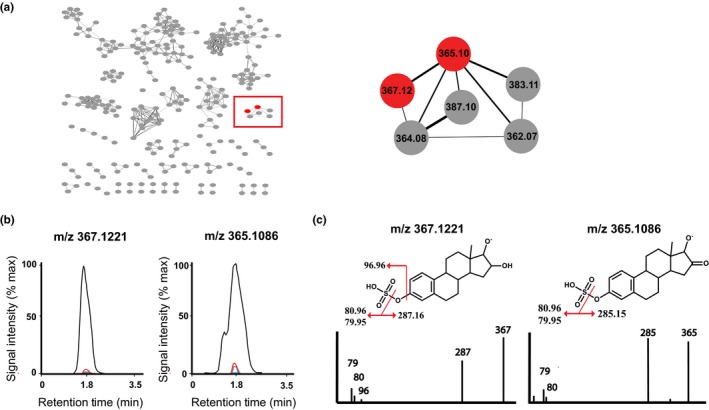
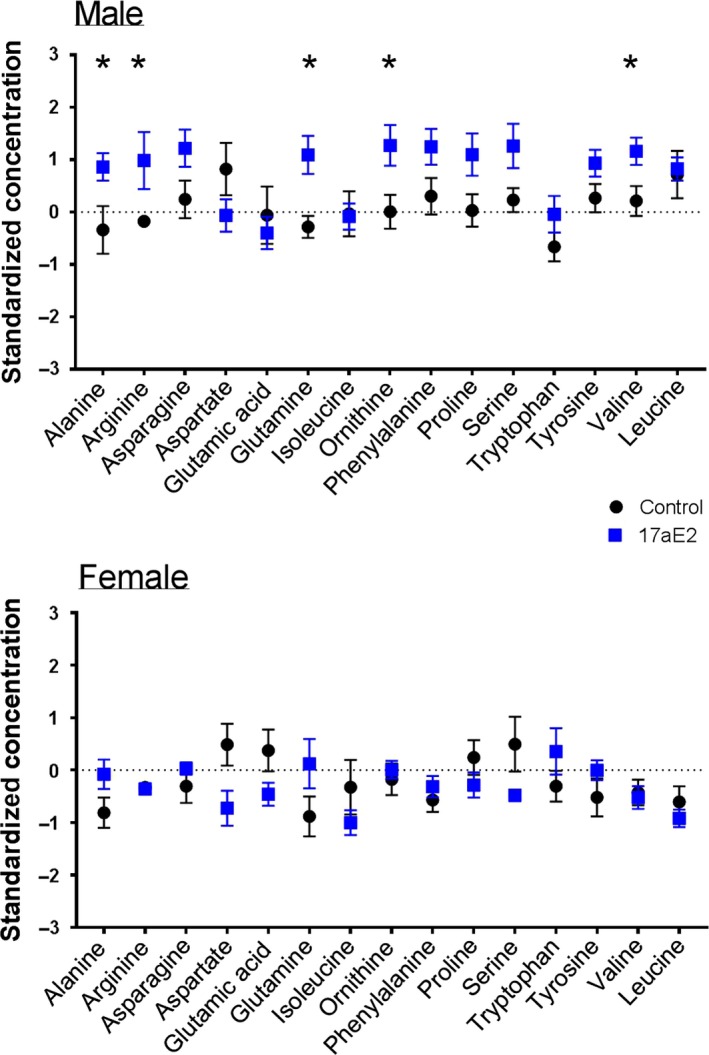
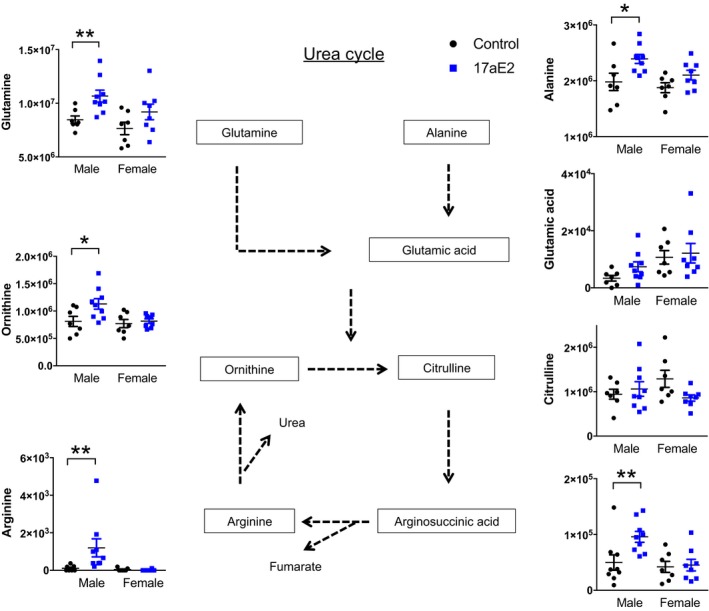
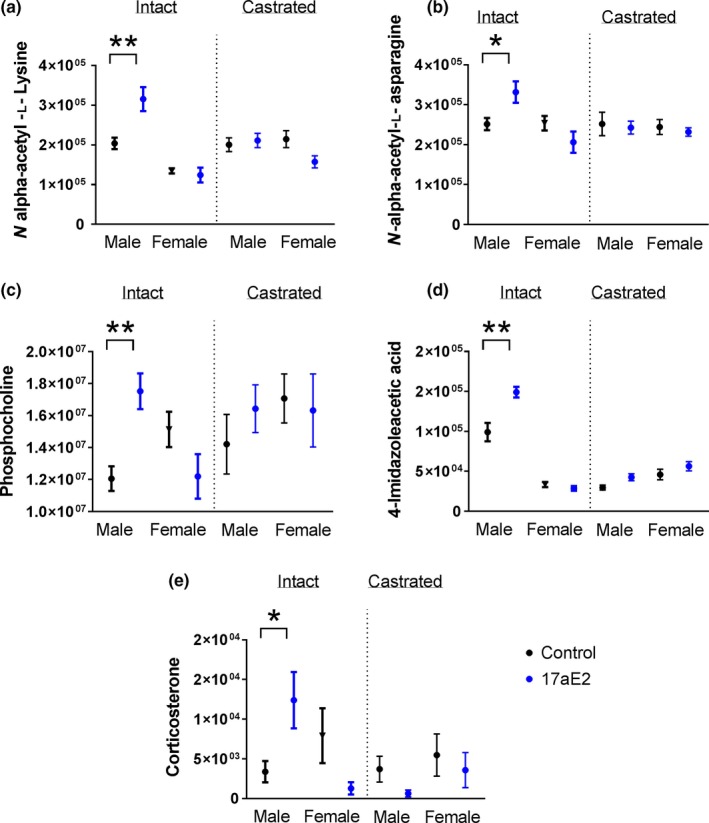
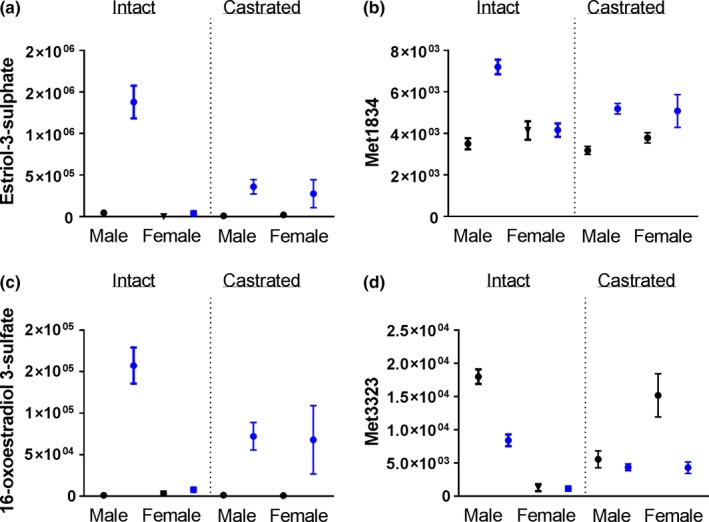
Summary: Longevity in mammals is influenced by sex, and lifespan extension in response to anti‐aging interventions is often sex‐specific, although the mechanisms underlying these sexual dimorphisms are largely unknown. Treatment of mice with 17‐α estradiol (17aE2) results in sex‐specific lifespan extension, with an increase in median survival in males of 19% and no survival effect in females. Given the links between lifespan extension and metabolism, we performed untargeted metabolomics analysis of liver, skeletal muscle and plasma from male and female mice treated with 17aE2 for eight months. We find that 17aE2 generates distinct sex‐specific changes in the metabolomic profile of liver and plasma. In males, 17aE2 treatment raised the abundance of several amino acids in the liver, and this was further associated with elevations in metabolites involved in urea cycling, suggesting altered amino acid metabolism. In females, amino acids and urea cycling metabolites were unaffected by 17aE2. 17aE2 also results in male‐specific elevations in a second estrogenic steroid—estriol‐3‐sulfate—suggesting different metabolism of this drug in males and females. To understand the underlying endocrine causes for these sexual dimorphisms, we castrated males and ovariectomized females prior to 17aE2 treatment, and found that virtually all the male‐specific metabolite responses to 17aE2 are inhibited or reduced by male castration. These results suggest novel metabolic pathways linked to male‐specific lifespan extension and show that the male‐specific metabolomic response to 17aE2 depends on the production of testicular hormones in adult life.
Overview
The claims and statistics of this paper haven’t been checked yet.
Run the check — free, no account needed. It reads the open-access text and checks the sources it cites.
Integrity signals
Registry
Cites
Statistics
Figures
Verification
Claims the paper makes
The claims and statistics of this paper haven’t been checked yet.
Run the check — free, no account needed. It reads the open-access text and checks the sources it cites.
Claims other papers make about this one
Each is checked against this paper’s own text: does it say what the citing paper says it does?
In the citing paper
“Conversely, the lifespan of male mice is extended by acarbose and 17-α estradiol, and these compounds increased hepatic mTORC2 activity 118.”
From Targeting the biology of aging with mTOR inhibitors (2023) · cites this paper as [118]
Self-check
Percentages, sums and reported differences re-computed from the paper’s own numbers.
The self-check needs the paper’s full text.
Citations
Cites
Sex differences in metabolic homeostasis, diabetes, and obesity
Mauvais-Jarvis, F. (2015) · Biology of Sex Differences · doi:10.1186/s13293-015-0033-y · Cited by 626 · cited 1×
“Female-specific production of 17-b estradiol contributes to sex differences in metabolism, supported by the observation that circulating 17-b estradiol production declines during menopause, a fall associated with lower glucose homeostasis and elevated visceral adiposity (Mauvais-Jarvis, 2015).”
BackgroundStrong, R., Miller, R. A., Antebi, A., Astle, C. M., Bogue, M., Denzel, M. S., Fernandez, E., Flurkey, K., Hamilton, K. L., Lamming, D. W., et al. (2016) · Aging Cell · doi:10.1111/acel.12496 · Cited by 362
Self-citationNordihydroguaiaretic acid and aspirin increase lifespan of genetically heterogeneous male mice
Strong, R., Miller, R. A., Astle, C. M., Floyd, R. A., Flurkey, K., Hensley, K. L., Javors, M. A., Leeuwenburgh, C., Nelson, J. F., Ongini, E., et al. (2008) · Aging Cell · doi:10.1111/j.1474-9726.2008.00414.x · Cited by 349
Self-citation
Research works printed but not linked: 40
- 10.1016/S0039-128X(96)00242-5 · DOI
- 10.1530/jrf.0.0140113 · DOI
- 10.18632/oncotarget.2984 · DOI
- 10.1111/j.2517-6161.1995.tb02031.x · DOI · Paper page
- 10.1111/nyas.13302 · DOI
- 10.1093/jn/136.1.207S · DOI · Paper page
- 10.1073/pnas.1603023113 · DOI · Paper page
- 10.1111/acel.12656 · DOI · Paper page
- 10.1093/gerona/glx127 · DOI
- 10.1093/gerona/glw041 · DOI
- 10.1111/acel.12570 · DOI
- 10.1093/geronj/24.4.395 · DOI
- 10.1111/acel.12170 · DOI · Paper page
- 10.1016/S0039-128X(02)00058-2 · DOI
- 10.1111/j.1469-7998.1997.tb02806.x · DOI
- 10.1002/ajp.22399 · DOI
- 10.1530/EJE-16-0868 · DOI
- 10.1016/B978-0-12-374271-1.00014-9 · DOI
- 10.1016/0022-4731(84)90004-9 · DOI
- 10.7554/eLife.19130 · DOI · Paper page
- 10.1126/scisignal.aad8170 · DOI
- 10.1093/gerona/glp134 · DOI
- 10.1111/acel.12194 · DOI
- 10.1016/j.cub.2012.06.036 · DOI
- 10.1002/ddr.20284 · DOI
- 10.1159/000210897 · DOI
- Pasqualini J. R., 1985, Biosynthesis and metabolism of different hormones in the fetal and placental compartments, in production, concentration and metabolism during pregnancy
- 10.1016/j.beem.2013.05.016 · DOI
- 10.1016/j.mce.2017.02.031 · DOI · Paper page
- 10.1111/acel.12590 · DOI
- Schriefers H., 1991, Inhibition of testosterone metabolism by 17‐alpha‐estradiol in rat liver slices, Arzneimittel‐Forschung, 41, 1186
- 10.1111/acel.12061 · DOI
- Stout M. B., 2016, 17α‐Estradiol alleviates age‐related metabolic and inflammatory dysfunction in male mice without inducing feminization, The Journals of Gerontology Series A, Biological Sciences and Medical Sciences, 72, 1
- 10.1016/0039-128X(84)90042-4 · DOI
- 10.1523/JNEUROSCI.22-19-08391.2002 · DOI
- 10.1210/en.2004-1616 · DOI
- 10.1021/acs.analchem.6b04337 · DOI
- 10.1073/pnas.1203689109 · DOI
- 10.1124/mol.109.056705 · DOI · Paper page
- 10.1093/nar/gkq329 · DOI
Cited by
Sorted by citations
Targeting the biology of aging with mTOR inhibitors
Mannick, J. B., & Lamming, D. W. (2023) · Nature Aging · doi:10.1038/s43587-023-00416-y · Cited by 372
Metadata
- Authors
- Garratt, M., Lagerborg, K. A., Tsai, Y., Galecki, A., Jain, M., & Miller, R. A.
- Affiliations
- Department of Pathology University of Michigan Medical School Ann Arbor Michigan
- Departments of Medicine & Pharmacology University of California San Diego San Diego California
- Venue
- Aging Cell
- Publisher
- Wiley
- Published
- 2018-05-27
- Volume
- 17
- Issue
- 4
- ISSN
- 1474-9718
- 1474-9726
- PMC
- PMC6052402
- Cited by
- 63
- References
- 3
- Language
- en
- Funders
- National Institutes of Health (1S10OD020025, AG022303, R03AG053287)
- Glenn Foundation for Medical Research
- University of California, San Diego
About these checks
Registry, retraction, Cites and statistics results are computed, not judged, with one exception: a printed reference that no index lists is read once by a model before it counts as a citation error. Claims are extracted by a model and kept only when their quote appears verbatim in the text; each cited source is then checked, with a model’s help, for whether it says what the claim relies on. Those verdicts can be wrong — read the claim’s quote and the cited source before relying on one.
Statistics and arithmetic are recomputed, not judged.
Confidence bands are shown only for fields calibrated on our annotated test set. None is calibrated yet, so no band is shown.
What counts as a claim ›How we measure confidence ›How we check this ›
Are you an author, or do you see a problem with this page? Request a review
How to cite
Cite CoChat for the checks on this page, and the paper for its own findings.
- This page
- CoChat. (2026). Citation check: Male lifespan extension with 17‐α estradiol is linked to a sex‐specific metabolomic response modulated by gonadal hormones in mice. https://app.cochat.ai/papers/10.1111/acel.12786
- The paper
- Garratt, M., Lagerborg, K. A., Tsai, Y., Galecki, A., Jain, M., & Miller, R. A. (2018). Male lifespan extension with 17‐α estradiol is linked to a sex‐specific metabolomic response modulated by gonadal hormones in mice. Aging Cell. https://doi.org/10.1111/acel.12786
