

Progress and trends in the development of therapies for Hutchinson–Gilford progeria syndrome
The DOI matches its Crossref record; 90 of the 90 references it cites were found in a registry or an index.
Abstract
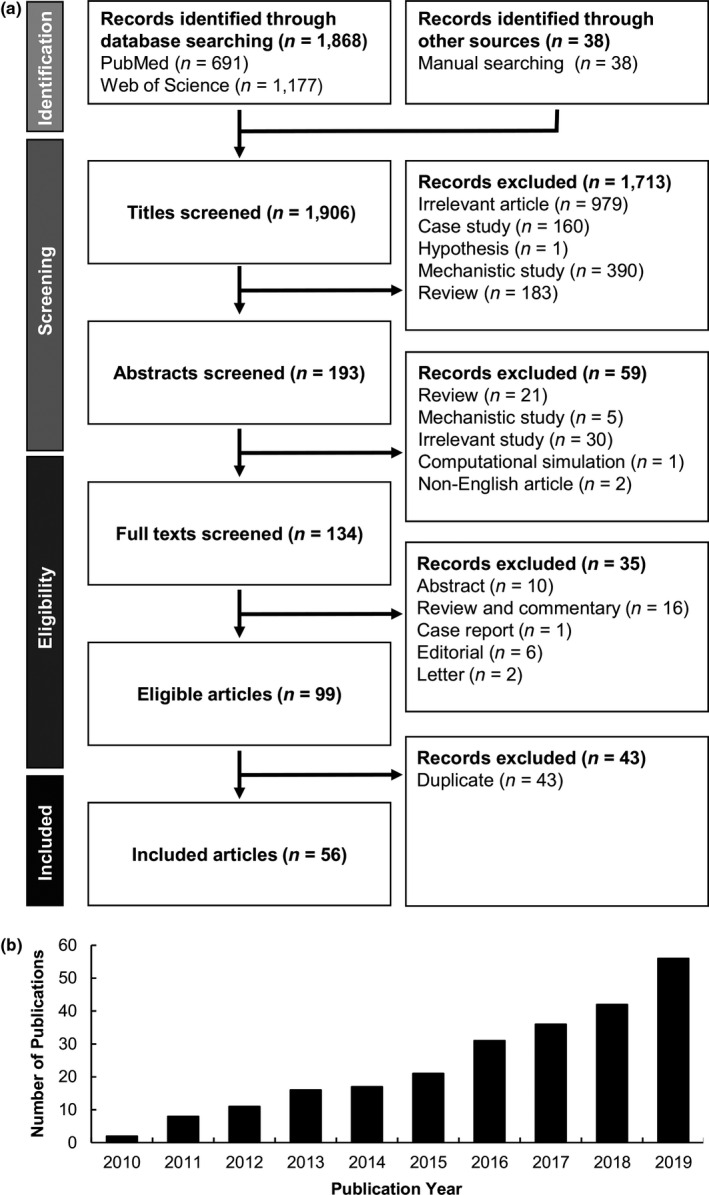
Hutchinson–Gilford progeria syndrome (HGPS) is an autosomal‐dominant genetic disease that leads to accelerated aging and often premature death caused by cardiovascular complications. Till now clinical management of HGPS has largely relied on the treatment of manifestations and on the prevention of secondary complications, cure for the disease has not yet been established. Addressing this need cannot only benefit progeria patients but may also provide insights into intervention design for combating physiological aging. By using the systematic review approach, this article revisits the overall progress in the development of strategies for HGPS treatment over the last ten years, from 2010 to 2019. In total, 1,906 articles have been retrieved, of which 56 studies have been included for further analysis. Based on the articles analyzed, the trends in the use of different HGPS models, along with the prevalence, efficiency, and limitations of different reported treatment strategies, have been examined. Emerging strategies for preclinical studies, and possible targets for intervention development, have also been presented as avenues for future research.
Overview
The claims and statistics of this paper haven’t been checked yet.
Free: it reads the open-access text and checks the first 5 claims that cite a source we can check. Create a free account to check every claim.
Integrity signals
Registry
Cites
Statistics
Figures
Verification
Claims the paper makes
The claims and statistics of this paper haven’t been checked yet.
Free: it reads the open-access text and checks the first 5 claims that cite a source we can check. Create a free account to check every claim.
Claims other papers make about this one
Each is checked against this paper’s own text: does it say what the citing paper says it does?
In the citing paper
“The causal implication of nuclear lamina abnormalities in premature aging has been corroborated by the observation that decreasing prelamin A or progerin levels delays the onset of progeroid features and extends lifespan in mouse models of HGPS.”
From Hallmarks of aging: An expanding universe (2023) · cites this paper as [26]
Self-check
Percentages, sums and reported differences re-computed from the paper’s own numbers.
The self-check needs the paper’s full text.
Citations
Cites
Recurrent de novo point mutations in lamin A cause Hutchinson-Gilford progeria syndrome
Eriksson, M., Brown, W. T., Gordon, L. B., Glynn, M. W., Singer, J., Scott, L., Erdos, M. R., Robbins, C. M., Moses, T. Y., Berglund, P., et al. (2003) · Nature · doi:10.1038/nature01629 · Cited by 1,990
Insertional oncogenesis in 4 patients after retrovirus-mediated gene therapy of SCID-X1
Hacein-Bey-Abina, S., Garrigue, A., Wang, G. P., Soulier, J., Lim, A., Morillon, E., Clappier, E., Caccavelli, L., Delabesse, E., Beldjord, K., et al. (2008) · Journal of Clinical Investigation · doi:10.1172/jci35700 · Cited by 1,854 · cited 2×
“…since the early 2000s when two patients suffering from severe combined immunodeficiency-X1 (SCID-X1) had developed acute lymphoblastic leukemia (T-ALL) after recipient of gene therapy mediated by the retroviral vector (Hacein-Bey-Abina et al., 2008; Kohn et al., 2003; McCormack & Rabbitts, 2004).”
BackgroundLamin a truncation in Hutchinson-Gilford progeria
De Sandre-Giovannoli, A., Bernard, R., Cau, P., Navarro, C., Amiel, J., Boccaccio, I., Lyonnet, S., Stewart, C. L., Munnich, A., Le Merrer, M., et al. (2003) · Science · doi:10.1126/science.1084125 · Cited by 1,346
Ott, M. G., Schmidt, M., Schwarzwaelder, K., Stein, S., Siler, U., Koehl, U., Glimm, H., Kühlcke, K., Schilz, A., Kunkel, H., et al. (2006) · Nature Medicine · doi:10.1038/nm1393 · Cited by 1,051
In Vivo Amelioration of Age-Associated Hallmarks by Partial Reprogramming.
Ocampo, A., Reddy, P., Martinez-Redondo, P., Platero-Luengo, A., Hatanaka, F., Hishida, T., Li, M., Lam, D., Kurita, M., Beyret, E., et al. (2016) · Cell · doi:10.1016/j.cell.2016.11.052 · Cited by 988 · cited 7×
“…mice to whom MSCs are implanted (Kubben et al., 2016), mice carrying copies of the OSKM polycistronic cassette and the rtTA transactivator (Ocampo et al., 2016), and mice with osteoblastand osteocyte-specific inducible transgenic expression of the most common HGPS mutation (Strandgren et…”
BackgroundMethodInfluentialPhenotype and Course of Hutchinson–Gilford Progeria Syndrome
Merideth, M. A., Gordon, L. B., Clauss, S., Sachdev, V., Smith, A. C. M., Perry, M. B., Brewer, C. C., Zalewski, C., Kim, H. J., Solomon, B., et al. (2008) · New England Journal of Medicine · doi:10.1056/nejmoa0706898 · Cited by 743
Healthspan and lifespan extension by fecal microbiota transplantation into progeroid mice
Bárcena, C., Valdés-Mas, R., Mayoral, P., Garabaya, C., Durand, S., Rodríguez, F., Fernández-García, M. T., Salazar, N., Nogacka, A. M., Garatachea, N., et al. (2019) · Nature Medicine · doi:10.1038/s41591-019-0504-5 · Cited by 661 · cited 4×
“…adenoviral vector designed to correct the HGPS mutation Liu et al. (2011) (Continues) wild-type mice, the healthspan and lifespan of both LmnaG609G/G609G and Zmpste24−/− mice have been shown to be improved, even though the disease-causing gene mutation has not been corrected (Barcena et al., 2019).”
BackgroundMethodInfluentialImpaired immune surveillance accelerates accumulation of senescent cells and aging
Ovadya, Y., Landsberger, T., Leins, H., Vadai, E., Gal, H., Biran, A., Yosef, R., Sagiv, A., Agrawal, A., Shapira, A., et al. (2018) · Nature Communications · doi:10.1038/s41467-018-07825-3 · Cited by 578 · cited 9×
“, 2016), ABT-737 (Ovadya et al., 2018), sodium salicylate (Osorio et al.”
BackgroundMethodInfluentialHutchinson–Gilford progeria syndrome: Review of the phenotype
Hennekam, R. C. M. (2006) · American Journal of Medical Genetics Part A · doi:10.1002/ajmg.a.31346 · Cited by 575
Pendás, A. M., Zhou, Z., Cadiñanos, J., Freije, J. M. P., Wang, J., Hultenby, K., Astudillo, A., Wernerson, A., Rodríguez, F., Tryggvason, K., et al. (2002) · Nature Genetics · doi:10.1038/ng871 · Cited by 554 · cited 1×
“One of them is the Zmpste24−/− mice, which emerged in the literature in the early 2000s (Bergo et al., 2002; Pendas et al., 2002).”
Background
Research works printed but not linked: 3
- Ahmed, M. S., Ikram, S., Bibi, N., & Mir, A. (2018). Hutchinson‐Gilford progeria syndrome: A premature aging disease. Molecular Neurobiology, 555, 4417– 4427. 10.1007/s12035-017-0610-7 28660486 · DOI
- Gordon, L. B., Brown, W. T., & Collins, F. S. (1993). Hutchinson‐Gilford progeria syndrome In Adam M. P., Ardinger H. H., Pagon R. A., Wallace S. E., Bean L. J. H., Stephens K., & Amemiya A. (Eds.), GeneReviews. Seattle, WA: University of Washington, Seattle. 20301300
- Kuk, M. U., Kim, J. W., Lee, Y. S., Cho, K. A., Park, J. T., & Park, S. C. (2019). Alleviation of senescence via ATM inhibition in accelerated aging models. Molecules and Cells, 423, 210– 217. 10.14348/molcells.2018.0352 PMC6449716 30726661 · DOI
Cited by
Hallmarks of aging: An expanding universe
López-Otín, C., Blasco, M. A., Partridge, L., Serrano, M., & Kroemer, G. (2023) · Cell · doi:10.1016/j.cell.2022.11.001 · Cited by 6,549
In vivo base editing rescues Hutchinson–Gilford progeria syndrome in mice
Koblan, L. W., Erdos, M. R., Wilson, C., Cabral, W. A., Levy, J. M., Xiong, Z.-M., Tavarez, U. L., Davison, L. M., Gete, Y. G., Mao, X., et al. (2021) · Nature · doi:10.1038/s41586-020-03086-7 · Cited by 483
González‐Dominguez, A., Montañez, R., Castejón‐Vega, B., Nuñez‐Vasco, J., Lendines‐Cordero, D., Wang, C., Mbalaviele, G., Navarro‐Pando, J. M., Alcocer‐Gómez, E., & Cordero, M. D. (2021) · EMBO Molecular Medicine · doi:10.15252/emmm.202114012 · Cited by 32
Metadata
- Authors
- Lai, W., & Wong, W.
- Affiliations
- School of Life and Health Sciences The Chinese University of Hong Kong (Shenzhen) Shenzhen China
- Department of Applied Biology and Chemical Technology Hong Kong Polytechnic University Hong Kong Special Administrative Region China
- Venue
- Aging Cell
- Publisher
- Wiley
- Published
- 2020-06-28
- Volume
- 19
- Issue
- 7
- ISSN
- 1474-9718
- 1474-9726
- PMC
- PMC7370734
- Cited by
- 29
- References
- 90
- Language
- en
- Funders
- Natural Science Foundation of Guangdong Province (2018A030310485)
About these checks
Registry, retraction, Cites and statistics results are computed, not judged, with one exception: a printed reference that no index lists is read once by a model before it counts as a citation error. Claims are extracted by a model and kept only when their quote appears verbatim in the text; each cited source is then checked, with a model’s help, for whether it says what the claim relies on. Those verdicts can be wrong — read the claim’s quote and the cited source before relying on one.
Statistics and arithmetic are recomputed, not judged.
Confidence bands are shown only for fields calibrated on our annotated test set. None is calibrated yet, so no band is shown.
What counts as a claim ›How we measure confidence ›How we check this ›
Are you an author, or do you see a problem with this page? Request a review
Data sources
Bibliographic data: Semantic Scholar, OpenAlex, Crossref.
Contains information from the Semantic Scholar Academic Graph Datasets, made available under the ODC Attribution License (ODC-BY 1.0).
Semantic Scholar’s data is described in: Kinney, R., et al. (2023). The Semantic Scholar Open Data Platform. arXiv:2301.10140.
