

Progress and trends in the development of therapies for Hutchinson–Gilford progeria syndrome
The DOI matches its Crossref record; 13 of the 13 references it cites were found in a registry or an index.
Abstract
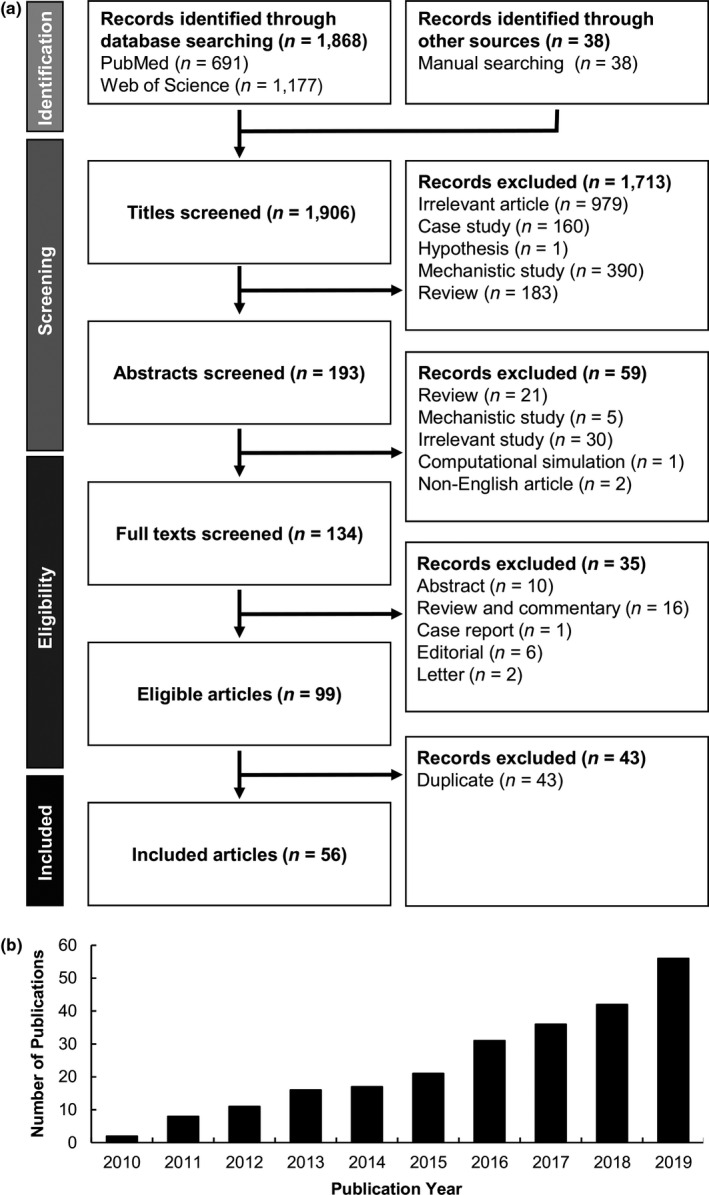
Hutchinson–Gilford progeria syndrome (HGPS) is an autosomal‐dominant genetic disease that leads to accelerated aging and often premature death caused by cardiovascular complications. Till now clinical management of HGPS has largely relied on the treatment of manifestations and on the prevention of secondary complications, cure for the disease has not yet been established. Addressing this need cannot only benefit progeria patients but may also provide insights into intervention design for combating physiological aging. By using the systematic review approach, this article revisits the overall progress in the development of strategies for HGPS treatment over the last ten years, from 2010 to 2019. In total, 1,906 articles have been retrieved, of which 56 studies have been included for further analysis. Based on the articles analyzed, the trends in the use of different HGPS models, along with the prevalence, efficiency, and limitations of different reported treatment strategies, have been examined. Emerging strategies for preclinical studies, and possible targets for intervention development, have also been presented as avenues for future research.
Overview
The claims and statistics of this paper haven’t been checked yet.
Free: it reads the open-access text and checks the first 5 claims that cite a source we can check. Create a free account to check every claim.
Integrity signals
Registry
Cites
Statistics
Figures
Verification
Claims the paper makes
The claims and statistics of this paper haven’t been checked yet.
Free: it reads the open-access text and checks the first 5 claims that cite a source we can check. Create a free account to check every claim.
Claims other papers make about this one
Each is checked against this paper’s own text: does it say what the citing paper says it does?
In the citing paper
“The causal implication of nuclear lamina abnormalities in premature aging has been corroborated by the observation that decreasing prelamin A or progerin levels delays the onset of progeroid features and extends lifespan in mouse models of HGPS.”
From Hallmarks of aging: An expanding universe (2023) · cites this paper as [26]
Self-check
Percentages, sums and reported differences re-computed from the paper’s own numbers.
The self-check needs the paper’s full text.
Citations
Cites
Insertional oncogenesis in 4 patients after retrovirus-mediated gene therapy of SCID-X1
Hacein-Bey-Abina, S., Garrigue, A., Wang, G. P., Soulier, J., Lim, A., Morillon, E., Clappier, E., Caccavelli, L., Delabesse, E., Beldjord, K., et al. (2008) · Journal of Clinical Investigation · doi:10.1172/jci35700 · Cited by 1,854 · cited 2×
“…since the early 2000s when two patients suffering from severe combined immunodeficiency-X1 (SCID-X1) had developed acute lymphoblastic leukemia (T-ALL) after recipient of gene therapy mediated by the retroviral vector (Hacein-Bey-Abina et al., 2008; Kohn et al., 2003; McCormack & Rabbitts, 2004).”
BackgroundIn Vivo Amelioration of Age-Associated Hallmarks by Partial Reprogramming.
Ocampo, A., Reddy, P., Martinez-Redondo, P., Platero-Luengo, A., Hatanaka, F., Hishida, T., Li, M., Lam, D., Kurita, M., Beyret, E., et al. (2016) · Cell · doi:10.1016/j.cell.2016.11.052 · Cited by 988 · cited 7×
“…mice to whom MSCs are implanted (Kubben et al., 2016), mice carrying copies of the OSKM polycistronic cassette and the rtTA transactivator (Ocampo et al., 2016), and mice with osteoblastand osteocyte-specific inducible transgenic expression of the most common HGPS mutation (Strandgren et…”
BackgroundMethodInfluentialHealthspan and lifespan extension by fecal microbiota transplantation into progeroid mice
Bárcena, C., Valdés-Mas, R., Mayoral, P., Garabaya, C., Durand, S., Rodríguez, F., Fernández-García, M. T., Salazar, N., Nogacka, A. M., Garatachea, N., et al. (2019) · Nature Medicine · doi:10.1038/s41591-019-0504-5 · Cited by 661 · cited 4×
“…adenoviral vector designed to correct the HGPS mutation Liu et al. (2011) (Continues) wild-type mice, the healthspan and lifespan of both LmnaG609G/G609G and Zmpste24−/− mice have been shown to be improved, even though the disease-causing gene mutation has not been corrected (Barcena et al., 2019).”
BackgroundMethodInfluentialImpaired immune surveillance accelerates accumulation of senescent cells and aging
Ovadya, Y., Landsberger, T., Leins, H., Vadai, E., Gal, H., Biran, A., Yosef, R., Sagiv, A., Agrawal, A., Shapira, A., et al. (2018) · Nature Communications · doi:10.1038/s41467-018-07825-3 · Cited by 578 · cited 9×
“, 2016), ABT-737 (Ovadya et al., 2018), sodium salicylate (Osorio et al.”
BackgroundMethodInfluentialPendás, A. M., Zhou, Z., Cadiñanos, J., Freije, J. M. P., Wang, J., Hultenby, K., Astudillo, A., Wernerson, A., Rodríguez, F., Tryggvason, K., et al. (2002) · Nature Genetics · doi:10.1038/ng871 · Cited by 554 · cited 1×
“One of them is the Zmpste24−/− mice, which emerged in the literature in the early 2000s (Bergo et al., 2002; Pendas et al., 2002).”
BackgroundStem-Cell Gene Therapy for the Wiskott–Aldrich Syndrome
Boztug, K., Schmidt, M., Schwarzer, A., Banerjee, P. P., Díez, I. A., Dewey, R. A., Böhm, M., Nowrouzi, A., Ball, C. R., Glimm, H., et al. (2010) · New England Journal of Medicine · doi:10.1056/nejmoa1003548 · Cited by 532 · cited 1×
“Such concerns have been further accentuated when other instances of preneoplastic or truly neoplastic cell expansion have been reported to be associated with gene therapy of Wiskott–Aldrich syndrome (WAS) (Boztug et al., 2010) and of X-linked chronic granulomatous diseases (Ott et al., 2006).”
BackgroundRepression of the Antioxidant NRF2 Pathway in Premature Aging
Kubben, N., Zhang, W., Wang, L., Voss, T. C., Yang, J., Qu, J., Liu, G.-H., & Misteli, T. (2016) · Cell · doi:10.1016/j.cell.2016.05.017 · Cited by 489 · cited 20×
“…(2016) TAT-14 Kubben et al. (2016) AI-1 Kubben et al. (2016) Constitutively activated NRF2 Kubben et al. (2016) siRNA to knock down CAND1 expression Kubben et al. (2016) Sulforaphane Gabriel et al. (2015); Gabriel et al. (2017) Calcium-phosphate deposition Sodium pyrophosphate tetrabasic…”
BackgroundInfluentialSplicing-directed therapy in a new mouse model of human accelerated aging
Osorio, F. G., Navarro, C. L., Cadiñanos, J., López-Mejía, I. C., Quirós, P. M., Bartoli, C., Rivera, J., Tazi, J., Guzmán, G., Varela, I., et al. (2011) · Science Translational Medicine · doi:10.1126/scitranslmed.3002847 · Cited by 432 · cited 8×
“…Lmna splicing The therapy reduced the accumulation of progerin, ameliorated progeroid phenotypes, and extended the lifespan of progeroid mice Osorio et al. (2011) To increase lamin C production at the expense of prelamin A The therapy ameliorated the aortic pathology observed in…”
BackgroundInfluentialCao, K., Graziotto, J. J., Blair, C. D., Mazzulli, J. R., Erdos, M. R., Krainc, D., & Collins, F. S. (2011) · Science Translational Medicine · doi:10.1126/scitranslmed.3002346 · Cited by 350 · cited 3×
“This agent and its analog, temsirolimus, have been found to enhance progerin clearance through an autophagic mechanism (Akinci et al., 2017; Bikkul et al., 2018; Cao et al., 2011; Cenni et al., 2011; Gabriel et al., 2016; Kawakami et al., 2019) and hence are thought to be drug candidates for the treatment of HGPS.”
BackgroundMethodHutchinson-Gilford Progeria Syndrome: A premature aging disease caused by LMNA gene mutations
Gonzalo, S., Kreienkamp, R., & Askjaer, P. (2017) · Ageing Research Reviews · doi:10.1016/j.arr.2016.06.007 · Cited by 324
Ho, Y.-H., del Toro, R., Rivera-Torres, J., Rak, J., Korn, C., García-García, A., Macías, D., González-Gómez, C., del Monte, A., Wittner, M., et al. (2019) · Cell Stem Cell · doi:10.1016/j.stem.2019.06.007 · Cited by 315 · cited 8×
“…mice with a β3-AR agonist, namely BRL37344, has also successfully decreased premature expansion of myeloid cells and hematopoietic stem cells (HSCs) (Ho et al., 2019), suggesting the possibility of ameliorating some of the HGPS symptoms simply by targeting the bone marrow microenvironment.”
BackgroundMethodInfluentialMethionine Restriction Extends Lifespan in Progeroid Mice and Alters Lipid and Bile Acid Metabolism
Bárcena, C., Quirós, P. M., Durand, S., Mayoral, P., Rodríguez, F., Caravia, X. M., Mariño, G., Garabaya, C., Fernández-García, M. T., Kroemer, G., et al. (2018) · Cell Reports · doi:10.1016/j.celrep.2018.07.089 · Cited by 185 · cited 7×
“, 2015), growth hormone (GH)/insulin/ IGF-1 signaling pathway (Barcena et al., 2018; Marino et al., 2010), and AMPK-TOR pathway (Akinci et al.”
BackgroundInfluentialAguado, J., Sola-Carvajal, A., Cancila, V., Revêchon, G., Ong, P. F., Jones-Weinert, C. W., Wallén Arzt, E., Lattanzi, G., Dreesen, O., Tripodo, C., et al. (2019) · Nature Communications · doi:10.1038/s41467-019-13018-3 · Cited by 133 · cited 8×
“…mice expressing progerin with a FLAG epitope tag in epidermal keratinocytes (Wang, Ostlund, & Worman, 2010), whereas another study has used a tetracycline-inducible transgenic mouse line in which progerin is expressed in the keratin 5 (K5)-positive compartment of the skin (Aguado et al., 2019).”
BackgroundInfluential
Research works printed but not linked: 80
- Ahmed, M. S., Ikram, S., Bibi, N., & Mir, A. (2018). Hutchinson‐Gilford progeria syndrome: A premature aging disease. Molecular Neurobiology, 555, 4417– 4427. 10.1007/s12035-017-0610-7 28660486 · DOI
- Akinci, B., Sankella, S., Gilpin, C., Ozono, K., Garg, A., & Agarwal, A. K. (2017). Progeroid syndrome patients with ZMPSTE24 deficiency could benefit when treated with rapamycin and dimethylsulfoxide. Cold Spring Harbor Molecular Case Studies, 31, a001339 10.1101/mcs.a001339 PMC5171694 28050601 · DOI
- Ao, Y., Zhang, J., Liu, Z., Qian, M., Li, Y., Wu, Z., … Wang, Z. (2019). Lamin A buffers CK2 kinase activity to modulate aging in a progeria mouse model. Science Advances, 53, eaav5078 10.1126/sciadv.aav5078 PMC6426468 30906869 · DOI
- Apelo, S. I. A., & Lamming, D. W. (2016). Rapamycin: An inhibitor of aging emerges from the soil of Easter Island. Journals of Gerontology. Series A, Biological Sciences and Medical Sciences, 717, 841– 849. PMC4906330 27208895 · DOI · Paper page
- Ashapkin, V. V., Kutueva, L. I., Kurchashova, S. Y., & Kireev, I. I. (2019). Are there common mechanisms between the Hutchinson‐Gilford progeria syndrome and natural aging? Frontiers in Genetics, 10, 455 10.3389/fgene.2019.00455 31156709 PMC6529819 · DOI · Paper page
- Benson, E. K., Lee, S. W., & Aaronson, S. A. (2010). Role of progerin‐induced telomere dysfunction in HGPS premature cellular senescence. Journal of Cell Science, 123(15), 2605– 2612. 10.1242/jcs.067306 20605919 PMC2908049 · DOI · Paper page
- Bergo, M. O., Gavino, B., Ross, J., Schmidt, W. K., Hong, C., Kendall, L. V., … Young, S. G. (2002). Zmpste24 deficiency in mice causes spontaneous bone fractures, muscle weakness, and a prelamin A processing defect. Proceedings of the National Academy of Sciences of the United States of America, 9920, 13049– 13054. 10.1073/pnas.192460799 PMC130584 12235369 · DOI · Paper page
- Beyret, E., Liao, H. K., Yamamoto, M., Hernandez‐Benitez, R., Fu, Y., Erikson, G., … Izpisua Belmonte, J. C. (2019). Single‐dose CRISPR‐Cas9 therapy extends lifespan of mice with Hutchinson‐Gilford progeria syndrome. Nature Medicine, 253, 419– 422. 10.1038/s41591-019-0343-4 PMC6541418 30778240 · DOI · Paper page
- Bifulco, M., D'Alessandro, A., Paladino, S., Malfitano, A. M., Notarnicola, M., Caruso, M. G., & Laezza, C. (2013). N6‐isopentenyladenosine improves nuclear shape in fibroblasts from humans with progeroid syndromes by inhibiting the farnesylation of prelamin A. FEBS Journal, 28023, 6223– 6232. 10.1111/febs.12544 24112551 · DOI
- Bikkul, M. U., Clements, C. S., Godwin, L. S., Goldberg, M. W., Kill, I. R., & Bridger, J. M. (2018). Farnesyltransferase inhibitor and rapamycin correct aberrant genome organisation and decrease DNA damage respectively, in Hutchinson‐Gilford progeria syndrome fibroblasts. Biogerontology, 196, 579– 602. 10.1007/s10522-018-9758-4 PMC6223735 29907918 · DOI
- Brassard, J. A., Fekete, N., Garnier, A., & Hoesli, C. A. (2016). Hutchinson‐Gilford progeria syndrome as a model for vascular aging. Biogerontology, 171, 129– 145. 10.1007/s10522-015-9602-z 26330290 · DOI
- Cenni, V., Capanni, C., Columbaro, M., Ortolani, M., D'Apice, M. R., Novelli, G., … Lattanzi, G. (2011). Autophagic degradation of farnesylated prelamin A as a therapeutic approach to lamin‐linked progeria. European Journal of Histochemistry, 554, e36 10.4081/ejh.2011.e36 PMC3284238 22297442 · DOI · Paper page
- Cho, H. J., Park, J., Lee, H. W., Lee, Y. S., & Kim, J. B. (2004). Regulation of adipocyte differentiation and insulin action with rapamycin. Biochemical and Biophysical Research Communications, 3214, 942– 948. 10.1016/j.bbrc.2004.07.050 15358118 · DOI
- Chojnowski, A., Ong, P. F., Foo, M. X. R., Liebl, D., Hor, L. P., Stewart, C. L., & Dreesen, O. (2020). Heterochromatin loss as a determinant of progerin‐induced DNA damage in Hutchinson‐Gilford progeria. Aging Cell, 193, e13108 10.1111/acel.13108 PMC7059134 32087607 · DOI
- Chojnowski, A., Ong, P. F., Wong, E. S., Lim, J. S., Mutalif, R. A., Navasankari, R., … Dreesen, O. (2015). Progerin reduces LAP2alpha‐telomere association in Hutchinson‐Gilford progeria. Elife, 4, e07759 10.7554/eLife.07759 PMC4565980 26312502 · DOI · Paper page
- Davies, B. S., Barnes, R. H. 2nd, Tu, Y., Ren, S., Andres, D. A., Spielmann, H. P., … Fong, L. G. (2010). An accumulation of non‐farnesylated prelamin A causes cardiomyopathy but not progeria. Human Molecular Genetics, 1913, 2682– 2694. 10.1093/hmg/ddq158 PMC2883346 20421363 · DOI · Paper page
- De Sandre‐Giovannoli, A., Bernard, R., Cau, P., Navarro, C., Amiel, J., Boccaccio, I., … Levy, N. (2003). Lamin a truncation in Hutchinson‐Gilford progeria. Science, 3005628, 2055 10.1126/science.1084125 12702809 · DOI · Paper page
- Del Campo, L., Hamczyk, M. R., Andres, V., Martinez‐Gonzalez, J., Rodriguez, C., & en nombre del Grupo de trabajo de Biologia Vascular de la Sociedad Espanola de, A., (2018). Mechanisms of vascular aging: What can we learn from Hutchinson‐Gilford progeria syndrome? Clínica E Investigación En Arteriosclerosis, 303, 120– 132. 10.1016/j.arteri.2017.12.007 29602596 · DOI
- Egesipe, A. L., Blondel, S., Lo Cicero, A., Jaskowiak, A. L., Navarro, C., Sandre‐Giovannoli, A., … Nissan, X. (2016). Metformin decreases progerin expression and alleviates pathological defects of Hutchinson‐Gilford progeria syndrome cells. NPJ Aging and Mechanisms of Disease, 2, 16026 10.1038/npjamd.2016.26 28721276 PMC5515002 · DOI
- Endisha, H., Merrill‐Schools, J., Zhao, M., Bristol, M., Wang, X., Kubben, N., & Elmore, L. W. (2015). Restoring SIRT6 expression in Hutchinson‐Gilford progeria syndrome cells impedes premature senescence and formation of dysmorphic nuclei. Pathobiology, 821, 9– 20. 10.1159/000368856 25765721 · DOI · Paper page
- Eriksson, M., Brown, W. T., Gordon, L. B., Glynn, M. W., Singer, J., Scott, L., … Collins, F. S. (2003). Recurrent de novo point mutations in lamin A cause Hutchinson‐Gilford progeria syndrome. Nature, 4236937, 293– 298. 10.1038/nature01629 PMC10540076 12714972 · DOI · Paper page
- Fong, L. G., Frost, D., Meta, M., Qiao, X., Yang, S. H., Coffinier, C., & Young, S. G. (2006). A protein farnesyltransferase inhibitor ameliorates disease in a mouse model of progeria. Science, 3115767, 1621– 1623. 10.1126/science.1124875 16484451 · DOI · Paper page
- Gabriel, D., Gordon, L. B., & Djabali, K. (2016). Temsirolimus partially rescues the Hutchinson‐Gilford progeria cellular phenotype. PLoS One, 1112, e0168988 10.1371/journal.pone.0168988 PMC5199099 28033363 · DOI
- Gabriel, D., Roedl, D., Gordon, L. B., & Djabali, K. (2015). Sulforaphane enhances progerin clearance in Hutchinson‐Gilford progeria fibroblasts. Aging Cell, 141, 78– 91. 10.1111/acel.12300 PMC4326906 25510262 · DOI · Paper page
- Gabriel, D., Shafry, D. D., Gordon, L. B., & Djabali, K. (2017). Intermittent treatment with farnesyltransferase inhibitor and sulforaphane improves cellular homeostasis in Hutchinson‐Gilford progeria fibroblasts. Oncotarget, 839, 64809– 64826. 10.18632/oncotarget.19363 PMC5630293 29029393 · DOI
- Garcia‐Aguirre, I., Alamillo‐Iniesta, A., Rodriguez‐Perez, R., Velez‐Aguilera, G., Amaro‐Encarnacion, E., Jimenez‐Gutierrez, E., … Cisneros, B. (2019). Enhanced nuclear protein export in premature aging and rescue of the progeria phenotype by modulation of CRM1 activity. Aging Cell, 185, e13002 10.1111/acel.13002 PMC6718587 31305018 · DOI
- Geng, L., Liu, Z., Zhang, W., Li, W., Wu, Z., Wang, W., … Liu, G. H. (2019). Chemical screen identifies a geroprotective role of quercetin in premature aging. Protein Cell, 106, 417– 435. 10.1007/s13238-018-0567-y PMC6538594 30069858 · DOI · Paper page
- Gonzalo, S., & Kreienkamp, R. (2015). DNA repair defects and genome instability in Hutchinson‐Gilford progeria syndrome. Current Opinion in Cell Biology, 34, 75– 83. 10.1016/j.ceb.2015.05.007 26079711 PMC4522337 · DOI · Paper page
- Gordon, L. B., Brown, W. T., & Collins, F. S. (1993). Hutchinson‐Gilford progeria syndrome In Adam M. P., Ardinger H. H., Pagon R. A., Wallace S. E., Bean L. J. H., Stephens K., & Amemiya A. (Eds.), GeneReviews. Seattle, WA: University of Washington, Seattle. 20301300
- Gordon, L. B., Kleinman, M. E., Massaro, J., D'Agostino, R. B. Sr, Shappell, H., Gerhard‐Herman, M., … Kieran, M. W. (2016). Clinical trial of the protein farnesylation inhibitors lonafarnib, pravastatin, and zoledronic acid in children with Hutchinson‐Gilford progeria syndrome. Circulation, 1342, 114– 125. 10.1161/CIRCULATIONAHA.116.022188 PMC4943677 27400896 · DOI · Paper page
- Gordon, L. B., Kleinman, M. E., Miller, D. T., Neuberg, D. S., Giobbie‐Hurder, A., Gerhard‐Herman, M., … Kieran, M. W. (2012). Clinical trial of a farnesyltransferase inhibitor in children with Hutchinson‐Gilford progeria syndrome. Proceedings of the National Academy of Sciences of the United States of America, 10941, 16666– 16671. 10.1073/pnas.1202529109 PMC3478615 23012407 · DOI · Paper page
- Gordon, L. B., Shappell, H., Massaro, J., D'Agostino, R. B. Sr, Brazier, J., Campbell, S. E., … Kieran, M. W. (2018). Association of lonafarnib treatment vs no treatment with mortality rate in patients with Hutchinson‐Gilford progeria syndrome. JAMA, 31916, 1687– 1695. 10.1001/jama.2018.3264 PMC5933395 29710166 · DOI · Paper page
- Griveau, A., Wiel, C., Le Calve, B., Ziegler, D. V., Djebali, S., Warnier, M., … Bernard, D. (2018). Targeting the phospholipase A2 receptor ameliorates premature aging phenotypes. Aging Cell, 176, e12835 10.1111/acel.12835 PMC6260922 30216637 · DOI
- Hamczyk, M. R., Villa‐Bellosta, R., Quesada, V., Gonzalo, P., Vidak, S., Nevado, R. M., … Andres, V. (2019). Progerin accelerates atherosclerosis by inducing endoplasmic reticulum stress in vascular smooth muscle cells. EMBO Molecular Medicine, 114, e9736 10.15252/emmm.201809736 PMC6460349 30862662 · DOI · Paper page
- Harhouri, K., Navarro, C., Baquerre, C., Da Silva, N., Bartoli, C., Casey, F., … De Sandre‐Giovannoli, A. (2016). Antisense‐based progerin downregulation in HGPS‐like patients' cells. Cells, 53, 31 10.3390/cells5030031 PMC5040973 27409638 · DOI
- Harhouri, K., Navarro, C., Depetris, D., Mattei, M.‐G., Nissan, X., Cau, P., … Lévy, N. (2017). MG132‐induced progerin clearance is mediated by autophagy activation and splicing regulation. EMBO Molecular Medicine, 99, 1294– 1313. 10.15252/emmm.201607315 PMC5582415 28674081 · DOI · Paper page
- Hennekam, R. C. (2006). Hutchinson‐Gilford progeria syndrome: Review of the phenotype. American Journal of Medical Genetics. Part A, 14023, 2603– 2624. 10.1002/ajmg.a.31346 16838330 · DOI · Paper page
- Ibrahim, M. X., Sayin, V. I., Akula, M. K., Liu, M., Fong, L. G., Young, S. G., & Bergo, M. O. (2013). Targeting isoprenylcysteine methylation ameliorates disease in a mouse model of progeria. Science, 3406138, 1330– 1333. 10.1126/science.1238880 PMC4295631 23686339 · DOI · Paper page
- Kang, H. T., Park, J. T., Choi, K., Choi, H. J. C., Jung, C. W., Kim, G. R., … Park, S. C. (2017). Chemical screening identifies ROCK as a target for recovering mitochondrial function in Hutchinson‐Gilford progeria syndrome. Aging Cell, 163, 541– 550. 10.1111/acel.12584 PMC5418208 28317242 · DOI · Paper page
- Kawakami, Y., Hambright, W. S., Takayama, K., Mu, X., Lu, A., Cummins, J. H., … Huard, J. (2019). Rapamycin rescues age‐related changes in muscle‐derived stem/progenitor cells from progeroid mice. Molecular Therapy ‐ Methods & Clinical Development, 14, 64– 76. 10.1016/j.omtm.2019.05.011 31312666 PMC6610712 · DOI · Paper page
- Kohn, D. B., Sadelain, M., & Glorioso, J. C. (2003). Occurrence of leukaemia following gene therapy of X‐linked SCID. Nature Reviews Cancer, 3, 477– 488. 10.1038/nrc1122 12835668 · DOI · Paper page
- Kreienkamp, R., Croke, M., Neumann, M. A., Bedia‐Diaz, G., Graziano, S., Dusso, A., … Gonzalo, S. (2016). Vitamin D receptor signaling improves Hutchinson‐Gilford progeria syndrome cellular phenotypes. Oncotarget, 721, 30018– 30031. 10.18632/oncotarget.9065 PMC5058660 27145372 · DOI · Paper page
- Kudlow, B. A., Stanfel, M. N., Burtner, C. R., Johnston, E. D., & Kennedy, B. K. (2008). Suppression of proliferative defects associated with processing‐defective lamin A mutants by hTERT or inactivation of p53. Molecular Biology of the Cell, 1912, 5238– 5248. 10.1091/mbc.E08-05-0492 PMC2592682 18843043 · DOI · Paper page
- Kuk, M. U., Kim, J. W., Lee, Y. S., Cho, K. A., Park, J. T., & Park, S. C. (2019). Alleviation of senescence via ATM inhibition in accelerated aging models. Molecules and Cells, 423, 210– 217. 10.14348/molcells.2018.0352 PMC6449716 30726661 · DOI
- Lai, W. F. (2011). Nucleic acid therapy for lifespan prolongation: Present and future. Journal of Biosciences, 364, 725– 729. 10.1007/s12038-011-9096-z 21857119 · DOI
- Lai, W. F. (2012). Protein kinases as targets for interventive biogerontology: Overview and perspectives. Experimental Gerontology, 474, 290– 294. 10.1016/j.exger.2012.01.002 22269334 · DOI
- Lai, W. F. (2013). Nucleic acid delivery: Roles in biogerontological interventions. Ageing Research Reviews, 121, 310– 315. 10.1016/j.arr.2012.08.003 22982112 · DOI
- Lai, W. F., Lin, M., & Wong, W. T. (2019). Tackling aging by using miRNA as a target and a tool. Trends in Molecular Medicine, 258, 673– 684. 10.1016/j.molmed.2019.04.007 31126873 · DOI
- Lee, J. M., Nobumori, C., Tu, Y., Choi, C., Yang, S. H., Jung, H. J., … Fong, L. G. (2016). Modulation of LMNA splicing as a strategy to treat prelamin A diseases. Journal of Clinical Investigation, 1264, 1592– 1602. 10.1172/JCI85908 PMC4811112 26999604 · DOI · Paper page
- Lee, S. J., Jung, Y. S., Yoon, M. H., Kang, S. M., Oh, A. Y., Lee, J. H., … Park, B. J. (2016). Interruption of progerin‐lamin A/C binding ameliorates Hutchinson‐Gilford progeria syndrome phenotype. Journal of Clinical Investigation, 12610, 3879– 3893. 10.1172/JCI84164 PMC5096810 27617860 · DOI · Paper page
- Li, Y., Zhou, G., Bruno, I. G., Zhang, N., Sho, S., Tedone, E., … Shay, J. W. (2019). Transient introduction of human telomerase mRNA improves hallmarks of progeria cells. Aging Cell, 184, e12979 10.1111/acel.12979 PMC6612639 31152494 · DOI · Paper page
- Liu, B., Ghosh, S., Yang, X., Zheng, H., Liu, X., Wang, Z., … Zhou, Z. (2012). Resveratrol rescues SIRT1‐dependent adult stem cell decline and alleviates progeroid features in laminopathy‐based progeria. Cell Metabolism, 166, 738– 750. 10.1016/j.cmet.2012.11.007 23217256 · DOI · Paper page
- Liu, B., Wang, Z., Zhang, L., Ghosh, S., Zheng, H., & Zhou, Z. (2013). Depleting the methyltransferase Suv39h1 improves DNA repair and extends lifespan in a progeria mouse model. Nature Communications, 4, 1868 10.1038/ncomms2885 PMC3674265 23695662 · DOI · Paper page
- Liu, C., Arnold, R., Henriques, G., & Djabali, K. (2019). Inhibition of JAK‐STAT signaling with baricitinib reduces inflammation and improves cellular homeostasis in progeria cells. Cells, 810, 1276 10.3390/cells8101276 PMC6829898 31635416 · DOI
- Liu, G. H., Suzuki, K., Qu, J., Sancho‐Martinez, I., Yi, F., Li, M., … Izpisua Belmonte, J. C. (2011). Targeted gene correction of laminopathy‐associated LMNA mutations in patient‐specific iPSCs. Cell Stem Cell, 86, 688– 694. 10.1016/j.stem.2011.04.019 PMC3480729 21596650 · DOI · Paper page
- Marino, G., Ugalde, A. P., Fernandez, A. F., Osorio, F. G., Fueyo, A., Freije, J. M., & Lopez‐Otin, C. (2010). Insulin‐like growth factor 1 treatment extends longevity in a mouse model of human premature aging by restoring somatotroph axis function. Proceedings of the National Academy of Sciences of the United States of America, 10737, 16268– 16273. 10.1073/pnas.1002696107 PMC2941281 20805469 · DOI · Paper page
- Mateos, J., Fafian‐Labora, J., Morente‐Lopez, M., Lesende‐Rodriguez, I., Monserrat, L., Odena, M. A., … Arufe, M. C. (2018). Next‐generation sequencing and quantitative proteomics of Hutchinson‐Gilford progeria syndrome‐derived cells point to a role of nucleotide metabolism in premature aging. PLoS One, 1310, e0205878 10.1371/journal.pone.0205878 PMC6209416 30379953 · DOI
- Mayoral, P., Bárcena, C., & López‐Otín, C. (2018). Progeria mouse models In Ram J. L., & Conn P. M. (Eds.), Conn's handbook of models for human aging (2nd ed., pp. 689– 701). US: Academic Press. · DOI
- McCormack, M. P., & Rabbitts, T. H. (2004). Activation of the T‐cell oncogene LMO2 after gene therapy for X‐linked severe combined immunodeficiency. New England Journal of Medicine, 350, 913– 922. 10.1056/NEJMra032207 14985489 · DOI · Paper page
- Mehta, I. S., Eskiw, C. H., Arican, H. D., Kill, I. R., & Bridger, J. M. (2011). Farnesyltransferase inhibitor treatment restores chromosome territory positions and active chromosome dynamics in Hutchinson‐Gilford progeria syndrome cells. Genome Biology, 128, R74 10.1186/gb-2011-12-8-r74 PMC3245614 21838864 · DOI
- Merideth, M. A., Gordon, L. B., Clauss, S., Sachdev, V., Smith, A. C., Perry, M. B., … Introne, W. J. (2008). Phenotype and course of Hutchinson‐Gilford progeria syndrome. New England Journal of Medicine, 3586, 592– 604. 10.1056/NEJMoa0706898 PMC2940940 18256394 · DOI · Paper page
- Osorio, F. G., Barcena, C., Soria‐Valles, C., Ramsay, A. J., de Carlos, F., Cobo, J., … Lopez‐Otin, C. (2012). Nuclear lamina defects cause ATM‐dependent NF‐kappaB activation and link accelerated aging to a systemic inflammatory response. Genes & Development, 2620, 2311– 2324. 10.1101/gad.197954.112 PMC3475803 23019125 · DOI · Paper page
- Ott, M. G., Schmidt, M., Schwarzwaelder, K., Stein, S., Siler, U., Koehl, U., … Grez, M. (2006). Correction of X‐linked chronic granulomatous disease by gene therapy, augmented by insertional activation of MDS1‐EVI1, PRDM16 or SETBP1. Nature Medicine, 12, 401– 409. 10.1038/nm1393 16582916 · DOI · Paper page
- Pacheco, L. M., Gomez, L. A., Dias, J., Ziebarth, N. M., Howard, G. A., & Schiller, P. C. (2014). Progerin expression disrupts critical adult stem cell functions involved in tissue repair. Aging Albany NY, 612, 1049– 1063. 10.18632/aging.100709 PMC4298365 25567453 · DOI · Paper page
- Park, S. K., & Shin, O. S. (2017). Metformin alleviates ageing cellular phenotypes in Hutchinson‐Gilford progeria syndrome dermal fibroblasts. Experimental Dermatology, 2610, 889– 895. 10.1111/exd.13323 28192606 · DOI · Paper page
- Pellegrini, C., Columbaro, M., Capanni, C., D'Apice, M. R., Cavallo, C., Murdocca, M., … Squarzoni, S. (2015). All‐trans retinoic acid and rapamycin normalize Hutchinson Gilford progeria fibroblast phenotype. Oncotarget, 630, 29914– 29928. 10.18632/oncotarget.4939 PMC4745772 26359359 · DOI · Paper page
- Prokocimer, M., Barkan, R., & Gruenbaum, Y. (2013). Hutchinson‐Gilford progeria syndrome through the lens of transcription. Aging Cell, 124, 533– 543. 10.1111/acel.12070 23496208 · DOI · Paper page
- Richards, S. A., Muter, J., Ritchie, P., Lattanzi, G., & Hutchison, C. J. (2011). The accumulation of un‐repairable DNA damage in laminopathy progeria fibroblasts is caused by ROS generation and is prevented by treatment with N‐acetyl cysteine. Human Molecular Genetics, 2020, 3997– 4004. 10.1093/hmg/ddr327 21807766 · DOI · Paper page
- Sagelius, H., Rosengardten, Y., Schmidt, E., Sonnabend, C., Rozell, B., & Eriksson, M. (2008). Reversible phenotype in a mouse model of Hutchinson‐Gilford progeria syndrome. Journal of Medical Genetics, 4512, 794– 801. 10.1136/jmg.2008.060772 18708427 · DOI · Paper page
- Santiago‐Fernandez, O., Osorio, F. G., Quesada, V., Rodriguez, F., Basso, S., Maeso, D., … Lopez‐Otin, C. (2019). Development of a CRISPR/Cas9‐based therapy for Hutchinson‐Gilford progeria syndrome. Nature Medicine, 253, 423– 426. 10.1038/s41591-018-0338-6 PMC6546610 30778239 · DOI · Paper page
- Scaffidi, P., & Misteli, T. (2005). Reversal of the cellular phenotype in the premature aging disease Hutchinson‐Gilford progeria syndrome. Nature Medicine, 114, 440– 445. 10.1038/nm1204 PMC1351119 15750600 · DOI · Paper page
- Strandgren, C., Nasser, H. A., McKenna, T., Koskela, A., Tuukkanen, J., Ohlsson, C., … Eriksson, M. (2015). Transgene silencing of the Hutchinson‐Gilford progeria syndrome mutation results in a reversible bone phenotype, whereas resveratrol treatment does not show overall beneficial effects. The FASEB Journal, 298, 3193– 3205. 10.1096/fj.14-269217 25877214 · DOI · Paper page
- Trigueros‐Motos, L., Gonzalez, J. M., Rivera, J., & Andres, V. (2011). Hutchinson‐Gilford progeria syndrome, cardiovascular disease and oxidative stress.. Frontiers in Bioscience, 3, 1285– 1297. 10.2741/226 21622271 · DOI
- Ullrich, N. J., Kieran, M. W., Miller, D. T., Gordon, L. B., Cho, Y. J., Silvera, V. M., … Kleinman, M. E. (2013). Neurologic features of Hutchinson‐Gilford progeria syndrome after lonafarnib treatment. Neurology, 815, 427– 430. 10.1212/WNL.0b013e31829d85c0 PMC3776537 23897869 · DOI
- Varela, I., Pereira, S., Ugalde, A. P., Navarro, C. L., Suarez, M. F., Cau, P., … Lopez‐Otin, C. (2008). Combined treatment with statins and aminobisphosphonates extends longevity in a mouse model of human premature aging. Nature Medicine, 147, 767– 772. 10.1038/nm1786 18587406 · DOI · Paper page
- Villa‐Bellosta, R. (2019). ATP‐based therapy prevents vascular calcification and extends longevity in a mouse model of Hutchinson‐Gilford progeria syndrome. Proceedings of the National Academy of Sciences of the United States of America, 11647, 23698– 23704. 10.1073/pnas.1910972116 PMC6876227 31690656 · DOI
- Villa‐Bellosta, R., Rivera‐Torres, J., Osorio, F. G., Acin‐Perez, R., Enriquez, J. A., Lopez‐Otin, C., & Andres, V. (2013). Defective extracellular pyrophosphate metabolism promotes vascular calcification in a mouse model of Hutchinson‐Gilford progeria syndrome that is ameliorated on pyrophosphate treatment. Circulation, 12724, 2442– 2451. 10.1161/CIRCULATIONAHA.112.000571 23690466 · DOI · Paper page
- Wang, Y., Ostlund, C., & Worman, H. J. (2010). Blocking protein farnesylation improves nuclear shape abnormalities in keratinocytes of mice expressing the prelamin A variant in Hutchinson‐Gilford progeria syndrome. Nucleus, 15, 432– 439. 10.4161/nucl.1.5.12972 PMC3037539 21326826 · DOI
- Xiong, Z. M., Choi, J. Y., Wang, K., Zhang, H., Tariq, Z., Wu, D., … Cao, K. (2016). Methylene blue alleviates nuclear and mitochondrial abnormalities in progeria. Aging Cell, 152, 279– 290. 10.1111/acel.12434 PMC4783354 26663466 · DOI · Paper page
- Zhang, J., Lian, Q., Zhu, G., Zhou, F., Sui, L., Tan, C., … Colman, A. (2011). A human iPSC model of Hutchinson Gilford progeria reveals vascular smooth muscle and mesenchymal stem cell defects. Cell Stem Cell, 81, 31– 45. 10.1016/j.stem.2010.12.002 21185252 · DOI · Paper page
Cited by
Hallmarks of aging: An expanding universe
López-Otín, C., Blasco, M. A., Partridge, L., Serrano, M., & Kroemer, G. (2023) · Cell · doi:10.1016/j.cell.2022.11.001 · Cited by 6,549
In vivo base editing rescues Hutchinson–Gilford progeria syndrome in mice
Koblan, L. W., Erdos, M. R., Wilson, C., Cabral, W. A., Levy, J. M., Xiong, Z.-M., Tavarez, U. L., Davison, L. M., Gete, Y. G., Mao, X., et al. (2021) · Nature · doi:10.1038/s41586-020-03086-7 · Cited by 483
González‐Dominguez, A., Montañez, R., Castejón‐Vega, B., Nuñez‐Vasco, J., Lendines‐Cordero, D., Wang, C., Mbalaviele, G., Navarro‐Pando, J. M., Alcocer‐Gómez, E., & Cordero, M. D. (2021) · EMBO Molecular Medicine · doi:10.15252/emmm.202114012 · Cited by 32
Metadata
- Authors
- Lai, W., & Wong, W.
- Affiliations
- School of Life and Health Sciences The Chinese University of Hong Kong (Shenzhen) Shenzhen China
- Department of Applied Biology and Chemical Technology Hong Kong Polytechnic University Hong Kong Special Administrative Region China
- Venue
- Aging Cell
- Publisher
- Wiley
- Published
- 2020-06-28
- Volume
- 19
- Issue
- 7
- ISSN
- 1474-9718
- 1474-9726
- PMC
- PMC7370734
- Cited by
- 29
- References
- 13
- Language
- en
- Funders
- Natural Science Foundation of Guangdong Province (2018A030310485)
About these checks
Registry, retraction, Cites and statistics results are computed, not judged, with one exception: a printed reference that no index lists is read once by a model before it counts as a citation error. Claims are extracted by a model and kept only when their quote appears verbatim in the text; each cited source is then checked, with a model’s help, for whether it says what the claim relies on. Those verdicts can be wrong — read the claim’s quote and the cited source before relying on one.
Statistics and arithmetic are recomputed, not judged.
Confidence bands are shown only for fields calibrated on our annotated test set. None is calibrated yet, so no band is shown.
What counts as a claim ›How we measure confidence ›How we check this ›
Are you an author, or do you see a problem with this page? Request a review
Data sources
Bibliographic data: Semantic Scholar, OpenAlex, Crossref.
Contains information from the Semantic Scholar Academic Graph Datasets, made available under the ODC Attribution License (ODC-BY 1.0).
Semantic Scholar’s data is described in: Kinney, R., et al. (2023). The Semantic Scholar Open Data Platform. arXiv:2301.10140.
