

The DOI matches its Crossref record; 4 of the 4 references it cites were found in a registry or an index.
Basophil activation test: Mechanisms and considerations for use in clinical trials and clinical practice
Published version of a preprint
Abstract
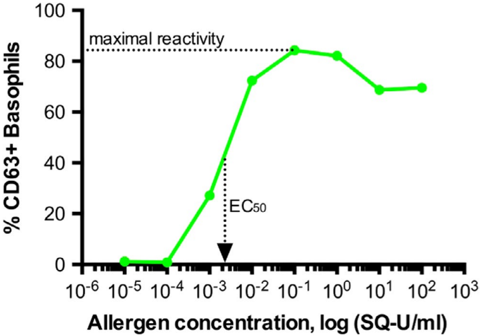
The basophil activation test (BAT) is a functional assay that measures the degree of degranulation following stimulation with allergen or controls by flow cytometry. It correlates directly with histamine release. From the dose‐response curve resulting from BAT in allergic patients, basophil reactivity (%CD63 + basophils) and basophil sensitivity (EC 50 or similar) are the main outcomes of the test. BAT takes into account all characteristics of IgE and allergen and thus can be more specific than sensitization tests in the diagnosis of allergic disease. BAT reduces the need for in vivo procedures, such as intradermal tests and allergen challenges, which can cause allergic reactions of unpredictable severity. As it closely reflects the patients' phenotype in most cases, it may be used to support the diagnosis of food, venom and drug allergies and chronic urticaria, to monitor the natural resolution of food allergies and to predict and monitor clinical the response to immunomodulatory treatments, such as allergen‐specific immunotherapy and biologicals. Clinical application of BAT requires analytical validation, clinical validation, standardization of procedures and quality assurance to ensure reproducibility and reliability of results. Currently, efforts are ongoing to establish a platform that could be used by laboratories in Europe and in the USA for quality assurance and certification.
Overview
The claims and statistics of this paper haven’t been checked yet.
Run the check — free, no account needed. It reads the open-access text and checks the sources it cites.
Integrity signals
Registry
Cites
Statistics
Figures




Verification
Claims the paper makes
The claims and statistics of this paper haven’t been checked yet.
Run the check — free, no account needed. It reads the open-access text and checks the sources it cites.
Claims other papers make about this one
Each is checked against this paper’s own text: does it say what the citing paper says it does?
In the citing paper
“Moreover, approximately 10% to 15% of individuals are “nonresponders”, meaning their basophils respond to non-IgE-mediated stimulants but not to IgE-mediated controls or allergens, rendering the test results uninterpretable [209].”
From Pollen–Food Allergy Syndrome: Allergens, Clinical Insights, Diagnostic and Therapeutic Challenges (2024) · cites this paper as [209]
Self-check
Percentages, sums and reported differences re-computed from the paper’s own numbers.
The self-check needs the paper’s full text.
Citations
Cites
Monitoring human basophil activation via CD63 monoclonal antibody 435
Knol, E. F., Mul, F. P. J., Jansen, H., Calafat, J., & Roos, D. (1991) · Journal of Allergy and Clinical Immunology · doi:10.1016/0091-6749(91)90094-5 · Cited by 421
Early improvement in basophil sensitivity predicts symptom relief with grass pollen immunotherapy
Schmid, J. M., Würtzen, P. A., Dahl, R., & Hoffmann, H. J. (2014) · Journal of Allergy and Clinical Immunology · doi:10.1016/j.jaci.2014.04.029 · Cited by 63
Self-citationPros and Cons of Clinical Basophil Testing (BAT)
Hoffmann, H. J., Knol, E. F., Ferrer, M., Mayorga, L., Sabato, V., Santos, A. F., Eberlein, B., Nopp, A., & MacGlashan, D. (2016) · Current Allergy and Asthma Reports · doi:10.1007/s11882-016-0633-6 · Cited by 50
Self-citationCD-Sens Can Be a Reliable and Easy-to-Use Complement in the Diagnosis of Allergic Rhinitis
Nopp, A., Cardell, L. O., & Johansson, S. G. O. (2013) · International Archives of Allergy and Immunology · doi:10.1159/000345133 · Cited by 16
Research works printed but not linked: 116
- 10.1016/j.jaci.2014.04.039 · DOI
- 10.1111/all.14206 · DOI
- 10.1111/j.1398-9995.2010.02431.x · DOI
- 10.1111/all.12698 · DOI
- 10.1186/s13601-016-0100-4 · DOI
- 10.1016/S0091-6749(97)70033-2 · DOI
- 10.1371/journal.pone.0012204 · DOI
- 10.1038/sj.cr.7290301 · DOI
- Smiljkovic M, 2017, Apigenin‐7‐O‐glucoside versus apigenin: insight into the modes of anticandidal and cytotoxic actions, EXCLI J, 16, 795
- 10.1159/000328756 · DOI
- 10.3389/fimmu.2018.01644 · DOI
- 10.1080/20013078.2019.1650458 · DOI
- 10.1016/j.jim.2011.09.003 · DOI
- 10.1111/j.1365-2222.2010.03572.x · DOI
- 10.1016/j.cellsig.2009.03.018 · DOI
- 10.1042/BST20170450 · DOI
- 10.1002/eji.200737634 · DOI
- 10.1155/2019/9542656 · DOI
- 10.1111/j.1398-9995.2010.02460.x · DOI
- 10.1016/j.jaip.2018.09.034 · DOI
- 10.1186/1476-7961-6-12 · DOI
- 10.1016/j.jaci.2005.11.016 · DOI
- 10.1111/all.12952 · DOI
- 10.1016/j.jaci.2020.03.035 · DOI
- 10.1016/j.jaci.2013.06.038 · DOI
- 10.1111/cea.12155 · DOI
- 10.1111/j.1365-2222.2012.04013.x · DOI
- 10.4049/jimmunol.0801782 · DOI
- 10.1016/S0091-6749(06)80015-1 · DOI
- Kwok M, 2017, Improved standardisation of the whole blood basophil activation test to peanut, Clin Transl Allergy, 8, 15
- 10.1016/j.jaci.2016.04.060 · DOI
- 10.1111/j.1398-9995.2009.02004.x · DOI
- Pascal M, 2020, Building confidence in the basophil activation test: standardization and external quality assurance ‐ an EAACI task force, Allergy, 75, 115
- 10.1002/cyto.b.21537 · DOI
- 10.1016/j.jaci.2014.09.001 · DOI
- 10.1111/j.1398-9995.2004.00624.x · DOI
- 10.1111/j.1398-9995.2005.00870.x · DOI
- 10.1111/j.1365-2222.2011.03763.x · DOI
- 10.1111/j.1398-9995.2011.02754.x · DOI
- 10.1159/000350923 · DOI
- 10.1111/j.1398-9995.2008.01900.x · DOI · Paper page
- 10.1111/j.1398-9995.2005.00894.x · DOI
- 10.1111/j.1365-2222.2010.03524.x · DOI
- 10.1111/all.14264 · DOI
- 10.1111/j.1398-9995.2006.00987.x · DOI · Paper page
- 10.1111/j.1398-9995.2007.01476.x · DOI
- 10.1111/j.1398-9995.2009.02144.x · DOI
- 10.1111/j.1399-3038.2011.01260.x · DOI
- 10.1111/cea.12515 · DOI
- 10.1111/j.1365-2222.2011.03838.x · DOI · Paper page
- 10.1111/all.12581 · DOI · Paper page
- 10.1111/j.1365-2249.2011.04503.x · DOI
- 10.1016/0091-6749(93)90266-I · DOI
- 10.1016/j.jaci.2006.09.040 · DOI
- 10.1189/jlb.1208724 · DOI
- 10.1111/cea.12964 · DOI
- 10.1007/s11882-018-0831-5 · DOI
- Santos AF, 2019, Identifying allergic children with severe adverse events during oral peanut challenges in the LEAP studies by assessing basophil activation, Allergy, 74, 73
- 10.1186/s13601-016-0098-7 · DOI
- 10.1016/j.jaci.2012.02.008 · DOI
- 10.1111/all.13949 · DOI
- 10.1016/j.jaci.2008.12.1128 · DOI
- 10.1016/j.jaci.2018.01.044 · DOI
- 10.1016/j.anai.2015.01.006 · DOI
- 10.1111/j.1398-9995.2010.02432.x · DOI
- 10.1016/j.anai.2018.04.020 · DOI
- 10.1111/cea.13078 · DOI
- 10.1111/all.13135 · DOI
- 10.1111/all.13368 · DOI
- 10.1016/j.jaci.2019.09.005 · DOI
- 10.1016/j.jaci.2019.07.028 · DOI
- 10.1016/j.jaci.2015.01.012 · DOI
- McKendry RT, 2019, Basophil and mast cell responses to food allergens in sensitised but tolerant patients are not mediated via the FcgRII and FcgRII receptors, Allergy, 74, 97
- 10.1056/NEJMoa1200435 · DOI
- 10.1016/j.jaci.2013.11.007 · DOI
- 10.1016/j.jaci.2014.09.049 · DOI
- 10.1111/j.1365-2222.2012.04028.x · DOI
- 10.1016/j.jaci.2014.11.010 · DOI
- 10.1016/j.jaci.2016.12.965 · DOI
- 10.1016/j.jaci.2012.05.038 · DOI
- 10.1159/000260086 · DOI
- 10.1111/cea.13469 · DOI
- 10.1016/j.jaci.2012.05.039 · DOI
- 10.1016/j.jaci.2013.04.056 · DOI
- 10.1016/j.jaci.2009.09.012 · DOI
- 10.1111/j.1398-9995.2009.02051.x · DOI
- 10.1016/j.jaci.2011.07.021 · DOI
- 10.1111/cea.13066 · DOI
- 10.1016/j.jaip.2016.12.004 · DOI
- 10.1111/all.13319 · DOI
- 10.1111/myc.13081 · DOI
- 10.1016/j.jcf.2016.02.004 · DOI
- 10.1002/cyto.a.23078 · DOI
- 10.1586/1744666X.2014.959498 · DOI
- 10.1002/cyto.b.21532 · DOI
- 10.1002/cyto.b.21104 · DOI
- 10.1002/cyto.b.21105 · DOI
- 10.1002/cyto.b.21107 · DOI
- Pascal M, 2020, Building confidence in the basophil activation test: standardization and external quality assurance ‐ an EAACI task force, Allergy, 75, 115
- 10.1016/j.jaip.2016.12.003 · DOI
- 10.1111/all.12939 · DOI · Paper page
- 10.1016/j.jaci.2019.10.038 · DOI
- 10.1016/j.jaci.2018.03.011 · DOI
- 10.1016/j.jaci.2019.09.005 · DOI
- 10.1159/000094495 · DOI
- 10.1159/000115885 · DOI
- 10.1007/s40629-016-0005-8 · DOI
- 10.1111/j.1365-2222.2009.03292.x · DOI
- 10.1111/j.1365-2222.2009.03426.x · DOI
- 10.1111/j.1365-2044.2011.06729.x · DOI
- 10.1111/j.1398-9995.2004.00400.x · DOI
- 10.1183/13993003.01068-2015 · DOI
- 10.1016/j.jaci.2016.12.989 · DOI
- 10.1111/j.1398-9995.2006.01094.x · DOI
- Hansen MR, 2014, Occupational asthma caused by maleic anhydride, Ugeskr Laeger, 176, V04140237
- 10.1111/cea.12600 · DOI · Paper page
Cited by
Sorted by citations
Kedar, O., Golberg, A., Obolski, U., & Confino‐Cohen, R. (2024) · Comprehensive Reviews in Food Science and Food Safety · doi:10.1111/1541-4337.13300 · Cited by 27
Pollen–Food Allergy Syndrome: Allergens, Clinical Insights, Diagnostic and Therapeutic Challenges
Haidar, L., Bănărescu, C. F., Uța, C., Moldovan, S. I., Zimbru, E.-L., Zimbru, R.-I., Ciurariu, E., Georgescu, M., & Panaitescu, C. (2024) · Applied Sciences · doi:10.3390/app15010066 · Cited by 21
Metadata
- Authors
- Santos, A. F., Alpan, O., & Hoffmann, H.
- Affiliations
- Department of Women and Children's Health (Pediatric Allergy) School of Life Course Sciences Faculty of Life Sciences and Medicine King's College London London UK
- Amerimmune Fairfax VA USA
- Department of Clinical Medicine Aarhus University Aarhus Denmark
- Venue
- Allergy
- Publisher
- Wiley
- Published
- 2021-02-27
- Volume
- 76
- Issue
- 8
- Pages
- 2420-2432
- ISSN
- 0105-4538
- 1398-9995
- Cited by
- 273
- References
- 4
- Language
- en
About these checks
Registry, retraction, Cites and statistics results are computed, not judged, with one exception: a printed reference that no index lists is read once by a model before it counts as a citation error. Claims are extracted by a model and kept only when their quote appears verbatim in the text; each cited source is then checked, with a model’s help, for whether it says what the claim relies on. Those verdicts can be wrong — read the claim’s quote and the cited source before relying on one.
Statistics and arithmetic are recomputed, not judged.
Confidence bands are shown only for fields calibrated on our annotated test set. None is calibrated yet, so no band is shown.
What counts as a claim ›How we measure confidence ›How we check this ›
Are you an author, or do you see a problem with this page? Request a review
