

The DOI matches its Crossref record; 5 of the 5 references it cites were found in a registry or an index.
Revisiting Type 2‐high and Type 2‐low airway inflammation in asthma: current knowledge and therapeutic implications
Abstract
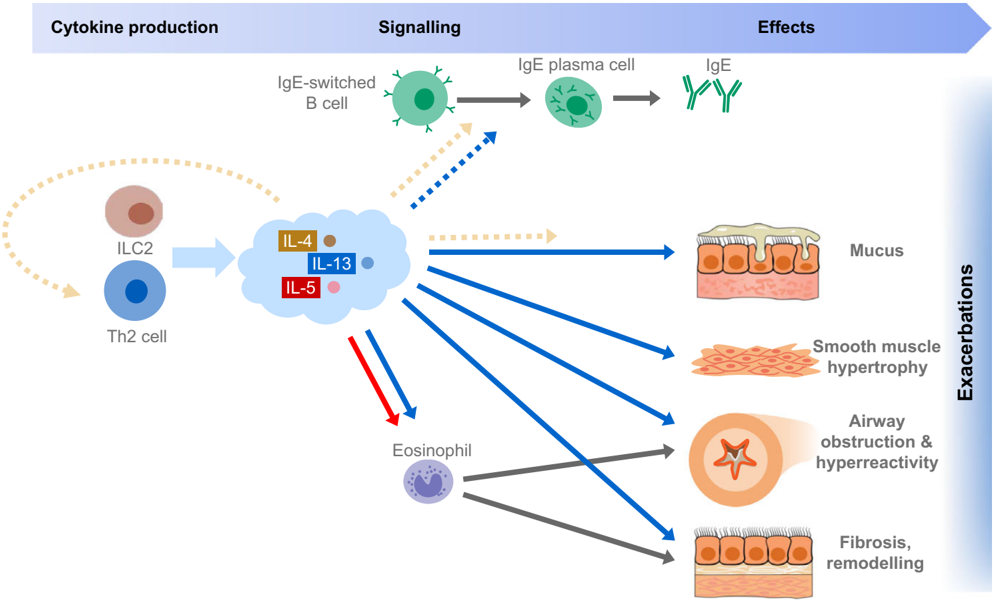
Summary: Asthma is a complex respiratory disorder characterized by marked heterogeneity in individual patient disease triggers and response to therapy. Several asthma phenotypes have now been identified, each defined by a unique interaction between genetic and environmental factors, including inflammatory, clinical and trigger‐related phenotypes. Endotypes further describe the functional or pathophysiologic mechanisms underlying the patient's disease. type 2‐driven asthma is an emerging nomenclature for a common subtype of asthma and is characterized by the release of signature cytokines IL ‐4, IL ‐5 and IL ‐13 from cells of both the innate and adaptive immune systems. A number of well‐recognized biomarkers have been linked to mechanisms involved in type 2 airway inflammation, including fractional exhaled nitric oxide, serum IgE, periostin, and blood and sputum eosinophils. These type 2 cytokines are targets for pharmaceutical intervention, and a number of therapeutic options are under clinical investigation for the management of patients with uncontrolled severe asthma. Anticipating and understanding the heterogeneity of asthma and subsequent improved characterization of different phenotypes and endotypes must guide the selection of treatment to meet individual patients’ needs.
Overview
The claims and statistics of this paper haven’t been checked yet.
Run the check — free, no account needed. It reads the open-access text and checks the sources it cites.
Integrity signals
Registry
Cites
Statistics
Figures
Verification
Claims the paper makes
The claims and statistics of this paper haven’t been checked yet.
Run the check — free, no account needed. It reads the open-access text and checks the sources it cites.
Claims other papers make about this one
Each is checked against this paper’s own text: does it say what the citing paper says it does?
In the citing paper
“Bronchial inflammation of atopic asthma is coordinated by cells of the adaptive immune system but also by ILC2s of the innate response, which together induce a type 2 response.39”
From Global issues in allergy and immunology: Parasitic infections and allergy (2017) · cites this paper as [39]
Self-check
Percentages, sums and reported differences re-computed from the paper’s own numbers.
The self-check needs the paper’s full text.
Citations
Cites
Harrington, L. E., Hatton, R. D., Mangan, P. R., Turner, H., Murphy, T. L., Murphy, K. M., & Weaver, C. T. (2005) · Nature Immunology · doi:10.1038/ni1254 · Cited by 4,742
A distinct lineage of CD4 T cells regulates tissue inflammation by producing interleukin 17
Park, H., Li, Z., Yang, X. O., Chang, S. H., Nurieva, R., Wang, Y.-H., Wang, Y., Hood, L., Zhu, Z., Tian, Q., et al. (2005) · Nature Immunology · doi:10.1038/ni1261 · Cited by 4,265
Dweik, R. A., Boggs, P. B., Erzurum, S. C., Irvin, C. G., Leigh, M. W., Lundberg, J. O., Olin, A.-C., Plummer, A. L., & Taylor, D. R. (2011) · American Journal of Respiratory and Critical Care Medicine · doi:10.1164/rccm.9120-11st · Cited by 2,539
T H 2 and T H 17 inflammatory pathways are reciprocally regulated in asthma
Choy, D. F., Hart, K. M., Borthwick, L. A., Shikotra, A., Nagarkar, D. R., Siddiqui, S., Jia, G., Ohri, C. M., Doran, E., Vannella, K. M., et al. (2015) · Science Translational Medicine · doi:10.1126/scitranslmed.aab3142 · Cited by 450
Voraphani, N., Gladwin, M. T., Contreras, A. U., Kaminski, N., Tedrow, J. R., Milosevic, J., Bleecker, E. R., Meyers, D. A., Ray, A., Ray, P., et al. (2014) · Mucosal Immunology · doi:10.1038/mi.2014.6 · Cited by 119
Research works printed but not linked: 168
- 10.1183/13993003.00853-2015 · DOI
- 10.1016/S0140-6736(06)69290-8 · DOI
- Corren J, 2013, Asthma phenotypes and endotypes: an evolving paradigm for classification, Discov Med, 15, 243
- 10.1016/j.jaci.2010.11.037 · DOI
- 10.1111/j.1365-2222.2011.03929.x · DOI
- 10.1136/thoraxjnl-2012-201657 · DOI
- 10.1016/S2213-2600(13)70288-1 · DOI
- 10.1183/09031936.00202013 · DOI · Paper page
- 10.1016/j.jaci.2003.12.591 · DOI · Paper page
- 10.1067/mai.2001.117880 · DOI
- 10.1111/j.1365-2222.2009.03298.x · DOI
- 10.1164/ajrccm.154.5.8912771 · DOI
- 10.1016/S0167-5699(99)01535-2 · DOI
- 10.1016/j.jaci.2007.02.042 · DOI
- 10.1111/j.1440-1843.2006.00784.x · DOI
- 10.1136/thorax.57.2.178 · DOI
- 10.1038/nm.3300 · DOI
- 10.1164/rccm.201109-1640OC · DOI
- 10.1136/thorax.57.10.875 · DOI
- 10.1371/journal.pone.0100645 · DOI
- 10.1097/MCP.0000000000000120 · DOI
- 10.1186/s12931-014-0163-5 · DOI
- 10.1183/13993003.00405-2015 · DOI
- 10.1111/j.1365-2222.2012.04014.x · DOI
- 10.1016/S2213-2600(16)30227-2 · DOI
- 10.1097/MCP.0000000000000337 · DOI
- 10.4049/jimmunol.136.7.2348 · DOI
- 10.1038/nri3786 · DOI
- 10.1086/317537 · DOI
- 10.1056/NEJM199201303260504 · DOI
- 10.1164/rccm.200903-0392OC · DOI
- 10.1016/j.jaci.2010.10.024 · DOI
- 10.1038/ni.2020 · DOI
- 10.1097/ACI.0000000000000090 · DOI
- 10.1016/j.jaci.2014.11.037 · DOI
- 10.1126/scitranslmed.3005374 · DOI
- 10.1016/j.jaci.2015.09.019 · DOI
- 10.1074/jbc.M210429200 · DOI
- 10.1111/j.1398-9995.2011.02576.x · DOI
- 10.4049/jimmunol.173.5.3482 · DOI · Paper page
- Leite‐de‐Moraes M, 2012, Crosstalk between innate and adaptive cells on allergic process, J Allergy (Cairo), 2012, 720568
- 10.1111/j.1365-2567.2011.03499.x · DOI
- 10.1002/1521-4141(200205)32:5<1428::AID-IMMU1428>3.0.CO;2-0 · DOI
- 10.1073/pnas.0806372105 · DOI
- 10.1097/WOX.0b013e31821188e0 · DOI
- 10.1016/j.jaci.2006.02.046 · DOI
- 10.1007/s00281-016-0556-2 · DOI
- 10.1002/eji.201142018 · DOI
- 10.1016/j.immuni.2006.12.006 · DOI
- 10.1586/ers.12.38 · DOI
- Tang Y, 2001, Study on mutations of beta chain of high‐affinity IgE receptor gene in people of Han nationality of southern China, Zhonghua Jie He He Hu Xi Za Zhi, 24, 142
- 10.2174/187152811795564073 · DOI
- 10.1186/1471-2466-11-14 · DOI
- 10.1038/ni1544 · DOI
- 10.1146/annurev.immunol.22.012703.104716 · DOI
- 10.1067/mai.2003.1333 · DOI
- 10.1164/rccm.200311-1488OC · DOI
- 10.1038/nm1332 · DOI
- 10.1038/sj.bjp.0705105 · DOI
- 10.1126/science.282.5397.2261 · DOI
- Scheerens H, 2012, Lebrikizumab treatment reduces serum periostin levels in asthma patients with elevated baseline levels of periostin, Am J Respir Crit Care Med, 185, A3960
- 10.1016/j.jaci.2013.04.016 · DOI
- 10.1067/mai.2000.107604 · DOI
- 10.1152/ajplung.00343.2001 · DOI
- 10.1152/ajplung.00247.2010 · DOI
- 10.1111/j.1365-2222.2007.02871.x · DOI
- 10.1172/JCI5909 · DOI
- 10.1067/mai.2001.118600 · DOI
- 10.1093/intimm/7.9.1405 · DOI
- 10.1016/j.jaci.2007.03.048 · DOI
- 10.4049/jimmunol.179.6.3452 · DOI
- 10.4049/jimmunol.154.10.5144 · DOI
- 10.2183/pjab.87.463 · DOI
- 10.1067/mai.2003.1382 · DOI
- 10.1002/stem.5530080713 · DOI
- 10.1165/rcmb.2002-0311OC · DOI
- 10.7861/clinmedicine.1-3-214 · DOI
- 10.1093/intimm/dxp102 · DOI
- Louahed J, 1995, IL‐9 induces expression of granzymes and high‐affinity IgE receptor in murine T helper clones, J Immunol, 154, 5061, 10.4049/jimmunol.154.10.5061 · DOI
- 10.1186/rr42 · DOI
- 10.1164/rccm.2105079 · DOI · Paper page
- 10.1164/rccm.200909-1462OC · DOI
- 10.4049/jimmunol.178.5.3244 · DOI · Paper page
- 10.2332/allergolint.13-RAI-0678 · DOI
- 10.1097/ACI.0000000000000028 · DOI
- 10.1111/j.1365-2222.2005.02314.x · DOI
- 10.1136/thx.2009.125443 · DOI
- 10.1111/j.1365-2222.2011.03694.x · DOI
- 10.1016/j.jaip.2014.08.007 · DOI · Paper page
- 10.2147/JAA.S15081 · DOI
- 10.1016/j.jaci.2013.05.007 · DOI
- 10.1016/S0140-6736(12)60988-X · DOI
- 10.1186/1471-2466-13-11 · DOI
- 10.1136/thx.50.10.1057 · DOI
- 10.1183/09031936.06.00137704 · DOI
- 10.1016/j.jaci.2011.03.035 · DOI
- 10.1016/S2213-2600(15)00419-1 · DOI
- 10.1016/j.rmed.2008.04.011 · DOI
- 10.1164/ajrccm.164.5.2011026 · DOI
- 10.1042/CS20110062 · DOI
- 10.1378/chest.12-2289 · DOI
- 10.3389/fphar.2013.00046 · DOI
- 10.1046/j.1365-2222.1998.00341.x · DOI
- 10.1183/09031936.00201813 · DOI
- 10.1016/j.jaci.2014.09.034 · DOI
- 10.1016/j.jaci.2013.03.044 · DOI
- 10.1136/thoraxjnl-2014-205634 · DOI
- 10.1016/j.jaci.2012.06.025 · DOI
- 10.1073/pnas.1009426107 · DOI
- 10.1073/pnas.0707413104 · DOI · Paper page
- 10.1038/mi.2008.15 · DOI
- 10.4049/jimmunol.1002359 · DOI
- 10.1056/NEJMoa1106469 · DOI
- 10.1136/thoraxjnl-2014-206719 · DOI
- Caswell‐Smith R, 2016, Reference ranges for serum periostin in a population without asthma or chronic obstructive pulmonary disease, Clin Exp Allergy, 00, 1
- 10.1016/j.jaci.2013.04.050 · DOI
- 10.1111/j.1600-065X.2011.01032.x · DOI
- 10.4049/jimmunol.180.11.7423 · DOI
- 10.4049/jimmunol.181.6.4089 · DOI
- 10.1016/j.rmed.2010.02.018 · DOI
- 10.1038/nm.4147 · DOI
- 10.1016/j.jaci.2009.02.024 · DOI
- 10.1378/chest.09-3058 · DOI
- 10.1164/rccm.200904-0573OC · DOI
- 10.1164/rccm.201212-2318OC · DOI
- 10.1016/j.rmed.2007.05.010 · DOI
- 10.1513/pats.200808-087RM · DOI
- 10.1111/cea.12345 · DOI
- 10.1056/NEJMoa073600 · DOI
- 10.1016/j.jaci.2013.03.003 · DOI
- 10.1016/j.anai.2014.05.024 · DOI
- 10.1136/thoraxjnl-2015-207326 · DOI
- 10.1016/j.jaci.2009.10.012 · DOI
- 10.1016/S2213-2600(15)00520-2 · DOI
- 10.1016/S2213-2600(15)00500-7 · DOI
- 10.1016/j.prrv.2004.01.006 · DOI
- 10.1002/ppul.23366 · DOI
- 10.1046/j.1365-2222.2002.01412.x · DOI
- 10.1016/j.jaci.2004.11.014 · DOI
- 10.1164/rccm.201208-1414OC · DOI
- 10.1016/j.rmed.2012.09.004 · DOI
- 10.1111/all.12599 · DOI
- 10.1016/j.jaci.2014.05.029 · DOI
- 10.1186/rr197 · DOI
- 10.1046/j.1365-2222.2000.00772.x · DOI
- 10.1056/NEJMoa0808991 · DOI
- 10.1016/S2213-2600(16)30179-5 · DOI
- 10.1016/j.jaci.2010.12.1077 · DOI
- 10.1378/chest.11-0618 · DOI
- Corren J, 2012, Inhibition of interleukin‐5 for the treatment of eosinophilic diseases, Discov Med, 13, 305
- 10.1016/j.jaci.2014.10.013 · DOI
- 10.1016/S2213-2600(16)30118-7 · DOI
- 10.1056/NEJMra1510061 · DOI
- 10.1183/09031936.01.00092101 · DOI
- 10.1111/j.1398-9995.2004.00772.x · DOI
- 10.7326/0003-4819-154-9-201105030-00002 · DOI
- 10.1016/S2213-2600(15)00042-9 · DOI
- 10.1016/j.chest.2016.03.032 · DOI
- 10.1016/j.chest.2016.03.018 · DOI
- 10.1056/NEJMoa1403290 · DOI
- 10.1056/NEJMoa1403291 · DOI
- 10.1016/S0140-6736(16)31324-1 · DOI
- 10.1016/S2213-2600(14)70201-2 · DOI
- 10.1016/S0140-6736(16)31322-8 · DOI
- 10.1016/S2213-2600(16)30265-X · DOI
- 10.1016/S2213-2600(15)00197-6 · DOI
- 10.1056/NEJMoa1304048 · DOI
- 10.1016/S0140-6736(16)30307-5 · DOI
Cited by
Sorted by citations
Hough, K. P., Curtiss, M. L., Blain, T. J., Liu, R.-M., Trevor, J., Deshane, J. S., & Thannickal, V. J. (2020) · Frontiers in Medicine · doi:10.3389/fmed.2020.00191 · Cited by 432
PM2.5 Exposure and Asthma Development: The Key Role of Oxidative Stress
Liu, K., Hua, S., & Song, L. (2022) · Oxidative Medicine and Cellular Longevity · doi:10.1155/2022/3618806 · Cited by 187
Global issues in allergy and immunology: Parasitic infections and allergy
Cruz, A. A., Cooper, P. J., Figueiredo, C. A., Alcantara-Neves, N. M., Rodrigues, L. C., & Barreto, M. L. (2017) · Journal of Allergy and Clinical Immunology · doi:10.1016/j.jaci.2017.09.005 · Cited by 82
Kim, S., Jung, H., Kim, M., Moon, J., Ban, G., Kim, S. J., Yoo, H., & Park, H. (2020) · Allergy · doi:10.1111/all.14236 · Cited by 59
Asthma in the Precision Medicine Era: Biologics and Probiotics
Chiu, C.-J., & Huang, M.-T. (2021) · International Journal of Molecular Sciences · doi:10.3390/ijms22094528 · Cited by 60
Metadata
- Authors
- Robinson, D., Humbert, M., Buhl, R., Cruz, A. A., Inoue, H., Korom, S., Hanania, N. A., & Nair, P.
- Affiliations
- Department of Respiratory Medicine Severe Asthma Service UCLH NHS Trust London UK
- Service de Pneumologie Hôpital Bicêtre Assistance Publique Hôpitaux de Paris University Paris‐Sud Université Paris‐Saclay INSERM U999 Le Kremlin‐Bicêtre France
- Pulmonary Department Mainz University Hospital Mainz Germany
- ProAR‐Center of Excellence in Asthma Federal University of Bahia School of Medicine Salvador Brazil
- Department of Pulmonary Medicine Graduate School of Medical and Dental Sciences Kagoshima University Kagoshima Japan
- F. Hoffmann‐La Roche Ltd Basel Switzerland
- Section of Pulmonary and Critical Care Medicine Baylor College of Medicine Houston TX USA
- Division of Respirology Department of Medicine McMaster University Hamilton ON Canada
- ORCID
- Venue
- Clinical & Experimental Allergy
- Publisher
- Wiley
- Published
- 2017-01-30
- Volume
- 47
- Issue
- 2
- Pages
- 161-175
- ISSN
- 0954-7894
- 1365-2222
- Cited by
- 357
- References
- 5
- Language
- en
- Funders
- AstraZeneca
- Chiesi Farmaceutici
- Roche
- Teva Pharmaceutical Industries
- Boehringer Ingelheim
- GlaxoSmithKline
- Novartis
- Merck Sharp and Dohme
- Astellas Pharma US
- Pfizer
- Sanofi
About these checks
Registry, retraction, Cites and statistics results are computed, not judged, with one exception: a printed reference that no index lists is read once by a model before it counts as a citation error. Claims are extracted by a model and kept only when their quote appears verbatim in the text; each cited source is then checked, with a model’s help, for whether it says what the claim relies on. Those verdicts can be wrong — read the claim’s quote and the cited source before relying on one.
Statistics and arithmetic are recomputed, not judged.
Confidence bands are shown only for fields calibrated on our annotated test set. None is calibrated yet, so no band is shown.
What counts as a claim ›How we measure confidence ›How we check this ›
Are you an author, or do you see a problem with this page? Request a review
