

The DOI matches its Crossref record; 21 of the 21 references it cites were found in a registry or an index.
Effects of meal type on the bioavailability of vutiglabridin, a novel anti-obesity agent, in healthy subjects
Open accessAbstract
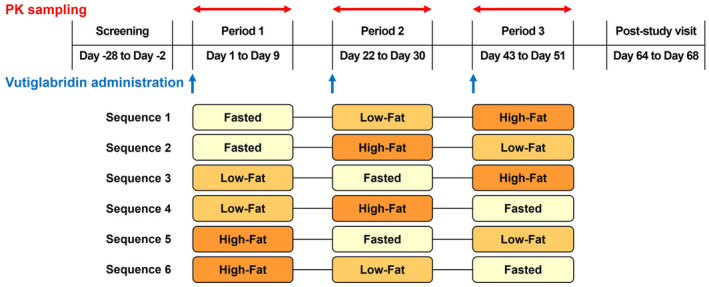
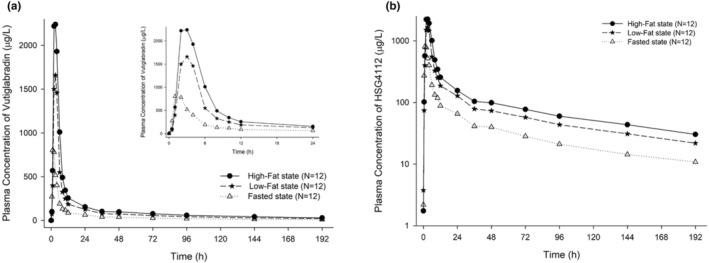
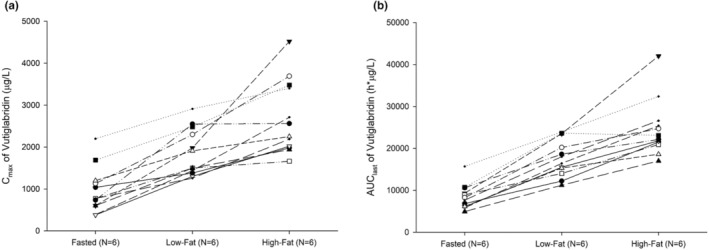
Vutiglabridin, which affects the pharmacokinetics (PKs) of food, is currently under clinical development for the treatment of obesity. This study aimed to evaluate the effects of low‐ and high‐fat meals on PKs of vutiglabridin in healthy male subjects. A randomized, open‐label, single‐dose, three‐period, six‐sequence crossover study was conducted. The subjects received a single oral dose of vutiglabridin 480 mg in a fasted state, 30 min after the intake of a low‐fat meal (total 500–600 kcal, fat content 100–125 kcal) and high‐fat meal (total 800–1000 kcal, fat content 500–600 kcal), with a 21‐day washout period. Geometric mean ratios (GMRs) and 90% confidence intervals (CIs) for maximum plasma concentration (Cmax) and area under the plasma concentration‐time curve to the last measurable timepoint (AUC last) were calculated. After intake of low‐ and high‐fat meals, systemic exposure to vutiglabridin was increased, and the time to reach Cmax (Tmax) was delayed compared to that in the fasted state. The GMRs (90% CIs) of low‐fat meal to fasted state for Cmax and AUC last were 2.14 (1.76–2.60) and 2.15 (1.92–2.42), respectively, and those of high‐fat meal to fasted state were 3.07 (2.53–3.72) and 3.00 (2.67–3.37), respectively. The median Tmax was delayed by 1.5 h in both fed states compared with that in the fasted state. The study drug was well‐tolerated after administration in both the fed and fasted states. Food ingestion substantially increased the extent of oral vutiglabridin absorption in healthy subjects, and this enhancement increased with the fat content of the meal.
Overview
The claims and statistics of this paper haven’t been checked yet.
Run the check — free, no account needed. It reads the open-access text and checks the sources it cites.
Integrity signals
Registry
Cites
Statistics
Figures
Verification
Claims the paper makes
The claims and statistics of this paper haven’t been checked yet.
Run the check — free, no account needed. It reads the open-access text and checks the sources it cites.
Claims other papers make about this one
Each is checked against this paper’s own text: does it say what the citing paper says it does?
In the citing paper
“Importantly, medications such as phentermine, tirzepatide, and newer agents like S-309309 and vutiglabridin are increasingly used in non-diabetic individuals, yet comprehensive assessments of their GI safety profiles remain limited [2,3,15,16].”
From Gastrointestinal Adverse Effects of Anti-Obesity Medications in Non-Diabetic Adults: A Systematic Review (2025) · cites this paper as [15]
In the citing paper
“Agents such as Lipigo, Gymnema sylvestre, berberine, obex, and vutiglabridin demonstrated favorable short-term tolerability with only mild, transient GI events [14,15,17,19].”
From Gastrointestinal Adverse Effects of Anti-Obesity Medications in Non-Diabetic Adults: A Systematic Review (2025) · cites this paper as [15]
In the citing paper
“Won et al. reported vutiglabridin-related nausea in 25% of participants, resolving spontaneously [15].”
From Gastrointestinal Adverse Effects of Anti-Obesity Medications in Non-Diabetic Adults: A Systematic Review (2025) · cites this paper as [15]
In the citing paper
“Natural and emerging compounds such as silibinin, Lipigo, Gymnema sylvestre, berberine, and vutiglabridin appear well tolerated in early studies, but their small sample sizes and short follow-up preclude strong conclusions [14,15,17,22].”
From Gastrointestinal Adverse Effects of Anti-Obesity Medications in Non-Diabetic Adults: A Systematic Review (2025) · cites this paper as [15]
Self-check
Percentages, sums and reported differences re-computed from the paper’s own numbers.
The self-check needs the paper’s full text.
Citations
Cites
1 retracted
Advice on low-fat diets for obesity
Pirozzo, S., Summerbell, C., Cameron, C. M., & Glasziou, P. (2002) · Cochrane Database of Systematic Reviews · doi:10.1002/14651858.cd003640 · Cited by 92
RetractedObesity: global epidemiology and pathogenesis
Blüher, M. (2019) · Nature Reviews Endocrinology · doi:10.1038/s41574-019-0176-8 · Cited by 5,126
Sex Differences in Pharmacokinetics and Pharmacodynamics
Soldin, O. P., & Mattison, D. R. (2009) · Clinical Pharmacokinetics · doi:10.2165/00003088-200948030-00001 · Cited by 1,163
Preserving Healthy Muscle during Weight Loss
Cava, E., Yeat, N. C., & Mittendorfer, B. (2017) · Advances in Nutrition · doi:10.3945/an.116.014506 · Cited by 452
The danger of weight loss in the elderly
Miller, S. L., & Wolfe, R. R. (2008) · The Journal of nutrition, health and aging · doi:10.1007/bf02982710 · Cited by 384
Effects of Food on Clinical Pharmacokinetics
Singh, B. N. (1999) · Clinical Pharmacokinetics · doi:10.2165/00003088-199937030-00003 · Cited by 366
Regarding Obesity as a Disease
Kyle, T. K., Dhurandhar, E. J., & Allison, D. B. (2016) · Endocrinology and Metabolism Clinics of North America · doi:10.1016/j.ecl.2016.04.004 · Cited by 333
Nakagawa, K., Kishida, H., Arai, N., Nishiyama, T., & Mae, T. (2004) · Biological and Pharmaceutical Bulletin · doi:10.1248/bpb.27.1775 · Cited by 136
Food-Effect Bioavailability and Fed Bioequivalence Studies
최선옥, 정성희, 엄소영, 정서정, 김주일, & 정수연 (2004) · Journal of Korean Pharmaceutical Sciences · doi:10.4333/kps.2004.34.3.223 · Cited by 114
Weight management in older adults
Gill, L. E., Bartels, S. J., & Batsis, J. A. (2015) · Current Obesity Reports · doi:10.1007/s13679-015-0161-z · Cited by 109
Research works printed but not linked: 2
- Sombra LRS, 2022, StatPearls
- Malcolm Rowland TNT, 2019, Rowland and Tozer's Clinical Pharmacokinetics and Pharmacodynamics: Concepts and Applications
Cited by
Sorted by citations
Takrori, E., Peshin, S., & Singal, S. (2025) · Medicina · doi:10.3390/medicina61111987 · Cited by 13
Metadata
- Authors
- Won, H., Yoon, D. Y., Lee, S., Cho, J., Oh, J., Jang, I., Yoo, S., & Yu, K.
- Affiliations
- Seoul National University (KR)
- Glaceum (South Korea) (KR)
- Corresponding author
- Yu, Kyung‐Sang
- ORCID
- Venue
- Clinical and Translational Science
- Publisher
- Wiley
- Published
- 2024-03
- Volume
- 17
- Issue
- 3
- Pages
- e13744-e13744
- ISSN
- 1752-8054 (ISSN-L)
- 1752-8062
- PMC
- PMC10910614
- OpenAlex
- W4392376656
- Cited by
- 3
- References
- 21
- Citations by year
- 2025: 2 · 2024: 1
- FWCI
- 0.85
- Type
- journal article
- Language
- en
- Open access
- gold
- doi.org
- Licence
- Locations
- Clinical and Translational Science (publishedVersion, cc-by-nc-nd)
- PubMed Central (publishedVersion, cc-by-nc-nd)
- PubMed (publishedVersion)
- DOAJ (DOAJ: Directory of Open Access Journals) (submittedVersion)
- Topics
- Health Sciences › Medicine › Pharmacology (medical) › Pharmacology and Obesity Treatment
- Life Sciences › Pharmacology, Toxicology and Pharmaceutics › Pharmacology › Pharmacogenetics and Drug Metabolism
- Life Sciences › Pharmacology, Toxicology and Pharmaceutics › Pharmaceutical Science › Drug Solubulity and Delivery Systems
- Keywords
- food effect, high-fat meal, low-fat meal, pharmacokinetics, obesity, oral absorption, time to peak concentration, food-drug interactions, healthy volunteers
- MeSH terms
- Biological Availability, Humans, Male, Cross-Over Studies, Anti-Obesity Agents, Meals, Healthy Volunteers
About these checks
Registry, retraction, Cites and statistics results are computed, not judged, with one exception: a printed reference that no index lists is read once by a model before it counts as a citation error. Claims are extracted by a model and kept only when their quote appears verbatim in the text; each cited source is then checked, with a model’s help, for whether it says what the claim relies on. Those verdicts can be wrong — read the claim’s quote and the cited source before relying on one.
Statistics and arithmetic are recomputed, not judged.
Confidence bands are shown only for fields calibrated on our annotated test set. None is calibrated yet, so no band is shown.
What counts as a claim ›How we measure confidence ›How we check this ›
Are you an author, or do you see a problem with this page? Request a review
