

The DOI matches its Crossref record; 1 of the 1 references it cites were found in a registry or an index.
Species distribution modelling supports “nectar corridor” hypothesis for migratory nectarivorous bats and conservation of tropical dry forest
Abstract
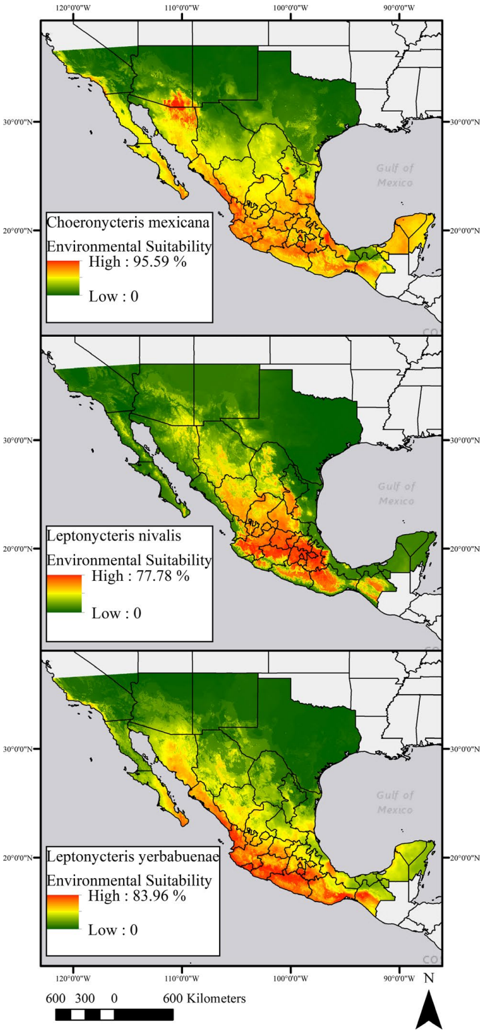
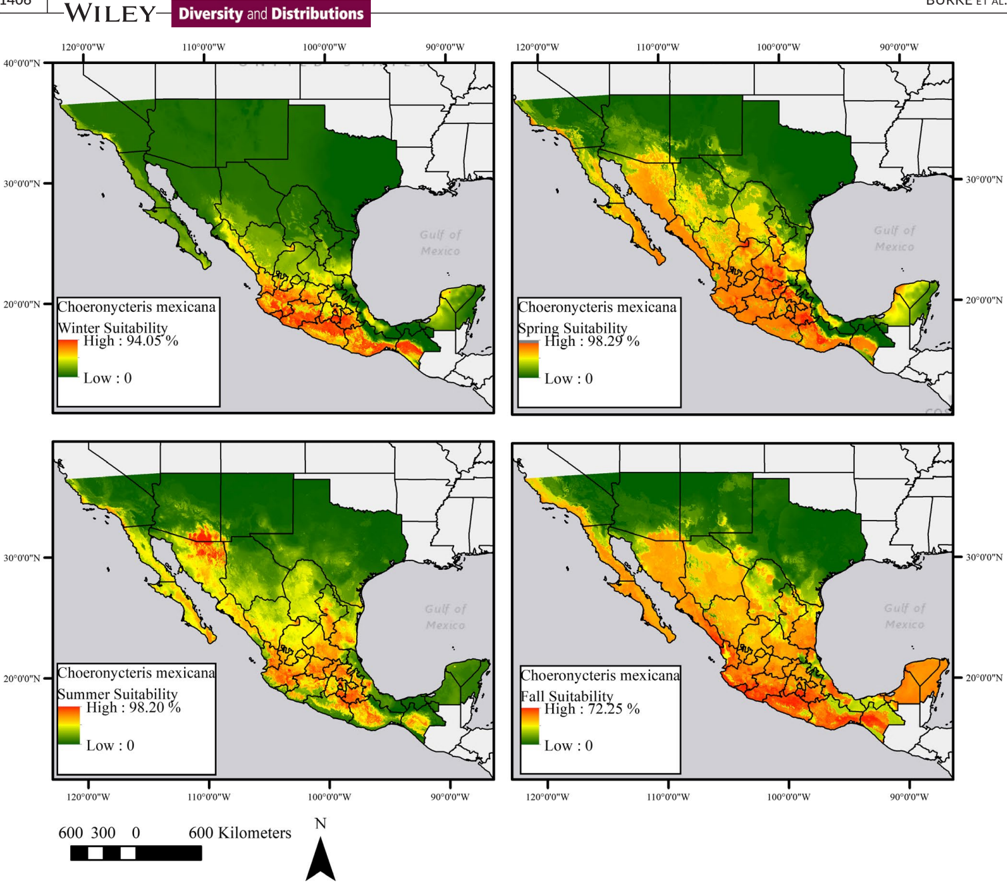
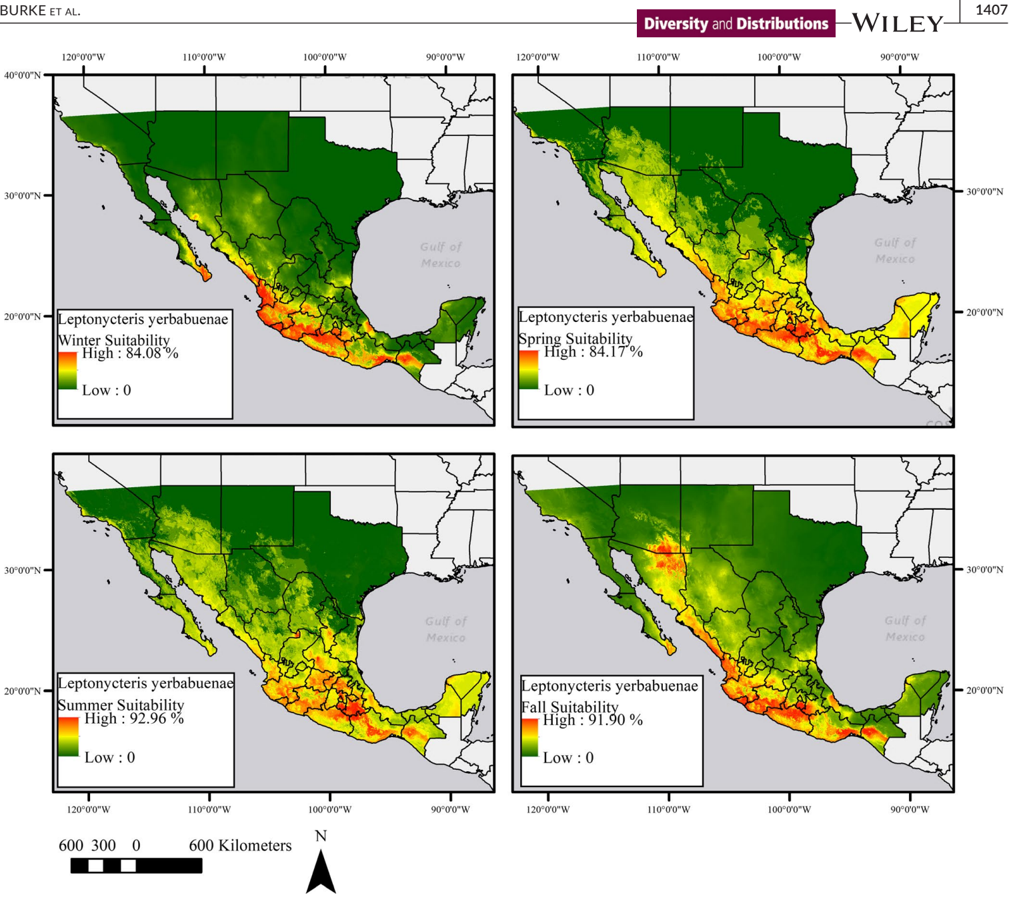
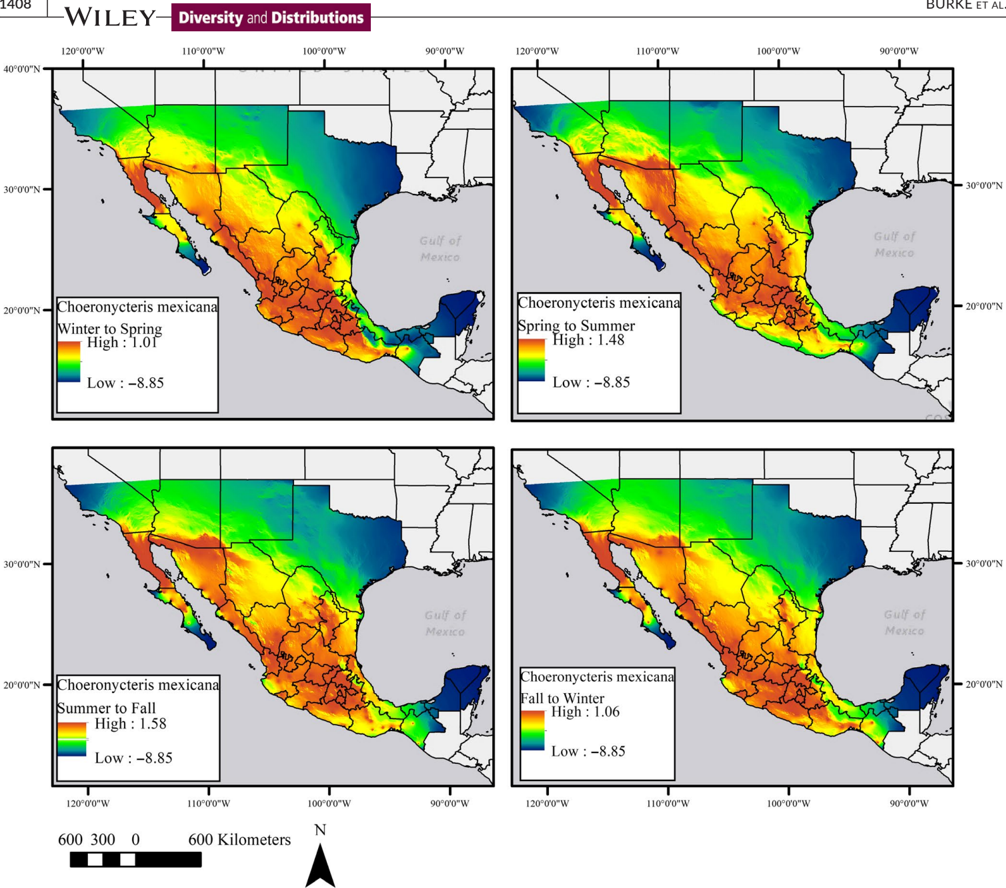
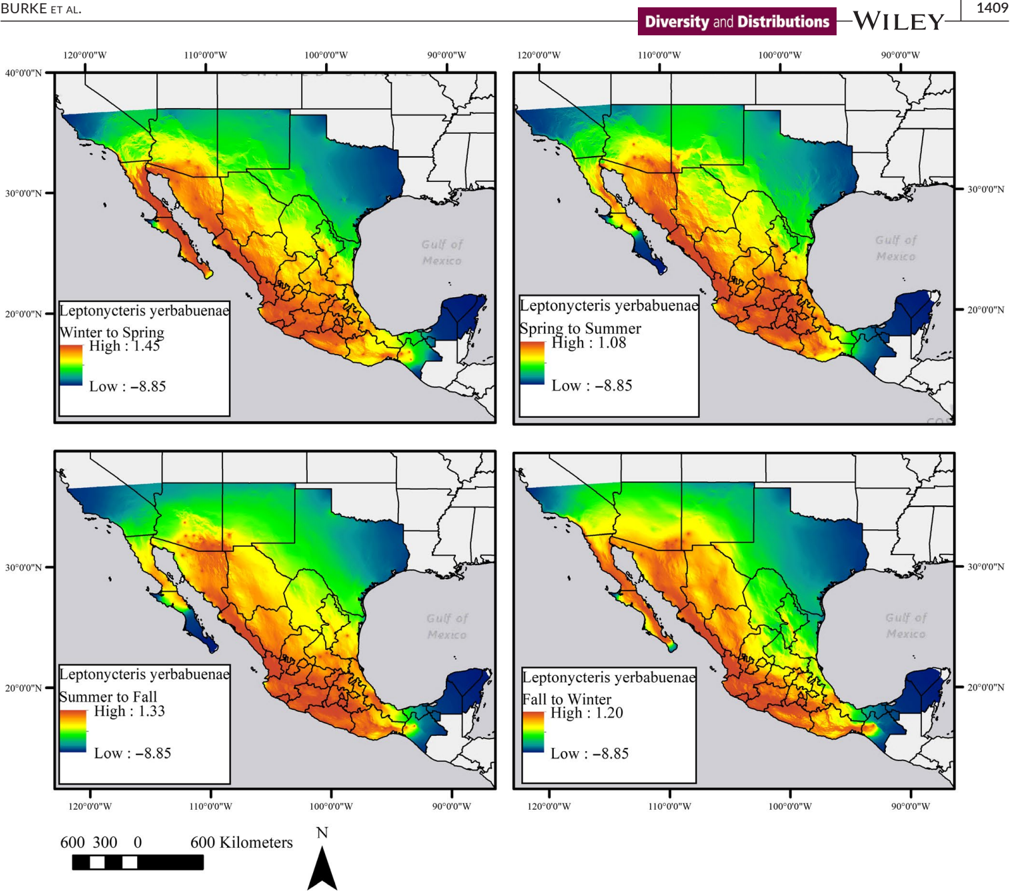
Aim: The Mexican long‐tongued bat ( Choeronycteris mexicana ), Mexican long‐nosed bat ( Leptonycteris nivalis ) and lesser long‐nosed bat ( Leptonycteris yerbabuenae ) (Phyllostomidae: Glossophaginae) undertake long‐distance migrations from south‐central Mexico to the south‐western United States. It is proposed that these bats migrate along a nectar corridor of columnar cacti and Agave species, but this has not been tested with independent data and the spatiotemporal nature of this relationship is poorly understood. Our goal was to test this nectar corridor hypothesis and determine the relative importance of food plant and abiotic variables to the distribution and seasonal movements of these migratory nectarivores. Location: Mexico and the south‐western United States. Methods: We generated species distribution models (SDMs) of documented food plants for these bats. We then created SDMs for each bat following a model selection approach, using food plant and abiotic predictor variables. We modelled migration pathways for C. mexicana and L. yerbabuenae using circuit theory and seasonal SDMs based on seasonally available food plants. Main conclusions: Food plants were more important than climatic and topographic variables in shaping the distribution of these bats. The most important predictors of distribution were Agave , columnar cacti and species richness of food plants . Species richness of food plants was the most consistently important variable, but the components of this diversity varied by bat species: Choeronycteris mexicana was influenced by Agave and cacti; Leptonycteris nivalis was influenced solely by Agave ; Leptonycteris yerbabuenae was influenced more generally by cacti, Agave and C3 plants. Migration models for C. mexicana and L. yerbabuenae provided independent support for the nectar corridor hypothesis and indicate shifts in relative importance of specific food plants throughout the year. These results suggest that conservation of these bats should focus more broadly on management for species richness of food plants, especially in tropical dry forests.
Overview
The claims and statistics of this paper haven’t been checked yet.
Run the check — free, no account needed. It reads the open-access text and checks the sources it cites.
Integrity signals
Registry
Cites
Statistics
Figures
Verification
Claims the paper makes
The claims and statistics of this paper haven’t been checked yet.
Run the check — free, no account needed. It reads the open-access text and checks the sources it cites.
Claims other papers make about this one
Each is checked against this paper’s own text: does it say what the citing paper says it does?
The source backs part of the claim, not all of it — or backs it for a different population, condition or comparison.
In the citing paper
“Moving the field of connectivity science toward dynamic assessments has been identified as an important research priority, a goal that motivated this Special Issue [27][28][29][30].”
From Circuitscape in julia: empowering dynamic approaches to connectivity assessment (2021) · cites this paper as [27]
Experimental — accuracy not yet measured
Self-check
Percentages, sums and reported differences re-computed from the paper’s own numbers.
The self-check needs the paper’s full text.
Citations
Cites
USING CIRCUIT THEORY TO MODEL CONNECTIVITY IN ECOLOGY, EVOLUTION, AND CONSERVATION
McRae, B. H., Dickson, B. G., Keitt, T. H., & Shah, V. B. (2008) · Ecology · doi:10.1890/07-1861.1 · Cited by 2,244
Research works printed but not linked: 147
- 10.1016/j.ecoinf.2017.10.002 · DOI
- 10.1371/journal.pone.0041195 · DOI
- 10.1111/j.1365-2664.2006.01214.x · DOI · Paper page
- 10.1016/j.ppees.2013.08.001 · DOI
- Ammerman L. K., 2012, Bats of Texas
- 10.1016/j.ecolmodel.2011.04.011 · DOI
- 10.3390/tropicalmed2030044 · DOI
- 10.3732/ajb.93.11.1675 · DOI
- 10.2307/1381831 · DOI
- Arita H. T., 1988, Revision taxonomica de los murcielagos magueyeros del genero Leptonycteris (Chiroptera: Phyllostomidae), Acta zoologica mexicana., 29, 1399
- 10.2307/1383205 · DOI
- Arroyo‐Cabrales J., 2008, Choeronycteris mexicana. The IUCN red list of threatened species 2008: e.T4776A11092896
- 10.2307/1378134 · DOI
- 10.1126/science.aaf5080 · DOI
- 10.1371/journal.pone.0007504 · DOI
- Bogan M. A., 2006, Roosts and nocturnal movements of long‐nosed bats (Leptonycteris curasoae and L. nivalis) in southwestern New Mexico, 50
- 10.3398/064.077.0305 · DOI
- 10.1016/j.ecolmodel.2013.12.012 · DOI
- 10.1071/WF18072 · DOI
- Brown D. E., 2014, A guide to North American grasslands, Desert Plants, 29, 1399
- Burnham K. P., 2002, Model selection and multimodel inference
- 10.1093/aob/mcn194 · DOI
- 10.1016/j.rmb.2015.07.010 · DOI
- 10.2307/2656814 · DOI
- 10.1016/j.ecolind.2018.08.043 · DOI
- Cockrum E., 1991, Seasonal distribution of northwestern populations of the long‐nosed bats, Leptonycteris sanborni family Phyllostomidae, Anales Del Instituto De Biología Serie Zoología, 62, 181
- Colditz R. R., 2014, Detection of North American land cover change between 2005 and 2010 with 250m MODIS data, Photogrammetric Engineering & Remote Sensing, 80, 918
- 10.1016/j.gecco.2017.08.001 · DOI
- 10.1016/j.jaridenv.2012.12.004 · DOI
- 10.1644/1545-1542(2003)084<0579:SDOMTB>2.0.CO;2 · DOI
- Cryan P. M., 2003, Recurrence of Mexican long‐tongued bats (Choeronycteris mexicana) at historical sites in Arizona and New Mexico, Western North American Naturalist, 63, 314
- 10.1016/j.biocon.2007.05.019 · DOI
- Cryan P. M., 2009, Ecological and behavioral methods for the study of bats, 476
- 10.1890/13-0752.1 · DOI
- 10.1080/11263504.2012.749955 · DOI
- Dingle H., 1996, Migration: The biology of life on the move, 10.1093/oso/9780195089622.001.0001 · DOI
- 10.1641/B570206 · DOI
- Earth Resources Observation and Science Center/U.S. Geological Survey/U.S. Department of the Interior(1997).USGS 30 ARC-second Global Elevation Data GTOPO30. Computational and Information Systems Laboratory: Research Data Archive at the National Center for Atmospheric Research.https://doi.org/10.5065/A1Z4-EE71. Accessed 01 January 2017. · DOI
- 10.1016/j.cub.2018.09.064 · DOI
- 10.2307/3671560 · DOI
- 10.1146/annurev.ecolsys.110308.120159 · DOI · Paper page
- 10.1111/j.1472-4642.2010.00725.x · DOI · Paper page
- England A., 2012, Pollination ecology of Agave palmeri in New Mexico, and landscape use of Leptonycteris nivalis in relation to agaves. Dissertation
- 10.4081/gh.2014.19 · DOI
- ESRI, 2016, ArcGIS desktop: Release 10.4.1
- 10.1890/09-1340.1 · DOI
- 10.1093/aob/mcp197 · DOI
- 10.2307/1934771 · DOI
- 10.1007/BF00317304 · DOI
- 10.1890/0012-9615(2001)071[0511:SDCCAT]2.0.CO;2 · DOI
- 10.1371/journal.pone.0097122 · DOI · Paper page
- 10.1371/journal.pone.0042737 · DOI
- 10.2307/1932675 · DOI
- Gentry H. S., 1982, Agaves of continental North America, 670, 10.2307/j.ctv1t4m2h4 · DOI
- 10.1111/j.1744-7429.2000.tb00502.x · DOI
- 10.1111/ddi.12499 · DOI
- 10.1007/BF00985877 · DOI
- 10.56021/9780801881077 · DOI
- 10.1111/j.1461-0248.2005.00792.x · DOI
- 10.1371/journal.pone.0132599 · DOI
- 10.3161/15081109ACC2015.17.1.013 · DOI
- 10.1371/journal.pone.0023773 · DOI
- Hernández R., 2016, Allocation of endogenous nutrients for reproduction in the lesser long‐nosed bat (Leptonycteris yerbabuenae) in Central Mexico, Journal of Mammalogy, 97, 3
- 10.1002/joc.1276 · DOI
- Hinman K. E., 2003, Arizona bat conservation strategic plan
- 10.1644/09-MAMM-S-086R2.1 · DOI
- 10.1111/j.1469-7998.1998.tb00062.x · DOI
- 10.2307/1936660 · DOI
- Janzen D. H., 1988, Biodiversity, 131
- 10.1371/journal.pone.0187027 · DOI
- 10.1111/ddi.12096 · DOI · Paper page
- 10.1007/978-1-4614-7397-8_15 · DOI
- 10.1371/journal.pone.0103042 · DOI
- 10.2307/1941416 · DOI
- 10.2307/2529310 · DOI · Paper page
- 10.1093/conphys/cov072 · DOI
- 10.1002/ece3.1878 · DOI
- 10.3732/ajb.90.7.1054 · DOI
- 10.1016/j.foreco.2011.06.045 · DOI
- Martinez‐Morales R., 1985, A demographic study of Maguey Verde (Agave salmiana ssp. crassipina) under conditions of intensive utilization, Desert Plants, 7, 61
- 10.4996/fireecology.0902026 · DOI
- McRae B. H., 2013, Circuitscape 4 user guide
- Medellín R., 2016, Leptonycteris nivalis. The IUCN red list of threatened species 2016: e.T11697A22126172
- Medellín R., 2016, Leptonycteris yerbabuenae. The IUCN red list of threatened species 2016: e.T136659A21988965
- Medellín R. A., 1997, Identificación de los murciélagos de México: Clave de campo
- 10.1093/jmammal/gyy016 · DOI
- 10.1111/j.1600-0587.2013.07872.x · DOI · Paper page
- 10.3732/ajb.90.7.1016 · DOI
- 10.7717/peerj.3093 · DOI · Paper page
- 10.1016/S0304-3800(00)00253-2 · DOI
- 10.1644/1545-1542(2004)085<0453:CDOLNM>2.0.CO;2 · DOI
- 10.1007/s11258-010-9784-z · DOI
- Muscarella R., 2014, ENMeval: An R package for conducting spatially independent evaluations and estimating optimal model complexity for Maxent ecological niche models, Methods in Ecology and Evolution, 6, 1199
- 10.1046/j.1523-1739.1993.07030457.x · DOI
- 10.1644/1545-1542(2003)084<0106:DOCAAI>2.0.CO;2 · DOI
- Nobel P. S., 1988, Environmental biology of Agaves and Cacti, 66
- 10.1111/mam.12064 · DOI
- 10.1007/s10531-005-4876-0 · DOI
- 10.1046/j.1523-1739.1996.10030769.x · DOI
- Pettit J., 2017, Day of year, temperature, wind, and precipitation predict timing of bat migration, Journal of Mammalogy, 98, 1236
- 10.1016/j.ecolmodel.2005.03.026 · DOI · Paper page
- 10.1111/j.0906-7590.2008.5203.x · DOI · Paper page
- 10.1371/journal.pone.0049390 · DOI · Paper page
- 10.1016/j.foreco.2009.06.023 · DOI
- 10.1111/jbi.12227 · DOI · Paper page
- 10.1371/journal.pone.0019227 · DOI
- Ramsey M., 2011, Range extension for Lesser long‐nosed bats in New Mexico, Western Bat Working Group News, 7, 9
- 10.1007/s10980-014-0030-2 · DOI
- Razgour O., 2016, Painting maps with bats: Species distribution modelling in bat research and conservation, Hystrix, the Italian Journal of Mammalogy, 27, 1399
- 10.1111/j.1365-2664.2009.01765.x · DOI
- 10.5642/aliso.20062201.27 · DOI
- Rojas‐Martínez A., 2012, Fruigvory diet of the lesser long‐nosed bat (Leptonycteris yerbabuenae), in the Tehuacán Valley of Central Mexico, Edición Especial Los Mamíferos De Oaxaca, 3, 371
- 10.1046/j.1365-2699.1999.00354.x · DOI
- 10.1016/j.agee.2018.07.024 · DOI
- 10.1080/00222930701483398 · DOI
- 10.1111/j.1366-9516.2005.00186.x · DOI
- 10.1016/j.biocon.2012.06.017 · DOI
- 10.1016/j.ecolmodel.2013.08.011 · DOI
- 10.1894/0038-4909(2004)049<0425:TOAPFA>2.0.CO;2 · DOI
- SEMARNAT, 2010, Norma Oficial Mexicana NOM‐059‐ SEMARNAT‐2010, Protección ambiental‐Especies nativas de México de flora y fauna silvestres‐Categorías de riesgo y especificaciones para su inclusión, exclusión o cambio‐Lista de especies en riesgo
- 10.1086/668600 · DOI
- 10.1371/journal.pone.0105034 · DOI
- 10.1007/s10531-018-1545-7 · DOI
- 10.1093/conphys/cov036 · DOI
- 10.1023/A:1021963819751 · DOI
- 10.1002/ece3.4526 · DOI
- 10.1126/science.1227548 · DOI
- 10.1016/S0006-3207(99)00188-3 · DOI
- U.S. Fish and Wildlife Service (USFWS), 1988, Endangered and threatened wildlife and plants; determination of endangered status for two long-nosed bats, Federal Register, 53, 38456
- U.S. Fish and Wildlife Service (USFWS), 2017, Endangered and Threatened Wildlife and Plants; Removal of the Lesser Long-Nosed Bat From the Federal List of Endangered and Threatened Wildlife, Federal Register, 82, 1665
- U.S. Fish and Wildlife Service, 2018, Endangered and threatened wildlife and plants; removal of the lesser long‐nosed bat from the federal list of endangered and threatened wildlife, Federal Register, 83, 17093
- U.S. Fish and Wildlife Service, 2016, Species status assessment for the lesser long‐nosed bat
- 10.1017/S0266467400009330 · DOI
- 10.1006/jare.1997.0267 · DOI
- 10.2307/2446020 · DOI
- 10.1016/j.jaridenv.2006.04.001 · DOI
- 10.1111/ecog.01509 · DOI
- 10.1086/693847 · DOI
- 10.1111/j.1558-5646.2008.00482.x · DOI
- 10.1111/j.1600-0587.2009.06142.x · DOI · Paper page
- 10.1890/10-1171.1 · DOI · Paper page
- 10.1111/ddi.12160 · DOI
- Weary D. J., 2014, Karst in the United States: A digital map compilation and database: U.S. Geological Survey Open‐ File Report 2014–1156, 23
- 10.1046/j.1365-294X.1996.00081.x · DOI
- 10.1111/ddi.12742 · DOI
- 10.1016/j.scitotenv.2018.04.112 · DOI
- 10.1038/srep22400 · DOI
Cited by
Sorted by citations
Circuitscape in julia: empowering dynamic approaches to connectivity assessment
Hall, K. R., Anantharaman, R., Landau, V. A., Clark, M., Dickson, B. G., Jones, A., Platt, J., Edelman, A., & Shah, V. B. (2021) · Land · doi:10.3390/land10030301 · Cited by 115
Metadata
- Authors
- Burke, R. A., Frey, J. K., Ganguli, A., & Stoner, K. E.
- Affiliations
- Department of Fish, Wildlife, and Conservation Ecology New Mexico State University Las Cruces New Mexico
- Department of Animal and Range Sciences New Mexico State University Las Cruces New Mexico
- Venue
- Diversity and Distributions
- Publisher
- Wiley
- Published
- 2019-06-18
- Volume
- 25
- Issue
- 9
- Pages
- 1399-1415
- ISSN
- 1366-9516
- 1472-4642
- Cited by
- 48
- References
- 1
- Language
- en
- Funders
- U.S. Bureau of Land Management
- New Mexico State University
About these checks
Registry, retraction, Cites and statistics results are computed, not judged, with one exception: a printed reference that no index lists is read once by a model before it counts as a citation error. Claims are extracted by a model and kept only when their quote appears verbatim in the text; each cited source is then checked, with a model’s help, for whether it says what the claim relies on. Those verdicts can be wrong — read the claim’s quote and the cited source before relying on one.
Statistics and arithmetic are recomputed, not judged.
Confidence bands are shown only for fields calibrated on our annotated test set. None is calibrated yet, so no band is shown.
What counts as a claim ›How we measure confidence ›How we check this ›
Are you an author, or do you see a problem with this page? Request a review
How to cite
Cite CoChat for the checks on this page, and the paper for its own findings.
- This page
- CoChat. (2026). Citation check: Species distribution modelling supports “nectar corridor” hypothesis for migratory nectarivorous bats and conservation of tropical dry forest. https://app.cochat.ai/papers/10.1111/ddi.12950
- The paper
- Burke, R. A., Frey, J. K., Ganguli, A., & Stoner, K. E. (2019). Species distribution modelling supports “nectar corridor” hypothesis for migratory nectarivorous bats and conservation of tropical dry forest. Diversity and Distributions. https://doi.org/10.1111/ddi.12950
