

The DOI matches its Crossref record; 74 of the 77 references it cites were found in a registry or an index.
Hypoglycaemia in Type 2 diabetes
Open accessAbstract
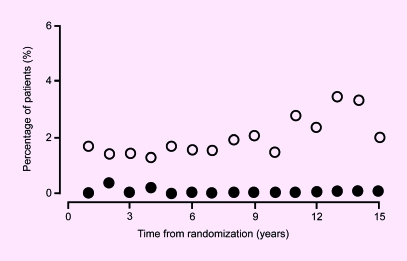
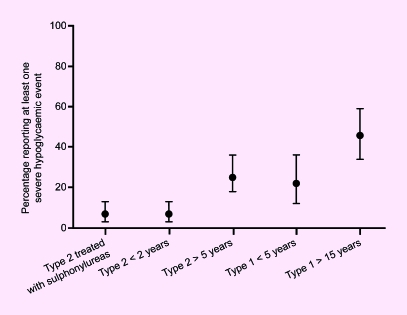
The primary cause of hypoglycaemia in Type 2 diabetes is diabetes medication—in particular, those which raise insulin levels independently of blood glucose, such as sulphonylureas (SUs) and exogenous insulin. The risk of hypoglycaemia is increased in older patients, those with longer diabetes duration, lesser insulin reserve and perhaps in the drive for strict glycaemic control. Differing definitions, data collection methods, drug type/regimen and patient populations make comparing rates of hypoglycaemia difficult. It is clear that patients taking insulin have the highest rates of self‐reported severe hypoglycaemia (25% in patients who have been taking insulin for > 5 years). SUs are associated with significantly lower rates of severe hypoglycaemia. However, large numbers of patients take SUs in the UK, and it is estimated that each year > 5000 patients will experience a severe event caused by their SU therapy which will require emergency intervention. Hypoglycaemia has substantial clinical impact, in terms of mortality, morbidity and quality of life. The cost implications of severe episodes—both direct hospital costs and indirect costs—are considerable: it is estimated that each hospital admission for severe hypoglycaemia costs around £1000. Hypoglycaemia and fear of hypoglycaemia limit the ability of current diabetes medications to achieve and maintain optimal levels of glycaemic control. Newer therapies, which focus on the incretin axis, may carry a lower risk of hypoglycaemia. Their use, and more prudent use of older therapies with low risk of hypoglycaemia, may help patients achieve improved glucose control for longer, and reduce the risk of diabetic complications.
Overview
The claims and statistics of this paper haven’t been checked yet.
Run the check — free, no account needed. It reads the open-access text and checks the sources it cites.
Integrity signals
Registry
Cites
Statistics
Figures
Verification
Claims the paper makes
The claims and statistics of this paper haven’t been checked yet.
Run the check — free, no account needed. It reads the open-access text and checks the sources it cites.
Claims other papers make about this one
Each is checked against this paper’s own text: does it say what the citing paper says it does?
In the citing paper
“plasma glucose concentrations ≤3.9 mmol/l (70 mg/dl) sometimes occur in non-diabetic individuals [1,3].This is true, particularly in women and children, albeit generally during prolonged fasting.”
From Preventing hypoglycaemia: what is the appropriate glucose alert value? (2009) · cites this paper as [3]
In the citing paper
“they recommend a therapeutic plasma glucose concentration lower limit of 4.0-4.5 mmol/l (72-81 mg/dl).”
From Preventing hypoglycaemia: what is the appropriate glucose alert value? (2009) · cites this paper as [3]
In the citing paper
“Amiel et al. [3] also suggest a value of 3.5 mmol/l (63 mg/dl).”
From Preventing hypoglycaemia: what is the appropriate glucose alert value? (2009) · cites this paper as [3]
In the citing paper
“However, maintaining glycaemic control in patients is no easy task, as hypo- or hyperglycaemia can result from administration of the currently available treatments resulting in either too much or not enough, respectively, of an anti-hyperglycaemic effect.3,48”
From A review of current trends with type 2 diabetes epidemiology, aetiology, pathogenesis, treatments and future perspectives (2021) · cites this paper as [48]
Self-check
Percentages, sums and reported differences re-computed from the paper’s own numbers.
The self-check needs the paper’s full text.
Citations
Cites
Stratton, I. M. (2000) · BMJ · doi:10.1136/bmj.321.7258.405 · Cited by 9,059
Turner, R. C., Fox, C., Matthews, McElroy, H. H., Cull, C. A., Holman, R. R., Neil, P., Hadden, D. R., Wright, D., Manley, E., et al. (1998) · The Lancet · Cited by 8,419
Dormandy, J. A., Charbonnel, B., Eckland, D. J., Erdmann, E., Massi-Benedetti, M., Moules, I. K., Skene, A. M., Tan, M. H., Lefèbvre, P. J., Murray, G. D., et al. (2005) · The Lancet · doi:10.1016/s0140-6736(05)67528-9 · Cited by 4,129
Glycemic durability of rosiglitazone, metformin, or glyburide monotherapy
Kahn, S. E., Haffner, S. M., Heise, M. A., Herman, W. H., Holman, R. R., Jones, N. P., Kravitz, B. G., Lachin, J. M., O'Neill, M. C., Zinman, B., et al. (2006) · New England Journal of Medicine · doi:10.1056/nejmoa066224 · Cited by 2,962
DeFronzo, R. A., Ratner, R. E., Han, J., Kim, D. D., Fineman, M. S., & Baron, A. D. (2005) · Diabetes Care · doi:10.2337/diacare.28.5.1092 · Cited by 1,559
Buse, J. B., Henry, R. R., Han, J., Kim, D. D., Fineman, M. S., Baron, A. D., & for the Exenatide-113 Clinical Study Group (2004) · Diabetes Care · doi:10.2337/diacare.27.11.2628 · Cited by 1,346
Kendall, D. M., Riddle, M. C., Rosenstock, J., Zhuang, D., Kim, D. D., Fineman, M. S., & Baron, A. D. (2005) · Diabetes Care · doi:10.2337/diacare.28.5.1083 · Cited by 1,177
Cryer, P. E., Davis, S. N., & Shamoon, H. (2003) · Diabetes Care · doi:10.2337/diacare.26.6.1902 · Cited by 1,160
Defining and Reporting Hypoglycemia in Diabetes
American Diabetes Association Workgroup on Hypoglycemia (2005) · Diabetes Care · doi:10.2337/diacare.28.5.1245 · Cited by 1,146
Research works printed but not linked: 3
- Canadian Diabetes Association, 2003, Hypoglycemia, Can J Diabetes, 27, S43
- 10.1210/jc.82.5.1458 · DOI
- Curtis L, 2006, Unit Costs of Health and Social Care
Cited by
Sorted by citations
Rodbard, H. W., Jellinger, P. S., Davidson, J. A., Einhorn, D., Garber, A. J., Grunberger, G., Handelsman, Y., Horton, E. S., Lebovitz, H., Levy, P., et al. (2009) · Endocrine Practice · doi:10.4158/ep.15.6.540 · Cited by 942
Haak, T., Hanaire, H., Ajjan, R., Hermanns, N., Riveline, J.-P., & Rayman, G. (2017) · Diabetes Therapy · doi:10.1007/s13300-016-0223-6 · Cited by 623
Diabetic emergencies - ketoacidosis, hyperglycaemic hyperosmolar state and hypoglycaemia
Umpierrez, G., & Korytkowski, M. (2016) · Nature Reviews Endocrinology · doi:10.1038/nrendo.2016.15 · Cited by 563
Reed, J., Bain, S., & Kanamarlapudi, V. (2021) · Diabetes, Metabolic Syndrome and Obesity: Targets and Therapy · doi:10.2147/dmso.s319895 · Cited by 441
Yaffe, K. S. (2013) · JAMA Internal Medicine · doi:10.1001/jamainternmed.2013.6176 · Cited by 439
Metadata
- Authors
- Amiel, S. A., Dixon, T., Mann, R., & Jameson, K.
- Affiliations
- King's College London (GB)
- University of Sheffield (GB)
- MSD (UK) Limited (United Kingdom) (GB)
- Corresponding author
- Amiel, S. A.
- Venue
- Diabetic Medicine
- Publisher
- Wiley
- Published
- 2008-02-27
- Volume
- 25
- Issue
- 3
- Pages
- 245-254
- ISSN
- 0742-3071 (ISSN-L)
- 1464-5491
- PMC
- PMC2327221
- OpenAlex
- W2156888511
- Cited by
- 472
- References
- 77
- Citations by year
- 2026: 4 · 2025: 7 · 2024: 10 · 2023: 11 · 2022: 15 · 2021: 14 · 2020: 15 · 2019: 22 · 2018: 34 · 2017: 17 · 2016: 29 · 2015: 33 · 2014: 46 · 2013: 55 · 2012: 46
- FWCI
- 5.23
- Type
- journal article
- Language
- en
- Open access
- bronze
- doi.org
- Locations
- Diabetic Medicine (publishedVersion)
- PubMed Central (publishedVersion, cc-by)
- PubMed (publishedVersion)
- Research Portal (King's College London) (submittedVersion)
- Topics
- Health Sciences › Medicine › Endocrinology, Diabetes and Metabolism › Diabetes Management and Research
- Health Sciences › Medicine › Endocrinology, Diabetes and Metabolism › Diabetes Treatment and Management
- Health Sciences › Medicine › Public Health, Environmental and Occupational Health › Patient Safety and Medication Errors
- Keywords
- hypoglycemia, type 2 diabetes, sulfonylureas, insulin therapy, severe hypoglycemia, glycemic control, incretin-based therapy, hospital costs, diabetes complications
- MeSH terms
- Diabetes Mellitus, Type 2, Hospitalization, Humans, Hypoglycemia, Insulin, Risk Factors, Sulfonylurea Compounds, Antidiuretic Agents
About these checks
Registry, retraction, Cites and statistics results are computed, not judged, with one exception: a printed reference that no index lists is read once by a model before it counts as a citation error. Claims are extracted by a model and kept only when their quote appears verbatim in the text; each cited source is then checked, with a model’s help, for whether it says what the claim relies on. Those verdicts can be wrong — read the claim’s quote and the cited source before relying on one.
Statistics and arithmetic are recomputed, not judged.
Confidence bands are shown only for fields calibrated on our annotated test set. None is calibrated yet, so no band is shown.
What counts as a claim ›How we measure confidence ›How we check this ›
Are you an author, or do you see a problem with this page? Request a review
