

ESTIMATING SPECIATION AND EXTINCTION RATES FROM DIVERSITY DATA AND THE FOSSIL RECORD
Open accessThe DOI matches its Crossref record; 42 of the 42 references it cites were found in a registry or an index; none of the 7 sources its claims cite is checked for support yet.
Abstract
Understanding the processes that underlie biodiversity requires insight into the evolutionary history of the taxa involved. Accurate estimation of speciation, extinction, and diversification rates is a prerequisite for gaining this insight. Here, we develop a stochastic birth-death model of speciation and extinction that predicts the probability distribution of both extinct and extant numbers of species in a clade. We present two estimation methods based on this model given data on the number of extinct species (from the fossil record) and extant species (from diversity assessments): a multivariate method of moments approach and a maximum-likelihood approach. We show that, except for some special cases, the two estimation methods produce very similar estimates. This is convenient, because the usually preferred maximum-likelihood approach is much more computationally demanding, so the method of moments can serve as a proxy. Furthermore, we introduce a correction for possible bias that can arise by the mere fact that we will normally only consider extant clades. We find that in some cases the bias correction affects the estimates profoundly. Finally, we show how our model can be extended to incorporate incomplete preservation. Preservation rates can, however, not be reliably estimated on the basis of numbers of extant and extinct species alone.
Overview
CoChat Summary
TL;DR
Etienne and Apol develop a stochastic birth-death model that predicts the joint probability distribution of extinct and extant species in a clade, then derive method-of-moments and maximum-likelihood estimators for speciation and extinction rates. They find the two estimators usually agree except when extant species are few and extinct species are many, that conditioning on clade survival can strongly change estimates, and that preservation rates cannot be reliably estimated from species counts alone.
Key findings
- The stochastic model’s expected numbers of extant and extinct species are identical to the deterministic Rosenzweig and Vetault (1992) model, so the unconditional method-of-moments estimates equal the RV deterministic estimates.
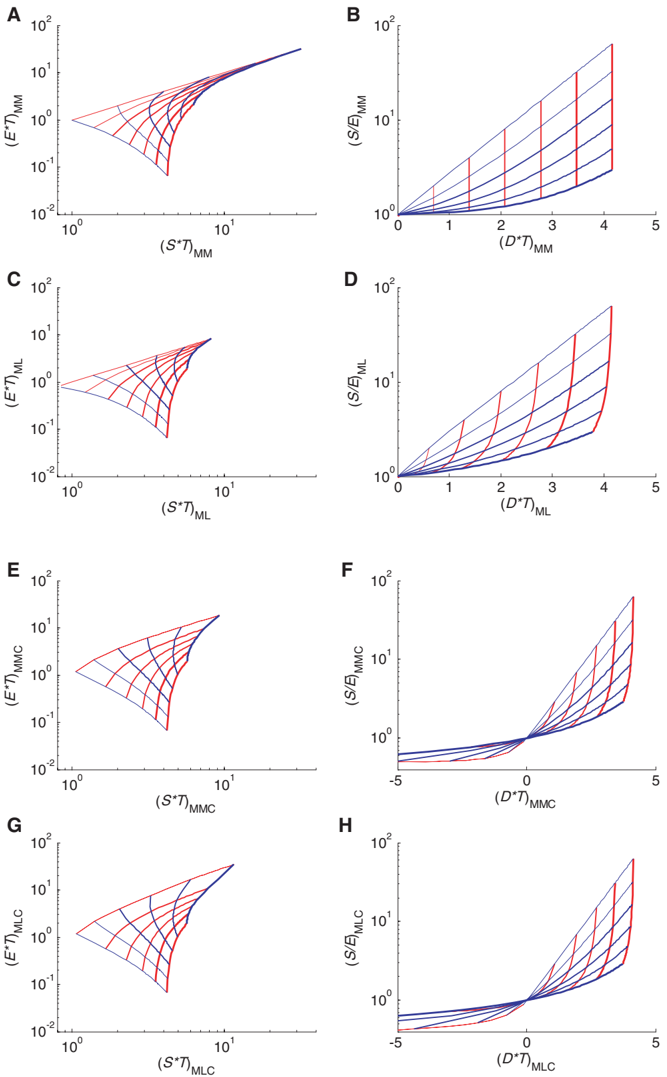
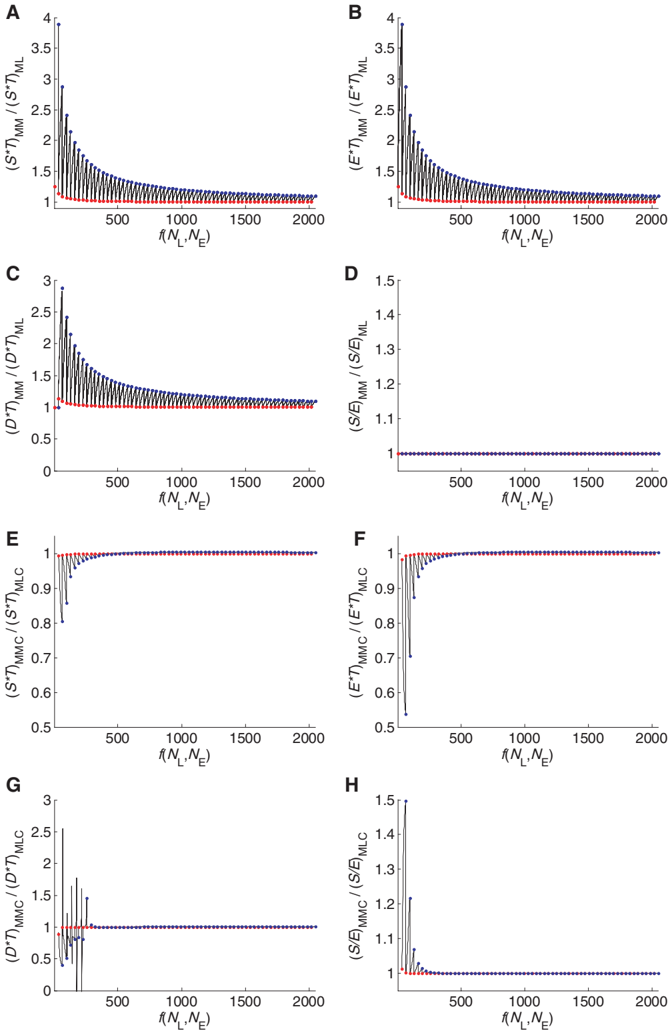
- Method-of-moments and maximum-likelihood estimates are similar except for low \(N_L\) and high \(N_E\); in the unconditional case method-of-moments gives higher \(S\) and \(E\) than ML, while in the conditional case it gives lower values. The authors suggest ML for \(N_L \le 50\) and method-of-moments for \(N_L > 50\).
- Conditioning on \(N_L > 0\) can profoundly affect estimates: conditional diversification rates can be negative and are always lower than unconditional ones due to lower speciation and higher extinction; for \(N_L = 1\), conditional extinction and diversification estimates are infinite unless \(N_E = 0\).
- For the Tragelaphus clade in Table 1 (\(T=7\), \(N_E=9\), \(N_L=7\)), estimates are \(S_{MM}=0.695\), \(E_{MM}=0.417\), \(D_{MM}=0.278\); \(S_{ML}=0.538\), \(E_{ML}=0.323\), \(D_{ML}=0.215\); \(S_{MMC}=0.514\), \(E_{MMC}=0.378\), \(D_{MMC}=0.139\); \(S_{MLC}=0.516\), \(E_{MLC}=0.380\), \(D_{MLC}=0.136\).
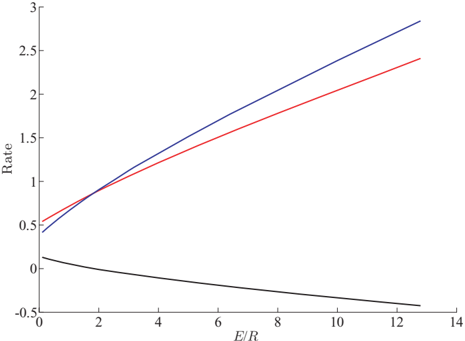
- Extending the model to incomplete preservation with \(p_R = R/(E+R)\) shows that preservation rates cannot be reliably estimated from numbers of extant and extinct species alone; the likelihood surface is very flat, so high extinction/high preservation and low extinction/low preservation can produce similar fossil counts.
Methods
- A stochastic birth-death model at the species level, governed by a master equation for \(P(N_E, N_L, t)\), with constant per-species speciation rate \(S\) and extinction rate \(E\), initial \(N_0=1\), and solution via a probability-generating function.
- Two estimation approaches: a multivariate method of moments equating observed and expected \(N_E\) and \(N_L\), and maximum likelihood using \(P(N_E, N_L, T)\), optionally conditioned on \(N_L > 0\); standard errors are computed from the observed information matrix.
- Applied to mammal clades from Vrba (1987) and Rosenzweig and Vetault (1992) in Table 1, to sister-clade pairs in Table 2, and extended to incomplete preservation using \(p_R = R/(E+R)\).
Limitations
- Stated: the model assumes punctuated equilibrium speciation, constant rates, and preservation probability \(p_R=1\) in the main model; preservation rates cannot be reliably estimated from \(N_L\) and \(N_E\) alone; ML is computationally demanding, method-of-moments lacks comparable error estimates, and conditional \(N_L=1\) yields infinite extinction/diversification estimates unless \(N_E=0\).
- Stated: combining clades assumes equal \(S\) and \(E\) across clades; the preservation extension has a very flat likelihood and wide confidence intervals because high extinction/high preservation and low extinction/low preservation can yield similar numbers of preserved extinct species.
- Evident from the text: estimates are unreliable for low \(N_L\) and high \(N_E\); the choice to condition is described as “mainly a philosophical one”; the model ignores population sizes and assumes rates do not depend on species identity.
Model-written summary. Check it against the paper before relying on it.
Integrity signals
Registry
Cites
Statistics
Figures
Verification
Claims the paper makes
0 Valid · 0 Not valid · 5 Not checked · 55 Own results and interpretations
A result the paper states — it cites no source for it, so there is none to check. The quote shows it is in the paper.
In the paper
“which in general does not simplify further.”
§ ESTIMATING SPECIATION AND EXTINCTION RATES FROM DIVERSITY DATA AND THE FOSSIL RECORD > Discussion
plain- Asserted: passes — The authors put it forward as true.
- Checkable: passes — It can be checked against evidence.
- Load-bearing: passes — The paper’s conclusions depend on it.
- Based: passes — The paper gives a reason why it holds.
A result the paper states — it cites no source for it, so there is none to check. The quote shows it is in the paper.
In the paper
“Here, we develop a stochastic birth-death model of speciation and extinction that predicts the probability distribution of both extinct and extant numbers of species in a clade.”
§ ESTIMATING SPECIATION AND EXTINCTION RATES FROM DIVERSITY DATA AND THE FOSSIL RECORD > Abstract
plainstates a cause- Asserted: passes — The authors put it forward as true.
- Checkable: passes — It can be checked against evidence.
- Load-bearing: passes — The paper’s conclusions depend on it.
- Based: passes — The paper gives a reason why it holds.
- Rests on 3 assumptions not shown here.
A result the paper states — it cites no source for it, so there is none to check. The quote shows it is in the paper.
In the paper
“The estimates are roughly the average of the estimates for each clade separately and the error in the estimates is smaller, as may be expected.”
§ ESTIMATING SPECIATION AND EXTINCTION RATES FROM DIVERSITY DATA AND THE FOSSIL RECORD > Clade
hedged- Asserted: passes — The authors put it forward as true.
- Checkable: passes — It can be checked against evidence.
- Load-bearing: passes — The paper’s conclusions depend on it.
- Based: passes — The paper gives a reason why it holds.
A result the paper reports from its own data — it cites no other source for it, so there is none to check. The quote shows it is in the paper.
In the paper
“This would be reasonable if the number of extinct and extant species were high, but in most examples they are not (see for example Table 1, where we reanalyze the data used by RV and Vrba).”
§ ESTIMATING SPECIATION AND EXTINCTION RATES FROM DIVERSITY DATA AND THE FOSSIL RECORD > Abstract
plain- Asserted: passes — The authors put it forward as true.
- Checkable: passes — It can be checked against evidence.
- Load-bearing: passes — The paper’s conclusions depend on it.
- Based: passes — The paper gives a reason why it holds.
A result the paper states — it cites no source for it, so there is none to check. The quote shows it is in the paper.
In the paper
“and these expressions are identical to those for N L (t) and N E (t) in the deterministic model (as expected in a linear model).”
§ ESTIMATING SPECIATION AND EXTINCTION RATES FROM DIVERSITY DATA AND THE FOSSIL RECORD > THE STOCHASTIC MODEL
plain- Asserted: passes — The authors put it forward as true.
- Checkable: passes — It can be checked against evidence.
- Load-bearing: passes — The paper’s conclusions depend on it.
- Based: passes — The paper gives a reason why it holds.
- Rests on 3 assumptions not shown here.
37 more claims
Create a free account to see all 60 claims and to verify the 4 references still open.
- Probably not a substantial claim. 8
- The quote only partly states this claim. 3
- It may state two separate claims as one. 10
Self-check
Percentages, sums and reported differences re-computed from the paper’s own numbers.
Each contradiction between two passages listed here was confirmed by an independent check.
Rated minor: it would not touch a result — a value no result rests on, a p-value that stays on the same side of the significance level, or a conflict that is clerical, resolved elsewhere in the paper, or outside its own findings.
In the paper
§ ESTIMATING SPECIATION AND EXTINCTION RATES FROM DIVERSITY DATA AND THE FOSSIL RECORD > Clade
“The conditional diversification rates are always lower than the unconditional ones due to a lower speciation rate and higher extinction rate.”
§ ESTIMATING SPECIATION AND EXTINCTION RATES FROM DIVERSITY DATA AND THE FOSSIL RECORD > THE STOCHASTIC MODEL
“Giraffa 5 8 1 1.600 1.600 0 0.721 (0.304) 0.721 (0.304) 0 (0.360) 0.800 ∞ -∞ 0.800 (0.282) ∞ -∞”
Citations
Cites
The Unified Neutral Theory of Biodiversity and Biogeography
Jetschke, G. (2002) · Ecology · doi:10.1890/0012-9658(2002)083[1771:tuntob]2.0.co;2 · Cited by 6,993
The Unified Neutral Theory of Biodiversity and Biogeography
Hubbell, S. P. (2001) · Project Muse (Johns Hopkins University) · Cited by 4,198
Punctuated equilibria: an alternative to phyletic gradualism
Eldredge, N., Gould, S. J., & Schöpf, T. J. M. (1972) · Cited by 3,257
DENNETT, D. C. (1995) · The Sciences · doi:10.1002/j.2326-1951.1995.tb03633.x · Cited by 1,975
Macroevolution, pattern and process
Stanley, S. M. (1979) · Cited by 1,348
Mitchell, M. (1996) · Complexity · doi:10.1002/(sici)1099-0526(199609/10)2:1<32::aid-cplx8>3.0.co;2-h · Cited by 1,118
Adler, P. B., HilleRisLambers, J., & Levine, J. M. (2007) · Ecology Letters · doi:10.1111/j.1461-0248.2006.00996.x · Cited by 1,059
The reconstructed evolutionary process
Nee, S., May, R. M., & Harvey, P. H. (1994) · Philosophical Transactions of the Royal Society of London. Series B: Biological Sciences · doi:10.1098/rstb.1994.0068 · Cited by 820
Origination and extinction components of taxonomic diversity: General problems
Foote, M. (2000) · Paleobiology · doi:10.1017/s0094837300026890 · Cited by 521
Systematics and the Fossil Record: documenting evolutionary patterns
Smith, A. B. (1994) · Wiley eBooks · doi:10.1002/9781444313918 · Cited by 456
ALONSO, D., ETIENNE, R., & MCKANE, A. (2006) · Trends in Ecology & Evolution · doi:10.1016/j.tree.2006.03.019 · Cited by 397
Self-citationBirth-Death Models in Macroevolution
Nee, S. (2006) · Annual Review of Ecology, Evolution, and Systematics · doi:10.1146/annurev.ecolsys.37.091305.110035 · Cited by 342 · cited 1×
“…explanations of diversity within a taxon or clade use simple models of speciation (origination) and extinction, where species may give birth to new species and eventually die, leading to extinction, with rates that usually does not depend on species identity (Nee 2004, 2006 and references therein).”
BackgroundPreservation of Species Abundance in Marine Death Assemblages
Kidwell, S. M. (2001) · Science · doi:10.1126/science.1064539 · Cited by 339
Fossil preservation and the stratigraphic ranges of taxa
Foote, M., & Raup, D. M. (1996) · Paleobiology · doi:10.1017/s0094837300016134 · Cited by 278
THE QUALITY OF THE FOSSIL RECORD: Populations, Species, and Communities
Kidwell, S. M., & Flessa, K. W. (1995) · Annual Review of Ecology and Systematics · doi:10.1146/annurev.es.26.110195.001413 · Cited by 277
Macroevolution: Pattern and Process
Templeton, A. R., & Freeman, W. H. (1980) · Evolution · doi:10.2307/2408307 · Cited by 246
Origination and Extinction through the Phanerozoic: A New Approach
Foote, M. (2003) · The Journal of Geology · doi:10.1086/345841 · Cited by 242
Resolving the biodiversity paradox
Clark, J. S., Dietze, M., Chakraborty, S., Agarwal, P. K., Ibanez, I., LaDeau, S., & Wolosin, M. (2007) · Ecology Letters · doi:10.1111/j.1461-0248.2007.01041.x · Cited by 216
INFERRING SPECIATION RATES FROM PHYLOGENIES
Nee, S. (2001) · Evolution · doi:10.1554/0014-3820(2001)055[0661:isrfp]2.0.co;2 · Cited by 202
Strong and weak tests of macroecological theory
McGill, B. (2003) · Oikos · doi:10.1034/j.1600-0706.2003.12617.x · Cited by 200
Neutral theory: a historical perspective
LEIGH, E. G. (2007) · Journal of Evolutionary Biology · doi:10.1111/j.1420-9101.2007.01410.x · Cited by 192
Systematics and the Fossil Record
Wagner, P. J., & Smith, A. (1995) · PALAIOS · doi:10.2307/3515163 · Cited by 189
On the probability of ancestors in the fossil record
Foote, M. (1996) · Paleobiology · doi:10.1017/s0094837300016146 · Cited by 185
Ecology in relation to speciation rates: some case histories of Miocene-Recent mammal clades
Vrba, E. S. (1987) · Evolutionary Ecology · doi:10.1007/bf02071554 · Cited by 173
USING PHYLOGENETIC TREES TO STUDY SPECIATION AND EXTINCTION
Hey, J. (1992) · Evolution · doi:10.1111/j.1558-5646.1992.tb02071.x · Cited by 170
ON SOME MODES OF POPULATION GROWTH LEADING TO R. A. FISHER'S LOGARITHMIC SERIES DISTRIBUTION
KENDALL, D. G. (1948) · Biometrika · doi:10.1093/biomet/35.1-2.6 · Cited by 163
The neutral theory of biodiversity: do the numbers add up?
Nee, S. (2005) · Functional Ecology · doi:10.1111/j.0269-8463.2005.00922.x · Cited by 156
A comment on Hubbell's zero‐sum ecological drift model
Ricklefs, R. E. (2003) · Oikos · doi:10.1034/j.1600-0706.2003.12018.x · Cited by 143
Estimating taxonomic durations and preservation probability
Foote, M. (1997) · Paleobiology · doi:10.1017/s0094837300019692 · Cited by 131
Assessing the fidelity of the fossil record by using marine bivalves
Valentine, J. W., Jablonski, D., Kidwell, S., & Roy, K. (2006) · Proceedings of the National Academy of Sciences · doi:10.1073/pnas.0601264103 · Cited by 130
Etienne, R. S., & Olff, H. (2005) · Ecology Letters · doi:10.1111/j.1461-0248.2005.00745.x · Cited by 124
Self-citationWagner, P. J. (2000) · Systematic Biology · doi:10.1080/10635150050207393 · Cited by 116
Modes of speciation and the neutral theory of biodiversity
Etienne, R. S., Apol, M. E. F., Olff, H., & Weissing, F. J. (2007) · Oikos · doi:10.1111/j.0030-1299.2007.15438.x · Cited by 81
Self-citationCan extinction rates be estimated without fossils?
Paradis, E. (2004) · Journal of Theoretical Biology · doi:10.1016/j.jtbi.2004.02.018 · Cited by 68
Strait, D. S., & Wood, B. A. (1999) · Proceedings of the National Academy of Sciences · doi:10.1073/pnas.96.16.9196 · Cited by 62
TESTING FOR EQUAL RATES OF CLADOGENESIS IN DIVERSE TAXA
Bokma, F. (2003) · Evolution · doi:10.1111/j.0014-3820.2003.tb01492.x · Cited by 58
On fossil preservation and the stratigraphic ranges of taxa
Solow, A. R., & Smith, W. (1997) · Paleobiology · doi:10.1017/s0094837300019680 · Cited by 54
The pattern of evolution in Pleistocene human brain size.
Lee, S.-H., & Wolpoff, M. H. (2003) · Paleobiology · doi:10.1017/s0094837300018054 · Cited by 27
Extinct meets extant: simple models in paleontology and molecular phylogenetics
Nee, S. (2004) · Paleobiology · doi:10.1666/0094-8373(2004)030<0172:emesmi>2.0.co;2 · Cited by 22
Estimation of stratigraphic ranges when fossil finds are not randomly distributed
Solow, A. R. (2003) · Paleobiology · doi:10.1666/0094-8373(2003)029<0181:eosrwf>2.0.co;2 · Cited by 16
Calculating speciation and extinction rates in fossil clades
Rosenzweig, M. L., & Vetault, S. (1992) · Evolutionary Ecology · doi:10.1007/bf02285336 · Cited by 11
Using Phylogenetic Trees to Study Speciation and Extinction
Hey, J. (1992) · Evolution · doi:10.2307/2409633
Research works printed but not linked: 1
- Coyne, J. A., and H. A. Orr. 2004. Speciation. Sinauer, Sunderland MA.
Cited by
Nine exceptional radiations plus high turnover explain species diversity in jawed vertebrates
Alfaro, M. E., Santini, F., Brock, C., Alamillo, H., Dornburg, A., Rabosky, D. L., Carnevale, G., & Harmon, L. J. (2009) · Proceedings of the National Academy of Sciences · doi:10.1073/pnas.0811087106 · Cited by 833
Reconciling molecular phylogenies with the fossil record
Morlon, H., Parsons, T. L., & Plotkin, J. B. (2011) · Proceedings of the National Academy of Sciences · doi:10.1073/pnas.1102543108 · Cited by 381
Slater, G. J., Harmon, L. J., & Alfaro, M. E. (2012) · Evolution · doi:10.1111/j.1558-5646.2012.01723.x · Cited by 334
Etienne, R. S., & Rosindell, J. (2012) · Systematic Biology · doi:10.1093/sysbio/syr091 · Cited by 197
Self-citationBurbrink, F. T., & Pyron, R. A. (2009) · Evolution · doi:10.1111/j.1558-5646.2009.00888.x · Cited by 109
Metadata
- Authors
- Etienne, R. S., & Apol, M. E. F.
- Affiliations
- University of Groningen (NL)
- Corresponding author
- Etienne, Rampal S.
- ORCID
- Etienne, Rampal S.
- Venue
- Evolution
- Publisher
- Oxford University Press (OUP)
- Published
- 2009-01
- Volume
- 63
- Issue
- 1
- Pages
- 244-255
- ISSN
- 0014-3820 (ISSN-L)
- 1558-5646
- OpenAlex
- W2142295440
- Semantic Scholar
- a0d16df4066803e143613e14e2b4ce48271f14ed
- Cited by
- 34
- References
- 40
- Citations by year
- 2026: 1 · 2024: 2 · 2023: 1 · 2022: 6 · 2021: 1 · 2019: 1 · 2018: 1 · 2017: 1 · 2016: 1 · 2015: 3 · 2013: 1 · 2012: 3
- FWCI
- 2.28
- Type
- journal article
- Language
- en
- Open access
- hybrid
- doi.org
- Licence
- cc-by
- doi.wiley.com/10.1002/tdm_license_1.1 (tdm, 2434 d)
- Locations
- Evolution (publishedVersion, cc-by)
- PubMed (publishedVersion)
- University of Groningen research database (University of Groningen / Centre for Information Technology) (publishedVersion)
- BioOne Complete (BioOne) (submittedVersion)
- University of Groningen research database (University of Groningen / Centre for Information Technology) (submittedVersion)
- Funders
- University of Oregon
- Nederlandse Organisatie voor Wetenschappelijk Onderzoek (613.000.446)
- Topics
- Physical Sciences › Earth and Planetary Sciences › Paleontology › Evolution and Paleontology Studies
- Life Sciences › Agricultural and Biological Sciences › Ecology, Evolution, Behavior and Systematics › Plant Diversity and Evolution
- Life Sciences › Biochemistry, Genetics and Molecular Biology › Genetics › Evolution and Genetic Dynamics
- Keywords
- speciation rates, extinction rates, diversification rates, birth-death model, fossil record, extinct species, method of moments, maximum likelihood estimation, bias correction, clade diversification
- MeSH terms
- Animals, Models, Genetic, Models, Statistical, Biodiversity, Genetic Speciation, Extinction, Biological
About these checks
Registry, retraction, Cites and statistics results are computed, not judged, with one exception: a printed reference that no index lists is read once by a model before it counts as a citation error. Claims are extracted by a model and kept only when their quote appears verbatim in the text; each cited source is then checked, with a model’s help, for whether it says what the claim relies on. Those verdicts can be wrong — read the claim’s quote and the cited source before relying on one.
A language model drew the claims from the paper on 2026-11-18, under version 3 of the claim definition (model deepseek-v4.1-flash, prompt extract-v3).
A second model labelled each claim on 2026-11-18 (model jev-1.13-20260917, definition revision gold-guideline-v0.2).
Statistics and arithmetic are recomputed, not judged.
Confidence bands are shown only for fields calibrated on our annotated test set. None is calibrated yet, so no band is shown.
What counts as a claim ›How we measure confidence ›How we check this ›
Are you an author, or do you see a problem with this page? Request a review
Data sources
Bibliographic data: Semantic Scholar, OpenAlex, Crossref.
Contains information from the Semantic Scholar Academic Graph Datasets, made available under the ODC Attribution License (ODC-BY 1.0).
Semantic Scholar’s data is described in: Kinney, R., et al. (2023). The Semantic Scholar Open Data Platform. arXiv:2301.10140.
