

The DOI matches its Crossref record; 3 of the 3 references it cites were found in a registry or an index.
Sixty years of second language aptitude research: A systematic quantitative literature review
Abstract
Second language (L2) aptitude has been broadly defined as the rate and ease of initially acquiring a second language. Historically, L2 aptitude has been understood as a stable trait that predetermined L2 achievement, regardless of individual learners’ efforts to acquire an L2. This traditional view of L2 aptitude as fixed and stable has led to it being a relatively neglected area of research within second language acquisition (SLA) studies. The little research that was in fact conducted was diagnostic in nature, and mostly used tests such as the Modern Language Aptitude Test (MLAT) to select potentially gifted L2 learners. Given that six decades have passed since the publication of the MLAT, now is a good time to revisit the literature and investigate whether L2 aptitude continues to be viewed as an individual difference of little interest to SLA research. While summative literature reviews of L2 aptitude research have been written, few systematic reviews exist. This article conducts a systematic quantitative literature review (SQLR) to provide a principled, comprehensive and reproducible synthesis of research into L2 aptitude published over the last 60 years (1959–2019). In this SQLR, close to one hundred journal articles and PhD dissertations were examined to discern generalisations and limitations in the field. This SQLR identifies a shift in the rationale for L2 aptitude testing, in which a diagnostic focus has been replaced by an explanatory perspective. Furthermore, our article points to a renewed interest in L2 aptitude research, which has come to be characterised by a more nuanced and sophisticated understanding of the concept and its components.
Overview
The claims and statistics of this paper haven’t been checked yet.
Run the check — free, no account needed. It reads the open-access text and checks the sources it cites.
Integrity signals
Registry
Cites
Statistics
Figures

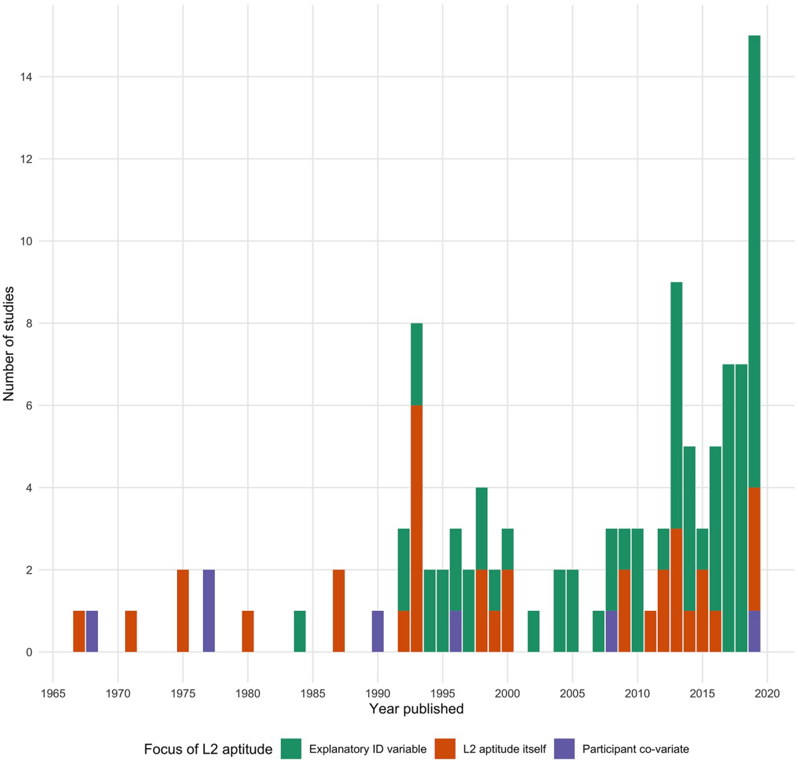
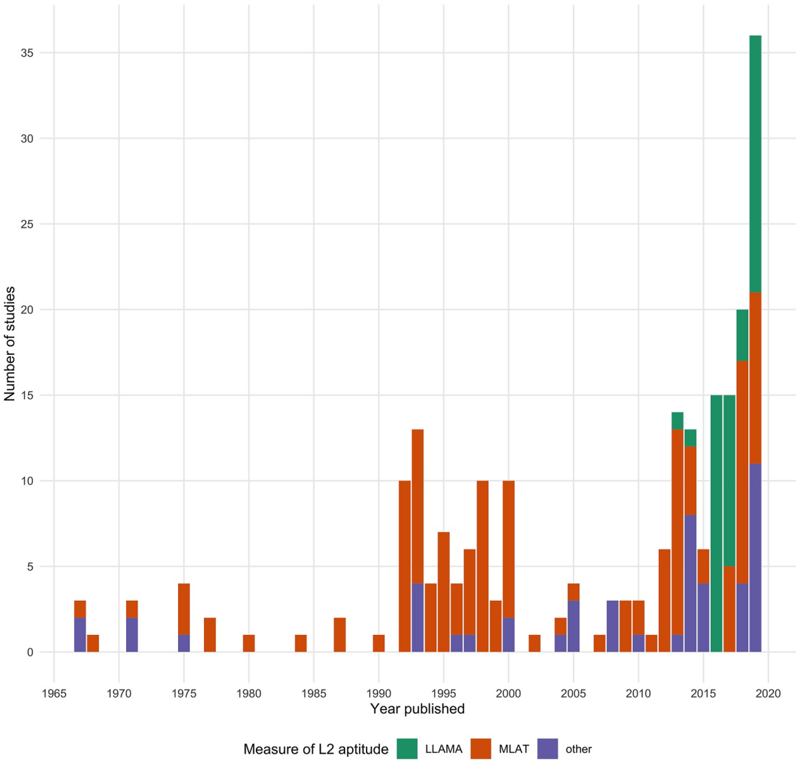
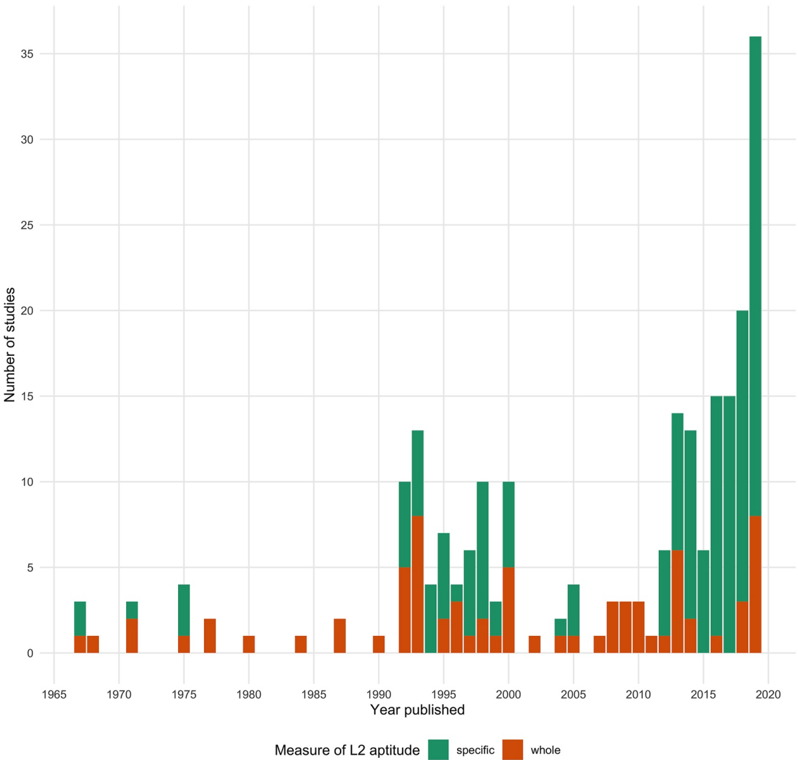
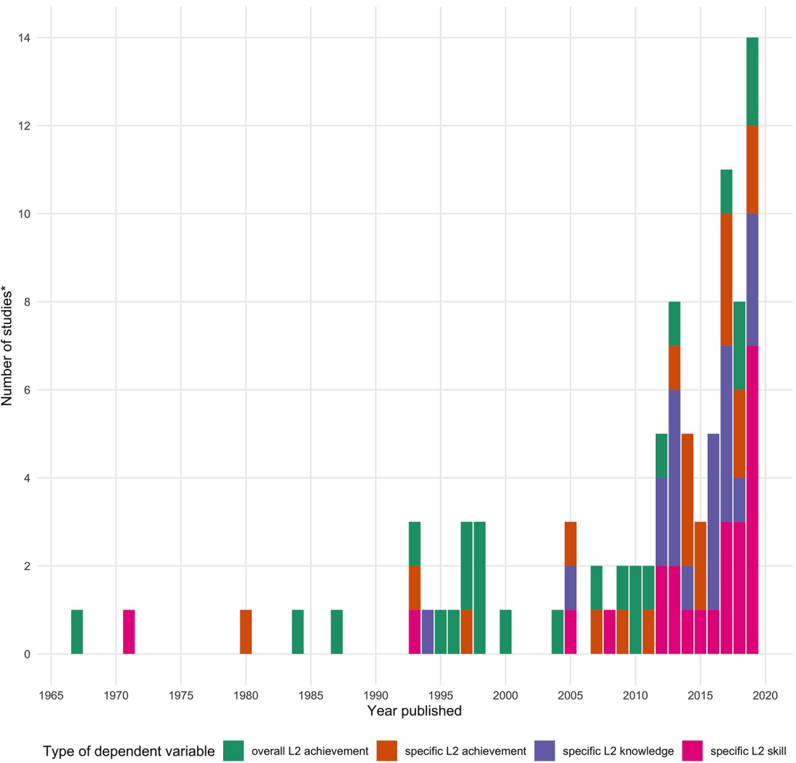

Verification
Claims the paper makes
The claims and statistics of this paper haven’t been checked yet.
Run the check — free, no account needed. It reads the open-access text and checks the sources it cites.
Claims other papers make about this one
Each is checked against this paper’s own text: does it say what the citing paper says it does?
In the citing paper
“The MLAT has demonstrated strong reliability and validity and has been widely used for studying grammar, vocabulary learning, and overall achievement (Chalmers et al., 2021;Dale & Sparks, 2024;Li, 2019;Sparks & Dale, 2023b).”
From On English Language Learners’ Prosody: The Possible Impact of L2 Aptitude, Musical Ability, and Proficiency on Nuclear Accent Placement in Spanish L1 Contexts (2026) · cites this paper as Chalmers et al., 2021
In the citing paper
“It must be pointed out that L2 aptitude has largely been studied in relation to L2 learning success, yet its role in L2 pronunciation learning remains unexplored (Chalmers et al., 2021;Li, 2019;Saito, 2023).”
From On English Language Learners’ Prosody: The Possible Impact of L2 Aptitude, Musical Ability, and Proficiency on Nuclear Accent Placement in Spanish L1 Contexts (2026) · cites this paper as Chalmers et al., 2021
Self-check
Percentages, sums and reported differences re-computed from the paper’s own numbers.
The self-check needs the paper’s full text.
Citations
Cites
Foreign language aptitude theory: Yesterday, today and tomorrow
Wen, Z. (., Biedroń, A., & Skehan, P. (2017) · Language Teaching · doi:10.1017/s0261444816000276 · Cited by 248
Is the Foreign Language Classroom Anxiety Scale Measuring Anxiety or Language Skills?
Sparks, R. L., & Ganschow, L. (2007) · Foreign Language Annals · doi:10.1111/j.1944-9720.2007.tb03201.x · Cited by 169
EFFECTS OF MASSING AND SPACING ON THE LEARNING OF SEMANTICALLY RELATED AND UNRELATED WORDS
Nakata, T., & Suzuki, Y. (2019) · Studies in Second Language Acquisition · doi:10.1017/s0272263118000219 · Cited by 78
Research works printed but not linked: 46
- 10.1017/S027226310808073X · DOI · Paper page
- Carroll J. B., 1962, Training research and education, 87
- Carroll J. B., 1981, Individual differences and universals in language learning aptitude, 83
- Carroll J. B., 1959, Modern language aptitude test
- 10.1111/lang.12341 · DOI
- Cummins J., 1975, Set, objectification and second language learning, Journal of Psychology, 10, 91
- Dąbrowska E., 2018, Experience, aptitude, and individual differences in linguistic attainment: A comparison of native and nonnative speakers, Language Learning, 69, 72
- 10.1177/003368827100200102 · DOI
- Dörnyei Z., 2010, The psychology of the language learner: Individual differences in second language acquisition
- Doughty C. J., 2014, The companion to language assessment, 25
- 10.1111/lang.12322 · DOI
- 10.1017/S0267190521000076 · DOI
- 10.1111/lang.12018 · DOI
- 10.1093/applin/amu013 · DOI
- 10.1017/S0142716415000120 · DOI · Paper page
- 10.1111/0026-7902.00076 · DOI
- 10.1093/applin/amu054 · DOI
- 10.1017/S027226311500042X · DOI
- 10.1075/aals.16.03li · DOI
- 10.4324/9781315122021-5 · DOI
- 10.1017/S0272263121000024 · DOI · Paper page
- 10.1017/S0142716418000796 · DOI
- 10.1111/lang.12011 · DOI
- 10.4324/9781315617046 · DOI
- 10.1017/S0267190517000095 · DOI
- 10.1080/07294360.2013.841651 · DOI
- Pimsleur P., 1966, Pimsleur language aptitude battery
- Reardon S. F., 2014, Handbook of research in education, finance and policy, 491
- 10.1007/978-3-642-20850-8_4 · DOI · Paper page
- 10.1075/eurosla.16.07rog · DOI
- 10.22599/jesla.24 · DOI · Paper page
- 10.1111/lang.12244 · DOI
- 10.1111/j.1467-1770.1993.tb00625.x · DOI
- 10.1111/j.1467-1770.1993.tb00617.x · DOI
- 10.1177/0265532211434015 · DOI
- 10.1017/CBO9781139524780.013 · DOI · Paper page
- 10.14746/ssllt.2017.7.1.5 · DOI
- Skehan P., 1998, A cognitive approach to language learning
- 10.1075/lllt.2.06ske · DOI · Paper page
- 10.1111/lang.12025 · DOI
- 10.1111/j.1467-9922.2009.00504.x · DOI
- 10.1177/026553229501200304 · DOI
- 10.1111/j.1540-4781.2013.12007.x · DOI
- 10.21832/9781783095735 · DOI
- 10.4324/9781315122021 · DOI
- 10.1111/j.1540-4781.2013.01428.x · DOI
Cited by
Sorted by citations
Barra–García, C. F., Véliz-Campos, M., Figueroa Candia, M. A., Pereira-Reyes, Y., & Kartsevski Dune, M. (2026) · Language Teaching Research Quarterly · doi:10.32038/ltrq.2026.55.04
Metadata
- Authors
- Chalmers, J., Eisenchlas, S. A., Munro, A., & Schalley, A. C.
- Affiliations
- Library and Learning Services Torrens University Fortitude Valley Queensland Australia
- School of Humanities, Languages and Social Science Griffith University Nathan Queensland Australia
- Department of Language, Literature and Intercultural Studies Karlstad University Karlstad Sweden
- Venue
- Language and Linguistics Compass
- Publisher
- Wiley
- Published
- 2021-11
- Volume
- 15
- Issue
- 11
- ISSN
- 1749-818X
- Cited by
- 12
- References
- 3
- Language
- en
About these checks
Registry, retraction, Cites and statistics results are computed, not judged, with one exception: a printed reference that no index lists is read once by a model before it counts as a citation error. Claims are extracted by a model and kept only when their quote appears verbatim in the text; each cited source is then checked, with a model’s help, for whether it says what the claim relies on. Those verdicts can be wrong — read the claim’s quote and the cited source before relying on one.
Statistics and arithmetic are recomputed, not judged.
Confidence bands are shown only for fields calibrated on our annotated test set. None is calibrated yet, so no band is shown.
What counts as a claim ›How we measure confidence ›How we check this ›
Are you an author, or do you see a problem with this page? Request a review
