

The DOI matches its Crossref record; 4 of the 4 references it cites were found in a registry or an index.
Advances in the physiology of gastric emptying
Abstract
There have been many recent advances in the understanding of various aspects of the physiology of gastric motility and gastric emptying. Earlier studies had discovered the remarkable ability of the stomach to regulate the timing and rate of emptying of ingested food constituents and the underlying motor activity. Recent studies have shown that two parallel neural circuits, the gastric inhibitory vagal motor circuit (GIVMC) and the gastric excitatory vagal motor circuit (GEVMC), mediate gastric inhibition and excitation and therefore the rate of gastric emptying. The GIVMC includes preganglionic cholinergic neurons in the DMV and the postganglionic inhibitory neurons in the myenteric plexus that act by releasing nitric oxide, ATP, and peptide VIP. The GEVMC includes distinct gastric excitatory preganglionic cholinergic neurons in the DMV and postganglionic excitatory cholinergic neurons in the myenteric plexus. Smooth muscle is the final target of these circuits. The role of the intramuscular interstitial cells of Cajal in neuromuscular transmission remains debatable. The two motor circuits are differentially regulated by different sets of neurons in the NTS and vagal afferents. In the digestive period, many hormones including cholecystokinin and GLP‐1 inhibit gastric emptying via the GIVMC, and in the inter‐digestive period, hormones ghrelin and motilin hasten gastric emptying by stimulating the GEVMC. The GIVMC and GEVMC are also connected to anorexigenic and orexigenic neural pathways, respectively. Identification of the control circuits of gastric emptying may provide better delineation of the pathophysiology of abnormal gastric emptying and its relationship to satiety signals and food intake.
Overview
The claims and statistics of this paper haven’t been checked yet.
Run the check — free, no account needed. It reads the open-access text and checks the sources it cites.
Integrity signals
Registry
Cites
Statistics
Figures
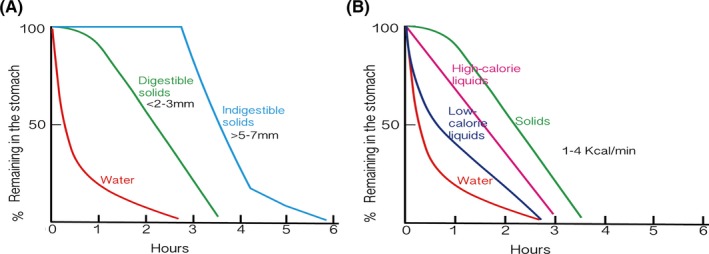
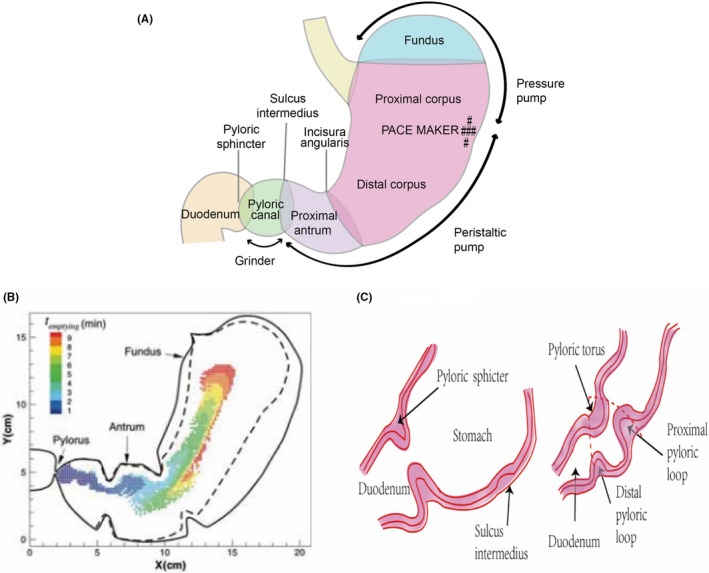
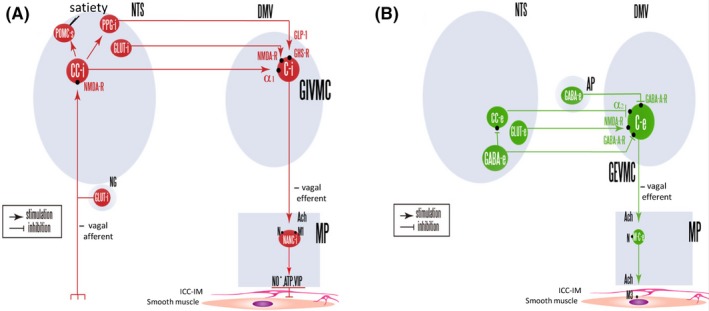
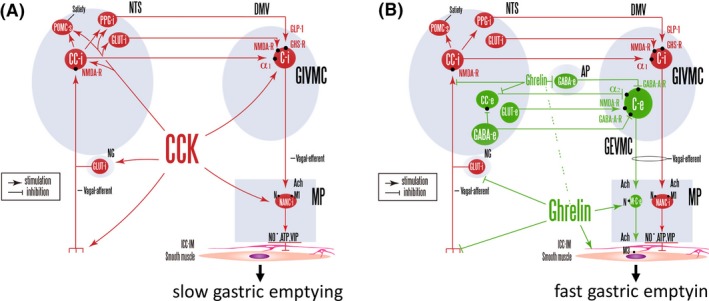
Verification
Claims the paper makes
The claims and statistics of this paper haven’t been checked yet.
Run the check — free, no account needed. It reads the open-access text and checks the sources it cites.
Claims other papers make about this one
Each is checked against this paper’s own text: does it say what the citing paper says it does?
The cited source says what the claim attributes to it.
In the citing paper
“Gastric emptying is one of the critical factors affecting postprandial glycaemia and food intake, which is a complex interplay involving gastric, intestinal and central neuronal and humoral mechanisms.11”
Self-check
Percentages, sums and reported differences re-computed from the paper’s own numbers.
The self-check needs the paper’s full text.
Citations
Cites
Müller, T. D., Nogueiras, R., Andermann, M. L., Andrews, Z. B., Anker, S. D., Argente, J., Batterham, R. L., Benoit, S. C., Bowers, C. Y., Broglio, F., et al. (2015) · Molecular Metabolism · doi:10.1016/j.molmet.2015.03.005 · Cited by 1,034
The enteric nervous system and gastrointestinal innervation: integrated local and central control
Furness, J. B., Callaghan, B. P., Rivera, L. R., & Cho, H.-J. (2014) · Advances in Experimental Medicine and Biology · doi:10.1007/978-1-4939-0897-4_3 · Cited by 827
Parkman, H. P., Hasler, W. L., & Fisher, R. S. (2004) · Gastroenterology · doi:10.1053/j.gastro.2004.09.055 · Cited by 738
Browning, K. N., & Travagli, R. A. (2014) · Comprehensive Physiology · doi:10.1002/cphy.c130055 · Cited by 541
Research works printed but not linked: 115
- 10.1016/j.clnu.2014.11.003 · DOI
- Ehrlein HJ, 2005, Gastrointestinal Motility
- 10.1016/0950-3528(91)90034-X · DOI
- 10.1016/0016-5085(85)90650-X · DOI
- 10.1016/0016-5085(88)90669-5 · DOI
- 10.1038/nrgastro.2016.76 · DOI · Paper page
- 10.1152/ajpendo.00199.2014 · DOI
- 10.2337/dc16-0351 · DOI
- 10.1152/ajpendo.00514.2007 · DOI
- 10.1016/j.jbiomech.2006.06.006 · DOI
- 10.1016/0016-5085(84)90085-4 · DOI
- 10.1016/S0016-5085(83)80232-7 · DOI
- 10.2967/jnmt.107.048116 · DOI
- 10.1016/j.jss.2009.01.035 · DOI
- 10.1111/j.1365-2982.2005.00664.x · DOI
- 10.1046/j.1365-2982.2001.00258.x · DOI
- 10.1113/jphysiol.1990.sp017999 · DOI
- Treacy PJ, 1992, Duodenal intramural nerves in control of pyloric motility and gastric emptying, Am J Physiol, 263, G1
- 10.1111/j.1365-2982.2011.01710.x · DOI
- 10.1136/gut.10.7.543 · DOI
- 10.1016/j.jchemneu.2008.05.002 · DOI
- 10.1038/nrgastro.2012.57 · DOI
- 10.1113/jphysiol.2003.049700 · DOI
- 10.1023/A:1012374408853 · DOI
- 10.1056/NEJM199208203270802 · DOI
- 10.1053/j.gastro.2008.06.039 · DOI
- 10.1016/j.neuroscience.2011.04.036 · DOI
- 10.1113/JP271600 · DOI
- 10.1113/JP271971 · DOI
- 10.1113/jphysiol.2013.254292 · DOI
- 10.1038/nrgastro.2016.161 · DOI
- 10.1152/ajpgi.00344.2007 · DOI
- 10.1056/NEJM199604253341707 · DOI
- 10.1152/ajpgi.00309.2006 · DOI
- 10.1152/ajpgi.00478.2002 · DOI
- 10.1146/annurev.physiol.68.040504.094635 · DOI · Paper page
- 10.1111/j.1469-7793.1999.369ae.x · DOI
- 10.1152/ajpgi.2001.280.3.G361 · DOI
- 10.1172/JCI107829 · DOI
- 10.1136/gut.14.4.300 · DOI
- 10.1097/00000658-197309000-00009 · DOI
- 10.1111/j.1469-7793.1997.197bo.x · DOI
- 10.1007/s00429-003-0357-y · DOI
- Malbert CH, 1995, Vagal control of pyloric resistance, Am J Physiol, 269, G558
- 10.1172/JCI108013 · DOI
- 10.1113/jphysiol.1992.sp018994 · DOI
- 10.1113/jphysiol.1993.sp019524 · DOI
- 10.1146/annurev.physiol.68.040504.094707 · DOI
- 10.1111/j.1469-7793.1997.479be.x · DOI
- 10.1152/ajpregu.00717.2005 · DOI
- 10.1371/journal.pone.0162146 · DOI
- 10.1152/ajpgi.00380.2014 · DOI
- 10.3389/fmed.2018.00001 · DOI
- 10.1152/ajpcell.00080.2014 · DOI
- 10.1113/JP271587 · DOI
- 10.1111/j.1365-2982.2010.01592.x · DOI
- 10.1523/JNEUROSCI.3502-07.2007 · DOI
- 10.1523/JNEUROSCI.3187-10.2011 · DOI
- 10.1152/ajpgi.00289.2003 · DOI
- 10.1152/ajpregu.00155.2003 · DOI
- 10.1152/ajpgi.90567.2008 · DOI
- 10.1523/JNEUROSCI.20-04-01393.2000 · DOI
- 10.1113/JP271972 · DOI
- 10.1111/j.1469-7793.2000.00105.x · DOI
- 10.1074/jbc.M115.654384 · DOI
- 10.1152/ajpregu.00179.2003 · DOI
- 10.1177/1535370216654228 · DOI
- 10.1152/ajpgi.00223.2017 · DOI
- 10.1113/JP272069 · DOI
- 10.1152/ajpgi.00395.2017 · DOI
- 10.1152/ajpgi.00363.2010 · DOI
- 10.1152/ajpgi.00382.2017 · DOI
- 10.1152/ajpgi.00043.2014 · DOI
- 10.1152/ajpgi.00180.2017 · DOI
- 10.3233/JPD-160817 · DOI
- 10.1053/j.gastro.2017.08.069 · DOI
- 10.1136/gut.2005.078121 · DOI
- 10.1113/jphysiol.2012.227959 · DOI
- 10.1152/ajpgi.00431.2003 · DOI
- 10.1152/ajpgi.00255.2016 · DOI
- 10.1113/jphysiol.2011.217497 · DOI
- 10.1016/0016-5085(95)90445-X · DOI
- 10.1124/jpet.104.072868 · DOI
- 10.1113/jphysiol.2010.191023 · DOI
- Willing AE, 1997, Gastric distension‐induced c‐fos expression in catecholaminergic neurons of rat dorsal vagal complex, Am J Physiol, 272, R59
- 10.1113/jphysiol.2009.175067 · DOI
- 10.1038/sj.ijo.0801910 · DOI
- 10.1152/ajpgi.00356.2010 · DOI
- 10.1152/ajpregu.00517.2006 · DOI
- 10.1038/nn1214 · DOI
- 10.1523/JNEUROSCI.4177-04.2005 · DOI
- 10.1016/0016-5085(86)90080-6 · DOI
- 10.1016/j.bbrc.2016.02.095 · DOI
- 10.1111/dom.13080 · DOI
- 10.1098/rstb.2006.1858 · DOI
- 10.1016/j.beem.2009.03.005 · DOI · Paper page
- 10.2337/db11-0489 · DOI
- 10.1023/A:1018863716749 · DOI
- 10.3109/00365527909179889 · DOI
- 10.5115/acb.2012.45.1.1 · DOI
- 10.1016/j.neuron.2017.09.043 · DOI
- 10.1007/164_2016_104 · DOI
- 10.1053/gast.2002.35954 · DOI
- 10.1152/ajpgi.00536.2006 · DOI
- 10.1210/en.2016-1815 · DOI
- 10.1177/1073858407311100 · DOI · Paper page
- 10.1111/nmo.12261 · DOI
- 10.1136/gut.2005.065896 · DOI
- 10.1016/j.regpep.2007.07.008 · DOI
- 10.1371/journal.pone.0064777 · DOI
- 10.1113/JP270788 · DOI
- 10.14814/phy2.13105 · DOI
- 10.1677/JME-09-0095 · DOI
- 10.1016/j.cmet.2006.09.004 · DOI
- 10.1523/JNEUROSCI.2742-12.2013 · DOI
Cited by
Sorted by citations
Profiling the human intestinal environment under physiological conditions
Shalon, D., Culver, R. N., Grembi, J. A., Folz, J., Treit, P. V., Shi, H., Rosenberger, F. A., Dethlefsen, L., Meng, X., Yaffe, E., et al. (2023) · Nature · doi:10.1038/s41586-023-05989-7 · Cited by 484
Urva, S., Coskun, T., Loghin, C., Cui, X., Beebe, E., O'Farrell, L., Briere, D. A., Benson, C., Nauck, M. A., & Haupt, A. (2020) · Diabetes, Obesity and Metabolism · doi:10.1111/dom.14110 · Cited by 143
Semaglutide delays 4‐hour gastric emptying in women with polycystic ovary syndrome and obesity
Jensterle, M., Ferjan, S., Ležaič, L., Sočan, A., Goričar, K., Zaletel, K., & Janez, A. (2023) · Diabetes, Obesity and Metabolism · doi:10.1111/dom.14944 · Cited by 102
Kolacz, J., Kovacic, K. K., & Porges, S. W. (2019) · Developmental Psychobiology · doi:10.1002/dev.21852 · Cited by 94
Kovacic, K., Kolacz, J., Lewis, G. F., & Porges, S. W. (2020) · American Journal of Gastroenterology · doi:10.14309/ajg.0000000000000753 · Cited by 51
Metadata
- Authors
- Goyal, R. K., Guo, Y., & Mashimo, H.
- Affiliations
- Department of Medicine, VA Boston Healthcare System Harvard Medical School Boston Massachusetts
- Venue
- Neurogastroenterology & Motility
- Publisher
- Wiley
- Published
- 2019-02-10
- Volume
- 31
- Issue
- 4
- ISSN
- 1350-1925
- 1365-2982
- PMC
- PMC6850045
- Cited by
- 369
- References
- 4
- Language
- en
- Funders
- U.S. Department of Veterans Affairs (5101 BX002806-04)
About these checks
Registry, retraction, Cites and statistics results are computed, not judged, with one exception: a printed reference that no index lists is read once by a model before it counts as a citation error. Claims are extracted by a model and kept only when their quote appears verbatim in the text; each cited source is then checked, with a model’s help, for whether it says what the claim relies on. Those verdicts can be wrong — read the claim’s quote and the cited source before relying on one.
Statistics and arithmetic are recomputed, not judged.
Confidence bands are shown only for fields calibrated on our annotated test set. None is calibrated yet, so no band is shown.
What counts as a claim ›How we measure confidence ›How we check this ›
Are you an author, or do you see a problem with this page? Request a review
