Cited by 129Plant biochemistry and biosynthesisAlgal biology and biofuel productionMicrobial Metabolic Engineering and Bioproduction

The DOI matches its Crossref record; 96 of the 96 references it cites were found in a registry or an index.

Engineering the unicellular alga Phaeodactylum tricornutum for high‐value plant triterpenoid production

Open access
D'Adamo, Sarah, Schiano di Visconte, Gino, Lowe, Gavin, Szaub‐Newton, Joanna, Beacham, Tracey, Landels, Andrew, Allen, Michael J., Spicer, Andrew, Matthijs, Michiel·2019·Plant Biotechnology Journal

Abstract

Plant triterpenoids constitute a diverse class of organic compounds that play a major role in development, plant defence and environmental interaction. Several triterpenes have demonstrated potential as pharmaceuticals. One example is betulin, which has shown promise as a pharmaceutical precursor for the treatment of certain cancers and HIV. Major challenges for triterpenoid commercialization include their low production levels and their cost-effective purification from the complex mixtures present in their natural hosts. Therefore, attempts to produce these compounds in industrially relevant microbial systems such as bacteria and yeasts have attracted great interest. Here, we report the production of the triterpenes betulin and its precursor lupeol in the photosynthetic diatom Phaeodactylum tricornutum, a unicellular eukaryotic alga. This was achieved by introducing three plant enzymes in the microalga: a Lotus japonicus oxidosqualene cyclase and a Medicago truncatula cytochrome P450 along with its native reductase. The introduction of the L. japonicus oxidosqualene cyclase perturbed the mRNA expression levels of the native mevalonate and sterol biosynthesis pathway. The best performing strains were selected and grown in a 550-L pilot-scale photobioreactor facility. To our knowledge, this is the most extensive pathway engineering undertaken in a diatom and the first time that a sapogenin has been artificially produced in a microalga, demonstrating the feasibility of the photo-bio-production of more complex high-value, metabolites in microalgae.

Overview

The claims and statistics of this paper haven’t been checked yet.

Run the check — free, no account needed. It reads the open-access text and checks the sources it cites.

A few free checks a day · papers already verified open instantly · results are public

Integrity signals

Registry

Crossref · 10.1111/pbi.12948

Cites

96 of 96 references verified0 citation errors · 0 not checkable

Statistics

Figures

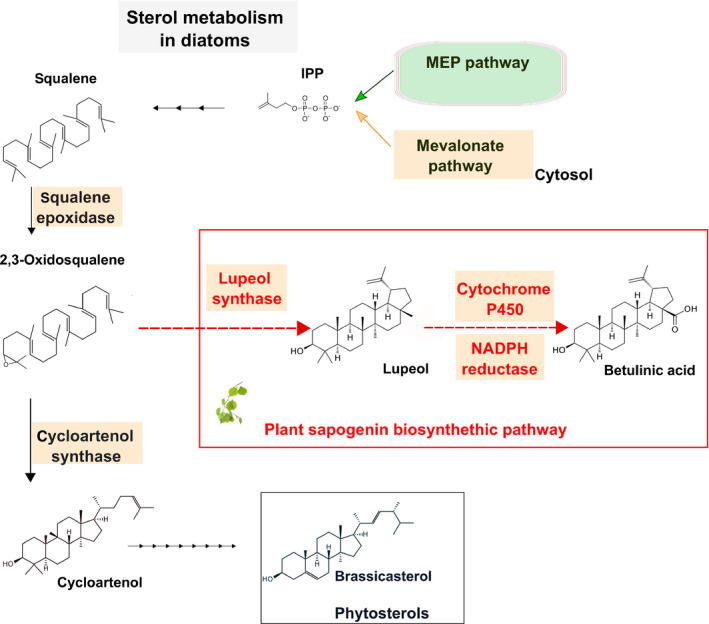
Figure 1 Engineering Phaeodactylum tricornutum by introducing a plant sapogenin pathway. Schematic representation of sterol metabolism in diatoms starting from the precursor isopentenyl pyrophosphate (IPP) and leading to brassicasterol. In the plant sapogenin pathway, the 2,3‐oxidosqualene precursor is cyclized to lupeol, by a lupeol synthase; the lupeol can be further modified to betulinic acid through a cytochrome P450 family enzyme, along with its coenzyme NADPH reductase. The plant sapogenin pathway enzymes introduced in P. tricornutum will, therefore, compete with the native cycloartenol synthase for the common precursor 2,3‐oxidosqualene.
Figure 1 Engineering Phaeodactylum tricornutum by introducing a plant sapogenin pathway. Schematic representation of sterol metabolism in diatoms starting from the precursor isopentenyl pyrophosphate (IPP) and leading to brassicasterol. In the plant sapogenin pathway, the 2,3‐oxidosqualene precursor is cyclized to lupeol, by a lupeol synthase; the lupeol can be further modified to betulinic acid through a cytochrome P450 family enzyme, along with its coenzyme NADPH reductase. The plant sapogenin pathway enzymes introduced in P. tricornutum will, therefore, compete with the native cycloartenol synthase for the common precursor 2,3‐oxidosqualene.CC BY · PubMed Central
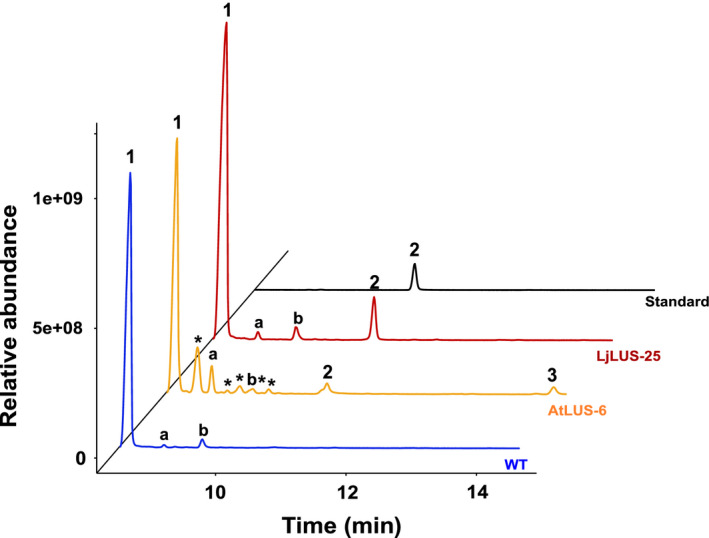
Figure 2 Lupeol production in Phaeodactylum tricornutum transformant lines. GC‐MS analysis of transformant lines AtLUS‐6 (yellow) and LjLUS‐25 (red) with the wild type (blue). Lupeol standard in black. 1. Brassicasterol (major sterol in P. tricornutum). 2. Lupeol; 3. 3β, 20‐dihydroxylupane by‐product of AtLUS enzyme only. Additional peaks: a. campesterol; b. unidentified diterpene molecule; *unidentified terpenoid molecules, mass spectra for these peaks with their best database hits are shown in Figure S3.
Figure 2 Lupeol production in Phaeodactylum tricornutum transformant lines. GC‐MS analysis of transformant lines AtLUS‐6 (yellow) and LjLUS‐25 (red) with the wild type (blue). Lupeol standard in black. 1. Brassicasterol (major sterol in P. tricornutum). 2. Lupeol; 3. 3β, 20‐dihydroxylupane by‐product of AtLUS enzyme only. Additional peaks: a. campesterol; b. unidentified diterpene molecule; *unidentified terpenoid molecules, mass spectra for these peaks with their best database hits are shown in Figure S3.CC BY · PubMed Central
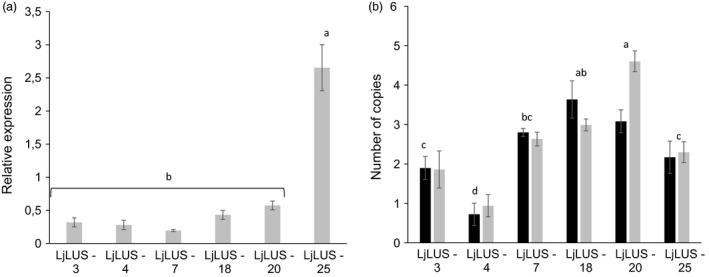
Figure 3 Expression and copy number of lupeol‐producing strains. (a) qPCR analysis of six lines showing expression of the Lotus japonicus lupeol synthase (LjLUS) mRNA relative to the geometric average of the RP3a and UBQ reference genes (b) Copy number of integrated LjLUS expression cassettes (black) and the ble r resistance marker (grey). Error bars represent the standard deviation from three biological replicates. Identical letters denote groups where means are not statistically different according to a post hoc Tukey test with α = 0.01.
Figure 3 Expression and copy number of lupeol‐producing strains. (a) qPCR analysis of six lines showing expression of the Lotus japonicus lupeol synthase (LjLUS) mRNA relative to the geometric average of the RP3a and UBQ reference genes (b) Copy number of integrated LjLUS expression cassettes (black) and the ble r resistance marker (grey). Error bars represent the standard deviation from three biological replicates. Identical letters denote groups where means are not statistically different according to a post hoc Tukey test with α = 0.01.CC BY · PubMed Central
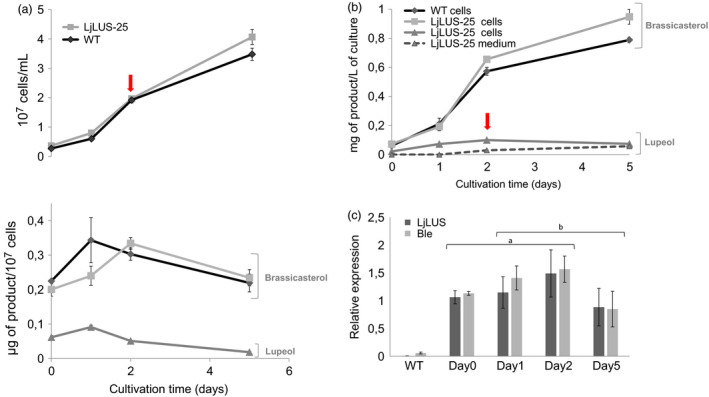
Figure 4 Lupeol productivity in 400‐mL batch cultures. Triplicate cultures were grown in F/2 medium in laboratory‐scale Algem® photobioreactors for 5 days. (a) Cell density and productivity per cell of brassicasterol for the wild type (diamonds) and LjLUS‐25 (squares). Lupeol was only detected in the LjLUS‐25 line (triangles). (b) Brassicasterol extracted from cell pellet of WT (diamonds) and the LjLUS‐25 line (squares). Lupeol extracted from LjLUS‐25 is shown by the triangles in the cell (full line) and the medium (dashed line). No brassicasterol was detected in the medium of either the WT or LjLUS‐25. (c) Gene expression of LjLUS and ble r resistance marker for LjLUS‐25 transformant line (WT as negative control) monitored during culturing time and relative to the reference genes RP3a and UBQ. Red arrows indicate the day when maximum lupeol productivity is observed corresponding to mid‐exponential growth phase as described in the text. All error bars represent the standard deviation from three biological replicates. Identical letters denote groups where means are not statistically different according to a post hoc Tukey test with α = 0.01.
Figure 4 Lupeol productivity in 400‐mL batch cultures. Triplicate cultures were grown in F/2 medium in laboratory‐scale Algem® photobioreactors for 5 days. (a) Cell density and productivity per cell of brassicasterol for the wild type (diamonds) and LjLUS‐25 (squares). Lupeol was only detected in the LjLUS‐25 line (triangles). (b) Brassicasterol extracted from cell pellet of WT (diamonds) and the LjLUS‐25 line (squares). Lupeol extracted from LjLUS‐25 is shown by the triangles in the cell (full line) and the medium (dashed line). No brassicasterol was detected in the medium of either the WT or LjLUS‐25. (c) Gene expression of LjLUS and ble r resistance marker for LjLUS‐25 transformant line (WT as negative control) monitored during culturing time and relative to the reference genes RP3a and UBQ. Red arrows indicate the day when maximum lupeol productivity is observed corresponding to mid‐exponential growth phase as described in the text. All error bars represent the standard deviation from three biological replicates. Identical letters denote groups where means are not statistically different according to a post hoc Tukey test with α = 0.01.CC BY · PubMed Central
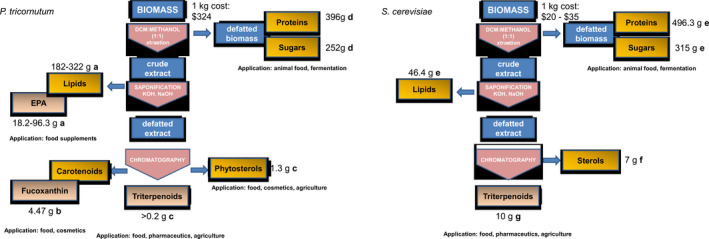
Figure 5 Schematic representation of proposed model for extraction procedure with a biorefinery approach of triterpenes from Phaeodactylum tricornutum and Saccharomyces cerevisiae biomass. The extraction procedure for triterpenoids from P. tricornutum simultaneously isolates more commercially relevant coproducts compared to the yeast S. cerevisiae. Cost of extraction is estimated to be assuming equal levels of extraction efficiency. Cost of biomass for P. tricornutum is higher (produced in Europe, Necton), but market sizes of lipids omega 3 and carotenoids (unique products in microalgae) create cost offsets. References for panel A: a: *W. Yongmanitchai and O. P. Ward Growth of and Omega‐3 Fatty Acid Production by Phaeodactylum tricornutum under Different Culture Conditions Appl. Env. Micro., Feb. 1991, p. 419–425 0099‐2240/91/020419‐07$02.00/0, b: Yu‐Hong Yang, Lei Du, Masashi Hosokawa, Kazuo Miyashita, Yume Kokubun, Hisayoshi Arai and Hiroyuki Taroda. Fatty Acid and Lipid Class Composition of the Microalga Phaeodactylum tricornutum J. Oleo Sci. 66, (4) 363–368 (2017) https://doi.org/10.5650/jos.ess16205, c: this paper, d: S. M. Tibbetts, J. E. Milley, P. Santosh and J. Lall Chemical composition and nutritional properties of freshwater and marine microalgal biomass cultured in photobioreactors J Appl Phycol (2015) 27:1109–1119. References for panel B: e: International Journal of Environment, Agriculture and Biotechnology (IJEAB) Vol‐2, Issue‐2, Mar–Apr 2017 https://doi.org/10.22161/ijeab/2.2.2 ISSN: 2456–1878 Page | 558, f: M. Lamac Ka and J. S Ajbidor Ergosterol determination in Saccharomyces cerevisiae. Comparison of different methods. Biotech. Tech. 11, 723–725 (1997), g: E. Czarnotta, M. Dianat, M. Korf, F. Granica, J. Merz, J. Maury, S. A. Baallal Jacobsen, J. Förster, B. E. Ebert, and L. M. Blank. Fermentation and purification strategies for the production of betulinic acid and its lupane‐ type precursors in Saccharomyces cerevisiae. Biotech. Bioeng. 114, 2528–2538 (2017) https://doi.org/10.1002/bit.26377
Figure 5 Schematic representation of proposed model for extraction procedure with a biorefinery approach of triterpenes from Phaeodactylum tricornutum and Saccharomyces cerevisiae biomass. The extraction procedure for triterpenoids from P. tricornutum simultaneously isolates more commercially relevant coproducts compared to the yeast S. cerevisiae. Cost of extraction is estimated to be assuming equal levels of extraction efficiency. Cost of biomass for P. tricornutum is higher (produced in Europe, Necton), but market sizes of lipids omega 3 and carotenoids (unique products in microalgae) create cost offsets. References for panel A: a: *W. Yongmanitchai and O. P. Ward Growth of and Omega‐3 Fatty Acid Production by Phaeodactylum tricornutum under Different Culture Conditions Appl. Env. Micro., Feb. 1991, p. 419–425 0099‐2240/91/020419‐07$02.00/0, b: Yu‐Hong Yang, Lei Du, Masashi Hosokawa, Kazuo Miyashita, Yume Kokubun, Hisayoshi Arai and Hiroyuki Taroda. Fatty Acid and Lipid Class Composition of the Microalga Phaeodactylum tricornutum J. Oleo Sci. 66, (4) 363–368 (2017) https://doi.org/10.5650/jos.ess16205, c: this paper, d: S. M. Tibbetts, J. E. Milley, P. Santosh and J. Lall Chemical composition and nutritional properties of freshwater and marine microalgal biomass cultured in photobioreactors J Appl Phycol (2015) 27:1109–1119. References for panel B: e: International Journal of Environment, Agriculture and Biotechnology (IJEAB) Vol‐2, Issue‐2, Mar–Apr 2017 https://doi.org/10.22161/ijeab/2.2.2 ISSN: 2456–1878 Page | 558, f: M. Lamac Ka and J. S Ajbidor Ergosterol determination in Saccharomyces cerevisiae. Comparison of different methods. Biotech. Tech. 11, 723–725 (1997), g: E. Czarnotta, M. Dianat, M. Korf, F. Granica, J. Merz, J. Maury, S. A. Baallal Jacobsen, J. Förster, B. E. Ebert, and L. M. Blank. Fermentation and purification strategies for the production of betulinic acid and its lupane‐ type precursors in Saccharomyces cerevisiae. Biotech. Bioeng. 114, 2528–2538 (2017) https://doi.org/10.1002/bit.26377CC BY · PubMed Central
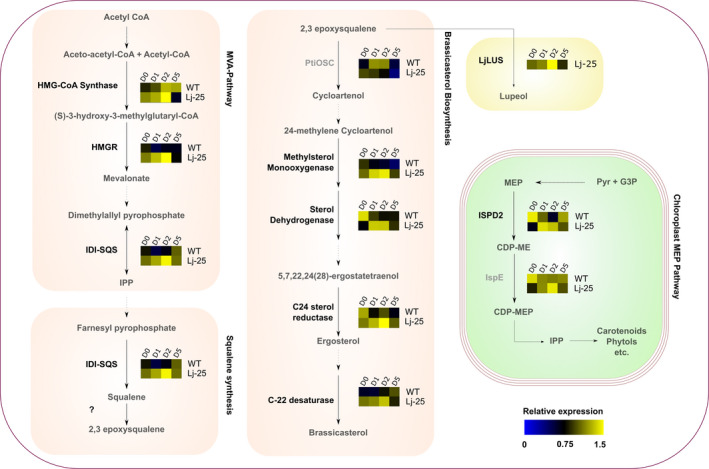
Figure 6 mRNA expression of sterol biosynthesis enzymes during a five‐day time course in the wild type (WT) and the LjLUS‐25 line. Schematic representation of sterol metabolism in Phaeodactylum tricornutum, indicating the gene selected for mRNA expression analysis and relative heat map for WT and LjLUS‐25 line. Values are the expression relative to the geometric average of the RP3a and UBQ reference genes. Transcripts not significantly different between wt and LjLUS are indicated in grey. Enzymes involved in the cytosolic MVA pathway: HMGS: hydroxymethylglutaryl‐CoA synthase; HMGR: 3‐hydroxy‐3‐methyl‐glutaryl‐coenzyme A reductase; IDI‐SQS: isopentenyl diphosphate isomerase‐squalene synthase. Enzymes involved in brassicasterol biosynthesis: PtOSC: oxidosqualene cyclase, methylsterol monooxygenase, sterol dehydrogenase, C24 sterol reductase, C22 sterol desaturase. Enzymes involved in the plastidial MEP pathway: ISPD2: 2‐C‐methyl‐d‐erythritol 4‐phosphate cytidylyltransferase, ISP‐E: 4‐diphosphocytidyl‐2‐C‐methyl‐d‐erythritol kinase. In the yellow box, the non‐native lupeol synthase from Lotus japonicus, introduced in our engineered strain LjLUS25. Dashed lines indicate multiple reactions. Gene accession numbers are mentioned in the results section. Precursor abbreviations: IPP: Isopentyl pyrophosphate, MEP: 2‐C‐methyl‐d‐erythritol 4‐phosphate, CDP‐ME: 4‐diphosphocytidyl‐2‐ c ‐methylerythritol, CDP‐MEP: 4‐diphosphocytidyl‐2‐ c ‐methyl‐d‐erythritol 2‐phosphate, DMAP: dimethylallyl pyrophosphate, G3P: glycerol 3‐phosphate, Pyr: pyruvate.
Figure 6 mRNA expression of sterol biosynthesis enzymes during a five‐day time course in the wild type (WT) and the LjLUS‐25 line. Schematic representation of sterol metabolism in Phaeodactylum tricornutum, indicating the gene selected for mRNA expression analysis and relative heat map for WT and LjLUS‐25 line. Values are the expression relative to the geometric average of the RP3a and UBQ reference genes. Transcripts not significantly different between wt and LjLUS are indicated in grey. Enzymes involved in the cytosolic MVA pathway: HMGS: hydroxymethylglutaryl‐CoA synthase; HMGR: 3‐hydroxy‐3‐methyl‐glutaryl‐coenzyme A reductase; IDI‐SQS: isopentenyl diphosphate isomerase‐squalene synthase. Enzymes involved in brassicasterol biosynthesis: PtOSC: oxidosqualene cyclase, methylsterol monooxygenase, sterol dehydrogenase, C24 sterol reductase, C22 sterol desaturase. Enzymes involved in the plastidial MEP pathway: ISPD2: 2‐C‐methyl‐d‐erythritol 4‐phosphate cytidylyltransferase, ISP‐E: 4‐diphosphocytidyl‐2‐C‐methyl‐d‐erythritol kinase. In the yellow box, the non‐native lupeol synthase from Lotus japonicus, introduced in our engineered strain LjLUS25. Dashed lines indicate multiple reactions. Gene accession numbers are mentioned in the results section. Precursor abbreviations: IPP: Isopentyl pyrophosphate, MEP: 2‐C‐methyl‐d‐erythritol 4‐phosphate, CDP‐ME: 4‐diphosphocytidyl‐2‐ c ‐methylerythritol, CDP‐MEP: 4‐diphosphocytidyl‐2‐ c ‐methyl‐d‐erythritol 2‐phosphate, DMAP: dimethylallyl pyrophosphate, G3P: glycerol 3‐phosphate, Pyr: pyruvate.CC BY · PubMed Central
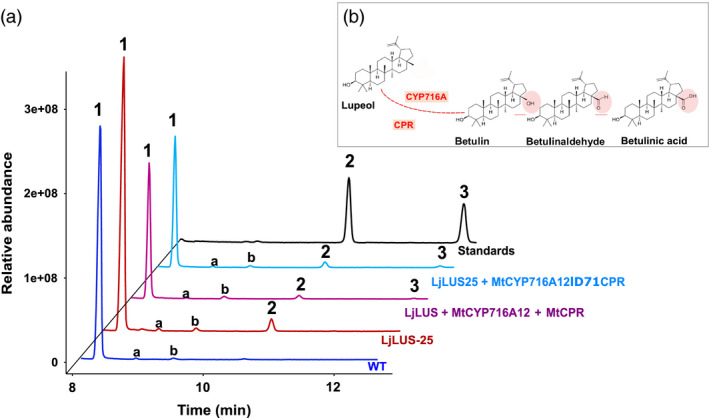
Figure 7 Betulin production in Phaeodactylum tricornutum transformant lines. (a) GC‐MS analysis of WT (blue), LjLUS‐25 containing only the Lotus japonicus lupeol synthase (LjLUS) (red); transformant line with constructs harbouring L. japonicus lupeol synthase (LjLUS), Medicago truncatula cytochrome P450 (MtCYP716A12) and cytochrome P450 reductase (MtCPR) in WT background (purple); transformant line with construct harbouring fused P450‐reductase protein MtCYP716A12λΔ72CPR in LjLUS‐25 background (light blue); standards (black). Peak as indicated 1. Brassicasterol; 2. Lupeol; 3. Betulin. (b) Detail of CYP716A enzyme reaction. The oxidation at C28 leads to betulin intermediate, which is converted to betulin aldehyde, and betulinic acid.
Figure 7 Betulin production in Phaeodactylum tricornutum transformant lines. (a) GC‐MS analysis of WT (blue), LjLUS‐25 containing only the Lotus japonicus lupeol synthase (LjLUS) (red); transformant line with constructs harbouring L. japonicus lupeol synthase (LjLUS), Medicago truncatula cytochrome P450 (MtCYP716A12) and cytochrome P450 reductase (MtCPR) in WT background (purple); transformant line with construct harbouring fused P450‐reductase protein MtCYP716A12λΔ72CPR in LjLUS‐25 background (light blue); standards (black). Peak as indicated 1. Brassicasterol; 2. Lupeol; 3. Betulin. (b) Detail of CYP716A enzyme reaction. The oxidation at C28 leads to betulin intermediate, which is converted to betulin aldehyde, and betulinic acid.CC BY · PubMed Central

Verification

Claims the paper makes

The claims and statistics of this paper haven’t been checked yet.

Run the check — free, no account needed. It reads the open-access text and checks the sources it cites.

A few free checks a day · papers already verified open instantly · results are public

Claims other papers make about this one

Each is checked against this paper’s own text: does it say what the citing paper says it does?

Self-check

Percentages, sums and reported differences re-computed from the paper’s own numbers.

The self-check needs the paper’s full text.

Citations

Cites

Show all 96 references

Cited by

Sorted by citations

See all 129

Metadata

Authors
D'Adamo, S., Schiano di Visconte, G., Lowe, G., Szaub‐Newton, J., Beacham, T., Landels, A., Allen, M. J., Spicer, A., & Matthijs, M.
Affiliations
  • Eden Laboratory Algenuity Stewartby UK
  • Eden Project (GB)
  • Plymouth Marine Laboratory (GB)
  • Rothamsted Research (GB)
  • University of Exeter (GB)
Corresponding author
Matthijs, Michiel
Venue
Plant Biotechnology Journal
Publisher
Wiley
Published
2018-06-19
Volume
17
Issue
1
Pages
75-87
ISSN
  • 1467-7644 (ISSN-L)
  • 1467-7652
OpenAlex
W2800109986
Cited by
129
References
96
Citations by year
2026: 12 · 2025: 21 · 2024: 12 · 2023: 19 · 2022: 16 · 2021: 20 · 2020: 14 · 2019: 12 · 2018: 3
FWCI
4.36
Type
journal article
Language
en
Open access
Locations
  • Plant Biotechnology Journal (publishedVersion, cc-by)
  • Europe PMC (PubMed Central) (publishedVersion, other-oa)
  • PubMed Central (publishedVersion, cc-by)
  • PubMed (publishedVersion)
  • Marine Biological Association (acceptedVersion)
  • Socio-Environmental Systems Modeling (acceptedVersion, cc-by)
  • Data Archiving and Networked Services (DANS) (submittedVersion, cc-by)
Funders
Seventh Framework Programme (FP7/2007‐2013/, 613692)
Topics
  • Life Sciences › Biochemistry, Genetics and Molecular Biology › Molecular Biology › Plant biochemistry and biosynthesis
  • Physical Sciences › Energy › Renewable Energy, Sustainability and the Environment › Algal biology and biofuel production
  • Life Sciences › Biochemistry, Genetics and Molecular Biology › Molecular Biology › Microbial Metabolic Engineering and Bioproduction
Keywords
Phaeodactylum tricornutum, betulin, lupeol, oxidosqualene cyclase, cytochrome P450, mevalonate pathway, sterol biosynthesis, pathway engineering, microalgae, photobioreactors, high-value metabolites
MeSH terms
Lotus, Lupanes, Betulinic Acid, Cytochrome P-450 Enzyme System, Genetic Engineering, Terpenes, Triterpenes, Diatoms, Bioreactors, Intramolecular Transferases, Plants, Genetically Modified, Medicago truncatula, Pentacyclic Triterpenes

About these checks

Registry, retraction, Cites and statistics results are computed, not judged, with one exception: a printed reference that no index lists is read once by a model before it counts as a citation error. Claims are extracted by a model and kept only when their quote appears verbatim in the text; each cited source is then checked, with a model’s help, for whether it says what the claim relies on. Those verdicts can be wrong — read the claim’s quote and the cited source before relying on one.

Statistics and arithmetic are recomputed, not judged.

Confidence bands are shown only for fields calibrated on our annotated test set. None is calibrated yet, so no band is shown.

What counts as a claim ›How we measure confidence ›How we check this ›

Are you an author, or do you see a problem with this page? Request a review