

The DOI matches its Crossref record; 60 of the 60 references it cites were found in a registry or an index; none of the 67 sources its claims cite is checked for support yet.
Effortful listening under the microscope: Examining relations between pupillometric and subjective markers of effort and tiredness from listening
Open accessAbstract
Effort during listening is commonly measured using the task‐evoked pupil response (TEPR); a pupillometric marker of physiological arousal. However, studies to date report no association between TEPR and perceived effort. One possible reason for this is the way in which self‐report effort measures are typically administered, namely as a single data point collected at the end of a testing session. Another possible reason is that TEPR might relate more closely to the experience of tiredness from listening than to effort per se. To examine these possibilities, we conducted two preregistered experiments that recorded subjective ratings of effort and tiredness from listening at multiple time points and examined their covariance with TEPR over the course of listening tasks varying in levels of acoustic and attentional demand. In both experiments, we showed a within‐subject association between TEPR and tiredness from listening, but no association between TEPR and effort. The data also suggest that the effect of task difficulty on the experience of tiredness from listening may go undetected using the traditional approach of collecting a single data point at the end of a listening block. Finally, this study demonstrates the utility of a novel correlation analysis technique (“rmcorr”), which can be used to overcome statistical power constraints commonly found in the literature. Teasing apart the subjective and physiological mechanisms that underpin effortful listening is a crucial step toward addressing these difficulties in older and/or hearing‐impaired individuals.
Overview
CoChat Summary
TL;DR
Across two preregistered experiments, task-evoked pupil response (TEPR) tracked within-subject changes in tiredness from listening but not subjective effort. The authors argue TEPR may be a physiological marker of listening-related tiredness/arousal rather than effort per se.
Key findings
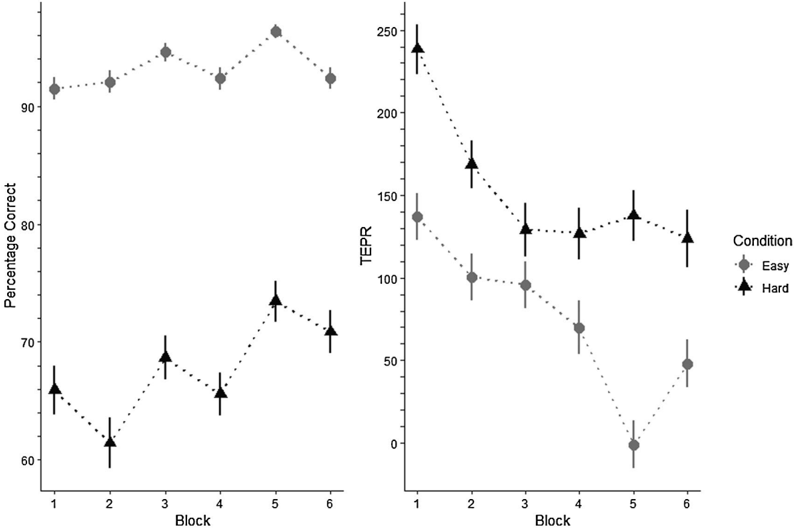
- In Experiment 1, TEPR was larger in the hard than easy condition (hard M = 154.94, SE = 25.79; easy M = 77.06, SE = 19.98; F(1,27) = 30.51, p < .001, partial η² = 0.53), and TEPR decreased over time (F(1,27) = 39.82, p < .001, partial η² = 0.60).
- Subjective effort and tiredness from listening were higher in the hard than easy condition in Experiment 1: effort hard M = 66.49, SE = 2.23 vs. easy M = 32.28, SE = 2.49, F(1,27) = 196.78, p < .001, partial η² = 0.88; tiredness hard M = 16.85, SE = 2.69 vs. easy M = 7.07, SE = 2.77, F(1,27) = 5.35, p = .03, partial η² = 0.17.
- Rmcorr showed a negative within-subject association between TEPR and tiredness from listening in Experiment 1 (r = −.40, 95% CI [−.53, −.25]) and Experiment 2 (r = −.48, 95% CI [−.63, −.31]), but no association between TEPR and effort in either experiment (Exp 1 r = .03, 95% CI [−.14, .19]; Exp 2 r = .03, 95% CI [−.18, .23]).
- In Experiment 2, TEPR decreased over time (F(1,18) = 35.54, p < .001, partial η² = 0.66) and tiredness from listening increased over time (F(1,19) = 77.61, p < .001, partial η² = 0.80), while effort ratings showed no linear change over time (F(1,19) = 0.65, p = .43, partial η² = 0.03).
Methods
- Two preregistered experiments used speech recognition with IEEE sentences in a competing female-talker masker. Experiment 1 included 28 young adults (5 male), aged 18–30, with normal hearing; participants completed easy and hard SNR blocks (hard mean adapted SNR = −9.5 dB, SD = 1.75; easy = hard + 10 dB). Experiment 2 included 20 healthy young adults (2 male), aged 18–30, who completed one hard condition only (mean adapted SNR = −8.6 dB, SD = 1.88) over 120 trials lasting approximately 35–40 min.
- Pupil size was recorded with EyeLink 1000 Plus at 250 Hz; TEPR was baseline-corrected using the 2-s masker preceding target onset and calculated as relative change during the 3-s window after target speech onset.
- Subjective effort, tiredness from listening, and performance evaluation were collected repeatedly during listening. Analyses included repeated-measures ANOVAs, standard Pearson/Spearman correlations, and repeated-measures correlation (“rmcorr”) to examine within-subject associations.
Limitations
- The paper states that of 48 participants, only seven were male, so sex-related differences cannot be ruled out; it advocates a more balanced sex ratio in future research.
- The paper states that causality cannot be inferred from these correlational findings, and notes at least two possible causal interpretations for the negative TEPR–tiredness association.
- The text makes evident that both experiments used young, normal-hearing adults, so findings may not generalize to older and/or hearing-impaired individuals; Experiment 1’s rmcorr analyses were also not preregistered and were treated as exploratory.
Model-written summary. Check it against the paper before relying on it.
Integrity signals
Registry
Cites
Statistics
Figures


Verification
Claims the paper makes
0 Valid · 1 Not valid · 52 Not checked · 131 Own results and interpretations
A result the paper reports from its own data — it cites no other source for it, so there is none to check. The quote shows it is in the paper.
In the paper
“In both experiments, we showed a within-subject association between TEPR and tiredness from listening, but no association between TEPR and effort.”
§ Effortful listening under the microscope: Examining relations between pupillometric and subjective markers of effort and tiredness from listening > Abstract
plainstates an association- Asserted: passes — The authors put it forward as true.
- Checkable: passes — It can be checked against evidence.
- Load-bearing: passes — The paper’s conclusions depend on it.
- Based: passes — The paper gives a reason why it holds.
A result the paper reports from its own data — it cites no other source for it, so there is none to check. The quote shows it is in the paper.
In the paper
“In both experiments, we showed a within-subject association between TEPR and tiredness from listening, but no association between TEPR and effort.”
§ Effortful listening under the microscope: Examining relations between pupillometric and subjective markers of effort and tiredness from listening > Abstract
plain- Asserted: passes — The authors put it forward as true.
- Checkable: passes — It can be checked against evidence.
- Load-bearing: passes — The paper’s conclusions depend on it.
- Based: passes — The paper gives a reason why it holds.
A result the paper reports from its own data — it cites no other source for it, so there is none to check. The quote shows it is in the paper.
In the paper
“The data also suggest that the effect of task difficulty on the experience of tiredness from listening may go undetected using the traditional approach of collecting a single data point at the end of a listening block.”
§ Effortful listening under the microscope: Examining relations between pupillometric and subjective markers of effort and tiredness from listening > Abstract
hedged- Asserted: passes — The authors put it forward as true.
- Checkable: passes — It can be checked against evidence.
- Load-bearing: passes — The paper’s conclusions depend on it.
- Based: passes — The paper gives a reason why it holds.
- Rests on an assumption not shown here.
A result the paper reports from its own data — it cites no other source for it, so there is none to check. The quote shows it is in the paper.
In the paper
“There was a significant main effect of condition on performance accuracy (F (1,27) = 213.95,p < .001,partial η 2 = 0.89).”
§ Effortful listening under the microscope: Examining relations between pupillometric and subjective markers of effort and tiredness from listening > 1.3.1 | Speech recognition performance
plain- Asserted: passes — The authors put it forward as true.
- Checkable: passes — It can be checked against evidence.
- Load-bearing: passes — The paper’s conclusions depend on it.
- Based: passes — The paper gives a reason why it holds.
A result the paper reports from its own data — it cites no other source for it, so there is none to check. The quote shows it is in the paper.
In the paper
“There was a significant main effect of condition on effort ratings (F (1,27) = 196.78,p < .001,partial η 2 = 0.88).”
§ Effortful listening under the microscope: Examining relations between pupillometric and subjective markers of effort and tiredness from listening > 1.3.3 | Subjective ratings
plain- Asserted: passes — The authors put it forward as true.
- Checkable: passes — It can be checked against evidence.
- Load-bearing: passes — The paper’s conclusions depend on it.
- Based: passes — The paper gives a reason why it holds.
- Rests on an assumption not shown here.
105 more claims
Create a free account to see all 184 claims and to verify the 55 references still open.
- It may state two separate claims as one. 43
- Probably not a substantial claim. 37
- The quote only partly states this claim. 3
Statistics recomputed
Every reported test result, recomputed from its test statistic and degrees of freedom. A result shows as not adding up only once an independent check has confirmed it.
- ConsistentF(1, 27) = 213.95reported p < .001 · recomputed p < .001
“F (1,27) = 213.95,p < .001”
- ConsistentF(1, 27) = 29.6reported p < .001 · recomputed p < .001
“F (1,27) = 29.60,p < .001”
- ConsistentF(1, 27) = 2.64reported p = .12 · recomputed p = .116
“F (1,27) = 2.64, p = .12”
- ConsistentF(1, 27) = 30.51reported p < .001 · recomputed p < .001
“F (1,27) = 30.51,p < .001”
- ConsistentF(1, 27) = 39.82reported p < .001 · recomputed p < .001
“F (1,27) = 39.82,p < .001”
14 more recomputed tests
Create a free account to see every test the Stats check recomputed.
Self-check
Percentages, sums and reported differences re-computed from the paper’s own numbers.
Each contradiction between two passages listed here was confirmed by an independent check.
Rated minor: it would not touch a result — a value no result rests on, a p-value that stays on the same side of the significance level, or a conflict that is clerical, resolved elsewhere in the paper, or outside its own findings.
In the paper
§ Effortful listening under the microscope: Examining relations between pupillometric and subjective markers of effort and tiredness from listening > 3.1 | TEPR as a marker of tiredness from listening, not effort
“5. Speech recognition performance .05[-.16, .25]-.49 [-.62, -.32] .11”
§ Effortful listening under the microscope: Examining relations between pupillometric and subjective markers of effort and tiredness from listening > 3.1 | TEPR as a marker of tiredness from listening, not effort
“[-.30, .09].59[.44, .70]”
Rated minor: it would not touch a result — a value no result rests on, a p-value that stays on the same side of the significance level, or a conflict that is clerical, resolved elsewhere in the paper, or outside its own findings.
In the paper
§ Effortful listening under the microscope: Examining relations between pupillometric and subjective markers of effort and tiredness from listening > 3.2 | Relations between subjective measures
“Analyses of each condition subset in Experiment 1 yielded similar effect sizes for easy (r = .36)and hard (r = .28)conditions”
§ Effortful listening under the microscope: Examining relations between pupillometric and subjective markers of effort and tiredness from listening > 1.4 | Discussion
“4. Performance evaluation rating .05[-.22, .12]-.76 [-.83, -.69] -.36 [-.49, -.20]”
Citations
Cites
Statistical power analyses using G∗Power 3.1: tests for correlation and regression analyses
Faul, F., Erdfelder, E., Buchner, A., & Lang, A.-G. (2009) · Behavior Research Methods · doi:10.3758/brm.41.4.1149 · Cited by 37,615
Development of NASA-TLX (Task Load Index): Results of Empirical and Theoretical Research
(1988) · Advances in Psychology · doi:10.1016/s0166-4115(08)62386-9 · Cited by 15,003
Aston-Jones, G., & Cohen, J. D. (2005) · Annual Review of Neuroscience · doi:10.1146/annurev.neuro.28.061604.135709 · Cited by 4,472
The TRACE model of speech perception
McClelland, J. L., & Elman, J. L. (1986) · Cognitive Psychology · doi:10.1016/0010-0285(86)90015-0 · Cited by 2,956
Bakdash, J. Z., & Marusich, L. R. (2017) · Frontiers in Psychology · doi:10.3389/fpsyg.2017.00456 · Cited by 2,018
Hearing Impairment and Cognitive Energy: The Framework for Understanding Effortful Listening (FUEL)
Pichora-Fuller, M. K., Kramer, S. E., Eckert, M. A., Edwards, B., Hornsby, B. W. Y., Humes, L. E., Lemke, U., Lunner, T., Matthen, M., Mackersie, C. L., et al. (2016) · Ear & Hearing · doi:10.1097/aud.0000000000000312 · Cited by 1,318
IEEE Recommended Practice for Speech Quality Measurements
(1969) · IEEE Transactions on Audio and Electroacoustics · doi:10.1109/tau.1969.1162058 · Cited by 1,232
Pupillometry: Psychology, Physiology, and Function
Mathôt, S. (2018) · Journal of Cognition · doi:10.5334/joc.18 · Cited by 900
Voice and Articulation Drillbook
Seashore, C. E. (1940) · Music Educators Journal · doi:10.2307/3388520 · Cited by 892
Speech recognition in adverse conditions: A review.
Mattys, S. L., Davis, M. H., Bradlow, A. R., & Scott, S. K. (2012) · Language and Cognitive Processes · doi:10.1080/01690965.2012.705006 · Cited by 809
Self-citation
Research works printed but not linked: 3
- Hart S. G., 1988, Advances in psychology, 139
- Nike, 2020, Speech in noise mixing, signal to noise ratio
- RStudio Team, 2019, RStudio: Integrated Development for R
Cited by
Contadini-Wright, C., Magami, K., Mehta, N., & Chait, M. (2023) · Journal of Neuroscience · doi:10.1523/jneurosci.0242-23.2023 · Cited by 49
Grenzebach, J., & Romanus, E. (2022) · Noise and Health · doi:10.4103/nah.nah_34_22 · Cited by 42
Shields, C., Sladen, M., Bruce, I. A., Kluk, K., & Nichani, J. (2023) · Trends in Hearing · doi:10.1177/23312165221137116 · Cited by 40
Listening effort and fatigue in native and non-native primary school children
Brännström, K. J., Rudner, M., Carlie, J., Sahlén, B., Gulz, A., Andersson, K., & Johansson, R. (2021) · Journal of Experimental Child Psychology · doi:10.1016/j.jecp.2021.105203 · Cited by 39
Older adults show a more sustained pattern of effortful listening than young adults.
McGarrigle, R., Knight, S., Rakusen, L. L., Geller, J., & Mattys, S. L. (2021) · Psychology and Aging · doi:10.1037/pag0000587 · Cited by 36
Self-citation
Metadata
- Authors
- McGarrigle, R., Rakusen, L., & Mattys, S.
- Affiliations
- University of York (GB)
- Corresponding author
- McGarrigle, Ronan
- Venue
- Psychophysiology
- Publisher
- Wiley
- Published
- 2020-10-08
- Volume
- 58
- Issue
- 1
- Pages
- e13703-e13703
- ISSN
- 0048-5772 (ISSN-L)
- 1469-8986
- OpenAlex
- W3092441470
- Cited by
- 43
- References
- 60
- Citations by year
- 2026: 1 · 2025: 8 · 2024: 8 · 2023: 14 · 2022: 5 · 2021: 7
- FWCI
- 5.83
- Type
- journal article
- Language
- en
- Open access
- hybrid
- doi.org
- Licence
- Locations
- Psychophysiology (publishedVersion, cc-by)
- PsyArXiv (OSF Preprints) (submittedVersion, cc-by)
- PubMed (publishedVersion)
- White Rose Research Online (University of Leeds, The University of Sheffield, University of York) (submittedVersion)
- PsyArXiv (OSF Preprints) (submittedVersion)
- Funders
- Economic and Social Research Council (ES/R003572/1)
- Topics
- Health Sciences › Health Professions › Speech and Hearing › Hearing Loss and Rehabilitation
- Life Sciences › Neuroscience › Sensory Systems › Hearing, Cochlea, Tinnitus, Genetics
- Life Sciences › Neuroscience › Cognitive Neuroscience › Neuroscience and Music Perception
- Keywords
- listening effort, pupillometry, perceived effort, task difficulty, attentional demands, statistical power, older adults, hearing-impaired listeners
- MeSH terms
- Adolescent, Adult, Attention, Female, Humans, Male, Pupil, Speech Acoustics, Speech Perception, Recognition, Psychology, Young Adult
About these checks
Registry, retraction, Cites and statistics results are computed, not judged, with one exception: a printed reference that no index lists is read once by a model before it counts as a citation error. Claims are extracted by a model and kept only when their quote appears verbatim in the text; each cited source is then checked, with a model’s help, for whether it says what the claim relies on. Those verdicts can be wrong — read the claim’s quote and the cited source before relying on one.
A language model drew the claims from the paper on 2026-11-19, under version 3 of the claim definition (model deepseek-v4.1-flash, prompt extract-v3).
A second model labelled each claim on 2026-11-19 (model jev-1.13-20260917, definition revision gold-guideline-v0.2).
Statistics and arithmetic are recomputed, not judged.
Confidence bands are shown only for fields calibrated on our annotated test set. None is calibrated yet, so no band is shown.
What counts as a claim ›How we measure confidence ›How we check this ›
Are you an author, or do you see a problem with this page? Request a review
How to cite
Cite CoChat for the checks on this page, and the paper for its own findings.
- This page
- CoChat. (2026). Citation check: Effortful listening under the microscope: Examining relations between pupillometric and subjective markers of effort and tiredness from listening. https://app.cochat.ai/papers/10.1111/psyp.13703
- The paper
- McGarrigle, R., Rakusen, L., & Mattys, S. (2021). Effortful listening under the microscope: Examining relations between pupillometric and subjective markers of effort and tiredness from listening. Psychophysiology. https://doi.org/10.1111/psyp.13703
Data sources
Bibliographic data: Semantic Scholar, OpenAlex, Crossref.
Contains information from the Semantic Scholar Academic Graph Datasets, made available under the ODC Attribution License (ODC-BY 1.0).
Semantic Scholar’s data is described in: Kinney, R., et al. (2023). The Semantic Scholar Open Data Platform. arXiv:2301.10140.
