

Effects of plasmapheresis frequency on health status and exercise performance in men: A randomized controlled trial
Open accessPublished version of a preprint
The DOI matches its Crossref record; 25 of the 25 references it cites were found in a registry or an index; none of the 39 sources its claims cite is checked for support yet.
Abstract
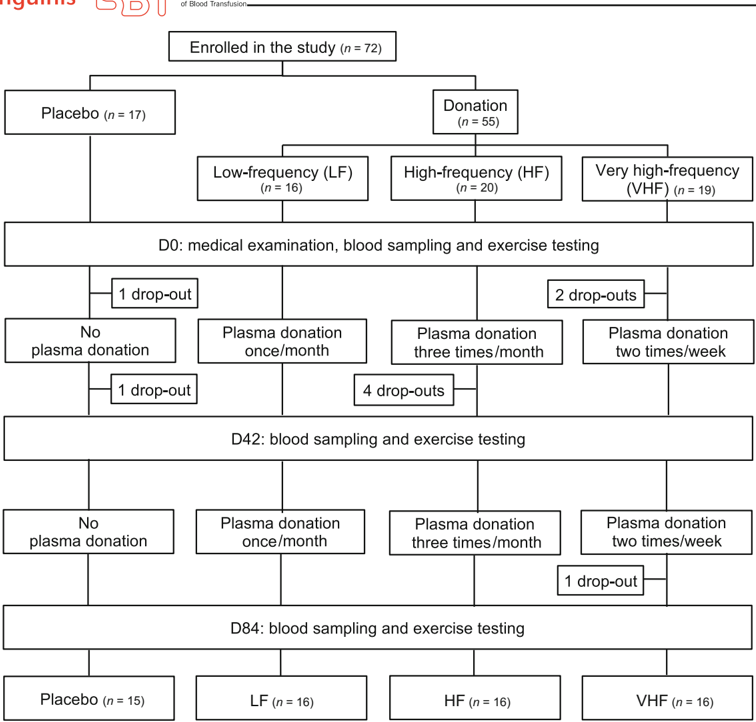
Background and Objectives: Most research studies on the effects of repeated plasma donation are observational with different study limitations, resulting in high uncertainty on the link between repeated plasma donation and health consequences. Here, we prospectively investigated the safety of intensive or less intensive plasma donation protocols. Materials and Methods: Sixty‐three male subjects participated in this randomized controlled trial and were divided into low‐frequency (LF, once/month, n = 16), high‐frequency (HF, three times/month, n = 16), very high‐frequency (VHF, two times/week, n = 16) and a placebo (P, once/month, n = 15) groups. Biochemical, haematological, clinical, physiological and exercise‐related data were collected before (D0), after 1½ months (D42) and after 3 months (D84) of donation. Results: In VHF, red blood cells, haemoglobin and haematocrit levels decreased while reticulocyte levels increased from D0 to D84. In both HF and VHF, plasma ferritin levels were lower at D42 and D84 compared to D0. In VHF, plasma levels of albumin, immunoglobulin G (IgG), immunoglobulin A (IgA) and immunoglobulin M (IgM) dropped from D0 to D42 and remained lower at D84 than at D0. In HF, plasma IgG, IgA and IgM were lower at D42, and IgG and IgM were lower at D84, compared to D0. Few adverse events were reported in HF and VHF. Repeated plasma donation had no effect on blood pressure, body composition or exercise performance. Conclusion: VHF plasmapheresis may result in a large reduction in ferritin and IgG levels. HF and VHF plasmapheresis may result in little to no difference in other biochemical, haematological, clinical, physiological and exercise‐related parameters.
Overview
CoChat Summary
TL;DR
In a 3-month randomized controlled trial in men, very high-frequency plasmapheresis (twice weekly) reduced ferritin and IgG levels, with clinically meaningful drops, while high-frequency and very high-frequency donation caused few adverse events and little to no difference in most other biochemical, haematological, physiological, and exercise parameters. The authors conclude VHF may lower ferritin and IgG substantially, but repeated plasma donation did not affect blood pressure, body composition, or exercise performance.
Key findings
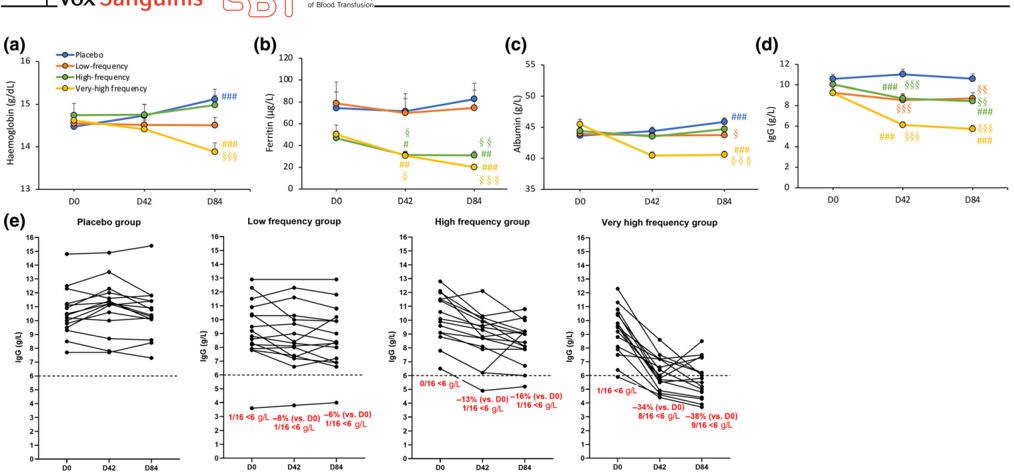
- In VHF, ferritin fell from 50.2 to 20.1 μg/L (60% reduction) and IgG from 9.23 to 5.73 g/L (38% reduction); 9/16 (56%) had IgG <6 g/L at D84. VHF also decreased red blood cells, haemoglobin, and haematocrit and increased reticulocytes from D0 to D84.
- In HF and VHF, plasma ferritin was lower at D42 and D84 vs D0. In HF, IgG, IgA, and IgM were lower at D42, and IgG and IgM lower at D84; in VHF, albumin, IgG, IgA, and IgM dropped from D0 to D42 and remained lower at D84.
- Few adverse events occurred: 5 haematomas, 5 vasovagal reactions, and 5 anaemia events in four VHF donors; no serious adverse events were reported.
- Repeated plasma donation had no effect on blood pressure, body composition, or exercise performance; the authors state other statistically significant differences were within normal ranges and of no clinical importance.
Methods
- Randomized controlled trial at UCLouvain, Belgium, March–December 2022; 63 male subjects after dropouts: placebo once/month (n=15), low-frequency once/month (n=16), high-frequency three times/month (n=16), and very high-frequency twice/week (n=16). Inclusion: male, age 18–50 years, BMI 20–28 kg/m², no contraindication to maximum-intensity exercise.
- Measurements before first donation (D0), after 1.5 months (D42), and after 3 months (D84): blood biochemistry/haematology, blood pressure, body composition by DXA, grip and leg strength, cycling VO₂peak, and adverse events. Plasma donation was maximum 650 mL; placebo had a simulated donation with NaCl 0.9%.
- Analysis used mixed ANOVA for repeated measures with Sidak correction, p<0.05; power analysis required 64 subjects (16 per group).
Limitations
- Stated: only middle-aged men and one new donor were included, limiting external validity to new donors, women, or elderly populations; the 3-month duration cannot exclude longer-term effects; randomization was sub-optimal because allocation sometimes conflicted with participant availability.
- Evident from the text: VHF compliance was low (5/16, 31% fully compliant; some missed up to 10 donations) and dropouts were excluded, which may dilute observed effects; small group sizes and few adverse events limit precision.
Model-written summary. Check it against the paper before relying on it.
Integrity signals
Registry
Cites
Statistics
Figures

Verification
Claims the paper makes
0 Valid · 0 Not valid · 18 Not checked · 83 Own results and interpretations
A result the paper reports from its own data — it cites no other source for it, so there is none to check. The quote shows it is in the paper.
In the paper
“The maximum power output decreased from D0 to D42 in LF ( p = 0.019) and from D0 to D42 (p = 0.013) and D84 (p = 0.012) in VHF (Figure 3a).”
§ Effects of plasmapheresis frequency on health status and exercise performance in men: A randomized controlled trial > No effect of repeated plasma donation on exercise performance
plainstates a cause- Asserted: passes — The authors put it forward as true.
- Checkable: passes — It can be checked against evidence.
- Load-bearing: passes — The paper’s conclusions depend on it.
- Based: passes — The paper gives a reason why it holds.
A result the paper reports from its own data — it cites no other source for it, so there is none to check. The quote shows it is in the paper.
In the paper
“Albumin and IgG levels at D42 and D84 in VHF were lower than those of P at the same time (p < 0.01-0.001).”
§ Effects of plasmapheresis frequency on health status and exercise performance in men: A randomized controlled trial > VHF donation affects IgG levels
plainstates an association- Asserted: passes — The authors put it forward as true.
- Checkable: passes — It can be checked against evidence.
- Load-bearing: unclear — It is unclear whether the paper’s conclusions depend on it.
- Based: passes — The paper gives a reason why it holds.
A result the paper reports from its own data — it cites no other source for it, so there is none to check. The quote shows it is in the paper.
In the paper
“Compared to D0, total cholesterol levels were higher at D42 in HF ( p < 0.001) and at D84 in P (p = 0.014), LF ( p = 0.049) and HF ( p = 0.005).”
§ Effects of plasmapheresis frequency on health status and exercise performance in men: A randomized controlled trial > No effect of repeated plasma donation on glycaemia, insulinemia and cholesterol levels
plainstates an association- Asserted: passes — The authors put it forward as true.
- Checkable: passes — It can be checked against evidence.
- Load-bearing: unclear — It is unclear whether the paper’s conclusions depend on it.
- Based: passes — The paper gives a reason why it holds.
A result the paper reports from its own data — it cites no other source for it, so there is none to check. The quote shows it is in the paper.
In the paper
“In HF, compared to D0, plasma IgG (p < 0.001), IgA (p = 0.011) and IgM (p = 0.006) were lower at D42, and IgG (p < 0.001) and IgM (p < 0.001) lower at D84.”
§ Effects of plasmapheresis frequency on health status and exercise performance in men: A randomized controlled trial > VHF donation affects IgG levels
plain- Asserted: passes — The authors put it forward as true.
- Checkable: passes — It can be checked against evidence.
- Load-bearing: unclear — It is unclear whether the paper’s conclusions depend on it.
- Based: passes — The paper gives a reason why it holds.
A result the paper reports from its own data — it cites no other source for it, so there is none to check. The quote shows it is in the paper.
In the paper
“Fat-free mass and fat-free mass + bone mineral content were lower at D84 compared to D0 ( p = 0.040 and p = 0.049, respectively) in P (Table 2).”
§ Effects of plasmapheresis frequency on health status and exercise performance in men: A randomized controlled trial > No effect of repeated plasma donation on body composition
plain- Asserted: passes — The authors put it forward as true.
- Checkable: passes — It can be checked against evidence.
- Load-bearing: passes — The paper’s conclusions depend on it.
- Based: passes — The paper gives a reason why it holds.
50 more claims
Create a free account to see all 101 claims and every source verdict.
- It may state two separate claims as one. 35
- Probably not a substantial claim. 20
- The quote only partly states this claim. 1
Claims other papers make about this one
Each is checked against this paper’s own text: does it say what the citing paper says it does?
In the citing paper
“For instance, there is evidence that IgG falls more than 1 g/L in very frequent donors [29].”
From Use of immunoglobulin Ghomeostatic set point and recovery time in plasmapheresis donor safety monitoring: A retrospective observational cohort study (2025) · cites this paper as [29]
Self-check
Percentages, sums and reported differences re-computed from the paper’s own numbers.
Each contradiction between two passages listed here was confirmed by an independent check.
Rated major: it would touch a result — a value a result rests on, reported and recomputed p-values on opposite sides of the significance level, two passages that conflict with no sign which is right, or a cited work retracted before this paper was published.
In the paper
§ Effects of plasmapheresis frequency on health status and exercise performance in men: A randomized controlled trial > DISCUSSION
“The maximum power output, maximum oxygen consumption or blood lactate levels were not modified by repeated plasma donation, whatever the intensity of the donation.”
§ Effects of plasmapheresis frequency on health status and exercise performance in men: A randomized controlled trial > No effect of repeated plasma donation on exercise performance
“The maximum power output decreased from D0 to D42 in LF ( p = 0.019) and from D0 to D42 (p = 0.013) and D84 (p = 0.012) in VHF (Figure 3a).VO 2 peak was higher at D42 compared to D0 in HF ( p = 0.009, Figure 3b).”
Rated minor: it would not touch a result — a value no result rests on, a p-value that stays on the same side of the significance level, or a conflict that is clerical, resolved elsewhere in the paper, or outside its own findings.
In the paper
§ Effects of plasmapheresis frequency on health status and exercise performance in men: A randomized controlled trial > DISCUSSION
“IgG levels were reduced even in the LF group, donating once a month, while IgA and IgM levels were decreased only in the HF and VHF groups.”
§ Effects of plasmapheresis frequency on health status and exercise performance in men: A randomized controlled trial > VHF donation affects IgG levels
“IgM (g/L) P 0.8 ± 0.1 0.9 ± 0.1 0.9 ± 0.1 LF 0.9 ± 0.1 0.8 ± 0.1 0.8 ± 0.1 #”
Citations
Cites
Sample Size Estimation in Clinical Research
Wang, X., & Ji, X. (2020) · Chest · doi:10.1016/j.chest.2020.03.010 · Cited by 452 · cited 1×
“A statistical power analysis was carried out to determine the optimum number of subjects needed to find a difference in total serum protein mean of 10% [8] with a standard deviation of 8% and a power of 80% according to the calculator developed by Wang and Ji [ 19].”
MethodClinical uses of intravenous immunoglobulin
Jolles, S., Sewell, W. A. C., & Misbah, S. A. (2005) · Clinical and Experimental Immunology · doi:10.1111/j.1365-2249.2005.02834.x · Cited by 374
Iron considerations for the athlete: a narrative review
Sim, M., Garvican-Lewis, L. A., Cox, G. R., Govus, A., McKay, A. K. A., Stellingwerff, T., & Peeling, P. (2019) · European Journal of Applied Physiology · doi:10.1007/s00421-019-04157-y · Cited by 274
Soldan, K., Barbara, J. A. J., Ramsay, M. E., & Hall, A. J. (2003) · Vox Sanguinis · doi:10.1046/j.1423-0410.2003.00296.x · Cited by 140
Schulzki, T., Seidel, K., Storch, H., Karges, H., Kiessig, S., Schneider, S., Taborski, U., Wolter, K., Steppat, D., Behm, E., et al. (2006) · Vox Sanguinis · doi:10.1111/j.1423-0410.2006.00794.x · Cited by 76 · cited 5×
“All studies that investigated IgG found reduced levels in donors with frequencies from once a month to twice a week, with a higher risk at falling below the normal range [4, 6, 8, 11].”
BackgroundInfluentialLaub, R., Baurin, S., Timmerman, D., Branckaert, T., & Strengers, P. (2010) · Vox Sanguinis · doi:10.1111/j.1423-0410.2010.01345.x · Cited by 57 · cited 3×
“All studies that investigated IgG found reduced levels in donors with frequencies from once a month to twice a week, with a higher risk at falling below the normal range [4, 6, 8, 11].”
BackgroundMethodZou, S., Musavi, F., Notari, E. P., Stramer, S. L., & Dodd, R. Y. (2010) · Transfusion · doi:10.1111/j.1537-2995.2010.02621.x · Cited by 50
Apheresis affects bone and mineral metabolism
Amrein, K., Katschnig, C. K., Sipurzynski, S., Stojaković, T., Lanzer, G., Stach, E., Pieber, T. R., & Dobnig, H. (2009) · Bone · doi:10.1016/j.bone.2009.11.008 · Cited by 50 · cited 2×
“The majority of the studies were retrospective [7 – 12] or limited to one single donation [13 – 15].”
BackgroundTran‐Mi, B., Storch, H., Seidel, K., Schulzki, T., Haubelt, H., Anders, C., Nagel, D., Siegler, K. E., Vogt, A., Seiler, D., et al. (2004) · Vox Sanguinis · doi:10.1111/j.0042-9007.2004.00408.x · Cited by 42 · cited 4×
“All studies that investigated IgG found reduced levels in donors with frequencies from once a month to twice a week, with a higher risk at falling below the normal range [4, 6, 8, 11].”
BackgroundInfluentialRobert, P. (2009) · Pharmaceuticals Policy and Law · doi:10.3233/ppl-2009-0250 · Cited by 40 · cited 1×
“As such, the demand for plasma as the starting material for the manufacture of intravenous immunoglobulin and other plasma derivatives is growing significantly and is expected to continue to increase [2].”
Background
Cited by
Haugen, M., Magnussen, K., Aarsland, T. E., Nissen-Meyer, L. S. H., & Strand, T. A. (2024) · Trials · doi:10.1186/s13063-024-08035-7 · Cited by 9
“The first randomized controlled trial (RCT) investigating the effect of plasma donation frequency on donor health [13] aimed to collect data on biochemical markers, physiological and exercise-related parameters, and adverse events (AEs) in donors donating plasma once per month to twice per week.”
BackgroundD'aes, T., van den Hurk, K., Schroyens, N., Mikkelsen, S., Severijns, P., De Buck, E., O'Leary, P., Tiberghien, P., Compernolle, V., Erikstrup, C., et al. (2024) · Transfusion Medicine Reviews · doi:10.1016/j.tmrv.2024.150851 · Cited by 9
Self-citationRemoortel, H. V., van den Hurk, K., Compernolle, V., O'Leary, P., Tiberghien, P., & Erikstrup, C. (2023) · Transfusion · doi:10.1111/trf.17601 · Cited by 9
Self-citationMacKay, K. J., Schiltz, F., & Vandekerckhove, P. G. (2024) · Vox Sanguinis · doi:10.1111/vox.13613 · Cited by 8
“A randomized controlled trial examined blood parameters across four plasma donation frequencies [12].”
BackgroundSelf-citationHaugen, M., Nissen‐Meyer, L. S. H., Strand, T. A., & Magnussen, K. (2025) · Vox Sanguinis · doi:10.1111/vox.70105 · Cited by 6
“The first RCT on plasmapheresis frequency [19] found clinically relevant IgG and ferritin reductions after 3 months of donations twice weekly.”
The availability of plasma donors and plasma: A sociologist's perspective
Merz, E. (2024) · Vox Sanguinis · doi:10.1111/vox.13588 · Cited by 5
Key Updates in the WADA 2025 Prohibited List: Implications for Competitive Sports
Michalik, M., Lorenc, T., Muras, M., Marcinkowski, K., Mikszta, N., Mikszta, J., & Marcinkowska, J. (2025) · Quality in Sport · doi:10.12775/qs.2025.42.61192 · Cited by 4
Thibert, J., von Bonsdorff, L., Plançon, J., de Angelis, V., So‐Osman, C., Erikstrup, C., Tiberghien, P., & van den Hurk, K. (2026) · Vox Sanguinis · doi:10.1111/vox.70245 · Cited by 3
“…by apheresis over the last few decades to meet the demand for production of PDMPs related to the increased patient needs has also raised the question of the impact of repeated plasma donations on the levels (i.e., the depletion effect) of plasma proteins such as immunoglobulins (Igs) [16].”
Donation-Induced Protein and Iron Depletion in High-Frequency Plasma Donors
Prinsze, F. J., Vrielink, H., Paalvast, Y., Lieshout-Krikke, R., & van den Hurk, K. (2025) · Transfusion Medicine Reviews · doi:10.1016/j.tmrv.2025.150951 · Cited by 2
Tiberghien, P., Rodrigues, B., Jacques, M., O'Leary, P., & Domanović, D. (2023) · Transfusion Clinique et Biologique · doi:10.1016/j.tracli.2023.09.390 · Cited by 2
Blood, sweat, and fears: Athletes' perceptions of blood donation and engagement in physical activity
Masser, B., Webster, H., Thorpe, R. D., & Jensen, K. S. (2023) · Transfusion · doi:10.1111/trf.17607 · Cited by 2
Warner, J. V., Drinkwater, M. J., Chu, G. J., Kelly, S., & McComish, J. S. (2025) · Vox Sanguinis · doi:10.1111/vox.13800 · Cited by 1
Plasma donation rates and infection risk: A multicentre observational study in Denmark
Kaspersen, K. A., Barkos, I., Hindhede, L., Mikkelsen, S., Dinh, K. M., Brøns, N., Træholt, J., Mikkelsen, C., Bay, J. T., Pedersen, O. B., et al. (2026) · Vox Sanguinis · doi:10.1111/vox.70300 · Cited by 1
“A recent Belgian RCT (63 male donors) showed that donating twice weekly for 12 weeks (per US guidelines) decreased IgG by 38%, while donating three times monthly (per European guidelines) led to an 11% reduction, with the steepest decline in the first 6 weeks [ 9].”
Consistent supply of global plasma for global patients
Fransen, M., Simon, T. L., Knowles, J., & Penrod, J. M. (2024) · Vox Sanguinis · doi:10.1111/vox.13771 · Cited by 1
“2 in Mortier et al., IgG levels were starting to stabilize and/or increase in both high-frequency (HF) and VHF groups on test day 84 [7].”
Relevance of circulating IgG levels as a marker of health in plasma donors
Laforce‐Lavoie, A., Deschênes, J., Cloutier, M., Lewin, A., & Bazin, R. (2026) · Transfusion · doi:10.1111/trf.70373
Plasma Donor Health Protection: Mapping Current Practices Through an International Survey
Someh, S. A. E., Spekman, M. L. C., Mikkelsen, S., Pouchol, É., O'Leary, P., Tiberghien, P., Georgsen, J., Sommerville, K., Remoortel, H. V., Erikstrup, C., et al. (2026) · Transfusion Medicine Reviews · doi:10.1016/j.tmrv.2026.151039
Germain, M., & Tiberghien, P. (2026) · Wiley eBooks · doi:10.1002/9781394292004.ch7
Metadata
- Authors
- Mortier, A., Khoudary, J., van Dooslaer de Ten Ryen, S., Lannoy, C., Benoit, N., Antoine, N., Copine, S., Van Remoortel, H., Vandekerckhove, P., Compernolle, V., & Deldicque, L.
- Affiliations
- UCLouvain (BE)
- Blood Services Belgian Red Cross Mechelen Belgium
- Institute of Neuroscience UCLouvain Louvain‐la‐Neuve Belgium
- Centre for Evidence‐Based Practice Belgian Red Cross Mechelen Belgium
- KU Leuven (BE)
- Ghent University (BE)
- Corresponding author
- Deldicque, Louise
- ORCID
- Venue
- Vox Sanguinis
- Publisher
- Wiley
- Published
- 2023-11-24
- Volume
- 119
- Issue
- 2
- Pages
- 134-143
- ISSN
- 0042-9007 (ISSN-L)
- 1423-0410
- OpenAlex
- W4388982443
- Cited by
- 17
- References
- 25
- Citations by year
- 2026: 5 · 2025: 4 · 2024: 5 · 2023: 3
- FWCI
- 2.73
- Type
- journal article
- Language
- en
- Open access
- hybrid
- doi.org
- Licence
- Locations
- Vox Sanguinis (publishedVersion, cc-by-nc)
- medRxiv (submittedVersion, cc-by-nc-nd)
- Ghent University Academic Bibliography (Ghent University) (publishedVersion, cc-by-nc)
- Lirias (publishedVersion, cc-by-nc)
- PubMed (publishedVersion)
- Digital Access to Libraries (submittedVersion, other-oa)
- Funders
- Vlaamse regering
- Topics
- Health Sciences › Medicine › Hematology › Blood donation and transfusion practices
- Health Sciences › Medicine › Physiology (medical) › Exercise and Physiological Responses
- Health Sciences › Medicine › Hematology › Blood transfusion and management
- Keywords
- plasmapheresis, exercise performance, health status, ferritin, immunoglobulins, hematological parameters, red blood cell indices, serum albumin, adverse events, men
- MeSH terms
- Ferritins, Health Status, Humans, Immunoglobulin A, Immunoglobulin G, Immunoglobulin M, Male, Plasmapheresis
About these checks
Registry, retraction, Cites and statistics results are computed, not judged, with one exception: a printed reference that no index lists is read once by a model before it counts as a citation error. Claims are extracted by a model and kept only when their quote appears verbatim in the text; each cited source is then checked, with a model’s help, for whether it says what the claim relies on. Those verdicts can be wrong — read the claim’s quote and the cited source before relying on one.
A language model drew the claims from the paper on 2026-11-28, under version 3 of the claim definition (model deepseek-v4.1-flash, prompt extract-v3).
A second model labelled each claim on 2026-11-28 (model jev-1.13-20260917, definition revision gold-guideline-v0.2).
Statistics and arithmetic are recomputed, not judged.
Confidence bands are shown only for fields calibrated on our annotated test set. None is calibrated yet, so no band is shown.
What counts as a claim ›How we measure confidence ›How we check this ›
Are you an author, or do you see a problem with this page? Request a review
Data sources
Bibliographic data: Semantic Scholar, OpenAlex, Crossref.
Contains information from the Semantic Scholar Academic Graph Datasets, made available under the ODC Attribution License (ODC-BY 1.0).
Semantic Scholar’s data is described in: Kinney, R., et al. (2023). The Semantic Scholar Open Data Platform. arXiv:2301.10140.
