

Variability in exercise tolerance and physiological responses to exercise prescribed relative to physiological thresholds and to maximum oxygen uptake
Open accessThe DOI matches its Crossref record; 44 of the 45 references it cites were found in a registry or an index.
Abstract
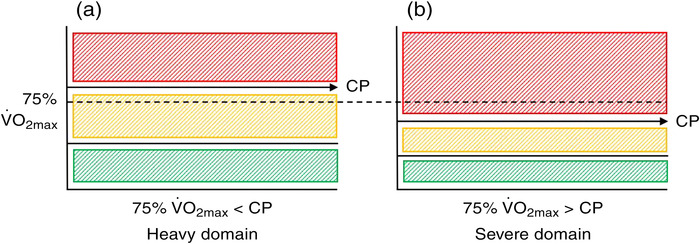
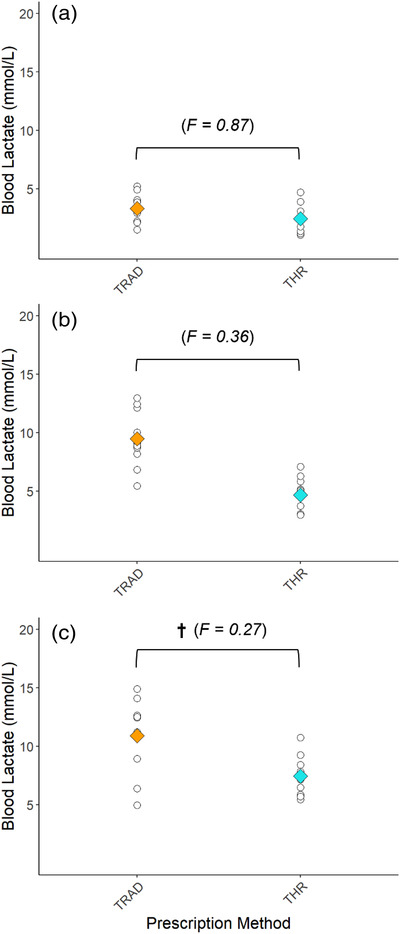
The objective of this study was to determine whether the variability in exercise tolerance and physiological responses is lower when exercise is prescribed relative to physiological thresholds (THR) compared to traditional intensity anchors (TRAD). Ten individuals completed a series of maximal exercise tests and a series of moderate (MOD), heavy (HVY) and severe intensity (HIIT) exercise bouts prescribed using THR intensity anchors (critical power and gas exchange threshold) and TRAD intensity anchors (maximum oxygen uptake; ). There were no differences in exercise tolerance or acute response variability between MOD THR and MOD TRAD . All individuals completed HVY THR but only 30% completed HVY TRAD . Compared to HVY THR , where work rates were all below critical power, work rates in HVY TRAD exceeded critical power in 70% of individuals. There was, however, no difference in acute response variability between HVY THR and HVY TRAD . All individuals completed HIIT THR but only 20% completed HIIT TRAD . The variability in peak ( F = 0.274) and average ( F = 0.318) blood lactate responses was lower in HIIT THR compared to HIIT TRAD . The variability in W′ depletion (the finite work capacity above critical power) after the final interval bout was lower in HIIT THR compared to HIIT TRAD ( F = 0.305). Using physiological thresholds to prescribe exercise intensity reduced the heterogeneity in exercise tolerance and physiological responses to exercise spanning the boundary between the heavy and severe intensity domains. To increase the precision of exercise intensity prescription, it is recommended that, where possible, physiological thresholds are used in place of .
Overview
The claims and statistics of this paper haven’t been checked yet.
Free: it reads the open-access text and checks the first 5 claims that cite a source we can check. Create a free account to check every claim.
Integrity signals
Registry
Cites
Statistics
Figures




Verification
Claims the paper makes
The claims and statistics of this paper haven’t been checked yet.
Free: it reads the open-access text and checks the first 5 claims that cite a source we can check. Create a free account to check every claim.
Claims other papers make about this one
Each is checked against this paper’s own text: does it say what the citing paper says it does?
In the citing paper
“However, despite engaging in exercise at the same relative intensity, not only young but also older populations exhibit significant variations in acute physiological responses to exercise and the time to task failure [601].”
From Global consensus on optimal exercise recommendations for enhancing healthy longevity in older adults (ICFSR) (2025) · cites this paper as [601]
Self-check
Percentages, sums and reported differences re-computed from the paper’s own numbers.
The self-check needs the paper’s full text.
Citations
Cites
Limiting factors for maximum oxygen uptake and determinants of endurance performance
BASSETT, D. R. (2000) · Medicine & Science in Sports & Exercise · doi:10.1097/00005768-200001000-00012 · Cited by 2,410
Anaerobic threshold and respiratory gas exchange during exercise.
Wasserman, K., Whipp, B. J., Koyl, S. N., & Beaver, W. L. (1973) · Journal of Applied Physiology · doi:10.1152/jappl.1973.35.2.236 · Cited by 2,094
Encyclopedia of research design
(2011) · Choice Reviews Online · doi:10.5860/choice.48-2447 · Cited by 1,910
Thompson, P. D., Arena, R., Riebe, D., & Pescatello, L. S. (2013) · Current Sports Medicine Reports · doi:10.1249/jsr.0b013e31829a68cf · Cited by 1,823
Acsm's Guidelines for Exercise Testing and Prescription
Acsm (2017) · Cited by 1,436
Milanović, Z., Sporiš, G., & Weston, M. (2015) · Sports Medicine · doi:10.1007/s40279-015-0365-0 · Cited by 923
Bouchard, C., An, P., Rice, T., Skinner, J. S., Wilmore, J. H., Gagnon, J., Pérusse, L., Leon, A. S., & Rao, D. C. (1999) · Journal of Applied Physiology · doi:10.1152/jappl.1999.87.3.1003 · Cited by 875
Mezzani, A., Hamm, L. F., Jones, A. M., McBride, P. E., Moholdt, T., Stone, J. A., Urhausen, A., & Williams, M. A. (2013) · European Journal of Preventive Cardiology · doi:10.1177/2047487312460484 · Cited by 550
Critical Power: An Important Fatigue Threshold in Exercise Physiology
POOLE, D. C., BURNLEY, M., VANHATALO, A., ROSSITER, H. B., & JONES, A. M. (2016) · Medicine & Science in Sports & Exercise · doi:10.1249/mss.0000000000000939 · Cited by 535
Measurement of the maximum oxygen uptake V̇ o 2max : V̇ o 2peak is no longer acceptable
Poole, D. C., & Jones, A. M. (2017) · Journal of Applied Physiology · doi:10.1152/japplphysiol.01063.2016 · Cited by 533 · cited 1×
“Work rate was set at 85% of the maximum power output achieved in the GXT and was performed to task failure (Poole & Jones, 2017).”
Method
Cited by
Izquierdo, M., de Souto Barreto, P., Arai, H., Bischoff-Ferrari, H. A., Cadore, E. L., Cesari, M., Chen, L.-K., Coen, P. M., Courneya, K. S., Duque, G., et al. (2025) · The Journal of nutrition, health and aging · doi:10.1016/j.jnha.2024.100401 · Cited by 273
A Perspective on High-Intensity Interval Training for Performance and Health
Coates, A. M., Joyner, M. J., Little, J. P., Jones, A. M., & Gibala, M. J. (2023) · Sports Medicine · doi:10.1007/s40279-023-01938-6 · Cited by 246
Inglis, E. C., Iannetta, D., Rasica, L., Mackie, M. Z., Keir, D. A., MacInnis, M. J., & Murias, J. M. (2024) · Medicine & Science in Sports & Exercise · doi:10.1249/mss.0000000000003406 · Cited by 65
Hodgkiss, D. D., Bhangu, G. S., Lunny, C., Jutzeler, C. R., Chiou, S., Walter, M., Lucas, S. J. E., Krassioukov, A. V., & Nightingale, T. E. (2023) · PLoS Medicine · doi:10.1371/journal.pmed.1004082 · Cited by 49
Unhjem, R. (2024) · Scandinavian Journal of Medicine and Science in Sports · doi:10.1111/sms.14637 · Cited by 34
Meyler, S., Swinton, P. A., Bottoms, L. M., Dalleck, L. C., Hunter, B., Sarzynski, M. A., Wellsted, D. M., Williams, C. J., & Muniz‐Pumares, D. (2024) · Sports Medicine · doi:10.1007/s40279-024-02125-x · Cited by 33
Self-citationHooren, B. V., Mennen, B., Gronwald, T., Bongers, B. C., & Rogers, B. (2023) · Journal of Sports Sciences · doi:10.1080/02640414.2023.2277034 · Cited by 30
Durability as an index of endurance exercise performance: Methodological considerations
Hunter, B., Maunder, E., JONES, A. M., Gallo, G., & Muniz‐Pumares, D. (2025) · Experimental Physiology · doi:10.1113/ep092120 · Cited by 36
Self-citationThe Training Intensity Distribution of Marathon Runners Across Performance Levels
Muniz‐Pumares, D., Hunter, B., Meyler, S., Maunder, E., & Smyth, B. (2024) · Sports Medicine · doi:10.1007/s40279-024-02137-7 · Cited by 21
Self-citationCritical power: a paradigm‐shift for benchmarking exercise testing and prescription
Poole, D. C., & JONES, A. M. (2023) · Experimental Physiology · doi:10.1113/ep091126 · Cited by 16
Benítez‐Muñoz, J. A., Benito, P. J., Guisado‐Cuadrado, I., Cupeiro, R., & Peinado, A. B. (2024) · European Journal of Applied Physiology · doi:10.1007/s00421-024-05622-z · Cited by 18
Rosenblat, M. A., Watt, J. A., Arnold, J. I., Treff, G., Sandbakk, Ø. B., Esteve-Lanao, J., Festa, L., Filipas, L., Galloway, S. D. R., Muñoz‐Pérez, I., et al. (2025) · Sports Medicine · doi:10.1007/s40279-024-02149-3 · Cited by 28
Birnbaumer, P., Dostal, T., Cipryan, L., & Hofmann, P. (2023) · Frontiers in Physiology · doi:10.3389/fphys.2023.1178913 · Cited by 16
Bossi, A. H., Naumann, U., Passfield, L., & Hopker, J. (2024) · European Journal of Applied Physiology · doi:10.1007/s00421-023-05340-y · Cited by 13
“…anchors (Lansley et al. 2011; McLellan and Skinner 1985; Meyler et al. 2023), critical power modelling (Ferguson et al. 2013; Jones and Vanhatalo 2017; Meyler et al. 2023), and maximal self-paced intervals (Villerius et al. 2008; Seiler and Sylta 2017; Nicolò et al. 2014; Brosnan et al. 2000).”
BackgroundResultInfluentialReuter, M., Rosenberger, F., Barz, A., Venhorst, A., Blanz, L., Hecksteden, A., & Meyer, T. (2023) · Sports Medicine - Open · doi:10.1186/s40798-023-00579-3 · Cited by 18
Remote Determination of Critical Speed and Critical Power in Recreational Runners
Hunter, B., Ledger, A., & Muniz‐Pumares, D. (2023) · International Journal of Sports Physiology and Performance · doi:10.1123/ijspp.2023-0276 · Cited by 15
Self-citationJohn, K., Kathuria, S., Peel, J., Page, J., Aitkenhead, R., Felstead, A., Heffernan, S. M., Jeffries, O., Tallent, J., & Waldron, M. (2024) · European Journal of Applied Physiology · doi:10.1007/s00421-024-05460-z · Cited by 14
Vascular dysfunction and the age‐related decline in critical power
Dorff, A., Bradford, C., Hunsaker, A., Atkinson, J., Rhees, J., Leach, O. K., & Gifford, J. R. (2023) · Experimental Physiology · doi:10.1113/ep091571 · Cited by 13
Gronwald, T., Horn, L., Schaffarczyk, M., & Hoos, O. (2024) · European Journal of Sport Science · doi:10.1002/ejsc.12175 · Cited by 12
Marcourt, C., Pin-Barre, C., Langeard, A., Rivera, C., Temprado, J.-J., & Laurin, J. (2025) · Scientific Reports · doi:10.1038/s41598-025-90719-4 · Cited by 13
The accuracy of fixed intensity anchors to estimate lactate thresholds in recreational runners
Nuuttila, O., Kaikkonen, P., Sievänen, H. T., Vasankari, T. J., & Kyröläinen, H. (2025) · European Journal of Applied Physiology · doi:10.1007/s00421-025-05748-8 · Cited by 15
Renaghan, E., Wittels, H. L., Feigenbaum, L. A., Wishon, M. J., Chong, S., Wittels, E. D., Hendricks, S. F., Hecocks, D., Bellamy, K., Girardi, J., et al. (2023) · Journal of Functional Morphology and Kinesiology · doi:10.3390/jfmk8030134 · Cited by 10
Fischer, J., Hävecker, F., Ji, S., Wahl, P., & Keller, S. (2025) · European Journal of Applied Physiology · doi:10.1007/s00421-025-05744-y · Cited by 12
Lei, T., Wang, I., Chen, Y., Liu, X., Fujii, N., Koga, S., Perry, B. G., Mündel, T., Wang, F., Cao, Y., et al. (2023) · Experimental Physiology · doi:10.1113/ep091429 · Cited by 13
Bras, P. G., Gonçalves, A. V., Reis, J., Moreira, R. I., Pereira‐da‐Silva, T., Rio, P., Timóteo, A. T., Silva, S., Soares, R. M., & Ferreira, F. (2023) · Life · doi:10.3390/life13101985 · Cited by 12
Acute Oxygen Consumption Response to Fast Start High-Intensity Intermittent Exercise
Miller, P., Perez, N., & Farrell, J. W. (2023) · Sports · doi:10.3390/sports11120238 · Cited by 11
Inglis, E. C., Rasica, L., Iannetta, D., Mackie, M. Z., Maturana, F. M., Keir, D. A., MacInnis, M. J., & Murias, J. M. (2025) · Medicine & Science in Sports & Exercise · doi:10.1249/mss.0000000000003697 · Cited by 12
Huang, Q., Li, J., Wang, J., & Liu, B. (2025) · Frontiers in Psychology · doi:10.3389/fpsyg.2025.1629818 · Cited by 9
Muniz‐Pumares, D., & Meyler, S. (2025) · Experimental Physiology · doi:10.1113/ep092258 · Cited by 8
Self-citationBenítez‐Muñoz, J. A., Alcocer‐Ayuga, M., Cupeiro, R., Guisado‐Cuadrado, I., Rojo‐Tirado, M. Á., Alfaro-Magallanes, V. M., Romero‐Parra, N., de Castro, E. A., Ramos‐Campo, D. J., Sotillo, A. A., et al. (2025) · European Journal of Sport Science · doi:10.1002/ejsc.12323 · Cited by 11
Gronwald, T., Schaffarczyk, M., Fohrmann, D., Hoos, O., & Hollander, K. (2025) · Physiological Reports · doi:10.14814/phy2.70177 · Cited by 7
Marcourt, C., Rivera, C., Tuvikene, J., Langeard, A., Esvald, E., Cabrera-Cabrera, F., Timmusk, T., Temprado, J.-J., & Laurin, J. (2025) · GeroScience · doi:10.1007/s11357-025-01820-5 · Cited by 7
Coconut Water: A Sports Drink Alternative?
O’Brien, B. J., Bell, L. R., Hennessy, D., Denham, J., & Paton, C. D. (2023) · Sports · doi:10.3390/sports11090183 · Cited by 16
Comparison of Physiological Responses between a W´BAL-INT Training Model and a Critical Power Test
Galán‐Rioja, M. Á., González‐Mohíno, F., Abián, J., & González‐Ravé, J. M. (2024) · Journal of Human Kinetics · doi:10.5114/jhk/186976 · Cited by 6
Wilson, H., Bernert, L., Spillane, P., Squires, E., Crawford, L., Piasecki, J., Julian, R., Wilhelm, E. N., Hicks, K. M., & Ansdell, P. (2025) · American Journal of Physiology-Regulatory, Integrative and Comparative Physiology · doi:10.1152/ajpregu.00306.2024 · Cited by 6
Supramaximal interval training using anaerobic speed reserve or sprint interval training in rowers
Yu, T., Jinghui, Z., Chuanwei, D., Zijian, Z., & Yuxiong, X. (2025) · Frontiers in Physiology · doi:10.3389/fphys.2025.1516268 · Cited by 9
Pacitti, L. J., Shikaze, K. E., Simpson-Stairs, N., Stringer, J., & Gurd, B. J. (2025) · European Journal of Applied Physiology · doi:10.1007/s00421-025-05711-7 · Cited by 3
Physiological drift during steady-state exercise based on the incremental Talk Test
Foster, C., Walraven, L., Bok, D., Barroso, R., Boullosa, D. A., Casado, A., Cortis, C., de Koning, J. J., Festino, E., Fusco, A., et al. (2025) · Human Movement · doi:10.5114/hm/199730 · Cited by 6
Gifford, J. R., & Larsen, J. (2023) · Experimental Physiology · doi:10.1113/ep091512 · Cited by 4
Physiological and perceptual response to critical power anchored HIIT: a sex comparison study
Pacitti, L. J., Laberge, J., Shikaze, K. E., Drouin, P. J., Tschakovsky, M. E., McGlory, C., & Gurd, B. J. (2024) · European Journal of Applied Physiology · doi:10.1007/s00421-024-05600-5 · Cited by 3
Dias, G., Panissa, V. L. G., Derchain, S., Ferreira, M. L. V., Telles, G. D., Buzaglo, G. B. B., Araújo, R. B., VECHIN, F. C., & Conceição, M. S. (2024) · Sports Medicine · doi:10.1007/s40279-024-02145-7 · Cited by 6
Esteve-Lanao, J., Sellés, S., Arévalo-Chico, H., & Cejuela, R. (2026) · Sports · doi:10.3390/sports14010029 · Cited by 2
Rozier-Delgado, P., Vonderscher, M., Blervaque, L., Brivio, F., Buuveibaatar, B., Chamaillé‐Jammes, S., Ciuti, S., Christe, P., English, H. M., Eriksen, A., et al. (2026) · Journal of Experimental Biology · doi:10.1242/jeb.251129 · Cited by 3
Odden, I. U., Hamarsland, H., Urianstad, T., Hammarström, D., Rustaden, A. M., Koll, L., Hanestadhaugen, M., Larsen, S., Ellefsen, S., Hansen, J., et al. (2026) · Journal of Applied Physiology · doi:10.1152/japplphysiol.00154.2026 · Cited by 5
Inglis, E. C., Rasica, L., Iannetta, D., Sales, K. M., Keir, D. A., MacInnis, M. J., & Murias, J. M. (2024) · European Journal of Applied Physiology · doi:10.1007/s00421-024-05674-1 · Cited by 2
Sex-Based Differences at Ventilatory Thresholds in Trained Runners
Rodríguez‐Barbero, S., Alda-Blanco, A., Salinero, J. J., & González‐Mohíno, F. (2025) · Applied Sciences · doi:10.3390/app15168843 · Cited by 3
Effects of photobiomodulation therapy on acute recovery after exhausting cycling exercise
Liu, Y., & Tong, Y. (2025) · Molecular & cellular biomechanics · doi:10.62617/mcb823 · Cited by 1
Soo, J., Goods, P. S. R., Girard, O., Deldicque, L., Lawler, N. G., & Fairchild, T. J. (2025) · Experimental Physiology · doi:10.1113/ep092338 · Cited by 3
High-intensity exercise training mitigates post-exercise orthostatic hypotension in men
Lei, T., Li, H., Goulding, R. P., Wang, F., Amano, T., Fujimoto, T., Fujii, N., Kondo, N., Perry, B. G., & Mündel, T. (2025) · European Journal of Applied Physiology · doi:10.1007/s00421-025-05893-0 · Cited by 1
Evaluation of moderate to vigorous boundary under free-living conditions with accelerometry
Rozier-Delgado, P., Domenico, H. D., & Morel, B. (2025) · Journal of Sports Sciences · doi:10.1080/02640414.2025.2568284 · Cited by 3
Galán‐Rioja, M. Á., Fernando, G.-M., Turner, A. P., & González‐Ravé, J. M. (2025) · International Journal of Sports Medicine · doi:10.1055/a-2760-9847 · Cited by 1
Bone, J., Richards, D. L., & Gibala, M. J. (2025) · Scientific Reports · doi:10.1038/s41598-025-28231-y · Cited by 2
Antenucci, L., Schmidt, C., & Malatesta, D. (2026) · The Journal of Strength and Conditioning Research · doi:10.1519/jsc.0000000000005545 · Cited by 1
Wolte, C., Gronwald, T., Schaffarczyk, M., & Wilke, J. (2024) · Research Square · doi:10.21203/rs.3.rs-5135420/v1 · Cited by 3
Wilson, H. V., Bernert, L., Spillane, P., Squires, E., Crawford, L., Piasecki, J., Julian, R., Wilhelm, E. N., Hicks, K. M., & Ansdell, P. (2024) · bioRxiv (Cold Spring Harbor Laboratory) · doi:10.1101/2024.11.08.622119 · Cited by 1
Standardizing moderate- and vigorous-intensity exercise doses – considerations from acute responsesPreprint
Nuuttila, O., Kaikkonen, P., Malinen, T., Sievänen, H. T., Vasankari, T. J., & Kyröläinen, H. (2025) · Research Square · doi:10.21203/rs.3.rs-8128823/v1 · Cited by 1
Fractional utilization of the 10-minute treadmill test velocity in running performance
Antonio, D. S., Krause, M. P., de Borba, E. F., Ulbrich, A. Z., Buzzachera, C. F., & Silva, S. G. (2024) · International Journal of Sports Medicine · doi:10.1055/a-2408-7467
ACEITUNO, H. F., Cano-Cappellacci, M. A., Opazo‐Díaz, E., Amador-Castro, P., Yhuma-Laiz, M. J., & Ramírez-Jiménez, M. (2025) · Sport Sciences for Health · doi:10.1007/s11332-025-01563-y
Peng, Q., Zhang, Z., Gao, L., Zhang, H., & Liu, Y. (2025) · Journal of Sports Science and Medicine · doi:10.52082/jssm.2025.839
Allgemeine Grundlagen, Planung und Organisation des Trainings
Hofmann, P., & Tschakert, G. (2025) · Springer eBooks · doi:10.1007/978-3-662-68883-0_13
Çabuk, R., & Egemen, A. L. P. (2025) · Spor ve Performans Araştırmaları Dergisi · doi:10.17155/omuspd.1770805 · Cited by 1
Hsieh, C., Liu, H., Cheng, H.-C., & Tsai, S. (2026) · Current Nutrition Reports · doi:10.1007/s13668-025-00726-0
Nuuttila, O., Kaikkonen, P., Malinen, T., Sievänen, H. T., Vasankari, T. J., & Kyröläinen, H. (2026) · European Journal of Applied Physiology · doi:10.1007/s00421-026-06157-1 · Cited by 2
McCarthy, S. F., Jackson, G. S., Islam, H., & Little, J. P. (2026) · Journal of science and medicine in sport · doi:10.1016/j.jsams.2026.08.207
Pacitti, L. J., Aube, J. J., & Gurd, B. J. (2026) · Applied Physiology, Nutrition, and Metabolism · doi:10.1139/apnm-2026-0084
Metadata
- Authors
- Meyler, S., Bottoms, L., Wellsted, D., & Muniz‐Pumares, D.
- Affiliations
- University of Hertfordshire (GB)
- Corresponding author
- Muniz‐Pumares, Daniel
- Venue
- Experimental Physiology
- Publisher
- Wiley
- Published
- 2023-01-29
- Volume
- 108
- Issue
- 4
- Pages
- 581-594
- ISSN
- 0958-0670 (ISSN-L)
- 1469-445X
- PMC
- PMC10103872
- OpenAlex
- W4318456849
- Cited by
- 66
- References
- 45
- Citations by year
- 2026: 8 · 2025: 27 · 2024: 15 · 2023: 16
- FWCI
- 20.22
- Type
- journal article
- Language
- en
- Open access
- gold
- doi.org
- Licence
- Locations
- Experimental Physiology (publishedVersion, cc-by)
- PubMed Central (publishedVersion, cc-by)
- PubMed (publishedVersion)
- University of Hertfordshire Research Archive (University of Hertfordshire) (acceptedVersion)
- DOAJ (DOAJ: Directory of Open Access Journals) (submittedVersion, cc-by-sa)
- University of Hertfordshire Research Archive (University of Hertfordshire) (submittedVersion, cc-by)
- Topics
- Health Sciences › Medicine › Physiology (medical) › Cardiovascular and exercise physiology
- Health Sciences › Medicine › Orthopedics and Sports Medicine › Sports Performance and Training
- Health Sciences › Nursing › Nutrition and Dietetics › Muscle metabolism and nutrition
- Keywords
- exercise intensity prescription, physiological thresholds, critical power, gas exchange threshold, VO2max, exercise tolerance, high-intensity interval training, heavy exercise, interindividual variability
- MeSH terms
- Exercise Test, Humans, Oxygen, Oxygen Consumption, Pulmonary Gas Exchange, Exercise, Exercise Tolerance
About these checks
Registry, retraction, Cites and statistics results are computed, not judged, with one exception: a printed reference that no index lists is read once by a model before it counts as a citation error. Claims are extracted by a model and kept only when their quote appears verbatim in the text; each cited source is then checked, with a model’s help, for whether it says what the claim relies on. Those verdicts can be wrong — read the claim’s quote and the cited source before relying on one.
Statistics and arithmetic are recomputed, not judged.
Confidence bands are shown only for fields calibrated on our annotated test set. None is calibrated yet, so no band is shown.
What counts as a claim ›How we measure confidence ›How we check this ›
Are you an author, or do you see a problem with this page? Request a review
Data sources
Bibliographic data: Semantic Scholar, OpenAlex, Crossref.
Contains information from the Semantic Scholar Academic Graph Datasets, made available under the ODC Attribution License (ODC-BY 1.0).
Semantic Scholar’s data is described in: Kinney, R., et al. (2023). The Semantic Scholar Open Data Platform. arXiv:2301.10140.
