

The DOI matches its Crossref record; 72 of the 72 references it cites were found in a registry or an index; none of the 61 sources its claims cite is checked for support yet.
Effect of live‐high, train‐low strategy induced by chronic low‐dose carbon monoxide exposure on haematological parameters and performance in trained individuals
Open accessAbstract
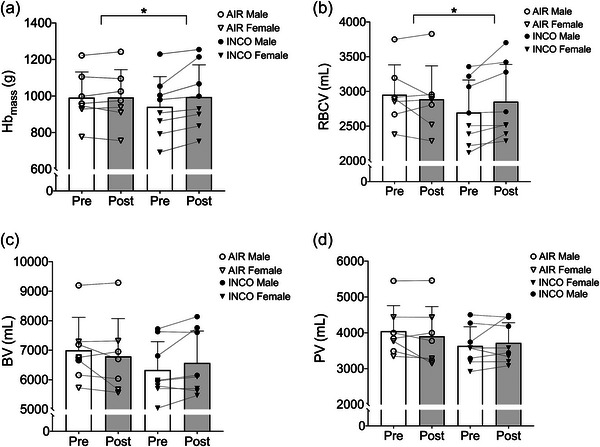
Altitude training enhances haematological adaptations and endurance at sea level, typically requiring exposure to ∼2500 m altitude for 3–4 weeks. Emerging evidence suggests that low‐dose carbon monoxide (CO) inhalation might mimic hypoxia and might be used by elite athletes. In this study, we examine whether periodic low‐dose CO exposure can replicate the live‐high, train‐low model in well‐trained individuals, focusing primarily on haematological and performance effects of CO exposure, with haematological markers commonly used to interpret haemoglobin mass changes discussed as exploratory. Eight well‐trained individuals (four males and four females) participated in a randomized crossover study. They completed two training blocks of 4 weeks at sea level: one with CO inhalation (INCO) to simulate live‐high, train‐low and one with ambient air as a control (AIR), separated by a 6 month washout. Haematological variables, in vivo muscle oxidative capacity and performance metrics were assessed before and after each intervention. After INCO, haemoglobin mass ( p = 0.018; +53.6 ± 10.8 g. vs. +0.8 ± 11.8 g), red blood cell volume ( p = 0.032; +156.6 ± 66.7 mL vs. −65.1 ± 50.7 mL) and blood volume ( p = 0.036; +240.4 ± 120.5 mL vs. −208.3 ± 167.5 mL) increased significantly compared with AIR. INCO significantly reduced immature reticulocytes ( p = 0.04), but muscle oxidative capacity and performance metrics remained unchanged. These findings suggest that daily low‐dose CO exposure at sea level over 4 weeks enhanced haematological adaptations more than standard training but did not affect muscle oxidative capacity or performance.
Overview
CoChat Summary
TL;DR
In a randomized crossover study of eight well-trained swimmers, 4 weeks of low-dose carbon monoxide inhalation at sea level increased haemoglobin mass, red blood cell volume, and blood volume compared with ambient-air control. However, muscle oxidative capacity and swimming performance metrics did not improve.
Key findings
- Haemoglobin mass increased after INCO vs AIR: +53.6 ± 10.8 g vs +0.8 ± 11.8 g (treatment effect p = 0.018; time effect p = 0.013), corresponding to a 5.7% increase vs 0.1%.
- Red blood cell volume increased after INCO vs AIR: +156.6 ± 66.7 mL vs −65.1 ± 50.7 mL (p = 0.032), and blood volume increased: +240.4 ± 120.5 mL vs −208.3 ± 167.5 mL (p = 0.036).
- Immature reticulocyte fraction decreased significantly post-INCO (time effect p = 0.031; treatment effect p = 0.042), while [Hb], HCT, and other standard haematological markers showed no significant time or treatment effects.
- Muscle oxidative capacity and submaximal/maximal swimming performance metrics remained unchanged; the estimated hypoxic dose for INCO was 847.9 km h.
Methods
- Eight well-trained individuals (four males, four females) completed a single-blind, randomized crossover study with two 4-week sea-level training blocks: INCO (CO inhalation to simulate live-high, train-low) and AIR (ambient air placebo), separated by a ~6-month washout.
- CO was inhaled three times daily at rest, 6 days/week, with boluses tailored to raise [COHb]; mean [COHb] was 9.0% [1.9, 16.0] for INCO and 1.1% [1.0, 1.2] for AIR.
- Outcomes included Hbmass and intravascular blood volumes by CO-rebreathing, haematological and urinary steroid markers, muscle oxidative capacity by NIRS, and swimming performance/lactate profile; analysis used ANCOVA with baseline as covariate, paired t-tests, and univariate ANOVA.
Limitations
- The paper states the small sample size of eight participants may limit generalizability, the mechanism of the erythropoietic response could not be explained, no skeletal muscle biopsy was obtained, performance testing lacked a tapering phase, and only one baseline sample limited Athlete Biological Passport adaptive-model assessment.
- The text also makes evident that V̇O2max and erythropoietin were not measured, so the link between increased Hbmass and maximal aerobic capacity or the proposed erythropoietin drive could not be directly assessed.
- The study was single-blind, and the authors note the performance tests and post-intervention timing may have been insufficient to capture benefits of increased blood oxygen-carrying capacity.
Model-written summary. Check it against the paper before relying on it.
Integrity signals
Registry
Cites
Statistics
Figures
Verification
Claims the paper makes
0 Valid · 0 Not valid · 45 Not checked · 52 Own results and interpretations
A result the paper reports from its own data — it cites no other source for it, so there is none to check. The quote shows it is in the paper.
In the paper
“muscle oxidative capacity and performance metrics remained unchanged”
- Also stated in: § Effects of INCO on submaximal and maximal swimming performance · hedged
“No significant time or treatment effects were observed in swimming speed corresponding to 2 and 4 mM of blood lactate, 200 m swimming time or average speed during the 200 m swimming test, indicating no effect of time or treatment (INCO vs. AIR) (Table 2).”
§ Effect of live‐high, train‐low strategy induced by chronic low‐dose carbon monoxide exposure on haematological parameters and performance in trained individuals > Abstract
plain- Asserted: passes — The authors put it forward as true.
- Checkable: passes — It can be checked against evidence.
- Load-bearing: passes — The paper’s conclusions depend on it.
- Based: passes — The paper gives a reason why it holds.
- Also stated in: § Effects of INCO on submaximal and maximal swimming performance · hedged
A result the paper reports from its own data — it cites no other source for it, so there is none to check. The quote shows it is in the paper.
In the paper
“No time or treatment effects were observed for the blood variables [Hb], HCT, MCH, MCHC, MCV, RBC and RET# (Table 3)”
§ Effect of live‐high, train‐low strategy induced by chronic low‐dose carbon monoxide exposure on haematological parameters and performance in trained individuals > RESULTS > Effects of INCO on haematological and hormonal markers
plain- Asserted: passes — The authors put it forward as true.
- Checkable: passes — It can be checked against evidence.
- Load-bearing: passes — The paper’s conclusions depend on it.
- Based: passes — The paper gives a reason why it holds.
A result the paper reports from its own data — it cites no other source for it, so there is none to check. The quote shows it is in the paper.
In the paper
“There was no effect of CO on measured androgen hormone levels.”
§ Effect of live‐high, train‐low strategy induced by chronic low‐dose carbon monoxide exposure on haematological parameters and performance in trained individuals > RESULTS > Effects of INCO on haematological and hormonal markers
plain- Asserted: passes — The authors put it forward as true.
- Checkable: passes — It can be checked against evidence.
- Load-bearing: unclear — It is unclear whether the paper’s conclusions depend on it.
- Based: passes — The paper gives a reason why it holds.
A result the paper reports from its own data — it cites no other source for it, so there is none to check. The quote shows it is in the paper.
In the paper
“INCO significantly reduced immature reticulocytes (p = 0.04)”
- Also stated in: § Effects of INCO on haematological and hormonal markers · plain
“except for IRF, which decreased significantly post‐INCO (time effect, p = 0.031) and was significantly different following AIR (treatment effect, p = 0.042).”
§ Effect of live‐high, train‐low strategy induced by chronic low‐dose carbon monoxide exposure on haematological parameters and performance in trained individuals > Abstract
plainstates a cause- Asserted: passes — The authors put it forward as true.
- Checkable: passes — It can be checked against evidence.
- Load-bearing: unclear — It is unclear whether the paper’s conclusions depend on it.
- Based: passes — The paper gives a reason why it holds.
- Also stated in: § Effects of INCO on haematological and hormonal markers · plain
A result the paper reports from its own data — it cites no other source for it, so there is none to check. The quote shows it is in the paper.
In the paper
“muscle oxidative capacity and performance metrics remained unchanged”
- Also stated in: § Effects of INCO on muscle oxygen uptake recovery rate constant · plain
“No time or treatment effects were observed in the muscle oxygen uptake recovery rate following INCO and AIR (Table 2).”
§ Effect of live‐high, train‐low strategy induced by chronic low‐dose carbon monoxide exposure on haematological parameters and performance in trained individuals > Abstract
plain- Asserted: passes — The authors put it forward as true.
- Checkable: passes — It can be checked against evidence.
- Load-bearing: passes — The paper’s conclusions depend on it.
- Based: passes — The paper gives a reason why it holds.
- Also stated in: § Effects of INCO on muscle oxygen uptake recovery rate constant · plain
36 more claims
Create a free account to see all 97 claims and to verify the 46 references still open.
- It may state two separate claims as one. 36
- The quote only partly states this claim. 1
- Probably not a substantial claim. 31
Self-check
Percentages, sums and reported differences re-computed from the paper’s own numbers.
Each contradiction between two passages listed here was confirmed by an independent check.
Rated major: it would touch a result — a value a result rests on, reported and recomputed p-values on opposite sides of the significance level, two passages that conflict with no sign which is right, or a cited work retracted before this paper was published.
In the paper
§ Effect of live‐high, train‐low strategy induced by chronic low‐dose carbon monoxide exposure on haematological parameters and performance in trained individuals > RESULTS > Effects of INCO on haematological and hormonal markers
“epitestosterone, testosterone and 5α‐androstane‐3α,17β‐diol showed a significant reduction from pre‐ to post‐INCO.”
§ Effect of live‐high, train‐low strategy induced by chronic low‐dose carbon monoxide exposure on haematological parameters and performance in trained individuals > RESULTS > Effects of INCO on muscle oxygen uptake recovery rate constant
“| 5α‐Androstane‐3α,17β‐diol, ng × mL−1 | 50.0 ± 19.4 | 36.7 ± 9.2 | 5 | 0.037 | 63.2 ± 39.9 | 48.5 ± 25.7 | 5 | 0.086 | 0.523 |”
Rated minor: it would not touch a result — a value no result rests on, a p-value that stays on the same side of the significance level, or a conflict that is clerical, resolved elsewhere in the paper, or outside its own findings.
In the paper
§ Effect of live‐high, train‐low strategy induced by chronic low‐dose carbon monoxide exposure on haematological parameters and performance in trained individuals > MATERIALS AND METHODS > Carbon monoxide administration
“The volume of each inspired CO bolus was tailored to raise individual [COHb] to 15%.”
§ Effect of live‐high, train‐low strategy induced by chronic low‐dose carbon monoxide exposure on haematological parameters and performance in trained individuals > MATERIALS AND METHODS > Carbon monoxide administration
“[COHb]t is the target COHb concentration, i.e., 10%;”
Cited works that were retracted
Works this paper cites that were later retracted, from the retraction notices publishers deposit. Major when the notice came out before this paper was published.
A note, not an issue: for example, a cited work that was retracted only after this paper was published, which its authors could not have known.
In the paper
“10.1242/jcs.03318”
Cited work 10.1242/jcs.03318 · retraction date not known · this paper published 2026-01-12
Citations
Cites
1 retracted
RETRACTED: A new activating role for CO in cardiac mitochondrial biogenesis
Suliman, H. B., Carraway, M. S., Tatro, L. G., & Piantadosi, C. A. (2006) · Journal of Cell Science · doi:10.1242/jcs.03318 · Cited by 213
RetractedHIF-1: mediator of physiological and pathophysiological responses to hypoxia
Semenza, G. L. (2000) · Journal of Applied Physiology · doi:10.1152/jappl.2000.88.4.1474 · Cited by 1,822
Lactate Threshold Concepts: How Valid are They?
Faude, O., Kindermann, W., & Meyer, T. (2009) · Sports Medicine · doi:10.2165/00007256-200939060-00003 · Cited by 882
Levine, B. D., & Stray-Gundersen, J. (1997) · Journal of Applied Physiology · doi:10.1152/jappl.1997.83.1.102 · Cited by 560
Red blood cells in sports: Effects of exercise and training on oxygen supply by red blood cells
Mairbäurl, H. (2013) · Frontiers in Physiology · doi:10.3389/fphys.2013.00332 · Cited by 482
Understanding near infrared spectroscopy and its application to skeletal muscle research
Barstow, T. J. (2019) · Journal of Applied Physiology · doi:10.1152/japplphysiol.00166.2018 · Cited by 470
Combining Hypoxic Methods for Peak Performance
Millet, G. P., Roels, B., Schmitt, L., Woorons, X., & Richalet, J. (2009) · Sports Medicine · doi:10.2165/11317920-000000000-00000 · Cited by 459
Ferrari, M., Muthalib, M., & Quaresima, V. (2011) · Philosophical Transactions of the Royal Society A: Mathematical, Physical and Engineering Sciences · doi:10.1098/rsta.2011.0230 · Cited by 450
The laws of combination of hæmoglobin with carbon monoxide and oxygen
Douglas, C. G., Haldane, J. B. S., & Haldane, J. B. S. (1912) · The Journal of Physiology · doi:10.1113/jphysiol.1912.sp001517 · Cited by 424
The optimised CO-rebreathing method: a new tool to determine total haemoglobin mass routinely
Schmidt, W., & Prommer, N. (2005) · European Journal of Applied Physiology · doi:10.1007/s00421-005-0050-3 · Cited by 335
Research works printed but not linked: 3
- Haldane J. B. S., 1912, The dissociation of oxyhemoglobin in human blood during partial CO poisoning, The Journal of Physiology, 45, 1912
- Olbrecht J., 1992, Biomechanics and medicine in swimming. swimming science VI, 243
- WHO guidelines for indoor air quality: selected pollutants
Cited by
Carbon monoxide to ‘simulate altitude’: The ethical grenade
Faiss, R., & Brocherie, F. (2026) · Experimental Physiology · doi:10.1113/ep093704 · Cited by 2
Hemoglobin Mass as a Determinant of Inter-Individual Susceptibility to Carbon Monoxide Poisoning
Sotiridis, A., Makris, A. P., Geladas, N. D., & Koskolou, M. D. (2026) · Oxygen · doi:10.3390/oxygen6040037
Reply to letter to the editor in response to: “Carbon monoxide to ‘simulate altitude’”
Villanova, S., Porcelli, S., Ekström, L., & Cardinale, D. A. (2026) · Experimental Physiology · doi:10.1113/ep093872
Self-citationCarbon monoxide and other “tricks” in sports: does the winner take it all?
HEINONEN, I. H. A. (2026) · Frontiers in Sports and Active Living · doi:10.3389/fspor.2026.1847660
Talarowski, K., Talarek, K., Pluta, W., Tylec, P., Bryl, J., Milaniuk, R., Pacek, A., Daniszewski, S., Czerny, I., Ściubak, A., et al. (2026) · Quality in Sport · doi:10.12775/qs.2026.74.75254
Metadata
- Authors
- Villanova, S., Porcelli, S., Ekström, L., & Cardinale, D. A.
- Affiliations
- Foro Italico University of Rome (IT)
- University of Pavia (IT)
- Karolinska Institutet (SE)
- Corresponding author
- Cardinale, Daniele A.
- Venue
- Experimental Physiology
- Publisher
- Wiley
- Published
- 2026-01-12
- Volume
- 111
- Issue
- 4
- Pages
- 1891-1903
- ISSN
- 0958-0670 (ISSN-L)
- 1469-445X
- PMC
- PMC13140526
- OpenAlex
- W7123355368
- Cited by
- 5
- References
- 72
- Citations by year
- 2026: 5
- FWCI
- 15.60
- Type
- journal article
- Language
- en
- Open access
- gold
- doi.org
- Locations
- Experimental Physiology (publishedVersion, cc-by)
- PubMed Central (publishedVersion, cc-by)
- PubMed (publishedVersion)
- Diva portal (Dalarna University Library) (submittedVersion, other-oa)
- DOAJ (DOAJ: Directory of Open Access Journals) (submittedVersion, cc-by-sa)
- Funders
- Karolinska Institutet
- Topics
- Health Sciences › Medicine › Physiology (medical) › High Altitude and Hypoxia
- Health Sciences › Medicine › Physiology (medical) › Cardiovascular and exercise physiology
- Health Sciences › Medicine › Physiology (medical) › Exercise and Physiological Responses
- Keywords
- carbon monoxide inhalation, live high-train low, altitude training, hemoglobin mass, erythrocyte volume, blood volume, reticulocytes, muscle oxidative capacity, endurance performance, trained athletes
- MeSH terms
- Adaptation, Physiological, Adult, Altitude, Hypoxia, Carbon Monoxide, Female, Hemoglobins, Humans, Male, Oxygen Consumption, Physical Endurance, Exercise, Muscle, Skeletal, Cross-Over Studies, Young Adult, Athletes
About these checks
Registry, retraction, Cites and statistics results are computed, not judged, with one exception: a printed reference that no index lists is read once by a model before it counts as a citation error. Claims are extracted by a model and kept only when their quote appears verbatim in the text; each cited source is then checked, with a model’s help, for whether it says what the claim relies on. Those verdicts can be wrong — read the claim’s quote and the cited source before relying on one.
A language model drew the claims from the paper on 2026-11-13, under version 3 of the claim definition (model deepseek-v4.1-flash, prompt extract-v3).
A second model labelled each claim on 2026-11-13 (model jev-1.13-20260917, definition revision gold-guideline-v0.2).
Statistics and arithmetic are recomputed, not judged.
Confidence bands are shown only for fields calibrated on our annotated test set. None is calibrated yet, so no band is shown.
What counts as a claim ›How we measure confidence ›How we check this ›
Are you an author, or do you see a problem with this page? Request a review
Data sources
Bibliographic data: Semantic Scholar, OpenAlex, Crossref.
Contains information from the Semantic Scholar Academic Graph Datasets, made available under the ODC Attribution License (ODC-BY 1.0).
Semantic Scholar’s data is described in: Kinney, R., et al. (2023). The Semantic Scholar Open Data Platform. arXiv:2301.10140.
