

Agreement between muscle saturation breakpoints and lactate thresholds: Muscles comparison and sex difference in world‐class Nordic skiers
Open accessThe DOI matches its Crossref record; 62 of the 62 references it cites were found in a registry or an index; 27 of the 39 sources its claims cite were checked for support.
Abstract
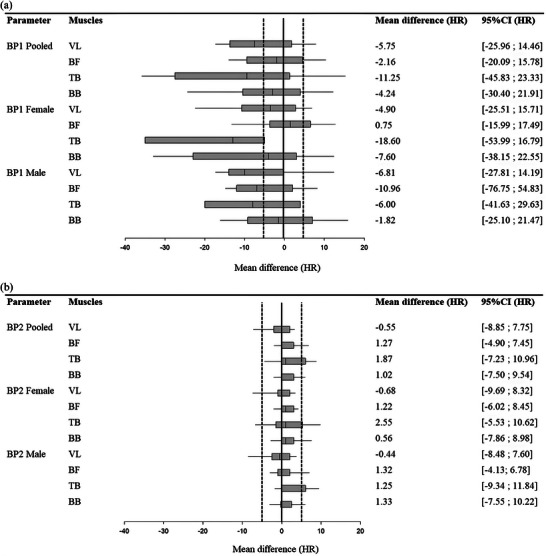
Near‐infrared spectroscopy (NIRS) has emerged as a potential alternative method for determination of breakpoints equivalent to lactate thresholds. However, the optimal NIRS location remains unclear, particularly in Nordic skiing, which requires both upper‐ and lower‐limb contributions. This study aimed to evaluate the feasibility and accuracy of NIRS‐derived breakpoints determination (i.e., BP1 and BP2) compared to first (LT1) and second (LT2) lactate thresholds and to compare different muscle sites in male and female world‐class Nordic skiers. Fifty‐two world‐class Nordic skiers (29 males, 23 females) performed an incremental treadmill test on roller skis. NIRS sensors were located simultaneously on four muscles: vastus lateralis (VL), biceps femoris (BF), biceps brachii (BB), and triceps brachii (TB). Oxygen saturation () was collected and analysed to detect BP1 and BP2 vs. LT1 and LT2. First, BP1 was too often undetectable or inaccurately detected, suggesting an unsuitable practical use. Second, BP2 was detected in VL (88.5%), BF (96.2%) and BB (86.5%) but not in TB (24.1%). Third, there was a very good accuracy (i.e., bias [95% CI] in heart rate between BP2 and LT2 in VL (−0.6 bpm [−8.9, 7.8]), BF (+1.3 bpm [−2.8, 4.2]) and BB (+1.0 bpm [−7.5, 9.5]). Finally, no significant differences were found between male and female athletes. NIRS appears as an effective non‐invasive method for detecting breakpoint equivalent to LT2 in both male and female world‐class Nordic skiers, especially if positioned on both BB and BF.
Overview
CoChat Summary
TL;DR
In 52 world-class Nordic skiers, NIRS-derived BP1 was mostly undetectable or inaccurate, while BP2 was a reliable surrogate for LT2, especially at biceps femoris and biceps brachii. No significant sex differences were found in BP2 feasibility or accuracy.
Key findings
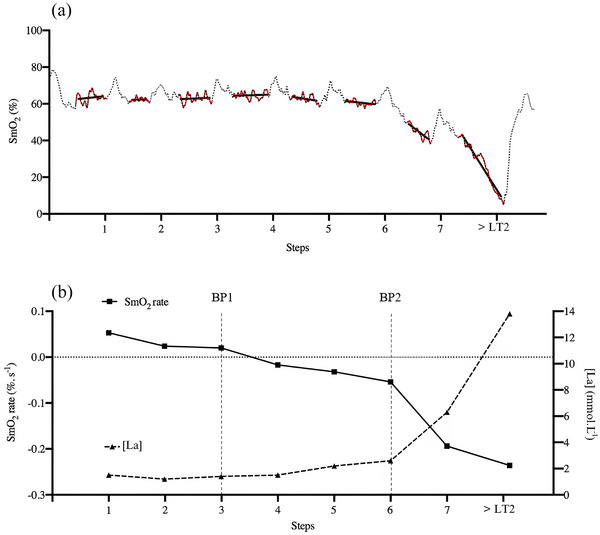
- BP1 was often not usable: pooled detection was 69.2%, with high inter-individual variability in HR differences versus LT1 (e.g., VL −2.5 ± 6.4 bpm; BF +0.2 ± 5.2 bpm; BB −4.7 ± 7.9 bpm; TB −10.3 ± 9.0 bpm).
- BP2 detection was high for VL (88.5%), BF (96.2%), and BB (86.5%), but low for TB (32.7%); detection reached 100% when at least one muscle was considered.
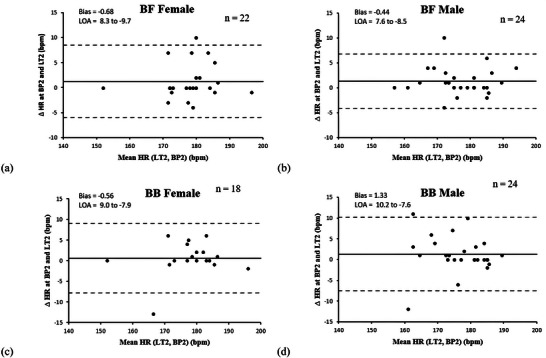
- BP2 vs LT2 HR bias [95% CI] was very good: VL −0.6 bpm [−8.9, 7.8], BF +1.3 bpm [−2.8, 4.2], and BB +1.0 bpm [−7.5, 9.5]. Reliability was highest for BF (males ICC = 0.954, SEM = 0.58 bpm; females ICC = 0.904, SEM = 1.11 bpm).
- No significant sex differences were found in BP determination feasibility or accuracy; BP accuracy was not correlated with body fat percentage (BP1 r = 0.08, P = 0.52; BP2 r = −0.05, P = 0.67).
Methods
- Fifty-two world-class Nordic skiers (29 males, 23 females; 12 Tier 5, 40 Tier 4) performed an incremental treadmill roller-ski test using V2 technique, with 3-min work intervals and 15-s rests, 7% incline, starting at 9.0 km/h with 1 km/h increments.
- NIRS sensors (Moxy Monitor) were placed simultaneously on the right vastus lateralis (VL), biceps femoris (BF), biceps brachii (BB), and triceps brachii (TB); SmO2, HR, capillary blood lactate, and skinfold thickness were measured.
- BP1/BP2 were identified from SmO2 rate using segmented linear regression with visual inspection; LT1/LT2 were determined by the Dmax method. Agreement was assessed with Bland–Altman, ICC, and SEM, alongside repeated-measures ANOVA/Friedman tests, chi-square tests, and Pearson correlations.
Limitations
- Stated: the Moxy monitor’s single-source continuous-wave technology has lower spatial resolution and appears less robust than multi-distance NIRS devices; findings are specific to world-class Nordic skiers/biathletes and may not transfer to other sports or lower-calibre athletes.
- Stated: 3-min stages were used to accommodate elite participants, which may have altered BP detection precision compared with longer stages; no formal inter-rater reliability assessment was conducted, although curves were reviewed by two investigators with consensus.
- Evident: the text reports 23 female athletes in the abstract and methods, but Table 1 lists female n = 22, an inconsistency in the reported sample.
Model-written summary. Check it against the paper before relying on it.
Integrity signals
Registry
Cites
Statistics
Figures
Verification
Claims the paper makes
15 Valid · 3 Not valid · 5 Not checked · 44 Own results and interpretations
The cited sources support only part of this claim — read each source’s verdict below.
In the paper
“Additionally, differences in blood flow dynamics between muscles likely impact the NIRS signal quality (Bartlett et al., 2021), along with the presence of a thin adipose tissue layer over BF and BB, which may facilitate better light penetration and improve measurement reliability (Kirby et al., 2021; Vásquez Bonilla et al., 2023).”
§ Agreement between muscle saturation breakpoints and lactate thresholds: Muscles comparison and sex difference in world‐class Nordic skiers > DISCUSSION > Second breakpoint (BP2) determination is more accurate when measured on biceps brachial and BF than on the other muscles
What the sources say
- Partly supportedcites Bartlett et al., 2021 matched to “Impact of cutaneous blood flow on NIR-DCS measures of skeletal muscle blood flow index” (2021) sourceExperimental — accuracy not yet measured
The Discussion reports that increased skin blood flow impaired NIR-DCS estimates of forearm muscle perfusion, supporting the general point that blood flow can affect an optical measurement. It does not compare blood flow dynamics between different muscles, and it reports that its FDMD-NIRS oxygenation measurements remained reliable despite increased skin blood flow. The cited effect therefore does not establish the claimed difference in NIRS signal quality between muscles. (LLM, conf=0.84)
hedgedstates a possible cause- Asserted: passes — The authors put it forward as true.
- Checkable: passes — It can be checked against evidence.
- Load-bearing: passes — The paper’s conclusions depend on it.
- Based: passes — The paper gives a reason why it holds.
- Partly supported
The cited sources support only part of this claim — read each source’s verdict below.
In the paper
“However, caution is required due to the inherent limitations of the Moxy‐derived measurements, which appear less robust than other NIRS devices (Crum et al., 2017; Feldmann et al., 2019).”
§ Agreement between muscle saturation breakpoints and lactate thresholds: Muscles comparison and sex difference in world‐class Nordic skiers > DISCUSSION > Strengths and limitations
What the sources say
- Not checked — no full text of the sourcecites Crum et al., 2017 matched to “Validity and reliability of the Moxy oxygen monitor during incremental cycling exercise” (2017) source
- Partly supportedcites Feldmann et al., 2019 matched to “Near-infrared spectroscopy-derived muscle oxygen saturation on a 0% to 100% scale: reliability and validity of the Moxy Monitor” (2019) sourceExperimental — accuracy not yet measured
The Limitations section identifies outliers, possible noise and a low output rate, supporting caution about Moxy-derived measurements. The Conclusion also questions the validity of its 0%–100% scale, but calls the device valid and reliable under the tested conditions. Neither passage establishes that Moxy is less robust than other NIRS devices. (LLM, conf=0.86)
hedged- Asserted: passes — The authors put it forward as true.
- Checkable: passes — It can be checked against evidence.
- Load-bearing: unclear — It is unclear whether the paper’s conclusions depend on it.
- Based: passes — The paper gives a reason why it holds.
Every source the paper cites for this claim was checked and supports it.
In the paper
“According to the classification proposed by McKay et al. (2022), the sample represents 12 world‐class athletes, (Tier 5) such as Olympic or World Championship medalists, and 40 international‐level athletes, (Tier 4) such as national team members, typically within 7% of world‐leading performances.”
§ Agreement between muscle saturation breakpoints and lactate thresholds: Muscles comparison and sex difference in world‐class Nordic skiers > METHODS > Participants
What the sources say
- Supportedcites McKay et al. (2022) matched to “Defining Training and Performance Caliber: A Participant Classification Framework” (2022) source
The paper’s ‘A New Paradigm for Participant Training and Performance Classification’ section defines Tier 5 as World Class and includes Olympic or World Championship medalists. It defines Tier 4 as Elite/International Level, including national-team athletes and those performing within approximately 7% of world-leading results. The counts of 12 and 40 describe the citing paper’s sample, not a finding attributed to McKay et al. (LLM, conf=0.92)
plain- Asserted: passes — The authors put it forward as true.
- Checkable: passes — It can be checked against evidence.
- Load-bearing: unclear — It is unclear whether the paper’s conclusions depend on it.
- Based: passes — The paper gives a reason why it holds.
- Supported
The cited sources support only part of this claim — read each source’s verdict below.
In the paper
“To date, conflicting findings have been reported in the literature. For instance, some studies (Possamai et al., 2024; Sendra‐Perez, Sanchez‐Jimenez et al., 2023) have reported weak or no significant correlation between SmO2‐derived BPs and traditional physiological thresholds such as the maximal lactate steady state (MLSS) and critical power (CP), highlighting potential NIRS limitations to deline”
§ Agreement between muscle saturation breakpoints and lactate thresholds: Muscles comparison and sex difference in world‐class Nordic skiers > INTRODUCTION
What the sources say
- Supportedcites Possamai et al., 2024 matched to “Comparison of NIRS exercise intensity thresholds with maximal lactate steady state, critical power and rowing performance” (2024) source
The Results report correlations ranging from trivial to large between NIRS-derived thresholds and MLSS or CP. The Discussion describes a low association with MLSS and contrasts findings across exercise modes, supporting the claim that some findings show weak relationships. The cited passages have no page numbers in our copy. (LLM, conf=0.88)
- Partly supportedcites Sendra‐Perez, Sanchez‐Jimenez et al., 2023 matched to “Reliability of threshold determination using portable muscle oxygenation monitors during exercise testing: a systematic review and meta-analysis” (2023) sourceExperimental — accuracy not yet measured
The Results (Meta-analyses; page unavailable) report widely varying agreement between muscle-oxygenation and lactate or ventilatory thresholds, including low ICCs of 0.23 and 0.29. This supports the claim that findings vary and some relationships are weak. The paper does not report comparisons with maximal lactate steady state (MLSS) or critical power (CP), or establish the claimed lack of statistically significant correlation for those thresholds. (LLM, conf=0.88)
plain- Asserted: passes — The authors put it forward as true.
- Checkable: passes — It can be checked against evidence.
- Load-bearing: passes — The paper’s conclusions depend on it.
- Based: passes — The paper gives a reason why it holds.
- Supported
The cited sources that could be checked couldn’t confirm or dispute this claim.
In the paper
“The performance level of our participants (i.e., Tiers 4–5), who generally have lower levels of adipose tissue thickness compared to the broader population (Larsson & Henriksson‐Larsen, 2008; Sandbakk et al., 2016), further reinforces these finding, due to the minimized variability and attenuated effects generally observed with NIRS measurements.”
§ Agreement between muscle saturation breakpoints and lactate thresholds: Muscles comparison and sex difference in world‐class Nordic skiers > DISCUSSION > Sex differences
What the sources say
- Not checked — no full text of the sourcecites Larsson & Henriksson‐Larsen, 2008 matched to “Body Composition and Performance in Cross-Country Skiing” (2008) source
- Could not verifycites Sandbakk et al., 2016 matched to “The Physiological Capacity of the World’s Highest Ranked Female Cross-country Skiers” (2016) sourceExperimental — accuracy not yet measured
The Methods (Instruments and Materials) describe measuring body mass, while the Results and Discussion compare skiing performance and physiological capacity. Searches for adipose tissue thickness, skinfolds, and body composition found no passage comparing the skiers’ adipose tissue thickness with that of the broader population. (LLM, conf=0.73)
plainstates an association- Asserted: passes — The authors put it forward as true.
- Checkable: passes — It can be checked against evidence.
- Load-bearing: passes — The paper’s conclusions depend on it.
- Based: passes — The paper gives a reason why it holds.
21 more claims · 3 with their cited sources checked
Create a free account to see all 67 claims and to verify the 3 references still open.
- It may state two separate claims as one. 24
- Probably not a substantial claim. 19
Self-check
Percentages, sums and reported differences re-computed from the paper’s own numbers.
Each contradiction between two passages listed here was confirmed by an independent check.
Rated major: it would touch a result — a value a result rests on, reported and recomputed p-values on opposite sides of the significance level, two passages that conflict with no sign which is right, or a cited work retracted before this paper was published.
In the paper
“BF (+1.3 bpm [−2.8, 4.2])”
§ Agreement between muscle saturation breakpoints and lactate thresholds: Muscles comparison and sex difference in world‐class Nordic skiers > Abstract
Reported 1.3 · recomputed 0.7
Rated major: it would touch a result — a value a result rests on, reported and recomputed p-values on opposite sides of the significance level, two passages that conflict with no sign which is right, or a cited work retracted before this paper was published.
In the paper
§ Agreement between muscle saturation breakpoints and lactate thresholds: Muscles comparison and sex difference in world‐class Nordic skiers > RESULTS > Breakpoint determination
“Similarly, the determination of BP2 was more frequent in females for VL (95.7% vs. 86.2%, P = 0.044)”
§ Agreement between muscle saturation breakpoints and lactate thresholds: Muscles comparison and sex difference in world‐class Nordic skiers > RESULTS > Breakpoint determination
“| P a | 0.090 | 0.421 | 0.137 | 0.094 | 0.998 |”
Rated major: it would touch a result — a value a result rests on, reported and recomputed p-values on opposite sides of the significance level, two passages that conflict with no sign which is right, or a cited work retracted before this paper was published.
In the paper
§ Agreement between muscle saturation breakpoints and lactate thresholds: Muscles comparison and sex difference in world‐class Nordic skiers > RESULTS > Breakpoint determination
“The determination of BP1 was more frequent in females than in males for VL (87.0% vs. 58.6%, P = 0.014; Table 2)”
§ Agreement between muscle saturation breakpoints and lactate thresholds: Muscles comparison and sex difference in world‐class Nordic skiers > RESULTS > Breakpoint determination
“| P a | 0.069 | 0.742 | 0.183 | 0.611 | 0.801 |”
Rated minor: it would not touch a result — a value no result rests on, a p-value that stays on the same side of the significance level, or a conflict that is clerical, resolved elsewhere in the paper, or outside its own findings.
In the paper
§ Agreement between muscle saturation breakpoints and lactate thresholds: Muscles comparison and sex difference in world‐class Nordic skiers > RESULTS > Breakpoint determination
“| Pooled | 69.2% | 84.6% | 69.2% | 21.2% | 96.1% |”
§ Agreement between muscle saturation breakpoints and lactate thresholds: Muscles comparison and sex difference in world‐class Nordic skiers > RESULTS > Breakpoint determination
“| Female | 87.0% | 87.0% | 65.2% | 21.7% | 95.7% | | Male | 58.6% | 86.2% | 75.9% | 24.1% | 96.6% |”
Rated minor: it would not touch a result — a value no result rests on, a p-value that stays on the same side of the significance level, or a conflict that is clerical, resolved elsewhere in the paper, or outside its own findings.
In the paper
§ Agreement between muscle saturation breakpoints and lactate thresholds: Muscles comparison and sex difference in world‐class Nordic skiers > RESULTS > Breakpoint determination
“no difference was observed for BF (96.6% vs. 100%, P = 0.730), BB (96.6% vs. 78.3%, P = 0.473) and TB (44.8% vs. 21.7%, P = 0.757).”
§ Agreement between muscle saturation breakpoints and lactate thresholds: Muscles comparison and sex difference in world‐class Nordic skiers > RESULTS > Breakpoint determination
“| Female | 95.7% | 100.0% | 78.3% | 21.7% | 100.0% | | Male | 86.2% | 96.6% | 96.6% | 44.8% | 100.0% |”
3 more findings
Create a free account to see every finding of this check.
Citations
Cites
STATISTICAL METHODS FOR ASSESSING AGREEMENT BETWEEN TWO METHODS OF CLINICAL MEASUREMENT
Martin Bland, J., & Altman, D. (1986) · The Lancet · doi:10.1016/s0140-6736(86)90837-8 · Cited by 47,965
Durnin, J. V. G. A., & Womersley, J. (1974) · British Journal of Nutrition · doi:10.1079/bjn19740060 · Cited by 6,343 · cited 1×
“A Polar H10 HR monitor (Polar Electro, Kempele, Finland) was used to continuously recorded HR. Adipose tissue thickness was calculated with four skinfold thickness measured by caliper, as previously described (Durnin & Womersley, 1974).”
Defining Training and Performance Caliber: A Participant Classification Framework
McKay, A. K. A., Stellingwerff, T., Smith, E. S., Martin, D. T., Mujika, I., Goosey-Tolfrey, V. L., Sheppard, J., & Burke, L. M. (2022) · International Journal of Sports Physiology and Performance · doi:10.1123/ijspp.2021-0451 · Cited by 3,093
Data on the distribution of fibre types in thirty-six human muscles
Johnson, M. A., Polgar, J., Weightman, D., & Appleton, D. (1973) · Journal of the Neurological Sciences · doi:10.1016/0022-510x(73)90023-3 · Cited by 2,200
Understanding near infrared spectroscopy and its application to skeletal muscle research
Barstow, T. J. (2019) · Journal of Applied Physiology · doi:10.1152/japplphysiol.00166.2018 · Cited by 470 · cited 4×
“Recently, the advent of near-infrared spectroscopy (NIRS) technology to measure skeletal muscle tissue oxy/deoxygenation offers a new avenue for threshold determination (Barstow, 2019; Millet & Brocherie, 2024; van der Zwaard et al., 2021).”
InfluentialCooper, R. J., Selb, J., Gagnon, L., Phillip, D., Schytz, H. W., Iversen, H. K., Ashina, M., & Boas, D. A. (2012) · Frontiers in Neuroscience · doi:10.3389/fnins.2012.00147 · Cited by 421 · cited 1×
“…of carefully considering muscle selection when using NIRS for physiological assessments, as factors such as movement artifacts (Siddiquee et al., 2018), compression effects and signal stability (Cooper et al., 2012) may influence measurement accuracy more than the metabolic demand per se.”
A New Approach for the Determination of Ventilatory and Lactate Thresholds
Cheng, B., Kuipers, H., Snyder, A., Keizer, H., Jeukendrup, A., & Hesselink, M. (1992) · International Journal of Sports Medicine · doi:10.1055/s-2007-1021309 · Cited by 371 · cited 1×
“Bloodlactatelevels were then analysed to determine LT1 and LT2 using the Dmax method (Cheng et al., 1992; Sendra-Pérez, Encarnacion-Martinez et al., 2023), which identified the point of maximal deviation from a straight line drawn between the first and last data points on the lactate-intensity…”
Hamaoka, T., McCully, K. K., Quaresima, V., Yamamoto, K., & Chance, B. (2007) · Journal of Biomedical Optics · doi:10.1117/1.2805437 · Cited by 329
Blood lactate accumulation and muscle deoxygenation during incremental exercise
Grassi, B., Quaresima, V., Marconi, C., Ferrari, M., & Cerretelli, P. (1999) · Journal of Applied Physiology · doi:10.1152/jappl.1999.87.1.348 · Cited by 248 · cited 1×
“Conversely,anotherstudyreportedastrongrelationshipbetweenBP1 and LT1 (Grassi et al., 1999).”
Changes in onset of blood lactate accumulation (OBLA) and muscle enzymes after training at OBLA
Sj�din, B., Jacobs, I., & Svedenhag, J. (1982) · European Journal of Applied Physiology and Occupational Physiology · doi:10.1007/bf00428962 · Cited by 227
Research works printed but not linked: 1
- McCully, K. K., & Hamaoka, T. (2000). Near‐infrared spectroscopy: What can it tell us about oxygen saturation in skeletal muscle?. Exercise and Sport Sciences Reviews, 28(3), 123– 127. 10916704
Cited by
Fernández-Jarillo, I., Montraveta, J., Iglesias, X., McManus, C., Skotzke, P., & Chaverri, D. (2026) · European Journal of Applied Physiology · doi:10.1007/s00421-026-06357-9
Metadata
- Authors
- Forot, J., Schorderet, F., Burdet, C., Brocherie, F., & Millet, G. P.
- Affiliations
- University of Lausanne (CH)
- French Ski Federation Annecy France
- Institut National du Sport, de l'Expertise et de la Performance (FR)
- Corresponding author
- Millet, Grégoire P.
- Venue
- Experimental Physiology
- Publisher
- Wiley
- Published
- 2026-02-11
- Volume
- 111
- Issue
- 4
- Pages
- 2002-2013
- ISSN
- 0958-0670 (ISSN-L)
- 1469-445X
- PMC
- PMC13140459
- OpenAlex
- W7128690272
- Semantic Scholar
- 376320f183b5fc29e569ff46937e48206aa85c1a
- Cited by
- 1
- References
- 60
- Citations by year
- 2026: 1
- FWCI
- 3.05
- Type
- journal article
- Language
- en
- Open access
- gold
- doi.org
- Licence
- cc-by
- creativecommons.org/licenses/by/4.0/ (vor)
- doi.wiley.com/10.1002/tdm_license_1.1 (tdm)
- Locations
- Experimental Physiology (publishedVersion, cc-by)
- PubMed Central (publishedVersion, cc-by)
- PubMed (publishedVersion)
- HAL (submittedVersion)
- DOAJ (DOAJ: Directory of Open Access Journals) (submittedVersion, cc-by-sa)
- IRIS (submittedVersion)
- Topics
- Health Sciences › Medicine › Physiology (medical) › Cardiovascular and exercise physiology
- Health Sciences › Medicine › Orthopedics and Sports Medicine › Sports Performance and Training
- Health Sciences › Medicine › Radiology, Nuclear Medicine and Imaging › Optical Imaging and Spectroscopy Techniques
- Keywords
- lactate threshold, near-infrared spectroscopy, Nordic skiing, sex differences, muscle oxygen saturation, vastus lateralis, biceps femoris, biceps brachii, triceps brachii, heart rate, incremental treadmill test, roller skis, world-class athletes
- MeSH terms
- Adult, Exercise Test, Female, Humans, Male, Oxygen Consumption, Sex Characteristics, Sex Factors, Skiing, Anaerobic Threshold, Muscle, Skeletal, Spectroscopy, Near-Infrared, Lactic Acid, Young Adult
About these checks
Registry, retraction, Cites and statistics results are computed, not judged, with one exception: a printed reference that no index lists is read once by a model before it counts as a citation error. Claims are extracted by a model and kept only when their quote appears verbatim in the text; each cited source is then checked, with a model’s help, for whether it says what the claim relies on. Those verdicts can be wrong — read the claim’s quote and the cited source before relying on one.
The claim verdicts this report counts are experimental: their accuracy is not yet measured.
A language model drew the claims from the paper on 2026-10-13, under version 3 of the claim definition (model deepseek-v4.1-flash, prompt extract-v3).
A second model labelled each claim on 2026-10-13 (model jev-1.13-20260917, definition revision gold-guideline-v0.2).
Cited sources are checked with a language model’s help (gpt-6-sol).
Statistics and arithmetic are recomputed, not judged.
Confidence bands are shown only for fields calibrated on our annotated test set. None is calibrated yet, so no band is shown.
What counts as a claim ›How we measure confidence ›How we check this ›
Are you an author, or do you see a problem with this page? Request a review
How to cite
Cite CoChat for the checks on this page, and the paper for its own findings.
- This page
- CoChat. (2026). Citation check: Agreement between muscle saturation breakpoints and lactate thresholds: Muscles comparison and sex difference in world‐class Nordic skiers. https://app.cochat.ai/papers/10.1113/ep093311
- The paper
- Forot, J., Schorderet, F., Burdet, C., Brocherie, F., & Millet, G. P. (2026). Agreement between muscle saturation breakpoints and lactate thresholds: Muscles comparison and sex difference in world‐class Nordic skiers. Experimental Physiology. https://doi.org/10.1113/ep093311
Data sources
Bibliographic data: Semantic Scholar, OpenAlex, Crossref.
Contains information from the Semantic Scholar Academic Graph Datasets, made available under the ODC Attribution License (ODC-BY 1.0).
Semantic Scholar’s data is described in: Kinney, R., et al. (2023). The Semantic Scholar Open Data Platform. arXiv:2301.10140.
