

The DOI matches its Crossref record; 4 of the 4 references it cites were found in a registry or an index.
Photonics of time-varying media
Abstract
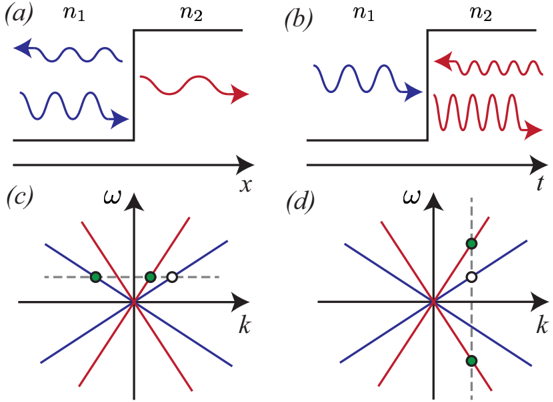
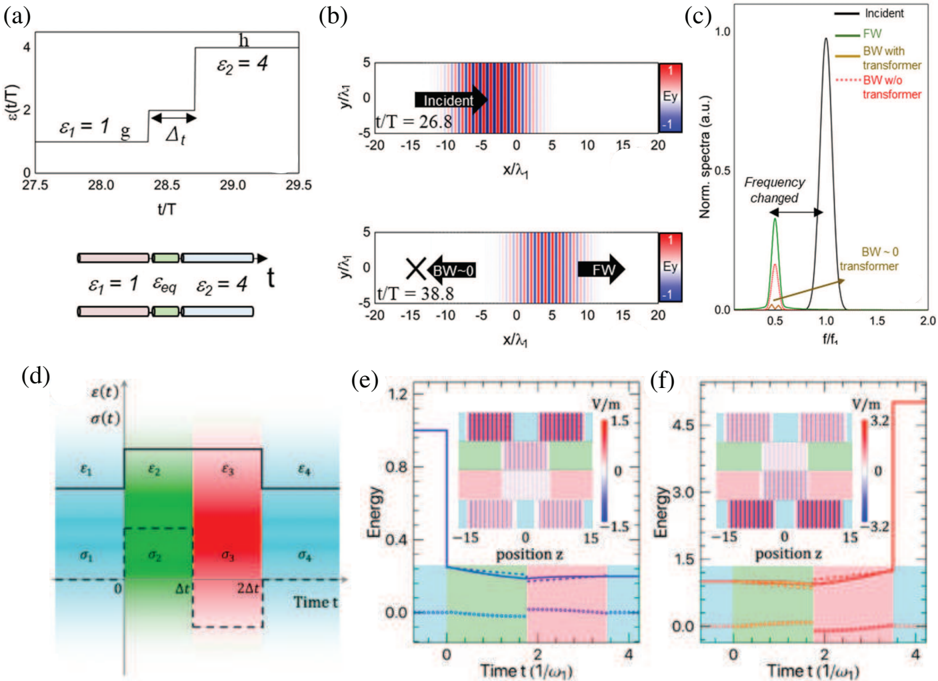
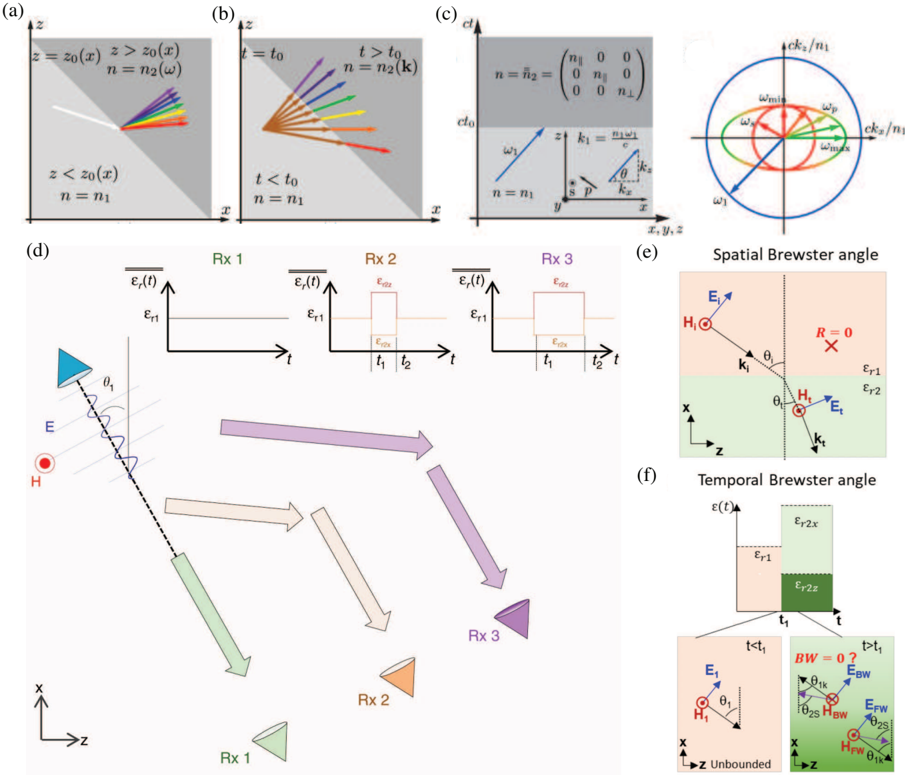
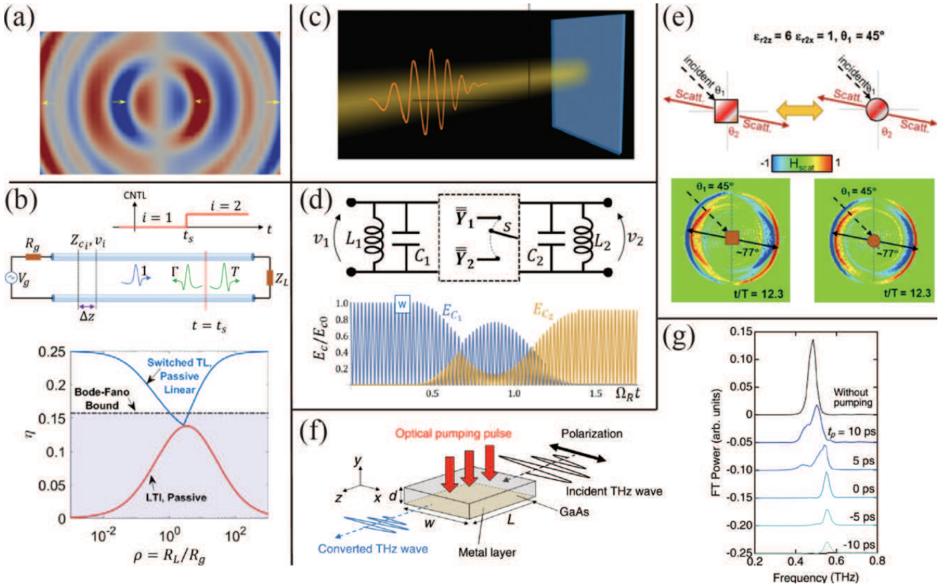
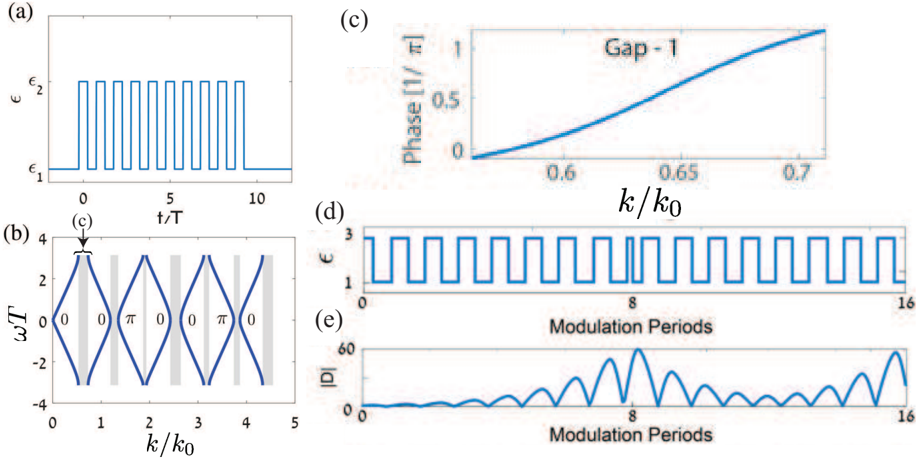
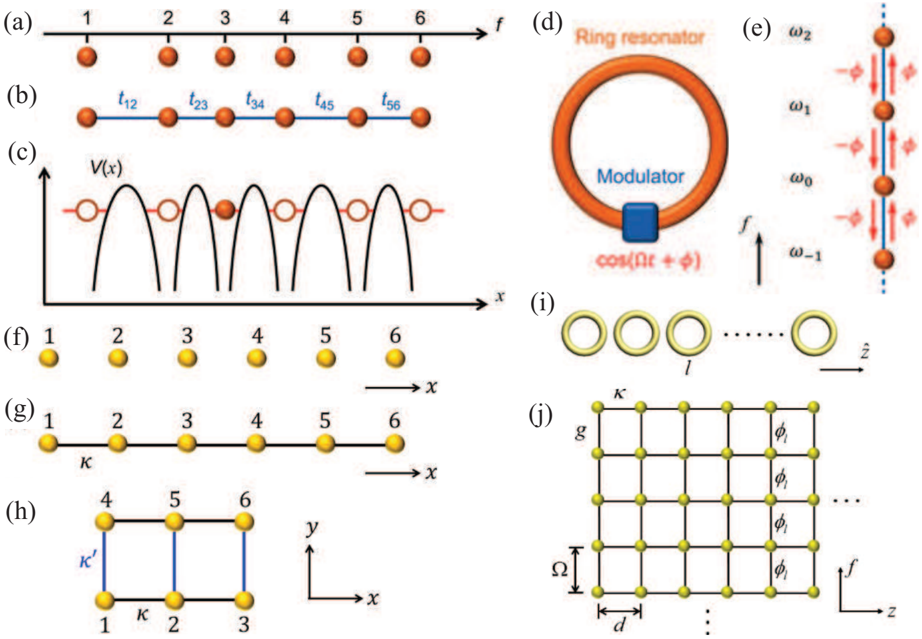
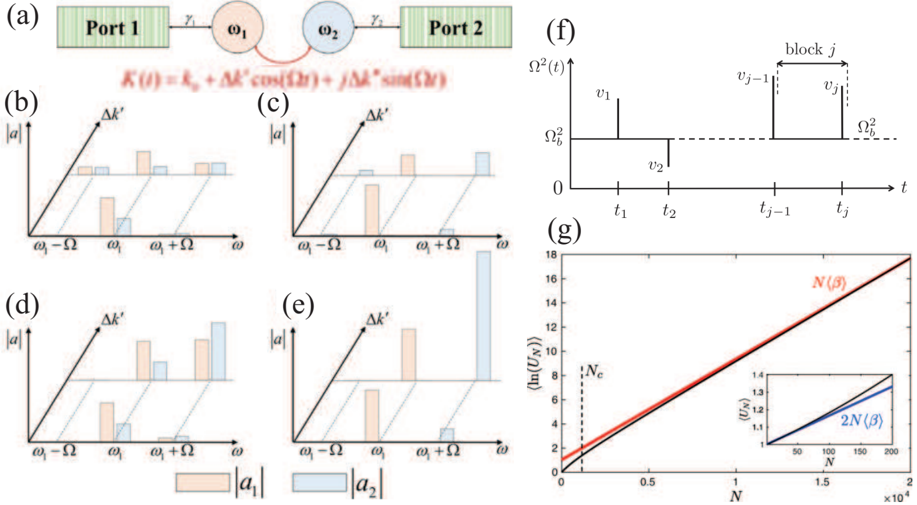
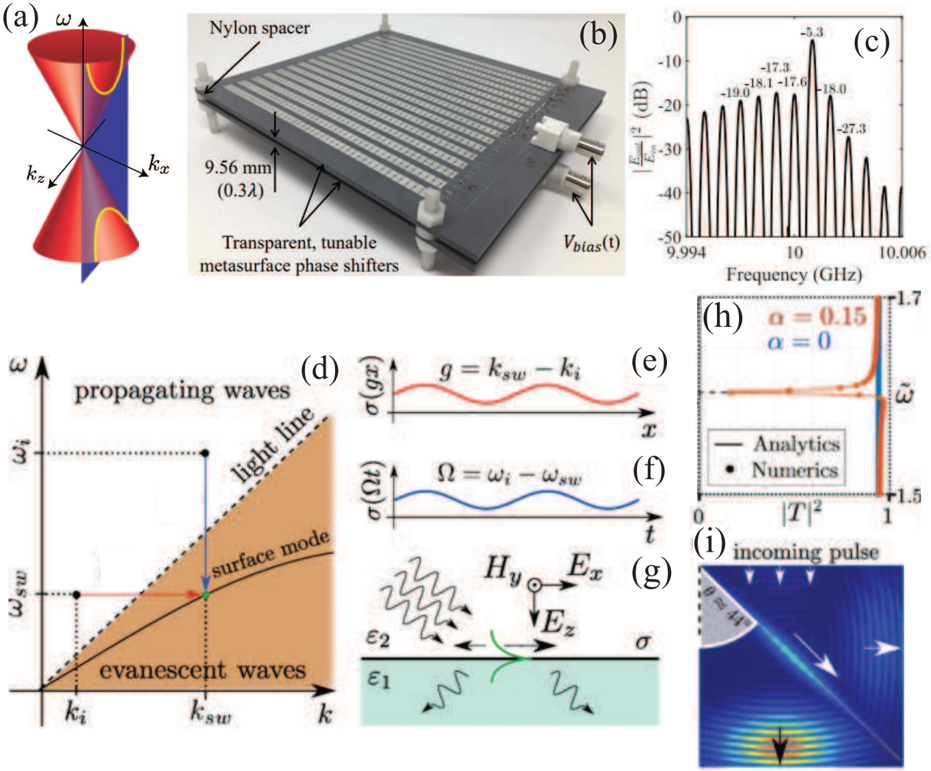
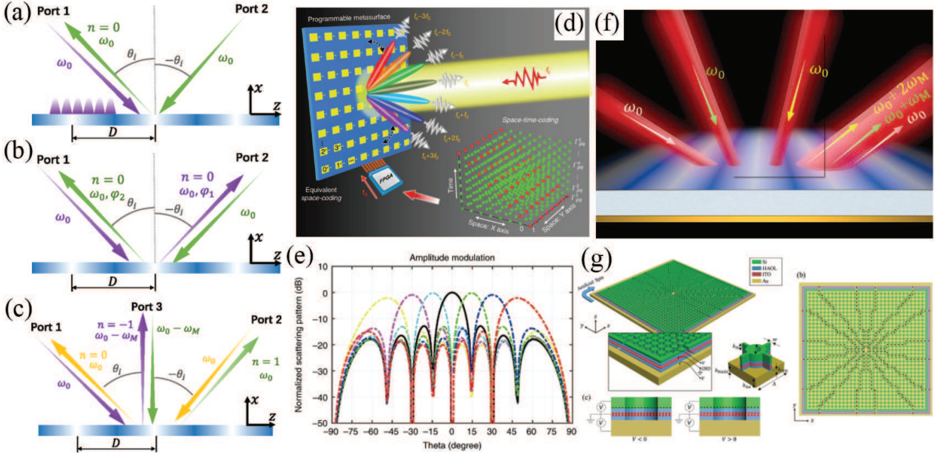
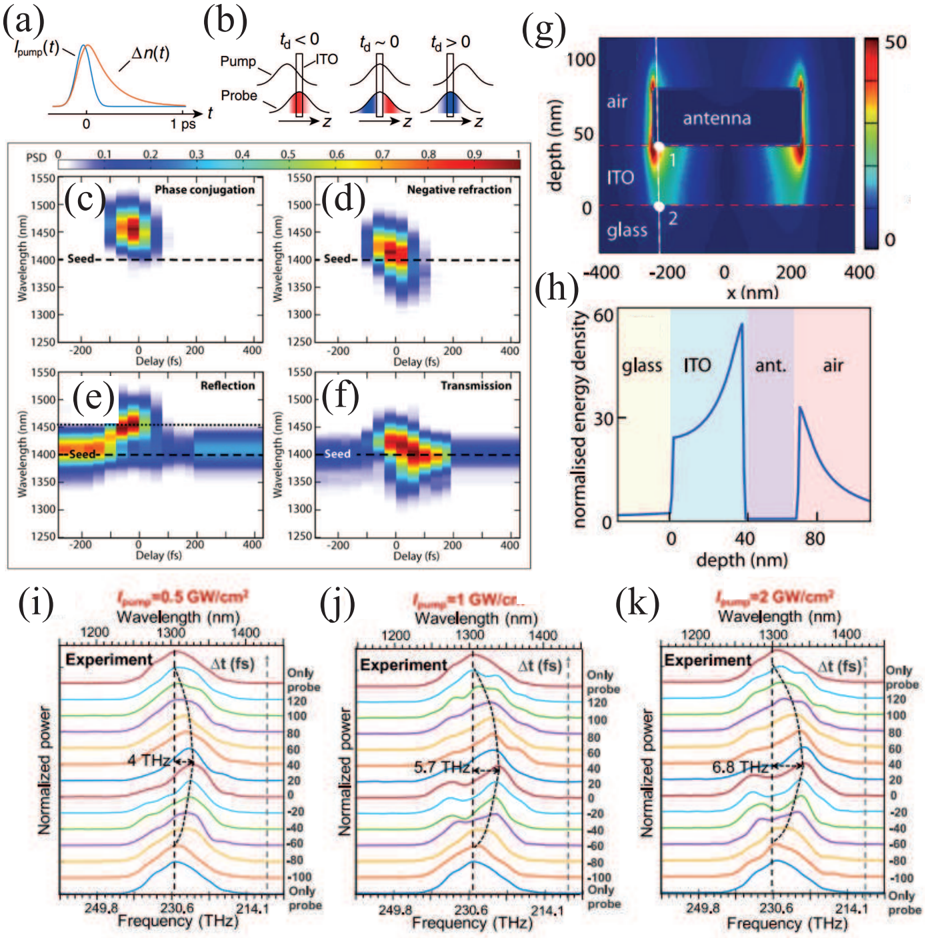
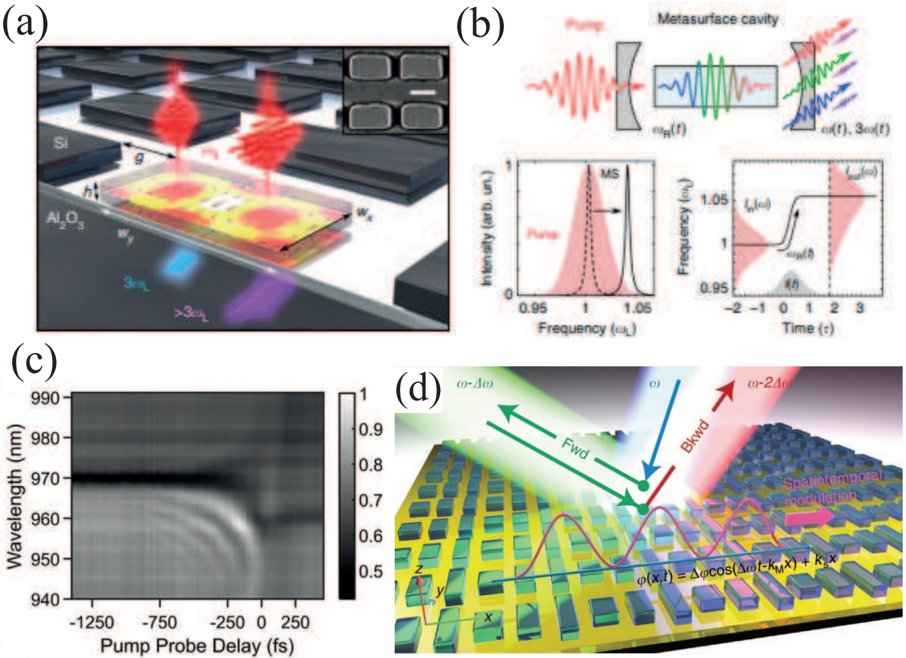
Time-varying media have recently emerged as a new paradigm for wave manipulation, due to the synergy between the discovery of highly nonlinear materials, such as epsilon-near-zero materials, and the quest for wave applications, such as magnet-free nonreciprocity, multimode light shaping, and ultrafast switching. In this review, we provide a comprehensive discussion of the recent progress achieved with photonic metamaterials whose properties stem from their modulation in time. We review the basic concepts underpinning temporal switching and its relation with spatial scattering and deploy the resulting insight to review photonic time-crystals and their emergent research avenues, such as topological and non-Hermitian physics. We then extend our discussion to account for spatiotemporal modulation and its applications to nonreciprocity, synthetic motion, giant anisotropy, amplification, and many other effects. Finally, we conclude with a review of the most attractive experimental avenues recently demonstrated and provide a few perspectives on emerging trends for future implementations of time-modulation in photonics.
Overview
The claims and statistics of this paper haven’t been checked yet.
Run the check — free, no account needed. It reads the open-access text and checks the sources it cites.
Integrity signals
Registry
Cites
Statistics
Figures
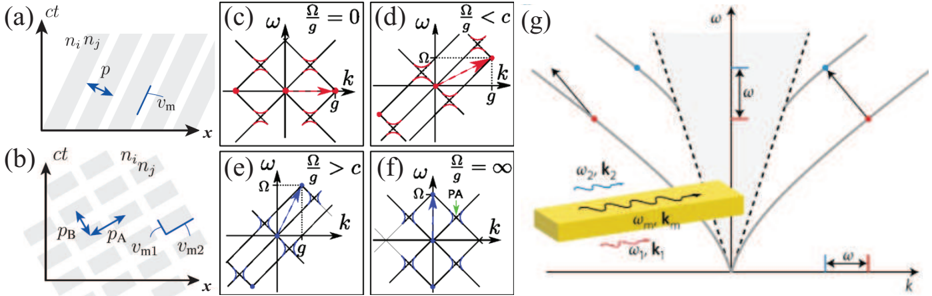
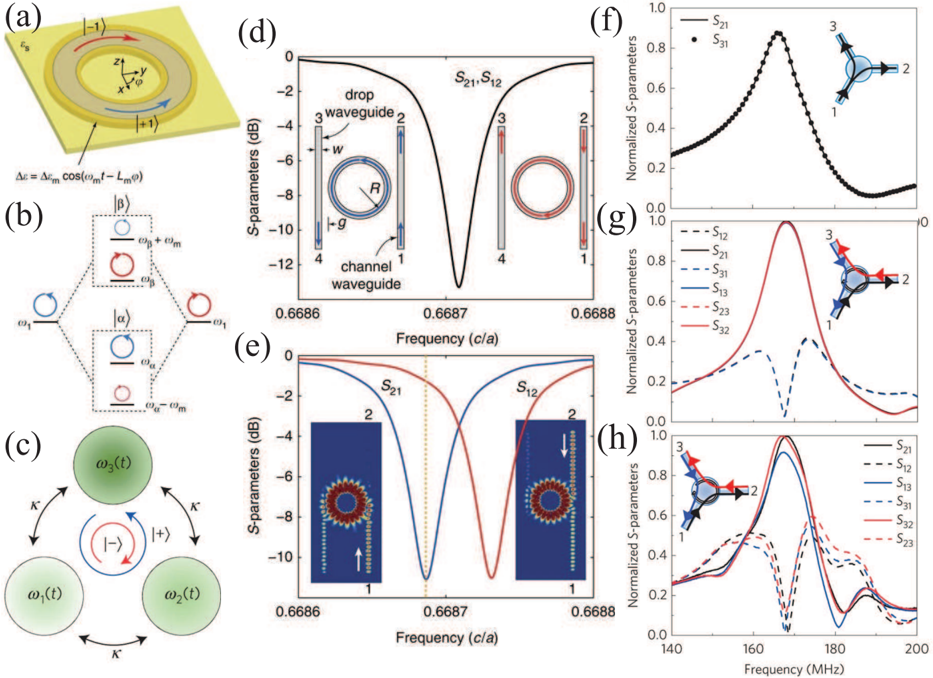
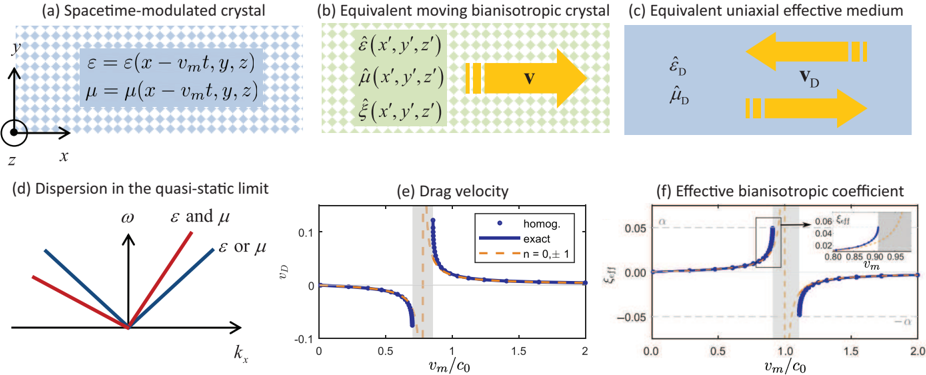
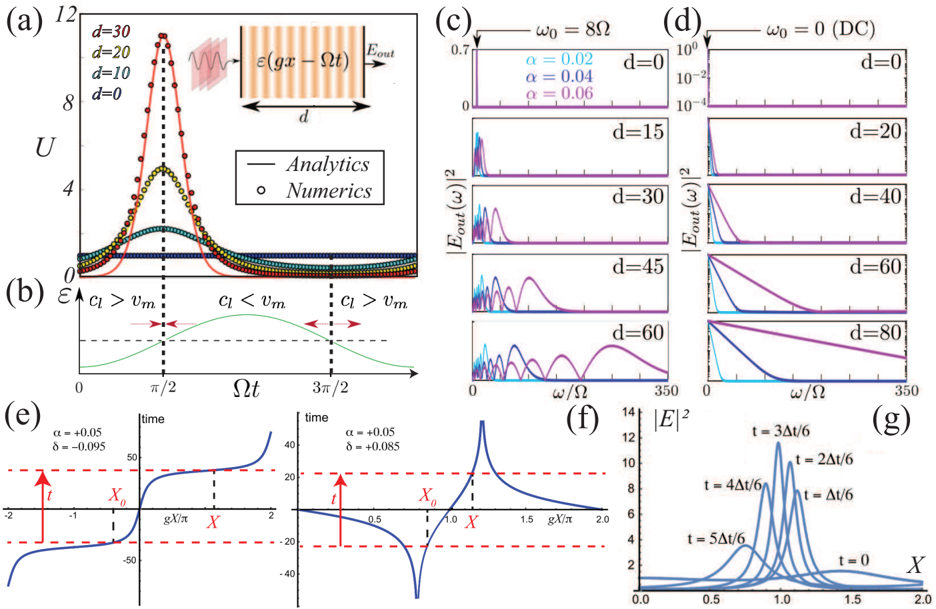
Verification
Claims the paper makes
The claims and statistics of this paper haven’t been checked yet.
Run the check — free, no account needed. It reads the open-access text and checks the sources it cites.
Claims other papers make about this one
Each is checked against this paper’s own text: does it say what the citing paper says it does?
The check wasn’t confident either way, so it gives no verdict — never disputed.
In the citing paper
“and can be driven by the skyrmion Hall effect [61,62], spin-orbit torque [99,100], and even the light [101][102][103][104][105].”
From Optical skyrmions and other topological quasiparticles of light (2024) · cites this paper as [100]
Experimental — accuracy not yet measured
Self-check
Percentages, sums and reported differences re-computed from the paper’s own numbers.
The self-check needs the paper’s full text.
Citations
Cites
The electronic properties of graphene
Castro Neto, A. H., Guinea, F., Peres, N. M. R., Novoselov, K. S., & Geim, A. K. (2009) · Reviews of Modern Physics · doi:10.1103/revmodphys.81.109 · Cited by 24,803
Negative Refraction Makes a Perfect Lens
Pendry, J. B. (2000) · Physical Review Letters · doi:10.1103/physrevlett.85.3966 · Cited by 12,159
Self-citationElectronically programmable photonic molecule
Zhang, M., Wang, C., Hu, Y., Shams-Ansari, A., Ren, T., Fan, S., & Lončar, M. (2019) · Nature Photonics · doi:10.1038/s41566-018-0317-y · Cited by 255
Photonic Weyl point in a two-dimensional resonator lattice with a synthetic frequency dimension
Lin, Q., Xiao, M., Yuan, L., & Fan, S. (2016) · Nature Communications · doi:10.1038/ncomms13731 · Cited by 233
Research works printed but not linked: 248
- E. Knox and A. Wilson, Routledge Companion to the Philosophy of Physics (2021).
- R. Schützhold and W. G. Unruh, "Hawking radiation in an electromagnetic waveguide?," Phys. Rev. Lett. 95, 031301 (2005).
- T. G. Philbin, C. Kuklewicz, S. Robertson, et al., "Fiber-optical analog of the event horizon," Science 319(5868), 1367-1370 (2008).
- A. Shapere and F. Wilczek, "Classical time crystals," Physical review letters 109(16), 160402 (2012).
- K. Sacha and J. Zakrzewski, "Time crystals: a review," Reports on Progress in Physics 81(1), 016401 (2017).
- N. Y. Yao, C. Nayak, L. Balents, et al., "Classical discrete time crystals," Nature Physics 16(4), 438-447 (2020).
- H. Keßler, P. Kongkhambut, C. Georges, et al., "Observation of a dissipative time crystal," Phys. Rev. Lett. 127, 043602 (2021).
- N. Engheta, "Metamaterials with high degrees of freedom: space, time, and more," Nanophotonics 10(1), 639-642 (2021).
- L. Novotny and B. Hecht, Principles of nano-optics, Cambridge university press (2012).
- B. E. Saleh and M. C. Teich, Fundamentals of photonics, john Wiley & sons (2019).
- R. W. Boyd, Nonlinear optics, Academic press (2020).
- V. G. Veselago, "Electrodynamics of substances with simultaneously negative and," Usp. fiz. nauk 92, 517 (1967).
- A. Alu, M. G. Silveirinha, A. Salandrino, et al., "Epsilon-near-zero metamaterials and electromagnetic sources: Tailoring the radiation phase pattern," Physical review B 75(15), 155410 (2007).
- A. K. Iyer, A. Alù, and A. Epstein, "Metamaterials and metasurfaces-historical context, recent advances, and future directions," IEEE Transactions on Antennas and Propagation 68(3), 1223-1231 (2020).
- F. R. Morgenthaler, "Velocity modulation of electromagnetic waves," IRE Transactions on microwave theory and techniques 6(2), 167-172 (1958).
- J. T. Mendonc ¸a, Theory of photon acceleration, CRC Press (2000).
- J. D. Jackson, Classical Electrodynamics, John Wiley & Sons (2012).
- B. Auld, J. H. Collins, and H. Zapp, "Signal processing in a nonperiodically time-varying magnetoelastic medium," Proceedings of the IEEE 56(3), 258-272 (1968).
- R. Fante, "Transmission of electromagnetic waves into time-varying media," IEEE Trans- actions on Antennas and Propagation 19(3), 417-424 (1971).
- R. Fante, "On the propagation of electromagnetic waves through a time-varying dielectric layer," Applied Scientific Research 27(1), 341-354 (1973).
- P. Mukherjee and S. Talwar, "Reflection and transmission of electromagnetic waves at a moving magnetoplasma half-space," Radio Science 8(7), 653-665 (1973).
- Y. Xiao, D. N. Maywar, and G. P. Agrawal, "Reflection and transmission of electromagnetic waves at a temporal boundary," Optics letters 39(3), 574-577 (2014).
- M. A. Salem and C. Caloz, "Space-time cross-mapping and application to wave scattering," arXiv preprint arXiv:1504.02012 (2015). · arXiv
- C. Caloz and Z.-L. Deck-Léger, "Spacetime Metamaterials-Part II: Theory and Applica- tions," IEEE Transactions on Antennas and Propagation 68(3), 16 (2020).
- M. Bakunov and A. Maslov, "Reflection and transmission of electromagnetic waves at a temporal boundary: comment," Optics letters 39(20), 6029-6029 (2014).
- D. K. Kalluri, Electromagnetics of time varying complex media: frequency and polarization transformer, CRC Press (2018).
- A. Akbarzadeh, N. Chamanara, and C. Caloz, "Inverse prism based on temporal discontinu- ity and spatial dispersion," Optics letters 43(14), 3297-3300 (2018).
- M. Bakunov, A. Shirokova, M. Kurnikov, et al., "Light scattering at a temporal boundary in a lorentz medium," Optics Letters 46(19), 4988-4991 (2021).
- J. Gratus, R. Seviour, P. Kinsler, et al., "Temporal boundaries in electromagnetic materials," New Journal of Physics 23(8), 083032 (2021).
- J. Zhang, W. Donaldson, and G. Agrawal, "Temporal reflection and refraction of optical pulses inside a dispersive medium: an analytic approach," JOSA B 38(3), 997-1003 (2021).
- J. Zhang, W. Donaldson, and G. P. Agrawal, "Time-domain fabry-perot resonators formed inside a dispersive medium," JOSA B 38(8), 2376-2382 (2021).
- D. V. Else, B. Bauer, and C. Nayak, "Floquet time crystals," Physical review letters 117(9), 090402 (2016).
- N. Y. Yao, A. C. Potter, I.-D. Potirniche, et al., "Discrete time crystals: Rigidity, criticality, and realizations," Physical review letters 118(3), 030401 (2017).
- V. Pacheco-Peña and N. Engheta, "Temporal metamaterials with gain and loss," arXiv preprint arXiv:2108.01007 (2021). · arXiv
- J. Mendonc ¸a, A. Martins, and A. Guerreiro, "Temporal beam splitter and temporal interfer- ence," Physical Review A 68(4), 043801 (2003).
- V. Pacheco-Peña and N. Engheta, "Antireflection temporal coatings," Optica 7(4), 323-331 (2020).
- D. Christodoulides, J. Yang, et al., Parity-time Symmetry and its Applications, vol. 280, Springer (2018).
- H. Li, S. Yin, E. Galiffi, et al., "Temporal parity-time symmetry for extreme energy trans- formations," Physical Review Letters 127(15), 153903 (2021).
- V. Pacheco-Peña and N. Engheta, "Temporal aiming," Light: Science & Applications 9, 129 (2020).
- V. Pacheco-Peña and N. Engheta, "Temporal brewster angle," arXiv preprint arXiv:2102.13305 (2021). · arXiv
- J. Xu, W. Mai, and D. H. Werner, "Complete polarization conversion using anisotropic temporal slabs," Optics Letters 46(6), 1373-1376 (2021).
- Z. Hayran, A. Chen, and F. Monticone, "Spectral causality and the scattering of waves," Optica 8(8), 1040-1049 (2021).
- D. M. Solís and N. Engheta, "Functional analysis of the polarization response in linear time-varying media: A generalization of the kramers-kronig relations," Physical Review B 103(14), 144303 (2021).
- E. Yablonovitch, "Spectral Broadening in the Light Transmitted through a Rapidly Growing Plasma," Physical Review Letters 31, 877-879 (1973).
- E. Yablonovitch, "Self-Phase Modulation of Light in a Laser-Breakdown Plasma," Physical Review Letters 32, 1101-1104 (1974).
- C.-L. Jiang, "Wave propagation and dipole radiation in a suddenly created plasma," IEEE Transactions on Antennas and Propagation 23(1), 83-90 (1975).
- S. Wilks, J. Dawson, and W. Mori, "Frequency up-conversion of electromagnetic radiation with use of an overdense plasma," Physical review letters 61(3), 337 (1988).
- G. A. Menendez and B. Maes, "Time reflection and refraction of graphene plasmons at a temporal discontinuity," Optics letters 42(23), 5006-5009 (2017).
- J. Wilson, F. Santosa, M. Min, et al., "Temporal control of graphene plasmons," Physical Review B 98(8), 081411 (2018).
- A. Maslov and M. Bakunov, "Temporal scattering of a graphene plasmon by a rapid carrier density decrease," Optica 5(12), 1508-1515 (2018).
- A. Shlivinski and Y. Hadad, "Beyond the bode-fano bound: Wideband impedance matching for short pulses using temporal switching of transmission-line parameters," Physical review letters 121(20), 204301 (2018).
- W. Mori, T. Katsouleas, J. Dawson, et al., "Conversion of dc fields in a capacitor array to radiation by a relativistic ionization front," Physical review letters 74(4), 542 (1995).
- M. Cirone, K. Rzaz-Dotewski, and J. Mostowski, "Photon generation by time-dependent dielectric: a soluble model," Physical Review A 55(1), 62 (1997).
- M. J. Mencagli, D. L. Sounas, M. Fink, et al., "Static-to-dynamic field conversion with time-varying media," arXiv preprint arXiv:2107.11420 (2021). · arXiv
- H. Li and A. Alù, "Temporal switching to extend the bandwidth of thin absorbers," Optica 8(1), 24-29 (2021).
- Y. Mazor, M. Cotrufo, and A. Alù, "Unitary excitation transfer between coupled cavities using temporal switching," Physical Review Letters 127(1), 013902 (2021).
- G. Ptitcyn, M. S. Mirmoosa, and S. A. Tretyakov, "Time-modulated meta-atoms," Physical Review Research 1(2), 023014 (2019).
- M. S. Mirmoosa, T. T. Koutserimpas, G. A. Ptitcyn, et al., "Dipole polarizability of time- varying particles," arXiv:2002.12297 [physics] (2020). · arXiv
- V. Pacheco-Peña and N. Engheta, "Spatiotemporal isotropic-to-anisotropic meta-atoms," New Journal of Physics 23(9), 095006 (2021).
- F. Miyamaru, C. Mizuo, T. Nakanishi, et al., "Ultrafast frequency-shift dynamics at tempo- ral boundary induced by structural-dispersion switching of waveguides," Physical Review Letters 127(5), 053902 (2021).
- J. Tunesi, L. Peters, J. T. Gongora, et al., "Terahertz emission mediated by ultrafast time- varying metasurfaces," Physical Review Research 3(4), L042006 (2021).
- L. Stefanini, D. Ramaccia, A. Toscano, et al., "Temporal interfaces and metamaterial re- sponse enabled by boundaries," arXiv preprint arXiv:2105.14350 (2021). · arXiv
- J. R. Sanmartín, "O botafumeiro: Parametric pumping in the middle ages," American Jour- nal of Physics 52(10), 937-945 (1984).
- F. Wilczek, "Quantum time crystals," Physical review letters 109(16), 160401 (2012).
- E. Lustig, Y. Sharabi, and M. Segev, "Topological aspects of photonic time crystals," Optica 5, 1390 (2018).
- D. Torrent, W. J. Parnell, and A. N. Norris, "Loss compensation in time-dependent elastic metamaterials," Phys. Rev. B 97, 014105 (2018).
- D. Ramaccia, A. Alù, A. Toscano, et al., "Temporal multilayer structures for designing higher-order transfer functions using time-varying metamaterials," Applied Physics Letters 118(10), 101901 (2021).
- G. Castaldi, V. Pacheco-Peña, M. Moccia, et al., "Exploiting space-time duality in the syn- thesis of impedance transformers via temporal metamaterials," Nanophotonics (2021).
- J. G. Gaxiola-Luna and P. Halevi, "Temporal photonic (time) crystal with a square profile of both permittivity ε(t) and permeability µ (t)," Physical Review B 103(14), 144306 (2021).
- L. Yuan, A. Dutt, and S. Fan, "Synthetic frequency dimensions in dynamically modulated ring resonators," APL Photonics 6(07), 1102 (2021).
- L. Yuan, Q. Lin, M. Xiao, et al., "Synthetic dimension in photonics," Optica 5(11), 1396- 1405 (2018).
- L. Yuan, Y. Shi, and S. Fan, "Photonic gauge potential in a system with a synthetic frequency dimension," Optics letters 41(4), 741-744 (2016).
- A. Dutt, Q. Lin, L. Yuan, et al., "A single photonic cavity with two independent physical synthetic dimensions," Science 367(6473), 59-64 (2020).
- C. W. Peterson, W. A. Benalcazar, M. Lin, et al., "Strong nonreciprocity in modulated res- onator chains through synthetic electric and magnetic fields," Physical review letters 123(6), 063901 (2019).
- J. S. Hung, J. Busnaina, C. Chang, et al., "Quantum simulation of the bosonic creutz ladder with a parametric cavity," arXiv preprint arXiv:2101.03926 (2021). · arXiv
- A. Dutt, M. Minkov, Q. Lin, et al., "Experimental demonstration of dynamical input isola- tion in nonadiabatically modulated photonic cavities," ACS Photonics 6(1), 162-169 (2018).
- X. Ni, S. Kim, and A. Alù, "Topological insulator in two synthetic dimensions based on an optomechanical resonator," Optica 8(8), 1024-1032 (2021).
- T. T. Koutserimpas and R. Fleury, "Nonreciprocal gain in non-hermitian time-floquet sys- tems," Physical review letters 120(8), 087401 (2018).
- R. Carminati, H. Chen, R. Pierrat, et al., "Universal statistics of waves in a random time- varying medium," arXiv preprint arXiv:2104.00051 (2021). · arXiv
- T. T. Koutserimpas, A. Alu, and R. Fleury, "Parametric amplification and bidirectional in- visibility in pt-symmetric time-floquet systems," Physical Review A 97(1), 013839 (2018).
- F. Arscott, "Theory and application of mathieu functions. by nw mclachlan. pp. xii, 401.(dover, new york.)," The Mathematical Gazette 52(379), 94-95 (1968).
- N. Wang, Z.-Q. Zhang, and C. T. Chan, "Photonic floquet media with a complex time- periodic permittivity," Phys. Rev. B 98, 085142 (2018).
- A. Bossart and R. Fleury, "Non-hermitian time evolution: from static to parametric instabil- ity," arXiv preprint arXiv:2103.15915 (2021). · arXiv
- T. T. Koutserimpas and R. Fleury, "Electromagnetic fields in a time-varying medium: Ex- ceptional points and operator symmetries," IEEE Transactions on Antennas and Propaga- tion 68(9), 6717-6724 (2020).
- M. Li, X. Ni, M. Weiner, et al., "Topological phases and nonreciprocal edge states in non- hermitian floquet insulators," Physical Review B 100(4), 045423 (2019).
- B. Apffel, S. Wildeman, A. Eddi, et al., "Time localization of energy in disordered time- modulated systems," arXiv preprint arXiv:2102.07583 (2021). · arXiv
- Y. Sharabi, E. Lustig, and M. Segev, "Disordered photonic time crystals," Physical Review Letters 126(16), 163902 (2021).
- J. Pendry, "The evolution of waves in disordered media," Journal of Physics C: Solid State Physics 15(16), 3493 (1982).
- Z. Wu and A. Grbic, "Serrodyne frequency translation using time-modulated metasurfaces," IEEE Transactions on Antennas and Propagation 68(3), 1599-1606 (2019).
- E. Galiffi, Y.-T. Wang, Z. Lim, et al., "Wood anomalies and surface-wave excitation with a time grating," Physical Review Letters 125(12), 127403 (2020).
- U. C. Fischer and D. Pohl, "Observation of single-particle plasmons by near-field optical microscopy," Physical review letters 62(4), 458 (1989).
- R. W. Wood, "Xlii. on a remarkable case of uneven distribution of light in a diffraction grat- ing spectrum," The London, Edinburgh, and Dublin Philosophical Magazine and Journal of Science 4(21), 396-402 (1902).
- R. C. Cumming, "The serrodyne frequency translator," Proceedings of the IRE 45(2), 175- 186 (1957).
- X. Wang, A. Diaz-Rubio, H. Li, et al., "Theory and design of multifunctional space-time metasurfaces," Physical Review Applied 13(4), 044040 (2020).
- D. Ramaccia, D. L. Sounas, A. Alù, et al., "Phase-induced frequency conversion and doppler effect with time-modulated metasurfaces," IEEE Transactions on Antennas and Propagation 68(3), 1607-1617 (2019).
- C. Scarborough, Z. Wu, and A. Grbic, "Efficient computation of spatially-discrete traveling- wave modulated structures," arXiv preprint arXiv:2103.02494 (2021). · arXiv
- Z. Wu, C. Scarborough, and A. Grbic, "Space-time-modulated metasurfaces with spatial discretization: Free-space n-path systems," Physical Review Applied 14(6), 064060 (2020).
- D. Ramaccia, D. L. Sounas, A. V. Marini, et al., "Electromagnetic isolation induced by time- varying metasurfaces: Nonreciprocal bragg grating," IEEE Antennas and Wireless Propa- gation Letters 19(11), 1886-1890 (2020).
- H. B. Sedeh, M. M. Salary, and H. Mosallaei, "Time-varying optical vortices enabled by time-modulated metasurfaces," Nanophotonics 9(9), 2957-2976 (2020).
- Y. Hadad, D. L. Sounas, and A. Alu, "Space-time gradient metasurfaces," Phys. Rev. B 92, 100304 (2015).
- J. S. Martínez-Romero and P. Halevi, "Parametric resonances in a temporal photonic crystal slab," Phys. Rev. A 98, 053852 (2018).
- L. Zhang, M. Z. Chen, W. Tang, et al., "A wireless communication scheme based on space- and frequency-division multiplexing using digital metasurfaces," Nature Electronics 4(3), 218-227 (2021).
- L. Zhang, X. Q. Chen, S. Liu, et al., "Space-time-coding digital metasurfaces," Nature communications 9(1), 1-11 (2018).
- A. M. Shaltout, K. G. Lagoudakis, J. van de Groep, et al., "Spatiotemporal light control with frequency-gradient metasurfaces," Science 365(6451), 374-377 (2019).
- X. Wang, G. Ptitcyn, V. Asadchy, et al., "Nonreciprocity in bianisotropic systems with uniform time modulation," Physical Review Letters 125(26), 266102 (2020).
- J. S. Martínez-Romero, O. Becerra-Fuentes, and P. Halevi, "Temporal photonic crystals with modulations of both permittivity and permeability," Physical Review A 93(6), 063813 (2016).
- Z.-L. Deck-Léger, N. Chamanara, M. Skorobogatiy, et al., "Uniform-velocity spacetime crystals," Advanced Photonics 1, 1 (2019). 115
- J. Pierce, "Theory of the beam-type traveling-wave tube," Proceedings of the IRE 35(2), 111-123 (1947).
- A. Oliner and A. Hessel, "Wave Propagation in a Medium with a Progressive Sinusoidal Disturbance," IRE Transactions on Microwave Theory and Techniques 9, 337-343 (1961).
- E. Cassedy and A. Oliner, "Dispersion relations in timespace periodic media: Part i-stable interactions," Proceedings of the IEEE 51, 1342 (1963). 119
- E. Cassedy, "Dispersion relations in time-space periodic media part II-Unstable interac- tions," Proceedings of the IEEE 55, 1154-1168 (1967).
- R. L. Fante, "Optical propagation in space-time-modulated media using many-space-scale perturbation theory," JOSA 62(9), 1052-1060 (1972).
- J. N. Winn, S. Fan, J. D. Joannopoulos, et al., "Interband transitions in photonic crystals," Physical Review B 59, 1551-1554 (1999). 122
- F. Biancalana, A. Amann, A. V. Uskov, et al., "Dynamics of light propagation in spatiotem- poral dielectric structures," Physical Review E 75, 046607 (2007).
- D. L. Sounas and A. Alu, "Non-reciprocal photonics based on time modulation," Nature Photonics 11(12), 774-783 (2017).
- S. Taravati, N. Chamanara, and C. Caloz, "Nonreciprocal electromagnetic scattering from a periodically space-time modulated slab and application to a quasisonic isolator," Physical Review B 96, 165144 (2017).
- Y. Sivan, S. Rozenberg, and A. Halstuch, "Coupled-mode theory for electromagnetic pulse propagation in dispersive media undergoing a spatiotemporal perturbation: Exact derivation, numerical validation, and peculiar wave mixing," Physical Review B 93(14), 144303 (2016).
- H. Lira, Z. Yu, S. Fan, et al., "Electrically Driven Nonreciprocity Induced by Interband Photonic Transition on a Silicon Chip," Physical Review Letters 109, 033901 (2012).
- C. Caloz and Z.-L. Deck-Leger, "Spacetime Metamaterials-Part I: General Concepts," IEEE Transactions on Antennas and Propagation 68, 1569-1582 (2020). 129
- E. Galiffi, P. A. Huidobro, and J. B. Pendry, "Broadband Nonreciprocal Amplification in Luminal Metamaterials," Physical Review Letters 123, 206101 (2019).
- Z.-L. Deck-Leger, N. Chamanara, M. Skorobogatiy, et al., "Uniform-velocity spacetime crystals," Advanced Photonics 1, 1 (2019).
- D. L. Sounas, C. Caloz, and A. Alu, "Giant non-reciprocity at the subwavelength scale using angular momentum-biased metamaterials," Nature communications 4(1), 1-7 (2013).
- N. A. Estep, D. L. Sounas, J. Soric, et al., "Magnetic-free non-reciprocity and isolation based on parametrically modulated coupled-resonator loops," Nature Physics 10(12), 923- 927 (2014).
- D.-W. Wang, H.-T. Zhou, M.-J. Guo, et al., "Optical Diode Made from a Moving Photonic Crystal," Physical Review Letters 110, 093901 (2013).
- N. Chamanara, S. Taravati, Z.-L. Deck-Léger, et al., "Optical isolation based on space-time engineered asymmetric photonic band gaps," Physical Review B 96(15), 155409 (2017).
- C. Caloz, A. Alù, S. Tretyakov, et al., "Electromagnetic nonreciprocity," Phys. Rev. Applied 10, 047001 (2018). 136
- J. V. Bladel, Relativity and Engineering, Springer Verlag, Berlin (1984).
- J. A. Kong, Electromagnetic Wave Theory, EMW Publishing, Cambridge, Massachusetts (2008).
- S. Lannebère and M. G. Silveirinha, "Wave instabilities and unidirectional light flow in a cavity with rotating walls," Phys. Rev. A 94, 033810 (2016). 142
- J. B. Pendry, "Shearing the vacuum -quantum friction," J. Phys.: Condens. Matter 9, 10301 (1997).
- M. G. Silveirinha, "Theory of quantum friction," New J. Phys. 16, 063011 (2014).
- Y. B. Zeldovich, "Generation of waves by a rotating body," JETP Lett. 14, 180 (1971).
- M. G. Silveirinha, "Optical instabilities and spontaneous light emission by polarizable mov- ing matter," Phys. Rev. X 4, 031013 (2014).
- D. Faccio and E. M. Wright, "Nonlinear zeldovich effect: Parametric amplification from medium rotation," Phys. Rev. Lett. 118, 093901 (2017).
- V. K. O. Sydoruk, E. Shamonina and L. Solymar, "Terahertz instability of surface optical- phonon polaritons that interact with surface plasmon polaritons in the presence of electron drift," Physics of Plasmas 17, 102103 (2010).
- T. A. Morgado and M. G. Silveirinha, "Negative landau damping in bilayer graphene," Phys. Rev. Lett. 119, 133901 (2017).
- B. V. Duppen, A. Tomadin, A. N. Grigorenko, et al., "Current-induced birefrigent absorp- tion and non-reciprocal plasmons in graphene," 2D Mater. 3, 015011 (2016).
- T. A. Morgado and M. G. Silveirinha, "Drift-induced unidirectional graphene plasmons," ACS Photonics 5, 4253 (2018). 151
- Y. Dong, L. Xiong, I. Y. Phinney, et al., "Fizeau drag in graphene plasmonics," Nature 594, 513 (2021).
- W. Zhao, S. Zhao, H. Li, et al., "Efficient fizeau drag from dirac electrons in monolayer graphene," Nature 594, 517 (2021).
- P. A. Huidobro, E. Galiffi, S. Guenneau, et al., "Fresnel drag in space-time-modulated meta- materials," Proceedings of the National Academy of Sciences 116, 24943-24948 (2019).
- Y. Mazor and A. Alù, "One-way hyperbolic metasurfaces based on synthetic motion," IEEE Transactions on Antennas and Propagation 68(3), 1739-1747 (2019).
- P. A. Huidobro, M. G. Silveirinha, E. Galiffi, et al., "Homogenization theory of space-time metamaterials," Physical Review Applied 16(1), 014044 (2021).
- D. R. Smith and J. Pendry, "Homogenization of metamaterials by field averaging," J. Opt. Soc. Am. B 23, 391 (2006).
- M. G. Silveirinha, "Metamaterial homogenization approach with application to the charac- terization of microstructured composites with negative parameters," Phys. Rev. B 75, 115104 (2007).
- C. R. Simovski and S. A. Tretyakov, "Local constitutive parameters of metamaterials from an effective-medium perspective," Phys. Rev. B 75, 195111 (2007).
- A. Alù, "First-principles homogenization theory for periodic metamaterials," Phys. Rev. B 84, 075153 (2011).
- H. T. To, "Homogenization of dynamic laminates," J. Math. Anal. Appl. 354, 518 (2009).
- K. Lurie, An introduction to the mathematical theory of waves, Springer, New York, NY (2007). 163
- D. E. Aspnes, "Local-field effects and effective-medium theory: A microscopic perspec- tive," American Journal of Physics 50, 704 (1982). 164
- J. B. Pendry, A. J. Holden, D. J. Robbins, et al., "Magnetism from conductors and enhanced nonlinear phenomena," IEEE Trans. Microw. Theory Techn. 47, 2075 (1999).
- D. N. Astrov, "Magnetoelectric effect in chromium oxide," Sov. Phys. JETP 13, 729 (1961).
- S. Coh and D. Vanderbilt, "Canonical magnetic insulators with isotropic magnetoelectric coupling," Phys. Rev. B 88, 121106 (2013).
- S. Taravati, "Giant Linear Nonreciprocity, Zero Reflection, and Zero Band Gap in Equili- brated Space-Time-Varying Media," Physical Review Applied 9, 064012 (2018). 168
- E. Galiffi, New degrees of freedom for metamaterials and metasurfaces: from hidden spatial dimensions to dynamical structures. PhD thesis, Imperial College London (2020). 169
- E. Galiffi, M. G. Silveirinha, P. A. Huidobro, et al., "Photon localization and Bloch symme- try breaking in luminal gratings," Physical Review B 104, 014302 (2021). 170
- J. Pendry, E. Galiffi, and P. Huidobro, "Gain in time-dependent media-a new mechanism," JOSA B 38(11), 3360-3366 (2021). 171
- J. Pendry, E. Galiffi, and P. Huidobro, "Gain mechanism in time-dependent media," Optica 8(5), 636-637 (2021).
- N. Chamanara, D. G. Cooke, and C. Caloz, "Linear Pulse Compansion based on Space- Time Modulation," in 2019 IEEE International Symposium on Antennas and Propagation and USNC-URSI Radio Science Meeting, 239-240, IEEE, (Atlanta, GA, USA) (2019).
- H. Barati Sedeh, M. M. Salary, and H. Mosallaei, "Topological space-time photonic tran- sitions in angular-momentum-biased metasurfaces," Advanced Optical Materials 8(11), 2000075 (2020).
- Y. Hadad, J. C. Soric, and A. Alu, "Breaking temporal symmetries for emission and absorp- tion," Proceedings of the National Academy of Sciences 113(13), 3471-3475 (2016).
- A. Shaltout, A. Kildishev, and V. Shalaev, "Time-varying metasurfaces and Lorentz non- reciprocity," Optical Materials Express 5, 2459 (2015).
- L. Zhang, X. Q. Chen, R. W. Shao, et al., "Breaking reciprocity with space-time-coding digital metasurfaces," Advanced Materials 31(41), 1904069 (2019).
- H. Rajabalipanah, A. Abdolali, S. Iqbal, et al., "Analog signal processing through space- time digital metasurfaces," Nanophotonics 10(6), 1753-1764 (2021).
- D. Oue, K. Ding, and J. Pendry, " Čerenkov radiation in vacuum from a superluminal grat- ing," arXiv preprint arXiv:2105.13681 (2021). · arXiv
- W. J. M. Kort-Kamp, A. K. Azad, and D. A. R. Dalvit, "Space-time quantum metasurfaces," Phys. Rev. Lett. 127, 043603 (2021).
- N. Chamanara, Z.-L. Deck-Léger, C. Caloz, et al., "Unusual electromagnetic modes in space-time-modulated dispersion-engineered media," Physical Review A 97, 063829 (2018). 181
- D. Torrent, "Strong spatial dispersion in time-modulated dielectric media," Physical Review B 102(21), 214202 (2020). 182
- E. Galiffi, P. A. Huidobro, and J. Pendry, "An archimedes' screw for light," arXiv preprint arXiv:2109.14460 (2021). · arXiv
- R. Fleury, A. B. Khanikaev, and A. Alù, "Floquet topological insulators for sound," Nature Communications 7, 11744 (2016).
- L. He, Z. Addison, J. Jin, et al., "Floquet chern insulators of light," Nature communications 10(1), 1-6 (2019).
- K. Fang, Z. Yu, and S. Fan, "Photonic Aharonov-Bohm Effect Based on Dynamic Modula- tion," Physical Review Letters 108, 153901 (2012).
- G. W. Milton and O. Mattei, "Field patterns: a new mathematical object," Proceedings of the Royal Society A: Mathematical, Physical and Engineering Sciences 473(2198), 20160819 (2017).
- O. Mattei and G. W. Milton, "Field patterns without blow up," New Journal of Physics 19(9), 093022 (2017).
- D. Torrent, O. Poncelet, and J.-C. Batsale, "Nonreciprocal Thermal Material by Spatiotem- poral Modulation," Physical Review Letters 120, 125501 (2018).
- H. Nassar, H. Chen, A. N. Norris, et al., "Quantization of band tilting in modulated phononic crystals," Physical Review B 97, 014305 (2018). 191
- J. Li, X. Zhu, C. Shen, et al., "Transfer matrix method for the analysis of space-time- modulated media and systems," Physical Review B 100, 144311 (2019).
- M. Camacho, B. Edwards, and N. Engheta, "Achieving asymmetry and trapping in diffusion with spatiotemporal metamaterials," Nature Communications 11, 3733 (2020). 193
- Y. Wang, B. Yousefzadeh, H. Chen, et al., "Observation of Nonreciprocal Wave Propagation in a Dynamic Phononic Lattice," Physical Review Letters 121, 194301 (2018).
- X. Xu, Q. Wu, H. Chen, et al., "Physical Observation of a Robust Acoustic Pumping in Waveguides with Dynamic Boundary," Physical Review Letters 125, 253901 (2020).
- C. Cho, X. Wen, N. Park, et al., "Digitally virtualized atoms for acoustic metamaterials," Nature communications 11(1), 1-8 (2020).
- X. Wen, X. Zhu, A. Fan, et al., "Asymmetric frequency conversion with acoustic non- hermitian space-time varying metamaterial," arXiv preprint arXiv:2011.01006 (2020). · arXiv
- V. Bacot, G. Durey, A. Eddi, et al., "Phase-conjugate mirror for water waves driven by the faraday instability," Proceedings of the National Academy of Sciences 116(18), 8809-8814 (2019).
- K. Schultheiss, N. Sato, P. Matthies, et al., "Time refraction of spin waves," Physical Review Letters 126(13) (2021). 200
- E. A. Kittlaus, N. T. Otterstrom, P. Kharel, et al., "Non-reciprocal interband brillouin mod- ulation," Nature Photonics 12(10), 613-619 (2018).
- N. Kinsey, C. DeVault, A. Boltasseva, et al., "Near-zero-index materials for photonics," Nature Reviews Materials 4(12), 742-760 (2019).
- L. Caspani, R. P. M. Kaipurath, M. Clerici, et al., "Enhanced nonlinear refractive index in ǫ-near-zero materials," Phys. Rev. Lett. 116, 233901 (2016).
- T. S. Luk, D. de Ceglia, S. Liu, et al., "Enhanced third harmonic generation from the epsilon- near-zero modes of ultrathin films," Applied Physics Letters 106(15), 151103 (2015).
- E. G. Carnemolla, L. Caspani, C. DeVault, et al., "Degenerate optical nonlinear enhance- ment in epsilon-near-zero transparent conducting oxides," Optical Materials Express 8(11), 3392 (2018).
- M. Ferrera and E. G. Carnemolla, "Ultra-fast transient plasmonics using transparent con- ductive oxides," Journal of Optics 20(2), 024007 (2018).
- S. Vezzoli, V. Bruno, C. DeVault, et al., "Optical time reversal from time-dependent epsilon- near-zero media," Phys. Rev. Lett. 120, 043902 (2018).
- V. Bruno, S. Vezzoli, C. DeVault, et al., "Broad frequency shift of parametric processes in epsilon-near-zero time-varying media," Applied Sciences 10(4), 1318 (2020).
- J. Bohn, T. S. Luk, and E. Hendry, "Spatiotemporal refraction of light in an epsilon-near- zero ito layer," arXiv preprint arXiv:2107.05970 (2021). · arXiv
- C. Liu, M. Z. Alam, K. Pang, et al., "Photon acceleration using a time-varying epsilon-near- zero metasurface," ACS Photonics 8(3), 716-720 (2021).
- S. Vassant, J.-P. Hugonin, F. Marquier, et al., "Berreman mode and epsilon near zero mode," Optics Express 20(21), 23971 (2012).
- V. Bruno, C. DeVault, S. Vezzoli, et al., "Negative refraction in time-varying strongly cou- pled plasmonic-antenna-epsilon-near-zero systems," Phys. Rev. Lett. 124, 043902 (2020).
- K. Pang, M. Z. Alam, Y. Zhou, et al., "Adiabatic frequency conversion using a time-varying epsilon-near-zero metasurface," Nano Letters 21(14), 5907-5913 (2021).
- Y. Yang, J. Lu, A. Manjavacas, et al., "High-harmonic generation from an epsilon-near-zero material," Nature Physics 15(10), 1022-1026 (2019).
- N. Karl, P. P. Vabishchevich, M. R. Shcherbakov, et al., "Frequency conversion in a time- variant dielectric metasurface," Nano Letters 20(10), 7052-7058 (2020).
- C. Husko, A. De Rossi, S. Combrie, et al., "Ultrafast all-optical modulation in gaas photonic crystal cavities," Applied Physics Letters 94(2), 021111 (2009).
200 of 248 shown
Cited by
Sorted by citations
Optical skyrmions and other topological quasiparticles of light
Shen, Y., Zhang, Q., Shi, P., Du, L., Yuan, X., & Zayats, A. V. (2024) · Nature Photonics · doi:10.1038/s41566-023-01325-7 · Cited by 469
Metadata
- Authors
- Galiffi, E., Tirole, R., Yin, S., Li, H., Vezzoli, S., Huidobro, P. A., Silveirinha, M. G., Sapienza, R., Alù, A., & Pendry, J. B.
- Venue
- Advanced Photonics
- Publisher
- SPIE-Intl Soc Optical Eng
- Published
- 2022-02-14
- Volume
- 4
- Issue
- 01
- Pages
- 1-32
- ISSN
- 2577-5421
- Cited by
- 591
- References
- 4
- Funders
- Air Force Office of Scientific Research (MURI)
About these checks
Registry, retraction, Cites and statistics results are computed, not judged, with one exception: a printed reference that no index lists is read once by a model before it counts as a citation error. Claims are extracted by a model and kept only when their quote appears verbatim in the text; each cited source is then checked, with a model’s help, for whether it says what the claim relies on. Those verdicts can be wrong — read the claim’s quote and the cited source before relying on one.
Statistics and arithmetic are recomputed, not judged.
Confidence bands are shown only for fields calibrated on our annotated test set. None is calibrated yet, so no band is shown.
What counts as a claim ›How we measure confidence ›How we check this ›
Are you an author, or do you see a problem with this page? Request a review
